Followers

Saturday, September 26, 2009

Genesis Has Strengthened My Faith

Recently I was asked what these 30+ years of research on Genesis have meant for my faith. That gave me pause, and I’ve been asking myself how the research has edified me as a Christian? I believe that I’m ready to answer this question.

First, I have been blessed to be so deep in God’s written Word. I meditate on it night and day. I often dream about what I'm studying. Sometimes the dreams are glorious and I am unable to describe them with words. Such dreams involve patterns and symbols of the ineffable. This must be how the rabbis and fathers of old came to understand what is not teachable by words.

Second, I have come to understand how the whole Bible rests upon the foundation of Genesis. This may seem obvious to most people who read the Bible, but for me the recognition involves tracing the threads that are interwoven from Genesis to Revelation and realizing that this unity is God’s work. He who creates all things has created a unique book. The author of our salvation has authored the greatest tome ever written.

There is also the discovery that this book testifies to Holy Tradition so that one must, by the witness of Scripture, conclude that Holy Tradition precedes the Holy Bible and is preserved for us in the pages of Scripture. This tells me that every generation has a witness to the Truth of God’s love, not only in creation as St. Paul attests, but also in the Tradition received through the passing generations of Abraham’s people. We who have been grafted into the Faith of Father Abraham are heirs of this Holy Tradition concerning the coming Christ. Were the Bible to be lost or taken from us, we would still have the Gospel. May God be praised!

Finally, I have come to the unshakeable persuasion that the Bible is truer than we can even conceive as empirically-minded moderns. Were we to allow it to speak for itself, not insisting on our interpretation, but accepting what it says, we would be led to see the truth and our view of reality would come into clear focus.

Some will regard what I’ve written as too intellectual and for that I make no apologies. That is my character and I trust that God has a place for intellectuals in the Kingdom. There is a notion within some circles that head knowledge blocks or interrupts the work of the heart. Orthodoxy is said to be “a religion of the heart, not of the head.” In humility, I ask why? Were not the Fathers men of intellect and good hearts? St. Paul was one of the greatest intellects of all history and yet he was also a man of great passion.

Doubtless some will use this emphasis on receiving Christ through the heart as an excuse to be lazy in their study of the Scriptures preserved supernaturally for our instruction and reproof. Beware! Faith comes by many avenues. Do not put limits on the work of the Spirit.

Tuesday, September 22, 2009

Marrying that Messiah May Be Born


Alice C. Linsley

In the letter disseminated in December 2009, Sephardic Chief Rabbi Shlomo Amar and Ashkenazi Chief Rabbi Yona Metzger noted that approximately 50,000 abortions are performed in Israel every year. That is, 20,000 approved by Health Ministry abortion committees, and 30,000 unapproved procedures performed illegally in private clinics. The chief rabbis wrote that abortions, which Judaism permits under certain circumstances, “delay the coming of the Messiah.”

These Rabbis do not recognize Jesus as Messiah, so they are waiting. From their perspective, Jewish women having abortions could potentially delay Messiah's coming. They await a Messiah of their own invention, however. Since Judaism rejects belief in God Father and God Son, their expectation can never align with the historical Jesus, the Son of God.


Endogamous Marriage

The Hebrew ruler-priests caste practiced endogamy from long before the time of Abraham. It appears that they expected a woman of their caste to bring forth the Son of God, the Messiah. That expectation is first expressed in Genesis 3:15 which speaks of the Woman (not Eve) who is to deliver the Son/Seed of God who will crush the serpent's head. 

The Horite and Sethite Hebrew believed that the Woman would conceive by divine overshadowing just as the Angel Gabriel declared to the Virgin Mary (Lk.1:35). The archetype for the Theotokos was Hathor, the mother of Horus who is uniquely shown in ancient iconography wearing the solar crown between the horns of the celestial Bull.


The Horite and Sethite Hebrew were devotees of the High God who they believed has a son. In ancient texts the son is called HR, which in ancient Egyptian means "Most High One". The Horite and Sethite moieties maintained separate shrines along the Nile River. From there, they dispersed widely in the service of the early kingdom builders like Nimrod the Kushite (Gen. 10).

Among the early Hebrew were Cain and Seth whose descendants intermarried. The descendants of Ham and Shem also intermarried, as did the descendants of Abraham and his brother Nahor.

David was descended from Tamar, the daughter of a priest who, according to Jewish tradition, was called Melchizedek-Shem. His hometown of Bethlehem was a Horite Hebrew settlement before Judaism emerged. Among the "fathers" of Bethlehem was Hur. Hur is a Horus name. 

Matthew 2 explains that "Nazarene" is derived from the prophecy "He will be called a Nazorean", but this has no source in the Hebrew Bible. The term is from the older Akkadian language. Na-Zor in Akkadian means "one belonging to the Zorites". In 1 Chronicles 2:54, Salma of Judah is called the “father” of the Zorites. 1 Chronicles 2:5 states that Salma is also the "father of Bethlehem". So, the prophecy connects Jesus to both Nazareth and Bethlehem.


Jesus our Great High Priest

Jesus' priesthood is "in the order of Melchizedek" and that order of priests existed long before Judaism. Mary and Joseph, both descendants of the Horite Hebrew ruler-priest caste, were cousins. They married according to the marriage and ascendancy pattern of their ruler-priest ancestors.

Marriage and ascendancy patterns are highly resistant to change. If the pattern survived Egyptian captivity and deportation to Babylon, it surely continued afterwards. 

The Hebrew lines had been intermarrying from before Abraham's time and continued to intermarry up to the birth of Jesus Christ. Joseph's family lived in Nazareth which was the home of the eighteenth division of priests, that of Happizzez (1 Chr. 24:15).

Jesus' mother's name was named Miriam daughter of Joachim Son of Pntjr (Panther). From predynastic times (4000 B.C.), ntjr designated a ruler in the service of the High God. Pntjr was the name of Joachim's mother, evidence that the Hebrew traced lineage by both the male and female lines. A limestone stela (1539-1291 B.C.) bearing the names of Pekhty-nisu and his wife, Pa-netjer, is on exhibit at the Brooklyn Museum.

It is certain that Mary was of the ruler-priest caste because even those who hated her admit this. Sanhedrin 106a says: “She who was the descendant of princes and governors played the harlot with carpenters.”

Abraham's people traced bloodline through the mother (as with Jews today), but social status and occupation of the sons was inherited through the father. So, Joseph was a carpenter like his father. St. Paul was Hebrew because he had a Hebrew mother, and he was a tent maker like his father.

Jesus was the Son of God, born to "the Woman" according to the ancient expectation (Gen. 3:15). Mary was the proper bride for Joseph since she was of a priestly line, and his patrilineal cousin. Joseph was also of the priestly line of Nazareth. Joseph of Nazareth married the daughter of a priest as did Joseph in Egypt, and Moses in Midian.

Why did Abraham's people preserve this unique and distinctive pattern of intermarriage between priestly lines? They did it for practical reasons: preservation of their Hebrew identity and wealth, but also because they believed that the expected Messiah would be born of their people. This is what Jesus indicated when he said to the Jewish authorities, "Your father Abraham rejoiced that he would see my day. He saw it and was glad." (John 8:56)

Likewise, John the Forerunner's testimony concerning Jesus as "the Lamb of God that takes away the sin of the world" (John 1:29) springs from direct knowledge of the tradition of his Horim (Horite Hebrew ancestors) that the Son of God was coming into the world to save sinners.


Related reading: The Hebrew Were a Caste; Horite and Sethite MoundsMarriage Partner Selection Among the Hebrew; The Marriage and Ascendancy Pattern of the Early HebrewJesus' Horite Hebrew Ancestry; The Blessed Woman of Genesis 3:15; The Marriage and Inheritance of Hebrew Daughters


Sunday, September 20, 2009

Was the Garden of Eden a Virgin Forest?


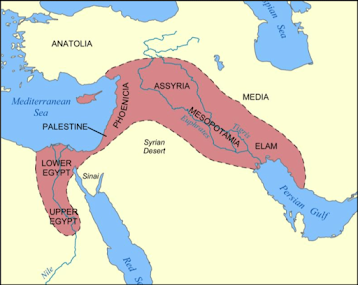
Henry Breasted's map of the Fertile Crescent. He coined the term "Fertile Crescent."


Alice C. Linsley


The final of the nine questions asked by a reader of Just Genesis is: "Was the garden of Eden a real place or a myth?"

Eden, as it is described in Genesis 2, was a vast well-watered region that extended from the sources of the Nile in Uganda and Ethiopia to the Tigris and Euphrates in Mesopotamia. This corresponds to the Fertile Crescent described by Henry Breasted (shown above). The biblical writers were aware that this is the cradle of the earliest civilizations.

The term Eden is derived from the Akkadian word edinu which refers to a fertile plain or a well-watered region. Akkadian is the oldest known Semitic language and predates Hebrew by nearly 2000 years. The Akkadian language shares many roots with other Afroasiatic languages. A Yoruba word for the fertile soil of a virgin forest is egàn which is related to the Hebrew word gan, meaning for garden.


Eridu ramparts in the Nigerian jungle


Asar Imhotep made linguistic connections to ancient Egyptian and Yoruba:

Yoruba iju “jungle” is cognate with Egyptian ju “mountain.” The underlying semantic spirit of each term demonstrates a primary connotation of “wilderness.” The wilderness for the Yoruba was the jungle: for the Egyptians it was the inhospitable desert of the red mountains (dsrt). The inhospitable wilderness of the jungle is described in Yoruba as aginju “dark wilderness.” The qualifier agin- (cf. egàn “the soil under the forest cover” – black, fertile, soil) is from the same root oganjo (ogan-jo) “the dark part of the day,” the dead of night, oganjo oru.

(The word for mountain in Ancient Egyptian is usually transcribed djew, not ju.)

According to Genesis, the garden would have been east of Noah's homeland in the region of Lake Chad. In the language of the local Kanuri, Lake Chad is Bahar Nuhu, meaning "Sea of Noah." Other place names in that region are Benue and Borno. These place names mean "land of Noah." 

Genesis 3 states that God drove Adam and Eve out of the garden and caused them "to dwell east of the garden." The same explanation appears in reference to Cain's banishment to the "east of Eden" (Gen. 4:15). These early Hebrew were moving east, and the way back was closed by the angels stationed on the east of the garden (Gen. 3:24).

Sunday, September 13, 2009

Original Sin or Inheritance of Death?


Question number 8 of the most commonly asked Questions about Genesis is: "Did I understand you to say the Orthodox don't believe in inherited (original) sin? If so, how you they explain David saying he was conceived in sin, and sinful from birth?"

In response, I defer to one who is better qualified to answer the first part of this question. The Very Reverend Antony Hughes, M.Div., is the rector of St. Mary’s Orthodox Church in Cambridge, Massachusetts. He has served as the Orthodox Chaplain at Harvard University. Father Hughes has written an excellent explanation of the difference between original sin and ancestral sin. Here is an excerpt:

"As pervasive as the term original sin has become, it may come as a surprise to some that it was unknown in both the Eastern and Western Church until Augustine (c. 354-430). The concept may have arisen in the writings of Tertullian, but the expression seems to have appeared first in Augustine’s works. Prior to this the theologians of the early church used different terminology indicating a contrasting way of thinking about the fall, its effects and God’s response to it. The phrase the Greek Fathers used to describe the tragedy in the Garden was ancestral sin.

Ancestral sin has a specific meaning. The Greek word for sin in this case, amartema, refers to an individual act indicating that the Eastern Fathers assigned full responsibility for the sin in the Garden to Adam and Eve alone. The word amartia, the more familiar term for sin which literally means “missing the mark”, is used to refer to the condition common to all humanity (Romanides, 2002). The Eastern Church, unlike its Western counterpart, never speaks of guilt being passed from Adam and Eve to their progeny, as did Augustine. Instead, it is posited that each person bears the guilt of his or her own sin. The question becomes, “What then is the inheritance of humanity from Adam and Eve if it is not guilt?” The Orthodox Fathers answer as one: death. (I Corinthians 15:21) “Man is born with the parasitic power of death within him,” writes Fr. Romanides (2002, p. 161). Our nature, teaches Cyril of Alexandria, became “diseased… through the sin of one” (Migne, 1857-1866a). It is not guilt that is passed on, for the Orthodox fathers; it is a condition, a disease.

In Orthodox thought Adam and Eve were created with a vocation: to become one with God gradually increasing in their capacity to share in His divine life — deification (Romanides, 2002, p. 76-77). “They needed to mature, to grow to awareness by willing detachment and faith, a loving trust in a personal God” (Clement, 1993, p. 84). Theophilus of Antioch (2nd Century) posits that Adam and Eve were created neither immortal nor mortal. They were created with the potential to become either through obedience or disobedience (Romanides, 2002)."

Read more here.

In answer to the second part of the question: why David said he was conceived in sin and sinful from birth - he is speaking of ancestral sin. This is significant since it was likely during King David's reign that the geneological information in Genesis and Exodus was complied.

Why so much interest in his ancestors? Because David believed the prophecy concerning the coming of the Son of God from his line of ancestors (Gen. 3:15) - He who would crush the head of the cosmic serpent. So the Orthodox proclaim that the Son of God, born of the line of David, reversed the curse that fell upon His and our ancestors.

This is the heart of our catholic Faith: Jesus Christ, the Son of God, has come into the world to save sinners such as me. The Eternal Son became flesh and in His death He destroyed death and the works of the devil.

"For God so loved the world that He sent His only Begotten Son, that whoever believes in Him should not perish but have everlasting life. Fof God did not send His Son into the world to condemn the world, but that the world thorugh Him might be saved."

Three bear witness on earth to the appearing of the Son of God: the Spirit, the water and the blood (I John 5:8). In real time these are Anna the Prophetess (Spirit), John the Forerunner (water), and Simeon the Priest (blood)

“He who believes in the Son of God has the witness in himself; he who does not believe God has made Him a liar because he has not believed the testimony God has given of His Son. This is the testimony: that God has given us eternal life, and this life is in His Son. He who has the Son of God has life; he who does not have the Son of God does not have life.” (I John 5, 10, 11)

Justin Martyr: “There is not a single race…among whom prayers and thanksgivings are not offered in the name of Jesus…”

Irenaeus: “Such is the common faith and tradition…In whom have all the nations believed, but in the Christ…”

The testimony of Scripture: “These things I have written to you who believe in the name of the Son of God, that you may know that you have eternal life and that you may continue to believe in the name of the Son of God.” (I John 5:13)

Jesus came to "trample down death by death" and to overturn the curse that fell upon all the creation when Eve, the crown of creation, subjected herself to the will of the serpent, the lowest of creatures in the hierarchy of creation.


Related reading:  Hierarchy in Creation: The Biblical View; The Biblical Meaning of Eve: St. John Chrysostom on Eve's Sin

Thursday, September 10, 2009

Visitors Use the INDEX!

Since I started this blog 3 years ago, visitors from the United States have comprised about 75% of the readership. Today I looked at the breakdown of readers and I discovered something interesting. 50% of the readers this week are from only 3 countries: Australia, the Philippines and India.

I also found that about 10% of the visitors are using the INDEX to search for information by topic. One topic that draws a diverse readership is Serpent Symbolism. Moses and Abraham are also of great interest.

Friday, September 4, 2009

Was Polygyny Among Abraham's People Immoral?


Alice C. Linsley

Before reading this post, I recommend reading Abraham's Complaint.


Question number 7 of the Nine Meaty Questions is: "If marriage is between one man and one woman, as Gen. 2 seems to be saying....what is all this about men having two wives one North and one South? Is this disobedience or part of God's design, and if so, why doesn't Christianity accept polygamy now?"

Answer: Marriage, as we know it in the West, is not instituted in Genesis 2. Or, to express this a different way, Genesis 2 is about the order of creation, not about the institution of marriage.

It is also important to note that the practice of having 2 wives pertained only to ruler-priests. The context is more African than Asian. In traditional African societies, rulers are expected to have more than one wife. Were Henry VIII to have followed this practice, he would have had his male heir and spared the lives of his wives (we can hope). So we see the practicality of the custom.

The actual term for the kinship pattern of these ruler-priests is "polygyny," that is, multiple wives. Noble women did not take multiple husbands, at least not legally. In fact, were a priest's daughter found in a sexual relationship outside of marriage, the law required that she be burned alive. This is why Judah ordered that Tamar should be burned. Tamar was the daughter of a priest.

The placement of wives on a north-south axis is both practical and religious. It is practical because the wives' settlements marked the northern and southern boundaries of the ruler's territory. These households were guarded by trained soldiers who intercepted all who crossed through the ruler's territory. Between the 2 settlements were the grazing lands for the ruler's herds. The herds drank at major water systems that were about halfway between the wives.

This arrangement is found in the cases of Cain, Seth, and Na'hor the Elder, and characterized the the Horites of living between Mt. Hor (northeast of Kadesh-barnea) and Mt. Harun (in Jordan).

We recognize the religious significance of the placement of the wives when we remember that the Sun was a symbol of the Creator for Abraham's Horite people. The Sun appears to make a circuit from east to west. They perceived of this as the Creator making a daily inspection of His territory. So the Creator's territory stretched from east to west. Out of reverance for the Creator, the ruler-priests placed their wives on a north-south axis. Only the braggert Lamech, who set himself up as God, placed his wives on an east-west axis. (Adah means dawn and Zillah means dusk.)

I believe that this was part of God's plan as it speaks to us about the Kingdom of God. Ruler-priests had two wives who lived in separate households yet belonged to and shared jointly in the same Kingdom. Likewise, the Kingdom of God consists of the Bride of Christ (New Covenant) and the Beloved of God (Old Covenant). Together these bear witness to the Truth: Jesus Christ, the only Begotten Son of the Father, came into the world to save sinners (such as me).

Christianity stresses the humility, simplicity and servanthood of Christ. Multiple wives are a status symbol, as only rulers had more than wife. Christian men don't pattern themselves after such worldly pursuits. They are content to be the husband of one wife or to be celibate.

From the beginning of Christianity none who came to faith in Christ Jesus was required to follow any custom other than to "abstain from food offered to idols, from blood and from sexual immorality" (Acts 15:29). As priests during the time of Jesus had multiple wives, that clearly was not regarded as immoral.


Related reading: The Marriage and Ascendancy Pattern of Abraham's People; Sent-Away Sons


Thursday, September 3, 2009

Telling My Story - Coming Home


Alice C. Linsley

I conclude this account of how I came to be an Episcopal priest and then left the priesthood and the Episcopal Church by recounting the final months of my parish work. I will also write about coming to Orthodoxy.

My Last Months in Parish Ministry
The last parish I served as an Episcopal priest was an African American congregation in downtown Lexington, Kentucky. I was their first female priest and they decided to call me “Mother Alice.” It was a small parish and because it couldn’t afford full time clergy, I served as a bi-vocational priest. My primary income came from teaching Spanish at a private school.

When I began there were about 20 people on a Sunday morning, but by the time I left there were regularly around 50. We also renovated the parish hall, building a Sunday school room, putting in new windows, a new floor, fresh paint, and installing the first ever centralized heating and air conditioning system. The total cost was about $40,000, but we paid as we went so we never had to borrow money. It took about 18 months to finish the project. Having renovated several houses, I served as the project manager.

In the last 18 months of my parish work, the bishop appointed a deacon to assist our growing congregation. Neither he nor the deacon told me that she was a lesbian. She did many good things in the parish and the people came to love her.

When in June 2003 General Convention approved the election of Gene Robinson, I was devastated. To me this seemed an inconceivable departure from Scripture and Tradition, though I shouldn’t have been surprised. Most people in my parish seemed hardly concerned about this development. I realized that many simply didn’t know what the Church taught and so I set about to preach and teach why this was wrong, stressing that this innovation would ultimately split the Anglican Communion.

The Sunday following General Convention, I spoke to this issue in my sermon. I told the congregation that I could not support General Convention’s action and that the decision underscored the need for thorough catechesis in the Historic Faith and Practice of the Church. At the passing of the peace, the deacon literally hissed at me, telling me that I would have her resignation immediately following the service.

That didn’t happen, of course. Instead she called the bishop, who wanted her to stay and who certainly would have offered his support to her should she stay and fight. Fighting was not in the woman’s nature and she seemed to be depressed by her situation. At this time, her mother was dying and this contributed to her misery. She had told me that she wanted to return to her former parish, which is where her parents were members, and so I wrote a letter to the Bishop asking him to consider moving her back to her former parish. It seemed the most compassionate thing to do for her, and since she was being used to divide the parish, it addressed one of the causes of division, which it was my responsibility to do.

That private letter was to contribute to my undoing. It somehow came into the hands of members who supported the bishop's radical agenda. The private nature of my letter should have been evident, if nothing else by the pleading tone with which I asked him to repent and return to the true Faith (for God would surely bless him and use him, should he do so). This letter was used as ammunition against me, but to this day I have no regrets about writing it.

First they called all the members of the congregation and informed them that I was trying to get rid of their beloved deacon. Then in a parish meeting, they read aloud my plea for the bishop to repent, representing it as disrespect and insubordination. At that parish meeting, I looked around at the faces of the people I had served for 3 years, to whom I had preached the Gospel in and out of season, and I realized that most were against me, a handful were clueless as to what was happening, and only a few were on my side. One rose to speak in my defense. She was a pillar of this African American congregation, respected and honored by all except a newcomer who, as it turns out, had a history of causing dissent in churches. As Elva spoke in my defense, this brash young man started to shout her down. Everyone was stunned. Someone told him to sit down and be quiet. Elva, standing under 5 feet, straightened her shoulders and seemed to grow in stature. She had her say and sat down again. The lot was cast. Clearly, my days at that parish were numbered.

This was early September 2003. I continued to serve the parish, though each week there were bigger fires to put out. I prayed hard, kept my head low, and waited until God gave me the go ahead to resign. After one especially difficult week, I decided to pray and fast. I took a day off from work – it was a Friday - and I prayed and fasted over the entire weekend. I finally fell asleep about 4:00 am on Saturday morning and when I awoke around 9:00 am I knew exactly what I was to do.

I called the members of the Vestry and asked them to meet with me on Sunday morning (the next day) before the service. I told them that I would be submitting my resignation. None seemed surprised, though a few seemed sad.

The next day I presented my letter of resignation, effective immediately following the service. After the service a woman on the Vestry who had been an outspoken opponent, feigned sadness at my departure and offered to throw a farewell party if I would come back the following Sunday. I declined the offer.

After the service that last day, I went with Elva and her children to a picnic at another church where people loved each other. It helped me to regain perspective and Elva and her daughter Olivia eased my aching heart.

It wasn’t until I arrived home that afternoon and turned on the television, that I realized that I had resigned on the very Sunday that Gene Robinson was consecrated Bishop of New Hampshire. So it was ironic when I was accused of grandstanding by resigning on the Sunday of Robinson’s consecration.

That action drew a good deal of fire! I received hate mail, threatening phone calls, pornographic e-mail, and I lost friends. It was a difficult time, and things were to get worse before they got better.

When I left parish work, I took a $10,000 cut in pay, but at least I had income from teaching. As a single person this was adequate to pay the mortgage on the house I had built for my retirement, if I tightened my already tight budget. I didn’t know that within 5 months I would lose my teaching job and would have to sell the house. I didn’t know that I would not be able to find employment for almost 2 years. I didn’t know what God had for me, but I trusted Him because He had always faithfully led me step by step.

In prayer one morning when I was feeling especially insecure, He spoke to me through Scripture about hiding me in the cleft of the rock. At the same time I had a vision of a white cottage on a lake. My first house had been a white cottage near a lake and I always regretted that I had to sell it. It turns out that when my house sold, and no one would rent to me because I didn't have employment, a dear Christian family offered me a tenant house on their farm. It was a white cottage on a lake and it was set in a geological anomaly, rather like a cleft in the earth. I've been living there for the past 5 years and this home has become the base of my new life and ministry, both of which God has blessed and expanded beyond my ability to ever imagine.

Many traditional Anglicans are at the point where they may be faced with hard decisions. I want to encourage you not to be afraid to leave the Episcopal Church, or the Anglican Church of Australia, or the Church of England, if that is what God is directing. As you consider what lays ahead, don't be anxious about what you will eat, or what you will wear, or where you will live, only continue to feed on Christ, to put on Christ, and to make His eternal Kingdom your home. He is faithful and rewards those who love Him above their comforts.

Going Home to Orthodoxy
At a recent Forward in Faith Conference in Victoria (Australia) Bishop David Chislett spoke of how former Archbishop of Canterbury Robert Runcie regarded Anglicanism as "transitional." That has certainly proven the case for many people who have passed through Anglicanism on their journeys from Protestantism to the catholic Faith. Some have gone to Roman Catholicism, others have gone to Orthodoxy.

As I considered where God would have me go, I looked first toward Rome. I had visited a local Roman Catholic parish and found the Vatican II liturgy comfortable. I could see how the Eucharistic liturgy of the 1979 Book of Common Prayer was in debt to the Roman liturgical reforms of the 1960's and 1970's. Liturgically going to Rome would have made for an easy adjustment. However, there were certain doubts that I wanted to address before making the decision. So I entered a class taught by a liberal Roman Catholic nun who asked me to read a book written for Americans converting to Roman Catholicism. I read the book and found within it every destructive seed of liberalism that had come to fruition in the Episcopal Church. I also wasn't comfortable with the innovations of Papal infallibility and Rome's insistence that the Papacy has primacy of jurisdiction over all other churches regardless of whether or not this is officially recognized. In the end I just couldn't jump from one body that freely innovates to another that also innovates (though less often and with superior theological statements to support the innovation).

That left only Orthodoxy. It was at this exact moment that a perfect stranger emailed me with the website for an Antiochian Orthodox Church that he encouraged me to visit. I went the next Sunday and I knew I had come home the minute I entered the church. I began to worship every Sunday, attending Matins and Divine Liturgy (though without receiving the Sacrament). After some months the priest began to catechize me - a process that lasted almost a year - and I was chrismated in February 2007. Ironically, I was not re-baptized because I had been baptized at a Baptist church by full immersion using the Trinitarian Formula at age 14. If I had been baptized in the Episcopal Church after about 1968, Father Tom would have re-baptized me, which speaks about TEC's slide into heterodoxy, even heresy.

I laugh when I hear TEC's claim of diversity and inclusion. Episcopal churches are populated by a predictably narrow segment of American society. That became more obvious once I came to Orthodoxy. My parish is a United Nations and in addition to English, parts of the liturgy are sung in Russian, Greek, and Arabic.

While I've always had great respect for the scholarship of Roman Catholicism, I've sensed through the years a dis-connect between the Roman and the Semitic worldviews, yet when I read Scripture I hear Semitic tones. This is another reason that Orthodoxy, and especially the Antiochian Church, appeals to me.

Finally there is the matter of Holy Tradition. While this is an oversimplification, Roman Catholicism views Scripture as a complement to Tradition; Scripture AND Tradition. Orthodoxy views Tradition as the vessel that carries Scripture; Scripture IN Tradition. As I came to understand Holy Tradition better (from the perspective of anthropology), the balance tilted to the Orthodox view.

Along this journey I have made both friends and enemies. To my enemies I say "Forgive me if I have offended you." To my friends, especially the former women priests who have come into Orthodoxy, I say "Rejoice with me in this wondrous Love of the Father, and the Son, and the Holy Spirit. Rejoice with me in His Resurrection!"

(Part I of this series is here. Part II is here.)

NOTE: I'm in Australia and it is Saturday morning here. I've just received news that Father Dan Sullivan has died. May his memory be eternal!

The Parish Administrator at the Church of the Good Samaritan, Jeff Moretzsohn, reports that Fr. Dan and Adele were vacationing in Connecticut when Dan came down with flu like symptoms. He spent a week in the hospital, was released, and two days later was admitted when he had a "neurological event". Fr. Dan seemed to improve and then came a swift decline. He slipped into a coma on Monday, and he passed away on Wednesday morning. There is to be a memorial service at Good Samaritan in Paoli, PA. Jeff writes, "We've lost one of the best."

Into thy hands, O merciful Savior, we commend the soul of thy servant, now departed from the body. Acknowledge, we beseech thee, a sheep of thine own fold, a lamb of thine own flock, a sinner of thine own redeeming. Receive him into the arms of thy mercy, into the blessed rest of everlasting peace, and into the glorious company of the saints in light. Amen.


Postscript: After 6 years sojourn with the Antiochian Orthodox I returned to the Anglican Way. I am now affiliated with the Anglican Province of America. The ministries to which the Lord Jesus has led me are more numerous and varied than I could ever have imagined, including ministry with women in prison, catechetical instruction in the parish, work with the Billy Graham Evangelistic Association, and writing for publication. Additionally, there have been opportunities to teach philosophy and anthropology, and to speak at conferences. This is the address I gave to the 2015 International Catholic Congress of Anglicans.


Wednesday, September 2, 2009

Witnesses to the Truth of Christianity


Alice C. Linsley

Some readers of Just Genesis have asked where can we find information about the origins of this unique faith we call Christianity? In answer, I believe that we must look at the tradition that Abraham "our father in the faith" received from his Nilo-Saharan ancestors. Note that I'm not saying that we should look into some special revelation that Abraham might have received.


The One to whom all true prophets bear witness

I've been having an interesting conversation with Scott L at The Prodigal Thought on this very subject. Scott takes the view that those in the time of Genesis "had some revelation, but that revelation was in seed form. It’s only as the revelation progresses in the OT writings that we get the idea that the Messiah would be the ‘Son’ of God." What about Genesis 3:15 which speaks about the divine Seed? Seed in this verse clearly refers to offspring.

Yet Scott believes what Jesus says in John 8:56 - "Your father Abraham rejoiced that he would see my day. He saw it and was glad." So my question is, if you believe what Jesus said, why do you doubt that Abraham had expectation of the appearing of the Son of God? It is a contradiction to say that you believe Jesus and then to discount what He says as anachronism.

Abraham’s people certainly did not have the perspective we have today, but they had the ancient expectation of the Son of God’s appearing in the flesh. This ancient expectation came from what God promised in Genesis 3:15 – the Protevangelion. In other words, God, in His immense faithfulness, has raised up witnesses to His Righteous Son in every generation. Just as an infant recognizes the parent and responds to that love, without intellectual knowledge, so humanity has had consciousness of the Father’s love for the Son, even before Jesus’ Incarnation. This is proof that the Son abides eternally with the Father and was with the Father “in the beginning” and that all things were made through Him.

Scott goes on to say: "So Abraham had some kind of revelation in his day. But I think it could possibly be a little too anachronistic to read a full theology of the ‘Son of God incarnate’ back into Gen 3:15 and Abraham’s understanding. Even those words in Gen 3:15 would not have registered as Messianic to Adam and Eve. They would have been thinking about one of their immediate sons or grandsons."

How very perceptive! My research on the kinship of Abraham’s people using the Genesis genealogical information shows that they DID believe it would be one of their sons. They traced bloodline through the mothers and made sure that the daughters of priests (such as Mary) only married priests or the sons of priests. The intermarriage between priestly lines (endogamy) is evident in analysis of the intermarriage between the rulers listed in Genesis 4 and Genesis 5.  The identical marriage and ascendancy pattern can be trace to Jesus Christ. The lines of Cain and Seth intermarried. The lines of Ham and Shem intermarried, and the lines of Joktan and Sheba intermarried. These are the ruler-priest ancestors of Abraham and it is from these priestly lines that Joseph and Mary are descended. Therefore we have no reason to doubt that Abraham believed that the Son of God would one day be born among his people. This is the heart of Holy Tradition received by Abraham and passed to the Church. St. Paul wrote that he was careful to pass alone without change that which he received.

Holy Tradition is attested by at least seven witnesses. They are:

The Witness of History

The Horite rulers of Edom are listed in Genesis 36.  Abraham's entire territory was within the region of Edom. Josephus calls the descendants of Abraham and Keturah "Horites." Quoting an ancient authority, he speaks of them as "conquerors of Egypt and founders of the Assyrian Empire." The Horites were devotees of Horus, who was called "Son of Ra" and the Horite metal workers venerated Horus' mother as their patroness.

The Witness of the Church Fathers

Justin Martyr: “There is not a single race of men…among whom prayers and thanksgivings are not offered in the name of Jesus the crucified…”

Irenaeus: “Such is the common faith and tradition of the Churches …In whom have all the nations believed, but in the Christ who is already come?”

Hippolytus: “The eye of reason is the Spirit; by it we discern spiritual things. If you have the Spirit, you will comprehend heavenly things, for like comprehends like.”

The Witness of The Three - I John 5:8

Three bear witness to the appearing of the Son of God: the Spirit, the water and the blood. These bear witness of earth: Anna the Prophetess (Spirit), John the Forerunner (water) and Simeon the Priest (blood).

The Witness of the Undivided Kingdom

Ruler-priests had two wives who lived in separate households yet belonged to and shared jointly in the same Kingdom. Likewise, the Kingdom of God consists of the Bride of Christ (New Covenant) and the Beloved of God (Old Covenant). Together these bear witness to the Truth: Jesus Christ, the only Begotten Son of the Father, came into the world to save sinners (such as me).

The Witness of Scripture

“These things I have written to you who believe in the name of the Son of God, that you may know that you have eternal life and that you may continue to believe in the name of the Son of God.” I John 5:13

The Witness of the Church

“He who believes in the Son of God has the witness in himself; he who does not believe God has made Him a liar because he has not believed the testimony God has given of His Son. This is the testimony: that God has given us eternal life, and this life is in His Son. He who has the Son of God has life; he who does not have the Son of God does not have life.” I John 5:10,11

The Witness of the Heavens

Psalm 19:1 says that the "heavens declare the glory of God." That has always been true and explains how tribal peoples, who observe the heavens more closely that modern people, often know more about God's nature than we do.

The greatest celestial witness is one which God set to go off in the heavens like an alarm clock. On December 24 A.D. 3, the king planet Jupiter completed a triple coronation of and aligned with the king star Regelus in the constellation of Leo to produce the brightest heavenly light ever seen. The ancients who expected the Son of God to be born recognized the sign and followed the Bethlehem Star to the Son of God. This event is confirmed by sophisticated astronomical software. For more information, visit http://www.bethlehemstar.com/

Conclusion

If all these bear witness to Jesus the Christ, we should not be timid in proclaiming the Gospel. We have received more than enough to argue our case for the truth of Christianity. We should not hold back, waffle or hedge. We should join our voices with the song of the stars, with the hymn of the saints, and with the chorus of heavenly hosts to acclaim Him as Lord over all, our eternal King.


Related reading: Red and Black Smiths; Righteous Rulers and the Resurrection; What is Holy Tradition?