Followers

Friday, July 29, 2011

The Binary Distinctions of the Horite Hebrew


Alice C. Linsley


Binary Distinctions Reflects Horite Hebrew Values


Archaic Nilotic peoples were attuned to the patterns observed in nature and aligned their thinking with those patterns. This is evident in the orientations of their tombs and in the astronomical alignments of their monuments. It is also evident in their binary theological perspective which frames the Biblical worldview.

The binary sets are expressed in the distinctions and separations within "kinds" or essences. The waters (firmament) above are separated from the waters below. Male and female are of the same kind yet distinct. Other binary sets include heaven-earth; God-mankind; day-night, sun-moon, and life-death. One of the entities in the binary set is superior to the other in strength, brilliance, glory, or purpose and its lesser is a reflection of the greater. So humans reflect the image of the Creator, the moon reflects the light of the sun, and Adam recognizes the woman as distinct from him but of his essence, i.e.,  "bone of my bone and flesh of my flesh..." (Genesis 2:23)

The superiority of one of the entities of the binary set kept the Horites from slipping into the dualism that characterizes other world religions.

Observed natural entities were associated with gender, numbers and symbols. The sun, for example, was associated with a male ruler over the universe and represented the masculine principle of rule and insemination. It was the emblem of Re, the father of Horus. Hathor, Horus’ virgin mother, was believed to conceive the son of God by the overshadowing of Re. Because of this association of the sun with maleness, the ancient Egyptian rulers exposed themselves to the sun’s rays to turn their skin reddish brown (edom, odam, adam). Their royal wives, on the other hand, were covered with chalk to make them white like the moon.


In the Song of Songs the sister bride praises her beloved whose skin is dark as the tents of Kedar because he, like David, was made to work in the sun by his brothers. The tents of Kedar were woven with the black wool from the Nubian desert goats. His dark skin is associated with the masculine virtues of the sun. The sister bride was "made white" through the application of a white chaulky powder. Her pale skin is associated with the feminine virtues of the moon.

The moon was associated with femaleness or the feminine principle. This intuitive association extends to semen and milk. The sun inseminates the earth and the moon stimulates female reproduction and lactation. Because the moon affects water, tides, and body fluids in a repeating cycle there is a natural association of the moon with the periodicity of the menstrual cycle. Many ancient peoples associated pregnancy with the moon and in France menstruation is called “le moment de la lune.”

In a dualistic view, the sun and the moon are equals so both are worthy of veneration. In a binary view, one of the entities of the binary set is always superior and to venerate the lesser entity is a form of idol worship. This is what stands behind the Joshua 24 criticism of Terah. (Note this is not a criticism of Abraham.) There is no other verse in the Bible to support the view that Terah, a Horite, worshiped the moon god contrary to the practice of his ancestors who regarded the sun as the emblem of the Creator. Abraham's Horite ancestors did not worship Napir/Sin as was done in Ur and Haran and later in Mecca. The Horite ruler-priests were devotees of Horus who was called "son of God," and his emblem was the sun. The ossuaries of the Horite members of the Sanhedrin during the Second Temple bore the 6-prong solar symbol image.


Ossuary of Miriam, the daughter of Y'shua

Genesis 1:16 expresses the binary view in these words: "God made the two great lights; the greater to rule the day and the lesser to rule the night." Sometimes the binary distinction is rather subtle and easy to miss. Consider, for example, the binary set of hot and cool encounters with God. Abraham was visited “in the heat of the day” by God in three Persons (Gen. 18:1). The binary opposite is “in the cool of the day”, the time of God’s visitation to Adam and Eve in Paradise (Gen. 3:8). We have encounters with God described as hot and cool. We must always pay attention to such distinctions. In the first God has come to punish Sodom and Gomorrah, and in the second God has come to enjoy fellowship with the Man and the Woman.

Binary logic is based on empirical observation. The Sun's light is greater than the refulgent light of the Moon. Males are larger and stronger than females. Life is stronger than death. Life involves vitality. The dead are simply dead.

Another example on binary thinking is found in the male-female couplets involving trees. The prophetess Deborah sat under her tamar tree (Judges 4:4-6). A tamar is a date nut palm and was associated with the female principle. The prophet or "moreh" consulted by Abraham sat under an oak (Genesis 12). This tree was associated with the masculine principle.

The male principle involves insemination, protection of the weaker, expansion and uprightness. It is symbolized in the ancient world by meteorites and iron seeds covering the surface of the earth, by the Sun's rays shining down, the lengthening of shadows, and the strength of mountains and pillars. The female principle involves receptivity, birthing, nurturing, fluidity and softness.


Binary Distinctions and Blood

Blood was also viewed according to a binary pattern. A distinction was made between the blood work of men in killing and the blood work of women in birthing. The two bloods represent the binary opposites of life and death. The blood shed in war, hunting and animal sacrifice fell to warriors, hunters and priests. The blood shed in first intercourse, the monthly cycle and in childbirth fell to wives and midwives. The two bloods were never to mix or even to be present in the same space. Women did not participate in war, the hunt, and in ritual sacrifices, and they were isolated during menses. Likewise, men were not present at the circumcision of females or in the birthing hut.

The mixing of life-giving substances with the blood shed in killing was absolutely forbidden among the Afro-Asiatics. This is why the Israelites were commanded never to boil a young goat it its mother’s milk. It also places into context the Judeo-Christian teaching against abortion, which mixes birth blood with killing blood, thus perverting the binary distinction between male and female to a point of desecration. It is also significant that among tribal peoples, brotherhood pacts are formed by the intentional mixing of bloods between two men, but never between male and female. The binary distinctions of male and female are maintained as part of the sacred tradition.

Early man had an intuitive anxiety about blood. We see this in the belief that the blood of Abel cries to God from the ground (Gen. 4:10). Anxiety about the shedding of blood is universal and very old. The sacrificing priesthood likely came into existence the first day that blood was shed and the individual and the community sought relief of blood anxiety and guilt.

As a point of fact, the first blood shed in the Bible was shed by Eve when she gave birth. This is significant because it places life-giving blood ahead of the blood shed when Cain killed Abel.

The second shedding of blood was when God made clothes of animal skins for Adam and Eve. Here we see the first sacrifice of animals for the benefit of humans. This places God at the center between the life-giving blood and the blood shed by Cain when he killed his brother. Between the two bloods (birthing and murder) God sacrifices an animal to provide for the needs of humanity. In this sense, God is the first Priest and that first animal is a symbol of Jesus Christ, the Lamb of God that takes away the sin of the world.

According to the cosmology of Abraham’s people what is at the sacred center is of God. The image of blood at the center speaks of the blood of the Incarnate God. We glimpse this mystery of the sacrifice on the mountain where God has Abraham cut into half a 3-year old ram, a three-year old heifer and a three-year old she-goat (Gen. 15:9-21). This story and the story of the Three-Person God apparing to Abraham at Mamre (Gen. 18) are very old. The symbolism of the number 3 suggests the Egyptian/Kushite divine Triad.

When the sun set and it was dark a smoking firepot and a flaming torch passed between the animal pieces. On that day God promised Abraham that "this country" would be given his descendants. Here the descendants are not specified as Jews. As Abraham was a Horite and so were his sons and daughters, he would have understood this to mean that "this land" was to be a Horite possession.

God moved as a fire between the sacrificed animals that Abraham had cut into halves. God trailed across a bloody strip of earth, like a scarlet thread. God passed through it to confirm an unconditional covenant with Abraham concerning the land for his descendants.

The scarlet thread that hung from Rahab’s window brought salvation to her and to her household. The scarlet smudge over the doors in Egypt brought deliverance from the death of the firstborn. These images of blood speak of God’s prevenient grace whereby blessing precedes every human act, thought or intention.


Related reading:  Rethinking "Biblical Equality"The Horite Ancestry of Jesus ChristLevi-Strauss and Derrida on Binary Oppositions; God as Male Priest; Blood and Binary Distinctions; Afro-Asiatic vs Aryan Religion: The Horse as Example; The Scarlet Cord Woven Through the Bible; The Story of Ontology

Wednesday, July 27, 2011

The Cross and Reality


"Buddhism is centripetal [center-seeking], but Christianity is centrifugal [tending away from centralization]: it breaks out. For the circle is perfect and infinite in it nature; but it is fixed forever in its size; it can never be larger or smaller. But the cross, though it has at its heart a collision and a contradiction, can extend its four arms for ever without altering its shape. Because it has a paradox in its center it can grow without changing. The circle returns upon itself and is bound. The cross opens its arms to the four winds; it is a signpost for free travelers."--G.K. Chesterton (Orthodoxy, Chapter 2)


Alice C. Linsley

The cross presents a great paradox. It veils and is veiled, yet it is found everywhere in the order of nature. Consider the cross-shaped image of laminin (right). Laminin is a cell adhesion molecule that holds the body together. Referring to Jesus Christ, Paul wrote, “He is before all things, and in Him all things hold together.” (Colossians 1:17)  The beta and alpha chains of laminin "influence pre-synaptic and post-synaptic development, thus providing a way to coordinate maturation of the sending and receiving sides of the synapse."

The cross is represented by the intersection of the directional axes of east-west and north-south, and by the solar arc. It is found as a solar symbol in archaic cultures. It is one of the symbols found in the Vinča culture. The cross symbol, called kolasta azdija, is a solar symbol referenced in numerous epic poems of people living in the region of the Vinča culture.


Symbols dating from the oldest period of Vinča culture (6th-5th millennia BC)

Th archaic rulers who dispersed widely in the ancient world  venerated the Sun. The Sun was the emblem of the Creator and the source of life and light on Earth.  The overshadowing of the Sun at high noon marked the temporal center, and noon on the mountain top marked the spatial center. This is the significance of sacred pillars and mountains (bnbn in Ancient Egyptian) that connected heaven and earth.

The cross appears in many monuments along the Nile. The sun and the cross were associated with Horus. Both were found on stone reliefs at the Temple of Horus in Edfu (shown below). The relief also shows the sun resting over the banks of the Nile (directly below the bird). A variation of this image is the Hebrew horned altar, an apophatic solar image. The sun resting over a place or person represents divine appointment and blessing. In this same image we find the sun resting over the cross (center). The Canaanite Y is another example.

Photo: Maureen Palmer

Abraham's Nilotic ancestors believed that Earth emerged as a peak rising out of a universal sea. Life began when the Sun rested exactly at the peak of that mound. This is likely the origin of the belief that a woman of their Horite priestly lines would be overshadowed by the Creator and would conceive the Seed of Genesis 3:15.  In Orthodox iconography sometimes the pregnant Theotokos is drawn as a mountain.  As such, she became the sacred center, the tabernacle of God, the new mount Zion. For Abraham's ancestors the swelling of Sun, river and the female belly spoke of the Creator's power to give life.

The perpendicular axes of north-south and east-west form a cross and this is the oldest known symbolic mark. Its great age is testified by its appearance on prehistoric rocks in Sudan, on Paleolithic ostrich shells in Southern Africa, and in the Proto-Saharan Thamudic scripts.


Nilo-Saharan Cosmology

In ancient times, the Nile was identified with the Milky Way which arches over the Earth from the extreme south to the extreme north. The Nile was viewed as Earth's Milky Way. The north-south axis was represented by the northward flow and the east-west axis was represented by the water's span from horizon to horizon. The center of the river at noon was regarded as the sacred spatial and temporal center. This cosmology is reflected in ancient Nilotic imagery, especially at Elephantine Island (Yebu). Even before Elephantine, the directional poles and the movement of circumpolar stars comprised an element of religion and were a factor in the construction of ancient monuments.

Andrew Collins notes "the earliest Neolithic cult centres, the prototypes of stone circles and chambered barrows everywhere, were directed roughly north-south. Since the north was a direction of death and rebirth at Çatal Hüyük, I quickly realized that the focus of attention at places such as Karahan Tepe and Göbekli Tepe was the movement of circumpolar stars around the northern celestial pole, for there was no Pole Star in c. 9500-9000 BC. I looked closely at the Skyglobe astronomical program for these dates, and realised that only one constellation could have been the object of their gaze, and this was Cygnus, which in European starlore is the celestial swan. However, there is clear evidence that in Ancient Mesopotamia Cygnus was seen as a raptor bird, while in classical myth it was occasionally seen as a vulture, the symbol of the transmigration of the soul in the Neolithic cult of the dead."

The Pole Star was only one way by which the ancients could determine true north. Their cosmology was binary, which means that no pole can isolated from its opposite. The poles are binary opposites and in the binary worldview on of the opposites is regarded as superior in some way to its opposite. Among the Horites, north and east were the superior directions but they were never considered in isolation from south and west. The Nilotic worldview was characterized by binary sets such as male-female and sun-moon.

The intersection of the axes was represented by X or T in ancient glyphs. This cross-shaped cosmology is fundamental to the binary distinctions and metaphysical tensions that characterized the ancient Nilotic worldview. The great contribution of Jacques Derrida, an Arabic-speaking North African Jew, was to re-introduce to Western Philosophy this binary approach to meaning.

As Derrida suggested: "Deconstruction cannot limit itself or proceed immediately to neutralization: it must, by means of a double gesture, a double science, a double writing, practice an overturning of the classical opposition, and a general displacement of the system. It is on that condition alone that deconstruction will provide the means of intervening in the field of oppositions it criticizes" (Metaphysics).

This reversal of the subordinated term of an opposition is no small aspect of deconstruction's strategy. Derrida's argument is that in examining a binary opposition and reversals, deconstruction brings to light traces of meaning that cannot be said to be present, but which must have metaphysical existence. This is not a new idea or even a new approach to meaning. It is consistent with the most ancient Biblical approach to meaning, that of the Semites and their Kushite ancestors.


Among the Horites, North and East Were the Superior Poles

Among Abraham's Horite people the Pole Star was an important celestial marker.  Beside this, they were metal workers who had discovered that magnetized iron particles pointed to magnetic north. In fact, the word compass (kom-pas) is originally an Egyptian word. Horite rulers were buried with their heads to the north and their faces toward the east.

All the rulers among Abraham's ancestors had two wives. The wife of the man's youth was a half-sister and the wife on his later years was a patrilineal cousin or niece. The wives lived in separate households on a north-south axis. In Abraham's case, Sarah lived in Hebron and Keturah lived in Beersheba. Sarah, as the first wife, ranked above Keturah. Only the firstborn son of the half-sister wife ascended to the throne of his father. So Issac became Abraham's heir, though he was not Abraham's firstborn son.

The placement of the wives' settlements reflects the Horite belief that the Sun was the Creator's solar boat or chariot which He rides daily to survey his territory from east to west. This idea was apparent even before Noah. Lamech the Elder (Gen. 4) is portrayed as a braggart not only because he boasted of killing a man, but also because he set his wives on an east-west axis, thereby setting himself up as God.

The Sun's east-west path was thought to be the Creator's circuit, stretched "as far as the east is from the west." The Almighty comes as a bridegroom from the tent of the Sun and makes his circuit from east to west (Ps. 19).

While north was associated with death and judgment, its opposite was associated with birth and renewal of life. South symbolized earth, fertility and birth. It was to the south that Abraham went seeking a second wife. Abraham, still without a heir, consulted the Moreh at the Oak between Bethel and Ai. His next move, chronicled in Genesis, was a journey to Beersheba in the Negev. There he married his patrilineal cousin Keturah, by whom he had five sons.

Marriage to a second wife was required before a Horite chief could ascend to the throne. Abraham's marriage to Keturah enabled him to become the ruler over a territory hat extended between Hebron and Beersheba. It did not provide him with an heir since the firstborn son of the cousin wife ascended to the throne of his maternal grandfather, after whom he was named. The sons of concubines and the younger sons of wives were given gifts and sent away to establish territories of their own. They are the sent-away sons who expanded the Kushite dominion far beyond in the Nile. The marriage and ascendancy pattern of Abraham's Horite caste drove Kushite expansion into Europe, Mesopotamia, Southern India, Cambodia and even Japan. The Kushite migration out of Africa has been verified by DNA studies.


Ethical Implications

The ethical implications of a cross-shaped reality are evident. There is a geometrical quality that suggests lines, angles and boundaries. The boundaries fixed by the Creator can be observed in genetics, climate cycles, and in time and space. Abraham's people wanted to discern and respect the boundaries since they perceived of them as having been established by God. Worship, rituals such as the blessing of the Sun, gender distinctions, laws concerning purity among the ruler-priests, all these reflect concern to distinguish between the binary sets of Heaven-Earth; God-Man, Pure-Defiled, and Life-Death and to serve the greater.

In this cross-shaped Reality, the only safe place, metaphysically speaking, is the sacred center. After all his deconstruction, Jacques Derrida concluded that there is a center and that something is there. He spoke of this something as "presence." He claimed that throughout the history of Philosophy this metaphysical presence is called by different names, “God” being one of them. This is uncomfortable for those who hold to materialist ideologies. They are baffled by the metaphysical. It is terrifying for those who claim there is no Creator. If there is something, a "presence" (Derrida's term) at the metaphysical center, it must surely be of greater power and authority than they. Even the Atheist exhibits existential angst about the possibility that any form of authority depends on God's existence (Rom.13:1).

Abraham's Proto-Saharan ancestors were famous sky watchers. For them a lunar eclipse was less significant than a solar eclipse because they regarded the sun was as superior to the moon. This was not an arbitrary preference nor does it represent mythological ignorance, as Materialist and Atheists often assert. Rather it is a description of reality since the sun gives light whereas the moon merely reflects the sun's light. The sun's superiority is expressed in Genesis 1:16: "God made the two great lights: the greater to rule the day, the lesser light to rule the night."  In our time, the idea that one entity is greater than another meets with great resistance. Many are lost in an ethical wilderness without a compass.

Ethics for Abraham's people meant being spiritually present at the center of X; finding the sacred center by reference to earth's spokes: north-south/east-west, and by reference to the binary sets observed in the order of creation. The late Rabbi Kaduri appears to have found that sacred center in contemplation of the tradition he received from his Horim. He was a highly respected rabbi in Israel who was deeply formed by the daily reading and recitation of the Hebrew Scriptures.


Rabbi Yitzhak Kaduri

Before he died at age 108, Yitzhak Kaduri left a signed note indicating Messiah's identity: Yeshua - Jesus. A few months before, Rabbi Kaduri had surprised his followers when he told them that he met the Messiah in dreams and visions. Kaduri gave a message in his synagogue on Yom Kippur, teaching how to recognize the Messiah. His manuscripts, written in his own hand for his students, have cross-symbols painted by Kaduri all over the pages.

Many Jews have attempted to explain away the crosses, arguing that the great Rabbi Kaduri was not a Christian. Only God knows. However, Rabbi Kaduri was wise and prayerful, and he knew the cosmology of his ancestors. Perhaps this lead him to Jesus, the Son of God, at the sacred center of our cross-shaped reality. Perhaps he found the One who his people have been awaiting.


The Sun Among Abraham's Horite People

Aspects of the ancient solar symbolism are found in the Bible and in historical texts. Psalm 92:2 describes the Lord as “a sun and a shield.” The Victory Tablet of Amenhotep III describes Horus as “The Good God, Golden [Horus], Shining in the chariot, like the rising of the sun; great in strength, strong in might…” (Tablet of Victory of Amenhotep III, J.H. Breasted, Ancient Records of Egypt, Part Two, p. 854).

At Angkor Wat in Cambodia, there is a stone relief of a solar boat with Horus flying as a falcon above the flames of the sun. Most of the religious depictions found in Southern India are also found among the Proto-Saharan peoples. There is strong evidence that messianic expectation began, not with the Jews, but with Abraham's Nilotic ancestors. They were devotees of Horus who they called "Son of God."  In a five day festival the ancient Egyptians commemorated the death and rising of Horus. He was associated with the rising or swelling sun and with the falling of grain into the earth.

In relation to the sun, Horus was said to rise in the morning as a calf or a lamb and to set in the evening as a bull or a ram. The east represented the present, and the west represented the future. On Mount Moriah Isaac was replaced with a ram.  To Abraham the Horite this would have meant that his offering was set aside by the provision of a greater sacrifice that was to come in the future. It would also have meant that Isaac was not the fulfillment of the promise made to Abraham's ancestors in Genesis 3:15. Isaac was not the "Seed" of the Woman who would make the curse of death void, crush the serpent's head, and restore Paradise. Jesus was the fulfillment of this first promise and prophecy of the Bible.  In speaking of his impending death, He told his disciples that only the "seed" that falls into the ground and dies can give life. (John 12:24)

As St. Augustine noted, the Egyptians took great care in the burial of their dead and never practiced cremation, as in the religions that seek to escape physical existence. Abraham's ancestors believed in the resurrection of the body and awaited a deified king who would rise from the grave and deliver his people from death.

On ancient Jewish ossuaries the sun was shown as a 6-pointed star inside a circle.  This was the solar boat of the Creator, the vehicle of Light that would carry the dead to the place of rest. From that place they hoped to rise on the Last Day. In the Iron Age this mer-ka-ba was shown as a chariot. The spokes within a circle are both the rays of the sun and the spokes of the chariot wheel. This symbol likely appeared on the Ark of the Covenant. In the Ethiopian Church a replica of the Ark, called ta-bot, is displayed in the churches. It is decorated with the 6-pointed star inside a circle at the center of the ark.

The spokes inside an orb also represent the precession of the equinoxes at various angles. The precession was symbolized by X inside a circle. This morphed into the Tau, which is used by Christians to represent the upright cross.


The precession cross and the merkaba are very ancient cosmological images. They have been traced to the Horite temple at Heliopolis on the Nile. Heliopolis is called ONN in Genesis and was shown in Old Egyptian as NXN, with the X representing the Creator's presence at the sacred center. Again, the cross is central and associated with the sun. Just as the sun is a universal symbol of light, so the sign of the cross is universally found in creation. The mark of Jesus Christ is ubiquitous. Reality is cross shaped and it stretches out in all direction to embrace in love.


Related reading: A Cross-Shaped Universe: Reflections of a Christian Physicist; The Sacred Center in Biblical Theology; Afro-Asiatic Rulers and Celestial Archetypes; Binary Distinctions and KenosisChrist's Sign in Creation; Tehut's Victory Over Tehom; The Ostrich in Biblical Symbolism; Cosmology and Ethics; The Rabbi Who Found Messiah

Monday, July 25, 2011

Solar Imagery of the Proto-Gospel


The stone ossuary of Miriam, the granddaughter of the High Priest Caiaphas.
Note the six-prong solar image.

Alice C. Linsley

To better understand the roots of the Messianic Faith called "Christianity" we must investigate the origin of Messianic expectation deep in antiquity. The hope for a ruler-priest who would overcome death and rise on the third day is at the heart of the Christian Faith and is a feature that makes Christianity unique among the world's religions.

An investigation into the roots of the Messianic Faith will take us to Abraham the Hebrew and his Nilo-Saharan ancestors for whom the Sun was an emblem of the High God and His Son. One of their shrine cities was Nekhen on the Nile.

Votive offerings at the Nekhen temple were ten times larger than the normal mace heads and bowls found elsewhere, suggesting that this was a very prestigious shrine. The temple was a large structure, fronted by huge cedar timber pillars, and it was to become the prototype for temple architecture for many millennia.

At Nekhen, Horite Hebrew priests placed invocations to God Father (Ra) and to the Son (HR) at the summit of the fortress as the sun rose. The primary orientation for the Hebrew and other biblical peoples of the Ancient Near East was east. The Hebrew word for East is קדם (qedem, Strong’s #6924), from the root word קדם (Q.D.M, Strong’s #6923) meaning "to meet," and the rising sun is "met" each morning facing the east.

Prayers were offered at dawn. This practice continued throughout dynastic Egypt. Moses was told to meet the king early in the morning as he was going down to the Nile to pray.

The relationship of the divine Father and the divine Son is central to the Christian Faith but belief in the divine Son is rejected by Judaism. YHWH has no son. Therefore, we find the introduction of a new idea about God, one that expresses the Jewish understanding and is removed from the Proto-Gospel with its understanding of the divine Father and divine Son.

The rising and setting of the sun was symbolic of the expectation of the rising God for the Horite Hebrew. This gives us insight into the significance of the lamb-ram transformation on Mount Moriah. The lamb was associated with the east and the rising sun. The ram was associated with the west, the setting sun, and the future. Horus rode the solar boat of his father in the morning hours. This state was called Mandjet, and the boat of the evening hours was called Mesektet. While Horus was on the Mesektet he was in his ram-headed form.

The ram provided on Mount Moriah represented God's acceptance of Abraham's offering at that moment (justification now) and God's acceptance of Abraham at the eschaton (future justification). What Isaac expected was a lamb, but what God proved was a ram in mature strength. Horus was the Lamb in his weaker (kenotic) existence, and he was the Ram in his glorified strength. Both are associated with the Horite Hebrew death and resurrection symbolism and with their Messianic expectation.

Messianic solar references are found throughout the Bible. Consider James 1:17. "Every good gift and every perfect gift is from above, and cometh down from the Father of lights, with whom is no variableness, neither shadow of turning."  God's presence is like the brightness of high noon when there are no shadows.

Psalm 84:11 says, "For the LORD God is a sun and shield."

Malachi 4:2 likewise uses solar language: "But for you who fear my name, the Sun of Righteousness will rise with healing in his wings (rays)."

The Father-Son relationship and the solar imagery was later suppressed under rabbinic Judaism in which there is no Son of God. John's Gospel seeks to correct this. John explains that the purpose of writing is "that you may believe that Jesus is the Messiah, the Son of God." (John 20:31) Likewise, Martha professes that Jesus is Messiah, the Son of God (John 11:27), and John the Baptist bears witness that Jesus is the Son of God (John 1:34).

The ancient Horite Hebrew knew the Father and the Son from the Nile to the Orontes and the Tigris and Euphrates. Among the Nilotes, the father was called Ra and the son Horus. Among the Akkadians, the father was called Ani and the son Enki.

Clearly this aspect of Christianity did not originate with the Jews, and it did not originate with the Disciples. It developed organically from deep roots. Therefore, it is nonsense to speak of Christianity as an invention. It is not a synthetic religion which cobbles together beliefs and ideas according to the spirit of the age. Rather, Christianity emerges out of a belief that God made a promise a long time ago to a certain people living in a place called "Eden" and that He has been busy fulfilling the Edenic Promise (Gen. 3:15) in the God-Man Jesus Christ.

Christianity draws some observances from Jewish worship practices, but the belief that God would take on flesh, die and rise again were evident among Abraham’s Hebrew people long before Judaism emerged. IN that sense, the roots of Christinaity are deeper than those of Judaism. 

The dying and rising of God was symbolized by the sun’s rising and setting. The early Hebrew did not worship the sun as is erroneously stated in some books on ancient civilizations. Rather the sun served as the symbol for the Creator's rule over the whole world.

The swelling of the sun speaks of God's greatness and sovereignty. The Arabic yakburu means “he is getting big” and with the intensive active prefix: yukabbiru means "he is enlarging." (The term biru refers to a sun temple, or house of God. Ha'biru/Hebrew refers to those who serve at the shrine or temple.) Such would have been the observation of the Horite Hebrew priests who greeted the rising sun and watched as it expanded across the horizon. This is the likely origin of the Hindu Sun blessing ritual (Agnihotra) and the Jewish Sun blessing (Birka Hachama) performed every 28 years.

What Jews in Jesus’ day believed and practiced emerged from the tradition that they received from their horim, their ancestors. The elements of this tradition align with the ancient Nilotic beliefs surrounding HR (Hor/Hur/Horus) who appears on ancient steles and monuments as a falcon-headed man or as a falcon flying above the Sun on his Father's solar boat, as shown below.


At the Horite temple in the Delta city of Behdet (Damnhour) Horus was represented by a winged Sun disk. The name Damnhour means "town of Horus" and derives from the ancient Egyptian dmi-Hor.

Aspects of the ancient solar symbolism are found in the Bible and in historical texts. Psalm 92:2 describes the Lord as “a sun and a shield.” The Victory Tablet of Amenhotep III describes Horus as “The Good God, Golden [Horus], Shining in the chariot, like the rising of the sun; great in strength, strong in might…” (Tablet of Victory of Amenhotep III, J.H. Breasted, Ancient Records of Egypt, Part Two, p. 854).

Horus was the guardian of the ancient Egyptian and Kushite kings from as early as 4000 B.C. The kings were perceived to be the representatives on earth of the Ruler of the universe, the “sons” of God. From the earliest Dynastic Period, the king's name was written in the rectangular device called a serekh, which depicted a falcon perched on a palace façade. Horus as guardian and deity was manifest within the palaces and the shrines as the king himself. The king’s “horus name” was associated with gold and the sun which is the meaning of the title “Golden Horus” in which a falcon appears on the hieroglyphic sign for gold.

Horus was sometimes shown with the sun as his right eye and the moon as his left. The right eye was the one with which he saw all things, but his left eye was weaker, having been injured in combat. This reflects the binary distinctions which characterize the Messianic Faith as it is revealed in the Bible. In this view, one entity of the binary set is superior to the other in an obvious way. The Sun is superior to the Moon (Genesis 1) because it is the greater light. The Moon's light is refulgent. The male is larger and stronger than the female.

The sun is to the moon what the male is to the female, superior in size and strength. This is characteristic of the binary distinctions observed by the early Hebrew in the patterns of Nature. Their acute observation of those patterns informed their binary reasoning.  

The Sun was assigned a masculine gender and was greater than the Moon which was assigned a feminine gender. This pattern was modeled on earth by the kings and their queens. The kings appeared with skin darkened by the Sun. Their queens appeared with white skin, representing the Moon.


The binary distinctions of the Horite and Sethite Hebrew were based on observable patterns in nature. By observing celestial and earthly patterns they recognized that one of the entities in the binary set is superior to its other in visible ways. Thus, the biblical worldview is binary. It involves binary sets in which one of the entities of the set is superior in a visible way. This is quite different from the dualism of religions that emerged later.

Religious traditions, such as that of the Horite and Sethite Hebrew, develop in traceable ways from great antiquity. Such traditions are passed down through families, clans and tribes. The core belief of Christianity concerning the Son of God can be traced to Abraham and his Horite Hebrew ancestors, long before Judaism. In this sense, Christianity isn't original, but what it lacks in originality, it makes up for in antiquity and therein rests its authority.


Related reading: Contextual Incongruities in GenesisThe Sun and Celestial HorsesThe Sun and the SacredThe Sun and the Moon in GenesisOf Dung Beetles and Red Herrings; A Tent for the Sun; Boats and Cows of the Nilo-Saharans; Solar Symbolism Among the R1b Peoples


Wednesday, July 20, 2011

Look Upon Her Whose Heart Was Pierced


Simeon, the priest, said to Jesus' Mother: "Yea, a sword shall pierce through thy own soul also."  Luke 2:35

O much sorrowing Mother of God, more highly exalted than all other maidens, according to thy purity and the multitude of thy suffering endured by thee on earth: Hearken to our sighs and soften the hearts of evil men, and protect us under the shelter of thy mercy. For we know no other refuge and ardent intercessor apart from thee, but as thou hast great boldness before the One who was born of thee, help and save us by thy prayers, that without offence we may attain the Heavenly Kingdom where, with all the saints, we will sing the thrice-holy hymn to One God Almighty in the Trinity, always now and ever and unto ages of ages. Amen.


Monday, July 18, 2011

The Priestly Divisions


Rabbi Shmuel Safrai 
The following article was written by Rabbi Shmuel Safrai. He immigrated to Palestine with his family in 1922. He was ordained as a rabbi at the age of twenty at the prestigious Mercaz Harav Yeshivah in Jerusalem. He later received his M.A. and Ph.D. from the Hebrew University of Jerusalem in the fields of Jewish History, Talmud and Bible. Safrai was recipient of the Jerusalem Prize (1986) and the Israel Prize (2002). He wrote over eighty articles and twelve books including Pilgrimage in the Period of the Second Temple and Rabbi Akiva ben Yosef: His Life and Teachings. He died July 16th, 2003 at age 84.


A Priest of the Division of Abijah

There was in the days of Herod, the king of Judea, a priest named Zechariah, of the division of Abijah; and his wife was of the daughters of Aaron, and her name was Elizabeth…. Once when he [Zechariah] was serving before God while his division was on duty... (Lk. 1:5, 8)

During the Second Temple period, the twenty-four priestly divisions served in the temple at Jerusalem in a rotation system. A list of priestly divisions can be found in 1 Chronicles 24:7-18, which is usually dated by scholars to the fifth century B.C.E. (Before Common Era, B.C. in Christian terminology). There is no mention there, however, of any fixed order of service. Only in post-biblical traditions is it mentioned that the priestly divisions served according to a weekly rotation system.

The priests themselves lived not only in Jerusalem but also in other settlements in the land of Israel. When it was "time for the division to go up [to Jerusalem]" (Mishnah, Ta'anit 4:2), the priests left their homes, went up to Jerusalem for a week, and afterwards returned to their homes in Judea or Galilee.


Priestly Settlements

The organization of Second Temple priests within a framework of divisions was of great importance for the priests. Even when the focus of Jewish life shifted from Judea to Galilee in the aftermath of the Bar Kochva Revolt (132–135 C.E., Common Era, A.D. in Christian terminology), priests of the same division continued to live together. The divisions that previously had been located in Judea settled together in villages and towns of Galilee.

The names of the priestly settlements in Galilee after 135 C.E. have been preserved. Tannaitic literature (rabbinic works up to 230 C.E.) mentions some of the residences of the priestly divisions in Galilee, while the later piyyutim or liturgical poems, although written several hundred years later, preserve the full list of the locations of the twenty-four divisions. In addition, portions of this list have been uncovered in the excavation of ancient synagogues in Israel and the Diaspora (for instance, in Yemen).

Nazareth was the home of the eighteenth priestly division, ha·pi·TSETS (Happizzez). In 1962 excavators discovered in the ruins of a synagogue at Caesarea a small piece of a list of the twenty-four priestly divisions. This third to fourth-century marble fragment is inscribed with the names of the places where four of the divisions resided, including Nazareth, the residence of Happizzez. Until that discovery there was no record of Nazareth's existence before the sixth century C.E., other than in the New Testament and later Christian literary sources.

Times of Service

Abijah was the eighth priestly division. The priestly rotation began in the Hebrew month of Nissan (mid-March to mid-April), and therefore the division of Abijah would have served at the end of Iyyar (mid-April to mid-May) and again at the end of Marheshvan (mid-October to mid-November).

Although Zechariah's division finished its service at the end of Iyyar or Marheshvan, we have no way of knowing exactly when this was. The divisions rotated on the Sabbath, but the Sabbath rarely fell exactly at the end of the month. We can never be sure of the exact date when a priestly division began or ended its duty period. Priests of Abijah, for instance, may have ended their spring week of service from the twenty-eighth of Iyyar to the fourth of Sivan.

Like the other divisions, the priests of Abijah served in the temple for one week twice a year. We cannot be sure whether the events connected with Zechariah mentioned by Luke took place during the week of his division's spring or autumn service. We also do not know how the divisions compensated for the additional month of Adar that was placed into the calendar twice every seven years. Therefore, we have no way of knowing exactly when Zechariah served. For the same reasons, it is impossible to calculate the date of Jesus' birth based on the time of Zechariah's service.


Names and Lineage

Apparently, the priestly division of Abijah was named after one of the priests who returned to the land of Israel with Zerubbabel and Jeshua (Nehemiah 12:4). Another Abijah, mentioned in Nehemiah 10:7, was one of the signatories of the covenant during the time of Nehemiah, a number of generations after Zerubbabel and the first wave of returnees to Israel. This Abijah probably was a descendant of the Abijah after whom the division was named. Other priests of the Second Temple period were named Zechariah. Rabbinic works mention two such priests from the last generation before the temple was destroyed: Rabbi Zechariah ben Auvkulos (Lamentations Rabbah 4:3) and Rabbi Zechariah ha-Katsav (Mishnah, Ketubot 2:9).

According to the gospel of Luke, Zechariah's wife Elizabeth was of the "daughters of Aaron," that is the daughter of a priest. It was common in that period to refer to people of priestly stock as descendants of Aaron. For example, a first-century inscription found in Jerusalem in 1971 mentions the heroic exploits of a person who introduces himself as: "I Abba son of the priest Eleaz[ar] the son of the great Aaron."

During the Second Temple period it was quite common for a priest to marry a woman from a priestly family, and there are many rabbinic traditions attesting to this. For instance, Rabbi Tarfon states that when he was a boy he stood on the steps outside the sanctuary to participate in the priestly benediction with "Shimshon, his mother's brother" (Ecclesiastes Rabbah 3:11). This indicates that his uncle Shimshon was also a priest, and that Tarfon's mother, therefore, was of priestly stock. In spite of the common maxim that "one should cling to his tribe and family" (Jerusalem Talmud, Ketubot 25c), meaning that one should marry within the same tribe, or at least within the extended family, it was permissible for a priest to marry a woman outside the priestly tribe, as well as for a woman of priestly stock to marry a non-priest. The high priest Aaron himself did not marry the daughter of a priest, but rather the daughter of Amminadab of the tribe of Judah (Exod. 6:23; Num. 1:7).

Luke notes that Elizabeth was related to Mary, the mother of Jesus (Lk. 1:36). It is quite possible that Mary also was of priestly descent even though her husband Joseph, who belonged to the tribe of Judah (Lk. 2:4), was not a priest. Of course it also is possible that Mary was related to Elizabeth without being the daughter of a priest.


Related reading:  The Priests of NazarethThe Daughters of Priests; Testimony of Blessed John the Forerunner; Matthew's Testimony Concerning the Empty Tomb

Friday, July 15, 2011

Thoughts on Blogging

Alice C. Linsley


I maintain 5 blogs and have 5 years experience as a blogger. That doesn’t make me an expert, but I have learned a few things that might be helpful to other bloggers.

I haven’t handled all readers with patience or sensitivity, so if I have offended you, please forgive me. Forgiveness such as that expressed in the comments here would make the blogging world a much better place!

That goes for moderation of comments. It is best to be generous and let prickly or aggressive comments stand, even when they are disdainful in tone. Usually other readers will challenge the comment and sometimes a good discussion ensues.

A comment shouldn’t be deleted simply because it represents a view with which you don’t agree. That isn’t moderation; that’s censorship. It is still censorship when done under the guise of "off topic." Rarely is a comment so far off topic as to necessitate deletion.

When it comes to moderation, STUDENTS PUBLISH HERE! must be watched vigilantly for inappropriate comments and links. I’ve discovered that the word “students” attracts predators, school recruiters, and a large amount of spam geared to young people. Because the virtual world isn’t safe, I never publish identifying information with the student’s poem or short story.

Ethics Forum was created to help my college Ethics, Philosophy and World Religions students. This is a resource to which they turn when preparing their final papers. Here readers will find the latest news from around the world related to ethics, religion, and the impact of philosophy on contemporary thought. Interestingly, the topics that have attracted the most comments deal with male/female circumcision and an article that I wrote for my Ethics classes titled “What Makes a Good Society?” Ethics Forum has a small number of regular readers, but of all my blogs it has the widest international readership.

The blog with the highest volume of visits is Just Genesis. Here the comments are generally thoughtful and relevant. Given the academic nature of the research and the narrow focus of the blog, most readers are people who sincerely want to know more about the first book of the Bible. Rarely do I have to delete a comment.

My rule is to delete comments that attack someone personally. Words like pompous, disturbed and boring signal the need for scrutiny. This is when I track the comment using Feedjit and I make a note of the origin of the comment for future reference. It is helpful to keep in mind that these words usually project on someone else the very traits that describe the person making the comment.

Sometimes a reader will email me rather than post a comment. This is a good way to express criticism or concern because it allows us to converse more candidly offline. Often these conversations stimulate my thinking and I will write about them at the blog.  I have some good internet friends whose acquaintance I first made by this means.

Biblical Anthropology is my newest blog. Here I publish research in my field of interest that doesn't relate directly to Genesis or Ethics.  These are occasional papers and of interest mainly to anthropologists.

There is an INDEX of topics with links at Just Genesis, Ethics Forum, Students Publish Here!, and Biblical Anthropology to facilitate web searches and I try to keep these up-to-date.  If I fall behind in this task it is because I actually do have a life outside of blogging! : )

Blogs can provide a valuable means of communication, inspiration, learning, debate, and encouragement. They also can be used to disseminate evil ideas and images, to inflict pain and to belittle. The blog owner is responsible for what happens and most of us take this responsibility seriously.

Monday, July 11, 2011

The Marriage and Ascendancy Pattern of Abraham's People


Alice C. Linsley


My sister took a course in Anthropology which exposed her to the discipline of kinship analysis. On the final exam 25% of the questions dealt with kinship. This question posed a real challenge: “The biblical pattern of tracing genealogy is patrilineal.” 

The answer that the professor wanted was “True.” 

Since my sister has followed my Genesis research for years she knew that this statement is only true in part. In fact, the biblical Hebrew had a pattern of double unilineal descent in which both the patrilineage and the matrilineage are recognized and honored, but in different ways.

Analysis of the structure of the Genesis "begats" reveals that lineage was traced through both the father and the mother (double descent). The double descent pattern is evident in the cousin bride's naming prerogative.

The Horite Hebrew had two wives. One was a half-sister (as was Sarah to Abraham) and the other was a patrilineal cousin (as was Keturah to Abraham). The first wife was the sister bride and the wife of the man's youth. The second wife was taken close to the time of the man's enthronement. 

Because there were two wives, there were also two first-born sons, but only one was the proper heir. The proper heir was the first-born son of the first wife. The first-born son of the cousin bride belonged to the household of his maternal grandfather. In his study of primitive kinship patterns Claude Levi-Strauss recognized in 1949 that mother and child do not always belong to the same household or clan.

Isaac ruled over Abraham's territory in Edom because he was Sarah's first and only son. The firstborn son of the cousin wife served the throne of his maternal grandfather, after whom he was named. The pattern is evident in this diagram.

Lamech the Elder had two wives. HIs daughter Naamah (Gen. 4) married her patrilineal cousin Methuselah and named their first-born son Lamech, after her father (Gen.5:26.)  


The line of the cousin wife is traced through the cousin bride’s naming prerogative. This custom explains why similar names appear in Genesis 4 and 5 two generations apart. For example: Irad’s daughter married her patrilineal cousin and named their first born son Jared after her father. Irad and Jared are linguistically equivalent names. Irad/Yrd is mentioned in Genesis 4:18 and Jared/Yrd is mentioned in Genesis 5:15.

The pattern continues to the time of Jesus Messiah. Lamech had two wives: Adah and Zillah. Abraham had two wives: Sarah and Keturah. Jacob had two wives: Rachel and Leah. Moses's father had two wives: Jochebed and Izhara. Moses had two wives: the "Kushite" bride and the Midianite bride, Zipporah. Samuel's father Elkanah had two wives: Penninah and Hannah. This was the pattern for the Horite Hebrew rulers who practiced endogamy.


Amram's cousin wife was Ishara/Izhar. She named their firstborn son Korah after her father. Korah the Younger ascended to the throne of his maternal grandfather. This means that Jochebed was Amram's half-sister wife. All of the people in this diagram are descendants of or kin to Seir the Horite Hebrew ruler (Gen. 36). 


Note that there are two named Esau in the diagram above. Esau the Elder married Adah, the daughter of Elon the Hittite. Esau the Younger married Oholibamah, the daughter of a Horite female chief named Anah. Esau the Younger would have been named for his mother's father, Esau the Elder. It is impossible to determine which wife was Esau the Younger's mother because the data is conflated in Genesis 26:34 and Genesis 28:9. Genesis 36:10 suggests that Esau the Elder's wives were Adah and Basemath. Both were Hittite brides, and probably the daughters of Horite Hebrew priests living among the Hittites of Canaan. The other wives are Judith (Hittite), Mahalath (Ishmaelite), and Oholibamah (Horite Hebrew). One of these women was probably a concubine, not a wife. 

This would mean that Esau was Jacob's half-brother. Esau was the son of Isaac's half-sister bride and his proper heir. Jacon was th son of Rebecca, Isaac's cousin bride. As such, Esau and Jacob would not have been in competition to rule over Isaac's territory. Esau was the proper heir and Jacob was the sent-away son. As Isaac's first-born son by his half-sister wife (a daughter of Abraham and Keturah), Esau would rule over the territory of his father Isaac. Jacob would have been sent away to establish himself in another territory.


The Cousin Bride's Naming Prerogative

The cousin bride's naming prerogative pertained to noble wives, not to concubines. Only the first-born sons ascended to rule in the Hebrew clans. The first-born of the first wife was the proper heir of his biological father. This explains why Isaac was Abraham's proper heir. The first-born son of the cousin bride served as a high official in the territory of his maternal grandfather.

Other sons were given gifts and sent away to establish territories of their own (Gen. 25:6). Many of the Bible's greatest figures were sent-away sons who had to rely on God's direction and provision to become established in their own territoires. This marriage and ascendancy pattern drove Kushite expansion out of Africa as has been confirmed by DNA studies. The same pattern contributed to the wide dispersion of the Horite Hebrew.

This marriage pattern is found among the Kushite pharaohs. For example, the Kushite ruler Amenhotep III was the father of Akhenaten the Younger who was named by Amenhotep's cousin wife after her father. This means that Akhenaten the Younger ascended to the throne of his maternal grandfather, after whom he was named.

Egypt under the Kushites had two thrones (symbolized by the double crown) and Horus was said unite the peoples. The Horite Hebrew were devotees of the High God and his son Horus. This belief in God Father and God Son is central to the faith of Abraham and his Horite Hebrew people. Abraham's faith lives in Christianity.


The Anthropolgical Evidence

The “begets” of Genesis 4 and 5 present a very old kinship pattern which I have diagrammed and analyzed using E.L. Schusky’s Manual for Kinship Analysis, one of the most important books of the 20th century because it presents a method for understanding ancient kinship patterns such as described in the Bible. Kinship patterns are like cultural signatures that can be used to trace the original homeland of a people or caste. The analysis of the kinship pattern presented in Genesis 4 and 5 directs us to the homeland of Abraham’s ancestors, who were ethnically Kushite. The antecedents of the Abraham's faith are found among the ancient Nilotes and Proto-Saharan ruler-priests. 

Analysis of the pattern shows that Cain and Seth married the daughters of a chief named Enoch. These brides named their first-born sons after their father. So it is that Cain's firstborn son is Enoch and Seth's firstborn son is Enosh. The names are linguistically equivalent and derived from the root NK. The names are related to African words that designate a proper heir or the one who its to ruler after his father. Enoch, anochi means one who ascends to the throne and the one who is heir. The title corresponds to the Hebrew first person singular pronoun forms anoki and ani and to the Akkadian first person singular pronoun anaku. In ancient Egyptian, the equivalent pronoun is ink which is related to the word Anochi, referring to the royal first person.

Among the Igbo, anochie means “a replacer” or “to replace” and among the Ashante the word anokyi means "Ano Junior" or the "Ano who follows his father." In both cases, one finds the idea of succession from father to son, suggesting a line of descent. A Nigerian friend reports that anochie also means "direct heir to a throne." The word Enoch is clearly associated with royal ascendancy.

Today a similar pattern is found among Nilotic and Kushitic rulers and metal working chiefs in Niger, Sudan, Nigeria, Cameroon, and the Horn of Africa. Emmanuel Kenshu Vubo, of the Department of Sociology and Anthropology of the University of Buea, Cameroon, has done a good deal of research on this among the peoples of Cameroon. However, the marriage and ascendancy pattern of the Horite Hebrew appears to be distinctive and probably unique to that ruler-priest caste.

The marriage and ascendancy pattern of these ancient rulers drove expansion into Africa, the Middle East, and Southern Europe. These are the Sumerian and Akkadian rulers of Genesis 11:1.


The Horite Hebrew dispersion under the ancient kingdom builders like Nimrod.


Before a man could become chief in his father's place, he had to have two wives. Rulers with this pattern include Lamech, Terah, Abraham, Jacob, Amram, Moses, Jesse, Elkanah, Ashur, Mered and Joash. The wives maintained separate households,usually on a north-south axis. Abraham's half-sister wife Sarah resided in Hebron, and his cousin wife Keturah resided in Beersheba to the south of Hebron. Their households marked the northern and southern boundaries of the chief’s territory.

The wives were placed on a north-south axis rather than on an east-west axis because the east-west axis marked the territory of the High God whose symbol was the Sun which makes a daily journey from east to west. Lamech's wives were Adah (dawn) and T-Zillah (dusk), suggesting that he assumed for himself equality with God.


Related reading: Moses's Horite Hebrew FamilySent-Away Sons; Kushite Brides; The Social Structure of the Biblical Hebrew; The Cousin Bride's Naming Prerogative; The Pattern of Two Wives; Horite Hebrew Rulers With Two Wives

Saturday, July 9, 2011

Response to Fr. Behr's Talk on Women Disciples

Alice C. Linsley


I listened to Fr. John Behr's talk on Women Disciples and laughed (a dismayed laugh). How true it is that there is nothing new under the Sun! As a friend said, "After one has heard this stuff for so long in TEC it is now amazing to hear it cropping up in the Orthodox Church."  She's right.  I too hear echoes of Episcopal clergy who abandoned Holy Tradition 25 years ago in Fr. Behr's ruminations.

Here are key points of his argument:

1.The early Fathers don't say much about what it is to be Man and Woman. - False.

St. John Chrysostom says volumes about man and woman and the importance of a right relationship in marriage. His sermons are very deeply grounded in Scripture, unlike the message of Fr. Behr. He doesn't want to talk about praxis, only theoria. That means he wants to set aside the clarity of Scriptural teaching on being made Male and Female!

2. Times have changed. Understandings of science on "sexuality" require that we adjust our view of Male and Female. - False

People who lived in Abraham's time knew about homosex and condemned it as a violation of God's order in creation. As people of the Bible we don't accomodate the biblical worldview to pseudo-science. There are only two genders - Male and Female and these were created by God at the beginning. There is no continuum of sexuality. That is a myth perpetuated mainly by gay/lesbian activists. Male and Female are an aspect of the fixed order of creation. Those born with gential confusion are less than 1% of the world's population and most of these know which gender they are and can be helped through surgery. Homosex is regarded as a disease in many countries, like addiction to pornography. India's Minister of Health made this comment last week. He said that homosexuality is a disease introduced from the sex-obsessed West.


3. The focus should be on what it means to be Human "after the stature of Christ." - False.

The Gospel is about the Son of God who came into the world to save sinners, to crush the serpent's head, to make void the curse, to set Eve free, and to restore Paradise. He did this as the "Son" of God. His being male is of great significance. Only a son could receive a kingdom from his Father and Jesus' kingdom is an eternal one, as we recite in the Creed.

This view that Jesus Christ came to perfect a genderless Humanity is nonsense and demeaning to both men and women. At the day of Resurrection we will rise in our bodies as male and female, not as genderless angels.

The Eastern Orthodox churches historically have resisted modernism and egalitarianism. Orthodox resistance was heartily demonstrated at the 1978 Anglican-Orthodox Joint Doctrinal Commission in Athens. Here the Orthodox delegates soundly rejected all possibility of ordaining women to the priesthood. However, Church of England clergy, feeling pressure from their Episcopalian cousins in the United States, were ready to discuss the question and opened Pandora's box.

The Orthodox are again under pressure to accommodate to the world. While most are standing firm on the Church's teaching, St. Vladimir Seminary wavers. Some seminarians at St. Vladimir believe that women should be ordained priests. It is a good thing that I have no authority there. I would dismiss every seminarian of this mindset, seeing that they do not discern the foremost necessity for a Priest, which is to preserve Holy Tradition.

The seminarians hardly can be blamed when their professors and their Dean encourage them in this waywardness. Bishop Kallistos is credited with opening the door. Thomas Hopko wrote in the Forward to Woman and the Priesthood (St. Vladimir Seminary Press, 1999) that Bishop Kallistos “has moved in the direction of greater tentativeness about the possible ordination of women as priests and bishops in the Orthodox Church. He demonstrates less conviction about the authority of the traditional Orthodox practice on the issue, and questions his own rather firm arguments against the ordination of women…” (work cited, p. 1)

Personally, I'm not impressed with the way things are heading at St. Vlads. If such nonsense isn't headed off now we'll be fighting to preserve the true Faith in Orthodoxy. As one who has been through "the Anglican wars" I don't relish the prospect of more battle wounds.


Thursday, July 7, 2011

Ossuary of Miriam, Daughter of Y'shua

2000-year-old ossuary of Miriam, daughter of Y'shua

Researchers from Bar-Ilan and Tel Aviv universities published a study confirming the authenticity of an ancient ossuary that was plundered from a tomb in the Valley of Elah (where David defeated Goliath).

The 2,000-year-old ossuary, a stone chest used for secondary burial of bones, belonged to a daughter of the Caiaphas family of high priests. It is marked with the 6 pointed star associated with the Horite ruling caste, and an Aramaic inscription that says, “Miriam Daughter of Yeshua Son of Caiaphas, Priests of Ma’aziah from Beth Imri.” The inscription dates to the time of the Second Temple.

The word Imri has scholars scratching their heads. It may be a reference to the present-day village of Beit Ummar in the hill country north of Hebron. As an alternative, the scholars Zissu and Goren suggest that ‘Beth Imri’ might be the name of a priestly family of Immer (Ezra 2:36–37; Neh 7:39–42), whose descendants might have been among the Ma’aziah priestly course.

The high priest Yehosef Bar Caiaphas was involved in the trial and crucifixion of Jesus. The historian Josephus informs us that his full name was Yosef bar Qayyafa. In 1990 his limestone ossuary was discovered in Jerusalem in a tomb which was in use during the Second Temple Period. The ossuary was inscribed with the name "Joseph son of Caiaphas," the name given by Flavius Josephus in Antiquities of the Jews 18:63.
 
The ossuary also contained the bones of a male individual in his 60’s. It is highly probable that the bones are those of the same Caiaphas who presided over the trial of Jesus (Matt. 26:57-67). He was appointed High Priest by the Roman prefect of Judaea, Valerius Gratus, in 18 CE and removed from office almost 20 years later. The Caiaphas family was related to the Ma’aziah priests, one of the 24 divisions of priests that maintained the offerings at the Temple in a rotation system. A list of priestly divisions can be found in 1 Chronicles 24:7-18, which is usually dated by scholars to the fifth century B.C.

The priests themselves lived not only in Jerusalem but also in other settlements in the land of Israel. When it was "time for the division to go up [to Jerusalem]" (Mishnah, Ta'anit 4:2), the priests left their homes, went up to Jerusalem for a week, and afterwards returned to their homes in Judea or Galilee.


The name "Miriam"

Miriam was a common name in Jesus' time and before.  The name is Meri in ancient Egyptian, Mania in Siamese, and Mari or Meru in the Nilo-Saharan languages.

The inscription on the ossuary is helpful in determining how the daughters of the ruler-priests were memorialized.  If we apply the same formula to the Virgin Mary, this is what we have:

"Miriam Daughter of Joachim Son of Pntjr (Panther) Priests of Nathan of Beth Lehem"

From the earliest predynastic times, ntjr designated the king among the Kushites. The name Panther or p-ntjr likely meant "God is King."

It is certain that Mary was of the ruler-priest caste because even those who hated her admit this. Sanhedrin 106a says: “She who was the descendant of princes and governors played the harlot with carpenters.” It is said that she was so despised that some Jews tried to prevent the Apostles from burying her body.

I Chronicles 4:4 lists Hur (Hor) as the "father of Bethlehem." The author of Chronicles knew that Bethlehem was originally a Horite settlement in the heart of Horite Hebrew territory. The prophets foretold Bethlehem as the birth place of the Son of God.

Joseph's family lived in Nazareth which was the home of the eighteenth division of priests, that of Happizzez (1 Chronicles 24:15).  The words happi and ntjr originate in the Nile Valley, as do the names of many of the ruler-priests listed in the genealogies in Luke and Matthew. Melchi, a name that appears twice in Mary's ancestry, means "my image" in Amharic.

Ma'aziah is Amaziah who ruled over Judah from 769 to 781 B.C. His mother was Jodah who is listed in Luke 3:27. As a member of this priestly family Caiaphas was probably born in the hills south of Bethlehem. This is not Yosef Bar Caiaphas, the Roman appointed high priest who interrogated Jesus. Miriam's paternal grandfather might have been the brother of Yosef.

Caiaphas is also spelled Ka-yafa.  Ka is the Kushitic word for king and yafa means beautiful.

Imri was the father of Zaccur who helped to rebuild a section of the wall of Jerusalem (Nehemiah 3:2). This priestly branch had been in captivity in Babylon. The Jews returned to Palestine between 338-315 B.C. The location of Beth Imri is not known. Some believe that it may be Beth Ummar located south of Bethlehem.

Y'shua is related to the name Shua. Shua was Judah's mother-in-law.  She is a descendant of the Shua mentioned in 1 Chronicles 7:32, a daughter of Eber.


The Six Prong Rosette/Solar Image

The six prong star is also found on the ossuary of Joseph Caiaphas, the high priest (shown below).


This is sometimes called a rosette, It appears on a tomb at Banais, Israel. Banais is thought to be one of the sources of the Jordan river. There is a large cave and various archaeological sites with pools of water running beneath and large cliffs rising above.


The same symbol appears on the top of the Magdala Stone (shown below) which was found in the western shores of the Sea of Galilee in September 2009.


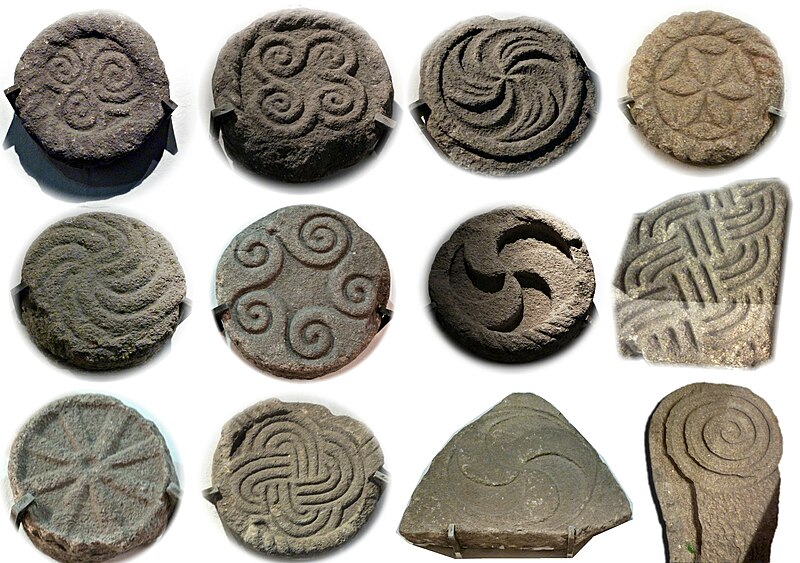
The 6-prong solar symbol was one of the images found among the Celts of the northern Iberian Peninsula. It is seen here on these 9th century BC artifacts found at the archaic high places.