Monday, January 31, 2011

New User-Friendly INDEX

More people are coming to Just Genesis to do research. They have used the INDEX which wasn't well organized. It has been improved. Take a look

The topics are arranged alphabetically and all of the essays are hot linked for quick access.

Additionally, I've included related reading at the end of the essays to enable readers to investigate a topic more deeper.

Best wishes,
Alice C. Linsley

Sunday, January 30, 2011

African Naming Practices


The West could learn from African naming practices, as is evident in this piece written by Uchenna Uzo, a Nigerian living in Barcelona Spain.


Names and the Value of a Human Person
Uchenna Uzo


How many people actually know what their first names mean? In the four years that I have spent outside of my home country in Nigeria, I have frequently asked the people I meet in Europe and the United States what their names actually mean. I have always found it amazing to get replies such as: I do not know? Who cares? Why is that important? Such responses are very different from the typical response of an African.

Take Nigeria, where I grew up. Nigerians actually introduce themselves by not only telling their names but also explaining their meanings to people who belong to other linguistic groups. Why is the meaning of names accorded so much value in Africa? It is because for an African, a name does not only represent a person´s identity but a name is also regarded as a promise, a vocation and a list of expectations.

For a similar reason, when Pope Benedict baptized 21 babies belonging to Vatican staff recently he took the opportunity to remind Catholics that a Christian name should be just that, Christian, since every new member of the faith acquires the character of a son or daughter of the Church.

In Africa it all starts a few months before a child is born. Parents draw up a list of possible names for the newborn and they share the list with grandparents, extended family members and family friends. The appropriate names from the list are selected depending on important family events surrounding the conception of the child and also the expectations of the parents from the child. When the child finally arrives a naming ceremony is organized to formally give the selected names. Each child is given at least three names: one from the parents and two from the maternal and paternal grandparents.

This is a common practice in several African countries such as Kenya, Togo, Sudan, Ghana, Cote’Ivoire and Nigeria. Among the Yoruba of South Western Nigeria, The first name is the personal name (oruko). The second name is the praise name (oriki), which reflects the hopes for the child. The third name connects the child to its family or community (orile).

Parents who have been childless for years and finally give birth to children give names such as "Ndidi" which means patience. Such names affirm that patience is usually rewarded. This name also represents a call to the child to remain patient in time of adversity.

Another example is the name "Nonye" which means "stay with us". This is the typical name that parents who have lost a child give to the new borne baby. In Cameroon, parents give names such as Pegwo (disappointment); Jurodoe, (faithful); Sohna (anxiety) to represent the circumstances around the child´s birth. Large families also have special names for their youngest children.

One might ask why all the fuss about giving names to children? At the heart of this practice among Africans is a profound appreciation of the value of the human person. By giving the child a name, parents and their family members go beyond seeing a child as a composition of cells to seeing the child as a person in search of an identity and a vocation. How does this compare with events in Europe and the United states?

In these countries where there are increasing rates of divorce, abortion, child-sex selection, and so on, it is not surprising that children’s names often reflect popular culture, with a host of little Ollies and Bellas named after film and television celebrities. Too bad that, by the time they are 15 or 20, the significance of their names will have been forgotten, along with other trends of the era.

The West does have a few rules about names. A couple in Sweden spent the 1990s protesting that country’s naming laws by giving their son the name “Brfxxccxxmnpcccclllmmnprxvclmnckssqlbb11116”, pronounced “albin”, and then simply “A”, which is pronounced the same way. It is hard to see where respect for the child and its future comes into this.

The Chinese, by contrast, put a lot more thought into naming their children, striving for something individual as well as meaningful since there are only about one hundred official surnames (family names) shared by most of China’s population. But, even there, historical events and patriotism can create the equivalent of pop culture trends -- “Space Travel” and “Olympic Games” were popular names a couple of years ago when the games were staged in Beijing.

Giving a child a meaningful name in Africa requires accepting that the child has a personal dignity right from the moment of conception that needs to be respected and protected. This respect for the dignity of the newly born is symbolized through practices associated with the naming ceremony. Among the Yorubas of Western Nigeria, water is dabbed on the child´s face during the ceremony to symbolize the child´s purity and the importance of having no enemies. In some other African countries, honey and bitter kolanuts represent the sweet and bitter dimensions of the life that the child is about to begin.

All these details reflect that naming is not a trivial exercise in Africa. In fact, naming is accorded almost the same significance as marriage. After the naming ceremony, parents take every available opportunity to reinforce the messages behind the names that are given to their children. Parents use popular African proverbs to drive home their messages. When children do not act according to expectations, they are told proverbs such as: "If you do not stand for something, you will fall for something"; "It is a bad child that does not take advice"; "For tomorrow belongs to the people who prepare for it today."

Africa has distinctive cultural qualities that the rest of the world can learn from. One of those who have emphasized this fact is Pope John Paul II who said in 1980 during his visit to Ghana: "The essential aspects of African culture are a vision of the world where the sacred is central, a deep awareness of the link between Creator and nature, a great respect for all life, a sense of family and of community that blossoms into an open and joyful hospitality, reverence for dialogue as a means of settling differences and sharing insights, spontaneity and the joy of living expressed in poetic language, song and dance".

The practices associated with naming in Africa show that naming represents an opportunity for parents to positively influence the life of their children and in the process influence their own lives.


--Uchenna Uzo is a student at IESE Business School in Barcelona Spain.
Reprinted from MercatorNet


Naming is a community concern in African societies.  The names given to the child assign him or her a place in the family, the community, and the cosmos.

Among the Yoruba babies are named on the 8th day (corresponding to the day of circumcision of boys among the Horites/Horim). Among the Edo (Edomites), babies are named on the 7th day.


Related reading:  The Cousin Bride's Naming Prerogative; Methuselah's Wife; An African Reflects on Biblical Names; Recovering the African Background of Genesis

Saturday, January 29, 2011

Science Teachers and Creationism

Alice C. Linsley


In a Live Science piece by Jennifer Welsh (28 Jan. 2011) some high school biology teachers are accused of lack of knowledge - that is, ignorance of their subject - because about 13 percent teach creationism in their classrooms. According to Welsh, these teachers believe that humans appeared on the surface of the Earth about 10,000 years ago.

Michael Berkman, co-author of the study, told Livescience: "Our general sense is they lack the knowledge and confidence to go in there and teach evolution, which makes them risk-averse."

Showing her own ignorance, Jennifer Welsh defines all who believe that God created the Earth as biblical literalists. She writes, "Creationists broadly believe God created Earth, its inhabitants and the universe, with Christian creationists taking a literal interpretation of the Book of Genesis in the Bible. However, scientific evidence says evolutionary theory, the idea that all organisms evolved from some common ancestor, by means of natural selection, explain the planet's diversity of life. Some of the earliest life on Earth dates back to 3.7 billion years ago."

I believe that God created the Earth and I also believe that the earliest life on Earth appeared billions of years ago. I know that the oldest human fossils are about 3.4 million years and that they show the same anatomical range as modern humans. When Jeremy DeSilva, an anthropologist, compared the ankle joint, the tibia and the talus of fossil "hominins" between 4.12 million to 1.53 million years old, he discovered that all of the hominin ankle joints resembled those of modern humans rather than those of apes.

The earliest human fossils show a range of anatomical features yet all these features are found among humans today. The nearly complete skulls of people who lived 160,000 years ago are, in the words of paleontologist Tim White, "like modern-day humans in almost every feature."

Some of the australopithecine fossils dating between 700,000 and 2.4 million years are recognized as "early human fossils". Although classified as "ape of the South", some are recognized as having had human dentition, bipedalism and stone tools.

With DNA samples from 2400 individuals from more than 100 modern African populations, researchers have identified a panel of 1327 sites of genetic variation across the entire genome. Analysis of the data suggests that modern Africans are descended from 14 ancestral populations, which correlate with known linguistic groups. Comparative linguistics and genetics are moving to similar conclusions when it comes to the question of human origins. The evidence in both fields indicates flux, but no essential change.

In other words, there is no evidence to support the macro-evolutionary theory of change from one kind into another kind. The physical evidence indicates that humans appeared as humans and unheralded by sub-human ancestors more than 4 million years ago. Kenneth H. Roux admits, "Evolutionary convergence at the molecular level is presumed to be widespread, but is poorly documented."

Welsh's claim that the theory of evolution -  "the idea that all organisms evolved from some common ancestor" has been proven is simply false.  There are plenty of evolutionary scientists who question the theory.  I've mentioned a few already.

The battle ground is the book of Genesis, which few in this debate understand. Genesis isn't a scientific record of the beginning of life.  It really isn't about human origins.  It is about the origins of Messianic expectation.  But that's another subject for another day.

 
Related reading:  Genesis and Genetics; Genesis: Is it Really About Human Origins?; Oldest Human Fossils;
Theories of Creation; Evangelical Colleges Battle Over Creation and Evolution

Friday, January 28, 2011

A Child's Prayer

Sometimes we adults make things too complicated. Here is a child's prayer that says it all.  James is my niece's 3 year old son.


Dear Jesus,


Thank you for helping our sins.

Welcome to the earth.

We are clapping our hands.

Amen.

Thursday, January 27, 2011

Rabbi Altaf on Jesus and the Israelites

This is well worth watching! That's Part 1, in which Rabbi Simon Altaf discusses the origin of the Israelites. He talks of Africa, not Europe or Asia and points out the bias of European rabbis against the Kushites. He refers to literature of white European rabbis such as this:  Rabbi Hirsch on the Nations.  There always seems to be a racist element when interpreting Genesis.  This is evident in the writings of young earth creationists such as Terry Mortenson.

In Part 2, he speaks about Jesus' skin tone and His Nilotic heritage. Rabbi Simon recognizes Yeshua or Yahushua as Messiah, the Christ.

Wednesday, January 26, 2011

The Holy One Hidden and Revealed

Alice C. Linsley

Clement of Alexandria (AD 150-215) believed that the writers of scripture practiced a "prophetic and venerable system of concealment." He explained: "For many reasons the scriptures conceal their meaning; primarily, with the aim of making us diligent and unresting in our study of the words of salvation and, secondly, because it is not in the province of all men to examine their meaning, lest they should receive hurt through a mistaken interpretation.” (Clement of Alexandria by R.B. Tollinton. 1914. Volume II, p. 302.)

I can relate to Clement's belief that concealment of meaning actually encourages truth-seekers to dig deeper. That's one explanation for why this writer should spent 32 years trying to unravel the mysteries of Genesis. But what about this idea that some people who might be "hurt through mistaken interpretation" are, in a sense, protected by the concealment of meaning?

And what is the nature of this "prophetic and venerable system of concealment" of meaning in the Scriptures? The rabbis believed that sacred mysteries were concealed by mystical symbols. I think of Rabbi Kaduri's pronouncements that Messiah had been revealed and His name is Yehoshua or Yeshua (Jesus).

Mark's Gospel seems to veil the Christ more than the other Evangelists. It is Mark's Gospel that tells us that Jesus' true identify was known in Tyre, not in Jerusalem.

The king of Tyre was allied by kinship with David and sent skilled artisans to help David build a palace in Jerusalem. Hiram is also known as "Huram" and "Horam," which are versions of the names Hur and Hor and related to the name Harun (Aaron), as in Jabal Harun, the Mountain of Aaron in Jordan. The area of Jabal Harun was extensively occupied and quarried in the Paleolithic Period.

According to Midrashic tradition, Hur was Moses’ brother-in-law, the husband of Miriam. Hur’s grandson was one of the builders of the Tabernacle. I Chronicles 4:4 lists Hur as the "father of Bethlehem," that is the patriarch of the place known as the "city of David." Bethlehem was in the heartland of Horite territory.

In other words, the king of Tyre and David were related. Their common ancestors were Horites, and as the Genesis geneologies indicate, the Horite lineage can be traced back to Eden. The Horites believed that the Son of God would be born of their ruler-priest caste. They expected Him to come to visit them. This was fulfilled when Jesus, the Son of God, visited Tyre (Matt. 15:21-28; Mark 7: 24). Here the Markan mystery is revealed, for we are told that in Tyre Jesus "could not pass unrecognized."


Related reading:  Why Jesus Visited Tyre; Who Were the Horites?Horite Territory; The Christ in Nilotic Mythology; The Motif of Hidden Sons; Sons and The Son; Paleolithic Industries at Jabal Harun

Tuesday, January 25, 2011

Nubians Used Antibiotics

Alice C. Linsley


The Nubians were a Nilotic people who would have been called Kushites in the time of Abraham's ancestors. Before the naming of modern nations in Africa, Kush was ruled by powerful tribal chiefs. Ancient Kush was a much larger territory than generally recognized. It probably included Upper Egypt, and much of Sudan, Ethiopia, Somalia, Kenya and Tanzania.  The following is a report about tetracycline laced beer consumed by Nubians who lived between 350 and 550 A.D.  However, Egyptians and other Nilotic peoples consumed beer as early as 3000 B.C. so there is a long precedent for what George Armelagos found.

People have been using antibiotics for nearly 2,000 years, suggests a new study, which found large doses of tetracycline embedded in the bones of ancient African mummies.

What's more, they probably got it through beer, and just about everyone appears to have drank it consistently throughout their lifetimes, beginning early in childhood.

While the modern age of antibiotics began in 1928 with the discovery of penicillin, the new findings suggest that people knew how to fight infections much earlier than that — even if they didn't actually know what bacteria were.

Some of the first people to use antibiotics, according to the research, may have lived along the shores of the Nile in Sudanese Nubia, which spans the border of modern Egypt and Sudan.

"Given the amount of tetracycline there, they had to know what they were doing," said lead author George Armelagos, a biological anthropologist at Emory University in Atlanta. "They may not have known what tetracycline was, but they certainly knew something was making them feel better."

Armelagos was part of a group of anthropologists that excavated the mummies in 1963. His original goal was to study osteoporosis in the Nubians, who lived between about 350 and 550 A.D. But while looking through a microscope at samples of the ancient bone under ultraviolet light, he saw what looked like tetracycline — an antibiotic that was not officially patented in modern times until 1950.

Read it all here.
 
Related reading:  Who Were the Kushites?; The Saharan Origin of Pharaonic Egypt; Wine Use in Antiquity; Neolithic Medical Care


Saturday, January 22, 2011

Wine Use in Antiquity

Alice C. Linsley


Timeline of Archaeological Discoveries

6000 BC:  At the Chinese Neolithic site of Jiahu archaeologists found pottery shards with residue from a fermented beverage made of a mixture of rice, honey and fruit. Researchers found species of the tartrate from grape, hawthorn, or longyan cherry, or a combination of two or more of these.

4000 BC:  In 2007, a team excavating Areni-1, a cave complex in a canyon between the Little Caucasus and the Zagros mountains, found ancient grape seeds. The cave is near Armenia’s southern border with Iran outside a village still known for its wine-making activities.

3150 BC:  In the late 1980s, German archaeologists found remains of wine making equipment in the tomb of the ancient Nubian king Scorpion I. That find consisted of grape seeds, grape skins, dried pulp and imported ceramic jars covered inside with a yellow residue chemically consistent with wine. Ancient Egyptian murals depict details of wine-making. Egyptians flavored their wines with tree resins, herbs, and figs. The Nilotic peoples preferred beer to wine and their beer contained high levels of tetracycline. Wine was probably reserved for religious rituals. Plutarch wrote that the “priests of the Sun at Heliopolis never carry wine into their temples, for they regard it as indecent for those who are devoted to the service of any god to indulge in the drinking of wine whilst they are under the immediate inspection of their Lord and King. The priests of the other deities are not so scrupulous in this respect, for they use it, though sparingly.” We are told that Noah was drunk with wine on at least one occasion and the outcome wasn't good. Likewise, the outcome of Lot's drunken stupor was not good.  Genesis seems to be critical of excessive wine consumption.

1600 BC:  In 1963, two plaster basins that appear to have been used to press grapes were excavated in what is now Israel's West Bank.


Wine for Pleasure and for Ritual Use

One of the oldest uses of wine was in religious ritual. In tantric ritual, wine is called Shakti of Sakti. Sakti is also the name for the harvest moon celebration in Vedic tradition. The word may be related to the Falasha word sarki, which also refers to the harvest moon festival. Sarki is also an ancient reference to priests who prepare animals for the sacrifice. Sarki live as Haruwa in the Tarai region of Nepal and Har-wa is the ancient Egyptian word for priest. There are many such linguistics correspondences. The Egyptian word for meteoritic iron bja (metal from heaven) corresponds to the Sanscrit word bija, meaning semen or seed. The Hebrew word yasuah and the Sanscrit words asvah, asuah or yasuah means salvation.

In Genesis we find two fathers drunk with wine: Noah and Lot. In Noah’s case, his three sons decide what to do while their father sleeps in a drunken stupor. In Lot’s case, his two daughters decide what to do while their father sleeps. In both stories, the results are not good. Wine in these stories is not being used ritually, as far as we know. These stories stand in contrast to stories involving wine as a sign of redemption, as in the Passover and in the Eucharist.

The symmetry of these stories is remarkable. In the Egyptian Passover Moses is the central figure, but in the Jericho Passover, it is Rahab. Male and female, as binary opposites, are instrumental in bringing about deliverance. Here we find a parallel to the tantric understanding of wine use in the consummation of divine love in Hinduism and Buddhism.  In the West, where we are consumed with lust, there are no true practitioners, for as a Tantrica of West Bengel has explained: "Those most fit for Tantra almost never take it up, and those least fit pursue it with zeal."

The context of wine use in sexual consummation in the Bible is not exactly like that of Hinduism and Buddhism, however. In the biblical view, male and female are not equals in the order of creation, but in Shakta ritual male and female are equal. This is the difference between the binary worldview of the Bible and the dualism of the Asian religions.

The wine in the Passover Seder is not for common use, but ritual or sacramental. It is used to recount God's deliverance of the Israelites, and also speaks of the consummation of a love relationship, as is evident in Jesus' explanation to His disciples that he would not drink the cup again until the last promise is fulfilled: “This is My blood of the new covenant, which is shed for many for the remission of sins. I say to you, I will not drink this fruit of the vine from now on until that day when I drink it new with you in My Father’s kingdom” (Matt. 26:28-29). On that day, the Son of God shall take to Himself the Church, His royal bride. She is not His equal; rather her nobility is derived from her royal Groom.
 
 
Related reading:  Two Passovers and Two Drunken Fathers; Genesis and the Eucharist; Oldest Wine-Making Equipment

Patrick McGovern, an archaeochemist at the University of Pennsylvania Museum of Archaeology and Anthropology, has written about the archaeological and chemical evidence for fermented beverages in antiquity. His book is titled “Uncorking the Past: The Quest for Wine, Beer, and Other Alcoholic Beverages.”

Friday, January 21, 2011

The World's Oldest Books

Alice C. Linsley


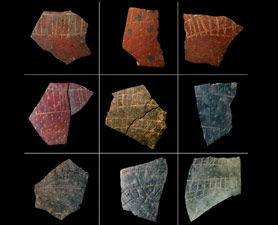
When considering written communication in antiquity, one must begin with the oldest known written communication. That would be ostrich eggshell fragments dating to 60,000 years ago. These have been hailed as the oldest example of symbolic written communication. The unusually large sample of 270 engraved eggshells were mostly excavated at Diepkloof Rock Shelter in South Africa.


However, if one wishes to consider the world's oldest books, there is now a set of 70 contending for that title.

A group of 70 or so "books", about the side of a credit car, with between five and 15 lead leaves bound by lead rings, were discovered in northern Jordan after a flash flood had exposed two niches inside the cave. One one of the niches was marked with a menorah. A Bedouin found the books.  They are believed to be extremely rare relics of early Christianity.  Below is a photo of a page showing a date nut palm (tamar) which is a "tree of life." (Read more here.)


The other books were found in Egypt.  Here's the report:

It was on January 20, 1988, while excavating a third- century Roman house at Kellis, part of the Dakhleh Oasis Project, that student volunteer Jessica Hallet excitedly called out to her supervisor to come and look at a piece of wood with writing on it. Colin Hope, director of the Centre for Archaeology and Ancient History at Australia’s Monash University, wandered over to delicately brush sand from it. What emerged from that ancient kitchen were two wooden-paged books. One contained three speeches by the Greek orator Isocrates; however, it was the other book, underneath that one, that has garnered more attention.

The three years of the Kellis book were either 361 to 364 or 376 to 379, just before the site was abandoned. Wooden books were popular at the time, though papyrus ones were about to come into common use. A private letter, written in Greek and found in the house next door, contained an order: “Send a well-proportioned and nicely executed 10-page notebook for your brother Ision.” The addressee didn’t have to go far. A room adjacent to where the book was found revealed a bookmaker’s workshop containing acacia-wood mallets, three cut wooden pages, a block marked for cutting and a tool box which allowed Hope to reconstruct the process of making the book.

Hope agrees that calling it “the world’s oldest book” is a matter of definition. “It’s certainly the oldest as we know a book,” he says, “with a front and back cover, a pagination system and individual pages bound at the spine.”

Made from a single block of acacia wood, the book’s eight pages measure 33 by 11 centimeters (13"by 4"). Each page is coated with gum arabic to provide a writing surface. They’re held together by tightly spun linen strings threaded through pairs of holes drilled at the top and bottom. Should the binding ever have broken, re-ordering the pages would have presented no problem: Notches along the spine line up to a perfect V when the pages are in the correct order.

The book is now safely housed in the Kharga Archeological Museum in Egypt’s Kharga Oasis, near Dakhleh, where crops similar to the ones named in it are grown, and similar payments continue to be made.

The second book, dubbed the Kellis Agricultural Account Book, is a revealing record written by the manager of an agricultural estate of all the comings and goings of the business of the estate over three years. Its 1784 entries list payables and receivables, including annual obligations to the landlord, the mistress of the house and the field workers. Income items include crops like wheat, barley, chickens, figs, olive oil, honey and wine. Outgoing payments included “to Syrion, for wage,” “to Father Psennouphis, for wedding gifts,” “transport charge,” and notes indicated how each payment was made, whether in cash or produce or both. It’s an extremely important written record that can be compared to archeological remains found at the site.

From here. Dakhleh is in the desert in the southwestern part of Egypt in what was part of ancient Kush.
 
 
Related reading:  Canaanite Origins of the Alphabet; The Origins of Written Communication; Sacred Writings and the Uniqueness of the Bible; Paleolithic Ostrich Eggshell Communication; The Writing of David's Realm

Monday, January 17, 2011

Biblical Anthropology and Antecedents

Alice C. Linsley

Evangelicals struggle to find Jesus Christ in Genesis, but young Jews mostly get it!

The Evangelicals say they believe biblical propositions but have trouble accepting the Nilotic antecedents of Abraham's ancestors, though Genesis tells us explicitly that one of Abraham's ancestors was Kush.

The young Jews note that both traditions concerning Messiah have Him born of lines that have non-Jewish mothers. This is troubling, since Jewishness is traced through the mother. It is more troubling that the Messiah is foreshadowed in Nilotic mythology long before we can speak of a people called Jews. 

Both groups are struggling with the question of antecedents, which is the special focus of biblical anthropology. Both groups rely on interpretations from rabbis, pastors, talmud and commentaries. Biblical anthropologists work with data and details, cutting through layers of often conflicting interpretations to reconstruct as accurately as possible the culture traits, beliefs and practices of Abraham's people. The focus of my research is primarily Abraham's ancestors who came out of the Nile region.

David Noel Freedman once said: “The Hebrew Bible is the one artifact from antiquity that not only maintained its integrity but continues to have a vital, powerful effect thousands of years later.”

The Bible is a miraculous book, clearly superintended through the centuries by the LORD. This is especially evident in the analysis of the kinship pattern of the priestly lines from Genesis 4-5 to Joseph, of the priestly line of Mattai, and Mary, daughter of the priest Joachim. The kinship pattern is unique and consistent throughout the Bible, proving that the priestly lines exclusively intermarried according to the pattern first found among Abraham's Kushite ancestors. This kinship pattern could not have been written back into the texts at a late date. It is the thread that weaves throughout the Bible, like the scarlet cord, from beginning to end.

The Bible is a reliable and useful resource for anthropologists, just as it is for biblical archaeologists. But when it comes to antecedents, we have to keep an open mind. We can't force data into a preconceived interpretation. Doing so represents very poor stewardship of God's Word.


Related reading:  God's Word Never Fails

Saturday, January 15, 2011

Who Were the Horites?

Alice C. Linsley


The Horites were a caste of rulers who controlled the trade routes from the Sahara to India. Originally, they controlled the major waters systems at a time when the Sahara, Arabia and Mesopotamia were wetter. Commerce moved along the rivers which were interconnected in the late Holocene.

The Horites served as river shrine and temple attendants. They interceded for others and offered sacrifice. Job offered sacrifice daily for the sins of his own family. At the end of the book, God tells Job to pray for his kinsmen Eliphaz, Zophar and Bildad. This is reminiscent of Abraham praying for Abimelech and his whole household (Gen. 20:17,18). Purity was an essential trait of the Horite priest.

The Horites were devotees of HR (Hor, Hur or Horus) who his mother Hathor-Meri (later called Isis) conceived miraculously by the overshadowing of the Sun (the Creator's emblem). Horus is the archetype by which Abraham's descendants would recognize Jesus as the promised Seed of the Woman (Gen. 3:15). His authentication was His rising from the dead on the third day, in accordance with Horite expectation. As St. Augustine noted, the Egyptians took great care in the burial of their dead and never practiced cremation, as in the religions that seek to escape physical existence. Abraham's ancestors believed in the resurrection of the body and awaited a deified king who would rise from the grave and deliver his people from death.

Hathor-Meri's animal totem was a cow. She is shown at the Dendura Temple holding her newborn son in a manger or stable. The stable was constructed by the Horite priest Har-si-Atef. Atef was the crown worn by deified rulers. The Arabic word atef or atif means "kind." The ruler who wore the atef crown was to embody kindness and he was to unite the peoples.

Horite belief in a deified son who would embody kindness and unite the peoples found fulfillment in Jesus Christ, a descendant of the Horite ruler-priests, the divine son of the Virgin Mary, daughter of the priest Joachim of the line of Nathan. Jesus Christ is the fulfillment of the promise made to Abraham's Horite ancestors in Eden (Gen. 3:15). This is why Frank Moore Cross cannot avoid the conclusion that the God of Israel is the God of the Horites.

Consider how Horus, the mythical archetype of Christ, describes himself in the Coffin texts (passage 148):

"I am Horus, the great Falcon upon the ramparts of the house of him of the hidden name. My flight has reached the horizon. I have passed by the gods of Nut. I have gone further than the gods of old. Even the most ancient bird could not equal my very first flight. I have removed my place beyond the powers of Set, the foe of my father Osiris. No other god could do what I have done. I have brought the ways of eternity to the twilight of the morning. I am unique in my flight. My wrath will be turned against the enemy of my father Osiris and I will put him beneath my feet in my name of 'Red Cloak'." (Myth and Symbol in Ancient Egypt by R.T. Rundle Clark, p. 216)

Here we find the words of Psalm 110:1, a messianic reference: The Lord says to my Lord: "Sit at My right hand until I make Your enemies a footstool for Your feet."


Horus, whose totem was the falcon or hawk, was known by many titles. He was called the "Son of God," "Horus of the Two Crowns," "Horus of the Two Horizons,"  and he was associated with the three superior planets Mars, Jupiter and Saturn. Mars was named "Horus of the Horizon" or "Horus the Red." Jupiter was called "Horus Who Illuminates the Two Lands." Saturn was named "Horus, Bull of the Sky." The three superior planets were always depicted with the falcon-head of Horus (Krupp 1979).


Horus of Nekhen, a very ancient Horite shrine city in Sudan


In his work Isis and Osiris Plutarch remarked that Horite priests burned incense three times a day: frankincense at dawn, myrrh at mid-day, and kyphi at dusk. These were the three most significant points in the Sun's daily journey and the mid-day (high noon) was considered the sacred center, a time when there are no shadows (James 1:17). The Sun was the emblem of Re, the Creator. His son was sometimes shown flying as a falcon above the Sun, as in this stone image from Anghor Wat in Cambodia. Wat means shrine, town and temple. Anghor is "ankh-Hor" in Egyptian and means Life to Horus!


Hor soaring as a falcon above the Sun, the emblem of Re the Father in His solar boat

Horite religious ideas spread across the ancient Afro-Asiatic Dominion, but originated in the Upper Nile region. Abraham's ancestors came from the Nile region which was later called Kush. His father Terah is associated with the Nubian Ainu who had a red skin tone. We first meet Abraham in the Ur-Haran region because he is a descendant of Nimrod who built a vast kingdom in Mesopotamia. Nimrod was a son of Kush. Likely he is Sargon the Great. Sar-gon means King of Kings or Most High King.

Horite does not designate a race or ethnicity. It designates a caste of rulers and priests. Jews are one group that descended from the Horites. That is why Jews call their ancestors horim. Some Jews and some Arabs have a common Horite ancestry.

The ancient world of the Afro-Asiatics was structured along caste lines. Typical of castes, the Horite lines exclusively intermarried (endogamy). The geneologies of the Bible reveal that intermarriage of the ruler-priests lines continued to the time of Jesus. Jesus is the culmination of the Horim's expectation of the fulfillment of the Edenic Promise. (Gen. 3:15)

It is from the Horite priesthood that the priesthood of Israel developed. Moses' two brothers, Korah and Aaron, were Horite priests before Judaism emerged as a distinct world religion, even before Israel can be identified as a nation. Horite priests served in the temple in Jerusalem on a rotating schedule. I Chronicles 4:4 lists Hur (Hor) as the "father of Bethlehem". The author of Chronicles knew that Bethlehem was originally a Horite settlement in the heart of Horite territory.

The word Horite is related to the Egyptian 'khar', a measurement of fuel used in burnt offerings and to a measurement of volume - gr - used across the ancient Afro-Asiatic Dominion. Khar is likely also related to the Egyptian word for priest harwa and to the word korah. One of Moses' older brothers was Korah and he was a Horite priest. Korah means "shaved head" and according to Numbers 16:17-18, Korah carried the censor to offer incense before God. This suggests that kor and tor are cognates.

Kor/KorahandTor/Torah both appear be related to blood sacrifice and the Horite priesthood. The Hebrew root thr = to be pure, corresponds to the Hausa/Hahm toro = clean, and to the Tamil tiru = holy. All are related to the proto-Dravidian tor = blood. The Horite priest was to be purified before entering the temple. The purification ritual involved shaving their heads and bodies.


Josephus calls the descendants of Abraham by Keturah "Horites" and quoting another ancient historian, speaks of them as "conquerors of Egypt and founders of the Assyrian Empire." Doubtless this is a reference to Nimrod (Sargon the Great) who established for himself a vast empire in Sumeria. Josephus failed to note, however, that the Horites already existed before Abraham married Keturah. They are Abraham's Kushite ancestors who spread the Proto-Gospel across the ancient Afro-Asiatic Dominion. The origins of Messianic expectation can be traced to Abraham's Horite ancestors.

Horite men married only Horite women and according to a pattern which was tied to ancient tradition. It is not a coincidence that Joseph married Asenath, the daughter of "the priest of On" (Gen. 41:45). The exclusive intermarriage between Horite lines requires that we take these words quite literally: "For me you shall be a kingdom of priests, a holy nation." (Ex. 19:6)

Special care was taken in the selection of the wives of the firstborn sons, and each ruler-priest had four firstborn sons. The firstborn son of the half-sister wife ascended to the throne of his biological father. The firstborn son of the patrilineal cousin or niece ascended to the throne of this maternal grandfather (as did Nimrod, who ascended to the throne of Nimrod the Elder). Nimrod the Younger was named by his mother after her father. This was done only by the cousin/niece brides, so while Nimrod's father is not known, we know that his mother was the daughter of the Kushite ruler Nimrod the Elder who conquer Nippur in 2340.

The firstborn sons by the ruler's two concubines, and sons by wives who didn't ascend to established thrones, were given gifts and sent away to conquer territories of their own. Sent-away sons include Cain, Abraham, Ishmael, Jacob, Joseph and Moses. By this means the marriage and ascendancy pattern of the Horites drove the Kushite expansion out of Africa.


The Horite Priesthood

We have no evidence that Horite priests performed the Canaanite practices condemned by the Biblical prophets, who were their descendants. Horite priests were concerned about purity, expecially when preparing for their time of service in the temple.

Horite priests were asked to pray for people because they were recognized as especially holy people. Abraham was asked to pray for Abimelech's household and Job was asked by God to pray for his friends. So the Horite priest's work involved intercessory prayer. That prayer sometimes involved sacrifice. Righteous Job offered sacrifice on behalf of his whole family.

Horite priests are also recognized as shepherds. They kept sheep for the sacrifice and maintained shrines at water systems where they could sustain their flocks. This is why the Horite leaders met their wives at wells.

The trial of Job, in which Satan acts as the accuser, parallels Zechariah 3:2-6 where Satan accuses the High Priest Yeshua. In Yeshua's trial, God acquits Yeshua and commands that he be clothed in clean garments and crowned with 2 crowns (ataroth).

The correspondence between the Horus Myth and the story of Jesus can be explained in two ways. Either Christians borrowed the Horus myth or Christianity emerges in an organic way from the belief system of Abraham and his Horite people. If we decide that Christians borrowed the Horus myth, we must explain why they should have selected this particular myth. There are other great world myths that could have served as the pattern for the story of Jesus. I know of no other religions that prefigure Jesus Christ, the Son of God, other than the faith of Israel as it emerges out of the faith of Abraham's Horite people.

Christians believe that Jesus is the Son of God and that He will receive an eternal kingdom from the Father. He is the Son of God, the fulfillment of the Edenic Promise of Genesis 3:15. He is able to conquer death and deliver sinners from the curse of death. This is the core of Christian belief. Surrounding this are attendant beliefs which logically follow. One is that to receive eternal life, we must acknowledge our need for mercy, forgiveness and salvation. Another is that God does this for us out of His boundless love. John wrote, "This is the revelation of God's love for us, that God sent his only Son into the world that we might have life through him." (1 John 4:9)

When Abraham went to the land of Canaan he did not abandon the tradition of his ancestors. He continued the marriage pattern of his Horite people, believing the promise made to them in Eden that the Seed of the Woman would be born of their bloodlines. That is why Abraham married his half-sister (Sarah) and his patrilineal cousin (Keturah), following the pattern of his ruler-priest ancestors. The Horites anticipated the coming of the Son of God to earth and believed that He would be born of their priestly bloodlines. That is why the lines of priests intermarrried exclusively and why unchaste daughters of priests were burned alive (Lev. 21:9). Sexual impurity was not tolerated.

Joseph, Jacob's first-born son by Rachel, married Asenath, the chaste daughter of a priest of Heliopolis (city of the Sun). Heliopolis, which was called Lunu by the Greeks, was a shrine city of Horus. Lunu means place of pillars because the temple of Heliopolis was constructed with many pillars. Heliopolis (Biblical On) was the most prestigious Horite center in the ancient world. The pyramids of Giza, Saqqara and Abisur are all aligned to the obelisk at Heliopolis.

In the ancient world Horite priests were known for their purity and devotion to the High God whose emblem was the Sun. Plutarch wrote that the “priests of the Sun at Heliopolis never carry wine into their temples, for they regard it as indecent for those who are devoted to the service of any god to indulge in the drinking of wine whilst they are under the immediate inspection of their Lord and King. The priests of the other deities are not so scrupulous in this respect, for they use it, though sparingly.”


Related reading:  Christian Faith Emerges from the Faith of AbrahamPetra Reflects Horite BeliefThe Afro-Asiatic Dominion; Horite Deified SonsSent-Away Sons; Abraham and Job: Horite Rulers; The Hapiru Were Devotees of Hor; The Nile-Tigris Linguistic Connection, Moses' Horite Family; The Genesis Record of Horite Rule; The Enigma of JosephSamuel's Horite Family; The Shock of Mohammed Atta's Afterlife


Friday, January 14, 2011

My Mother Has Gone Home

Mother's Day 1999

Betty Ruth Linsley died at 3:12 am Pacific time today.  Her dying was prolonged and at several times in the past 6 months we thought she would rally, but her 3 daughters know that this life is terminal. She would have been 89 in February.

For most of her life, my mother served Jesus Christ, the Son of God. In a very humble way, she led many to faith in HIM and I pray that her reward will be great in heaven. 

Dying is sometimes a slow and difficult process. Why some die instantly and others so slowly is a mystery.

In August, I was able to say goodbye to her. I prayed for her with my hand resting on her head and thought of how that head had breached her mother's womb at birth by God's grace and how she would breach the gateway to God's presence by that same grace.

As my older sister prayed for our mother she had this thought: "From life’s first cry to final breath, Jesus commands Mom's destiny."

Thanks to all who have prayed for her and our family: Tina, Ron, Sean, Margaret, Bishop David Chislett, David Ould, Brent, Michael, Lvka and Georgia.

Please remember her family as we will miss her very much.

Thank you.

Alice


For family and friends who wish to make a memorial gift, please consider a donation in her memory to one of these organizations:

The Christian Legal Society

USO

Thursday, January 13, 2011

John Coat's Book on Genesis

John R. Coats, a former Episcopal priest and graduate of Virginia Theological Seminary, has written Original Sinners: A New Interpretation of Genesis, in which he presents Genesis not as historical narrative, but as metaphor and symbolism reflecting the reader's own life. In other words, he misses the point of the book! Genesis is about the origin of Messianic expectation among Abraham's Horite people and about the ancestry of Jesus Christ.

Here is part of a review of the book:

The introduction lays out the sources used in compiling the chapters. One form of understanding these is known as Source Theory, which is briefly explained. The notes at the end list each page's group of references for further study if one chooses, since some are more obscure than others.

Coats sprinkles his thoughts with personal reflections of how he identifies with the people and places in Genesis. For the most part, these are interesting. The tale of an interaction with his daughter will curdle milk. While I realize it should be taken in context, Coats is also clearly out of line.

Rather than an interpretation of each chapter, there are four large sections covering a certain person or group. These sets have a further breakdown of Acts - three subsets apiece. In a way, this makes a lot of sense. Readers can read straight through, or select whatever section appeals best.

Despite Coats having a theological background, this book is easy enough to understand. There is a natural ebb and flow to his words so readers will want to know more as the pages go by. Is it the best interpretation out there? Each person can decide. Further study might be indicated, but perhaps not. Just don't consider this book the final word on the subject. Other ones exist.

From here.

Wednesday, January 12, 2011

The Christ in Nilotic Mythology


Alice C. Linsley


While the creation stories of Genesis are often likened to the Babylonian Gilgamesh Epic, they have much closer affinity to the creation stories of Africa. This is evident in motif and in theological detail. Since Abraham’s ancestors were Proto-Saharan and Nilotic peoples and Genesis reflects their worldview, we should not be surprised to find the closest parallels to the Genesis stories in this part of Africa. Here are some examples:

Asiatic/Nubian/Babylonian/Egyptian
The Shilluk of southern Sudan call the Creator Jo-Uk. Jo-Uk made white people out of white sand and the Shilluk of out black dirt. When he came to Egypt, he made the people there out of the Nile mud which is why the Egyptians are red-brown. 

Much of the soil of the Nile Valley is red or reddish brown due to the high levels of Chromic Cambisols which produce a strong brown or red color.

Here we find the motif of the Creator making the man from the dirt of the earth. We also have a clue as to the original context of the account of God creating the man (Gen. 2:7). The Hebrew adamah (Adam) means red clay and is related to the Hamitic/Hausa words odum, odu and edo, meaning red or reddish brown. So this story comes from that part of the Nile known as Egypt and probably dates to the time of the Kushite rulers. This is the origin of the associated of Edom with the color red. The Greek name for the Edomites was Idumea, meaning red people.

The Horites of Edom had a reddish skin tone. The Horites were a caste of ruler-priests who were devotees of Horus. Horus is the archetype by which Abraham's people would later recognize Jesus as the Son of Ra, the "Seed" of the Woman of Genesis 3:15.

Abraham's Proto-Saharan ancestors considered Horus the Seed of Ra because Hathor-Meri was said to conceive when she was overshadowed by the Sun. In the oldest known Messianic tradition the Son of God is born as a calf to Hathor-Meri who is portrayed as a sacred cow, and the birth took place in a stable with the Babe sleeping in a crib. By all appearances, Jesus fulfills the Horus myth perfectly.

The sacred cow is an ancient motif among the Proto-Saharans, Nilotes and Kushites. Jo-Uk brought forth his only begotten son, Kola, by the Sacred White Cow. Kola was the father of Uk-wa who had two wives. One of Uk-wa's son's was Nyakang who became the first ruler.
 
Here we find the idea of the Creator having an only begotten son. We also find the practice of the ruler having two wives, as did all the Horite ruler-priests among Abraham's people.

Hathor was later called Isis. She is part of the sacred Triad of the Nilotic peoples: Osirus (Re), Isis (Hathor) and Horus. Osirus and Horus are said to "be one." Hathor and Horus were often portrayed as a cow with her calf. The Hebrews asked Harun (Aaron) to make a golden calf, the symbol of Horus who was called the "son of God."

Abraham’s people were devotees of Horus (Horites/Horim). They were ethnically Kushite and the oldest known center of Horus worship is the ancient city of Nekhen in Sudan (Hierakonpolis) in Sudan. At the Nekhen temple, votive instruments were ten times larger than the mace heads and bowls found elsewhere, suggesting that this was a very prestigious shrine. Horite priests placed invocations to Horus at the summit of the fortress as the sun rose. This is the likely origin of the sun blessings in Hinduism (the Agnihotra morning ritual) and in Judaism (the Birka Hachama, or “Sun Blessing” ritual performed every 28 years).

The Kushites and Egyptians observed the death of Horus (Osirus) in a 5-day festival. The first 3 days were marked by solemnity (as Plutarch noted in Isis and Osiris, 69). The last 2 days were a time of feasting and rejoicing. Horus is said to have died on the 17th of Athyr. His death was commemorated by the planting of grain. On the third day, the 19th of Athyr, there was a celebration of Horus’ rising to life. It is no coincidence that Jesus alludes to the ancient Horite myth when describing his passion and resurrection. He is a direct descendant of the Horite ruler-priests lines which exclusively intermarried and he was born in Bethlehem of Judah, in the ruler-priest line of Matthew (Mattai/Mattan). This was the line of Joseph of Hari-mathea, a voting member of the Sanhedrin. He and Nicodemus, another member of the Sanhedrin, buried Jesus’ body.


The Bronze Serpent

Harun was apparently an Afro-Asiatic metal worker.  He also crafted the bronze serpent on Moses' rod. When bitten by vipers in the wilderness the people looked upon the rod with the serpent image and were saved. Jesus compared his crucifixion to Moses raising up the rod with a brass serpent: “As Moses lifted up the serpent in the wilderness, even so must the Son of Man be lifted up, that whoever believes in Him should not perish but have eternal life.” (John 3:14,15). Why the comparison? Because Moses’ staff was a symbol of Horus, who was called the "son of God."

Biblical anthropologist Susan Burns reports, "Jewelry work requires coils of metal. Coiling makes the metal stronger and easier to work. I have a picture of a bronze coil with a flattened nose resembling a snake from the Neolithic."

The flat part was where the metalworker held the coil while working the metal. Such coiled bronze serpents have been recovered at Neolithic metal working sites in the Arabah. Mining operations were always under auspices of Hat-Hor, the virgin mother of Horus, as at the Timna Valley copper mines near Eilat.


Horite Religion

The Horites were a caste of ruler-priests who were called Hapiru in Akkadian and Habiru in the Kushitic languages. The Egyptians called these temple attendants ˁpr.w, the w being the plural suffix. This has been rendered '*wap'er' by the Afro-Asiatic expert Christopher Ehret. The *wap'er had significant political authority alongside the ruler. They presided over the rituals directed toward the High God and acted as intercessors and prophets. The Habiru (Hebrew) were devotees of Horus, whose worship originated in what is today Sudan. At Nekhen in Sudan, Horite priests placed invocations to Horus at the summit of the fortress as the sun rose. The sun was the emblem of the Creator.

The Dravidian east-facing temple was termed O-piru, meaning Sun House or House of the Sun. The Arabic yakburu means “he is getting big” and with the intensive active prefix: yukabbiru means "he is enlarging." Likely this is a reference to the morning ritual of the Horite priests who greeted the rising sun and watched as it expanded across the horizon. This is the likely origin of the sun blessings in Hinduism (the Agnihotra morning ritual) and in Judaism (the Birka Hacama, or “Sun Blessing” ritual performed every 28 years).

Many Dravidian settlements and monuments are now submerged under the sea, but originally they were on a land bridge between the Arabian Peninsula and Southern Pakistan. This is sometimes referred to as the "Har-appa" civilization. Har refers to Horus and "appa" is the Dravidian word meaning father. The origin of Dravidian religion was apparently Egypt and ancient Kush.

The Indian archaeologist, B. B. Lal, contends that the Dravidians came from southern Egypt and Sudan (Nubia). Lal writes: "At Timos [Timnah in ] the Indian team dug up several megalithic sites of ancient Nubians which bear an uncanny resemblance to the cemeteries of early Dravidians which are found all over Western India from Kathiawar to Cape Comorin. The intriguing similarity extends from the subterranean structure found near them. Even the earthenware ring-stands used by the Dravidians and Nubians to hold pots were identical."

The Timnah Valley of the southwestern Arabah is rich in copper ore and has been actively mined since the 6th millennium BC. Here Beno Rothenberg excavated a small Horite shrine dedicated to Hat-Hor at the base of Solomon's Pillars. It was built during the reign of Pharaoh Seti I at the end of the 14th century BC. Hat-Hor was the Guardian of Afro-Arabian mines.


The Tree of Life and First Parents

The motifs of the Tree of Life and First Parents are also Nilotic. The Gikuyu of Kenya tell this story from precolonial times:  

There was wind and rain. And there was also thunder and terrible lightening. The earth and the forest around Mount Kerinyaga shook. The animals in the forest whom the Creator had recently put there were afraid. There was no sunlight. This went on for many days so that the whole land was in darkness. Because the animals could not move, they sat and moaned with the wind. The plants and trees remained dumb.
 
It was, our elders tell us, all dead except for the thunder, a violence that seemed to strangle life. It was this dark night whose depth you could not measure, not you nor I can conceive of its solid blackness, which would not let the sun pierce through it.

But in the darkness, at the foot of Mount Kerinyaga, a tree rose. At first it was a small tree and it grew up, finding a way even through the darkness. It wanted to reach the light and the sun. This tree had Life. It went up, sending forth the rich warmth of a blossoming tree - you know, a holy tree in the dark night of thunder and moaning. This was Mukuyu, God's tree.

Now you know that at the beginning of things there was only one man (Gikuyu) and one woman (Mumbi). It was under this Mukuyu that He first put them. And immediately the sun rose and the dark night melted away. The sun shone with a warmth that gave life and activity to all things. The wind and the lightening and thunder stopped. The animals stopped moaning and moved, giving homage to the Creator and to Gikuyu and Mumbi. And the Creator, who is also called Murungu, took Gikuyu and Mumbi from his holy mountain to the country of the ridges near Siriana and there stood them on a big ridge. The He took them to Mukuruwe wa Gathanga about which you have heard so much. But He had shown them all the land - yes, children, God showed Gikuyu and Mumbi all the land and told them: 'This land I hand over to you, O Man and Woman. It is yours to rule and to till in serenity, sacrificing only to me, your God, under my sacred tree.'

Here we find the motifs of primal darkness, a tree of life, first parents, sacred mountains, and sacrifice to the Creator.
 
The Kikuyu place the first parents on a ridge north of Muranga, a town south of Nyeri in Kenya. One can visit the site. A sky-blue gate marks the entrance to Mukurwe Wa Nyagathanga—the Tree of Gathanga. Inside the gate are two mud huts, one for Gikuyu and one for Mumbi. The site looks toward the cloud-shrouded Mount Kirinyaga (Mount Kenya).
 
To the Kikuyu, Mount Kenya was the seat of God, who they called Ngai. Ngai created Gikuyu and told him: “Build your homestead where the fig trees grow."  This is why many believe that the forbidden fruit was not an apple, but a fig.
 
At the foot of Mount Kenya's northeast slope, is the town of Meru, on the Kathita River. This town takes its name from Mount Meru in neighboring Tanzania. Some call Mount Meru "Kinyangiri," which is the equivalent of Kirinyaga, meaning Mount Kenya.
 
Mount Kenya stands at 15,000 feet and is 42 miles west-southwest of Mount Kilimanjaro. It is an extinct volcanic crater and the land at the base is rich volcanic soil. As one ascends the mountain, there are forests with fig and Acacia trees. Mahogany, olive, and date palm trees grow on the drier crater walls. So many species of animals live here that the Kenyan tourist agencies refer to Mount Meru as "Noah’s ark."  Some say that Mount Meru is where Noah's ark landed. This makes sense because the biblical Noah lived in the area of Lake Chad in Bor-No, meaning the "Land of Noah."  No other place on earth claims to be Noah's homeland.


The Meru/Meri/Meni Connection
 
The word "meni" appears in Isaiah 65:11, where it is paralleled with the word gad, meaning good fortune. A connection can be established between the word meni and sacrifice on mountain tops because where the word gad appears there is often a contextual reference to sacrifice on mountains. We recall that Noah offered burnt sacrifice on Ar-Meni after his deliverance (Gen. 8:20). Armenia is an incorrect translation of 'Ar-Meni.

Angkor Wat in Cambodia is a symbolic representation of Mount Meru in Buddhist and Hindu myths. This was originally a Horite shrine as evidenced from a stone relief which shows Horus as a falcon flying above the sun on Re' solar boat.

Horus at top right flying as a falcon above the sun.

Angkor Wat faces west toward the Nile. Angkor Wat and the Egyptian royal tombs correspond in form to the number 72. The number 72 represents represents the numerical sequence linked to the earth’s axial precession, which causes the apparent alteration in the position of the constellations one degree every 72 years. It has been noted also that Angkor Wat is located 72 degrees of longitude east of the Pyramids of Giza. The name Angkor correlates with the ancient Egyptian Anhk-Hor, meaning "May Horus Live." This was originally a Horite shrine, evidence that the Horite ruler-priests are responsible for the diffusion of Horite religious beliefs and practices across the ancient Afro-Asiatic Dominion.

Meru is Meri in Egyptian and Mary in English. In Cambodia, Meri is Meni, with the n taking the place of the r, as often happens in the Southeastern Asian languages. There Mary is called "Mania." The association of Mary with a sacred mountain is very old. The Virgin Mary, whose womb swelled with the Son of God, is often portrayed in Christian iconography as the sacred mountain.

The Prophet Daniel saw a mountain, from which a stone was cut by the hand of God (Dan. 2:34, 45). This is the stone which the builders rejected and which has become a stumbling block, even Jesus Christ, the Son of God.


Related reading:  The Horite Ancestry of Jesus ChristPetra Reflects Horite Beliefs; Horite Expectation and the Star of BethlehemWhat Color was Abraham?; The Genesis Creation StoriesThe Afro-Asiatic Metalworkers;  Mount Mary and the Origins of Life; Genesis: Is It Really About Human Origins?


Monday, January 10, 2011

Qesem Cave Finds in Perspective

In 2006, Archaeologists from Tel Aviv University found eight teeth in Qesem Cave. They are about 400,000 years old.

Avi Gopher, who led the team, told Agence France-Presse that this find casts doubt on the "out of Africa" theory.  However, Israel has always been geographically, linguistically and ethnically an extension of Africa. It is the homeland of the Hamitic and Semitic peoples, descended from Ham and Shem, whose lines intermarried.

The teeth found in Israel are not as old as the remains of other humans found in East Africa. The find contributes nothing to the picture of human origins. It merely confirms the existence of humans in Palestine 400,000 years ago.

The findings were just published this month in the "American Journal of Physical Anthropology."

Read more here.

Things to keep in mind when reading media reports such as this one:

1. The earliest human fossils show a range of anatomical features yet all these features are found among humans today. The nearly complete skulls of people who lived 160,000 years ago are, in the words of paleontologist Tim White, "like modern-day humans in almost every feature." (Read the report on the 160,000 year old Ethiopian fossils here.)

2. When Jeremy DeSilva, a British anthropologist, compared the ankle joint, the tibia and the talus of fossil "hominins" between 4.12 million to 1.53 million years old, he discovered that all of the hominin ankle joints resembled those of modern humans rather than those of apes. Chimpanzees flex their ankles 45 degrees from normal resting position. This makes it possible for apes to climb trees with great ease. While walking, humans flex their ankles a maximum of 20 degrees. The human ankle quite distinct from that of apes. Read more here.

3. Some of the australopithecine ("ape of the South") fossils dating between 700,000 and 2.4 million years are recognized as "early human fossils". Some are recognized as having had human dentition, bipedalism and stone tools. Working from their convergent evolution framework, Richard, Mary and Louis Leakey named some fossils "Zinjanthropus" (now called Australopithecus boisei), others "Homo habilis", and Lucy and her community "Australopithecus". These are presented as divergence strains of hominids, including the extinct and extant humans and mammals. This classification has been revised several times because the criterion of classification of human and ape has not been consistently applied.

4. With DNA samples from 2400 individuals from more than 100 modern African populations, researchers have identified a panel of 1327 sites of genetic variation across the entire genome. Analysis of the data suggests that modern Africans are descended from 14 ancestral populations, which correlate with known linguistic groups. Comparative linguistics and genetics are moving to similar conclusions when it comes to the question of "change" among humans. The evidence in both fields indicates a limited amount of flux, but no essential change. To read about Sarah Tishkoff's African gene study go here.

Sunday, January 9, 2011

Muslim Calls on God of Abraham

Who is the Savior?  Who alone has the power to save?  The God of Abraham!

Watch this video.

Saturday, January 8, 2011

Genesis: Is it Really About Human Origins?

Alice C. Linsley

The more I study Genesis, the more convinced I become that the book isn't about human origns. It is about the origins of Messianic expectation. Genesis is about the ruler-priests of Abraham's Horite caste and their faith in the promise that the Creator made to their ancestors in Eden.That said, Evangelical scientists are still trying to use Genesis to develop a model that reconciles current scientific (read evolutionary) understanding of human origins with the Genesis creation stories. 

Denis Alexander, Director of the Faraday Institute for Science and Religion at St. Edmund’s College, Cambridge recently gave a talk in which he stated this:

Building models to relate biblical texts to science requires no concordist interpretations of the text (in the traditional sense of the word ‘concordist’). The disciplines of both science and theology should be accorded their own integrity. The Genesis texts should be allowed to speak within their own contexts and thought-forms, which are clearly very distant from those of modern science. We can all agree that the early chapters of Genesis exist to convey theology and not science. The task of models is then to explore how the theological truths of Genesis might relate to our current scientific understanding of human origins.

Read more here.

There is a great difficulty here since the very notion of evolution is contradictory to understanding of creation held by those who gave us the Genesis material. They viewed the creation as having a fixed geometry, exhibiting a fixed order, with fixed boundaries between species.

Further, African origin stories can't be forced into an evolutionary mold. The idea that humans evolved from apes is considered an insult. Dr Mathole Motshekga, Executive Director: Kara Heritage Institute (IKS), has written: "The Custodians of African heritage, the Amakhosi and Izinyaka do not know or accept that humanity and Africans in particular descended from the baboons of Maropeng (Sterksfontein), they regard this as an insult visited on them by archeologists and paleontologists. They want the same amount of resources given to these so-called experts to be given to IKS researchers and custodians to research and document the African Genesis (i.e. the true story of our origins)."

In the West, people believe that change over time is progress. That's an illusion because nothing changes. This existence is one unchanging Reality, and prayer is a spiritual nod to this single Reality.

This is why the debate continues between anthropologists who are willing to admit that there is no physical evidence for macro-evolution and biologists who have taken Darwin as their religion.

Related reading:  "Q and A on Creaton vs. Evolution";  "Genesis and Genetics"; The Genesis Creation Stories; Overview of Human Origins

Thursday, January 6, 2011

A Diverse Readership

Here are some recent e-mail communications I've received. They come from people who read Just Genesis and represent the diverse readership.

January 4, 2011

Shalom Alice,
Just a thumbs up to say that I agree with your research on the kinship analysis. I have used one of your articles in my AF Bible on Keturah and give you credit for it. I agree with your research on kinship analysis however we may disagree on Adam being an archetype. I do not think he was an archetype as I see a real person there and see the pattern in of North/South divide in his two wives, one Lilith not documented but in the scriptures and one Chava. I have used these patterns to arrive at many relations of Yahushua (Jesus) in the Renewed Covenant writings in my book Beyth Yahushua. Thank you for your site and your valuable research. Though I have done research on this but I do not publish all mine as mostly it is private for teaching purposes.

The Rabbinic schools do not know these things and are too stuck in the Talmud to recognize any of this however that least bothers our work in both Asia and Africa to restore the lost sheep to the House of Israel.

Shalom B'Shem
Blessings in Yahushua
Rabbi Simon Altaf

Rabbi Simon Altaf
Ha'Shem is my strength and my song; He has become my Yahshuah.
http://www.abrahamic-faith.com/


January 3, 2011

Dear Alice,
In the late 1950's a world renown naval architect, Howard Chaplelle got into a rather hateful debate on the USS Constellation.

The Original ship was built before 1800 and the keel was so marked. Chapelle looked at the vessel and said it was built just before the civil war. This enraged the citizens of Baltimore (probably others too). Chapelle was alone is stating that the custom was to take salvageable wood from previous vessels and incorporate them into the new vessel. Both vessels in this case had the same name. The critics were extremely harsh.

After his death “science” and other records caught up with Chapelle. He was proved right and his critics were proven wrong.

The vessel now sits in Baltimore harbor with a proper history and Chapelle's finds are incorporated into the “record”.

So dear friend, even if you are right you will catch heck.

Anyway... illegitime non carborundum

The Rev. Paul Taylor, Priest
Washington Area Ministry

Tuesday, January 4, 2011

Dramatic Mixed-Media Genesis Narrative

Thanks go to Jim Morgan of Olympia, WA, who sent this to me. Readers of Just Genesis will appreciate the message and the mixed-media approach.

http://vimeo.com/11555977

The video is titled Free Fall.

Sunday, January 2, 2011

Who Were the Kushites?


The Kushites are the Nilo-Saharan peoples who contributed their binary worldview to the ancient Afro-Asiatic world. They include red, black and brown Nubians, pre-dynastic lower Nilotes, and the Ainu/Annu. Among them were Abraham's Horites ancestors who descended from Kush, the grandson of the great Proto-Saharan ruler Noah. The Horites were a caste of ruler-priests who were devotees of Hor/Horus. Jews call their ancestors Horim which is "Horite" in the English Bibles. Some Jews have Horite blood and some Arabs have Horite blood.

Abraham is a descendant of the Proto-Saharan rulers Ham and Shem as the lines of Ham and Shem intermarried (endogamy). This is a universal trait of castes.

To understand the significance of the Kushites and their migration out of Africa, see "A Scientific Timeline of Genesis."


Alice C. Linsley


Beginning in Nubia and Sudan about 10,000 years ago, the Kushites spread across the Levant and Mesopotamia, going as far as Central Asia. They also spread into the interior of Africa along the Shari and the Benue rivers, establishing kingdoms and chieftains as far at Lagos in Nigeria and into the southern Kordafan. They also went west. The Ashante of Ghana were Kushites. Nte means "people of" and Asha is a proper name. The Ashante are the people of Asha, a Kushite ruler who established a kingdom in West Africa.

The name Asha is a priestly name in the Bible. One of Jesse's grandsons was named Asah-el, which means "made by God." The priest Elkanah had a son named Am-asi (I Chron. 2:25, 35), and a Jerusalem priest was named Am-ashai (Neh. 11:13). This suggests that the origins of the priesthood of Israel are to be traced to the older Kushite civilization. This makes sense since Abraham's ancestors came from Kush.

The various regions of ancient Kush later came to be called by different names. Nubia, the land of gold (nu (means gold) was later called Aithiopia by the Greeks. Aithiopia means black. When the Arabs arrived, they translated aithiopia into the Arabic equivalent soudan (Sudan) which means black.

Before the naming of modern nations, the Kushite territories were ruled by tribal chiefs and overlords of larger territories. Biblical Kush included southern Egypt, Sudan, Ethiopia, the Horn of Africa and the western and eastern coastal areas of the Red Sea. Later, in the time of Sargon the Great (Nimrod), they controlled commerce on the Tigris River and then the Euphrates River. Kushite rulers controlled the water systems such as oases and wells and built shrines and temples on the Nile, Jordan, Euphrates and Tigris Rivers.

Linguistic and archaeological evidence supports the biblical picture of Abraham's ancestors coming from the Upper Nile region that was part of Kush and spreading their culture and religious beliefs by the great water systems across what I've termed the ancient "Afro-Asiatic Dominion."  During this period the Sahara was a much wetter region.

In ancient inscriptions from Africa and Central Asia the Kushites were called many names including Kush, and Ethiopian. In Sumerian inscriptions they are called Meluha-Kasi. There is historical evidence that the word Meluha was a geographical designation for peoples who lived in the area of Nubia, Arabia and Northern Africa. "The Babylonian designation for Arabia is 'Magan and Meluha' and the two expressions are used distinctively, the one (Magan) to denote the eastern and southern part - that situated nearest to Babylonia, the other (Meluha) to denote the N. and W. The district of Sinai would thus form part of Meluha." (From here.) A term that is used today for the peoples of this region is "Afro-Arabian."

Genesis tells us that Abraham was a descendant of Kush and of the great Kushite kingdom-builder, Nimrod.  Abraham lived after the time of the "division" that took place between Peleg and his brother Joktan.  This division had to do with territory, but did not change the marriage pattern of these people.  The priest lines of the Horite caste continued to intermarry according to the unique pattern of their people.


Genealogical Evidence


The Kushite marriage and ascendancy structure speaks of the promised Son to whom God the Father will deliver the eternal kingdom.

The Kushites traded with many surrounding people and kingdoms. There is evidence that the clans herded cattle from the grasslands to a communal gathering place at the Nile each year. (In 1986, cattle burials were found at Qustul, south of Abul Simbel, in the heart of Kush.) 

During the Chalcolithic Period, Kushites settled on the edges of the Beersheba Valley where they lived in subterranean dwellings carved out of the limestone with metal tools. An ivory workshop was discovered in one of these houses at Bir es-Safadi. The Bible refers to these cave-dwellers as Dedanites. Dedan, Tema and Buz comprized a Horite confederation. The oldest Arabic texts have been found around the North Arabian oases of Tema and Dedan. Tema, known by Arabs as Taima, lies about 70 miles north-east of Dedan. Tema, Dedan and Dumah were caravan stops along the trade route from Babylon to Sheba.

The term "Horite" can't be taken anachronistically when speaking of Abraham's ancestors, who were devotees of Horus, who they regarded as the “Son of God.” This is the origin of Messianic expectation, and some of Abraham's Jewish descendants recognized Jesus as the fulfillment of the prophetic pattern articulated by their Horite ancestors from Kush. This was apparently true of Nicodemus and Joseph of Har-Mathea, both disciples of Jesus and men in the priestly lines.

The men of Dedan shaved their heads (Jeremiah 25:23), as did Joseph and the Horite priests. This suggests that a confederation of Horite families lived in the Beersheba Valley. Genesis 36 confirms this, listing Dedan as a Horite ruler. Genesis 10 tells us that Dedan's father was Raamah, son of Kush.  Raamah and Nimrod were the first-born sons of Kush by different wives. From Raamah and Dedan come the Afro-Arabians and from Nimrod come the Afro-Asiatic Arameans. Genesis tells us that the separation between the two groups took place in the time of Peleg and Joktan and was a territorial separation, possibly due to climate change. However, the ruling lines of the Kushites and Horites continued to intermarry according to the long-standing custom of their people.


Archaeological Evidence

"Of particular significance is archeologist B. B. Lal's contention that the Dravidians probably came from Nubia, Upper Egypt. This theory would give them among other things their Mediterranean features and dark complexion. Lal writes: "At Timos the Indian team dug up several megalithic sites of ancient Nubians which bear an uncanny resemblance to the cemeteries of early Dravidians which are found all over Western India from Kathiawar to Cape Comorin. The intriguing similarity extends from the subterranean structure found near them. Even the earthenware ring-stands used by the Dravidians and Nubians to hold pots were identical." According to Lal, the Nubian megaliths date from around 1000 B.C." (From here.)

The word "sudra" means Sudanese. Herodotus referred to the Sudra/Dravidians as the “eastern Ethiopians” and described them thus: “The Eastern Ethiopians differed in nothing from the other Ethiopians, save in their language, and the character of their hair. For the Eastern Ethiopians have straight hair, while they of Libya are more woolly-haired…” (Herodotus VI.70, The History, trans. George Rawlinson, Dutton)

The Sudra buried their dead in wooden coffins with the head toward the north. This distinguished the Sudra from other Indians who cremate their dead. This is how Joseph was buried in Egypt. His body would have been mummified and wrapped in cloth before being placed in the coffin (Gen. 50:26).

In Goshen/Avaris, a city built on a series of sandy hillocks to avoid the annual Nile floods, Joseph had an Egyptian-style palace built over Jacob's dwelling. The magnificent palace enclosure had a garden tomb, the largest sepulcher found in Avaris, dating to the 13th Dynasty. Avaris was uncovered by Manfred Bietak and his Austrian team.  This attests to the antiquity of the Joseph story because royal burials were later in cemetaries far removed from residences. Avaris pottery fragments of Canaanite origin indicate that the people who lived in Avaris were Canaanites (peoples descended from Ham and Shem).

The most conclusive evidence of Saharan antecedents (Kushite origins) is the work of the Canadian archeologist, Mary McDonald. She has shown that the ancient Pharaonic civilization built upon the culture of Saharan peoples. Comparing ostrich eggshell excavated from the Bashendi circles with those found in Egypt, she found that nearly all of the shared artifacts showed up in Dakhleh, in the southwestern desert of Egypt, 500 to 2000 years before they appeared in the Nile Valley. Additionally, cattle domestication took place in the Sahara long before it appeared in the Nile Valley. No solid evidence has been found for cattle domestication in the Nile Valley before 6000 years ago.

Fekri Hassan, Petrie Professor of Archaeology at University College London, believes that “Mary’s work has been an outstanding contribution to our understanding of the origins of Egyptian civilization.” Hassan says, “Her work confirmed that one of the main strands in the early civilization of the Nile Valley was the contribution from the inhabitants of the Sahara."


Linquistic Evidence

Linguistically, the Kushites are in the Proto-Saharan group. A comparison of the lexicons and grammatical categories demonstrates that the languages of Saharan Africa, old Arabic, and Dravidian are cognate languages. (Arabic is older than Hebrew.)

These languages were spoken across a vast Afro-Asiatic Dominion that extended from the northern Nigeria to the Indus River valley around 10,000 years ago.  Consider the linguistic correspondences between these words:
  • The Semitic word "wadi" = river corresponds to the Sanskrit "nadi" = river.
  • The Semitic root “mgn” = to give, is the same as the Sanskrit “mgn” = to give.
  • The Semitic “svam” or “Sam-yim” = sky or heaven corresponds to the Sanskrit “svah” = sky or heaven. Both are likely dreived from the Proto-Dravidian word "van" = heaven.
  • The Sanskrit “Sakti” = harvest moon celebration, is the linguistic equivalent of the Falasha word “Sarki” = harvest moon festival.
  • The Semitic "yasuah" = salvation, corresponds to the Sanskrit words “asvah”, “asuah” or “yasuah” = salvation.
  • The Semitic root "thr" = to be pure, corresponds to the Hausa/Hahm "toro" = clean, and to the Tamil "tiru" = holy. All are related to the proto-Dravidian "tor" = blood.
  • Sarki live in Orissa, India and as ‘Haruwa’ in the Tarai region of Nepal. The word "haruwa" is equivalent to the ancient Egyptian word ‘har-wa”, meaning priest. In Nigeria the sarki are called "Kano Kings."
The spread of the worldview represented by these words appears largely to have been the work of Horite missionary priests, as evidenced by falcon-shaped fire altars found in the Sudan and Central Asia. The Vedas speak of falcon-shaped fire-altars. These are associated with Horus, whose totem is the falcon. Vedic tradition teaches that "he who desires heaven is to construct a fire-altar in the form of a falcon." (The hierofalcon has its origin in Africa. "Hiero" means priest.  This species is brown with an arrowhead pattern on its belly.)

Prof. Bator Vamos Toth has identified hundreds of place names that link the Sudan and Central Asia. For example, the places names Orissa and Kar-nak are found in Egypt and in Central Asia. The temples at Karnak in Egypt and at Karnak in Orissa, India, are sun temples associated with the cult of Horus, who the Horite ruler-priests regarded as the "son of God", miraculously begotten according to an ancient promise. This Kushite migration has been confirmed also by DNA studies.

Clyde A. Winters has shown that the "Elamites, Dravidians, Sumerians and Manding are all of Proto-Saharan origin. In the history of mankind they were called the Kushites. Testimony of the great heritage of the Kushites, resulted from their boldness in trade and seafaring expeditions. The authors of ancient Indian literature claimed that the Kushites ruled the world for 7000 years. According to Epiphanies, the age of the Kushites extended from the Flood to the age of Terah, the father of Abraham, the prophet of the Jews and Muslims.

The Egyptian term for these people was K-'-sh and K-'-sh-i. The Hebrews called them Kush, which is the biblical name for a people and a region. In the cuneiform inscriptions the Sudanese were called "Kushiya." (From here.)

The Horites were a caste of ruler-priests who were devotees of Horus who was called "son of God." They were ethnically Kushites or Afro-Arabians.  They appear to be the key to understanding the origins of Messianic expectation.


Related reading:  Kushite WivesKushite Gold; The Christ in Nilotic MythologyWho Were the Horites?; The Saharan Origin of Pharaonic Egypt; Peleg: Time of Division; Genesis and Climate Change; Pharaonic Survivals Between Lake Chad and the West Coast; Afro-Asiatic Metalworkers