Saturday, August 27, 2011

Theories about the Tree of Life


Alice C. Linsley


Susan Burns has written a fascinating piece here on the Hyphaene Thebaica or Doum Palm. She makes a case that this is the tree the author of Genesis had in mind as the "tree of life."  According to Coptic tradition Adam brought this tree from Paradise. 

Egyptian harvesting fruit from a Doum Palm
Unlike the Date Nut Palm (tamar) which symbolizes the Feminine Principle,
the Doum Palm symbolizes the Masculine Principle.


The Tree of Life is a very old idea, as is evident from the wide diffusion of the motif across Africa, Asia, Australia and South America. The principle of diffusion holds that the oldest culture traits, beliefs or practices are those that are most widely diffused across the earth. So we may assume that the Tree of Life motif is indeed very ancient.

The Tree of Life archetype is as old as the serpent archetype and the two are often portrayed together, as in the image of Re's cat killing the giant water serpent. The Nile region appears to be the point of origin of both the Tree and the Serpent archetypes.


Both the Tree of Life and the Serpent are associated with the first man and the first women. At the Horite shrine of Heliopolis the first couple was portrayed as emerging from the Tree of Life.

The association of the tree and serpent is found in the story of Moses' rod which the people were to look upon and be saved when they were being bitten by vipers in the wilderness.  In John 3:14, Jesus refers to this image when He spoke of his passion, saying: "As Moses lifted up the serpent in the wilderness, even so must the Son of Man be lifted up, that whoever believes in Him should not perish but have eternal life."

The Tree of Life is also associated with streaming water or the water of Life.

We find the Tree, Serpent and Water symbols in Genesis and Revelation, at the beginning and the end of the biblical history.


Other possible candidates

The Ijebu of Nigeria regard the Igi-Ose tree as the likely candidate for the "tree of Life."  The leaves of this tree are not to be touched except by the chief and priest. They are used to install Ijebu rulers ands to adorn shrines and other sacred places.

The Gikuyu of Kenya place their first parents on a ridge north of Muranga, a town south of Nyeri. One can visit the site Mukurwe Wa Nyagathanga and see the Tree of Gathanga. To the Gikuyu, Mount Kenya is God's seat on earth and fig trees grow in abundance on the slopes of the mountain.

The Gikuyu call the creator Ngai and when Ngai created Gikuyu he told him: “Build your homestead where the fig trees grow." This is why many believe that the Tree of Life was a fig tree. The fig tree plays a significant role in revealing Jesus as the Son of God in the Gospels (Mark 11, Matthew 21 and Luke 13).

Another likely candidate is the Baobab tree which stores water.  Again we find the association of the Tree of Life with water. The bark of the Baobob is used for cloth and rope and the leaves for condiments and medicines. The baobab’s fruit is called "monkey bread."


1000 year old Baobab tree


This legend surrounding the baobab describes what happens if you are never content with what you are:

The baobab was among the first trees to appear on the land. Next came the slender, graceful palm tree. When the baobab saw the palm tree, it cried out that it wanted to be taller. Then the beautiful flame tree appeared with its red flower and the baobab was envious for flower blossoms. When the baobab saw the magnificent fig tree, it prayed for fruit as well. The gods became angry with the tree and pulled it up by its roots, then replanted it upside down to keep it quiet.

In the wet months the baobab stores water in its thick, corky, fire-resistant trunk for the long dry period ahead. The water is tapped when drinking water becomes scarce and by this tree life is sustained in the arid months. Likely, this is the origin of the idea of a tree from which a river flows for the healing of the nations (Rev. 22:1-2), an image of the restoration of Paradise.

Monday, August 22, 2011

How Big Was Noah's Flood?


Noah lived during the late Holocene in the region of Lake Chad, but during his time Lake Chad was a giant lake known as Lake Mega-Chad with an area of 249,000 miles (400,000 km). At its maximum extent it was larger than any lake that exists on Earth today. Around 7500-6950 BC it was 586 feet deep.

The Komadugu River connects Lake Chad
and the Yobe River Basin.
This would have been the river route
that connected Kain, Nok (Enock) and Noah.
The Chari River in the south flowed into Lake Chad (as it does today) and there were waves driven by continental trade winds. Two distinct episodes have been identified in which the boundaires of the Lake expanded. These correspond to lower and middle Holocene phases of wetter conditions in central and northern Africa.  Noah lived around 2490-2415 BC when the Sahara experienced a wet period (Karl W. Butzer 1966). This is the period of the Old Kingdom.

There appears to have been a connection between Lake Mega-Chad and the Bahr Al-Ghazal which flows into Lake No (Noah's Lake) in Sudan and from there flows eastward as the White Nile (Bahr al-Abyad).

Around 4000 BC, the Horite city of Nekhen was along the Nile (in Sudan) and Lake Mega-Chad had split into three separate lakes: Lake Chad, Lake Fitri and Lake Bodele.


Reference: Shorelines in the Sahara: geomorphological evidence for an enhanced monsoon from palaeolake Megachad by Nick Drake and Charlie Bristow, Department of Geography, King’s College London

Sunday, August 21, 2011

Dumb News Report on Genesis


Here is a dumb news report on Genesis and Andrew Parker's use of Genesis. It is from the sensationalist Daily Mail:

The revalation [sic] came to Professor Andrew Parker during a visit to Rome. He was in the Sistine Chapel, gazing up at Michelangelo's awesome ceiling paintings, when a realisation struck him with dizzying force.

'A Biblical enigma exists that is on the one hand so cryptic it has remained camouflaged for millennia, and on the other so obvious one cannot miss it.'

The enigma is that the order of Creation as described in the Book of Genesis, and so powerfully depicted in the Sistine Chapel by the greatest artist of the Renaissance, has been precisely, eerily confirmed by modern evolutionary science.

Read it all here.


Andrew Parker is a biology professor from Oxford whose area of study is the evolution of the eye.  He claims to be an atheist and stirred the ire of fellow atheists when he asserted that evolution and Genesis can be reconciled.  In his The Genesis Enigma: Why the Bible is scientifically accurate he asserts that the people who gave us the book of Genesis understood evolution 3000 years ago.  Parker fails to identify who those people were. Would he think them so clever were he to recognize that they were ruler-priests who saw a fixed hierarchy in creation?  Or that they were Nilotic peoples who knew a great deal more about water creatures that Parker and over thousands of years never saw one species evolve from another species?  Had they done so they would have remarked on this fascinating observation in Genesis.

Parker has no friends among Young Earth Creationists either. He has said that, "Creationism is totally unfounded. It is as dangerous as fundamentalism in other religions."  He lost the literalists when he posited that the creation of lights in the sky to mark the seasons is a poetic description of the formation of vision. In Parker’s Day Five abundant sea life evolves in direct response to the evolution of vision. He writes, "Almost overnight, life suddenly grew vastly more complex. Predators were able to hunt far more efficiently, and so prey had to evolve fast too–or get eaten.”

Nor has he many friends among Christians who believe in theistic evolution because Parker fails to place Genesis in the theological context of divine creation. For him, life on earth developed according to the mechanism of evolution, not because the Creator created through the Generative Word.

The most important criticism of Parker's correlation of the days of creation with evolution is simply that Genesis holds to a fixed order in creation. To impose an evolutionary scheme on Genesis One is to make it say exactly the opposite of what it states: that life is organized within fixed genetic boundaries called "kinds."

For a man of Parker's academic caliber, the book is disappointing.  He should have stayed with the subject of vision and its development. Perhaps he hoped to cash in on the Bible busting trend that has put plenty of cash in the pockets of fellow atheists like Hitchens and Dawkins. 


Thursday, August 18, 2011

Reactions to My Genesis Research


Alice C. Linsley


After more than thirty years of presenting aspects of my Genesis research and engaging various viewpoints, I can accurately anticipate the reaction of different groups.


Racists of All Colors

It has not been welcomed by white supremacists because in their worldview nothing good comes out of Africa. White supremists recently took note of this blog and apparently have a bone to pick with me. They seem to think that only white people have contributed to the early development of organized religion. There is no arguing from facts with those who are dedicated to apartheid in America.

Sadly, there is evidence of this racism in the writings of Young Earth creationists. Most of their books contain the Twelve Affirmations and Denials of this movement. Let us consider Affirmation XII.

We affirm that all people living and dead are descended from Adam and Eve...and that the various people groups (with their various languages, cultures, and distinctive physical characteristics, including skin color) arose as a result of God's supernatural judgment at the Tower of Babel..."

The Tower of Babel story explains the division of related dialects into Afro-Arabian and Afro-Asiatic languages. This happened over a period of time, which does not exclude the possibility of divine intervention. The linguistic division occurred before Abraham's time. There are seventeen language families in the world. Each breaks down into hundreds of languages, dialects and sub-dialects. All the people groups mentioned in Genesis Chapter 10 belong to the Afro-Asiatic language group which originated in the Nile region and spread across Arabia, the Levant and Mesopotamia. Genesis tells us that Abraham's ancestors were Kushites, people of dark skin color, so it is ignorant and racist to say that skin color is the result of God's judgment.

Neither has my research been greeted charitably by black supremacists who insist that everything of value comes out of Africa. They would rather ignore the evidence that Asiatics played a large role in the spread of Horite religion. These people tend to argue that all peoples and languages have a common point of origin in Africa.

Black supremists are not to be confused with Afrocentrist scholars such as W.E.B. Dubois, Carter G. Woodson and Clyde A. Winters, all scholars who are concerned with archaeological, linguistic and genetic discoveries related to African peoples, their migration and their contributions.


Biblical Literalists

These Biblical literalists or "Fundamentalists" distort what the Bible reveals by imposing an ideology that makes the Bible acceptable to them. It is clear, however, that even these reductionists don’t agree. Some filter the Bible through Calvinism, with its emphasis on divine sovereignty, covenant theology and predestination. Others filter the material through the bestsellers of famous Protestant pastors. Many reductionists filter the Bible through the dispensational framework articulated in the Scofield Bible. This last approach breaks the single strand from Genesis to Revelation into numerous independent strands or “dispensations” in which the unchanging God changes. This would have been both foreign and anathema to Abraham’s Horite people.

Biblical literalists feel threatened when their assumptions about Genesis are questioned. In my view, their Young Earth position presents the greatest obstacles to understanding Genesis and the entire Bible. Their false assumptions are, without doubt, the most pervasive cause of confusion. The righteous tone with which they assert their version of Genesis fools some into believing that Young Earth Creationism is Biblical. In fact, their doctrines are quite contrary to what Genesis reveals.

Perusal of their books and websites causes the educated and scientifically-minded to scratch their heads in wonder. The Earth is only 6000 years old? Humans and dinosaurs co-existed? God created the Grand Canyon with the appearance of great age? These far-fetched conclusions contribute to prejudice against a scientific approach to Genesis, making my work as a Biblical Anthropologist more difficult. Many in the scientific and academic communities assume that all Christians think like Young Earth literalists and are unaware of the remarkable correspondence between the Biblical timeline and scientific studies.

Young Earth Creationists are building a Noah's Ark theme park in Kentucky. It will be a fun place for families and will perpetuate their ideology. Evangelicals who have bought into Darwinian evolutionary theory probably won't visit the park, but Biblical literalists will flock there in droves, as they do to Ken Ham's other attraction, the Creation Museum in Cincinnati.

Young Earth Creationism is declining in popularity among Evangelicals, especially those influenced by the BioLogos crowd which tends to think that Darwinian evolution is the only alternative to literalism, and that is not true. An anthropological approach to Genesis acknowledges Earth's great age and the milleniums of human existence without accepting the unproven tenets of evolution concerning human origins. Biblical Anthropology, as scientific study of the text, requires setting aside both ideological templates in order to determine the meaning in cultural context. This is a labor to which I am fully committed.


East Indians

Another group that attempts to refute my research are East Indians who insist that India is the cradle of the ancient religions and civilizations. I receive emails from them fairly regularly. Contrary to the evidence, they insist that the ancient practice of sacrifice at falcon-shaped altars and metal working came to the Nile and ancient Kush from India. This ignores the evidence of molecular genetics, linguistics, climate studies, anthropology and archaeology which reveal several movements out of Africa into Southern Pakistan and India.

There is also the evidence of place names such as Orisha/Orissa, Borno/Borneo, Karnak/Karnataka, and words such as sarki (priest caste) which is found from Nigeria to Nepal. Many Dravidian settlements and monuments are now submerged under the sea, but originally they were on a land bridge between the Arabian Peninsula and Southern Pakistan. This is sometimes referred to as the "Harappa" civilization. Har-appa means "Horus is Father" in the Dravidian language.

The origin of Dravidian religion was the Nile and ancient Kush. The Indian historian and anthropologist Bharatiya Vidya Bhavan has written: "We have to begin with the Negroid or Negrito people of prehistoric India who were the first human inhabitants. Originally they would appear to have come from Africa through Arabia and the coastlands of Iran and Baluchistan."

According to the Matsya, an ancient book from India, the world belonged to the Kushites (Saka) for 7000 years.

Vedic references to Kusha, Rama, Hori, Krishna and the Ancient One are all found in older Hebrew and Aramaic texts. Indeed, a study of Hindu religious motifs demonstrates that all were found among the Nilotics peoples, many of whom dispersed across Arabia, the Indian Sub-continent and into Indonesia and Japan. The Nile-Japan Ainu connection has been well demonstrated. There is also a connection between the Kushites and the Kushan (Kuşāņa) of Bactria and China.

For more on the expansion out of Africa see The Afro-Asiatic Dominion.


Jews

Most rabbis have ignored the research, secure in their often esoteric interpretations of the Bible. Rabbinic myth weaving has penetrated many commentaries on Genesis, especially commentaries written from an Evangelical perspective. Evangelicals, especially the American brand, tend to think that everything written by Jews has special authority. Yet these myths distort what Genesis and the Bible present about Abraham and his people. All of the Bible is about the fulfillment of God's promise to send the Divine Seed into the world to conquer death. This is what Abraham's ancestors expected and Jesus is the fulfillment of that ancient (pre-Israel) expectation.

Messianic passages of the Bible have parallels in the more ancient Horite texts. Consider how Horus, the archetype of Christ, describes himself in the Coffin texts (passage 148):

“I am Horus, the great Falcon upon the ramparts of the house of him of the hidden name. My flight has reached the horizon. I have passed by the gods of Nut. I have gone further than the gods of old. Even the most ancient bird could not equal my very first flight. I have removed my place beyond the powers of Set, the foe of my father Osiris. No other god could do what I have done. I have brought the ways of eternity to the twilight of the morning. I am unique in my flight. My wrath will be turned against the enemy of my father Osiris and I will put him beneath my feet in my name of ‘Red Cloak’.” (Myth and Symbol in Ancient Egypt by R.T. Rundle Clark, p. 216)

Note the similarity to Psalm 110:1, a messianic reference: The Lord says to my Lord: “Sit at My right hand until I make Your enemies a footstool for Your feet.”

Shaye Cohen, Professor at Harvard, is the author of The Beginnings of Jewishness in which he portrays of Abraham as the first Jew. Reading Cohen, it becomes evident that he does not personally believe this myth. During a November 2008 NOVA interview, Cohen admits that this view of Abraham as a Jew is of a “mythic kind.” He states, "So in a mythic kind of way we can say that Abraham recognizes God and that Abraham launches the process—biological and social and cultural—that will culminate in the people of Israel, who in turn will become Jews and the purveyors of Judaism.”

Cohen gets one thing right: Abraham recognized God. The rest is nonsense! Abraham's nine sons are the progenitors of many peoples, some of whom are identified today as Egyptians, Ethiopians, Jews and Arabs. Cohen is attempting to sell the myth of Jewish purity. However, the only lines which maintained blood purity through exclusive intermarried were the Horite priestly lines and there are Coptic, Jewish and Arab descendants of those lines.

Cohen notes that "the rabbis of old imagined that Abraham observed the whole Torah, that Abraham observed all the commandments: He observed the Sabbath, he observed the festivals, he observed the laws of culture and food. He observed everything, not just circumcision, which is attributed to him explicitly in Genesis, but everything else as well. Because how can you imagine our forefather Abraham, the founder of Judaism, not observing the Jewish rules, not observing the Jewish laws? This is a wonderful anachronism, a charming conceit. But historically speaking, how could it be?"

Dr. Cohen recognizes that the myth of Abraham as a Jew is not historically accurate, but he refuses to accept that Abraham and his caste were Horites. This would mean recognizing that they worshiped Horus and expected the myth of Horus to be fulfilled as promised in Genesis 3:15. There's the rub!  Jews always start their history after Genesis 3:15. Cohen says, “The biblical narrative gets going with Abraham in Genesis chapter 12. Abraham in turn Isaac, in turn Jacob, in turn Joseph and the twelve tribes, this brings us directly to the people of Israel and the covenant at Sinai. So Abraham is thought of as the first Jew, the archetype.”

While Genesis does trace a line from Abraham to Isaac and to Jacob (Yacob), it also traces the Horite lines of Seir and Esau, the lines of Ishmael the Egyptian, and the lines of Joktan the Arabian. Given that these ruler-priest lines intermarried exclusively, it is evident that some Jews, Arabs and Egyptians share common Horite blood. This becomes apparent when one digs deeper into the genealogical information.

The Genesis genealogical data makes it possible to trace Abraham’s ancestors as well as his descendants. This is the genealogical information that Dr. Cohen seeks to avoid by beginning the biblical narrative at Chapter 12.

It is impossible to speak of only one direct line from Abraham to the Israelites because Abraham’s descendants by his nine sons intermarried. The genealogical data strongly suggests that Abraham's first-born son was Joktan, the forefather of the Joktanite tribes of Arabia. This being the case, Abraham could as easily be described the “first Arab” or the “archetype” of the Arab, since Arabs are descended from him through his sons Joktan (Yaqtan) and Ishmael (Yismael).

Myth makers come in all stripes, including by angry bigots such as Herbert Schweigers and vicious killers such as Anders Breiviks. These days the Bible is used to promote all sorts of agendas. One of the benefits of Biblical Anthropology is that it exposes such lies.


Wednesday, August 17, 2011

Getting the Facts About Human Origins

Alice C. Linsley

In recent conversations with students I found that there is a great deal of confusion about the names given to the earliest human fossil populations. In this essay, we will briefly look at some of those finds to clarify the picture of early human populations.

Australopithecus afarensis
Australopithecus afarensis is the term coined by South African anatomist Donald C. Johanson. These 3.2 million year old remains were found in Hadar, Ethiopia in 1973. For about 20 years Australopithecus afarensis was described as the earliest known “human ancestor species.” Australopithecus means “Ape of the South” and afarensis refers to the Afar Triangle of Ethiopia where the fossils were found. The first discovered skeleton of this population was named "Lucy" and she was described as an ape rather than a human.  Only about 40 percent of her skeleton was recovered.

Lucy's skeleton

Since 1974, many more A. afarensis bones have been found in Africa, mainly in Cameroon, Ethiopia and Tanzania. All are at least 3 million years old. The bone structure reveals that these were not apes, but early humans. They walked upright (erect) and had human ankle bones.

When Jeremy DeSilva, a British anthropologist, compared the ankle joint, the tibia and the talus fossils of human ancestors ("hominins") between 4.12 million to 1.53 million years old, he discovered that all of the ankle joints resembled those of modern humans rather than those of apes. Chimpanzees flex their ankles 45 degrees from normal resting position. This makes it possible for apes to climb trees with great ease. While walking, humans flex their ankles a maximum of 20 degrees. The human ankle bones are quite distinct from those of apes. (Read about DeSilva’s research here.)

A recent discovery of a complete fourth metatarsal of A. afarensis at Hadar that shows the deep, flat base and tarsal facets that "imply that its midfoot had no ape-like midtarsal break. These features show that the A. afarensis foot was functionally like that of modern humans." (Carol Ward, William H. Kimbel, Donald C. Johanson, Feb. 2011) Read the report here.

Additionally, A. afarensis apparently used polished bone tools, shared food (which apes don’t do) and used fire. Some of the earliest evidence of controlled use of fire by humans was found at Swartkrans in South Africa. Other sites that indicate fire use include Chesowanja near Lake Baringo, Koobi Fora, and Olorgesailie in Kenya.

A. Afarensis also had human dentition which is quite easily distinguished from that of apes. In humans, the back teeth are larger than the front teeth (not so with apes), and the canines are not pointed. Humans also lack the characteristic diastema or tooth gap found in apes.

Mary Leakey’s 1979 discoveries in Tanzania added to the evidence that humans walked the earth about over 3 million years ago. At Laetoli, about 25 miles south of Olduvai Gorge in Tanzania, Leakey discovered footprints of a man, woman and child created about 3.6 million years ago and preserved under falling ash from the nearby Sadiman volcano. The raised arch and rounded heel of the footprints showed that whoever left these footprints walked as humans today.

Unfortunately, Donald C. Johanson had already announced to the world that the Australopithecus afarensis were apes, though Mary Leakey would have classified her Laetoli finds as Homo/human. She expressed her regret that “the Laetoli fellow is now doomed to be called Australopithecus afarensis.”

Johanson and Mary Leakey were scheduled to speak at a Nobel Symposium in Sweden in May 1978. The conference honored Mary Leakey, who received a medal from the King of Sweden for her scientific investigations. Mary Leakey received the Golden Linnaean Medal, but also was very embarrassed when Johanson announced the new name - Australopithecus afarensis - for his Afar Triangle finds and included Mary Leakey's 4 million year old Laetoli specimen (jaw bone LH4) from Tanzania as an exhibit.

Johanson, who was scheduled to speak before Mary Leakey, scooped Mary's speech. She was angry that Johanson had named her discoveries, using a designation that was totally at odds with what she believed to be the evidence. Johanson's name stuck though he clearly has doubts based on more recent discoveries as to the accuracy of the ape designation.

The designation of the finds in Ethiopia as apes is contradicted by the evidence that these fossils had oppositional thumbs, short fingers, human dentition, and apparently built fires. Recent discoveries in Dikika, near Gona and Bouri, Ethiopia indicate that they shared their food, and used flints to scrap, saw and chop. Two fossilized bones have been found that appear to be marked by stone tools. On the basis of low-power microscopic and environmental scanning electron microscope observations, these bones show unambiguous stone-tool cut marks for flesh removal and to access bone marrow.


Johanson has said, “There is no question that the announcement of stone tool use at 3.4 million years ago will unleash a flurry of controversy and genuine disbelief among some scholars. However, I believe the team has presented a convincing case of stone tool use during Lucy's time. These unexpected results may well generate a new understanding of early hominid behavior and will prompt a reexamination of the tens of thousands of animal bones already collected from this time period at Hadar, Lucy's home, and other sites in Kenya and Tanzania.”

Dr. Curtis Marean of the Institute of Human Origins at Arizona State University said, "Most of the marks have features that indicate without doubt that they were inflicted by stone tools." He helped to identify the nature of the marks.

Homo neanderthalenis or Neanderthal
Homo neanderthalenis is thet erm coined in 1863 by Irish anatomist William Kin.  This human population was named after the Neander Valley in Germany where this culture was discovered. Neanderthals are a proto-population of modern Europeans, but are not related to the older African populations (Nilotic, Chadic). There is considerable archaeological evidence that Neanderthals and European populations coexisted in the Middle East as early as 80,000 years ago.


T   
The sequencing of the Neanderthal genome is almost complete and not surprisingly it reveals that Neanderthals and modern humans are virtually identical. Here's the report:

After years of anticipation, the Neanderthal genome has been sequenced. It’s not quite complete, but there’s enough for scientists to start comparing it with our own.

According to these first comparisons, humans and Neanderthals are practically identical at the protein level. Whatever our differences, they’re not in the composition of our building blocks.

However, even if the Neanderthal genome won’t show scientists what makes humans so special, there’s a consolation prize for the rest of us. Most people can likely trace some of their DNA to Neanderthals.

“The Neanderthals are not totally extinct. In some of us they live on a little bit,” said Max Planck Institute evolutionary geneticist Svante Pääbo.

It took four years for Pääbo’s team to assemble a working sequence from DNA in the bones of three 38,000-year-old Neanderthal women, found in Croatia’s Vindija Cave. The sequence, published May 6 in Science, covers about 60 percent of the entire genome. (Read the full report here.)


Cro-Magnon
Cro-Magnon was once used to refer to the population that lived alongside Neanderthals between 35,000 and 10,000 years ago (mid to late Holocene). The name 'Cro-Magnon' refers to a rock shelter near the Dordogne Valley of France where parts of five skeletons were discovered in 1868. Scientists compared these skeletons to Neanderthal skeletons found in similarly dated sites at Paviland, Wales and at Combe Capelle and Laugerie-Basse in France, and decided they were different from the Neanderthals. However, further study revealed that Cro-Magnon remains were human and very like modern humans.


Conclusion
The earliest fossils that scientists agree to be fully human date to about 160,000 years and were found in desert sands near the Ethiopian village of Herto in 1997. These fossils show a range of anatomical features yet all the features are found among humans today. The nearly complete skulls of people who lived 160,000 years ago are, in the words of the American paleontologist Tim White, “like modern-day humans in almost every feature.”

Some of the Australopithecine fossils dating between 700,000 and 2.4 million years are recognized by scientists as early human fossils. Mary Leakey considered her 4 million year Tanzania finds to be Homo, not ape.

It is clear from this review of the data that the classification of fossils as ape or human has been revised several times because the criterion of classification of human and ape has not been consistently applied. It is also clear that scientists interpret evidence through their preconceptions and are prone to seek the limelight in order to gain funding to continue their work.

The evidence indicates that humans have been on the surface of the earth for millions of years and that a range of physical features from population to population has been the norm. Population specific features were likely enhanced because archaic people practiced endogamy (marriage within the clan). From 3 million years to the present, there was been a limited amount of physical changes in humans, but no change in the essence of humanity, and devotion to the theory of evolutionary branching of ape and human from a common ancestor simply isn’t supported by the data.


Related reading:  Genesis and Genetics; Humans Originated in Africa; African Religion Predates Hinduism

Monday, August 15, 2011

Odd Questions: How would you answer?

Over the years I've been asked many odd questions related to Genesis.  Here are four of the more interesting ones:

1. Was Atlantic City the true homeland of Noah?

2. Which of the Nubian ancestors were homosexuals?

3. Was Joshua the son of King Tut?

4. Where is Nimrod’s tomb?


How would you answer these?  If you can give a good answer that is also humorous you will make my day!

Best wishes,

Alice C. Linsley


Friday, August 12, 2011

The Descendants of Noah

Alice C. Linsley


Genesis tells us that Noah had three sons: Ham, Shem and Japheth. To these sons and their wives were born diverse peoples who are classified as Afro-Arabians and Afro-Asiatics. At the point in history (about 2500 B.C.) Noah lived in the region of Lake Chad. To this day the only place on the surface of earth that claims to be Noah's homeland is Bor'No, the Land of Noah in the region of Lake Chad. Noan and his sons were more African than Asiatic, as is evident by the name given to Ham's son "Kush" (Gen. 10:6), the ancestral head of the Kushites who united the Upper and Lower Nile regions and spread out of Africa into Arabia, Canaan and Mesopotamia. All of these men were rulers and kingdom builders.

It was the custom of these rulers to have two wives in separate households on a north-south axis. This made it easier for the rulers to control and tax commerical traffic moving through their territories. Remembering that Noah and his sons lived in the part of Africa through which the Nile flowed northward from its headlands in Nigeria, we can understand the practicality of this custom. In Canaan the commercial traffic moved in a north-south direction also.

In Genesis, three sons represent a tribal unity and there are many such units listed. Consider these 3-clan confederations:

Jubal, Jabal and Tubal-Kain
Ham, Shem and Japheth
Haran, Nahor and Abraham
Yisbak, Esau and Jacob
Og, Magog and Gog
Uz, Buz and Huz

Within these confederations three priest lines consistently intermarried. So the lines of Ham and Shem intermarried and the lines of Nahor and Abraham intermarried. It appears that Japheth's descendants moved out of the Upper Nile area into Europe and the Near East.

Ham
Ham was the father of great kingdom-builders whose territories spread from Nigeria to southern India. Kush was one of Ham's sons and Kush fathered the rulers Raamah and Nimrod by 2 different wives. Nimrod build a vast kingdom in the Tigris-Euphrates River Valley and Raamah's kingdom stretched from Tyre and Sidon to the cities of the Dead Sea Plain. Raamah's sons were Sheba and Dedan, who intermarried with the people of Shem. Genesis 10 tells us that Nimrod's son by his patrilineal cousin was Asshur, but this son technically belonged to the House of Shem. Likely Arpachshad was Nimrod's son by his half-sister wife.

Shem
Shem's descendants intermarried with the descendants of Ham. Rulers of Shem's house include Asshur, Arpachshad, Selah, and Eber. Eber's two sons were Peleg and Joktan (see diagram). These were born of different wives and the Bible tells us that a "division" took place in this generation (Gen. 10:25). One of Joktan's sons was Sheba, the grandson of Sheba the Elder, the grandson of Kush, the son of Ham. Sheba the elder's brother was Dedan. The Dedanites were the first to use Old Arabic script. The Asshurites and the Elamites used a different script so it is clear that there was a division linguistically.

Japheth
The descendants of Japheth are found in Europe, Turkey, Pakistan, Mongolia and the Upper Nile. This explains the linguistic similarity between some Afro-Asiatic names and some Turkish, Pashtun and Mongolian names, including Jochi, Beri, Malik and Khan. Khan was originally a title meaning king. Today it is a common surname in Turkey, Afghanistan, Pakistan, India and Mongolia. It is equivalent to the Afro-Asiatic Kain or Kayan. Some of the Pashtun tribes adopted Malik as the ruler's title instead of Khan. Malik is equivalent to the Afro-Asiatic Melek, meaning king or ruler.

Genghis Khan married a woman of the Olkut’Hun, or Ogur Hun meaning the Hun clan/community. The word ogur means clan/community and appears to be equivalent to the Pashto orkut, meaning community. So ogur, orkut and olkut are cognates and likely related to the Kandahar dialect, which has Tir-hari as a principal dialect. Tir is a form of the name Tiras, mentioned in Genesis 10 and hari is a form of the word for Horite. So Genghis Khan married into a community which had connections to Abraham's Horite people, probably through the ruler Nimrod.

In the Hungarian origin stories, Nimrod had two sons: Magor and Hunor. Magor is the equivalent of the Afro-Asiatic name Magog and the Hungarian word Magyar. Magyar is what the Hungarian people call themselves. Some Magyar still live in the Upper Nile area where they are called the Magyar-ab, meaning the Magyar tribe. This word is likely related to the word Ar-ab, the tribe or clans of Ar. The common explanation for the word Arab comes mostly from Jewish sources that claim it is derived from er-eb, meaning mixed or mongrel people.


Sunday, August 7, 2011

King Tut and the Dispersion of R1b


Alice C. Linsley


(Image from http://dnaconsultants.com/king-tut-gene)

Although African is its point of origin, the King Tut Gene is found in the Ainu (Micmac) of Eastern Canada, in the Orisha region of India, and in scattered populations of the Middle East including Jews and Arabs. 70% of British men are classified in haplogroup R1b.

Tutankhamum became pharaoh at the age of ten in 1333 BC and ruled for only nine years. His death marked the end of the royal line from the eighteenth dynasty of the New Kingdom.

The exact cause of young Tutankhamun's death is not known.  He suffered from malaria and necrosis, but otherwise he appeared to be fairly healthy.  He was apparently lame and walked with a cane.  More than 100 canes were found in his tomb.

Tutankhamum's cartouche shows the temple of On (Heliopolis) and bears the word shema which in Hebrew means "hear." The Creater Re is referred to as the "God of Manifestations."

As was typical of the Kushite-Egyptian marriage and ascendancy pattern, King Tut's parents were half-siblings. This was true also of Abraham and Moses. Sarah was Abraham's half-sister and Moses' Kushite wife was his half-sister. At his ascent to the throne, Tut married his half-sister Ankhesenpaaten. Had he lived, he would have taken a second wife at a later age. She would have been a patrilineal cousin or niece.


Debate about Tut's DNA

Debate about the origins of the Egyptian ruler Tutankhamun (and the genetic stock of up to 70% of British men) was stirred recently by an unscientific claim made by iGENEA, a Swiss personal genomics company. iGENEA claims to have reconstructed a DNA profile for King Tut by watching the Discovery Channel, based on what they say are genetic markers that appeared on a computer screen during the Discovery Channel's program.

The company claims that the results suggest more than half of Western European men are related to Tutankhamun. The focus was on the Y-chromosome haplogroup R1b.

Researchers in Egypt who compared Tut's genome say that iGENEA's claim is "unscientific." The Discovery Channel's coverage was equally speculative.  So we have speculation upon speculation. However, biblical anthropology can shed light on this dispute.

Haplogroup R1b is the most frequently occurring Y-chromosome haplogroup in western Europe, especially Spain and France, parts of Central Asia and in sub-Saharan Central Africa, especially around Chad and the Benue Trough, the region of origin of the Kushites' ancestors.

The Y-chromosome traces genetic ancestry through the males, but it does not give the full picture without also tracing the mitochondrial DNA (mtDNA), which traces decent through the females. In reproduction, the nuclear DNA of one parent mixes with the nuclear DNA of the other. MtDNA, on the other hand, almost always passes unaltered from mother to offspring. Recent studies show that paternal mtDNA can on rare occasions enter an egg during fertilization and alter the maternal mtDNA through recombination.

The Discovery Channel report of the research in Egypt never took into account the complex marriage and ascendency pattern of the Kushite rulers which involves descent through the wives. It is believed that King Tut was the grandson of Amenhotep III and the son of Akhenaten the Younger who was named by Amenhotep's cousin wife after her father. This means that Akhenaten the Younger ascended to the throne of his maternal grandfather, after whom he was named. This is typical of the Kushite marriage and ascendency pattern which involves the ruler's two wives: one a patrilineal half-sister and the other a cousin or niece, often from the mother's side.

If Tut were the firstborn son of Akhenaten by his half-sister wife, Tut would have been the heir to Akhenaten's throne. His Y-chromosome would be identical to his father and his mother. His mtDNA would likely match his mother's, but not necessarily his father's. If Tut were the firstborn of Akhenaten's cousin or niece wife, he would have been the heir to the throne of his maternal grandfather. His Y-chromosome would be the same as his father and grandfather, but his mtDNA might be different than his father's.


A more interesting study would involve comparing mitochrondrial samples of King Tut and Mystery Mummy of Tomb KV55 near Luxor (Upper Nile). Likely the mtDNA is identical, but what if it is not exactly alike? By looking at the similarities and differences of the mtDNA of Amenhotep III, Mystery Mummy, and Tut researchers could possibly trace two distinct maternal lines. This is what would be expected from the marriage and ascendancy pattern of the Kushite rulers. They were the first to unite the kingdoms of the Upper and Lower Nile.

Amenhotep III

In an inscription at Karnak, Amenhotep III, a Kushite kingdom builder, was described as "... the good shepherd, vigilant for all people, whom the maker thereof has placed under his authority."
J.H. Breasted, Ancient Records of Egypt, Part II, § 900

Amenhotep III ruled in the Eighteenth Dynasty between about 1382 and 1350 B.C. (about 630 years after Abraham). He ruled over a kingdom that stretched from Nubia to Libya, Gaza and Syria. It was during the 18th dynasty that the title 'King's Son of Kush' was first used. The 42-foot tall statue shown above was excavated in Thebes (near Luxor) on the west bank of the Nile.

So what did the DNA study reported by Discovery Channel prove? It proved that Amenhotep III and the Mystery Mummy in Tomb 55 located on the Upper Nile had a common male ancestor; not surprising since intermarriage between patrilineal lines was a characteristic of the Kushite rulers. It does not prove that the Mystery Mummy was King Tut's father, Akhenaten. In fact, the identity of the "deified" ruler's father was usually kept secret. The suggestion that the ruler was miraculously conceived was part of the ruler's mystique.

Kushite and Egyptian rulers did not name their biological fathers in their king lists. This is because they believed that the ruler-priest was the son of Re whose emblem was the sun. The Pharaoh was called "son of Re" which is why Egyptian texts never mention an earthly father of the king. Kingship was rather a manifestation of the solar deity's overshadowing of noble women. Sargon the Great (biblical Nimrod) claimed not to know his father. He based his authority to rule on the suggestion that he was conceived according to the royal myth of miraculous virgin conception.


Amenhotep II was connected to the House of Sheba
Queen Tiye, Wife of Amenhotep II
She is called a "Nubian" queen, but Nubia is not an ethnicity. It means "Land of Gold. She was likely a princess of the House of Sheba.


Amenhotep II's mother was Queen Merytre-Hatshebsut. Her name means Pure Love-Sign of Sheba of the South. She bore the title "Lady of Two Lands" which means that she ruled after the Kushites had united the kindgoms of the Upper and Lower Nile. Archaeologists have linked Sheba to settlements in East African and in Yemen.


It is likely that Queen Merytre-Hatshebsut selected a wife for her son Amenhotep II from among her people. We see this pattern associated with noble Egyptian mothers in Genesis 21:21 where we are told that Hagar found an Egyptian wife for her son Ishmael.


Explanation for the R1b Dispersion
 
African river peoples moved in many directions along the complex water ways of 12,00 to 10,000 years ago. They moved across the Levant and Mesopotamia, going as far as Central Asia. They spread along the Shari and Benue rivers, establishing kingdoms and chieftains in Nigeria and Ghana and into the southern Kordafan. The Ashante of Ghana originated in ancient Kush. Nte means "people of" and Asha is a proper name, probably a reference to their diety and his earthly representative.


They spread into Spain and France, the two European countries where the Y-chromosome haplogroup R1b is most dominant. If 70% of British men are classified in haplogroup R1b it is likely because of the Norman invasion.
The Benue Trough
Linguistic and archaeological evidence supports this picture of dispersion from the Upper Nile region and it connective waters in west central Africa. Noah lived in the region of Lake Chad (Bor'No mean "Land of Noah") and his ancestors Cain and Seth (whose royal lines intermarried) were connected to the kingdom of Enoch who appears to have controlled much of the Benue Trough.

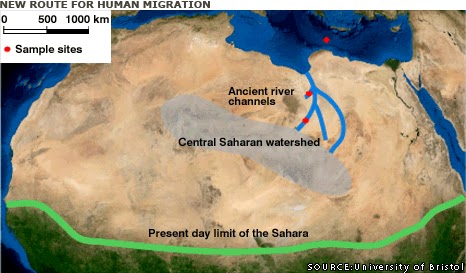
Kushite ruler-priests spread their culture and religious beliefs by the great water systems across what I've termed the ancient "Afro-Asiatic Dominion." During this period the Sahara and Benue Trough were much wetter, allowing for connections between the Atlantic, Lake Chad, Nile, Red Sea, Jordan and the Tigris-Euphrates.

Water systems of ancient Kush
In ancient inscriptions from Africa and Eurasia these Nilotic kingdom builders were called Kushite and sometimes Ethiopian (from the Greek word for black). In Sumerian inscriptions they were called Meluha-Kasi, a designation for peoples who lived in the area of Nubia, Arabia and the Lower Nile.

"The Babylonian designation for Arabia is 'Magan and Meluha' and the two expressions are used distinctively, the one (Magan) to denote the eastern and southern part - that situated nearest to Babylonia, the other (Meluha) to denote the N. and W. The district of Sinai would thus form part of Meluha." (From here.)  So there is textual evidence from antiquity linking Abraham to the Kushites and their early ancestors who lived around Lake Chad and in the Benue Trough.


Friday, August 5, 2011

Was the "Land of Nod" Enoch's Territory?


Alice C. Linsley


Analysis of the genealogical data in Genesis 4 and 5 reveals that Cain and his brother Seth married the daughters of a chief named Enoch. This is the reason for the similarity, indeed the linguistic equivalence of their firstborn sons' names: Enoch/Enosh. The names are the Hebraicized form of the African word anochie, which refers to an heir to the throne. Enoch was a royal title.

The land to which Cain went is called Nod, which is intended to mean "wandering."  Here we have a play on words. The words Nod נוד and Nok נוך are almost identical. This was recognized in 1984 by the Nigerian philologist Modupe Oduyoye. Oduyoye saw a connection between Cain and the ancient metal workers of Nok in the Jos Plateau of Nigeria. (The Sons of the Gods and the Daughters of Men: An Afro-Asiatic Interpretation of Genesis 1-11, NY, Orbis Books, 1984, p. 21.) They appear to be relatives of the metal-working Sudanese Beja.

The evidence suggests that Cain's father-in-law Enoch lived in what is today northeastern Nigeria. Not surprisingly there are places in Nigeria that reference both Kain and Nok.  Kano is a major city and Nok is both a preshistoric site and a recognized cultural sphere of influence. The Nok civilization is dated to about 1200 years ago but has earlier antecedents as evidenced by discoveries in an "increasingly larger area" of Nok influence that includes the Middle Niger Valley and the Lower Benue Valley.

Nod (נוד) is an etymological etiology intended to explain the apparent peripatetic lifestyle of Cain and his metal-working descendants, the Kenites. This sort of play on words is typical of rabbinic writings and suggests that this a later interpretation. It might have been inserted to suggest that Cain's descendants were without territory, but a deeper look reveals that they were associated with rulers over territories from west central Africa to Central Asia.  They worked for influential rulers in the days when the Sahara was much wetter between 8000 and 4500 years ago. At various periods water systems connected the Nile and Central Africa and these river routes were their trade routes.

This places Cain close to Bor'No (Land of Noah) in the region of Lake Chad. This is where Noah probably lived between B.C. 2415-2490 when the Sahara experienced a wet period (Karl W. Butzer 1966). Cain and Seth would have lived between 200 and 300 years before Noah. Noah was a descendant of Seth and Cain, since the lines of Seth and Cain exclusively intermarried. The rulers of their lines are listed in the Genesis 4 and 5 King Lists.


"And Cain went out from the presence of the LORD, and dwelt in the land of Nod, on the east of Eden." (Genesis 4:16)
Walls of Eredo in Nigeria
The western boundary of the Jebusites
According to Genesis, the Land of Nod is located "to the east of Eden" and Cain went there when he was banished after murdering his brother. The Hebrew “nod” means "wandering". Indeed, Cain worried that he would become a wanderer without a homeland of his own, but this did not happen. Instead, Cain married the daughter of a powerful ruler named Enoch (Nok) and built a settlement significant enough to be remembered as a “city” (Gen. 4:17). Cain named that settlement after his son, Enoch. The African equivalent of Enoch is Nok and possibly Nakht. Nakht means powerful in Egyptian (nkht - ruler of the horizon) and applied to rulers such as Pepi-Nakht-Heqaib. In Hebrew this takes the form of the name Hanok or Hanoch, which was the name given to the first-born son of Jacob's first-born son. It appears that the designated heir might be Hanok. The name is connected to the Nok civilization which predates the Chaldeans by 4000 years.

Analysis of the kinship pattern of Abraham’s people, reveals that Kenite chiefs maintained two wives in separate households on a north-south axis. One of Cain’s wives was the daughter of the chief of Nok. She named their first-born son Enoch/Nok, after her father, according to the cousin bride's naming prerogative. Cain's brother, Seth, married another daughter of Nok. Seth's first-born son was named Enosh, which is linguistically equivalent to Enoch/Nok/Nakht. So Genesis tells us that Cain and Seth married into a noble house of metal workers and craftsmen who controlled a territory in northern Nigeria and the region known as Bor-No. Bor-No is the only place on the surface of the earth that claims to be Noah's homeland.

Since Genesis tells us that Cain came to Nok from the west, it is possible to speculate that Cain came to from the region identified with the palace city of Sheba on the Atlantic coast of Nigeria. The photo above was taken of that site, called Eredo. It is the largest ancient monument ever found in Africa with a 72-foot high wall running for 100 miles. If indeed this city is associated with the people of Sheba, the claim that Cain came to Nok from the west was some material support. Sheba was a royal name among Abraham's ancestors. (For more on Eredo go here.)

In Genesis 4:17 we are told that Cain built a city and named it after his son, Enoch. Enoch and Nok are linguistically equivalent names. Directly north of Nok is another settlement associated with Cain, the modern city of Kano. (Cain is spelled with a K in Hebrew.) Before a man could become a chief over a territory he had first to take a second wife. The wives lived in separate households on a north-south axis. One wife resided at the northern boundary of the chief's territory and the other wife resided at the southern boundary. So it is possible to speculate that Cain had two wives. One was the daughter of Enoch, a princess bride. The other was likely his half sister, though she is not mentioned in Scripture.

Nok figurine
Kano and Nok are on a north-south axis, suggesting that Cain's territory may have extended between these two cities which he would have controlled. Likewise, Abraham's two wives lived in separate households on a north-south axis. Sarah resided in Hebron, and Keturah lived in Beersheba, to the south. Terah, Abraham's father, had the same pattern. One wife lived in Haran and the other in Ur, to the south. Terah would have controlled commerce between these two points.

Nok's people originated in the Nile region and his line intermarried with the Nubian rulers who conquered Egypt. Since the ruler-priests among Abraham's people were devotees of Horus whose totem was the falcon or hawk owl, we might consider the ancient Egyptian word for owl m-l-k (See Gabor Takacs, Etymological Dictionary of Egyptian, p. 1). The association of the falcon or hawk owl with Horus is the likely source of the Semitic malk or melek, meaning king. In Hausa, a Chadic language, the words horni and hanu are related. This suggests a possible connection between Horus and Hanoch (Dictionary of Hausa, p. 19).

The etymology of Old Testament names has been interpreted by the rabbis and through the Hebrew language, but Abraham's ancestors lived before Hebrew emerged as a distinct language. Abraham and his ancestors spoke a Nilotic/Kushitic language closer to languages in the Northern Arabic group which included Dedanite, Safaitic and Thamudic B,C and D.


The Jebusites Unveiled

The Jebusites have living descendants whose culture, religious beliefs and kinship pattern can be studied today. This is true of many of the peoples mentioned in the Old Testament. Yet reading some Christian writers one has the impression that there is no anthropological or historical evidence that any of these peoples lived. Let us consider the Jebusites, a people with ancient roots in Africa. This again highlights the value of an anthropological approach to the Bible.

The Jebusites were a Nilotic people originally. Some migrated westward along the connected water systems of central western Africa and settled at the confluence of the Niger and Benue Rivers in Nigeria. Here their rulers controlled the major water ways at the conjunction of the rivers and the Atlantic near modern Lagos. This was documented as recently as 1892 in the New York Times. The New York Times reported on the Jebu control of the water ways of the Port of Lagos. The king of the Jebu levied taxes on all products carried through his territory. This is consistent with the biblical information concerning Abraham’s ruler-priest ancestors who controlled water systems in Nigeria (where Jebu still reside), Canaan and Mesopotamia.

The Jebu also moved eastward into the land of Canaan where Melchizedek, the ruler-prist of Salem (Jerusalem) lived in Abraham's time (Gen. 14:18). Jerusalem was a Jebusite city when David took control of the oldest and highest areas. This is why Abraham payed tribute to Melchizedek and received a blessing from the great ruler-priest (Gen. 14:18-20).

The ancient rulers who controlled water systems in Africa, Arabia and Mesopotamian were Horites and ethnically Kushite. They were devotees of Horus, son of his father Re and his virgin mother Hathor. They spread their religious beliefs along the water systems from ancient Kush to Mesopotamia and beyond. This began about 10,000 years ago when there was a great Kushite migration and the Sahara was much wetter.

Dr. Christopher Ehret explains how the climate caused the movement of three groups of people. He writes, "The initial warming of climate in the Bølling-Allerød interstadial, 12,700-10,900 BCE, brought increased rainfall and warmer conditions in many African regions. Three sets of peoples, speaking languages of the three language families that predominate across the continent today, probably began their early expansions in this period. Nilo-Saharan peoples spread out in the areas around and east of the middle Nile River in what is today the country of Sudan. Peoples of a second family, Niger-Kordofanian, spread across an emerging east-west belt of savanna vegetation from the eastern Sudan to the western Atlantic coast of Africa. In the same era, communities speaking languages of the Erythraic branch of the Afrasian (Afroasiatic) family expanded beyond their origin areas in the Horn of Africa, northward to modern-day Egypt. (History in Africa 3-4)

The Jebusites are classified in the second group, as are the Ashante of Ghana. Asha-nte means “People of Asha” or “People of God.” (Asha, Azu, Asa, and Ashai are words for God in the ancient Afro-Asiatic languages.) The western boundary of the Jebu is marked by a 1000 year old rampart that is 70 feet high and 100 miles long. The British archaeologist Patrick Darling is credited with drawing world attention to the discovery of the Eredo system of walls. He reports, "We are not linking what we found to a city, but to a vast kingdom boundary rampart."

The Eredo walls and ditches are located to the south-west of the Jebu town of Ijebu-Ode in Ogun state in southwest Nigeria. This is the largest single pre-colonial monument in Africa. Local people link the Eredo boundary walls to Bilikisu Sungbo, another name for Sheba, according to Dr Patrick Darling. This discovery confirms the biblical genealogical data that links the clans of Sheba and Jebu.

Today the Jebu (Ijebu) are classified as Yoruba, but the term 'Yoruba' applied only after the Eighteenth Century. The Jebu identify themselves as distinct from other Yoruba peoples and are divided into two groups, the Nago-Jebu and the Ketu-Jebu. These are the biblical Jebusites.

Abraham’s second wife belonged to the Ketu division of the Jebusites as evidenced by her name Ketu-rah. She lived at the well shrine of Sheba (Beersheba). Her name means “the Ketu of Ra” and tells us that she and her people were devotees of the Triad Ra (father), Horus (son) and Hathor (the virgin mother of Horus). Hathor means “the Pure Mother of Hor.”

From study of the Jebu living today we discover that a kingdom is established when the ruler-apparent marries a second wife. This explains Abraham's urgency to fetch a cousin bride for Isaac before his death. Following the marriage and ascendency pattern of the rulers of his people, Isaac would have already had a half-sister wife in Beersheba.

Study of the living Jebusites enables us to trace the origin of certain enthronement practices, such as the use of palm fronds. The two Jebu in Nigeria have two divisions: Jebu Remu and Jebu Ode. The supreme ruler of both is called "awujali” and he is installed with palm branches.

Jude Adebo Adeleye Ogunade writes in his memoir about growing up Ijebu. He was warned not to touch the leaves of the Igi-Ose tree, because as his Mama Eleni explained: “That tree is the tree whose leaves are used to install Chiefs and Kings of Ijebu and as your grandfather was a custodian of the rites of chieftaincy and kingship you must not play with its leaves.” It is interesting that this plant has been found to be a blood purifier. (The University of Oxford, 1937 Institute Paper, no. 7 on Medicinal Plants; reference HA1k).

Fresh palm tree fronds are used ceremonially at the installation of chiefs and kings and are used to decorate places of worship. The association of palm trees (tamars) with rulers and prophets was common among Abraham's people. Deborah sat under a palm tree as a judge and a prophet in Israel.

When the people used palm fronds to greet Jesus as he entered Jerusalem, they greeted him as one to be enthroned. To this very day, the Jebusites use fresh palm fronds when greeting and installing a ruler or a high priest. This supplies the information we need as Christians to better understand who Jesus Christ is. He is our King and our Great High Priest.


Tuesday, August 2, 2011

Sons Who Stayed Home

Alice C. Linsley


Genesis 2: 22-24 speaks of how God fashioned the woman from the man’s rib and brought her to the man who recognized her immediately as bone of his bones and flesh of his flesh. Then we are told “For this reason a man will leave his father and mother, and shall cleave unto his wife and they shall become one flesh.”

The married man is apparently expected to leave his parents and to establish a new household.  For most Westerners this custom is so commonplace that they rarely dwell on the significance of this text. We tend not to respect grown men who stay home, whether married or not.  Stay-at-home sons often compete with their fathers or become "momma's boys." Jacob's stay-at-home son was Reuben and Reuben slept with his father's concubine, Bilhah (Gen. 35:22; 49:4).

When a pastor preaches on Genesis 2:22-24 the emphasis is usually on the nature of marriage between a man and a woman. Some also stress the husband’s independence from his parents as a prerequisite for forming a strong marriage bond. Rarely do pastors note that many high profile men of the Bible didn't adhere to the pattern of living geographically removed from their parents.  Nahor, Isaac and Reuben lived with their parents after marriage, but many of the great heroes of biblical history lived away from their parents. This includes Cain, Abraham, Ishmael, Jacob, Joseph, Moses and even David.

An anthropologist reading Genesis 2:24 finds evidence of the establishment of a new household geographically separate from the husband’s family. This is called “neolocal residence.” Analysis of the marriage and ascendancy pattern of Abraham’s Horite caste indicates that the neolocal pattern doesn’t apply to the firstborn sons of the patriarch’s wives. It applies only to sent-away sons. Sons who did not ascend to the thrones of their fathers or maternal grandfathers were sent-away sons.  Most sons of concubines were sent away. The firstborn sons of concubines often served as vassals of the firstborn sons of wives and these remained geographically close to the ruling sons.

An anthropologist sees another possibility in Genesis 2:24. “Cleaving to the wife” could suggest “matrilocal residence.” In this case the newly married couple would live with or in close proximity to the bride’s family. This would pertain to the firstborn son of the patriarch’s second wife. This son was the heir of his maternal grandfather, after whom he was named, and he would live with or near his mother’s people. So Abraham's firstborn son by his second wife belonged to the household of Joktan, Keturah's father, after whom he was named.

Genesis 2:24 implies that the preferred marriage arrangement was not “patrilocal residence.” This seems strange given the insistence of most Bible scholars that ancient Hebrew society was patriarchal. Only the firstborn son of the first wife lived with his parents as his father’s heir. This is why Isaac remained with his father. This also explains why Abraham gave gifts to his other sons and sent them away from Isaac (Gen. 25:6).

Genesis 2:24 pertains to sons who lived away from their biological fathers. This includes “sent-away sons” and the firstborn son of the patriarch’s second wife. Jacob's case is especially interesting. He was not Isaac's firstborn son and though he attempted to rob that birthright from Esau, Jacob established his residence with his mother's people. This suggests that Jacob and Esau may not have been twins.  They may have been Isaac's firstborn sons by different wives.  Esau was the firstborn of Isaac's first wife who would have been Isaac's half-sister. Jacob would have been the firstborn son of Isaac's second wife.  As the second wife was either a cousin or niece, as was Rebecca to Isaac, Jacob would have been Rebecca's firstborn son. As such he would belong to the household of his maternal grandfather, Bethuel.  However, this doesn't mean that Jacob was heir to Bethuel's throne in Padan-Aram.  Bethuel's heir appears to have been Laban.