Monday, January 30, 2012

Enns Casts Evangelicals as Anti-Darwin


I recently read this article by Peter Enns and, while I agree with much that he says, his premise - "If evolution is right about how humans came to be, then the biblical story of Adam and Eve isn't." - is false and misleading.  Enns needs to learn the facts about human origins.

One wonders what Enns means by the terms "evolution" and "Evangelical" and does he recognize that Evangelicals who hold an evolutionary view of human origins are equally guilty of imposing a foreign notion on the ancient text?  The Biologos crowd, with which he is associated, is characteristic of that position.

Then there is the evidence of molecular genealogy which supports the biblical assertion that humans appeared suddenly and unheralded in East Africa (the point of origin of Abraham's ancestors) many thousands of years ago. When Enns speaks of Adam and Eve as first humans he should clarify that this story comes from Abraham's Nilotic ancestors and is about their first parents who they believed to have a red skin tone (adam, edom, dam - red).


Peter Enns


Evangelicals have been butting heads with evolution for 150 years. A lot is at stake.

If evolution is right about how humans came to be, then the biblical story of Adam and Eve isn't. If you believe, as evangelicals do, that God himself is responsible for what's in the Bible, you have a problem on your hands. Once you open the door to the possibility that God's version of human origins isn't what actually happened -- well, the dominoes start unraveling down the slippery slope. The next step is uncertainty, chaos and despair about one's personal faith.

That, more or less, is the evangelical log flume of fear, and I have seen it played out again and again.
In recent years, the matter has gotten far worse. Popular figures like Richard Dawkins have done an in-your-face-break-the-backboard-slam-dunk over the heads of defenders of the biblical story. They've taken great delight in making sure Main Street knows evolution is true, and therefore the Bible is "God's big book of bad ideas" (Bill Maher) and Christians are morons for taking it seriously.

Evangelicals have been on high alert damage control mode.

Then you have the mapping of the human genome. It's a done deal: humans and primates are 90-something percent related genetically. The best explanation for it, geneticists tell us, is that humans evolved from primates. Since my greatest scientific achievement is doing puppet shows with dissected feral cats in high school biology, I feel I have no right to contest -- and I likely speak for many other evangelicals in that regard (sans puppet show). And it doesn't help things that an evangelical, Francis Collins, was the one who pointed all this out, got the Presidential Medal of Honor for it, and talked about it (twice) on "The Colbert Report."

If that wasn't enough, evolution is being used nowadays to explain all sorts of things about us humans -- including why we believe in God. If God is a product of evolution, like bipedalism and tool making, well, the jig's up (and not just for evangelicals).

Evolution is a threat, and many evangelicals are fighting to keep Adam in the family photo album. But in their rush to save Christianity, some evangelicals have been guilty of all sorts of strained, idiosyncratic or obscurantist tactics: massaging or distorting the data, manipulating the legal system, scaring their constituencies and strong-arming those of their own camp who raise questions.

These sorts of tactics get a lot of press, but behind them is a deeper problem -- a problem that gets close to the heart of evangelicalism itself and hampers any true dialogue.

It has to do with what evangelicals expect from the Bible.

Evangelicals look to the Bible to settle important questions of faith. So, faced with a potentially faith-crushing idea like evolution, evangelicals naturally ask right off the bat, "What does the Bible say about that?" And then informed by "what the Bible says," they are ready to make a "biblical" judgment.

This is fine in principle, but in the evolution debate this mindset is a problem: It assumes that the Adam and Eve story is about "human origins." It isn't. And as long as evangelicals continue to assume that it does, the conflict between the Bible and evolution is guaranteed.

Since the 19th century, through scads of archaeological discoveries from the ancient world of the Bible, biblical scholars have gotten a pretty good handle on what ancient creation stories were designed to do.

Ancient peoples assumed that somewhere in the distant past, near the beginning of time, the gods made the first humans from scratch -- an understandable conclusion to draw. They wrote stories about "the beginning," however, not to lecture their people on the abstract question "Where do humans come from?" They were storytellers, drawing on cultural traditions, writing about the religious -- and often political -- beliefs of the people of their own time.

Their creation stories were more like a warm-up to get to the main event: them. Their stories were all about who they were, where they came from, what their gods thought of them and, therefore, what made them better than other peoples.

Likewise, Israel's story was written to say something about their place in the world and the God they worshiped. To think that the Israelites, alone among all other ancient peoples, were interested in (or capable of) giving some definitive, quasi-scientific, account of human origins is an absurd logic. And to read the story of Adam and Eve as if it were set up to so such a thing is simply wrongheaded.

Reading the biblical story against its ancient backdrop is hardly a news flash, and most evangelical biblical scholars easily concede the point. But for some reason this piece of information has not filtered down to where it is needed most: into the mainstream evangelical consciousness. Once it does, evangelicals will see for themselves that dragging the Adam and Eve story into the evolution discussion is as misguided as using the stories of Israel's monarchy to rank the Republican presidential nominees.

Evangelicals tend to focus on how to protect the Bible against the attacks of evolution. The real challenge before them is to reorient their expectation of what the story of Adam and Eve is actually prepared to deliver.

These kinds of conversations are already happening, though too often quietly and behind closed doors. Evangelicals owe it to their children and their children's children to bring the discussion out into the open.

From here.


Related reading:  Biblical Anthropologist Discuss DarwinQ and A on Creation and Evolution; Christians Debate Genesis and Evolution; Is Genesis Really About Human Origins?; Genesis and Genetics; Parsing Genesis 1:1-2; A.S. Haley Series: Did Adam and Eve Exist?; Science Teachers and Creationism; Brief Overview of Human Origins

Saturday, January 28, 2012

Genesis as Ecological Ethics

Alice C. Linsley


A friend recently asked my opinion of a course on Genesis being offered at Pittsburgh Theological Seminary by Professor Jerome Creach.  It is a lecture series on "Genesis and the Moral Imagination" and the recommended text is Terence Fretheim's God and World in the OT: A Relational Theology of Creation, Abindgon, 2005.

Before I offer my opinion, I should preface it with a note to those who don't know me very well. 

I am an old curmudgeon and care less what people say, especially when they make unsubstantiable claims such as "women make better priests" or "Abraham was the first Jew."  I either leave them to their nonsense or I ask them to substantiate their claims. I'm not interested in arguing with them. 

Leon Kass wrote a rather comprehensive book from the Jewish perspective on Genesis and ethics. If that is the angle one wishes to take, I recommend his book, The Beginnings of Wisdom. Kass sees the overarching theme of Genesis as God's effort to create a human society that will practice justice and mercy.  It is no surprise that Christ is not found anywhere in the book and Messianic expectation is of little concern.

Professor Creach, on the other hand, is a Christian (Prebyterian).  Surely in his class students will find Christ at the heart of Genesis.  One would hope!  However, his take is not distinctly Christian, as far as I can tell.  Here is the course description:

"This study of the book of Genesis will explore some of the Bible's most popular stories..."

I take this to mean that the class will not look at the latest anthropolgical research confirming the historicity of Genesis. The focus will be on narrative and meaning.  If one wishes to take this approach, Robert Alter's Genesis and his The Art of Biblical Narrative are unsurpassed.

The course will focus on "moral and ethical concerns" such as "care for the natural world and the maintenance of justice." In other words, Creach will play it safe with the politically correct reading of Genesis which entirely misses the point of the book as a narrative about the origins of Messianic expectation among Abraham's ancestors.

Personally, I wouldn't be the least interested in this course. It would annoy me, but as I said, I'm an old curmudgeon.


Related reading:  Jesus Christ's Resurrection in Genesis; Jesus Christ, The Son of God; Jesus Christ in Genesis; The Kingdom of God in Genesis; Tracing Christ's Kushite Ancestors; The Christ in Nilotic Mythology; Genesis and the True Meaning of Christmas

Thursday, January 26, 2012

The Amorites: a caste of royal scribes?

Alice C. Linsley


Egyptologists Flinders Petrie and Assyriologist Archibald Sayce believed that the Amorites (Amurru) were white, with blue eyes and fair hair. According to Sayce (The Hittites, 1889):

The Amorites… were a tall, handsome people, with white skins, blue eyes and reddish hair, all the characteristics, in fact, of the white race.

The Amorites lived in ancient Egypt. According to Sayce, tomb No. 34 at Thebes, belonging to the Eighteenth Dynasty (c. 1550-c. 1292), illustrates a bearded Amorite chief with white skin and red-brown hair. This is long after the earliest evidence of Amorites in Genesis 10:16, but corresponds to the earliest known written communications.

Henry George Tomkins (1897), a member of the Royal Archaeological Institute wrote that the Amorites were blue eyed and fair haired.

Easton’s Bible Dictionary states the Amorites are “represented on the Egyptian monuments with fair skins, light hair, blue eyes, aquiline noses, and pointed beards.”

My guess is that the Amorites were Am-Ar, meaning the people/tribe/caste of Ar. Today we call them Aryans. Their name appears in the titles of many of their rulers. Some variations include Ar-Shem, Arsames, Artix, and Araxes, and all of these are named in historical texts.

Clearly, Aryans lived in the Nile region well before Abraham’s time. DNA studies indicate that the Nile Valley of East Africa had a population with greater genetic diversity than anywhere on earth. Genesis 10 does not tell us about all the human populations before and after Noah. There were many peoples and significant migrations of peoples 70,000 and 100,000 years ago, long before Noah.  However, the name Ar doesn't appear in the Genesis king lists until four generations after Noah. Consider the following:

B.C. 2490-2415 – Noah, lived when the Sahara experienced a wet period (Butzer 1966)
B.C. 2438-2363 – Ham, son of Noah by his cousin-wife
B.C. 2417-2342 – Kush/Cush, son of Ham by his half-sister (?) and the father of Nimrod and Raamah
B.C. 2290-2215 - Nimrod, probably “Sargon the Great
B.C. 2238-2163 - Arpacshad, son by Asshur's daughter. (Shad means happy.)
B.C. 2217-2042 - Salah, likely Arpacshad's son by his sister-wife
B.C. 2196-2121 - Eber, likely Salah's son by his sister-wife
B.C. 2175-2100 - Peleg, likely Eber's son by his sister-wife. Peleg's brother was Joktan the Elder.

Arpachshad, Salah, Eber, Peleg and Joktan would have lived during the 9th and 10th Dynasties between 2445–2160 B.C. The name Ar is found in the names of biblical places, such as Wadi Arnon. Ar-non (originally Ar-nxn) means the Ar of Onn/Heliopolis. Here we find a connection between Abraham's Annu ancestors of Onn and the Amorites.


The Amorites: Aryan Canaanites?

Genesis 10:16 and 1 Chronicles 1:13-14 mention the Amorites in connection with the Canaanites. The Arvadites (residents of Arvad) and Arkites (Gen. 10:15-18) appear to be related to the Amorites. They are peoples of Sidon and also classified as Canaanites.


During Abraham's time, the Amorites were centered in Engedi, a large oasis on the western shore of the Dead Sea bounded on the south by the Wadi Arnon. They apparently considered the Arnon a natural boundary because they eventually forced the Moabites south across the river.

Genesis 10 maintains that the Amorites are descendants of Noah by his great grandson Nimrod who, though himself a Kushite, lived in Mesopotamia. Clearly the Amorites had been living among and marrying Abraham’s Kushite ancestors.


The Amorites: a caste of ruler-scribes?

There are linguistic clues as to the Am-Ar’s identity as a scribal caste. Arsh means “throne” in Arabic, suggesting a connection to the royal house. Among the Igbo, the scribe clans are called Ar or Aro. It appears that the Am-Ar were a caste of ruler-scribes, just as the Horites were a caste of ruler-priests. This is further evidence that the archaic world had a caste structure and marriage within the ruling castes was endogamous.

Israelites associated by their names with the Am-Ar include Aroch (1 Chr 7:39, Ezra 2:5, Neh 6:18, Neh 7:10) and Ariel (Ezr 8:16, Isa 29:1, Isa 29:1, Isa 29:2, Isa 29:2, Isa 29:7). Ariel means “scribe/messenger of God.” So it appears that the Am-Ar were scribes and royal messengers. This is further suggested by the name Ar-vad. Vad means “to speak” in Sanskrit.

The association of the name Ar with the scribal caste is further demonstrated by the discovery of Aramaic scrolls from the satrap Arsames to his Egyptian administrator Psamshek and to an Egyptian ruler named Nekht-hor. (A.T. Olmstead, History of the Persian Empire, Chicago, 1948, pp.116-117)

The alphabetic inscriptions from the Wadi El-Hol in Egypt date between 1800 and 2000 B.C. and provide some of the earliest evidence for the development of the alphabet that would have been known to the Am-Ar. Concerning this find, Dr. John Coleman Darnell (Yale University) has stated, “These are the earliest alphabetic inscriptions, considerably earlier than anyone had thought likely."

The inscriptions were found at Mount Tjauti, where caravan routes converge about 25 miles northwest of Luxor and about 250 miles south of Cairo. The Farshut Road, or the “Road of Horses,” departs Thebes north of the Valley of the Kings, crosses the high plateau between Mount Antef and Mount Roma and descends at the Wadi el-Hol.  This is a very ancient commerce route, possibly established by King Menes who was the first to unite into a single empire the regions of the Upper and Lower Nile. Menes was called Ahauiti and Mount Tjauti was likely named for him.  His territory was called Tjenu. The earliest evidence of Tjenu as a ruled territory dates to 4000 B.C. Royal scribes and messengers would have traveled this route.

We find further association between Ar and the royal name Auti in the region of Arachosia, which corresponds to the Aryan land of Har-auti.  Har refers to Horus.

Dr. Catherine Acholonu writes, "The Igbo Ar/Aro are the scribes of the Igbo God Ele/El (Chukwu Abiama) who dwells in the southern extension of the Underground Duat called the Long Juju. They were and are still proficient in various kinds of ancient scripts called Akwukwo Aka Igwe, and Nsibidi which has many Sumerian pictographs and Egyptian hieroglyphics and has been said to be older than 5000 yrs. Sumerian pictographs were in use by 3500 BC. That shows how old Nsibidi is. It has been called the oldest writing system in Africa. The Aro were originally the military arm of the Eri clan of Priest-kings who were the first Pharaohs of Egypt and the first kings of the world. They were charged with guarding the Great Serpent's Shrine called ARO BU N'AGU."

The Ar venerated the serpent. The metal working Nes of Anatolia who venerated the serpent are likely related to the ancient scribes of old Nsibidi. In ancient Egypt Nesu biti referred to the ruler of a united Upper and Lower Nile.


Related reading:  The Peoples of Canaan; The Genesis King Lists; The Clans of Ar; Afro-Arabian versus Aryan Religion: the horse as example

Tuesday, January 24, 2012

Parsing Genesis 1:1-2

Alice C. Linsley


"Fee al-badi' khalaqa Allahu as-Samaawaat wa al-Ard . . . "

Genesis 1:1 - Arabic Bible


Genesis 1 should be considered in the context of Abraham's African ancestors from whom we received this amazing account. The elements of Genesis 1 align very closely with the creation accounts of African peoples who live in the Nile region or who migrated away from the Nile.  The correlation of theme, language and device is much closer to the African than to the Babylonian stories. The theology expressed is also distinctly African, as will be demonstrated in this parsing of Genesis 1:1-2.

In the beginning God ....
God was at the beginning. The Creator pre-existed eternally and is not constrained by time and space, as are creatures.

The phrase "In the beginning God" is common in African creation stories and songs, such as this song of the Mbuti Pygmies:

In the beginning was God
Today is God,
Tomorrow will be God.
Who can make an image of God?
He has no body.

God created the heavens and the earth ...
Both the heavens and the earth are created entities which owe their existence to God, the Creator. No other gods shared in the act of creation.

"I cast a spell with my own heart to lay a foundation in Maat. I made everything . I was alone. I had not yet breathed the divine one Shu, and I had not yet spit up the divine one Tefnut. I worked alone." (Egyptian)

Maat is the principle or platform whereby God orders the universe.  In the Psalms the principle is often called "wisdom" by which God orders all things.  The principle of Maat includes equilibrium and harmony between constituent parts, the cycle of the seasons, celestial and planetary movements, honesty in social and business interactions and justice. There appears to be a relationship between Maat and Tehut, just as there is a relationship between the watery chaos and Tehom.

The victory of Tehut (order) over Tehom (watery chaos) relates to the annual inundation of the Nile and helps us to understand the Egyptian concept of creation as a mound emerging from a primal ocean (mer). The first life form was a lily, growing on the peak of the emerging dry land called Tatjenen. This is symbolized by the rising pyramid along the Nile.

Compare this theology to the Babylonian "Epic of Creation" in which Marduk is created to defend the divine ones from attack by the sea goddess Tiamat. Marduk offers to save them on the condition that he be appointed their permanent ruler. The gods agree to Marduk's terms. Marduk kills Tiamat and from her corpse, which he cuts into two parts, he fashions the earth and the skies.


The earth was formless (tohu) and void/empty (bohu) ...
The formlessness of the earth could have more than one meaning. It may simply mean that God had not yet created the material world. However, the ancient Nilotic peoples may have been thinking metaphysically, that is to say, that God had not yet created the Forms or archetypes of which created forms are the shadow or reflection. Whatever is meant by formless, there was nothing on earth. This is conveyed in this account:

At the beginning of Things, when there was nothing, neither man, nor animals, nor plants, nor heaven, nor earth, nothing, nothing, God was and He was called Nzame. (Fan / Congo)
Boshongo

Darkness was over the surface of the deep ...

Darkness and chaotic waters are commonly associated with the beginning of creation.  This is expressed in the following African creation stories.

"In the beginning there was only darkness, water, and the great god Bumba." (Bantu / Central Africa)

"There was no sunlight... the whole land was in darkness." (Gikuyu / Kenya)

"In the beginning there was only the swirling watery chaos."  (Egyptian)


The Spirit of God was moving over the waters (·ra·ḥe·peṯ, Egyptian origin) ...
The Spirit (ruach) of God moved over the dark waters.  The ruach of God is the breath of life.  This  concept is found in Genesis 2:7: "the Lord God formed the man from the dust of the ground and breathed into his nostril the breath of life and the man became a living being."


In the image above a dead Egyptian receives the breath of life flowing over a sail.  The sail was associated with Ra's solar boat which rises after dying at the end of the day. By the wind/breath/spirit of the Creator, the deceased may enjoy life beyond the grave and avoid the second death. The Egyptians believed in the resurrection of the body and prayed for, offered sacrifice for and prepared the bodies of their dead in this hope. The African bishop Saint Augustine wrote "that the Egyptians alone believe in the resurrection, as they carefully preserved their dead bodies." ("Death, burial, and rebirth in the religions of antiquity", Jon Davies, Routledge, 1999, p. 27)


Related reading:  Genesis One Sets the Scene; The Christ in Nilotic Mythology

Wednesday, January 18, 2012

Genesis and Molecular Genealogy


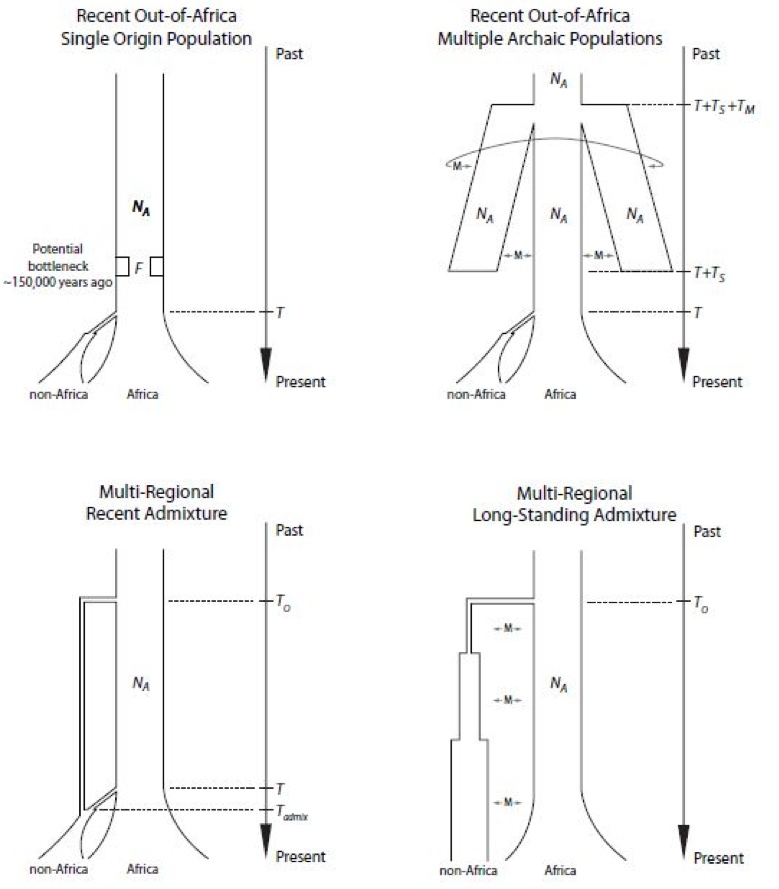
There are five scenarios to explain the current distribution of human populations. They can be seen in the figures below.

Source: http://arslanmb.org/ArmenianDNAProject/screenshot-38.jpg


Explanation of Molecular Genealogy Models

1. Recent out of Africa: Single Origin Population model
In this model, humans are a young species that underwent a bottleneck, and Eurasians are descended from a group of Africans that migrated out of Africa. This model has been criticized for its inability to explain deep divergence in autosomal DNA (atDNA). Autosomal DNA is a term used in genetic genealogy to describe DNA which is inherited from the autosomal chromosomes.  Each set of autosome is received from your mother and your father.  Their atDNA was received from their parents and their grandparents, these becoming more disjointed with each generation since most people no longer marry close kin.  Within endogamous groups such as Abraham's Horite people, the disjunction is considerably less, and depending on the mating structure, may be preserved quite well.

In this model, the African Eve, traced by mitochondrial DNA, lived 170,000 years ago while the African Adam, traced by Y-chromosome DNA, is believed to have lived 100,000 years ago. 

The Y-chromosone determines gender and is passed virtually unchanged from father to son. The mutation rate is very slow so the Y-chromosone can be used to trace lineage back many generations. 

Mitochrondrial DNA (mtDNA) passes from mother to daughter from generation to generation with very little change and is therefore a rich source of information for those studying deep ancestry. The Horites married only Horite women, so Horite ancestry can be traced by mitochondrial DNA. As Horite rulers married half-sisters and patrilineal cousins or nieces, there would be considerabe genetic stability. This stability was valued because the Horites expected God's Son to be born of their ruler-priest caste which practiced endogamy.

Mitochondrial Eve’s line will not die out because mitochondrial DNA is passed down to both male and female offspring. On the other hand, Y-Chromosomal Adam's line will not be the same at any point in history due to the fact that male lines can die out. When this occurs, a more recent ancestor becomes the new “Adam.” The most recent common male ancestor is believed to have lived 100,000 year ago.


2. Recent out of Africa: Multiple Archaic Populations model
This model is advocated by those who believe that modern humans evolved from ancestors common to modern humans and other archaic humans (hominins), some of whom became extinct.

Dienekes Pontikos holds this view but mainains that the mating structure of the African population indicates isolated long-standing subpopulations.  In this view, Eurasians are Afro-Asiatics who descend from one of these African subpopulations. The variants that have deep origins are presumed to have evolved separately in different African subpopulations and entered the modern gene pool after unstructured mating (panmictic) became more common.

Anthropological and archaeological discoveries support the recent Out-of-Africa view for modern humans, but don't support the view of separated archaic humans who became extinct. This view lacks physical evidence that the theorized extinct hominids were unlike modern humans.  This has been shown to be false by paleontologist Jeremy DeSilva and others.

DeSilva compared the ankle joint, the tibia and the talus fossils of human ancestors between 4.12 million to 1.53 million years old, he discovered that all of the ankle joints resembled those of modern humans rather than those of apes. Chimpanzees flex their ankles 45 degrees from normal resting position. This makes it possible for apes to climb trees with great ease. While walking, humans flex their ankles a maximum of 20 degrees. The human ankle bones are quite distinct from those of apes. Read about DeSilva’s research here.

Further, the discovery of a complete fourth metatarsal of A. afarensis at Hadar that shows the deep, flat base and tarsal facets that "imply that its midfoot had no ape-like midtarsal break. These features show that the A. afarensis foot was functionally like that of modern humans." (Carol Ward, William H. Kimbel, Donald C. Johanson, Feb. 2011) Read the report here.

Multi-Regional: Recent Admixture model
This view agrees on the recent African origin of modern humans, but maintains a place for long isolated pre-existing Eurasian populations who contributed some of their mtDNA to modern humans. Multiregionalism posits that the descendants of  H. erectus evolved into Neandertals, Denisovans, and modern humans in different regions. Populations coming from Africa mingled with the other groups and modern humans emerged.

This model presumes two variants with deep common ancestry stemming from the separated Eurasian and African strains. This model has found support by analysis of the Neandertal genome. However, recent studies have revealed that only 2–3% of the genome of non-Africans might come from Neanderthals.  Further, some believe that Neandertal introgression into Eurasians can be explained by the Multiple Archaic Populations in Africa model.


Multi-Regional: Long Standing Admixture model

In this view Africa is the point of origin of human Y chromosomes and mtDNA and separation took place about 150,000 years ago. Modern humans are descended from populations from around the world between which there has been gene flow. This model explains divergence, but does not offer an explanation for the African origin of the uniparental markers, the evidence for the appearance of anatomical modernity in East Africa and the evidence for less genetic variation in Eurasia with increasing distance from East Africa. 


Ancestral Bottleneck model
This view is proposed by Blum and Jakobsson, who speculate a bottleneck 150,000 years ago in an ancestral structured population. This model combines elements of the Single Origin Population model and the Multiple Archaic Populations model. It hypothesizes a single origin model for extant humans and allows for the possibility of structure in Africa prior to the bottleneck.  The breakdown of structured mating is set before the bottleneck. 

Blum and Jakobsson write, "Through the analysis of a public DNA sequence database, we find, similar to previous estimates, that the common ancestors of autosomal and X-linked genes are indeed very old, living, on average, respectively 1,500,000 and 1,000,000 years ago. However, contrary to previous conclusions, we find that these deep gene genealogies are consistent with the Out-of-Africa scenario provided that the ancestral effective population size was approximately 14,000 individuals. We show that an ancient bottleneck in the Middle Pleistocene, possibly arising from an ancestral structured population, can reconcile the contradictory findings from the mitochondrion on the one hand, with the autosomes and the X-chromosome on the other hand."                 

In other words, they support the view that the earliest human populations were in Africa and had a mating structure that preserved a genetic identity until about 130,000 years ago. The hand axe is the most common artefact of these early East African and "Old World" peoples.


Which of these views aligns with Genesis or does Genesis suggest yet another possible model?

What do you think?

Tuesday, January 17, 2012

Abraham, Descendant of Both Shem and Ham


A reader has asked this question: "Alice, I read your post about Horites. Fascinating and very helpful. In my reading, I understand that Abraham is a descendant of Shem (Genesis 11). Can you explain how he is a descendant of Ham?  Thanks!

Francien
 

Francien asks a question which is often posed to me, usually through email contacts.  He has read Genesis 11 and concluded that Abraham is a descendant of Shem only.  This is a common error.  All the genealogical data in Genesis is related so we must look at all of it, not simply one section.

Abraham's ancestors and descendants were related by both blood and marriage.  The clans intermarried (endogamy) and the rulers of the clans married according to a structure which is made evident in analysis of the Genesis King Lists found in chapters 4, 5, 11 and 36 with additional information in Genesis 10 and 22:20-24. Analysis of all the data makes it clear that Abraham was a descendant of both Shem and Ham.


Before Ham and Shem, the lines of Cain and Seth intermarried also. These were ruler-priest lines, so the Genesis King lists speak of the marriage and ascendency structure of the Horites.


The marriage structure of the Horite rulers involved two wives living in separate households. One wife was a half-sister (as was Sarah to Abraham) and the other wife was a patrilineal cousin or niece (as was Keturah to Abraham).

The brides were the daughters of ruler-priests. They contributed the mtDNA and their ruler husbands contributed the Y chromosome since males who share a common patrilineal ancestor also share a Y chromosome, diverging only with respect to accumulated mutations. The distinctive Kohan DNA or "priest marker" is identifiable because Horite priests married daughters of priests exclusively. 

In 1995, Canadian nephrologist Karl Skorecki designed an experiment to find out whether the descendants of the ancient Jewish ruler-priest - kohamim - could be verified by genetics. Skorecki reasoned that Jewish males who claim to be kohanim should have an identical set of marker mutations that trace back to biblical times. So the researchers gathered saliva from 200 Jewish males, a third of whom identified themselves as kohanim, at the Western Wall during the High Holidays. No matter whether they were Sephardic, Ashkenazic, or Oriental Jews, 98.5% of those who said they were kohanim shared a genetic marker for a common male ancestor.

Were the same sort of study done of Arabs who descend from Abraham's Horite line by his firstborn son Joktan, it is likely that this same genetic signature would be found in at least 3% of the Joktanite population of Arabia.

In 1996, a more extensive study found a set of marker mutations common to approximately 60% of self-proclaimed kohanim. Using complex mathematical calculations the research team identified the Cohan Modal Haplotype (CMH), a series of six genetic markers common to the kohanim which originated more than 3,000 years ago.

It is evident from Genesis that the ruler-priests (Horim/Horites) originated well before 3000 years ago. Aaron and his half-brother Korah were not the first ruler priests. Their father Amram was a ruler-priest and the descendant of a long line of ruler-priests who can be traced to at least 6000 years ago (4000 B.C.).


DNA studies confirm that the Horite ancestors of the priests of ancient Israel did marry exclusively within the priestly divisions/lines, which is what analysis of the Genesis genealogical material shows. This is the ancestry of Jesus Christ who was born to Mary, the wife of Joseph, both in the ruler-priest lines.


Related reading:  The Daughters of Horite Priests; Moses' Wives and Brothers

Thursday, January 12, 2012

A Kindling of Ancient Memory


Alice C. Linsley


I've been corresponding with a descendant of the Annu (Ainu) people who migrated thousands of years ago to Newfoundland and Labrador and to the eastern coast of Canada. My correspondant's native name is Sea’Key (the ’ is a little click made with the tongue.)  His name means White Salmon with a Heart of Gold.  He has been very generous with his time, sharing many accounts of his people's history.

He writes, "We are called MicMac now but early we were called the Beothique by the French and Beothuck by the English. Our people are said to be extinct, but we just left when the shooting started. A few 100 French did not wipe out 10,000’s of natives. It is said we migrated in 2 waves to Nova Scotia and Labrador."

MicMac means friend.  The early name of the territory of Sea'Key's people was Khan O Dan, or Can a dan, which became "Canadian" to the French. Sea'Kay reports that according to the oral tradition of his people, they came in two waves from the Middle East to Scandanavia, then to Greenland and to the Hudson Bay area of Eastern Canada.

His people are in mtDNA haplogroup X. The dispersion of haplogroup X is shown below. The greatest concentrations are indicated by the darker shade. MtDNA traces lineage by the mitochondria, received from the mothers.


The heaviest concentration of mtDNA haplogroup X is in Eastern Canada which is where Sea’Kay lives. The estimate is upwards of 55% in some tribes and averages at around 25%. The next highest concentration, about 40%, is found in the Druze population.

Only 7% of the Dene (Navajo) are in haplogroup X. Their language has been connected to Ket, a Yeniseic language spoken by a very small Siberian population. However, haplogroup X is virtually non-existent in Siberia, the land route to North America proposed by some anthropologists.

The genetic sequences of haplogroup X diverged from haplogroup N which originated in the region of the Lower Nile. Haplogroup X diverged further about 30,000 years ago with two sub-groups X1 and X2 now identified. Overall haplogroup X accounts for about 2% of the population of Europe, the Near East, and North Africa.

Sub-group X1 is restricted to North and East Africa, and also the Near East. Sub-group X2 appears to have undergone population expansion and dispersal after the last glacial maximum, between 21,000 and 18,000 years ago. Sub-group X1 is more strongly present in the Near East, the Caucasus, and Mediterranean Europe. There are concentrations of sub-group X2 in Georgia (8%), the Orkney Islands (7%) and amongst the Israeli Druze (27%), most of whom live in Galilee.
 
According to the Greenland Saga, Sea'Kay's ancestors used bows and arrows.  These weapons characterized the Ainu of the Nile whose land was called Ta-Seti which means "land of the bow."  The name of the biblical ruler Seth is related.

The Ainu migrations are not shown on the Bradshaw Foundation maps of migration out of East Africa. However, the Ainu are at the center of Cavalli-Szforza's Genetic Distance Chart, which is what would be expected of "First People." Ainu is also spelled Annu and Hannu.

Nyland (2001) found that many names of places and common objects in Hebrew are closely related to the Saharan proto-languages, the languages spoken by Abraham's Kushite ancestors.

If the mating structure of the Ainu rulers is the same as the structure of the Horites - which it appears to be, as Terah, Abraham's father, is associated with the Nilotic Annu and he was a Horite - then the expansion and dispersion of Haplogroup X can be explained in part by their marriage and ascendency pattern whereby younger sons were sent away to establish territories for themselves.

The Kushites were great explorers and kingdom builders. Their migration out of the Nile region has been confirmed through DNA and migration studies.  Though we first meet Abraham in Mesopotamia (Gen. 12), he is a descendant of Nimrod, the son of Kush (Gen. 10:8), who built a kingdom the length of the Euphrates.

Among the Kushites there was a caste of ruler-priests known as Horites. They are called "Horites" because they were devotees of Hor (Horus in Greek). The oldest temples dedicated to Horus have been located in modern-day Sudan at Nekhen.  From here the Horites spread their religion across the ancient Afro-Asiatic Dominion. This Dominion extended from present-day Benin to India, China and Cambodia.  There is little doubt that ancient Nilotic peoples, including the Annu, were masterful seamen and traveled widely. It is also evident that they didn't all migrate the same direction or at the same time.

The Horites named in Genesis 36 called their land Edom, which means red. David, one of their descendants, is said to have had a red skin tone. The red skin tone was enhanced by exposure to the sun.  The red tone represented the ruler as the servant of Ra, whose emblem was the sun. The queen made herself white to represent the moon.

Predynastic Egyptians varied in appearance.  Eye colors included blue, gray, green and brown, and some men wore full beards while others were beardless. The typical Egyptian had a reddish skin tone. Nubians ranged from light brown to black. Many had a dark reddish-brown skin tone.


Ancient Egyptians reflect a greater genetic diversity than is found outside the Nile Valley. 

As Sea'Key recently called to my attention, there is a close correlation between the Hebrew alphabet and the Japanese alphabet. Likely this is because both are based on the older writing system of the Ainu.

This is how Sea’Key describes his people: "We have beards and green eyes and we are very tall, between 6’ and 6’6”. " Here is an image of one of his ancestors (shown left).

The Ainu were the first settlers of Japan.  They were said to appear more Caucasian than Asian.

On the right is an image of an Ainu elder from Hokkaido Japan. Compare to the photo (left) of one of Sea'Kay's ancestors.  Note the similar robe designs and headdresses. Note also the reddish skin tone of the Ainu elder. 


Tuesday, January 10, 2012

No Kingdom by Deception

Alice C. Linsley


According to Genesis 25, Esau sold his birthright because he did not value it as much as he valued his stomach. This preaches well as an object lesson for those who aspire to be children of God, but is this a proper application of this passage?

Let's look closely at the text.

29 Once when Jacob was cooking some stew, Esau came in from the open country, famished. 30 He said to Jacob, “Quick, let me have some of that red stew! I’m famished!” (That is why he was also called Edom.)

31 Jacob replied, “First sell me your birthright.”

32 “Look, I am about to die,” Esau said. “What good is the birthright to me?”

33 But Jacob said, “Swear to me first.” So he swore an oath to him, selling his birthright to Jacob.

34 Then Jacob gave Esau some bread and some lentil stew. He ate and drank, and then got up and left.
So Esau despised his birthright.

What did Esau exchange for a pot of red porridge? What is meant by the term birthright?

The word rendered "birthright" in English is b'khora in Hebrew.  It is composed of the words barak and khora.  Barak means "blessing" in Hebrew, Arabic and Ancient Egyptian and khora refers to the Horite priesthood.

One of Moses' brothers was named Korah, meaning shaved one.  Horite priests shaved their bodies. So the birthright pertained to the Horite ruler-priests which was passed from father to the firstborn son of the ruler's half-sister wife and from maternal grandfather to the firstborn son of the ruler's cousin/niece wife.  Korah was a direct descendant of the Horite ruler Seir.


As the twin sons of Isaac's cousin wife, neither Esau nor Jacob were in line to inherit Isaac's territory. By Horite custom, the firsborn son of the cousin wife was heir to the territory of his maternal grandfather. So the birthright from Isaac was not Esau's to sell to Jacob.  There are some serious textual difficulties here.

As the firstborn of Isaac's cousin bride, Esau would be heir to the territory belonging to Rebecca's father. Part of the terrriotry was Padan-Aram.  Padan-Aram is where Jacob was sent by his parents after the first deception failed. There Jacob married two wives.  His wife Rachel stole the teraphim in an attempt to claim her father's inheritance for Jacob according to Horite law.  This is the second attempt at deception in the story of Jacob.  His mother attempted to make Jacob Issac's heir, but this failed.  His wife attempted to make Jacob the heir to her father's kingdom, but this failed also.

Jacob would not succeed in becoming a ruler by deception; only by God's grace, as was true also for his grandfather Abraham and for his descendants Moses and David.

Esau and Jacob are introduced as struggling (vayitrotzetzu) with each other from the womb (Genesis 25:22).  The text tells us that "two nations" (goiim) and "two peoples" (leumim) will emerge. Note that this explanation does not explicitly say from Rebecca's womb, leaving the possibility that these peoples come from Isaac by two different wives. It seems highly unlikely that Isaac did not maintain the marriage and ascendency pattern of the Horites.

Jacob later struggles with the angel of the Lord and gains the name Israel. He is claimed as the founder of the Jewish people, which is problematic since the priesthood of Israel remained Horite in Moses' time.

Esau is not spoken of as one who struggled.  Things seem to have come easier for him as the older brother.  He married a high ranking Horite woman - Oholibamah. Her importance is suggested by the fact that she is mentioned 7 times in Genesis 36.

Esau is a name associated with the Horites of Edom. There are two named Esau in Genesis 36.  Esau the elder married Adah. Their son Eliphaz married Timna, the daughter of the Horite ruler-priest Seir.


Related reading: Issac's Three Sons; Who Was Oholibamah?; Who Were the Horites?

Saturday, January 7, 2012

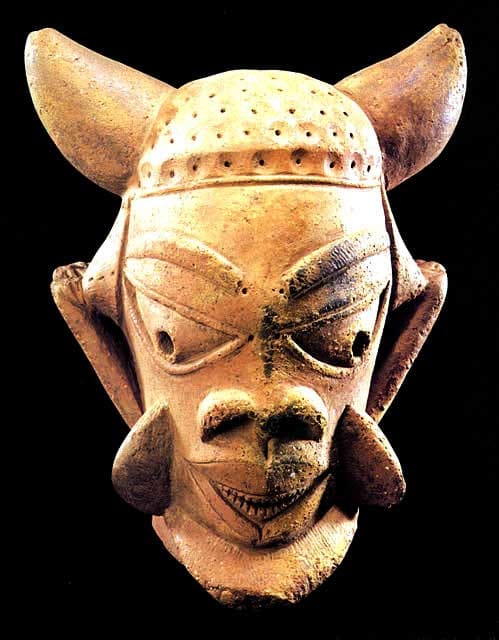
Exquisite Nok Figurine Discovered


2000 year Nok figurine of female ruler


This terracotta head, at around 2000 years old, is a rare exception. Excavated from a village in Nigeria, this is one of the best-preserved examples of its kind ever discovered. It is a product of the Nok culture that flourished from about 1000 BC to AD 500, when it mysteriously died out, and provides examples of the earliest figurative art in sub-Saharan Africa.

Archaeologists Peter Breunig and Nicole Rupp of the Goethe-University Frankfurt in Germany uncovered the head during the 2010 field season. It was found in Kushe, a small village about 150 kilometres north of the capital Abuja. Amazingly, this specimen was very close to the surface - only 60 centimetres down.

The Nok terracottas are a mystery. No one knows for sure what they were used for. They may represent dead members of the Nok community and could have been a votive offering at a shrine. Alternatively, the figurines may have been grave goods.

Africa has seen a resurgence of archaeological activity to investigate Nok culture. Part of this has to do with interest in Iron Age societies in Africa, which is surging as anthropologists consider how technologies - especially those based on iron - spread. The Nok are considered to be one of the earliest, if not the earliest, people to smelt iron on the African continent.

However, the research is under threat. Over the past half-century countless Nok terracotta specimens have been looted from hundreds of sites in central Nigeria. The booty has found its way onto the international art and antiquities market, ending up in the hands of private art collectors.

From here.


Many similarly excellent figurines have been found within the sphere of Nok culture.  Here is one of a male ruler:


The Nok are not extinct.  Today they are called Yoruba.  In Abraham's time, they were called Kushites. They migrated from the Nile along the great river basins that feed into the Benue Trough. 

The Nilotic origin of the Yoruba is evident in the correspondance between Yoruba words and ancient Egyptian words.

Nok is likely related to the Igbo word anochi which refers to rulers.  Only rulers had metal workers and scribes in their service.

The hairstyle of the recently discovered figurine is almost identical to this Nok figurine:


This is similar to the style worn by Igbo women today. The Igbo appear also to have Nilotic origins.


Related reading:  Was Nok Biblical Nod?; Is Nok/Enoch a Royal Title?; Extant Biblical Tribes and Clans

Monday, January 2, 2012

Of Dung Beetles and Red Herrings


Alice C. Linsley


In Ugaritic texts the liver and the heart are often correlated. This correlation came into Hebrew poetry, reflecting the influence of Babylonian culture on post-exilic Jews. The Ugaritic kbd (liver) stands in poetic parallelism with lb (heart). This is demonstrated in the Babylonian libbaki linuhkabittaki lipsab, meaning “May thy heart be at rest, thy liver be pacified.” (American Journal of Theology, Vol 2, p. 136. University of Chicago Divinity School

This parallelism from Babylonian culture led Bible translators to translate heart as liver in many Bible passages. Lamentations 2:11 is an example. "Mine eyes fail with tears, my heart is troubled; My liver is poured upon the earth..." (American Standard Version)

Allen P. Ross (Beeson Divinity School) has said that a Jew in ancient times would not say, "I love you with my whole heart" but rather “I love you with my whole liver." However, this parallelism is not found among Abraham’s Kushite ancestors for whom the heart was the single organ that was not extracted from the mummified body. All the other organs were removed and stored in canopic jars. Further, in ancient Egyptian medical texts the liver and the heart are not correlated. Egyptian physicians were well aware of the different functions of these organs.
Babylonian clay sheep liver dated between 2000 and 1500 BC (British Museum)  Babylonian priests used the livers of sacred sheep to investigate the cause of illness, to divine the future and to determine the will of the gods. 

It is clear that the parallelism of liver and heart in Old Testament poetry does not come from the Hebrew ancestors (Horim), but from the Babylonians. This post-exilic influence is a red herring when it comes to the Horite understanding of the heart and its importance for the resurrection of the dead.

Abraham’s Horite people viewed the heart as the mind and the seat of decision-making. The heart was the essential organ when it came to resurrection of the body, as it would be weighed in the afterlife. The body of the pure hearted would rise from the dead, as the sun rise in the morning. This is the significance of the dung beetle scarab, placed over the mummy's heart.

This beetle rolls balls of dung along the ground and deposits them in its burrows. The female lays her eggs in the dung ball and when they hatch, the larvae feed off the dung until they emerge from the earth. The orb of the lowly beetle replicated on earth the solar orb of the Creator.  Both were seen to sink below the earth and were believed to give life to those buried in the earth.

Among Abraham’s ancestors the heart was believed to be the seat of the will. It was weighed in the afterlife and only the pure heart would receive resurrection from the dead. David, a direct descendant of the Horite Abraham confessed his sin to God, and prayed, "Create in me a pure heart, O God." (Ps. 51:10) None have been so foolish as to translate this “Create in me a pure liver…” It is the pure heart that hopes for resurrection.

For the Horites the heart was the seat of the inner being. This is expressed in these words: "Behold, you delight in truth in the inward being, and you teach me wisdom in the secret heart." (Ps. 51:6)

The heart among Abraham’s Nilotic people was associated with the mind and decision-making. "I have stored up your word in my heart that I might not sin against you." (Ps. 119:11) Again, no Bible translator has thought to translate this “I have stored up your word in my liver..."  To do so would be to impose a foreign notion on Horite theology.


Related reading:  Solar Imagery of the Proto-Gospel; A Tent for the Sun