
Alice C. Linsley
Melchizedek, the ruler-priest of Jerusalem (Salem), is one of the most fascinating figures of Genesis. His Hebrew name is malkîtsedek, which means righteous king. He is mentioned in Genesis 14, Psalm 110:4 and in the book of Hebrews, where he is given much attention by the Apostle Paul. Melchizedek is also considered in the works of modern philosophers such as Soren Kierkegaard.
Melchizedek, the ruler-priest of Jerusalem (Salem), is one of the most fascinating figures of Genesis. His Hebrew name is malkîtsedek, which means righteous king. He is mentioned in Genesis 14, Psalm 110:4 and in the book of Hebrews, where he is given much attention by the Apostle Paul. Melchizedek is also considered in the works of modern philosophers such as Soren Kierkegaard.
At the time Abraham lived, most rulers of a region were related by blood (consanguine bond) or by marriage (affinal bond), or both. According to Genesis 14 and Hebrews 7, Melchizedek was a were ruler-priest of "the Most High God" ("El Elyon"), suggesting that he and Abraham belonged to the same ruler-priest caste. Castes are characterized by endogamy.
It is clear from Genesis 14 that Melchizedek and Abraham were well acquainted. They were likely kinsmen as the early Hebrew ruler-priests married only within their caste (endogamy).
It is clear from Genesis 14 that Melchizedek and Abraham were well acquainted. They were likely kinsmen as the early Hebrew ruler-priests married only within their caste (endogamy).
Based on what we know about the kinship pattern of the early Hebrew caste, we expect to find a familial relationship between these ruler-priests. I suspect that this is their relationship.

Melchizedek is claimed to have no parentage. This Jewish narrative is derived from midrash. Most midrashim come from the 2nd or 3rd century AD. There are many claims made about Melchizedek in Jewish texts that are not found in the Bible. Numbers Rabbah 4:8 says that Melchizedek handed down Adam's robes to Abraham/Abram. Another midrash claims that Melchizedek was so spiritually advanced that he was born circumcised. The rabbis taught that Melchizedek acted as a priest but was rejected by God and his priesthood was handed to the Jewish descendants of Abraham. Rabbi Zechariah said on the authority of Rabbi Ishmael: "The Holy One, blessed be He, intended to bring forth the priesthood from Shem" [not Shem and Ham whose lines intermarried]. Melchizedek was the priest of the Most High God but because he gave precedence in his blessing to Abraham over God, the LORD brought forth the priesthood of Israel from Abraham; as it is written, 'And he blessed him and said, Blessed be Abram of the Most High God, possessor of heaven and earth, and blessed be the Most High God' (Gen 14:19). Midrash claims that Abraham then said to Melchizedek, "Is the blessing of a servant to be given precedence over that of his master?" Straightway the priesthood was given to Abraham.
Melchizedek appears in 2 Enoch, and in the Dead Sea Scrolls he influences the demise of the Angel Belial and the wicked spirits in league with him. In 2 Enoch, he is taken by an angel to Eden. According to Rashi, a French medieval rabbi, Melchizedek was Shem. This is highly improbable since Melchizedek lived at least 300 years after Shem.
Melchizedek appears in 2 Enoch, and in the Dead Sea Scrolls he influences the demise of the Angel Belial and the wicked spirits in league with him. In 2 Enoch, he is taken by an angel to Eden. According to Rashi, a French medieval rabbi, Melchizedek was Shem. This is highly improbable since Melchizedek lived at least 300 years after Shem.
In Genesis 14, Melchizedek comes to Abraham after a great battle in which Abraham incurred blood guilt. Melchizedek's ministry in this situation would have been to perform the appropriate purification rites which included bread and wine. Ancient warrior societies had purification rites to help returning warriors deal with their blood guilt. In Genesis 14, Melchizedek performs the purification rite that absolves Abraham of blood guilt. In thanks, Abraham offers him the tithe.
In the book of Hebrews and in the writings of some Church Fathers, Melchizedek is a type of Jesus Christ. He is the righteous king and the prince of peace (Salem). This notion informs the Coptic view that Melchizedek was born of a virgin (2 Enoch). Jesus is the "priest after the order of Melchizedek" therefore, His priesthood is from of old, existing long before the time of Aaron.
In the book of Hebrews and in the writings of some Church Fathers, Melchizedek is a type of Jesus Christ. He is the righteous king and the prince of peace (Salem). This notion informs the Coptic view that Melchizedek was born of a virgin (2 Enoch). Jesus is the "priest after the order of Melchizedek" therefore, His priesthood is from of old, existing long before the time of Aaron.
The Hebrew ruler-priests expected the Divine Seed (Gen. 3:15), the Son of God to come into the world. They believed that He would be born of one of their virgins by divine overshadowing (Luke 1).
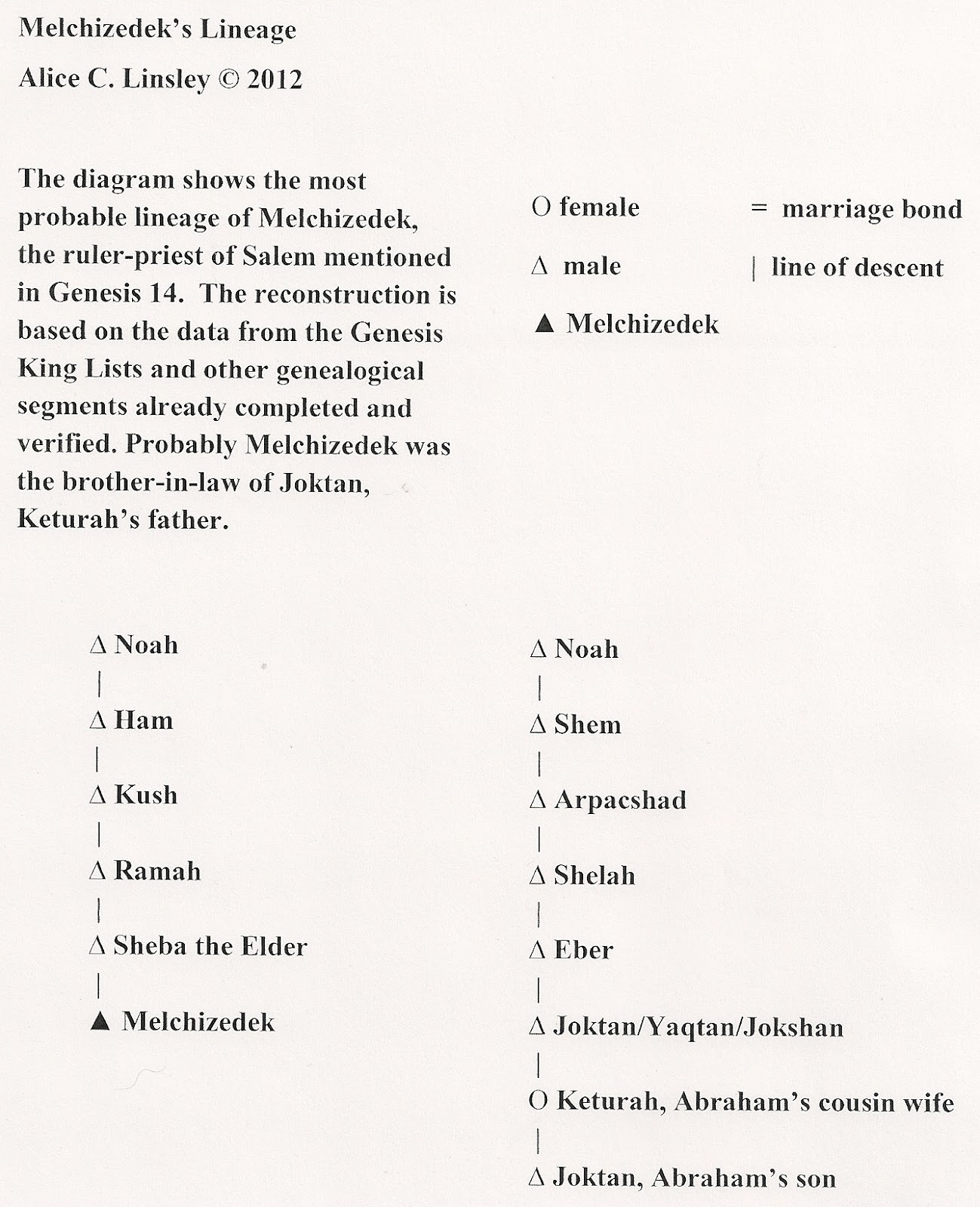
Melchizedek's earthly father was probably Sheba the Elder whose ancient royal line rivaled the House of David (II Sam. 20). The omission of Melchizedek's ancestry in the Hebrew Scriptures is consistent with the common practice of eliminating elements of history that do not serve the Jewish narrative. Omissions about ancestry and kinship, and aspersions cast upon some of the early Hebrew rulers is motivated by political expediency.
Melchizedek's earthly father was probably Sheba the Elder whose ancient royal line rivaled the House of David (II Sam. 20). The omission of Melchizedek's ancestry in the Hebrew Scriptures is consistent with the common practice of eliminating elements of history that do not serve the Jewish narrative. Omissions about ancestry and kinship, and aspersions cast upon some of the early Hebrew rulers is motivated by political expediency.
It is no coincidence that Jews begin their history with Abraham who they claim to be a Jew, though he is called a Hebrew. The Jewish narrative only works if one ignores the anthropological data of Genesis 4-11. When asked in this NOVA interview if Abraham was the first Jew, Dr. Shaye Cohen responded, "The biblical narrative gets going with Abraham in Genesis chapter 12. Abraham in turn Isaac, in turn Jacob, in turn Joseph and the twelve tribes, this brings us directly to the people of Israel and the covenant at Sinai. So Abraham is thought of as the first Jew, the archetype."
Dr. Cohen admits that his portrayal of Abraham as the first Jew lacks historical support. He says, "Historically speaking, of course, this doesn't make much sense. It's hard to talk about Jews living around the year 1800 B.C.E. or anytime near that."
This is true. We can speak of Jews only after about 580 B.C. and Abraham the Hebrew lived closer to 2100 B.C. He had at least 9 sons and the clan of Jacob (Israel) represents a small portion of the early Hebrew caste.
Related reading: The Hebrew Were a Caste; The Substance of Abraham's Faith; The Order of Melchizedek; The Messianic Priesthood of Jesus; Belief in the Most High God
No comments:
Post a Comment