|
| Ainu couple with pet bear and Japanese visitor circa 1930 The man wears the distinctive head gear of Ainu elders, the same worn by Micmac Ainu elders of Canada and by the Annu chiefs of the ancient Upper Nile. |
Alice C. Linsley
For some time I have been exploring the possible connections between the ancient Annu of the Upper Nile, the Ainu of Hokkaido and Okinawa, and the Ainu of Canada's eastern seaboard. Recent DNA studies have revealed that the Ainu of Hokkaido and the Ryukyuans of Okinawa have a closer genetic affinity than either group has to the Japanese. The Ainu of Japan possess almost exclusively Haplogroup D-M174 chromosomes.
One theory is that the Ainu migrated to Japan from the Nile Valley by a northern route.
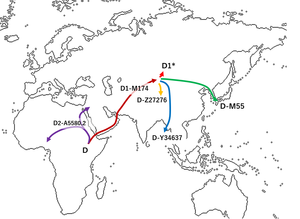
It is likely that they migrated by a southern route also and that there were different periods of migration. There is no doubt that the Ainu dispersed widely during the late Paleolithic and Neolithic Periods. "Ainu moshir" refers to the Ainu homeland, which includes many regions in which Ainu live. Tessa Morris-Suzuki has written that the geographical boundaries of the dispersed Ainu populations have never been precisely identified, and even the Ainu themselves are not able to identify all of them.
The ancient Nilotic Annu/Ainu were associated with the shrine at Heliopolis (Biblical On), one of the most prestigious of the ancient world. Anu is also the name of their God in Akkadian, suggesting that the Nilotic Annu were a preist caste that also migrated into Mesopotamia.
 |
| San of Botswana Note the skin tone |
The connections suggest a dispersion of Proto-Ainu much earlier than I would have guessed. The Ainu today appear to be the descendants of the prehistoric Wa. This indicates a connection back to Africa and to the Y-chromosomal Adam and Haplogroup A. The San are in Y-DNA Haplogroup A. This group is the foundation of all known patri-lineages carried by modern humans. However, Haplogoup A is found only among men in Africa, or among men outside of Africa of recent African extraction. The Ainu are in Y-DNA Haplogroup D, found in Northern Japan and Okinawa.
The Khoisan-Japanese connection calls for further research. The Arabic name for the San is Wakwak. The Sandawe (Tanzania) call the Bushmen Wanege. Wa was the earlier name for Japan and the word appears in the name Okina-wa.
While the Khoisan do not have a word for priest, they do recognize the role of the holy man who makes pure after blood is shed. W'b in ancient Egyptian refers to the priest caste, the pure ones, and the healer priest was called wab sxmt (wab sekhmet). There is an interesting connection to the Sumerian word wasabu which means to sit. The Egyptian word wabau is likely related. It refers to a healer-priest, one is sits by the sick person.
A comparison of the Kata Japanese and Hebrew scripts reveals a connection that is likely explained by the fact that the earliest scripts were those used by priests attached to rulers over many regions worldwide.

The Ainu attus is made from the fiber of an elm tree native to Hokkaido. This traditional robe bears close resemblance to the traditional African dashiki.
Luigi Cavalli-Sforza's genetic distance chart places the Ainu rather distant from the Bushman, but the anthropological and linguistic suggest a connection. Given this scheme, the dispersion of the ancestors of the Ainu out of Africa has to have taken place before the separation of Africans and Asians. Still, more research is needed.

A comparison of the Kata Japanese and Hebrew scripts reveals a connection that is likely explained by the fact that the earliest scripts were those used by priests attached to rulers over many regions worldwide.
A scribe called Wani Kishi is said to have brought Kata to Japan. It is used by the Ainu of Northern Japan. Japan's earliest known population was Ainu. The Kojiki indicates that Wani Kishi arrived sometime after 372, but before 375 AD. Kata was a priestly syllabic system, similar to Hebrew. Wa-kishi is an African term that refers to the ancestors.
There are many connections between Japanese and African words. For example, the name Isahi appears to be a variant of Esau or Issa. Kishi appears to be a variant of Kish and Kush. Obito, the title for a regional chief in Japan, is related to the Edo (Africa)/Edomite (Southern Arabia) word for chief, which is Oba. The first ruler of Petra was the Horite ruler Obodas. These ancient rulers were said to have a reddish skin tone (as was the case with Esau and David). The ancient Greeks called Edom "Idumea" which means "land of red people." The original name of Tokyo was Edo.
There are many connections between Japanese and African words. For example, the name Isahi appears to be a variant of Esau or Issa. Kishi appears to be a variant of Kish and Kush. Obito, the title for a regional chief in Japan, is related to the Edo (Africa)/Edomite (Southern Arabia) word for chief, which is Oba. The first ruler of Petra was the Horite ruler Obodas. These ancient rulers were said to have a reddish skin tone (as was the case with Esau and David). The ancient Greeks called Edom "Idumea" which means "land of red people." The original name of Tokyo was Edo.
There is artifact evidence of connections also. Consider the similarity between these two garments.
 |
| Banana thread (ito basho) robe of Ryukyu |
 |
| Kente cloth of Ashante ruler-priests |
The Ainu attus is made from the fiber of an elm tree native to Hokkaido. This traditional robe bears close resemblance to the traditional African dashiki.
 |
| Ainu attus |
 |
| African dashiki |
Luigi Cavalli-Sforza's genetic distance chart places the Ainu rather distant from the Bushman, but the anthropological and linguistic suggest a connection. Given this scheme, the dispersion of the ancestors of the Ainu out of Africa has to have taken place before the separation of Africans and Asians. Still, more research is needed.
Luigi Cavalli-Sforza's Genetic Distance Chart
places the Ainu at the center between Asian and African
The anthropological and linguistic evidence along with the evidence of migration studies strongly suggests that the urheimat of the ancestors of the Japanese Ainu and the Micmac Ainu of Eastern Canada may have been the Nile Valley. The genetic evidence is still outstanding. Molecular Geneticist, David Wilcox has written:
Let me clear up how the genealogies like Cavalli-Sforza's should be viewed. The position of the branches doesn't mean much - what counts is what they are connected to. Each branch point represents a point where two lineages diverged. The Japanese Aniu in the diagram are genetically closest to the group containing Japanese, Koreans, Mongols, Samoyed and Tibetian in their overall genomes. The present day Nilotic peoples are part of the African complex at the top. The distribution of the Haplogroup X (which did indeed arise from N in the Middle East - maybe 30 to 40,000 years ago), on the other hand, is interesting and might indeed indicate a migration from Europe rather than Asia - but it could also indicate an early migration from the west which was pushed eastward by the further migrations from Asia. I'm not sure what to think about it, but I would suggest that a few of the Micmac people submit their DNA to the National Geographic project for tracing migrations and see what sort of result they get - preferably someone from the easternmost area which has the highest level of X, and thus probably the lowest level of Asian admixture.
Let me clear up how the genealogies like Cavalli-Sforza's should be viewed. The position of the branches doesn't mean much - what counts is what they are connected to. Each branch point represents a point where two lineages diverged. The Japanese Aniu in the diagram are genetically closest to the group containing Japanese, Koreans, Mongols, Samoyed and Tibetian in their overall genomes. The present day Nilotic peoples are part of the African complex at the top. The distribution of the Haplogroup X (which did indeed arise from N in the Middle East - maybe 30 to 40,000 years ago), on the other hand, is interesting and might indeed indicate a migration from Europe rather than Asia - but it could also indicate an early migration from the west which was pushed eastward by the further migrations from Asia. I'm not sure what to think about it, but I would suggest that a few of the Micmac people submit their DNA to the National Geographic project for tracing migrations and see what sort of result they get - preferably someone from the easternmost area which has the highest level of X, and thus probably the lowest level of Asian admixture.
Best wishes,
David Wilcox
The genetic evidence connecting the Ainu of Hokkaido and Okinawa with the Edo of Nigeria is rather more substantial. The latest writings indicate a consensus that YAP’s origin is in West Africa (Nigeria), with a founding derivative clade in the ancestors of the Shiya Muslims who made their way to South Asia (India), Central Asia and eventually to Japan.

Related reading: Japanese Author Traces Nippon Origin to Hebrew Race; Who Are the Ainu?; The Nile-Japan Ainu Connection; A Kindling of Ancient Memory; More East Africa-Asia Connections; Edo, Edom, Idumea; The ongoing mystery of the Ainu portraits in France
The genetic evidence connecting the Ainu of Hokkaido and Okinawa with the Edo of Nigeria is rather more substantial. The latest writings indicate a consensus that YAP’s origin is in West Africa (Nigeria), with a founding derivative clade in the ancestors of the Shiya Muslims who made their way to South Asia (India), Central Asia and eventually to Japan.

Related reading: Japanese Author Traces Nippon Origin to Hebrew Race; Who Are the Ainu?; The Nile-Japan Ainu Connection; A Kindling of Ancient Memory; More East Africa-Asia Connections; Edo, Edom, Idumea; The ongoing mystery of the Ainu portraits in France


.jpg)