Alice C. Linsley
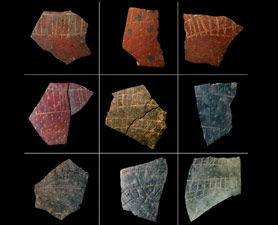
When considering written communication in antiquity, one must begin with the oldest known written communication. That would be ostrich eggshell fragments dating to 60,000 years ago. These have been hailed as the oldest example of symbolic written communication. The unusually large sample of 270 engraved eggshells were mostly excavated at Diepkloof Rock Shelter in South Africa.
However, if one wishes to consider the world's oldest books, there is now a set of 70 contending for that title.
A group of 70 or so "books", about the side of a credit car, with between five and 15 lead leaves bound by lead rings, were discovered in northern Jordan after a flash flood had exposed two niches inside the cave. One one of the niches was marked with a menorah. A Bedouin found the books. They are believed to be extremely rare relics of early Christianity. Below is a photo of a page showing a date nut palm (tamar) which is a "tree of life." (Read more here.)

The other books were found in Egypt. Here's the report:
It was on January 20, 1988, while excavating a third- century Roman house at Kellis, part of the Dakhleh Oasis Project, that student volunteer Jessica Hallet excitedly called out to her supervisor to come and look at a piece of wood with writing on it. Colin Hope, director of the Centre for Archaeology and Ancient History at Australia’s Monash University, wandered over to delicately brush sand from it. What emerged from that ancient kitchen were two wooden-paged books. One contained three speeches by the Greek orator Isocrates; however, it was the other book, underneath that one, that has garnered more attention.
The three years of the Kellis book were either 361 to 364 or 376 to 379, just before the site was abandoned. Wooden books were popular at the time, though papyrus ones were about to come into common use. A private letter, written in Greek and found in the house next door, contained an order: “Send a well-proportioned and nicely executed 10-page notebook for your brother Ision.” The addressee didn’t have to go far. A room adjacent to where the book was found revealed a bookmaker’s workshop containing acacia-wood mallets, three cut wooden pages, a block marked for cutting and a tool box which allowed Hope to reconstruct the process of making the book.
Hope agrees that calling it “the world’s oldest book” is a matter of definition. “It’s certainly the oldest as we know a book,” he says, “with a front and back cover, a pagination system and individual pages bound at the spine.”
Made from a single block of acacia wood, the book’s eight pages measure 33 by 11 centimeters (13"by 4"). Each page is coated with gum arabic to provide a writing surface. They’re held together by tightly spun linen strings threaded through pairs of holes drilled at the top and bottom. Should the binding ever have broken, re-ordering the pages would have presented no problem: Notches along the spine line up to a perfect V when the pages are in the correct order.
The book is now safely housed in the Kharga Archeological Museum in Egypt’s Kharga Oasis, near Dakhleh, where crops similar to the ones named in it are grown, and similar payments continue to be made.
The second book, dubbed the Kellis Agricultural Account Book, is a revealing record written by the manager of an agricultural estate of all the comings and goings of the business of the estate over three years. Its 1784 entries list payables and receivables, including annual obligations to the landlord, the mistress of the house and the field workers. Income items include crops like wheat, barley, chickens, figs, olive oil, honey and wine. Outgoing payments included “to Syrion, for wage,” “to Father Psennouphis, for wedding gifts,” “transport charge,” and notes indicated how each payment was made, whether in cash or produce or both. It’s an extremely important written record that can be compared to archeological remains found at the site.
From here. Dakhleh is in the desert in the southwestern part of Egypt in what was part of ancient Kush.
Related reading: The Writing System of Menes; Canaanite Origins of the Alphabet; The Origins of Written Communication; Sacred Writings and the Uniqueness of the Bible; Paleolithic Ostrich Eggshell Communication; The Writing of David's Realm
When considering written communication in antiquity, one must begin with the oldest known written communication. That would be ostrich eggshell fragments dating to 60,000 years ago. These have been hailed as the oldest example of symbolic written communication. The unusually large sample of 270 engraved eggshells were mostly excavated at Diepkloof Rock Shelter in South Africa.
However, if one wishes to consider the world's oldest books, there is now a set of 70 contending for that title.
A group of 70 or so "books", about the side of a credit car, with between five and 15 lead leaves bound by lead rings, were discovered in northern Jordan after a flash flood had exposed two niches inside the cave. One one of the niches was marked with a menorah. A Bedouin found the books. They are believed to be extremely rare relics of early Christianity. Below is a photo of a page showing a date nut palm (tamar) which is a "tree of life." (Read more here.)

The other books were found in Egypt. Here's the report:
It was on January 20, 1988, while excavating a third- century Roman house at Kellis, part of the Dakhleh Oasis Project, that student volunteer Jessica Hallet excitedly called out to her supervisor to come and look at a piece of wood with writing on it. Colin Hope, director of the Centre for Archaeology and Ancient History at Australia’s Monash University, wandered over to delicately brush sand from it. What emerged from that ancient kitchen were two wooden-paged books. One contained three speeches by the Greek orator Isocrates; however, it was the other book, underneath that one, that has garnered more attention.
The three years of the Kellis book were either 361 to 364 or 376 to 379, just before the site was abandoned. Wooden books were popular at the time, though papyrus ones were about to come into common use. A private letter, written in Greek and found in the house next door, contained an order: “Send a well-proportioned and nicely executed 10-page notebook for your brother Ision.” The addressee didn’t have to go far. A room adjacent to where the book was found revealed a bookmaker’s workshop containing acacia-wood mallets, three cut wooden pages, a block marked for cutting and a tool box which allowed Hope to reconstruct the process of making the book.
Hope agrees that calling it “the world’s oldest book” is a matter of definition. “It’s certainly the oldest as we know a book,” he says, “with a front and back cover, a pagination system and individual pages bound at the spine.”
Made from a single block of acacia wood, the book’s eight pages measure 33 by 11 centimeters (13"by 4"). Each page is coated with gum arabic to provide a writing surface. They’re held together by tightly spun linen strings threaded through pairs of holes drilled at the top and bottom. Should the binding ever have broken, re-ordering the pages would have presented no problem: Notches along the spine line up to a perfect V when the pages are in the correct order.
The book is now safely housed in the Kharga Archeological Museum in Egypt’s Kharga Oasis, near Dakhleh, where crops similar to the ones named in it are grown, and similar payments continue to be made.
The second book, dubbed the Kellis Agricultural Account Book, is a revealing record written by the manager of an agricultural estate of all the comings and goings of the business of the estate over three years. Its 1784 entries list payables and receivables, including annual obligations to the landlord, the mistress of the house and the field workers. Income items include crops like wheat, barley, chickens, figs, olive oil, honey and wine. Outgoing payments included “to Syrion, for wage,” “to Father Psennouphis, for wedding gifts,” “transport charge,” and notes indicated how each payment was made, whether in cash or produce or both. It’s an extremely important written record that can be compared to archeological remains found at the site.
From here. Dakhleh is in the desert in the southwestern part of Egypt in what was part of ancient Kush.
Related reading: The Writing System of Menes; Canaanite Origins of the Alphabet; The Origins of Written Communication; Sacred Writings and the Uniqueness of the Bible; Paleolithic Ostrich Eggshell Communication; The Writing of David's Realm


.jpg)