
Alice C. Linsley
Abraham lived at a time when the Sahara and Mesopotamia were drying out after the Holocene Wet Period which began about 12,000 years ago. Lakes filled basins throughout the region and the larger lakes reached levels sometimes 330 feet higher than their present levels. Around these bodies of water were spongy marshlands which provided channels for navigation for smaller boats. One such dugout, made of black mahogany, was discovered in 1987 in the region of Bor-nu at a depth of 16 feet under clays and sands whose alternating sequence indicated deposition in standing and flowing water. The dugout is 8000 years old. By comparison, Egypt's oldest boat is only about 5000 years old.
Historian and Africanist Roland Oliver has described the Green Sahara as follows:
"[In] the highlands of the central Sahara beyond the Libyan desert,... in the great massifs of the Tibesti and the Hoggar, the mountaintops, today bare rock, were covered at this period with forests of oak and walnut, lime, alder and elm. The lower slopes, together with those of the supporting bastions — the Tassili and the Acacus to the north, Ennedi and Air to the south — carried olive, juniper and Aleppo pine. In the valleys, perennially flowing rivers teemed with fish and were bordered by seed-bearing grasslands."
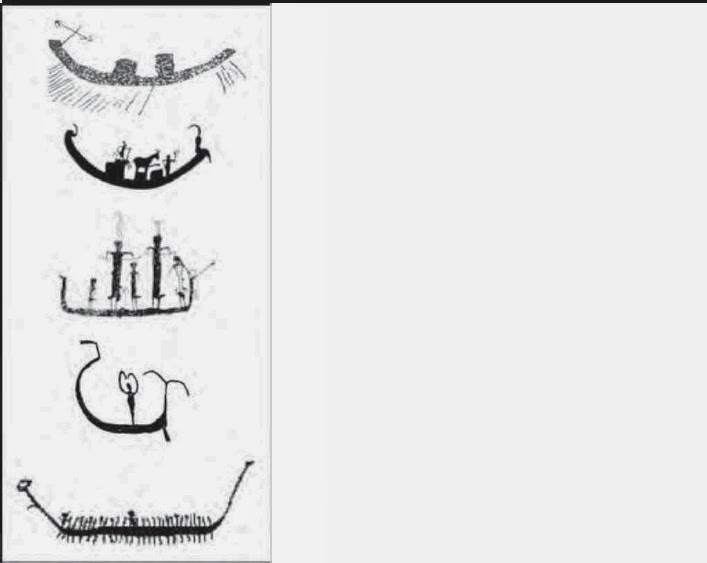 |
| Petroglyphs of boats found in the Eastern Central Desert of Egypt and Sudan They date to between 4300 and 2900 BC. |
The Sahara saw considerable flooding during the Holocene Wet Period and some believe that this was the time of Noah’s flood. According to local tradition Noah lived in the region of Lake Chad. In fact, this is the only place of the surface of the Earth that claims to be his homeland: Bor-No, meaning “Land of Noah.”
In the time of Noah (about 5,500 years ago), Lake Chad was a much larger body of water. The various footprints of ancient Lake Chad have been confirmed by satellite photography. Petroglyphs of boats found in the Eastern Central Desert of Egypt and Sudan date to between 4300 and 2900 BC. and are a testament to the wet conditions during Noah's lifetime.
The Nile waters swelled from increased rainfall and cut a deeper and wider floodplain, extending well into Sudan to the west. The area attracted merchants from southern Africa who moved their cargo along the rivers and paid tariffs to the chiefs who controlled the river junctions. When the climate began to change and the waters receded, those in power found it more difficult to control larger territories. Afro-Asiatic kingdom builders such as Nimrod, who depended on the large water systems to control their territories, were faced with shrinking territories.
These archaic rulers appear to have been related by blood and intermarriage. The dominion of these ruling houses extended from Nigeria to India. This “Afro-Asiatic Dominion” is referred to in Genesis 11:1 where we are told that all the “world spoke one language.” They charged tariffs for commerce conducted on the parts of the rivers that they controlled and their priests maintained shrines at sacred sites along the rivers. We see this pattern of swollen river systems in the Niger-Benue in Nigeria, the Tigris-Euphrates in Mesopotamia, and the Indus-Sarawati Rivers in India. Some Nile shrines disappeared with the flooding in more recent centuries, but there is ample evidence of their existence, just as there is evidence of the existence of shrines, temples and urban centers under what is now the Bay of Bengal.
From these centers the Nilo-Saharan rulers conducted trade with distant territories. At Hierakonpolis (Nekhen) rulers acquired exotic goods and animals from central Africa and Afghanistan 4000 years ago. At Tomb 100 there are two boats painted on the walls.
Related reading: Boat Petroglyphs in Egypt's Central Eastern Desert; Genesis and Climate Change; The Saharan Antecedants of Pharaonic Egypt; Sudan is Archaeologically Rich: The Buduma of Lake Chad by Guy Immega


.jpg)



4 comments:
How would the new evidence of early civilization in what is now the Persian Gulf, fit into your model?
http://www.livescience.com/history/lost-civilization-possibly-existed-beneath-persian-gulf-101209.html
Yes, I saw that piece, but was more interested in this piece on the Sahara, since it relates more directly to Abraham's ancestors in the Upper Nile.
There have been numerous migrations out of Africa. One about 100,000 years ago. Another about 70,000 years ago and a third about 40,000 years ago. The migration that interests me involved Kushite kingdom-builders like Nimrod. This is relatively recent history: between 10,000 and 7000 years ago.
Rising waters have covered other ancient civilizations, so this isn't new. Much of the ancient Harrapa civilization is under water, but none has ever claimed that to be Atlantis or the Garden of Eden. This is pure speculation, an attention-getting headline.
The most important detail to take away from this article is that human civilization has ancient antecedents. We are industrious, migratory, communal and have been from our first appearance on the earth over 3.8 million years ago.
Thank you for your fascinating insights, Alice. I have no expertise in this area -just 50 years of a very amateur interest in prehistory, archaeology, linguistics (and now DNA!)
I just wanted to mention to you a volume, found in a second hand book shop, as I think you would find it interesting. It is "The Followers of Horus" Eastern Desert Survey Report. Volume One ed. David Rohl. Pub ISIS (Institute for the Study of Interdisciplinary Sciences.) ISBN 0-9513811-3-X.
This book contains photographs and sketches of boats, animals, people and symbols from pre-dynastic rock art surveyed in the wadis of Edfu and Mersa Alam in the south and Kuft and Kuseir in the north of the Eastern Desert of Upper Egypt. Also given are maps and GPS coordinates.
The rock art is eye catching as it features so many boats and savannah animals in the context of today's completely dry wadis! There are recurring motifs too, some of which I suspect you will recognise.
There is much detail on the boats and there are 'superhuman' figures which have some intriguing poses. Something that could be a sack of wheat somehow looks rather like a small horned alter when it appears in one or two of the boat 'cabins.'
The falcon is there along with bulls and other 'totems'(?) 'tethered' to boats and apparently floating in the wind. There is an intriguing array of other items attached to prows and sterns and at least four different types of boats are represented.
The horns of the Aurochs/ Ankoli bulls and the arm shape of the 'dancing goddess' remind me of your depiction of Hathor -but without the sun disk. There are other arm positions too which look to be significant- maybe some kind of boatmans' signals to other boats or an indication of some quality or attitude attached to the figures?
There seems to be an occasional sun and moon symbol which looks like a bowl cupping an orb or disk. The cup is similar in shape to the outline of a menorah when it occurs at the top of a 'stand' (Perhaps it is a lamp!) The stand free version appears once inverted -so that the orb has a thin crescent moon hanging above it. Elsewhere there is a recognisable sun disc with rays.
There are dragged boat motifs and hunting scenes as well as animal motifs. Some rocks have been incised with lines. The authors suggest that these may be very early maps of the wadis and helpfully include comparative modern maps.
Finally, the rocks bear some Hieroglyphic, Greek and Nabatean inscriptions.
Most of this graffiti has been tentatively dated to Nakada 1 and early 2 periods (4000 - 3600 BCE)but some seems to span a wider period and some is clearly more recent. Apparently, there is much more to record as destruction is occurring and the rocks have no protection. The survey work was carried out about twenty five years ago.
I've been staring at the photographs and sketches for hours wondering what, if anything, they contribute towards the picture that you are building up about those wet periods and the peoples of the areas around the Nile.
I need all the help I can find with the earliest chapters of Genesis, an area that has fascinated me ever since I realised, at age 18, that the standard Protestant Church interpretations of these texts were not entirely satisfactory. (I clearly remember thinking that there must be much history and a whole host of meanings that seemed to be escaping us all.) So I look forward to your next postings.
Gerrie
Gerrie, Thank you for this thoughtful comment.
You will find more helpful information in these indices:
http://jandyongenesis.blogspot.com/2014/04/index-of-topics-at-just-genesis.html
http://biblicalanthropology.blogspot.com/2011/02/index-of-topics-at-biblical.html
Post a Comment