Thursday, July 29, 2010

Israel Museum Reopens

The Israel Museum reopened on July 26 after a three-year, $100 million reorganization and facelift.  Here is the report from Biblical Archaeology Review:

"The refurbished museum creates links across cultures and their histories by displaying fewer objects in a much larger space with deeper explanations. Museum director James S. Snyder, an American Jew who worked for 22 years at the Museum of Modern Art, did not want to display the history of the land solely from a Jewish perspective. He placed an emphasis on cultural commonalities, and sought to contextualize Jewish history within a broad context. The design minds behind the renewal of the Israel Museum include James Carpenter Design Associates of New York and Efrat-Kowalsky Architects of Tel Aviv."

The oldest object in the museum is the million-year-old horns of a wild bull. There is also a heel bone pierced by an iron nail with wood fragments, the oldest physical evidence of crucifixion.

Read more about the newly reopened Israel Museum here.

Tuesday, July 27, 2010

Jacob's Journeys

Alice C. Linsley


The biblical record of Jacob's journeys to and from Haran (Padan-aram) reveal a fascinating parallelism that suggests that these accounts have been carefully crafted. For example, both departures represent reactions to the anger of brothers. Jacob flees from Canaan for fear of his brother Esau and he later flees from Padan-aram for fear of his wives' brothers (Gen. 31:1, 2). Consider the following:

Departure from Canaan
  • Departure is precipitated by threat of violence from Jacob's brother
  • Jacob's mother and father deliberate with him about the best course of action
  • Departure is urgent, but well provisioned. In Genesis 32, Jacob says that he left Canaan with only his staff, but this is clearly hyperbole because in Genesis 28 we find that he has oil to anoint the pillar that he set up at Beth-el. His mother would have made sure that her favorite son was well provisioned before his journey. 
  • Another motive for Jacob's departure to Haran is marriage.  A proper marriage would be to a half-sister and/or a patrilineal cousin or niece. Rachel and Leah fit the requirement.
  • Isaac prays that God would make Jacob to become a "company of peoples" (Gen. 29:3 NAS).
  • On the way to Padan-aram Jacob covenants with God and sets up a stone pillar which he anoints with oil (Gen. 28:18).
  • Jacob is fearful of his reception in Padan-aram, but he arrives safely and is well received at the well where he meets Rachel, his future wife (Gen. 29:2-11).
Departure from Padan-aram
  • Departure is precipitated by the animosity of Rachel and Leah's brothers and Laban's change of attitude toward Jacob (Gen. 31:1, 2)
  • Jacob deliberated with his wives about the best course of action
  • Departure is urgent, but well provisioned. Jacob and his wives made sure that they had sufficient provisions for both wives' households/companies before the journey.
  • Another motive for Jacob's return to Canaan is his desire to keep his 2 wives (Gen. 31:31).
  • Jacob returns to Canaan with 2 companies or 2 households (Hebrew: mahanaim), the camp of Rachel and the camp of Leah.
  • On the way to Canaan Jacob and Laban form a covenant and set up stone pillars (Gen. 31:44-46).
  • Jacob is fearful of his reception in Canaan, but he and his 2 companies arrrive safely and are well received by his brother Esau.
The parallelism between Jacob's journeys is striking and invites us to further explore a possible parallel between the two events that don't appear to be connected: Jacob's dream of the ladder and Rachel's confiscation of the Teraphim.  We will now turn to the intriguing question of whether these represent parallel cosmological views.

Teraphim were ancestor statues that belonged to the great Afro-Asiatic kingdom builder Terah. Terah was the father of Haran, Nahor and Abraham. Ancestor statues or figurines are still used in traditional African religions. The ancestor figurines were are not worshiped, but were venerated as they represented great ruler-priests who were expected to intercede for their people after death. This is like the veneration shown by Christians to saints and martyrs to whom they turn for intercessions.[1]

The word Teraphim is usually rendered "images" or "idols" but the word actually means the things pertaining to Terah. The confusion is due to the appearance of the word in 1 Samuel 19:13 where we read that "Michal took the Teraphim and laid it on the bed, and put a quilt of goats' hair at its head, and covered it with clothes." She was attempting to make a decoy for David's sleeping body, so it is clear that this reference is not speaking of a small ancestor figurine such as Rachel was able to hide in a saddle.

The Teraphim and the ladder in Jacob's dream speak of a henotheistic worldview, that is, belief in a creator God supreme over all things who is assisted by lesser powers (baals), dieties, spirits or angels. These lesser powers do not act independently of God's sovereign will. In this view when good or evil comes upon a person it is because God has allowed it. This explains why there is often lack of precision about identifying angels and the spirits of the righteous (deified) dead in the Bible.[2] Both were seen as messengers or agents who could move between Heaven and Earth. 

So it appears that Jacob's ladder and Rachel's teraphim are part of the carefully crafted journey narratives and that Jacob's going to Haran and his return to Canaan are perfectly parallel.


NOTES
1. There is a darker side to ancestor veneration, observed today in Africa and experienced by St. Paul in Philippi (Acts 16:16-18), where demons are invoked and false prophets declare through demon possession.

2.  In Acts 12, Peter is delivered from prison by an angel.  He knocks at the door where the faithful are gathered and Rhoda tells the gathered that Peter is at the door, but they say that she must have seen Peter's angel.

Sunday, July 25, 2010

Elie Wiesel on Joseph

"Jacob refused him nothing. He owned the most beautiful clothes, for he liked to be regarded as graceful and elegant. He craved attention. He knew he was the favorite and often boasted of it. Moreover, he was given to whims and frequently was impertinent. Arrogant, vain, insensitive to other people's feelings, he said freely whatever was on his mind. We know the consequences: he was hated, mistreated, and finally sold by his brothers, who in truth were ready to kill him."

Messengers of God, Elie Wiesel

Saturday, July 24, 2010

Grasping at Mandrakes

Alice C. Linsley

The idea that the physical properties of a plant indicate its uses is very ancient. In the Middle Ages this was called the "Doctrine of Signatures" or the "Doctrine of Similitudes."

According to the Doctrine of Signatures or Similitudes “like cures like”  so that the physical appearance of a stone or a plant was perceived by archaic man to indicate the uses of the stone or plant. An orphic poem contains allusions to the virtues of gem-stones. The blood-red color of a jasper suggested the stone's use in treating haemorrhage; a green jasper brought fertility to the soil; and the purple wine-colour of amethyst pointed to its use in preventing intoxication. (Both animals and gemstones served as totems for clans and tribes. This is the significance of the 12 gemstones on the priestly breastplate of Aaron.)

The Mandrake plant (shown right), with parts resembling male and female organs, was regarded as a stimulate to sexual desire and fertility.  This is why Rachel and Leah desired it in their baby-making competition.  

The Mandrake usually grows as a weed in wheat fields. It was here that Reuben found the plants at the time of harvest and brought them to his mother Leah (Gen. 30:14).  Anxious to conceive, Rachel bargained with Leah, saying that Jacob would sleep with Leah in exchange for the plants.
 
The Mandrake consists of several large dark green leaves that lie flat upon the ground forming a rosette. In winter, a cluster of purple flowers appears in the center of this rosette. The root of the mandrake can be several feet long and weigh several pounds. The ovary or testicle-shaped fruits, mentioned in Song of Songs, are produced in the early summer and have a pleasant fragrance like ripe cantaloupe.  The fruits are green when they first appear and turn a deep gold color when mature.

The Doctrine of Signatures exerted considerable influence in Europe until late in the 17th century, but the idea is found much earlier in Africa and was developed by ancient Greek herbalists. Jakob Böhme (1575–1624) claimed to have had a mystical vision in which he saw the relationship between God and man signaled in all created things. In 1621, he wrote Signatura Rerum (The Signature of All Things) in which he applied the doctrine to the medicinal uses suggested by the form of plants.


Related reading:  The Mandrake in Folk Medicine

Thursday, July 22, 2010

Features of Ancient Afro-Asiatic Religion

Alice C. Linsley

Afro-Asiatic rulers were also priests who stood as intermediaries between God and their people. They were called sarki, a word of African origin. Among the ancient Egyptians the word meant priest. In Hausa sarki is the word for king (See Charles Henry Robinson, Dictionary of Hausa, XXIV Preface). Auran saraki refers to the king's minister and is usually rendered chief.

Aramean and Afro-Arabian ruler-priests are largely responsible for the diffusion of the Afro-Asiatic religious life that took root around the major water systems from west central Africa to the Indus River Valley. This religious life shares distinctive features, all of which are found in the Bible. These features include:

Hereditary priesthood and hereditary kingship: Originally the ruler and the priest were either the same person or the ruler had his own priest, who would have been a member of his family. The royal and priestly lines intermarried to preserve their bloodlines. These ruler-priests, whose lines intermarried, influenced the spread of their religious worldview from west central Africa to Nepal and Cambodia.

Shrines and temples along rivers, or near springs, well or oases: The Afro-Asiatic ruler-priests controlled the ancient water ways. This is why they build their shrines and temples near water. This also explains why Abraham, Isaac, Jacob and Moses all met their wives at wells. These women were the daughters of ruler-priests. About 75% of the women named in the Old Testament are the daughters of priests.  The ancient Kushite rulers made coronation journeys between 3 shrines on the Nile: the temples of Pnubs, Napata (Gebel Barkal) and Gematon (Kawa).

Binary distinctions: The observation of universal opposites in nature such as night-day, male-female, heaven-earth characterized teh ancient Afro-Asiatic worldview. This is quite different from Asian dualism in which teh opposites are of equal value or strength. Among the ancient Afro-Asiatics, one of the two was regarded as superior in some way to the other. The Sun is greater than the Moon which merely reflects ths Sun's light.  Males are bigger and stronger than females.  Heaven is more glorious than Earth, etc. This enabled prophets to discern God’s will by reading the signs in creation and directing the people toward the superior sign. The binary distinctions are observable as the pattern of nature and have been the basis for Law and Ethics for about 12,000 years.

The biblical worldview involves binary opposites and supplementary. Supplementary is about meaning. That is to say that meaning is derived from the relationship of the binary opposites. Supplementary is what makes a relationship meaningful. In fact, meaning is derived from the supplementary nature of two things. I experience hateful acts as evil because I have experience of loving acts and know them to be good. The reverse is also true. The male-female relationship has meaning because of the supplementary nature of male-female. Supplementary doesn’t mean equal, since one of the opposites is perceived as greater in some way. This is how the biblical worldview avoids the dualism.

Fixed order of creation: God created the world and established a predictable fixed order to His creation (Genesis 1; Psalm 104:19-20, Jeremiah 33:19-36). This predictable order is referred to as ‘RTA’ in Hinduism. It is an order which we perceive foremost as having binary opposites: God-Man; Heaven-Earth; Male-Female; Sun-Moon; Night-Day, etc. Because the order is fixed, entities can only be what they were created (as Aristotle recognized in his teleological conversations). What we often call 'change' or evolution is fluctuation in outward form but not change in essence. So water is always water (H2O) though its form fluctuates between liquid, vapor, and ice. This is where the biblical worldview and convergence evolution knock heads. By fixed order the Bible means that God established the order of creation with flexible but fixed boundaries. This means that there is change within species but not macro-evolution from one species to a totally different species, as implied by Darwinians.

This Afro-Asiatic view of the order of creation is fundamental to the worldview of Judaism, Christianity and Islam. Saint Paul spoke of how God has made his eternal nature and divine power known in creation. The Qur’an does not contain any creation stories such as those found in Genesis. However, Islam recognizes that what God has established is visible in the order of creation. The Qur’an teaches, Verily in the heavens and the earth are signs for those who believe. And in the creation of yourselves, and the fact that animals are scattered (through the earth), are signs for those of assured faith. And in the alternation of night and day, and that fact that Allah sends down sustenance from the sky, and revives therewith the earth after its death, and in the change of the winds, are signs for those who are wise. (45:3-5).

Likewise Romans 1:20 tell us that since the beginning of the world, God's invisible qualities - His eternal power and divine nature - are clearly perceived by means of that which God created, so that everyone is without excuse.  Paul is not advocated a touchy-feely, smell-a-flower-and-commune-with-Jesus theology. He is expressing the ancient belief that prolonged estudious observation of the fixed and binary order of creation will serve those who seek God to know what God has revealed.


Related reading:  Spread of the Afro-Asiatic Worldview; Who Were the Horites?; The Christ in Nilotic Mythology; The Substance of Abraham's Faith

Tuesday, July 20, 2010

Why Rachel Didn't Trust Laban

Alice C. Linsley

Rachel had the misfortune of having a father who few people trusted. Even Leah, Laban's other daughter, didn't trust him.  When Jacob proposed a plan to escape from servitude to Laban, his two wives were quick to support him, saying: "Are we still likely to inherit anything form our father's estate?  Does he not think of us as outsiders now? For not only has he sold us, but he has completely swallowed up the money he got for us." (Gen. 31:14,15, NJB)

Rachel and Leah had seen how Laban treated Jacob. As Jacob explained, "You yourselves know that I have worked for your father with all my might, and that your father has tricked me, changing my wages ten times over..." (31:6, NJB)

As Rachel and Leah were Jacob's cousin brides, one of them should have named their first born son after Laban.  The fact that neither did this suggests the possibility that neither son was in line to inherit Laban's territory. It is also possible that they declined their prerogative of naming their first-born sons after their father because by doing so they designated the sons as Laban's possession.[1]

Jacob and his wives were aware that Laban didn't plan to honor any agreements that might strengthen Jacob's position as a ruler.  Laban had other sons and they were jealous of Jacob's successes. These sons were saying, "Jacob has taken everything that belonging to our father; it is at our father's expense that he has acquired all this wealth." (31:1, NJB)  Rachel and Leah's brothers were watching for the right moment to deal with Jacob, for Jacob had to make plans with his wives out in the fields where he kept his flocks (31:4).  That way they wouldn't be overheard.

The plan involved leaving Paddan-Aram while Laban was away shearing sheep. Laban formed a war party with his brothers and went after Jacob.  When he located him, Laban pitched his tents on Mount Gilead from which he has a view of Jacob's tents on the hills below.  Laban was expremely angry because he felt that Jacob had stolen his daughters and the ancestor figurines which he had inherited from Terah, called Teraphim.  His thoughts were murderous, but the Lord cautioned Laban in a dream not to cause trouble with Jacob (31:24). For all his faults, Laban apparently feared God enough to seek a non-violent resolution.

According to Hurrian records, family shrine figurines [2] were passed to the son who would be heir to the father's territory. Laban intended that the Teraphim would go to one of his first-born sons. [3]  Jacob would never rule over Laban's territory, but there was still the threat of Leah's first-born who was named for the great Afro-Asiatic ruler Reu, son of Peleg in whose time the tribes became geographically separated.  At some point after Peleg, the Arameans became jealous of their control in the north while their brother Horites controlled the southern territories. The time of division began about 5 generations before Abraham, and involved a geographical separation, not a change in the marriage pattern of these ruling houses.
By taking the ancestor figurines, Rachel hoped to gain legal leverage for her first-born son in the southern territories. Rachel's first-born son was Joseph. Might this have given Joseph's brothers greater motivation to get rid of him?

This explains why Jacob named Rachel's second son Ben-Jamin, which means "son of the south." It was in the south, in Judah, that the promise of Genesis 3:15 would be fulfilled [4]. See diagram below.


This also explains why, according to Judges 1:21, the men of Benjamin did not force out the Jebusites who lived in Jerusalem.  The Jebusites and the Dedanites were southern kin to Benjamin.

NOTES

1. The famed Cultural Anthropologist Claude Levi-Stauss observed in 1949 that mother and son do not belong to the same clan in a patrilineal system of descent. The bride belongs to the house of her husband, but the first-born son of the couin or niece bride belongs to the house of the bride's father.  Example from the Genesis 4 and 5 King Lists: While Lamech's daughter belonged to the house of her husband, Methuselah, her first-born son belonged to her father's house. That was indicated by naming the son Lamech after his maternal grandfather.

2. The ancient Sao culture of Chad and Cameroon produced elaborate human figure sculptures, representing deified ancestors. Carbon-14 dates for the Sao figurines range from the 5th century BC to the 18th century AD. The Sao are the ancestors of the Sara who make up to 30% of Chad's population. About a sixth of them are Christians.  The Sara (meaning to laugh) have a 3-tribe confederation like that of Abraham's African ancestors.

3.  Afro-Asiatic chiefs had two wives and therefore almost always had two first-born sons.

4. Gen. 3:15 is the first divine promise made in the Bible. It involves the promise made to "the Woman' that she would bring forth a Son who would crush the head of the Serpent.

Sunday, July 18, 2010

Alice C. Linsley's Research on Genesis


Just Genesis is "an interesting blog dedicated to anthropological sleuthing of pre-Abrahamic origins." -- Madison Gentsch

"She has an excellent blog. I am amazed at the sources she analyzes and presents in her blog." -- Dr. Clyde Winters

"Alice, you are doing awesome work." -- Father Rick Lobs

"If only Christian discourse in this country were filled with such enlightened, such profound insights into the origins of human thought and life! You do us all a great service in writing things like this."-- Arturo Vasquez

"Alice, you are an amazing scholar! I have been searching for toponymic evidence for Enoch in Africa for a long time. You are a brave pioneer. Your blog is a box of jewels. I wish I could examine each gem more closely." -- Susan Burns, Biblical Anthropologist and member of Open Antropology Cooperative

"I have been immersed, (baptized) in your remarkable scholarship and compelling style. Thank you for sharing your gift and what can only be described as a passion." -- Father David W. Cardona

"The significance of my research is that I have identified the marriage pattern of Abraham's Horite caste and have demonstrated that this marriage pattern drove Kushite expansion and the diffusion of the proto-Gospel." --Alice C. Linsley

Read other reactions to Alice's research here.

Unique among all the blogs on creation and evolution, Just Genesis
  • takes an anthropological approach to the study of Genesis
  • acknowledges the great age of the earth and of human existence
  • rejects Darwinian theory on the basis that the material evidence isn't there
  • asserts that Genesis interprets itself on questions of origins
  • shows that the first verifiably historical persons in Genesis are kings listed in Genesis 4 and 5
  • examines the material in its original cultural context, that of ancient Nilotic peoples
  • argues that Genesis isn't about human origins ultimately. It is about the origin of Messianic expectation among Abraham's Kushite ancestors
About one-quarter of Genesis is the story of God’s dealings with Abraham and his ancestors (chapter 1-12). The other chapters deal with Abraham's descendants before the establishment of Israel. Because this is so, we must recognize that the promise concerning the coming of the Seed of God by the Woman (Gen. 3:15) does not originate with the Jews. It is much older. The expectation was preserved by Abraham's ancestors to whom the promise was first made in Eden, a well-watered region that extended from the Nile to the Tigris-Euphrates Valley.

The bulk of my research focuses on the first quarter of the book, material that is often dismissed as non-historical or simply ignored. Using the tools of cultural anthropology, I'm working to uncover antecedents of the religious life of Abraham's people.  This involves looking for patterns and analysis of the genealogical data. The oldest culture traits or patterns are those that are the most widely diffused geographically.

All the articles at Just Genesis are listed by topic and alphabetically arranged in the INDEX. Articles on Biblical Anthropology can be found at my other blog by that name.


Looking for Patterns through the Lens of Anthropology
 
To understand the Bible we must look for patterns that first appear in Genesis. In this sense, Genesis is foundational to a proper understanding of the whole Bible. Often the patterns are more evident when we focus on the women because blood lines were traced through the mothers, as is true today in Judaism. In the ancient Afro-Asiatic world, one's social status (caste) came from one's father, but one's ethnicity came from one's mother.  So it is peculiar that Abraham's mother is not mentioned in the Bible. When we exlpore her identity, we find the suggestion that Abraham was the son of a hign-ranking woman whose father was a Horite priest. According to the Babylonian Talmud, Abraham's maternal grandfather's name was Karnevo, a name associated with the Horus temple at Karnak.

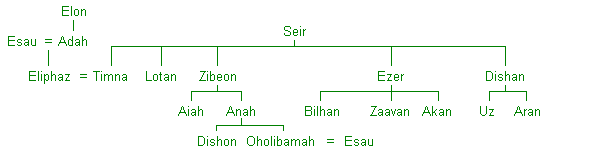
The Genesis genealogies are important because they help us to understand the Bible's purpose. From beginning to end, the Bible is about the royal ancestry of Jesus Christ. It is possible to trace His ancestry because of the cousin bride's naming prerogative, whereby the cousin or niece bride named her first-born son after her father.  This is why there are multiple rulers with the same name.  There is Lamech the Elder, who bragged to his two wives, and there is his grandson, Lamech the Younger, the first-born of Methuselah by Lamech's daughter, Naamah. There is Esau the Elder and his grandson, Esau, the brother of Jacob. Esau the Elder was a contemporary of Seir the Horite and their lines intermarried. Esau the Younger, Jacob's brother, married Seir's great-great granddaughter, Oholibamah.

The cousin-bride's naming prerogative is found from Genesis 4 to Numbers and beyond, so it is not coincidental, but characteristic of the unique marriage pattern of the rulers of Abraham's people. Scholars like Noth, Albright, Speiser, etc. concluded that Genesis 4 and Genesis 5 represent different oral or textual traditions of the same ruling line. This is NOT what the Bible claims, however, and I take the Bible's claims very seriously. Genesis claims that the rulers listed in Genesis 4 are the descendants of Cain and those listed in Genesis 5 are the descendants of Seth. The correspondence of names (Enoch/Enosh, Kain/Kenan, Irad/Jared, Lamech/Lamech, etc) between the two lists has to do with the cousin-bride's naming prerogative, something that I discovered after about 20 years of research.

All of the men listed in Genesis 4 and 5 are rulers who had two wives.  One wife was a half-sister (as Sarah was to Abraham) and the other was either a patrilineal cousin or a niece (As Keturah was to Abraham).  The cousin bride named her first-born son after her father because this son would ascend to the thorne of his maternal grandfather. So Lamech's daughter, Naamah married Methuselah, her patrilineal cousin or uncle and named their first born son Lamech, because this son of Methuselah would rule over Lamech the elder's territory, not over Methuselah's territory.  This is what Claude Lévi-Strauss discovered in his studies of primitive peoples (1949). He noted that in a patrilineal system, mother and son do not belong to the same clan.

The cultural patterns of the ancient Afro-Asiatics in general, and the Horite priest caste in particular, are reflected in Genesis, one of their many lasting contributions to the world. In my 33+ years of research on Genesis, I've discovered many traits of the ancient Afro-Asiatic worldview, established the binary nature of their cosmology, clarified the relationship between the Horites, the Jebusites, and the Dedanites, demonstrated the historical accuracy of the Kushite migration and kingdom-building, and identified the kinship pattern of Abraham and his ancestors, a pattern that continued until the birth of Jesus Christ, the Son of God. 


How I became interested in Anthropology

At a young age I was exposed to different cultures. This marks the beginning of my fascination with customs, artifacts and beliefs, a fascination that would later take me into the study of Anthropology. Much of my Genesis research draws on the disciplines of Anthropology, especially kinship analysis.

I have experienced societies in the Philippines, Spain, India, Thailand, Iran, Greece and many parts of the USA. At age 8 I visited the headhunters in the mountains of Luzon and even have a photo of my 6-foot tall father standing next to the 4-foot spear-carrying chief of the village. I attended Catholic Mass in a pew-less village church with a hard-packed dirt floor with chickens scurrying about our feet. As an adult, I studied two tribal groups while living in Iran and attended Divine Liturgy at the Armenian cathedral in Jolfa (Isfahan). I explored Orthodoxy again in Greece where I observed the Divine Liturgy and visited the Icon Museum in Athens.

Essentially what I am doing is pioneering Biblical Anthropology. What I have found is that the Bible is as reliable for anthropological study as it is for biblical archaeology.  How can this be?  Because of the Afro-Asiatics respected their received tradition and honored the celestial pattern.  In a 5,000 year old text, the Egyptian scribe, Ptah Hotep, states: "Don’t modify anything from your father’s (ancestor’s) teachings/instructions—not even a single word. And let this principle be the cornerstone for teachings to future generations."

Mircea Eliade (1907-1986) was a Romanian historian of religion who observed that for archaic man “real” objects and events are those that imitate, repeat or are patterned upon a celestial archetype. He believed that “the man who has made his choice in favor of a profane life never succeeds in completely doing away with religious behavior.” (The Sacred and the Profane)  He is right.  Even the most devout atheist enjoys liberties that are wrought by religious men.

Eliade wrote, " On Mount Sinai Jehovah shows Moses athe 'form' of the sancturary that he is to build for him: 'According to all that I shew thee, after the pattern of the tabernacle, and the pattern of al the instucments therefor, even so shall ye make it.... And look that thow make them after their pattern, which was shewed thee in the mount' (Exodus 25:9, 40). And when David gives his son Solomon the plan for the temple buildings, for the tabernacle, and for all their utensils, he assures him that 'All this... the Lord made me undersatnd in writing by his hand upon me, even all the works of this pattern" (I Chronciles 28:19). Hence he had seen the celestial model." (The Myth of the Eternal Return, p. 7)

The tabernacle and the temple on Zion were built according to the pattern of the Horite shrines, with pillars, water sources, and 3 chambers. This should not surprise us since Moses was the son of a Horite priest and David was the son of shepherd-priest who lived in the Horite settlement of Bethlehem (1 Chronicles 4:4), and both are descendants of earlier Horite ruler-priests. They were responsible for protecting and upholding the pattern which they received.  Their central myth reveals the pattern by which the Apostles and subsequent generations of Christians recognize that Jesus is indeed the Son of God who came into the world to save sinners, such as me.


Related reading:  An Apology; How I Approach Genesis: My Method; How Genesis Has Strengthened My Faith; Why a Blog About Genesis?; The Genesis King Lists

Saturday, July 17, 2010

Three-Clan Confederations to Twelve Tribes

Alice C. Linsley

Some groups in Genesis are 3-clan confederations (such as Isaac's 3 sons) and others are described as 12-tribe confederations. Nahor, Abraham's older brother, was the progenitor of twelve Aramean tribes through his twelve sons, of whom eight were born to him by Milcah and four by Reumah (Gen. 22.20-24).

Ishmael, Abraham's son by an Egyptian concubine, was the progenitor of twleve Nabatean tribes:  "Nebajoth; Kedar, Adbeel, Mibsam, Mishma, Dumah, Massa, Hadar, Tema, Jetur, Naphish, and Kedemah: These are the sons of Ishmael, and these are their names, by their towns, and by their castles; twelve princes according to their nations." (Genesis 25:13-16).

Jacob, a son of Isaac, was the progenitor of twelve Israelite tribes:  Reuben, Simeon, Levi, Judah, Issachar, Zebuln, Dan, Naphati, Gad, Asshur, Joseph and Ben-Jamin. There is discrepancy on the number of Israelite tribes. Some count Dinah's line and some count Joseph's two sons Ephraim and Manassah.

There is an attempt to organize Esau into a 12-tribe confederation in Genesis 36:40 but only eleven chiefs are listed.  The attempt fails because there are two named Esau. Esau the Elder was the father of Eliphaz.  Esau the Younger married Basemath who bore Reuel, and Oholibamah who bore Jeush, Jaalam, and Korah (Genesis 36:1-9). These were the people of Seir, the Horite. They were Horite clans. Their socio-political organization appears to be that of 3 clans.


The 12-tribe organization appears to be the handiwork of a writer influenced by Babylonian thought. It represents an attempt to neatly classify the ruler descendents of Noah according to a celestial pattern. However, the Bible tells us that these rulers intermarried. The lines of Kain and Seth intermarried, as did the lines of Ham and Shem. The lines of Abraham and Nahor also intermarried. This means that socio-political affiliations were less formal than suggested by the 12 tribe organization. 

Further, there is evidence that the older organization comprised three sons of the same father. Where three sons appear in Genesis we have a code indicating a joining of three clans or a tribal unity.  Perhaps this is why Leah named her third son Levi, meaning "joining" (Gen. 29:34).  Likely, Leah hoped that she would be credited (and loved?) by providing Jacob with the three sons necessary to establish a tribe.

The 12-tribe organization is likely imposed by a Mesopotamian source, since it suggests observation of the Moon.  Just as the days of the week are named for the seven visible planets, so the number twelve suggests the twelve cycles of the moon to complete a year.  Abraham's ancestors never associated the Moon with the Creator.  For them the Creator's emblem (boat or chariot) was the Sun. Veneration or worship of the Moon was characteristic of those who lived, not in Canaan, but "beyond the Euphrates". Joshua 24:2 says: “In olden times, your forefathers – Terah, father of Abraham and father of Nahor – lived beyond the Euphrates and worshiped other gods.” The implication is that Terah, whose ancestors came from Africa and Canaan, fell into worshiping contrary to his fathers’ tradition while living “beyond the Euphrates.” This is historically accurate since Abraham's Horite ancestors never worshiped the Moon, as was done in Ur and Haran.

The Joshua passage shares with the Deuteronomistic History a common concern with idolatry and places the covenant at Shechem at precisely the location where God appeared to Abraham in 3 Persons (Gen. 18). Here in reference to the Godhead, the number three speaks of one-ness or unity.
  
There is more evidence in the Bible for the 3-clan organization than for the 12-tribe organization. Consider the Horite confederations of Uz, Huz and Buz and Magog Og and Gog. Here are some of the 3-clan confederations listed in Scripture:

Cain Abel Seth (Gen. 4-5)

Ham Japeth Shem (Gen. 5-9)
Og Gog Magog (Gen. 10 and Nu. 21:33)
Haran Nahor Abraham (Gen. 11-12)
Ishmael Jokshan Isaac (Gen. 16, 21, and 25)
Jeush Jalam Korah (Gen. 36: 4-18)
Korah Moses Aaron (Ex. and Nu.)
Dedan Tema Buz (Jeremiah 25)

The Jebusite confederation is Yoruba, Egba and Ketu.  In Canaan, the 3-clan Jebusite confederation consisted of Sheba, Jebu and Joktan.
 
Among the Sara of Chad, Sudan and Somalia the confederation is comprised of the qir ka, the qin ka, and the qel ka. The Sara are descendents of the Sao, an earlier 3-tribe confederation of warriors and kingdom builders. According to legend, there were giants among them.

Martin Noth, in his seminal work "The Scheme of the Twelve Tribes of Israel" (1930), showed that the Twelve Tribes of Israel did not exist prior to the covenant assembly at Shechem described in the book of Joshua.

Thursday, July 15, 2010

Sara's Laughter

In Genesis 18: 13 we read that Sara laughed when she heard that she would bring forth a son in her old age.  Her laughter seems to be out of unbelief, certainly a natural response for a woman past her child bearing years.

Then we are told that Sarah denied laughing, another natural response for someone who doesn't want to insult a guest. The text doesn't lead us to believe that Sara knew that this was a divine announcement. If we contrast the annunciation to Sara with the annunciation to the Virgin Mary, we are struck by the fact that Sara was not the direct recipient of the message.  The biblical narrator tells us that the Lord made a promise to Abraham (which caused him to laugh) [1], but did Sara know that when visited at Mamre? The three Visitors pose a very different picture than Gabriel appearing directly to the Virgin Mary.

Later, when Isaac was born, Sara laughed again (Gen. 21: 6). The basic sense of the verb that appears in the Hebrew is “to laugh.”  The initial צְחֹק (in a rare participial form) refers to Sara's joyful  laughter upon giving birth to a son. This suggests that the name Sara is derived from the African word saran, meaning joy.  The word saran is also found in Hindi and is usually translated refuge. The word was probably introduced into India by the ancient Sudra (Sudanese) who established the Harappa civilization.

Then we are told that the child is named Isaac which means laughter. The name is Yitzak in Hebrew and Idhak in Arabic.

Genesis 26:8 says that Yitzak was caressing his wife Rebekah. The word translated "caressing" is the Piel/intensive form of the word "laugh" so the sentence would mean "He laughs was laughing intensively with his wife." Hebrew scholars suggest that this is a euphemism for having sex.

The association of laughter with the name Sara is suggested by several Afro-Asiatic languages.  The verb to laugh in Hausa, a Chadic language, is dara. Dara and Sara may be regarded as cognates since the letters d and s are interchangeable in Dravidian and many African languages. [2]

Sara might also be related to the Amharic sak', meaning to laugh, which is a cognate to the Kambaata word osalut, meaning ‘laughter’.

It is also possible that Sarah is related to the old Coptic sá nah meaning to make live. This would stress Sarah's birthing of her son. It likely also references the idea of refuge.

It is interesting to note also that the largest population group in Chad is called the Sara.[3] Sara society is organized by patrilineal descent from a common male ancestor. There is a 3-clan confederation such as characterizes Abraham's people. The qir ka are the eastern Sara, the qin ka are those living in central Chad, and the qel ka are the western groups. The Sara are descendents from an earlier 3-tribe confederation of warriors and kingdom builders. According to legend, there were giants among them.

NOTES
1. Genesis 17:17: Then Abraham fell upon his face, and laughed, and said in his heart, Shall a child be born to man who is one hundred years old? And shall Sarah, that is ninety years old, bear a child?

2. Dravidian languages are spoken in southern India and Sri Lanka. These languages are related to African languages of Chad, Sudan, Egypt and Somalia. Read more here.

3. The Sara make up to 30% of Chad's population. About a sixth of them are Christians and live in southern Chad. The Sara people include the Ngambaye, Mbaye, and Goulaye.

Tuesday, July 13, 2010

Analysis of the Genesis 4 and 5 King Lists


The pattern of two wives is illustrated in the case of Lamech the elder.


Related reading:  The Genesis King Lists

Thursday, July 8, 2010

The Serpent of Eden

Alice C. Linsley


Genesis tells us that Eden was a vast well-watered region extending from the Upper Nile Valley to the Tigris/Euphrates Valley.  This was the center of the Afro-Asiatic Dominion and here the oldest known divine promise was made to Mankind (Gen. 3:15).  Actually, that promise was made to "the Woman" (not Eve) concerning her Offspring who would crush the head of the serpent.[1]  To crush the head is an image of utter defeat.  So this is a promise about the victory of the Son over all that the serpent of Eden represents.

Nubian jar 300 BC
To better understand the Son's victory, we will explore what the Serpent of Eden represents in the context of the binary framework of Afro-Asiatic worldview in which the foremost distinction is always between the Creator God and the creation. This stands in contrast to religions in which this distinction is erased.

The serpent motif is found in Africa, Arabia, Pakistan, India, Central Asia and the Americas.  It is a significant symbol among traditional Africans and Native Americans, and in Judaism, Christianity, Islam, Hinduism and Buddhism. It is often found with symbols of the Sun and the Tree of Life. The great antiquity of these symbols is attested by their wide diffusion [2], yet their meaning has remained fairly stable in each religion.

Among archaic peoples the serpent was regarded as having powers to communicate [3], to deceive, to heal, to hide, to reveal and to protect. The oldest serpent veneration is associated with the 70,000 year old python stone carved in a mountainside in Botswana.

In Hindu mythology, the serpent-dragon RahuKetu tried to drink the nectar of immortality churned by the devas. The Solar and Lunar deities saw RahuKetu trying to do this and told Vishnu. Vishnu then threw his discus, cutting the dragon into Rahu (head) and Ketu (below the head) [4], but the dragon had already consumed the nectar and was thus immortal. Essentially, the serpent takes on divinity.

In the Gilgamesh Epic (Babylonian tale) Gilgamesh retrieves the Plant of Rejuvenation from the bottom of the sea. One evening as he was bathing in a pool, a serpent appeared and ate the Plant that Gilgamesh had left on the shore. The serpent then sloughed its skin and disappeared.  Here too is the implication that the serpent becomes immortal.

In Buddhist mythology, Buddha is often shown meditating under the hood of a seven-headed serpent (naga in Sanskrit; nahash in Hebrew). The serpent protects him from the rain. In another story, the celestial nagas shower the earth with rain as a blessing. They are deities in Buddhism, no longer simple creatures.

Jesus thought of the serpent as a creature with both positive and negative qualities, but never as an immortal being. He used serpent imagery to condemn the hypocrisy of the Jewish rulers: "Ye serpents, ye generation of vipers, how can ye escape the damnation of Gehenna?" (Matthew 23:33)  Yet earlier in Matthew's Gospel He sent forth his Apostles with this exhortation: "Behold, I send you forth as sheep in the midst of wolves: be ye therefore wise as serpents, and harmless as doves" (Matthew 10:16).

The ancient Greeks considered snakes sacred to Asclepius, the god of medicine. Asclepius carried a staff with one or two serpents wrapped around it. This has become the symbol of modern physicians. The ancient symbol of Ouroboros consists of a dragon or a snake curled into a hoop, consuming its own tail. In this image the serpent represents the eternal cycle of life.

As snakes shed their skins, revealing shiny new skins underneath, they symbolize rebirth, transformation, immortality, and healing.  In his novel The Voyage of the Dawn Treader C. S. Lewis uses this image to describe how sin can be sloughed only with Aslan's help. Eustace has turned into a dragon [5] and before he can step into the waters (Baptism) he must shed his scaley layers.  He sheds three layers but can't free himself to be the human he was originally created. Aslan must rip away the layers of sin before Eustace can step free.

In ancient Egyptian mythology, Apopis was a water serpent and a symbol of chaos. He is shown (right) being slain by Hathor, Ra's cat. Another story tells of how each night Apopis attacked Ra, the High God, but the serpent Mehen coiled himself around Ra's solar boat to protect Ra. This also illustrates the binary nature of ancient Egyptian thought, since the power of Mehen to protect is superior to the power of Apopis to destroy. This binary element is key to understanding the victory of Jesus Christ, whose victory is assured because He is one with the Father, not a creature.

In Exodus we read how Moses held up a rod which turned into a serpent and all who looked upon it were spared when they were bitten by vipers. The exalted Serpent was superior in every way to the serpents who attacked the Israelites in the wilderness. The Church Fathers interpreted this as a sign pointing to Jesus on the Cross. The Apostle John had this in mind when he wrote about how Jesus would be "lifted up from the earth" and thereby draw all Mankind to the Father (John 3: 14 and John 12:32).

The serpent of Eden is like those vipers in the wilderness. It is intent on spreading its poison and it achieves that end by means of confusion and deceit.  Here is how the serpent is described:

Now the serpent was more crafty than any of the wild animals the Lord God had made. He said to the woman, "Did God really say, 'You must not eat from any tree in the garden'?"

The woman said to the serpent, "We may eat fruit from the trees in the garden, but God did say, 'You must not eat fruit from the tree that is in the middle of the garden, and you must not touch it, or you will die.' "

"You will not surely die," the serpent said to the woman. "For God knows that when you eat of it your eyes will be opened, and you will be like God, knowing good and evil." (Gen. 3:1-5)

The serpent of Eden symbolizes deception, the promise of forbidden knowledge and self-elevation. It is not a deity, but it is "more cunning than any beast of the field which the Lord God had made."  Nevertheless, the serpent of Eden is very much a creature. The distinction between the Creator and the creature is clear.
 
The rabbis identify the serpent of Eden as Satan, the one who decieves and accuses 364 days of the year. Only on Yom Kippur is Satan not able to accuse.  That is the Day of Atonement. For those who believe that Jesus is the Son promised to the Woman in Eden, that is the day of Christ's atoning work on the Cross.  That day the Crucified One ripped away the great deception so that we who believe in Him might step free.
 
 
NOTES
1. The "Woman" of Gen. 3:15 is Mary, the Mother of Christ, our God. She is sometimes shown standing on a hemisphere with the serpent beneath Her foot.
 
2. Diffusion is the process by which a cultural trait, material object, idea, symbol or behavior pattern is spread from one society to another, often traceable to a central point or a point of origin. A principle of anthropology states that the wider the diffusion of a culture trait, the older the trait.  The point of origin for serpent veneration appears to be southern Africa.

3. Shinto shrines have snake pits where shamans go into trace states to communicate with the serpents and to communicate a message to humans from the serpent.

4. Ketu is the name of one of the 3 founders of the Jebusites. There are two Jebu territories and three founding brothers: Yoruba, Egba and Ketu. This 3-clan patriarchal confederation is typical of Abraham's African ancestors. Jebusite influence is reflected by the presence of the bronze serpent in the Israelite cult with many such serpent images having been found at Canaanite shrines in Gezer, Hazor, Meggido and Jerusalem.

5. In Christian iconography the serpent of Eden is often shown as a dragon.  Many famous paintings depict the serpent's defeat by either St. George or St. Michael, the Archangel.


Related reading:  Serpent Symbolism; The Cosmic Serpent Exposed; The Serpent from Africa to India

Tuesday, July 6, 2010

The Enigma of Joseph

Alice C. Linsley


Joseph, the favored son of Jacob, is an enigma.  He is a high-born youth who is sold as a slave and serves time in jail.  He was familiar enough with the customs of Egyptian nobility to adapt to his life in Potiphar's house and he went from slave to influential ruler. To understand the enigma of Joseph we must consider the finer details of his story.

He was a high-born slave
He was already Egyptianized before going to Egypt
He married a priest's daughter, as did Abraham, Isaac, Jacob and Moses
There is evidence that he had 2 wives, as did Abraham, Isaac, Jacob and Moses
He is claimed as a prophet by Jews, Christians and Muslims

Joseph's saga serves as the transition from the patriarchal narratives to the Exodus. After his death, he was mummified as a high-ranking Egyptian and buried in Goshen, adjacent to Avaris. Avaris was founded by Amenemhet I, the first king of the 12th dynasty. Archaeological and anthropological evidence indicates that the settlers of Goshen were people from Canaan who shared many features of Egyptian culture. This would be expected if Abraham's people were Horites, an Egyptian priesthood devoted to Horus of the Two Crowns.

Horite ruler-priests were careful to marry chaste daughters of priests. It is not a coincidence then that Joseph married Asenath, daughter of the "priest of Oon" (Gen. 41:45), later called Heliopolis (city of the Sun). Asenath's father was a Horite priest and the Horite priestly lines intermarried.  If the sons of Horite priests married the daughter of Horite priests, their sons were also in the caste of priest.  It means we must take these words quite literally: "For me you shall be a kingdom of priests, a holy nation." (Ex. 19:6)

Asenath, Joseph's wife, was raised at Heliopolis on the Nile. She was probably Joseph's cousin. Her first born son likely belonged to the Heliopolis shrine, whereas Ephraim, Joseph's younger son belonged to the House of Jacob. This explains why Jacob gave him the blessing that pertained to the first-born (Gen. 48:14).

Moses' two older brothers - Aaron and Korah - would also have married the daughters of priests. Korah's descendents are praised in 1 Chronicles 26, where they are grouped with the gatekeepers of Obed-Edom. Obed-Edom is a connection to Ruth, who named her first-born son Obed. Obed was the father of Jesse, the father of David. This picks up the Messianic thread, pointing us back to the Horite expectation of the Son of God who was coming into the world.


Traditions Concerning Joseph's Burial
According to tradition, Joseph was re-buried somewhere in Canaan, in Horite territory. Most claim that his tomb is near Nablus in Palestinian territory, a site regarded as holy by Jews, Christians and Muslims. The Tomb is located at the eastern entrance to the valley that separates Mount Gerizim and Mount Ebal. It is about 750 feet north of Jacob's Well, on the outskirts of Nablus, near biblical Shechem.

There is another Islamic tradition that places Joseph’s tomb in Haram al-Khalil in Hebron, in the tomb of the Patriarchs. This is the Tomb of the Patriarchs, a heavy rectangular building that encloses the underground Cave of Machpelah which was explored in 1967. This is the land and cave in Mamre that Abraham purchased for the burial of Sarah.

Under the 1993 Oslo Accords, Joseph's Tomb at Nablus was to be accessible to Jews and Christians. However, following peace talks at Camp David in September 2000, Arafat initiated his intifada in the West Bank. In October 2000, Fatah gunmen attacked the tomb repeatedly, killing two and injuring dozens, prompting Israel to evacuate Judaism's third holiest site on October 6, 2000. The attackers burned Jewish prayer books and repainted the white dome roof Muslim Green, transforming Joseph's resting place into another Muslim holy site and anachronistically pronouncing Joseph a Muslim

If the truth be told, Joseph does not fit the customary picture of Israelite or Arab. He married a Horite priest's daughter named Asenath.  Priest's daughters grew up around water shrines or river temples where their fathers served as priests. These were women of high rank but they did not live pampered lives. Zipporah was drawing water for livestock when she met Moses. Rebekah was likewise engaged when Abraham’s servant arrived to contract a marriage between her and Isaac. It is important to note that these priestly daughters had two sons:

Rebekah – Esau (oldest) and Jacob (youngest)
Rachel – Joseph (oldest) and Benjamin (youngest)
Asenath – Manasseh (oldest) and Ephraim (youngest)
Tamar – Zerah (oldest) and Perez (youngest)

In each case, the younger son was tagged as an ancestor of the Messiah. However, this does not mean that the other son was not an ancestor of Messiah since the priestly lines intermarried. We first find this elevation of the youngest son in the story of Cain, Abel and Seth. We also find it in the story of Abraham, who was the youngest of Terah's three sons. This pattern is found also with David, the youngest of Jesse's sons.

According to the Babylonian Talmud Abraham's mother was associated with the Nile shrine at Karnak. Horite rulers married the daughters of Horite priests.  About 75% of the women named in the Old Testament are daughters of priests. This was the practice among the royal priestly lines of Abraham’s people. So by every indication, Joseph was as thoroughly immersed in Horite religious practice as was Abraham, Isaac, Jacob and Moses.

The Horites were a caste of ruler-priests who were devotees of Horus, who they regarded as the "Son of God". Both Heliopolis (Anu) and Karnack were Horite shrines. The priests of these shrines were clean shaven, like Moses’ half-brother Korah, whose name means shaved one. There is a twice-life-size statue in Joseph's tomb. The statue shows a clean-shaven man, not a bearded man as would be expected of an Asiatic (as shown below, second from the right).

Horus is the pattern by which later generations would recognize Jesus. Horus' birth was miraculous. He was killed by his brother and he rose to life again. Heliopolis, which has been occupied since the Predynastic Period, was one of the shrines dedicated to Ra-harakhty, which literally means Ra who is Horus of the Two Horizons (East and West). Joseph would have been buried facing the West as preparation for the journey to the world of the dead, where the sun shone after leaving the world of the living.

Horus was said to be the Lord of Two Lands (Upper and Lower Egypt) and of Two Horizons. Horite ruler-priests married two wives and placed them in separate households on a North-South axis so as not to give offense to Horus who made his daily journey from East to West. Jesus claimed to be the Shepherd of two flocks. The two sheep folds represent the Kingdom He receives from the Father. One fold is comprised of all those who lived in expectation of His Incarnation and the other fold - the Church - is comprised of those who adore Him, the Son of God who has come in the flesh to save sinners, restore Paradise, and reign eternally.

In Goshen/Avaris, Joseph had a large Egyptian-style palace built over Jacob's dwelling. The palace enclosure had a garden tomb, the largest sepulcher found in Goshen.  Joseph's body would have been mummified and wrapped in cloth. He was buried in a coffin, either facing the west to greet the rising Sun or with the head toward the north, according to the custom of his Kushite/Sudra ancestors. This attests to the antiquity of the Joseph story because royal burials were later in cemetaries far removed from residences.

The Avaris palace had adjoining twin suites for two families. These may have been for Joseph's two wives or for the families of his two sons.  This would have been one of at least two residences belonging to Joseph. The other was likely in Heliopolis on the Nile.


Related reading:  Potiphar, Son of Horus; Who Were the Horites?

Saturday, July 3, 2010

Jesus Christ's Kushite Ancestors


Alice C. Linsley


The name Seth (Set) is associated with ancient Kush in the Upper Nile in what is today southern Egypt and Sudan. In Egyptian writings this land was called Ta-Seti, meaning "Land of the Bow," referring to the weapon used by warriors and hunters of that part of Africa. Khaem-wa-set, the brother of King Seti I (1302-1290 B.C.), was the Chief of the bowmen of Kush. 

Pharaoh Seti I was likely named for an earlier Seti. While it may not be possible to trace him back to Seth, Kain’s brother, it is possible to trace Seti's Kushite origins.

In Genesis 5 we read the list of rulers who descended from Seth. The tenth from Seth is Kush, a son of Ham. African story tellers (griots) generally recount lists of rulers and ancestors to the depth of 10, so the line of Seth would look like this:

Seth
Enosh
Kain (Kenan), grandson of Kain
Mahalalel
Jared (Irad or Yared)
Enoch
Methuselah
Lamech the Younger, son of Naamah and Methuselah
Noah
Ham
Kush

The Kushites began to achieve greatness around 5,000 B.C., about 2,000 years before Noah, whose homeland is called Bor-No (Land of Noah). The oldest Kushite culture to have undergone extensive excavation is that at Kerma.[1] A funerary temple in Kerma illustrates Kush’s connections to kingdoms at its northern/Egyptian and southern/Nigerian boundaries. One interior wall depicted Egyptian fishing boats, bullfights, and an enormous crocodile. Another wall showed rows of giraffes and hippopotamuses, wildlife characteristic of the territories to the southwest of Kush/Nubia. Naqada pottery dating to about 4000 B.C. is adorned with realistic images of ostriches and ibexes, animals not found near the Nile.

The Kushites traded with kingdoms to the north and to the south. There is evidence that the clans herded cattle from the grasslands to a communal gathering place at the Nile each year. [2]  Some settled during the Chalcolithic Period on the edges of the Beersheba Valley where they lived in subterranean dwellings carved out of the limestone wth metal tools. An ivory workshop was discovered in one of these houses at Bir es-Safadi.  The Bible refers to these as Dedanites.[3]  The men shaved their heads (Jeremiah 25:23), as did Horite priests. This suggests that a confederation of Horite families lived in the Beersheba Valley. Genesis 36 confirms this, listing Dedan as a Horite ruler. Genesis 10 tells us that Dedan's father was Raamah, son of Kush. His brother was Nimrod who established a vast kingdom in the Tigris-Euphrates River Valley.

There is still much to discover about ancient Kush. Unfortunately, many Kushite artifacts were destroyed when the Aswan Dam was built. Over 45 Nubian villages were washed away along the banks of the Nile south of Aswan. Twenty-four monuments were dismantled and relocated and many others were documented before the area was flooded.

This makes the biblical record even more valuable as a tool to reconstruct a picture of ancient Kush. And that biblical record is proving to be reliable. For example, Genesis 11:3 tells us that the towers in Mesopotamia were built of fired brick, an innovation which began in Kush around 2500 B.C. Fired bricks were not used for royal buildings which were always made of stone, but was used for common houses and to build walls. The use of fired brick to build towers in Mesopotamia suggests that this advancement moved eastward from Kush into the land of Shinar. All the Mesopotamian ziggurats were built with a core of mud brick and an exterior covered with baked brick. Ziggurats were stepped temples built in Sumer, Babylon and Assyria from about 2200 until 500 BC.


Kush was the father of Nimrod. Between 1100 and 800 B.C. the name Nimrod was a popular name in Egypt, according to Chaldean Genesis.  (Jesus was baptized at an ancient Egyptian river shrine on teh Jordan. The place was called Nim-rah, meaning the waters of God.) Nimrod built cities in Mesopotamia and he probably introduced the use of fired brick. We meet Nimrod’s descendents later in the persons of Nahor and Terah, Abraham’s father. Ramaah settled in the Arabian Peninsula, south of Dedan. We meet Ramaah’s descendents later in the person of Seir the Horite.[4]

What we have here is further evidence that the lines of Ham and Shem intermarried so that the ancestors of Christ our God were Nilotic peoples.


Related reading:  Who Were the Kushites?; Who Were the Horites?; The Christ in Nilotic Mythology


NOTES
1. Kerma was excavated by the Swiss archaeologist Charles Bonnet. To read Bonnet's chronology of Kerma, go here.

2. In 1986, cattle burials were found at Qustul, south of Abul Simbel, in the heart of Kush.

3. Dedan, Tema and Buz comprized a Horite confederation. The oldest Arabic texts have been found around the Afro-Arabian oases of Tema and Dedan. Tema, known by Arabs as Taima, lies about 70 miles north-east of Dedan. Tema, Dedan and Dumah were caravan stops along the trade route from Babylon to Sheba.

4. The term Horite can't be taken anachronistically when speaking of Abraham's ancestors, who were devotees of Horus, who they regarded as the “Son of God.”


Related reading:  Biblical Anthropology and Antecedents; Who Were the Kushites?; The Christ in Nilotic Mythology; Who Were the Horites?

Thursday, July 1, 2010

Methuselah's Wife

Lamech Segment Analysis
© 1998 Alice C. Linsley


According to the Hebrew Scriptures, the ruler Methuselah lived 969 years, the perfect number set in the context of ancient Egyptian numerology. By his cousin wife Naamah [1], he had a son named Lamech. This is Lamech the Younger named for Naamah’s father (see bottom portion of the diagram.)

Lamech ruled after Methuselah and is assigned another perfect number in the Masoretic text. He is said to have lived 777 years.[2] However, while the Scriptures agree on Methuselah’s 969 years, they disagree on the numbers assigned to Lamech. The Septuagint (Greek Old Testament) assigns Lamech 753 years, whereas the Samaritan Pentateuch assigns him 653 years. The Masoretic text provides the number that fits the biblical pattern. St. John Chrysostom noted the assignment of 7 to Cain, 77 to Lamech the Elder, and 777 to Lamech the Younger and believed that the number 7 in these cases speaks of God’s mercy shown to sinners.

It is likely that seven represents the seven visible planets and is linked to astrological concepts of ancient Egypt. We may never know exactly what these number sets signify, but the association of such auspicious numbers – 6, 7 and 9 – with Methuselah and his son Lamech indicate their greatness.[3]

Some view Lamech the Younger, named in Genesis 5, as the same Lamech named in Genesis 4 who bragged about killing a man. This is a mistake. Lamech the Elder is not presented as a righteous man, but as a braggart who set himself up as an equal to God.[4] Lamech the Younger, on the other hand, is the son of a righteous father and the father of Noah who found favor with God.

Why should there be such discrepancy in the number of years assigned to Lamech the Younger? Possibly the Septuagint didn’t recognize that there are two different persons named Lamech. Or the discrepancy might indicate dispute over Lamech’s character among the different recensions. Or it simply may be that the Septuagint and the Samaritan texts reflect lack of understanding of the kinship pattern of Abraham’s ruling ancestors.

I believe the discrepancy in numbers assigned to Lamech the Younger indicates lack of understanding of the kinship pattern. In this patrilineal system involving royalty and ascent to the throne, mother and first-born son do not belong to the same clan. The bride belongs to her husband’s clan while her son, if given her father’s throne name, belongs to the bride’s clan. The brilliant anthropologist, Lévi-Strauss recognized this in 1949, but his research was largely ignored by biblical scholars.

So it is that Naamah belonged to Methuselah’s clan, of the lne of Seth, while their first-born son belonged to the clan of his maternal grandfather, of the line of Kain.

NOTES

1. Naamah is a royal name as attested by the name's connection with the Davidic Dynasty. David's grandson's mother was named Naamah (II Chron. 12:13).  This is also the name of a region of Judah (Joshua 15:41).

2.  The number seven has special significance as related to the first-born son’s marriage and his reception of a kingdom. In Jewish weddings the seven marriage blessings (Sheva Brachot) are recited under the huppah and the wedding feast lasts seven days. The assignment of 777 to Lamech the Younger symbolizes the son's marriage and ascension to the throne of his father.

3. Numbers were associated with totems such as the Lion, the Falcon, the Baboon, etc. The four sons of Horus are an example. Imsety is shown with a man’s head. Tuamutf is shown with a jackel’s head. Kabhsenuf is shown with a baboon’s head, and Hapi is shown with a falcon or hawk’s head. Mummification involved removing the body's organs which were placed in four jars adorned with the heads of these four sons. These four stood as guardians over the organs until such a time as the Ka and the Ba could be united, thus avoiding the second death (of which John speaks). Likewise, the Four Gospels have totems: Eagle (Matthew), Bull (Mark), Lion (Luke) and Man (John) and the Gospel writers are indeed guardians of Holy Tradition concerning the Son of God.

3. Lamech’s wives were named Adah (dawn) and t-Zillah (dusk), suggesting that Lamech the Elder placed his 2 wives on an east-west axis. All the other rulers listed in Genesis 4 and 5 likely had 2 wives also but it appears that they placed them on a north-south axis, as did Abraham. Sarah lived in Hebron and Keturah lived in Beersheba, to the south. By placing his wives on an east-west axis, Lamech the Elder claimed a territory corresponding to that of the Creator, whose emblem the Sun, makes a daily journey over the Earth, traveling from east to west. It is interesting to note that Mohammed, a descendent of Abraham by Keturah, placed his 2 wives’ apartments on the east and west sides of his mosque in Medina. Doubtless, this lent credibilty to his claim to be The Prophet of Allah.


Related reading:  The Cousin Bride's Naming Prerogative; African Naming Practices; An African Reflects on Biblical Names