Followers

Showing posts with label birds. Show all posts

Tuesday, September 13, 2016

Noah's Birds


Alice C. Linsley

The historicity of Noah’s great flood is supported by findings in many disciplines. The key to the alignment of the data of the Bible and science is placing Noah in the correct location and time period. We can dismiss the idea that he lived in the region of the Black Sea and that the ark landed on Ararat. That idea dates from the 11th century A.D. when the Armenians began to identify Ararat as the ark's landing place. This was repeated in the two Catalan manuscripts known as the Ripoll and Roda Bibles written in Latin and illustrated at the beginning of the eleventh century in the monastery of Ripoll, during the time of Abbot Oliba (1008–1046). The Hebrew in Genesis 8: 4 states that the ark came to rest on hare 'ararat - hills of 'ararat. This is likely a pun on the Arabic word herarat - حرار - which means vehemence, a reference to God's wrath.

If we remove this very late gloss on the text, there is no longer any reason to assume that Noah lived in the region of the Black Sea. In fact, that suggestion runs contrary to all the other biblical data that indicates that Noah was a Proto-Saharan ruler and the grandfather of Kush (Gen. 10:6).

Noah was a ruler in the region of Lake Chad in central Africa. Climate studies reveal that the location of Lake Chad was much wetter in Noah's time than it is today. Noah lived between 4050 and 3800 BC, when the Sahara experienced a wet period called the Aqualithic or the African Humid Period). This places Noah in relatively recent history, not at the dawn of human existence.

Noah was one of the "might men of old" mentioned in Genesis 6. These rulers of the archaic period dispersed out of Africa into Mesopotamia, the Levant, and Southern Europe. Nimrod was one of the rulers who descended from Noah. He built his kingdom in the Tigris-Euphrates Valley. These great rulers were known as sar, meaning king. The word corresponds to the Sanskrit śāri and the Nilo-Saharan and Hausa word sarki. The Sumerian word for king is sar and the Chadic word for ruler is gon, so Sar-gon means "High King" or "King of Kings." The Elamite word for king was sunki, a variant of sarki. Another variant is the word šarka, found in the Lithuanian language.
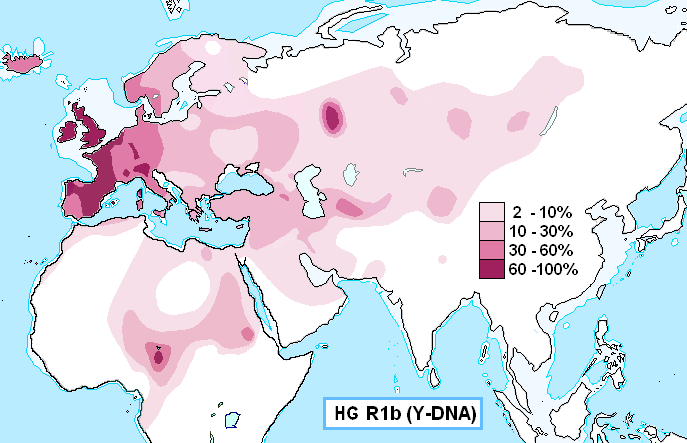
DNA studies that show that Noah's R1b peoples dispersed from Africa. The dispersion of the R1b group is shown on the map below. Note the bright red mark in central Africa. This is the region of Lake Chad, Noah's homeland.


In the story of Noah's ark, the Bible recounts how Noah released two birds after the rain stopped: a dove and a raven. In Africa the dove is a symbol of prophetic discernment so sending out a dove was Noah’s way of seeking guidance. Among the ancient Nilotes birds symbolized celestial wisdom.

Knowing the location of Noah's homeland helps us to narrow the species of doves and ravens. The most common dove in the part of Africa where the flood occurred is the Pink-bellied Dove. This species is abundant near water sources and and was associated with shrines located at rivers, springs and wells, so the idea of the Spirit hovering like a dove over the waters at the beginning of creation is consistent with empirical observation of these doves. The pink belly is suggestive of blood sacrifice which made peace between the penitent and God. This peace is symbolized by the olive branch which the dove brought to Noah.

The raven mentioned in Genesis is probably the Fan-tailed Raven, in the crow family. Its habitat extends across North Africa, Arabia, Sudan and Kenya. It also ranges across the Air Massif in Niger where it nests in crags. The red area shows the Fan-Tailed Raven’s habitat. This is the location of ancient Eden described in Genesis. Noah's descendants were rulers and priests in this red shaded area.


This is the natural habitat of both the Pink-bellied Dove and the Fan-tailed Raven, the birds that Noah might have released.

The raven was a symbol of the Creator and his son Horus. The root of the word is ḱoro- and koro is a variant of Horo or Horus. Koro is also an ancient term for war, suggesting a scavenger bird, similar to the falcon (Horus' totem) and the Egyptian vulture, both significant birds in the Bible.

The vulture, scorpion, horse and lion are found on stone pillars at the Gobekli Tepe site in Turkey which dates to about 9000 B.C. Here they appear to correspond to constellations at a time when Thuban was the pole star and they are likely clan totems. These creatures are commonly found on African images, which suggests that the structure at Gobekli Tepe was influenced by priests whose origins were in Africa. The vulture is especially important totem among the Nubians whose warrior deity was Yah/YHWH.


Sunday, July 21, 2013

Sea birds use sense of smell to navigate


Scientists have long known that reversals in the Earth’s magnetic field can affect climate, habitats and navigation of humans and wildlife. In the past 10 million years, there have been 4 or 5 reversals or "excursions" per million years.

Migration and motion of creatures like bats, the dung beetle, and sea birds is not affected because they use other sensory means of navigation. Some bats use vision and others navigate using a system of sonar called "echolocation." The African "rolling" dung beetle navigates by visual clues taken from observing the Milky Way.

A recent study of sea birds reveals that they rely on olfactory clues. Here is a summary of that report:

Pelagic birds, which wander in the open sea most of the year and often nest on small remote oceanic islands, are able to pinpoint their breeding colony even within an apparently featureless environment, such as the open ocean. The mechanisms underlying their surprising navigational performance are still unknown. In order to investigate the nature of the cues exploited for oceanic navigation, Cory's shearwaters, Calonectris borealis, nesting in the Azores were displaced and released in open ocean at about 800 km from their colony, after being subjected to sensory manipulation. While magnetically disturbed shearwaters showed unaltered navigational performance and behaved similarly to unmanipulated control birds, the shearwaters deprived of their sense of smell were dramatically impaired in orientation and homing. Our data show that seabirds use olfactory cues not only to find their food but also to navigate over vast distances in the ocean. 

Read the full report here.


Between geomagnetic reversals, volcanism, earthquakes, tsunamis, climate changes, and the expansion and contraction of the seas, Earth is constantly changing. Life on Earth is constantly adapting. How wonderful is God's design!

The British Geologic Survey reports, "There is no obvious correlation between human development and reversals. Similarly, reversal patterns do not match patterns in species extinction during geological history.

Some animals, such as pigeons and whales, may use the Earth's magnetic field for direction finding. Assuming that a reversal takes a number of thousand years, that is, over many generations of each species, each animal may well adapt to the changing magnetic environment, or develop different methods of navigation."


Related reading:  The Dung Beetle and Heavenly Lights; Climate Cycles Indicate a Dynamic Earth; The Bi-Polar Seesaw

Wednesday, February 1, 2012

Analysis of the Flood Story

Alice C. Linsley


There are two flood traditions in Genesis, expressing different perspectives on that event. In the chart that follows we see how the traditions are crafted into a chiastic narrative. The narrative reflects a Nilotic perspective and a Mesopotamian or Akkadian perspective. Both are very old, and the narrative is the work of an author who was familiar with both traditions. (Genesis 4 has a ABBAABB…ABBA chiastic structure.)

The Nilotic perspective is evident in the water and mountain archetypes, and in the use of the number 40.  The Nile flooded for 40 days and it took 40 days for the waters to abate.  The Mesopotamian perspective is evident in the covenant language and in the use of the number 7.

The two different birds may represent the different traditions concerning ravens and doves. However, both birds would have been native to East Africa, Arabia and Mesopotamia.

In Africa, the dove represents prophetic discernment, so sending out a dove was Noah’s way of seeking guidance. The most common dove in the region of the flood is the Pink-bellied Dove. This species is abundant near water and would have been associated with river shrines such as those along the Nile. The pink belly is suggestive of blood sacrifice which made peace between the penitent and God. This peace is symbolized by the olive branch which the dove brought to Noah.

The raven or crow was a trickster in Annu tradition.  While the dove returns with a message, the trickster does not. Annu means "those of royal blood" (See Gwendolyn Leick, A Dictionary of Ancient Near Eastern Mythology, 1998, p. 7.) and Abraham had Annu ancestors. Abraham's father was Terah, a royal name among the Nilotic Annu.

The analysis is from here.  The lines form the image of a bird in flight, perhaps representing Horus? Horus was shown with the body of a man and the head of a falcon. The falcon was his totem and a symbol of divine kingship. Horus or Hr is "the lord of the sky or "the one on high." The Horites spread their religious practices and beliefs from ancient Kush to Mesopotamia and beyond. The oldest fire altars were falcon shaped. This is why the Shulba Sutras state that "he who desires heaven is to construct a fire-altar in the form of a falcon."

Horite stone altar
In both the Nilotic and Mespotamian traditions we find water and mountains archetypes.  The pyramids of the Nile and the ziggurats of Mesopotamia are stylized mountains or the meeting place of God and the divinely appointed or chosen ruler. The ziggurat had 7 terraces.

The sacred center of the flood story (P in the chart above) casts us back to the beginning of creation when the Spirit moved over the waters (Gen. 1:2). "And God remembered Noah, and every living thing, and all the cattle that was with him in the ark: and God made a wind/spirit (ruach) to pass over the earth, and the waters asswaged..."

The temporal sacred center is when the Sun rests at the peak of the day, when there are no shadows (James 1:17).  In terms of the solar day, this is the temporal sacred center.

The spatial sacred center is between heaven and earth, on the mountain top where God meets with the chosen leader. Abraham, Moses, and Elijah encountered God on mountains. The spatial sacred center is the mountain, prefiguring the Christ's crucifixion and tranfiguration.  The center of the Genesis 6 flood narrative is bracketed by the covering/veiling and revealing/unveiling of mountains. Here we have a sign pointing to God's self-revealing in the Person of Jesus Christ.

The sacred center in ancient Canaan was Shechem (modern Nablus). It was located between the mountains of Ebal on the northern side of the valley and Mount Gerizim on the southern side. Mount Ebal rises 3084 feet above sea level, some 194 feet (59 meters) higher than Mount Gerizim. From Mount Gerizim the priests declared the blessings and from Mount Ebal the curses (Deut. 11:29). This was part of the covenant at Shechem, but curiously only the curses are recorded in Scripture (Deut. 27).

The mountain as celestial archetype is very old. The mountain is the safest place when the waters become the chaotic deep (tehom in Hebrew: תְּהוֹם‎). Noah's ark came to rest on the "mountain of vehemence" (ararat in Arabic). The binary opposite of tehom is tehut, divine order/wisdom.  The oldest known moral code is the Egyptian "Law of Tehut" which dates to about 5,000 B.C.  When God spoke the creation into being He fixed boundaries which those who honor the Creator are not trespass. Trespassing established boundaries invites chaos (tehom) to return like a great flood to the world. Tehom and tehut are binary opposites, and typical of the binary worldview of Abraham's people, there is a hierarchy, with tehut being greater because it preserves order and life.

The binary conception is evident also in the relationship of dry land and waters, which God separated in the beginning. The victory of tehut (order) over tehom (chaos) relates to the annual inundation of the Nile and helps us to understand the Egyptian concept of creation. One of the oldest creation myths envisioned the first place in the world as a mound emerging from the waters of a universal ocean. Here the first life form, a lily, grew on the peak of the primeval mound. The ancient Egyptians called the mound Tatjenen, meaning "the emerging land."


The map above shows the natural habitat of both the Fan-Tailed Raven (crow) and the Pink-bellied Dove, the birds that Noah may have released from the ark. It is also the Afro-Asiatic Dominion, with the Nile at the center. This vast area was controlled by the ruler-priests named in the king lists of Genesis 4, 5, 10, 22:20-24 and 36.  According to the flood account and Genesis 10, Shem, Ham and Japheth are the royal ancestors of the rulers of Mesopotamia and the Horite territory of Edom.


Feminine Imagery

The association of the waters with the origins of life is a distinctly feminine image which may explain the emergence of the goddess Tiamat, who along with Lillith, pertains to a later period of Babylonian mythology.  Among the Yoruba, living descendants of the ancient Nilotic peoples, the association of waters with the feminine principle is evident in the symbolism of the calabash and the rainbow. The calabash symbolizes the waters below and the womb, and the rainbow symbolizes the waters above. Together these represent the entire cosmos.

The mountain image for the Virgin Mary and the Nativity of Christ follows verses such as Habakkuk 3.3 - "God came from Mount Paran" and the portrayal of Mary as "Holy mountain" rests on ancient cosmology. The Virgin Mary, whose womb swelled with the Son of God, is sometimes portrayed in icons as the mountain of God. The Prophet Daniel saw a mountain, from which a stone was cut by the hand of God (Dan. 2:34, 45). This is the stone which the builders rejected and which has become a stumbling block, even Jesus Christ, the Son of God.


Related reading:  The Extent of Noah's Flood; Noah's Descendants; Mount Mary and the Origins of Life; The Victory of Tehut Over Tehom