Followers

Showing posts with label Noah's Flood. Show all posts

Monday, July 24, 2017

The Historicity of Noah's Flood


Alice C. Linsley

The historicity of the flood in Genesis is highly probably once we determine when and where Noah lived, using the data of Scripture. One of Noah's grandsons is called "Kush" (Gen. 10) which is also a place name associated with the Nile Valley. This is a clue that Noah lived in Africa, not the Middle East.

Noah lived c. 4200 BC, at a time when the water systems of Central Africa were larger. There was a seaway through the Sahara, and the Benue Trough connected to Lake Chad and to rivers and lakes of the east which in turn connected to the Nile.

Analysis of the kinship pattern of the rulers listed in Genesis chapters 4, 5, 10, 11, 25 and 36 reveals that these rulers have a common ancestry. This is because the Hebrew ruler-priests were a caste and typical of caste, they took the marriage partners from members of the caste (caste endogamy).

The Hebrew ruling lines intermarried. In the diagram below, the intermarriage of the lines of Ham and Shem is evident. Cain's daughter married her cousin and named their firstborn sone Kenan, after her father. Irad's daughter married her cousin and named their firstborn son Jared/Yared/Irad, after her father. Consistent with the cousin bride's naming prerogative, Lamech's daughter, Naamah, named her firstborn son Lamech, after her father.


Genesis 10:8 tells us that Nimrod was a Kushite kingdom builder who established his territory in Mesopotamia. He married a cousin, a Hebrew princess of Sumeria who named their firstborn son Asshur after her father. Abraham is one of Nimrod's descendants. Nimrod was one of Noah's great grandsons. This is a clue that Noah was not Mesopotamian. His homeland was in Africa.


This identical pattern of intermarry (endogamy) is evident between the lines of Cain and Seth. In the diagram below, note that Lamech, a descendant of Cain, had two wives. By his wife Zillah, he had a daughter named Naamah. Naamah married her patrilineal cousin Methuselah. Methuselah is a descendant of Seth. Naamah named her first born son Lamech, after her father. Lamech the Younger is the great grandfather of Noah.


We may logically wonder if Noah might have lived in the Nile Valley (Kush) or perhaps in the region of Lake Chad which connected to the Nile in the period of the African Aqualithic.

The region of Lake Chad was called Borno or Benue, meaning "Land of Noah." Even today the natives of that region consider it to be Noah's homeland. The local Kanuri people call Lake Chad Buhar Nuhu, meaning "Sea of Noah." This is the only place on earth that is claimed by the native population to be Noah's homeland. Since Abraham's early ancestors (4200 BC and before) came out of Africa this should not surprise us.

The Lake Chad Basin is relatively flat and prone to monsoonal flooding. It is ringed by mountains from which water drained into the Basin. The Chad River Basin is shown in this map outlined in red.


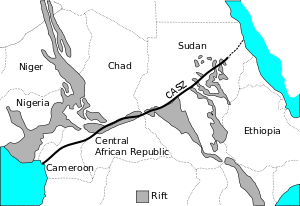
At the time Noah lived, the Sahara was much wetter. There was an extensive system of interconnected lakes and rivers. The western Nile watershed extended well into the Sudan. Hydrological studies indicate many periods of flooding from the Nile to the Atlantic coast of Nigeria. Noah lived in the region of Lake Chad. The gray shaded areas show the ancient water ways in the African Sheer Zone.


There was an abundance of reeds. According to Genesis 6:14, Noah's ark was constructed of גפר (gofer/gopher), which is the word used to describe the basket in which Moses floated on the Nile. In other words, the ark was constructed of reeds. The hollow reeds were extremely buoyant. Such vessels are still constructed by the marsh Arabs of Iraq and East Africans.


There is a great deal of evidence that boats were once prevalent in the Sahara. The black mahogany Dufuna dugout (shown below) was found in the Sudan buried 16 feet under clays and sands whose alternating sequence showed evidence of deposition in standing and flowing water. The dugout is 8000 years old. By comparison, Egypt's oldest boat is only about 5000 years old. Peter Breunig (University of Frankfurt, Germany) has written this description of the Dufuna boat: “The bow and stern are both carefully worked to points, giving the boat a notably more elegant form”, compared to “the dugout made of conifer wood from Pesse in the Netherlands, whose blunt ends and thick sides seem crude”. Judging by stylistic sophistication, Breunig reasons that, “It is highly probable that the Dufuna boat does not represent the beginning of a tradition, but had already undergone a long development, and that the origins of water transport in Africa lie even further back in time.”


Boats appear on prehistoric rock paintings in the Sahara. Many show people transporting long horn cows by boat. The Proto-Saharan were cattle-herding. Here are examples of the sickle, incurved sickle, square, incurved square, and flared boat types found on the prehistoric rock art of the Central Eastern Desert of Egypt.


The historicity of Noah’s concern for animals is supported by the discovery that Proto-Saharan rulers kept royal menageries of exotic animals. The oldest known zoological collection was found during the 2009 excavations at the shrine city of Nekhen on the Nile. The royal menagerie dates to about 3500 BC and included hippos, elephants, baboons and wildcats. Noah would have known about the shrine city of Nekhen. It was one of the earliest worship centers for the Horite Hebrew. This painting was found on the wall of a tomb in Nehken.


At Nekhen archaeologists discovered a mummified ruler with red hair and a red beard. Although most of the hair found in the graves at Nekhen was of a dark brown color, natural red hair was discovered in association with the male in Burial no. 79. (Nekhen News, page 8)

Noah and his descendants appear to be in Y-DNA Haplogroup R1b. The R1 rulers were the "mighty men of old" who dispersed into southern Europe, the Tarim Valley of China, and eventually into the British Isles. About 70% of native British men are in Haplogroup R1b. The dark red spot in Central Africa is Noah's homeland near Lake Chad.


Populations of the Lake Chad region before Noah

The oldest known cemetery in the Sahara dates to 7500 B.C., about 3500 years before the time of biblical Noah. The material evidence indicates a settled population at the edge of a very large lake or trough, possibly Lake Mega-Chad which connected to the Benue Trough.

The initial discovery was made by National Geographic photographer Mike Hettwer in 2000, and the excavation work was led by University of Chicago archaeologist, Paul C. Sereno, famous for his discovery of dinosaurs.

About 7500 B.C., at the time that this graveyard was used, Lake Chad had an area of about 249,000 miles. It is likely that the graveyard that Paul Sereno uncovered was originally at the edge of Lake Mega-Chad.

According to a recent report about the cemetery site, "The burial density, tool kit, ceramics, and midden fauna suggest a largely sedentary population with a subsistence economy based on fishing and on hunting of a range of savanna vertebrates."


This Gobero skeleton measures 6 feet.
Photo (c) Mike Hettwer, courtesy Project Exploration


According to Sereno, the Early Holocene people left when it became arid, but the area was repopulated by a taller people around 4600 B.C. when humid conditions returned. That is the time of Noah whose descendants are described as tall in the Bible.

The region was much wetter than today and the inhabitants of the area experienced flooding. There was flooding on and off over a long period, and wet conditions prevailed from 7700-6200 (phase 2).

Sereno states, "The darkened bone color of all human skeletons in phase 2 burials is indicative of sustained inundation." (Read about Sereno's findings here.)

Another wet period corresponds to the time that Noah would have lived in the region of Lake Chad, between 4200 and 3800 B.C.


Wednesday, May 11, 2016

Ken Ham and the "Ark Park" miss the boat


Image from Answers in Genesis


Alice C. Linsley

This is one of the ads to promote Ken Ham's "Ark Encounter" which is scheduled to open in Kentucky on July 7th. Look carefully at the animals in the doorway of the wooden ark. See a few problems?

At the time Noah lived, Nilo-Saharan rulers were building large boats out of גפר (gofer/gopher) wood, as described in Genesis 6:4. The word gofer refers to reeds and is used in reference to the basket made by Moses mother (Exodus 2:3). The Schocken Bible reads: "Make yourself an Ark of gofer wood, with reeds make the Ark...", Vol. I, p. 35. Noah's ark probably looked like this.


Anthropological study of Noah's ancestry, based on the biblical data, indicates that he was a Proto-Saharan ruler in the region of Lake Chad. This is the only place on earth where the people claim the land to be that of Noah, that is, Borno, in the region of Lake Chad. The word "bor" has a double meaning: "land/territory" and "flood". The Dinka/Nuer word for flood is bor, and the word No is an African variant of the Hebrew Noah.

During the time when Noah would have lived in the region of Lake Chad, this African Shear Zone was very wet due to a 500-year period of monsoonal rains known as the Aqualithic, the Gurian Wet Period, or the African Humid Period.


As to the animals, Proto-Saharan rulers kept personal menageries. The oldest known zoological collection was found during the 2009 excavations at Nekhen on the Nile. The royal menagerie dates to about 3500 BC and included hippos, elephants, baboons and wildcats. Noah likely kept a menagerie which he would have protected in the time of flood.

Were we to test the DNA of Noah and his descendants we would likely find them to be in the R1b Haplogroup (Y-DNA). The Biblical data concerning dispersion of the archaic rulers from this region and the genetic tracking of the dispersion of these peoples corresponds closely.

The dense red dot in central Africa is the region of BorNo, "the Land of Noah" near Lake Chad.

The "ark" according to Ken Ham looked like this:


It is impressive, but it is not an accurate representation of the ark as it is described in Genesis.

Wednesday, September 5, 2012

Noah's Homeland in Historical Perspective


A ship made of gopher (Gen. 6:14). Noah's ark would have looked like this.


Alice C. Linsley


There is a time honored tradition that associates Noah with the region of Lake Chad. Here we find the territory of Bor-No which means "Land of Noah." It is sometimes spelled Bor-Nu which means "Land of Gold" because Proto-Saharan kings such a Noah had access to the mineral resources of the Upper Nile.

The Sahara known to Noah was a wet place. According to Dr Kevin White, “Over the last 10,000 years, there have been two distinct humid phases, separated by an interval of highly variable but generally drying conditions between roughly 8,000 and 7,000 years ago. Another drying trend took place after about 5,000 years ago, leading to today’s parched environment.”

When Noah lived, approximately 2490-2415 BC, the Sahara experienced a wet period (Karl W. Butzer 1966). This is the period of the Old Kingdom, a time of great cultural and technological achievement. This places Noah and his sons in relatively recent history, not at the dawn of human existence.

The oldest known zoological collection was found in this region during excavations at Nekhen (Hierakonpolis) in 2009. The royal menagerie dates to ca. 3500 BC and included hippos, hartebeest, elephants, baboons and wildcats. Proto-Saharan rulers, like Noah, kept personal menagerie and in a time of flood would have made provision for the animals.

Nekhen is the oldest known site of Horite Hebrew worship. It was a shrine city as early as 4000 BC.

At least 3,500 years before Noah people were using dugouts to navigate the rivers of the Sahara. This is attested by the discovery of an 8000 year old black mahogany dugout in Dufuna in the Upper Yobe valley along the Komadugu Guna River in Northern Nigeria.

The 8000-year Dufuna boat was found in Nigeria.

Sir Harry Johnston
(1858-1927), an agent of British colonial system in West Africa, wrote several books on the history and linguistics of Africa. He makes the earliest reference to Bornu as a version of Borno and connects this region to biblical Noah.

In his 1836 monograph Anacalypsis: An Inquiry into the Origins of Languages, Nations and Religions, Godfrey Higgins noted that the reference to Noah's ark landing in the mountains of Ararat in "Armenia" could mean simply that it landed on "mount of Meru… that is, Ar or Er-Meni-ia, the country of mount Meru or Meni."

Higgins noted the linguistic similarity between Meru and Meni. Meru is spelled Meri in Egyptian and Meri is sometimes spelled Meni, with the n taking the place of the r, in Southeastern Asian languages like Siamese, where the Virgin Mary is called Mania.

Noah's mountain became Meru, the sacred mountain of  Hinduism and Buddhism. According to Buddhist tradition, the island of Sri Lanka broke off from Meru. Many Hindu temples have been built as symbolic representations of Mount Meru with its seven seas and seven surrounding mountain walls.

In the Bhagvad Gita, Lord Krishna says, "Among the mountains, I am Meru", that is the spinal cord of the world. The Vishnu Purana (c. 200 BC) details how there are seven continents ringed by seven oceans. This cosmology was a mirror image of the seven planets/bowls above. Here we have an example of the celestial archetypes about which Mircea Eliade writes in the Myth of the Eternal Return.

The Hindu story may contain a kernel of history. Noah may have settled on Mount Meru, Africa’s fifth highest mountain, located in northern Tanzania. It stands at 15,000 feet and is 42 miles west-southwest of Mount Kilimanjaro, near the Kenyan border. 

The Nigerian philologist Modupe Oduyoye observed the Noah-Borno connection in his book The Sons of Gods and the Daughters of Men (1984, Orbis Books). Oduyoye has written here about the African background of Genesis.


Proto-Saharan Climate

New evidence from satellite images reveals that the Nile flooded more extensively than previously thought. The waters spread nearly 100 miles west of the river and created "mega-lakes" in what is today the Sahara desert. (Read more here.)

The Chadic Sea in turn connected to the Benue and Niger River Troughs so that travel and commerce was possible on the major water systems from the Atlantic coast of modern Nigeria to the Nile, the Red Sea, The Arabian Ocean and Indian Ocean. At the time of Noah and his ancestors Cain and Seth, the Sahara was Green. 

This is how the historian Roland Oliver has described the Green Sahara: "[In] the highlands of the central Sahara beyond the Libyan desert,... in the great massifs of the Tibesti and the Hoggar, the mountaintops, today bare rock, were covered at this period with forests of oak and walnut, lime, alder and elm. The lower slopes, together with those of the supporting bastions — the Tassili and the Acacus to the north, Ennedi and Air to the south — carried olive, juniper and Aleppo pine. In the valleys, perennially flowing rivers teemed with fish and were bordered by seed-bearing grasslands."

In Noah's time boating and fishing industries were active on Lake Chad. The average fishermen used canoe dugouts which they could carve themselves, but nobles, such as Noah, used boats constructed of marsh reeds lashed together and sealed with pitch. It is likely that Noah had a fleet of such boats.

Proto-Saharan rulers were known to keep ménageries. The animals were kept in pairs so that they would reproduce. Likely these were the animals that Noah preserved by moving them on boats.

Lake Chad was at least 130 feet deeper than it is today and covered an area of about 135,000 square miles (350,000 sq km). The footprint of ancient Mega-Chad has been confirmed by satellite photography. The Nile waters swelled from increased rainfall and cut a deeper and wider flood plain, extending well into Sudan to the west. The area attracted merchants from southern Africa who moved their cargo along the rivers and paid tariffs to the chiefs who controlled the river junctions.


Evidence of the Holocene Wet Period

The Holocene Wet Period has be called the "Gurian Wet Period" and the "African Aqualithic."  The latter term was coined by British archaeologist John Sutton (Journal of Africa History 1974; Antiquity 1977).

Between 10 and 12 thousand years ago the Nile river system filled with waters from the Angolan Highlands, the result of geological uplift which created Lake Victoria and directed its excess flow north in the White Nile. The White Nile provides most of the Nile's water during the dry season.

The Holocene Wet Period owes the abundance of water to climate cycles related to Earth's Great Year, to monsoons off the Indian Ocean, and to the African rifts that created great watersheds or troughs.

Rifting combined with prolonged rains caused this entire region to flood.
Lake Chad is located at the boundary of Niger, Nigeria, Chad and Cameroon. 

Between 12 and 10 thousand years ago, the Nile connected to the Chadic and Niger water systems through a series of shallow lakes in the Sahara Desert. This explains the common plant and animal species found in all three water systems.

The now dry Botswanan lake basin was once a sea filled with water from the Angolan Highlands. Some of Africa's earliest human populations lived on the edges of this great lake and evidenced by thousands of man-made stone tools found there. The tools include mace heads and date to between 80,000 and 100,000 years.


Ancient Accounts of a Wet Period

Plato recounts that "Many great deluges have taken place during the nine thousand years" since Athens and Atlantis were preeminent. In these floods, water rose from below, and only those who lived on the mountains survived. He reports that the third great flood before Deucalion washed away most of Athens' fertile soil. [Timaeus 22; Critias 111-112]

The ancient Egyptians believed that flooding represented divine punishment of rebellion against Ra/Atum's appointed ruler. "People have become rebellious [lawless]. Atum said he will destroy all he made and return the earth to the Primordial Water which was its original state." (Genesis 1:2)

The chaotic waters is called tehom (Hebrew: תְּהוֹם‎) in Genesis 1 and has a Nilotic origin. It refers to is an ancient concept of a disordered deep God put in order by His Word (Egyptian hu or hut). Tehom is subdued by Tehut. The oldest known moral code is the Law of Tehut which dates to about 5,000 BC.

In Genesis 6:9-11, we are told that Noah was God's favored ruler on earth; "an upright man among his contemporaries." God saw that the earth was corrupt and full of lawlessness and determined to destroy the lawless ones by a great flood.

Genesis 2:10-14 says that Abraham's ancestors lived in a vast wet region which the Bible calls "Eden." It was watered by the Tigris, the Euphrates, the Pishon and the Gihon. The first two are in Mesopotamia and the last two are in Africa. This is the heart of the Afro-Asiatic Dominion which extended from Niger to Pakistan, India, Nepal and Cambodia. This is the place of origin of Abraham's ruler-priest ancestors and of "him that holds the scepter from the house of Eden." (Amos 1:5)

Genesis 2:11 states that the Pishon "flows through the whole land of Havilah." Ha-vilah refers to the head waters or place where the waters originate. It is also the territory of Havilah, a son of Kush (Gen. 10:7). The Kushites lived in the upper Nile region and the Sudan. Kushite kings were the early rulers of Egypt. The Upper and Lower Nile regions were first united by the Kushite warrior-king Menes.

Noah was the great grandfather of Kush. Kush's first born sons by his two wives were Nimrod (Gen. 10:8) and Raamah (Gen. 10:6). They ruled over separate territories in the ancient Afro-Asiatic Dominion. Nimrod ruled in the Tigris River valley. Raamah and his son Dedan controlled the eastern coastal area of the Yam Suph (Red Sea).

DNA studies have confirmed the Kushite migration out of Africa. However, there were already human populations scattered across the earth, especially at the more temporate zones. Some of those populations resulted from earlier migrations out of Africa. The first took place about 120,000 years ago and the second about 70,000 years ago. The Kushite expansion coincided with the spread of the Horite Hebrew religion. In Akkadian texts these priests were called "Abru" which is "Hebrew" in English Bibles.
 
The climate change that brought gradually drier conditions to what was once a vast wet world is explained in various sacred texts. The dry land swallowed the excess waters. The Koran [11:25-48] refers the earth swallowed the water, and says that Noah's boat came to rest on the mountain Al-Judi." 

In Revelation 12 the devil-dragon spews a flood of water to destroy the sun-clothed Woman who bore the Divine Son, but the earth protected the Woman and Child by swallowing the flood. This recapitulates the Genesis 3:15 reference to Woman giving birth to the Divine Seed.


The Extent of the Flooding During Noah's Time

Paul Sereno unearthed 10,000 year old skeletons at Gobero in Niger. These were buried on the edge of a paleolake on the northwestern rim of the Chad Basin. The Gobero site is the earliest known cemetery in the Sahara and the skeletons found there indicated that some were at least 6 feet tall.


Gobero skeleton (G3B8) measures 6 feet 6 inches
Photo (c) Mike Hettwer, courtesy Project Exploration

According to Sereno, these earlier Holocene people left when it became arid, but the area was repopulated by a taller people around 4600 B.C. when humid conditions returned. Flooding occurred on and off over a long period. Wet conditions prevailed from 7700-6200 (phase 2). Sereno states, "The darkened bone color of all human skeletons in phase 2 burials is indicative of sustained inundation." (Read about Sereno's findings here.)

Another wet period corresponds to the time that Noah would have lived in the region of Lake Chad, between 3000 and 2500 B.C.

At the time of the Gobero populations (9700-4400 years ago), humans were dispersed globally, and during the time of Noah these populations were not destroyed. Consider the following population estimates by urban center between 3000 and 2200 BC, around the time when Noah's flood would have occurred:

Memphis, Egypt - 32,000 inhabitants
Lagash, Iraq - 60,000 inhabitants
Mohenjo-daro, Pakistan - 40,000 inhabitants
Mari, Syria -50,000 inhabitants

Baodun settlements, China - Baodun is the largest settlement, covering an area of about 373 miles. There is no evidence of destruction by flooding though all six Baodun settlements straddled the Min River in central Sichuan province. The Min is a tributary of the upper Yangtze River.

There is no evidence that any of these peoples were wiped out by a worldwide flood. The evidence simply does not support the interpretation that all the peoples of the earth were destroyed in a catastrophic global flood and that the earth was repopulated by Noah's descendants.

Wednesday, May 30, 2012

Was Earth Repopulated After Noah's Flood?


Alice C. Linsley


Noah lived in the region of Lake Chad (Borno/Benue - "Land of Noah") approximately 5500-4500 B.C, when the Sahara experienced a wet period. Humans had already dispersed globally by 12,000 B.C. 

Some of those dispersed populations were from earlier migrations out of Africa. There have been multiple migrations out of Africa, probably as early as 500,000 years ago. 

Abraham was a descendant of the Kushite kingdom builder Nimrod who established his territory in the Tigris-Euphrates valley. This explains why in the Bible we first meet Abraham in Mesopotamia.


8000-year dugout found in the Sahara


About 4000 years before Noah people were using dugouts to navigate the rivers of the Green Sahara. This is attested by the discovery of an 8000-year-old black Mohagany dugout in Dufuna in the Upper Yobe valley along the Komadugu Guna River in Northern Nigeria. This region was much wetter at the time that Noah and his sons ruled there.

The oldest known zoological collection was discovered during excavations at Nekhen on the Nile in 2009. This royal menagerie that dates to 3500 B.C. and included hippos, hartebeest, elephants, baboons and wildcats. The story of the Proto-Saharan ruler Noah preserving a collection of animals is based on historical reality.

Nekhen is the oldest known site of Horite Hebrew worship (4200 B.C.). Noah probably knew of this place.


What was happening before Noah?

The evidence of archaic human industry, religion, ritual burial, and domesticity in Africa, Arabia and China creates a more accurate picture of the earlier populations.

On the Arabian Peninsula, the Qafzeh population was using tools 125,000 years ago at Jebel Faya and burying their dead in red ochre.

Humans were making reed mattresses 77,000 years ago in South Africa. That is where the oldest mattress— made from compacted grasses and leafy plants— was found at the Sibudu Cave site in KwaZulu-Natal. In this same region a stone carving of a python has been found that dates to 70,000 years.

There is the evidence of mining 80,000 to 100,000 years ago. These major mining operations in southern Africa included quarries and tunnels. It is estimated that a million kilos of red ocher ore were excavated from several mines. At one mine half a million stone-digging tools were found. The red ocher was ground to power and was used globally to bury rulers. Anthropologists agree that the red ocher symbolized blood. Apparently, it was connected to the people’s hope that the ruler might rise from the dead and lead his faithful people to immortality.

The Pengtoushan culture thrived along the Yangtze River between BC. 7500–6100, and the Yangshao culture flourished along the central Yellow River between BC. 5000 and 3000. Yangshao nobles wore silk garments. 

Cemetaries were established which reveal ritual burial. Paul Sereno unearthed 10,000-year skeletons at Gobero in Niger. These were buried on the edge of a paleolake on the northwestern rim of the Chad Basin. The Gobero site is the earliest known cemetery in the Sahara and the skeletons found there indicated that some were at least 6 feet tall.


Gobero skeleton (G3B8) measures 6 feet 6 inches
Photo (c) Mike Hettwer, courtesy Project Exploration

At the time of the Gobero populations (9700-4400 years ago), humans were dispersed globally, and during the time of Noah these populations were not destroyed. 

There is no evidence pf a worldwide flood that led to extinction of humans and animals. Human settlements in Europe, the Americas, Asia, and the Near East were along major water systems and prone to flooding. Flood stories often appear in ancient texts. A late source (Deuteronomist Historian) used the Noah story to promote his theology of God's wrath upon sinful humanity. 

Noah's flood was a large regional flood. The term "eretz" which appears in the Genesis flood stories can mean earth, land, or territory. The Lake Chad region was Noah's territory and is the only place on earth claimed to be Noah's homeland by the local populations. The local Kanuri people refer to Lake Chad as "Buhar Nuhu", meaning Sea of Noah.

Noah's three sons were Hebrew clan chiefs whose descendants intermarried (caste endogamy). Those descendants dispersed widely and carried their beliefs wherever they lived. However, they did not repopulate the earth after a catastrophic worldwide flood.


Wednesday, March 21, 2012

Answers to High Schoolers' Questions about the Flood


Alice C. Linsley


Part 4: The Flood
This continues the series on Questions that High Schoolers Ask about Genesis. Additional important data is provided here.


Q:  Was the flood global or regional?

A:  This was the question most often asked by the high school students about Noah's flood.  To answer this question we must consider who Noah was, where he lived, and the climate conditions that he experienced.  Not all of this information can be found in the Bible.  However, Genesis provides many clues that can direct the search for the historical Noah.

Noah lived approximately 2490-2415 BC, when the Sahara experienced a wet period (Karl W. Butzer 1966). This is the period of the Old Kingdom, a time of great cultural and technological achievement in Egypt.

Noah, a descendant of the men named in the Genesis 4 and 5 King Lists, was a great ruler.  The  rulers named in Genesis controlled the major water systems of Lake Chad, the Nile, and the Tigris and Euphrates.  The interconnected waterways were their roads. In other words, Noah would have been familiar with boats and likely had a fleet. 

These ancient rulers imposed taxes on cargo that moved through their territories. They used the rivers to expand their kingdoms and to spread their Afro-Asiatic worldview.  Nimrod is an example.  His father was Kush, a ruler who controlled a vast region of the Upper Nile.  Nimrod left the Nile region and built his kingdom along the Tigris in Mesopotamia. (Gen. 10:8-12)

Noah likely lived in the region of Bor-Nu (Land of Noah) near Lake Chad. This is the only place on Earth that claims to be Noah's homeland. Satellite photographs reveal that Lake Mega-Chad was once a huge body of water, five times the surface area of Lake Superior and with a depth ranging from 200 to 600 feet. This part of Africa was much wetter than it is today due to climate cycles and the African rifts that created great watersheds or troughs.

Rifting combined with prolonged rains caused this entire region to flood.
 Lake Chad is located at the boundary of Niger, Nigeria, Chad and Cameroon.


In Noah's time, there was a prolonged wet period due to monsoons circulating from the Indian Ocean. During this wet period, the major water systems from the Benue Trough to the Tigris-Euphrates overflowed, creating a vast watery world. This was the world that Noah knew, so from his perspective the whole world was flooded.

During the Late Holocene, Lake Chad had a surface area of approximately 159000 square miles. As the climate changed and the waters receded, what was once a single lake became three separate lakes: Lake Chad, Lake Bodele and Lake Fitri.

In 1987, a fully preserved boat was discovered in the region where Noah's flood took place. The Dufuna dugout was buried at a depth of 16 feet under clays and sands whose alternating sequence showed evidence of deposition in standing and flowing water. The dugout is 8000 years old. By comparison, Egypt's oldest boat is about 5000 years old.

Peter Breunig (University of Frankfurt, Germany) lead the excavation of the Dufuna boat. He said, “The bow and stern are both carefully worked to points, giving the boat a notably more elegant form.” Breunig believes that, “It is highly probable that the Dufuna boat does not represent the beginning of a tradition, but had already undergone a long development, and that the origins of water transport in Africa lie even further back in time.”

The Dufuna dugout dates from the time of the collapse of the Laurentide Ice Sheet in North America. This resulted in a significant rise in global sea levels. This event contributed to the success of European farming, but was not the main cause of Noah's flood. The flood recorded in Genesis was due more to seismic events and climate changes closer to Noah’s home in Africa.

The story of Noah's ark landing on a mountain in Armenia represents a misunderstanding of the Afro-Arabian words Har Meni, meaning Mount Meni located in East Africa. David M. Westley, PhD, Director of the African Studies Library at Boston University, reports that "From the center of the Chad Basin to Mount Meni is about 230 miles."


Not all peoples have flood stories. Those that do live near major water systems which had catastropic flooding in the past. There is no geological evidence for a worldwide flood. Nor is there sufficient water in Earth's biosphere for the mountains to be covered by flood waters.  It has been argued that God created more water to flood the entire earth, but this is contrary to the biblical assertion that God completed all His creation on the 6th day and thereafter rested from the work of creating.


Q:  Did Noah literally put two of every species on the Ark?

A:  According to Genesis 6:19, Noah brought only a male and female of the species onto the ark. However, Genesis 7:2 says that he saved seven pairs of only "clean" animals.  Clearly, there are two flood accounts, just as there are two creation stories. These represent different traditions among Abraham's Afro-Asiatic people.

The emphasis on having a male and female indicates God's concern that the various species survive the extensive flooding. The animals were indigenous to the region where Noah lived and some were imported. Noah probably had a ménagerie, something that was common among rulers during that period.  Ménagerie animals were kept in pairs so that they would reproduce. Perhaps these were the animals that God instructed Noah to save.

Syrian bears were brought to Egypt during the 5th Dynasty. These bears were generally docile and kept on leashes.  Athenaios of Naucratis reports that a white bear was housed by Ptolemy II in his private zoo at Alexandria.  The oldest known zoo was in Nekhen (Hierakonpolis), a shrine city dedicated to Horus (the Deity of Abraham's Horite people). The Nekhen ménagerie existed in the middle of the second millennium BC. It is believed that the local ruler kept powerful wild animals as symbols of his power.


Q:  How did Noah built the Ark? Did he have help?

A:  Noah was a great ruler. He would have had boat builders, household servants and gardeners.  He is remembered for having a vineyard (Gen. 9:20). As a king, Noah had access to the best and the most plentiful supply of boat building materials and shipwrights.

Noah's reign must have been one of great prosperity for his people.  An oracle concerning Noah states, “This one shall bring us relief from our work and the toil of our hands.” (Genesis 5:29)

The greatness of the Lake Chad region declined when the Monsoon Belt moved more to the south and the desert began to encroach. Apparently, many people migrated toward the Nile and the center of political power shifted from west central Africa to eastern Sudan, Egypt, Arabia and Mesopotamia. This corresponds to the Kushite migration of Abraham's ancestors confirmed by DNA studies.


Q:  Did Noah know about tar or pitch to seal the planks of his boat?

Egyptians making ropes and fishing lines
A:  Noah used technologies and materials that were available.  The ancient Egyptians used tar in mummification so it was known to Noah and was available. Tar and pitch were used in the ancient world to waterproof ship hulls and to caulk the seams of sailing vessels. Pitch is more solid while tar is more liquid. The words tar and pitch are often used interchangeably.

Ships and boats require wood rudders, sails and ropes.  The ancient Egyptians were the first to document how to make ropes. The Egyptians were consummate ship builders.  In Noah's day ships were built of both wood and reeds. 
4000 year old Egyptian ship plank


Q:  What was the weight capacity of Noah's Ark?

A: The answer to that question depends on the materials used to construct the boat.  According to Genesis 6:14, Noah's Ark was constructed of גפר (gofer/gopher) wood. Since this word does not appear elsewhere in the Bible, there is a good deal of speculation about the material used to build the Ark. Noah would have built with materials available to him and those materials included wood and reeds.

Noah's boats were likely constructed mainly of reeds. Reeds were an abundant building material in Bor-nu during Noah's time. The word translated "ark" in Genesis 6:14 is found only one other place in the Bible. Moses' mother put him in a reed basket which is called an "ark" in Exodus 2:3. This is why some Bibles read: "Make yourself an Ark of gofer wood, with reeds make the Ark..." (Schocken Bible, Vol. I, p. 35)

If the ark was constructed of a wood frame with hollow reeds in large bundles it would have had great buoyancy. Thor Heyerdahl learned from the Marsh Arabs that if the reeds are cut in August they retain their buoyancy rather than absorbing water.

Reed boats of this type were about 60 feet long and were capable of carrying 50 tons of cargo when fully loaded.


Q:  Maybe all the species on earth today evolved from the "pairs" of animals saved on Noah's Ark. Wouldn't this support evolution by natural selection?

A:  The animals on Noah's ark would be animals that we recognize today as species indigeneous to Africa and Arabia.  They are not the progenitors of all the animal species today.  The Bible does not provide evidence to support evolution of one species becoming an entirely different species gradually over time.


Related reading:  Analysis of the Flood Story; The Extent of Noah's Flood; Abraham's Ancestors Came Out of Africa; Part 1: Answers About God; Part 2: Answers About Adam and Eve; Part 3: Answers About the Serpent

Wednesday, February 1, 2012

Analysis of the Flood Story

Alice C. Linsley


There are two flood traditions in Genesis, expressing different perspectives on that event. In the chart that follows we see how the traditions are crafted into a chiastic narrative. The narrative reflects a Nilotic perspective and a Mesopotamian or Akkadian perspective. Both are very old, and the narrative is the work of an author who was familiar with both traditions. (Genesis 4 has a ABBAABB…ABBA chiastic structure.)

The Nilotic perspective is evident in the water and mountain archetypes, and in the use of the number 40.  The Nile flooded for 40 days and it took 40 days for the waters to abate.  The Mesopotamian perspective is evident in the covenant language and in the use of the number 7.

The two different birds may represent the different traditions concerning ravens and doves. However, both birds would have been native to East Africa, Arabia and Mesopotamia.

In Africa, the dove represents prophetic discernment, so sending out a dove was Noah’s way of seeking guidance. The most common dove in the region of the flood is the Pink-bellied Dove. This species is abundant near water and would have been associated with river shrines such as those along the Nile. The pink belly is suggestive of blood sacrifice which made peace between the penitent and God. This peace is symbolized by the olive branch which the dove brought to Noah.

The raven or crow was a trickster in Annu tradition.  While the dove returns with a message, the trickster does not. Annu means "those of royal blood" (See Gwendolyn Leick, A Dictionary of Ancient Near Eastern Mythology, 1998, p. 7.) and Abraham had Annu ancestors. Abraham's father was Terah, a royal name among the Nilotic Annu.

The analysis is from here.  The lines form the image of a bird in flight, perhaps representing Horus? Horus was shown with the body of a man and the head of a falcon. The falcon was his totem and a symbol of divine kingship. Horus or Hr is "the lord of the sky or "the one on high." The Horites spread their religious practices and beliefs from ancient Kush to Mesopotamia and beyond. The oldest fire altars were falcon shaped. This is why the Shulba Sutras state that "he who desires heaven is to construct a fire-altar in the form of a falcon."

Horite stone altar
In both the Nilotic and Mespotamian traditions we find water and mountains archetypes.  The pyramids of the Nile and the ziggurats of Mesopotamia are stylized mountains or the meeting place of God and the divinely appointed or chosen ruler. The ziggurat had 7 terraces.

The sacred center of the flood story (P in the chart above) casts us back to the beginning of creation when the Spirit moved over the waters (Gen. 1:2). "And God remembered Noah, and every living thing, and all the cattle that was with him in the ark: and God made a wind/spirit (ruach) to pass over the earth, and the waters asswaged..."

The temporal sacred center is when the Sun rests at the peak of the day, when there are no shadows (James 1:17).  In terms of the solar day, this is the temporal sacred center.

The spatial sacred center is between heaven and earth, on the mountain top where God meets with the chosen leader. Abraham, Moses, and Elijah encountered God on mountains. The spatial sacred center is the mountain, prefiguring the Christ's crucifixion and tranfiguration.  The center of the Genesis 6 flood narrative is bracketed by the covering/veiling and revealing/unveiling of mountains. Here we have a sign pointing to God's self-revealing in the Person of Jesus Christ.

The sacred center in ancient Canaan was Shechem (modern Nablus). It was located between the mountains of Ebal on the northern side of the valley and Mount Gerizim on the southern side. Mount Ebal rises 3084 feet above sea level, some 194 feet (59 meters) higher than Mount Gerizim. From Mount Gerizim the priests declared the blessings and from Mount Ebal the curses (Deut. 11:29). This was part of the covenant at Shechem, but curiously only the curses are recorded in Scripture (Deut. 27).

The mountain as celestial archetype is very old. The mountain is the safest place when the waters become the chaotic deep (tehom in Hebrew: תְּהוֹם‎). Noah's ark came to rest on the "mountain of vehemence" (ararat in Arabic). The binary opposite of tehom is tehut, divine order/wisdom.  The oldest known moral code is the Egyptian "Law of Tehut" which dates to about 5,000 B.C.  When God spoke the creation into being He fixed boundaries which those who honor the Creator are not trespass. Trespassing established boundaries invites chaos (tehom) to return like a great flood to the world. Tehom and tehut are binary opposites, and typical of the binary worldview of Abraham's people, there is a hierarchy, with tehut being greater because it preserves order and life.

The binary conception is evident also in the relationship of dry land and waters, which God separated in the beginning. The victory of tehut (order) over tehom (chaos) relates to the annual inundation of the Nile and helps us to understand the Egyptian concept of creation. One of the oldest creation myths envisioned the first place in the world as a mound emerging from the waters of a universal ocean. Here the first life form, a lily, grew on the peak of the primeval mound. The ancient Egyptians called the mound Tatjenen, meaning "the emerging land."


The map above shows the natural habitat of both the Fan-Tailed Raven (crow) and the Pink-bellied Dove, the birds that Noah may have released from the ark. It is also the Afro-Asiatic Dominion, with the Nile at the center. This vast area was controlled by the ruler-priests named in the king lists of Genesis 4, 5, 10, 22:20-24 and 36.  According to the flood account and Genesis 10, Shem, Ham and Japheth are the royal ancestors of the rulers of Mesopotamia and the Horite territory of Edom.


Feminine Imagery

The association of the waters with the origins of life is a distinctly feminine image which may explain the emergence of the goddess Tiamat, who along with Lillith, pertains to a later period of Babylonian mythology.  Among the Yoruba, living descendants of the ancient Nilotic peoples, the association of waters with the feminine principle is evident in the symbolism of the calabash and the rainbow. The calabash symbolizes the waters below and the womb, and the rainbow symbolizes the waters above. Together these represent the entire cosmos.

The mountain image for the Virgin Mary and the Nativity of Christ follows verses such as Habakkuk 3.3 - "God came from Mount Paran" and the portrayal of Mary as "Holy mountain" rests on ancient cosmology. The Virgin Mary, whose womb swelled with the Son of God, is sometimes portrayed in icons as the mountain of God. The Prophet Daniel saw a mountain, from which a stone was cut by the hand of God (Dan. 2:34, 45). This is the stone which the builders rejected and which has become a stumbling block, even Jesus Christ, the Son of God.


Related reading:  The Extent of Noah's Flood; Noah's Descendants; Mount Mary and the Origins of Life; The Victory of Tehut Over Tehom

Monday, August 22, 2011

How Big Was Noah's Flood?


Alice C. Linsley

Noah lived in the region of Lake Chad. He was one of the mighty men of old who controlled a section of the major water systems of that part of the wet Sahara. According to Dr Kevin White, “Over the last 10,000 years, there have been two distinct humid phases, separated by an interval of highly variable but generally drying conditions between roughly 8,000 and 7,000 years ago. Another drying trend took place after about 5,000 years ago, leading to today’s parched environment.”

Lake Chad was a giant lake known as Lake Mega-Chad with an area of 249,000 miles (400,000 km). At its maximum extent it was larger than any lake that exists on earth today. Around 7500-6950 BC it was 586 feet deep.

The Komadugu River connects Lake Chad
and the Yobe River Basin.
This would have been the river route
that connected Kain, Nok (Enock) and Noah.
The Chari River in the south flowed into Lake Chad (as it does today) and there were waves driven by continental trade winds. Two distinct episodes have been identified in which the boundaires of the Lake expanded. These correspond to lower and middle Holocene phases of wetter conditions in central and northern Africa. Noah lived around 2490-2415 BC when the Sahara experienced a wet period (Karl W. Butzer 1966). This is the period of the Old Kingdom.

There appears to have been a connection between Lake Mega-Chad and the Bahr Al-Ghazal which flows into Lake No (Noah's Lake) in Sudan and from there flows eastward as the White Nile (Bahr al-Abyad).

Around 4000 BC, the Horite city of Nekhen was along the Nile (in Sudan) and Lake Mega-Chad had split into three separate lakes: Lake Chad, Lake Fitri and Lake Bodele.


Reference: Shorelines in the Sahara: geomorphological evidence for an enhanced monsoon from palaeolake Megachad by Nick Drake and Charlie Bristow, Department of Geography, King’s College London

Saturday, October 23, 2010

Mary, the Mound and the Bread of Life


This Nativity icon shows Mary with the Christ Child (the Bread of Life) in a mound.
The mound is shaped like an ancient clay bread oven.

Alice C. Linsley

The mountain image for the Nativity of Christ follows verses such as Habakkuk 3.3 - "God came from Mount Paran" and the clay oven shape relates to the claim that Jesus is the "bread of Life."

In observation of the Heavens it is evident that the Sun always rises in the east and appears to journey across the sky to the west. The only time when there are no shadows is high noon, so in terms of the solar day, this is the temporal sacred center. The spatial sacred center is between Heaven and Earth, on the mountain top. Abraham, Moses and other biblical figures climbed to the tops of mountains to encounter the Creator.  Jesus, who "came down from Heaven", was revealed on Calvary and on the Mount of Transfiguration.

The sacred center is temporal and spatial, halfway between East and West as measured by the Sun's movement to high noon, and halfway between Heaven and Earth. This is the place of encounter between God and Man, the place of both judgment and redemption. 

The mountain image as a celestial pattern is very old. It is the safest place to be when the chaotic waters rise. Te-hom (Hebrew: תְּהוֹם‎), the chaotic deep,  is the opposite of te-hut, divine wisdom and order. (The oldest known moral code is the Law of Tehut which dates to about 5,000 B.C.) According to the ancient Afro-Asiatics, when God spoke the creation into being He also fixed boundaries which those who honor God are not trespass. Trespassing divinely established boundaries invites chaos (tehom) to return like a great flood to the world. So tehom and tehut are binary opposites, but tehut is the greater of the two because it preserves order and life.

The victory of tehut (order) over tehom (chaos) relates to the annual inundation of the Nile and helps us to understand the Egyptian concept of creation. One of the oldest creation myths envisioned the first place in the world as a mound emerging from the waters of a universal ocean. Here the first life form was seen as a lily, growing on the peak of the primeval mound. The ancient Egyptians called the mound Tatjenen, meaning "the emerging land".

In Hindu and Buddhist mythology the mound that emerged from the primordial seas at the beginning of time is called Mount Meru. It emerges from the center of the Cosmic Ocean, and the Sun and seven visible planets circle the mountain. Mount Meru in Hinduism is a mythological mountain. However, there are two mountains called Meru in Africa, one in Kenya and the other in Tanzania. Meru, spelled Meri in Egyptian, is Mary in English. Meri is sometimes spelled Meni, with the n taking the place of the r, as in the Southeastern Asian languages (like Siamese), which call Mary "Mania."

The Virgin Mary, whose womb swelled with the Son of God, is sometimes portrayed in icons as the mountain of God. The Prophet Daniel saw a mountain, from which a stone was cut by the hand of God (Dan. 2:34, 45). This is the stone which the builders rejected and which has become a stumbling block, even Jesus Christ, the Son of God.

The Virgin Mother of God is also called the "Mother of Life" as in the following Toparion (Tone 1):

In giving birth you preserved your virginity,
In falling asleep you did not forsake the world, O Theotokos.
You were translated to life, O Mother of Life,
And by your prayers, you deliver our souls from death.

This conception of Earth emerging from a universal ocean likely originated in the Upper Nile region where stone pillars and mounds of earth were erected. In the Lower Nile region small pyramids were carved from a single block of stone. These were known as a bnbn (benben), from the root, bn, meaning to "swell forth". The image of the sun resting at, or swelling forth from the peak of the pyramid or mountain is represented in the sign of tnt and in the Agadez crosses made by the Inadan metalworkers of west central Africa. The Egyptian word for the rising sun is wbn, which comes from the same root as benben.

One can't help but think of Noah's flood and how his ark landed in Ar-menia, which could mean "mount Meni". Godfrey Higgins, in his 1874 monograph Anacalypsis: An Inquiry into the Origins of Languages, Nations and Religions, noted that "Armenia" could mean "mount of Meru… that is, Ar or Er-Meni-ia, the country of mount Meru or Meni." This leaves open the possibility that Noah's ark landed on Mount Meni in central Africa, about 230 miles from the present limits of Lake Chad, and the most likely site of Noah's flood.

Higgins noted the conflation of the names Meni and Meru. Here is another indication that the legend of Noah was carried to the eastern extension of the ancient Afro-Asiatic Dominion by the ruler-priests of Abraham's people.

The sacred center is the place where the Sun rests at the peak of the day (noon). This is why the Sun is shown at the top center of many cross-like images such as the Agadez Cross, the sign of TNT, and the Egyptian Ankh.  For the individual the inner shrine is the sacred center. This notion of the inner shrine as the sacred center where God may dwell is evident in Hierakonpolis as early as 3200 B.C., when personal piety involved facing the rising sun and inviting the Deity to dwell within. The Pharaoh was called “son of Re,” whose emblem was the Sun. Egyptian king lists never mention the king's earthly father. Each Pharaoh was called the "son of Re" because kingship was a manifestation of the solar deity’s overshadowing of noble women.  So Mary is the one by whom both Jesus' kingship and His sonship are traced back to the Father.


Related reading:  Sacred Mountains; Peaks and Valleys; Baba: Earthen Bread Oven