Followers

Showing posts with label Noah's Ark. Show all posts

Monday, April 6, 2020


ABSTRACT: "The two Catalan manuscripts known as the Ripoll and Roda Bibles are giant Latin Bibles written and illustrated at the beginning of the eleventh century in the monastery of Ripoll, during the long abbacy of Oliba (1008–46). During this time of spiritual and cultural renewal the monks of the Ripoll scriptorium probably worked on a new recension of the Bible designed for study rather than liturgy and produced these one volume giant works, by collecting and unifying a vast amount of biblical, exegetical and pictorial material."


hare 'ararat - hills of 'ararat. This is likely a pun on the Arabic word herarat - حرار - which means vehemence, a reference to God's wrath.

In the Chaldean Genesis the ark rests upon Nizir, a region to the east of Assyria, the highest peak of which is called "the mountain of the world" (Elwend) in the cuneiform texts (Chaldean Genesis, p. 307).

The idea that the Ark came to rest on a ridge in Armenia dates from the 11th century A.D when the Armenians began to identify Ararat as the ark's landing place. This was repeated in the two Catalan manuscripts known as the Ripoll and Roda Bibles written in Latin and illustrated at the beginning of the eleventh century in the monastery of Ripoll, during the long abbacy of Oliba (1008–46).

Tuesday, October 17, 2017

Dark Sky and Howling Wind

Bronze bull head

Alice C. Linsley

The Peshitta is a version of the entire Bible read by Syrian Christians.This is the Bible that St. Ephrem the Syrian knew.

In the Peshitta, Noah's Ark landed in the “mountains of Quardu” (Gen. 8:4). Quardu or Kardu is formed from two Akkadian words: kur - land of, and  - hill. Note the similarity to the Arabic Đū Shará (ذو شرى‎) which means "Lord of the Mountain."

These people of Quardu are described as hill people or cave dwellers. They appear to be related to or associated with the Jats of Punjab, the Gutians (bull people) and the ancient Horites of Edom. Edom was called "Idumea" by the Greeks, meaning "land of red people."

The horns of the bull were a sacred symbol for the Horites. They formed a solar cradle that indicated divine appointment by overshadowing. In this image from Dendura, the sun rests in the horns of the sacred bull.


Images of Hathor, the mother of Horus, show her overshadowed. This amulet was found at Hazor. It shows the sun cradled in the bull's horns and rays of light radiating from the sun.


Divine appointment of the Horite Hebrew rulers was indicated by the solar cradle Y at the beginning of the ruler's name. Examples include: Yaqtan (Joktan); Yishmael (Ishmael); Yishbak; Yitzak (Isaac); Yacob (Jacob); Yosef (Joseph); Yetro (Jethro); Yeshai (Jesse), Yonah (Jonah), Josedech (Yosedech), and his son Yeshua (Joshua) who wore the double crown (Zechariah 6:11).

The rulers of Quardu are known to have had red hair, like the Horites of the hill country of Edom. Esau the Red, lived in the hill country of Seir the Horite (Gen. 36). Archaic populations lived along the ridges in rock shelters (kar or kur) and later in fortified shrine cities called "high places" in the Bible. These mountain peoples were in the R1b Haplogroup. The Horite high places are called "Horite Mounds" in the ancient Pyramid Texts

The dark red spot in Central Africa is Noah's homeland.
This is the region of Lake Chad.

The Peshitta appears to have preserved the connection between the R1b peoples who had dispersed into Turkey and Iran. This represents the eastern tradition of the older African account of Noah, a ruler in the region of Lake Chad.

There appears to be traces of the older account in Arabic. The identification of Noah's Ark with Ararat probably represents a misreading of the Arabic word herarat - حرار  - which means vehemence.  Har-arat, better translated, would mean Mountain of Vehemence. This fits the story of divine wrath expressed in extensive catastrophic flooding.


Armenia is likely a corruption of Har Meni, or Mount Meni which means Mountain of God or Mountain of Destiny. Har Meni appears to parallel the term Ararat, which is not a place name, but rather a description of an unknown mountain. The term "ararat" in Arabic means vehemence. Likely, a parallel was intended between har-meni and har-arat; that is between the Mountain of God and the Mountain of Vehemence.

The word "meni" appears in Isaiah 65:11, where it is paralleled with the word gad, meaning good fortune. This suggests a connection between meni and encounters with God on mountain tops because where the word gad appears in the context of sacrifice offered on mountains. We recall that Noah offered burnt sacrifice on the mountain in thanksgiving for his deliverance (Gen. 8:20) and that God established a covenant with Noah and his descendants.

The Gikuyu of East Africa tell this story of the experience of their first parents, Gikuyu and Mumbi:
There was wind and rain. And there was also thunder and terrible lightening. The earth and the forest around Mount Kerinyaga shook. The animals in the forest whom the Creator had recently put there were afraid. There was no sunlight. This went on for many days so that the whole land was in darkness. Because the animals could not move, they sat and moaned with the wind. The plants and trees remained dumb. 
It was, our elders tell us, all dead except for the thunder, a violence that seemed to strangle life. It was this dark night whose depth you could not measure, not you nor I can conceive of its solid blackness, which would not let the sun pierce through it. 
The wording is like that of an Akkadian flood. The 1646 to 1626 BC account begins with the creation of man and quickly moves to the flood. The saga gives this description: "The flood roared like a bull, Like a wild ass screaming, the winds howled.The darkness was total, there was no sun."

The Gikuyu story continues:
But in the darkness, at the foot of Mount Kerinyaga, a tree rose. At first it was a small tree and it grew up, finding a way even through the darkness. It wanted to reach the light and the sun. This tree had Life. It went up, sending forth the rich warmth of a blossoming tree - you know, a holy tree in the dark night of thunder and moaning. This was Mukuyu, God's tree. 
Now you know that at the beginning of things there was only one man (Gikuyu) and one woman (Mumbi). It was under this Mukuyu that He first put them. And immediately the sun rose and the dark night melted away. The sun shone with a warmth that gave life and activity to all things. The wind and the lightening and thunder stopped. The animals stopped moaning and moved, giving homage to the Creator and to Gikuyu and Mumbi. And the Creator, who is also called Murungu, took Gikuyu and Mumbi from his holy mountain to the country of the ridges near Siriana and there stood them on a big ridge.

Here we have language reminiscent of Abraham's encounter on a wild and windy mountain where salvation through the promised Son was revealed to him. William H. Willimon wrote: "The sky darkens, the wind howls and a young man walks up another Moriah, driven by a God who demands everything and who stops at nothing. He carries a cross on his back rather than sticks for a fire, but like Abraham, he is obedient to a wild and restless God who is determined to have his way with us, no matter what the cost."


Related reading: The Substance of Abraham's FaithAfrica in the Days of NoahPeaks and Valleys; Sacred Mountains and PillarsThe Animals on Noah's Ark; The Historicity of Noah's Flood; What Abraham Discovered on Mt. Moriah


Friday, December 16, 2016

Debunked Claims of the Ark's Discovery


Alice C. Linsley

Claims of the discovery of Noah's Ark have circulated for decades, but none have proven to be legitimate. Based on a common reading of Genesis, the attention has focused on the Ararat mountains (shown below).


Recently, the longstanding claim of the discovery of fossilized Ark material was debunked when it was shown that the supposed Ark in eastern Turkey is a slab of basalt. Read the account here.

A careful reading of Genesis diminishes hope that the ship of Noah will ever be found. The Bible tells us that it was built of gofer or papyrus reeds which would have disintegrated long ago.

Reed boat building
Reed boats of this type can carry up to 50 tons when fully loaded.

Reeds were readily available in the region of Bor-No (Land of Noah) during Noah's time. Moses's mother placed him in a reed (gofer) basket which is called an "ark" in Exodus 2:3. This is why some Bibles correctly read: "Make yourself an Ark of gofer wood, with reeds make the Ark..." (Schocken Bible, Vol. I, p. 35)

If the ark was constructed of a wood frame with hollow reeds in large bundles it would have had great buoyancy. Thor Heyerdahl learned from the Marsh Arabs that if the reeds are cut in August they retain their buoyancy rather than absorbing water.

Noah lived approximately 4190-4000 BC, when the Sahara experienced a time of wet conditions. In Genesis 6:9-11, Noah is described as God's favored ruler on earth; "an upright man among his contemporaries."

The Genesis accounts of Noah's flood do not specify a mountain and there is doubt that the word Ararat refers to a mountain chain. That idea is based on a supposition that the biblical Ararat corresponds to Urartu, the Assyrian name for a kingdom in the region of Lake Van.

This view is based on Jerome's reading of Antiquities of the Jews, in which Josephus wrote:
“the ark rested on the top of a certain mountain in Armenia ... However, the Armenians call this place, αποβατηριον 'The Place of Descent'; for the ark being saved in that place, its remains are shown there by the inhabitants to this day. Now all the writers of barbarian histories make mention of this flood, and of this ark; among whom is Berossus. For when he is describing the circumstances of the flood, he goes on thus: "It is said there is still some part of this ship in Armenia, at the mountain of the Cordyaeans; and that some people carry off pieces of the bitumen, which they take away, and use chiefly as amulets for the averting of mischiefs."  (I.3.5-6, trans. William Whiston)

However, there is another interpretation that aligns with the biblical data about Noah, the Proto-Saharan ruler. The word ararat is from the root RRT in which the T was a mark symbolizing a mountain. The reduplicated R symbolizes a high ranking ruler, even the Creator. According to this theory, the mount upon which Noah's ark rested is a metaphorical mountain that represents divine judgement and divine provision.

Throughout the Bible mountains represent God's interaction with Man. Abraham and Isaac encounter divine grace and provision on Mount Moriah. Moses comes face-to-face with God on Mount Horeb and Mount Sinai.

The motif of mountains as the connection to the Creator and the Heavens is found in many ancient texts. In the Bhagvad Gita, Krishna says, "Among the mountains, I am Meru", that is, the spinal cord of the world. The Vishnu Purana (c. 200 BC) speaks of seven peaked continents (volcanic?) ringed by seven oceans. This cosmology was a mirror image of the seven celestail planets/bowls, following the ancient belief "as in the Heavens, so on Earth."

Likely, the association of Noah with Armenia has both a mythological and a historical basis. The word Armenia may be an inaccurate rendering of Har-Meni, meaning Mount Meni. As Noah's territory was Bor-No in the region of Lake Chad we should consider a mountain closer to Lake Chad. David M. Westley, PhD, who served as Director of the African Studies Library at Boston University, reports that "From the center of the Chad Basin to Mount Meni is about 230 miles."

Josephus also quoted Nicolas of Damascus, where he wrote in his ninety-sixth book: "There is a great mountain in Armenia, over Minyas [a word for mountain], called Baris, upon which it is reported that many who fled at the time of the Deluge were saved; and that one who was carried in an ark came on shore upon the top of it; and that the remains of the timber were a great while preserved." In the Greek we find Minyas and Meni in connection to the mount upon which the Ark was said to rest.

Noah's reign in Central Africa must have been one of great prosperity. There was abundant fishing and hunting. The climate sustained vineyards (Genesis 9:20).  An oracle concerning Noah states, “This one shall bring us relief from our work and the toil of our hands.” (Genesis 5:29)

The dispersion of peoples from Noah's homeland has been verified by DNA studies. YDNA R1b is found in the region of Lake Chad and the Upper Nile, Europe, France, and the British Isles. This dispersion began about 20,000 years ago, long before Noah's time.


The dark red spot in Central Africa is Noah's homeland.

Haplogroup R1b, also known as haplogroup R-M343, is the most frequently occurring Y chromosome haplogroup in Western Europe, some parts of Russia (the Bashkir minority), Central Asia (e.g. Turkmenistan) and in the region of Lake Chad, Noah's territory.

This is the Haplogroup of Abraham's Proto-Saharan ancestors who dispersed widely and are known by different names in ancient history: KushitesKushanAnnuSaka, Hittites, etc. Among them was a caste of ruler-priests known in ancient texts as 'Apiru, Hapiru, Habiru or Hebrew


Wednesday, May 11, 2016

Ken Ham and the "Ark Park" miss the boat


Image from Answers in Genesis


Alice C. Linsley

This is one of the ads to promote Ken Ham's "Ark Encounter" which is scheduled to open in Kentucky on July 7th. Look carefully at the animals in the doorway of the wooden ark. See a few problems?

At the time Noah lived, Nilo-Saharan rulers were building large boats out of גפר (gofer/gopher) wood, as described in Genesis 6:4. The word gofer refers to reeds and is used in reference to the basket made by Moses mother (Exodus 2:3). The Schocken Bible reads: "Make yourself an Ark of gofer wood, with reeds make the Ark...", Vol. I, p. 35. Noah's ark probably looked like this.


Anthropological study of Noah's ancestry, based on the biblical data, indicates that he was a Proto-Saharan ruler in the region of Lake Chad. This is the only place on earth where the people claim the land to be that of Noah, that is, Borno, in the region of Lake Chad. The word "bor" has a double meaning: "land/territory" and "flood". The Dinka/Nuer word for flood is bor, and the word No is an African variant of the Hebrew Noah.

During the time when Noah would have lived in the region of Lake Chad, this African Shear Zone was very wet due to a 500-year period of monsoonal rains known as the Aqualithic, the Gurian Wet Period, or the African Humid Period.


As to the animals, Proto-Saharan rulers kept personal menageries. The oldest known zoological collection was found during the 2009 excavations at Nekhen on the Nile. The royal menagerie dates to about 3500 BC and included hippos, elephants, baboons and wildcats. Noah likely kept a menagerie which he would have protected in the time of flood.

Were we to test the DNA of Noah and his descendants we would likely find them to be in the R1b Haplogroup (Y-DNA). The Biblical data concerning dispersion of the archaic rulers from this region and the genetic tracking of the dispersion of these peoples corresponds closely.

The dense red dot in central Africa is the region of BorNo, "the Land of Noah" near Lake Chad.

The "ark" according to Ken Ham looked like this:


It is impressive, but it is not an accurate representation of the ark as it is described in Genesis.

Saturday, January 2, 2016

Boarding Noah's Ark


Just for fun!


Poor zebras!

That's another theory.


Friday, November 13, 2015

Saturday, December 18, 2010

Ark Theme Park: Here Come the Challenges

When Gov. Steve Beshear held a Capitol news conference to announce potential state tax incentives for an amusement park built around a life-size Noah's Ark earlier this month, he cited a feasibility study that predicted the park would attract 1.6 million visitors in its first year.

However, neither Beshear nor other state officials had seen or read the study, which was commissioned by Ark Encounter, LLC, the group building the theme park.

"The press release was a joint effort, and the Ark Encounter provided the numbers for the release based on their own research, much like how we work with companies on jobs announcements — they give us the info about their job numbers and investment and we work together on a release," said Beshear spokeswoman Kerri Richardson in an e-mail.

The state doesn't have a copy of the report, according to responses to requests under the Open Records Act sent by the Herald-Leader to the state tourism and economic development departments and to the governor's office.

Officials with Ark Encounter also declined to give the Herald-Leader a copy of the 10,000-page report, including its 200-page executive summary.

From here.  For more on this, go here.

Related reading:  "Noah's Ark Theme Park"

Saturday, December 4, 2010

Kentucky to Get Noah's Ark Theme Park


Plan of the Noah's Ark Theme Park


The state of Kentucky is going to contribute tax dollars to the brainchild of Ken Ham and his Young Earth Creationist cronies who publish Answers in Genesis. 

Ham is going to build an 800-acre Noah's Ark theme park in Grant County, Kentucky. It is to feature a “full scale replica” of Noah’s Ark. The theme park is expected to open in 2014. The groundbreaking will be in August 2011.

Some Kentuckians aren't happy about state funding of this venture though Ham has stated that the park will produce jobs in an economically depressed area.

Here is the blurb from the Creation Museum website:

The Ark Encounter, a private Limited Liability Corporation, will be partnering with Answers in Genesis (AiG), a 501(c)(3) organization, the group behind the highly successful Creation Museum. In three years, more than 1.2 million guests have visited the $35-million museum, which was funded by donations from tens of thousands of supporters.

The Ark Encounter will include a full-scale Ark, built according to the biblical dimensions and constructed with materials and methods as close as possible to those of Noah’s time.

More than just the Ark, the project will include a large complex of associated attractions, theaters, amenities, event venues, and ample parking to properly accommodate the expected crowds.

The nine main areas of the Ark Encounter are:

•The Walled City: Along with plenty of shopping and food, guests experience Bible events through various themed venues situated on 40 acres.

•The Ark: A full-size wooden Ark.

•Noah’s Animals: Live shows with animals from around the world, and a large petting zoo.

•Children’s Play Area: A highly themed, interactive environment where kids can explore and play.

•The Tower of Babel: A 100-foot-tall themed building with exhibits and a 500-seat 5-D special effects theater.

•Journey Through History: This themed attraction takes visitors on a trip through events of the Bible, experiencing spectacular special effects.

•The First-Century Village: This attractive area presents a town as it might have appeared in the Middle East.

•Aviary: three bird sanctuaries presented in a natural setting, plus a nearby butterfly exhibit.

•Special Events Area: A venue for large gatherings; this area will also showcase some of the Leader in Energy and Environmental Design (LEED) building techniques used to build the Ark complex.

From here.  

For information on the tax incentives, go here.

On challenges to the use of taxpayers' money for the YEC venture.


I wonder if they will reconstruct the Lake Chad region as it would have been about 6000 years ago?  Genesis tells us that Abraham's early ancestors came out of Africa. He was a descendant of the Kushite kingdom builder Nimrod (Gen. 10). 

Noah was a ruler in the region of Lake Chad, the only place on earth claimed by the native peoples to be Noah's homeland. The region is called Borno or Benue, both meaning "land of Noah." The local Kanuri people call Lake Chad Buhar Nuhu, meaning "Sea of Noah."

The ark was made of reed bundles lashed to a wood frame. It was not a huge wooden ship such as proposed by Ham. 


Tuesday, April 27, 2010

Latest News Flash on Noah's Ark

Alice C. Linsley

Websites are buzzing over claims that remains of Noah’s ark have been found in Turkey. The finders say they are "99.9 percent" sure that a wooden structure found on the mountainside was part of an ark that sheltered Noah, his family and a menagerie of creatures during a flood 4,800 years ago.  Disclaimers are flying.  It is a hoax, but some persist in believing that Noah's ark must be there somewhere, despite Biblical evidence to the contrary. Read about it here.


The Historical Noah

Noah lived approximately 2490-2415 BC, when the Sahara experienced a wet period (Karl W. Butzer 1966). This is the period of the Old Kingdom, a time of great cultural and technological achievement in Egypt.

Noah, a descendant of the Proto-Saharan ruler named in the Genesis 4 and 5. He was a great king. The rulers named in Genesis controlled the major water systems of Lake Chad, the Nile, and the Tigris and Euphrates. The interconnected waterways were their roads. In other words, Noah would have been familiar with boats and likely had a fleet.

Proto-Saharan rulers such as Noah kept menageries with a male and female specimen for breeding purposes.

These ancient rulers imposed taxes on cargo that moved through their territories. They used the rivers to expand their kingdoms and to spread their Afro-Asiatic worldview. Nimrod is an example. His father was Kush, a ruler who controlled a vast region of the Upper Nile. Nimrod left the Nile region and built his kingdom along the Tigris in Mesopotamia. (Gen. 10:8-12)

Noah likely lived in the region of Bor-Nu (Land of Noah) near Lake Chad. This is the only place on Earth that claims to be Noah's homeland. Satellite photographs reveal that Lake Mega-Chad was once a huge body of water, five times the surface area of Lake Superior and with a depth ranging from 200 to 600 feet. This part of Africa was much wetter than it is today due to climate cycles and the African rifts that created great watersheds or troughs.
Noah likely lived in the region of Bor-No (Land of Noah) near Lake Chad. This is the only place on Earth that claims to be Noah's homeland. Satellite photographs reveal that Lake Mega-Chad was once a huge body of water, five times the surface area of Lake Superior and with a depth ranging from 200 to 600 feet. This part of Africa was much wetter than it is today due to climate cycles and the African rifts that created great watersheds or troughs.
Noah was the grandfather of Kush, so we should not be surprised to find him in Africa. During Noah's time, the water systems of Lake Chad, the Benue Trough and the Nile were connected and Noah controlled the waterways of the Lake Chad Basin.

Noah's ark has never been found.  There are several reasons:
  • People are looking in the wrong place!
  • Noah's ark came to rest on Mount Meni (Har Meni) in East Africa, 230 miles from the Lake Chad Basin
  • The ark was made mostly of reeds, leaving little hope of finding remains after all this time


Related reading:  Answers to Questions About Noah's Flood

Tuesday, March 2, 2010

An African Reflects on Biblical Names


My friend Salamatou of Niger has shared some fascinating linguistic comparisons between the Hausa language and biblical names. Here they are:

Alice, I haven't heard from you lately. Hope all is well with you.

I was reading about Esau, being Ishan in Nigeria. I would say Isa which is a common name among the Hausas in Niger.

I will add, as I told you Hausa still uses names like:

Esaie = Isha'u
Salau which for me is Saul
Sarai = sarah
Nuhu = Noah

To tell you the truth, among my people leaders, there are Jews names. First they didn't make much sense to me but after researching; there might be a clue...

Dela or Delulu = Delila ( the song for Delulu is: "Dela, you are despised of women but the joy of men), all Delulu are also called "Kande=Kandas", she is called the one with twin names. It is not a given name, but a name given to all girls born after two, three, or various brothers. So a baby girl born after several brothers, not one, is named Delulu, Dela on the spot in addition to her baptism name. I am one.

Lutu = Loth, Zakariya'u = Zakariya'u, Dodo, Haruna = Aaron, Laban = Labo, Jeremiah = yerima, Sephora = Sahura etc...

Also, the story of Moses,"Musa" is told at night to children in remote villages, where people are illiterate, how he went through a big "kogi" with his people, calling to the all mighty for help, from the enemy coming after him.

And if Noah people originated in Africa, how is it that, the garden of Eden is said to be located in Irak? If Noah's arc stopped somewhere in Europe, how is it that most varieties of the animals it contained are found in Africa?

I am confused.

Salamatou


Dear Salamatou,

Genesis indicates that the biblical Noah lived in the area of Lake Chad. This is the only place on the surface of the earth that claims to be his homeland - Bor' Nu or Bor-No, meaning "land of Noah."

Armenia is probably Har'Meni, or more likely Har'Meru or Meri, only about 200 miles from the present shores of Lake Chad. Remember that in Noah's time Lake Chad was a sea, much larger than it is today.

Likewise, the word Ararat is not a reference to a place in Iraq, but is a misunderstanding of the Old Arabic herarat - حرار - which means vehemence. Better translated, har-arat would mean Mountain of Vehemence. This, coupled with the Genesis genealogical data showing that Noah's ancestors lived in the area of northern Nigeria and Lake Chad, seems conclusive. All the data fits this hypothesis: Noah's ark landed on a mountain in Africa.

When you read the book of Genesis you find 2 traditions about Noah (and 2 about the Garden). One is western (Afr-Arabian) and older, and the other is eastern (Mesopotamian) and later. This reflects the reality of the Afro-Asiatic Dominion which was ruled by Afro-Arabian and Afro-Asiatic (Aramaean) rulers who controlled water systems extending from west central Africa to the Indus River Valley. These ruling lines intermarried, as is the practice with ruling families. Their priests spread these stories and the binary worldview of the Bible.

Jewish names are close to the Hausa and Arabic. Hebrew, Hausa and Arabic are Afro-Asiatic languages that share common roots. The oldest of these common words pertain to priests, blood and ritual purity. They tell us a good deal about the Afro-Asiatic Dominion of the Afro-Arabians and Aramaeans. Their dominion has been reasonably well demonstrated by comparative linguistics, comparative mythology, cultural anthropology and archaeology.

You will find more information here:
http://jandyongenesis.blogspot.com/2007/12/finding-noahs-ark-lets-look-in-right.html


Salam,
Alice


Related reading:  Recovering the Africa Background of GenesisThe Afro-Asiatic Dominion; African Naming Practices; Mount Mary and the Origins of Life; The Christ in Nilotic Mythology

Friday, October 16, 2009

Where Did Noah's Ark Land?


Dr. Alice C. Linsley

The Peshitta is a version of the entire Bible read by Syrian Christians. The Old Testament of the Peshitta was translated from the Hebrew, probably in the 2nd century A.D. and is a late recension. This is the Bible that St. Ephrem the Syrian knew. 

In the Peshitta, Genesis 8:4 says that Noah's Ark landed in the “mountains of Quardu.” Quardu is an Akkadian word that refers to warlike mountain people. (See The Origin of Kurds, p. 77) These warlike mountain people were in the R1b Haplogroup, the same haplogroup as Noah and his sons.

A reader of Just Genesis has suggested that Noah's Ark landed on Ararat because that area is mainly populated by Armenian and Assyrian Turks who are the "new kids on the block", but the land is called "Hyastan" after Haig or Haicus who the Armenians regard as the son of Togarmah (Gen. 10). Hyastan means "Land of Hiacus" and the Armenians call themselves Haiks.

I wouldn't be surprised that Japhid/Japheth has a connection to the Lake Van area. The descendants of Japheth are found in Europe, especially in Hungary, Turkey, Pakistan, Mongolia. There are also some in the Nile Valley. This explains the linguistic similarity between some Afro-Asiatic roots and some Turkish, Pashtun and Mongolian roots, including Jochi, Beri, Malik and Khan.

Khan was originally a title meaning king. Today it is a common surname in Turkey, Afghanistan, Pakistan, India and Mongolia. It is equivalent to the Afro-Asiatic Kain or Kayan/Qayin. Some of the Pashtun tribes adopted Malik as the ruler's title instead of Khan. Malik is equivalent to the Afro-Asiatic Melek, meaning king or ruler.

Genghis Khan married a woman of the Olkut’Hun, or Ogur Hun meaning the Hun clan/community. The word ogur means clan/community and appears to be equivalent to the Pashto orkut, meaning community. It appears that ogur, orkut, and olkut are cognates and likely related to the Kandahar dialect, which has Tir-hari as a principal dialect. Tir is a form of the name Tiras, mentioned in Genesis 10, and hari is a form of the word for Horite. Genghis Khan married into a community which had ancestral connections to Abraham's Horite Hebrew people.

In the Hungarian origin stories, Nimrod had two sons: Magor and Hunor. Magor is the equivalent of the Afro-Asiatic name Magog and the Hungarian word Magyar. Magyar is the name for the Hungarian people. Some Magyar still live in the Upper Nile area where they are called the Magyar-ab, the Magyar tribe.

The descendants of Japheth appear to have been geographically separated from Noah's other 2 sons whose lines intermarried. However, Genesis 9:27 suggests the clan of Japheth remained in close contact with the other Hebrew clans. "God shall enlarge Japheth, and he shall dwell in the tents of Shem." (Gen. 9:27) The early Hebrew clans intermarried (endogamy), and geographical distances apparently did not impede the exchange goods, or the movement cargo along the major river systems. The dispersion of the early Hebrew kingdom builders has been reasonably well demonstrated by comparative religion, linguistics, onomastics, archaeology, and anthropology.

These populations associated with Noah and his people in Gensis 10 are in Haplogroup R1b which has a high concentration in the region of lake Chad, Noah's homeland. However, the dispersion of the R1b peoples took place before the tie of Noah (C.4100-4000 B.C.) and was complete by 40,000 years ago.


The archaic rulers controlled major water systems and mountain ridges at a time when Africa, the Levant, and Mesopotamia were much wetter. The descendants of Japheth moved into the region of what is today Hungary and some Magyar-Ab reside in the Nile Valley.

The data of Genesis acknowledges an eastward movement out of Africa. Adam and Eve went east. Cain went east, and we find Cain's descendants, the Kenites, living in Canaan. However, the evidence suggests that the biblical Noah lived in the area of Lake Chad. This is the only place on earth that is claimed by the indigenous peoples to be his homeland. The local Kanuri people call Lake Chad Buhar Nuhu, meaning "Sea of Noah."  Two regional names mean the "land of Noah" - Borno and Benue. 


Related reading: An Anthropologist Looks at Genesis 6; An Anthropologist Looks at Genesis 7, An Anthropologist Looks at Genesis 8Noah's Descendants; Finding Noah's ArkNoah's Sons and Their DescendantsINDEX of Topics at JUST GENESIS


Tuesday, July 21, 2009

On the Light Side


Noah was the greatest financier in the Bible. Why?
Because he was floating his stock while everyone else was in liquidation.


Why didn't they play cards on the Ark?
Because Noah was standing on the deck. (Groan .....)


Saturday, January 10, 2009

Noah's Ark


Alice C. Linsley

Noah is one of the most fascinating figures of the Bible. He was an archaic ruler who lived in the region of Lake Chad during the African Humid Period (Holocene Wet Period) between 10,000 and 3,000 BC. This region is called "Borno" - country of Noah - and is the only place on Earth that claims to be Noah's homeland.

The Holocene Wet Period has be called the "Gurian Wet Period" and the "Aqualithic." The latter term was coined by British archaeologist John Sutton (Journal of Africa History 1974; Antiquity 1977). The Holocene Wet Period owes the abundance of water to climate cycles related to Earth's Great Year, to monsoons off the Indian Ocean, and to the African rifts that created great watersheds or troughs.


Rifting combined with prolonged rains caused this entire region to flood.
Lake Chad is located at the boundary of Niger, Nigeria, Chad and Cameroon.


Between 12 and 10 thousand years ago, the Nile connected to the Chadic and Niger water systems through a series of shallow lakes in the Sahara Desert. This explains the common plant and animal species found in all three water systems. Living at Lake Chad he would have had a fleet of boats and he likely controlled commerce on the Lake and the major waters ways that connected Lake Chad to the Nile and to the Benue Trough.

Noah kept a personal menagerie of exotic animals, as was the custom for Proto-Saharan rulers. The oldest known zoological collection was found during the 2009 excavations at Nekhen on the Nile. The royal menagerie dates to about 3500 BC and included hippos, elephants, baboons and wildcats.

The raven mentioned in the Noah story is probably the fan-tailed raven, which is in the crow family. Its habitat extends across North Africa, Arabia, Sudan and the Horn of Africa. It also ranges across the Air Massif in Niger where it nests in crags. The red area on the map (right) shows the Fan-Tailed Raven’s habitat. This is also the location of Biblical Eden, a vast well-watered area that extended between the source of the Nile and the Tigris and Euphrates rivers.

There are at least ten species of dove found in Africa and the species indigenous to the Land of Noah is the pink-bellied turtle dove (Streptopelia hypopyrrha). In the ancient world the dove represented heavenly confirmation or divine appointment. Noah's dove returned with an olive branch. In paintings of the Annunciation, the dove is portrayed as descending to Mary as confirmation or God's Word. Likewise, the Sonship of Jesus is confirmed by the dove that descended at His baptism.


The Ark

According to Genesis 6:14, Noah's Ark was constructed of גפר (gofer/gopher) wood, which is the word used to describe the basket in which Moses floated on the Nile. In other words, the ark was constructed of reeds. The hollow reeds were extremely buoyant. The reeds were bundled and attached to a wood frame.

Genesis 6:14 tells us that reeds were used in the construction of the ark. "Make yourself an Ark of gofer wood, with reeds make the Ark." (The Schocken Bible, Vol. 1) Compare that to the King James Version - "Make yourself an ark of gopherwood; make rooms [Hebrew: kinnim] in the ark, and cover it inside and outside with pitch." Some scholars believe that instead of kinnim, the word should be read kanim, meaning reeds. The Jewish Encyclopedia believes "gofer" is likely from the Akkadian giparu, meaning reeds. The idea of rooms or compartments may be because the Sumerian word giparu also refers to reed huts. Keep in mind that ancient Hebrew is written without vowels.


Available Boat Building Materials

The common people of Noah's time used log dugouts, indicating the presence of forests in west central Africa. As the ruler of Borno, Noah would have had at his disposal the best building materials in plentiful supply and the best boat builders. After years of wetness the mahogany forests would have failed since their roots require firm ground to survive. Some of this wood would have been available, so we can't rule out the possibility that the Ark was made at least partially of African mahogany. Yet there is no evidence that gofer wood is mahogany.


A fully preserved black mahogany dugout was excavated in Borno in 1987. The Dufuna dugout (shown above) was buried at a depth of 16 feet under clays and sands whose alternating sequence showed evidence of deposition in standing and flowing water. The dugout is 8000 years old. By comparison, Egypt's oldest boat is only about 5000 years old.

According to Peter Breunig (University of Frankfurt, Germany), “The bow and stern are both carefully worked to points, giving the boat a notably more elegant form”, compared to “the dugout made of conifer wood from Pesse in the Netherlands, whose blunt ends and thick sides seem crude”. Judging by stylistic sophistication, Breunig reasons that, “It is highly probable that the Dufuna boat does not represent the beginning of a tradition, but had already undergone a long development, and that the origins of water transport in Africa lie even further back in time.”

Another theory is that the Ark was made of reeds, a building material that would have been abundant in Bor-nu during the Gurian Wet Period. This is supported by the fact that the word translated "ark" in Genesis 6:14 is found only one other place in the Bible: in the story of Moses' mother putting him in a reed basket (Exodus 2:3). Taking this line, the Schocken Bible reads: "Make yourself an Ark of gofer wood, with reeds make the Ark...", Vol. I, p. 35.

There is also the possibility that the word  gofer doesn't refer to a building material at all. Perhaps it is a description of the Ark's role in ransoming Noah and his household from destruction. The Hebrew word for ransom or compensation is kofer and the Hebrew kaphar means to propitiate, to atone for sin, or to cover. Kpr refers to the deified priest standing at altar to make atonement.

This view is supported by the literal translation of Genesis 6:14: Make for you a box of woods of gofer nests you will make the box and you will cover (kaphar) her from the inside and from the outside with a covering (kaphar).

It should also be noted that the Hebrew radicals k p r refer to "pitch" (bitumen) so the meaning may simply be to cover the box with pitch inside and out. Artifacts dating to over 70,000 years found in Syria, Israel and South Africa reveal that stone points were "hafted" to hand implements and weapons using various types of adhesives, including bitumen, resins and ground pigments.

However, it is interesting that the word kaphar resembles the Hausa word for atonement - kafa. Is it possible that gofer is kofer (ransom) and the meaning of this verse entails atonement? Are the boxes like the Ark of the Covenant with its angelic covering? If so, we have in Noah's Ark a picture of both divine protection and the work of Jesus Christ known as propitiation. This, of course, is how the Church Fathers have interpreted Noah's Ark.


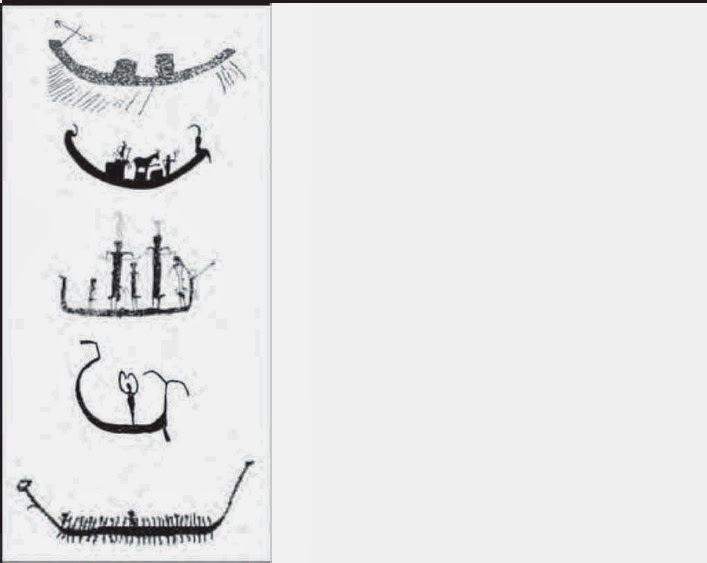
Related reading:  Was Noah Mesopotamian or Proto-Saharan?; Saving Noah; Noah's Birds; Noah's Homeland; Answers to Students' Questions About the Flood; Genesis and Climate ChangeBoat Petroglyphs in Egypt's Central Eastern Desert; Who Were the Kushites?; The Saharan Origin of Pharaonic Egypt; When the Sahara Was Wet; Finding Noah's Ark

Friday, October 10, 2008

The Search for Eden


BAR has reprinted an excerpt from Edgar James Banks Bismya: The Lost City of Adab (G.P. Putnam's Sons, 1912). This is a traveler's diary in which Banks recounts his search for the Garden of Eden (which he failed to find).

Edgar James Banks (1866–1945) served as an American consul to the Ottoman empire and explored throughout the Middle East as an archaeologist and collector of antiquities. Banks became the first American to climb Mt. Ararat, searching for Noah's ark (which he failed to find).

BAR writes about Banks: "As an antiquities dealer, he imported between 11,000 and 175,000 artifacts to the United States, including hundreds of cuneiform tablets. After returning to the U.S., he became a consultant for the legendary film maker Cecil B. DeMille. Banks is considered to be one of the inspirations for Indiana Jones."

Read the Banks' excerpt here.


This represents another failed attempt to locate Eden and Noah's ark. If we pay attention to what Genesis actually tells us, we should search for Eden and Noah's ark in Africa, not Mesopotamia. The African word for garden or virgin forest is "egan" which is the etiology of the Hebrew 'Eden'. According to Genesis, the garden would have been west of Lake Chad, the homeland of Noah. It may be Eredo on the coast of Nigeria, and Noah's ark would have landed on Mount Meni in modern day Niger.


Related reading:  Finding Noah's Ark; Where Did Noah's Ark Land?

Saturday, September 13, 2008

On the Lighter Side

At Students Publish Here, there is a delightful story written by a girl named Hannah Mulliken. She tells the story of the Flood from the perspective of twin mice born on Noah's ark. This is a story your children and grandchilren would love to hear!

Monday, December 10, 2007

Finding Noah's Ark


Alice C. Linsley


Despite claims that Noah’s ark has been found in Turkey, Noah’s boat has never been found. In fact, every claim of publicity seekers concerning the boat shaped forms on Greater Mount Ararat have been shown to be false. Noah's ark just isn't there.

The ark has never been found because people have been looking in the wrong place. Instead of searching the mountains of Turkey, they should be looking to the mountains of East Central Africa. This is the homeland of Noah, a Nilo-Saharan ruler who lived in the region of Lake Chad at a time when the Sahara was wet and the Nile was much wider.


As can be seen from the image above, Noah's homeland, called Borno, is almost exactly in the center of Africa, and Har-Meni is the likely mountain upon which the ark came to rest. Har-Meni means Mount Meni and Harmeni is close to the word Armenia. Ar-menia could mean ""mountain of Meni." In 1874, Godfrey Higgins, in his monograph Anacalypsis: An Inquiry into the Origins of Languages, Nations and Religions, noted that "Armenia" could mean "mount of Meru… that is, Ar or Er-Meni-ia, the country of mount Meru or Meni."

According to David M. Westley, Director of the African Studies Library at Boston University, "From the center of the Chad Basin to Mount Meni is about 230 miles."  Mount Meru, Africa’s fifth highest mountain, is located in northern Tanzania. It stands at 15,000 feet and is 42 miles west-southwest of Mount Kilimanjaro, near the Kenyan border. It is an extinct volcanic crater. The land at the base is rich volcanic soil. As one ascends the mountain, there are forests with fig and Acacia trees. Mahogany, olive, and date palm trees grow on the drier crater walls. There are so many species of animals living in the Arusa region that the Kenyan tourist agencies refer to Mount Meru as "Noah’s ark."

Noah likely lived during the Holocene Wet Period which is also called the "Gurian Wet Period" and the "Aqualithic." The latter term was coined by British archaeologist John Sutton (Journal of Africa History 1974; Antiquity 1977). There was an abundance of water in central Africa due to monsoons off the Indian Ocean, and to the African rifts that created great watersheds or troughs. Rifting, combined with prolonged rains. caused this entire region to flood.

Lake Chad is located at the boundary of Niger, Nigeria, Chad and Cameroon, an area of heavy rifting as shown in the map below.


Prehistoric boats and cows 
shown on Saharan rocks 
In the time of Africa's Wet Period Lake Chad extended many hundreds of miles beyond its present basin, and it is possible that there may have been water up to Mt. Meni in East Africa. I believe that is where Noah's ark landed, but no one knows for sure.

In the Bhagvad Gita, Lord Krishna says, "Among the mountains, I am Meru", that is the spinal cord of the world. The Vishnu Purana (from about 200 B.C.) details how there are seven continents ringed by seven oceans: "The central continent has Meru at its core, bounded by three mountain ranges to the north and three to the south. One of these ranges is the Himalayan barrier, interposed between Meru and ‘Bharatha’, the Indian subcontinent. Meru itself stands eighty-four thousand leagues high, with four faces of crystal, ruby, gold and lapis lazuli. Ganga falls from the heavens on Meru’s summit, circles the mountain and then divides into four mighty rivers which flow to the four quarters of the earth." According to Buddhist tradition, the island of Sri Lanka broke off from Meru. Many Hindu temples, including Angkor Wat in Cambodia, have been built as symbolic representations of Mount Meru.

The word meni appears only once in the Bible, in Isaiah 65:11, where it is paralleled with the word gad, meaning good fortune. I suspect that there is a connection between meni and the ancient practice of worship on mountain tops because where the word "gad" appears there is often a contextual reference to sacrifice or praise offered on mountains. We recall that Noah offered burnt sacrifice on the mountain in thanksgiving for his deliverance (Gen. 8:20) and that God established a covenant with Noah and his descendants.


Related reading: Noah's Flood: Where and When?; How Big Was Noah's Flood; Africa in the Days of Noah; Cemetery Predates Noah; Newly Discovered Pyramid Predates Noah; Was the Earth Repopulated After Noah's Flood?


Tuesday, October 9, 2007

Africa in the Days of Noah


Alice C. Linsley

8000 year old black mahogany dugout found in the region of Lake Chad, in the Land of Noah. The Dufuna dugout was buried at a depth of 16 feet under clays and sands whose alternating sequence showed evidence of deposition in standing and flowing water. The dugout is 8000 years old. By comparison, Egypt's oldest boat is only about 5000 years old.

Peter Breunig of the University of Frankfurt, Germany, an archaeologist involved in uncovering the Dufuna boat, reports that the canoe’s age “forces a reconsideration of Africa’s role in the history of water transport”. He adds, “that the cultural history of Africa was not determined by Near Eastern and European influences but took its own, in many cases parallel, course”. According to Breunig, “The bow and stern are both carefully worked to points, giving the boat a notably more elegant form”, compared to “the dugout made of conifer wood from Pesse in the Netherlands, whose blunt ends and thick sides seem crude”. To go by its stylistic sophistication, he reasons, “It is highly probable that the Dufuna boat does not represent the beginning of a tradition, but had already undergone a long development, and that the origins of water transport in Africa lie even further back in time.”

Indeed, the Dufana dugout was found in what is now the Sahara desert, but in the days of Noah this region of wet and the major water systems were interconnected. Lake Chad, a freshwater lake located in west-central Africa, was then a sea. Chad, Cameroon, Nigeria, and Niger all have shorelines on Lake Chad. This is the only place on the surface of the earth that claims to be Noah's homeland - Bor-No, meaning Land of Noah. Noah's boat probably came to rest on Mount Meru or possibly on Mount Kenya in Tanzania. Or it may have landed on a mountain in eastern Niger.

About 8000 years ago, the Chadic Sea was about 600 feet deep and sustained boating and fishing industries. The average fishermen used canoe dugouts (as shown above) which they could carve themselves, but nobles used boats constructed of marsh reeds lashed together and sealed with pitch.

Between 10,000 and 8000 BC the climate changed, ushering in years of persistent, heavy rains. The Nile was transformed from a slow stream into a roaring river with mile-deep gorges. This was the beginning of the wet period that would turn the Sahara into vast grasslands able to support elephants, antelopes, gazelles, ostriches, giraffes, and hyenas.

Lakes formed in the basins, large enough to support fish, crocodile and hippopotamus. Early hunters camped along the lakes, as evidenced by heaps of domestic refuse at many sites along the lake shores. Lake Chad filled and merged with the Mega-Chad Sea, creating a body of water comparable in size to the state of Sudan. The overflow spilled southwest out the Benue River to the Atlantic.

The flood of Noah likely occurred during the late Holocene Wet Period which lasted from about 10,000 to 3000 B.C. During the peak of the rainy period, around 8000, Mega-Chad would have covered 157,000 square miles. The surrounding land was spongy and there was great flooding at the confluence of the Niger, Benue, Yobe and Osimili Rivers. The floodwaters created a disaster of such proportions that it is still remembered. Rainbows would have been a common sight over the region due to rising mists.

In the ancient world, regional chiefs controlled rivers, lakes and wells from west central Africa to the Indus River Valley. The region where Lake Chad is located is called “Bor-no”, the “Land of Noah", suggesting that Noah controlled the water commerce in the area. As a chief he would have had access to the best and the most plentiful supply of boat building materials and shipwrights.

Since the worst flooding occurred about 8500 years ago we can assume that Noah ruled this region at that time. Noah was a figure of such importance that a great portion of the Genesis Prehistory pertains to him. We are told that the land of Noah was tilled and there were grape vines. In the late 1980s, German archaeologists found remains of wine making equipment in the tomb of the ancient Nubian king Scorpion I (dating to about 3150 BC). That find consisted of grape seeds, grape skins, dried pulp and imported ceramic jars covered inside with a yellow residue chemically consistent with wine. Ancient Egyptian murals depict details of wine-making. Egyptians flavored their wines with tree resins, herbs, and figs.

An oracle concerning Noah states, “This one shall bring us relief from our work and the toil of our hands.” (Genesis 5:29) We are also told that Noah was drunk with wine on at least one occasion.

Many factors caused population migration from the area of Borno. The region suffered the effects of a massive volcanic explosion on the floor of the Dead Sea. The eruption caused earthquakes and likely more severe flooding. The loss of life and homesteads among the peoples living in the southern edge of Lake Chad was apparently great and archaeologists report that the area shows no evidence or re-habitation for at least 200 years.

Doubtless the territories of the lake region declined in power and influence as a result of the Monsoon Belt moved more to the south and the desert began to encroach. This caused people to move toward the Nile and the center of political power moved from central west Africa to eastern Sudan, Egypt and Canaan.


Related reading: Boat Petroglyphs in Egypt's Central Eastern DesertWho Were the Kushites?; The Saharan Origin of Pharaonic Egypt; When the Sahara Was Wet; Finding Noah's Ark