Followers

Showing posts with label Nimrod. Show all posts

Monday, August 3, 2026

Identifying Strands of the Genesis Narratives


Dr. Alice C. Linsley


Genesis is a complex and layered text. Shalom Ratgeizer, an Israeli Bible scholar, notes, “The texts were written by different authors in different times and places in and outside Eretz Israel and were meant for different audiences. The literary styles, languages, and theological ideas are different and at times contradict each other.”

The older material in Genesis pertains to the earliest biblical populations and to the antecedents of the Messianic Faith among Abraham's Hebrew ancestors. Over these older layers are glosses and anachronisms that reflect at least two later sources: the Deuteronomist Historian, and the later hands of Jewish writers. The Deuteronomist writes from the context of the Neo-Babylonian Period, c.700-300 BC, about 1500 years after the time of Abraham. The Jewish insertions reflect even later periods. They date from around 400 B.C. to 200 A.D. The different sources are detected by the contextual incongruities and unraveling the interwoven elements is necessary if we hope to understand the Book of Genesis.

Understanding also requires attention to the anthropologically significant data that highlight contextual incongruities. Consider a Native American chief with a fleet of birch wood canoes controlling trade between villages on the Mississippi in 1720. Fast forward a mere 200 years to 1920 when a river magnate controls commerce on the same river with his fleet of riveted steel ships. Same river, very different cultural contexts.

The cultural contexts of the biblical persons in Genesis 4-12 were as distantly in the past for First Century Jews as they are to most readers today. Adam and Eve lived around 5000-4800 B.C. in a vast well-watered region called Eden. Nimrod, one of their descendants, left Kush (East Africa) and became a city builder in Southern Mesopotamia around 3500 B.C. (Gen. 10). Abraham the Hebrew was one of his descendants.

Abraham's territory extended between Hebron and Beersheba. He also had control of the wells that he dug in Gerar around 2000 B.C. To understand biblical history, we must grapple with the shifts in temporal, spatial, and cultural contexts, and the best disciplines to apply in this effort are cultural anthropology, archaeology, DNA studies, and linguistics.

Critical reading can prevent imposing a presumed or denominational interpretation on the text. The richness of the Genesis narratives is found by tracing the layers and listening for the subordinated voices. Often those are the voices of women.


Discerning the Antecedents

Biblical anthropology asks about antecedents. It explores what comes before what is described in the text. What events preceded the events recounted? It seeks to understand the cultural context of the earliest persons named in Genesis: Adam, Eve, Cain and Seth, etc. It is concerned with ancestors and received traditions. From what earlier context did certain practices develop? What traces of ancient memory can be uncovered?

The biblical text always speaks of something older, some prior action that solicits a response from later generations. The later generations are enjoined to worship the God of Abraham, Isaac, and Jacob. There is a thick cultural web surrounding the God of the early biblical Hebrew.

That context is not apparent to the casual reader because it is hidden behind layers of Jewish midrash, denominational interpretations, theological typologies and mythological motifs. The motifs of the tree of life and the serpent are found in many of the world's religions. They are clues as to the lush riverine contexts of the early Hebrew who believed that a woman of their ruler-priest caste would bring forth the Son/Seed of God who would crush the serpent's head (Gen. 3:15). God’s adversary bruises the foot of the Woman’s Son, but the Son crushes his head. That expectation was expressed around 4000 years ago and recorded in Utterance 388 of The Ancient Pyramid Texts: "Horus has shattered (crushed) the mouth of the serpent with the sole of his foot".

Similar references are found in the later Vedic texts. "The Ancient Man danced on the serpent, who still spewed poison from his eyes and hissed loudly in his anger, and he trampled down with his feet whatever head the serpent raised, subduing him calmly as if he were being worshipped with flowers. Kaliya, his umbrella of hoods shattered by the gay dance of death, his limbs broken, vomiting blood copiously from his mouths, remembered the Guru of all who move and are still, the Ancient Man, Narayana, and he surrendered to him in his heart." (Srimad Bhagavatam 10:6, from Andrew Wilson, Ed. World Scriptures, p. 449.) The early Hebrew were a priest caste that believed in God Father and God Son. The Son of God was called HR which means Most High One in ancient Egyptian. The Greeks referred to HR as Horus. In Ancient Egyptian Re means "father."

In the Ancient Pyramid Texts, a priest prays for the King, saying, "Horus is a soul and he recognizes his Father in you..." (Utterance 423)

In the Egyptian Book of the Dead, Horus is called the "advocate of his Father" (cf. 1 John 2:1), and all the gods are said to be "in the train of Horus." Here we find the language of a royal procession such as this: "When He ascended on high, He led captives in his train, and gave gifts to men.” (Eph. 4:8).

Biblical anthropology insists that the texts be read objectively and with an eye to extracting data that helps us to understand the earlier contexts. The mythological Adam and Eve are posed as the first parents (apical ancestors). This is consistent with many African origin stories. Among the Gikuyu, the first man and women were called Gikuyu and Mumbi. However, these are not the first humans on earth, but the founders of the Gikuyu people. Likewise, Adam and Eve are the founders of the clans that come to be identified as Horite and Sethite Hebrew. These were Abraham's ancestors.

Abraham is the father of many peoples, an icon of faith, and a "sent away son" to whom God delivered a territory in ancient Edom. The sending away of non-ascendant sons is a feature of the marriage and ascendancy pattern of the biblical Hebrew. That feature drove the Hebrew dispersion out of Africa and the spread of the primitive Messianic Faith that came to be known as "Christianity".


Monday, December 15, 2025

Where the Messianic Narrative Gets Lost


Dr. Alice C. Linsley


Genesis, the first book of the Bible, provides the data shown in the diagram. The science of Biblical Anthropology draws its data from the 66 canonical books of the Bible and regards books such as Jasher to be of secondary importance because of their late dates. Jasher (Sefer haYashar) belongs to the Jewish literature known as Midrash and dates to the Middle Ages. Such late rabbinic writings reflect the theology and historical narrative of Judaism which did not exist when Abraham and his ancestors lived. The people shown in the diagram above were all Hebrew. None were Jewish.

Abraham's father was Tera (Terah). The word means "priest", and it is found among Abraham's Hebrew ancestors, some of whom lived in the Nile Valley. The word is found among the rulers of the Nilotic Anu. The title "Tera-netjer" is shown on this tile found by the famous archaeologist Flinders Petrie. Tera-netjer means "priest of God/King".


A Sethite Hebrew priest at a temple of the ruler Heth among the cities of the Nilotic Anu.

Among the Nilotic Luo, Ja'ter refers to the priest who performs the widow cleansing rituals. Among the Dinka of East Africa, the word for priest is tier. The root of these words is TR, the same as appears in the original Hebrew which had no vowels.

In Joshua 24:2 we read: "In olden times, your forefathers – Terah, father of Abraham and father of Nahor – lived beyond the Euphrates and worshiped other gods...". 

Because of this, many assume that Abraham was the first of his family to turn from idol worship to iconoclastic monotheism. However, all of the men named in the diagram above worshipped the same God. They were a priest caste, and castes are united in their religion as well as by blood and marriage ties. 

The Joshua passage also is from a much latter time than the persons about which it speaks. The Joshua narrative rejects the model of monarchic and priestly power held among the early Hebrew (4000-2000 BC). That model defines Messiah's authority. This shift causes readers of the Old Testament to lose sight of the continuity between the Messianic expectation of Abraham's Hebrew ancestors and the later Messianic prophesies of the Old Testament. 

Abraham had 9 sons and all were Hebrew because the Hebrew ruler-priest caste practiced endogamy. Abraham lived c. 1500 years before Judaism emerged as a world religion. He lived c. 2200 years before Islam emerged. This is nonsense: "Abraham’s sons were the ancestors to the lineages from which Judaism and Islam emerged. Isaac, son of Sarah, is forebear of the Jewish people, while Ishmael, son of Hagar, is the ancestor of the Arab people and Prophet Muhammad, anchoring Islamic tradition."

Islam has nothing in common with the faith of Abraham the Hebrew. On the other hand, the Messianic faith that we call "Christianity" is consistent in its core beliefs with the religion of the early Hebrew (4000-2000 BC). See this: The Substance of Abraham's Faith and this: Abraham's Faith Lives in Christianity.

Sunday, November 23, 2025

Abraham was a Descendant of Nimrod


The diagram shows another example of the cousin bride's naming prerogative, a distinctive feature of the early Hebrew marriage and ascendancy pattern. Nimrod's Mesopotamian wife was a cousin and a princess. She named their firstborn son Asshur after her father. 


Dr. Alice C. Linsley


The so-called “begats” are king lists that predate the Sumerian King Lists by at least 1500 years. To gain a clearer understanding of the influence and authority of these early Hebrew rulers we must consider Genesis chapter 10. Here we are told that Nimrod was a son of Kush, a Hebrew ruler in the Nile region. That is where the oldest known site of Hebrew worship was located at Nekhen.

Nimrod became a high-ranking Hebrew official in Sumer and later in Mesopotamia. He is known for his expansive building projects in Shinar, a region of independent city-states as early as 4100 B.C. Eridu (Eredo) was the earliest known city in Sumeria. The Sumerian King Lists describes Eridu as the “city of the first kings”, stating, “After the kingship descended from heaven, the kingship was in Eridu”.

Later Nimrod began building projects in Northern Mesopotamia which is referred to as “Assyria”. Genesis 10:11 states that Nimrod went into the territory of Asshur or Assyria. The words Asshur and Assyria are the same in Hebrew. Asshur the Younger had a brother named Arpachshad. Among Arpachshad’s descendants are Eber, Peleg, Joktan, Nahor, Terah, and Abraham (Gen. 11:10-33).

This diagram shows another example of the cousin bride's naming prerogative. Lamech the Elder's daughter Naamah named her firstborn son Lamech after her father. She married her patrilineal cousin Methuselah. 

Wednesday, May 7, 2025

The Wealth of the Mesopotamian Rulers


Elite Mesopotamian burial ground dating to 2400 BC. 


Dr. Alice C. Linsley

Nimrod is designated a son of Kush in Genesis 10:8. As a sent-away son, he became established in Mesopotamia by marrying a Sumerian princess. It is likely that she and Nimrod were cousins. The couple enjoyed a life of opulence and prestige. They were among the first lords and ladies. They exercised great influence and power in the ancient world.


In the Ubaid period (c. 5500-4000 BC) there was vigorous commerce between the local walled villages. By the time Nimrod married a daughter of Asshur (c.3600-3200 BC), long-distance trade had become a source of wealth for the Mesopotamian lords and ladies. Ships coming from the Island of Bahrain (ancient Dilmun) brought wool, gold, copper, lapis lazuli, and carnelian to the Sumerian cities of Ur, Nippur, and Uruk. With the precious materials that came into Mesopotamia, royal craftsmen fabricated jewelry for the royal wives, daughters, and concubines.

As early as 7000 BC, Dilmun (Bahrain) served as a major trade depot with its own commercial seal. The weights used there were of the same denominations as the system of weights used in the Indus Valley. Ancient documents speak of Dilmun’s trade in gold, silver, ivory, sesame oil, wool, carnelian beads, lapis lazuli, and copper. One document details a cargo of eighteen tons of refined copper purchased in Dilmun.

Sumerian ships brought cargo to Dilmun and to port cities in the Indus valley. Ships sailed southeast on the Tigris or Euphrates to the Persian Gulf, making stops at the port city of Dilmun, passing the Oman Peninsula, and entering the Arabian Sea. From there the ships sailed northeast on the Indus River to Mohenjo-Daro and Harappa. Trade in lapis lazuli and carnelian beads ran between Egypt, Mesopotamia, India, and Afghanistan as early as 4000 BC. Indus seals with Harappan inscriptions have been found in Mesopotamia. Indus pottery and seals have been found along the maritime routes between the Indian subcontinent and Mesopotamia.

Genesis 10:10 mentions the Sumerian city of Erech (Uruk) in connection with Nimrod. Another important Sumerian city was Eridu, a major trade center in the land of Shinar as early as 5000 BC. The Sumerian King List cites Eridu as the “city of the first kings,” stating, “After the kingship descended from heaven, the kingship was in Eridu.” 

Nimrod was not the first city builder. In the Bible that is credited to Cain (Gen. 4). However, Nimrod's fame was such that he is remembered as one of the “mighty men of old” (Gen. 6:4). Some Bibles describe him as a “mighty hunter” or a maharba in Hausa or nahshirkan in the Targum. These terms appear to the be related to the Hausa sarkin maharba, meaning lead hunter or chief. Clearly, Nimrod was among the Nephilim, or powerful men who were considered "sons of God" in the ancient world because of their authority and grandeur. In Genesis 6, the phrase "sons of God" parallels the phrase "daughters of men." Such parallelism is typical of Semitic literature.

The cities in Mesopotamia were small settlements during the Ubaid Period (6500-4100 BC) when irrigation and other agricultural advancements were introduced. Between c.4000-3000 BC, Mesopotamia became a region of cultural advances in writing, animal husbandry, metal work, and boat building. Nimrod undertook his building projects during this period.

Archaeologists discovered a 4000-year-old boat at Uruk when the erosion of a riverbed at the edge of the city revealed the boat’s outline in 2018. The vessel measures 22 feet long and five feet wide. The boat was constructed of organic materials, probably bundles of marsh reeds, and covered in bitumen; a tar-like substance used for waterproofing. This technique was used in the construction of Noah’s ark (Gen. 6:14).

River trade generated great wealth for the rulers who controlled commerce on the Tigris and Euphrates Rivers. Commerce led to the expansion of the major Sumerian cities during Nimrod's time, especially Uruk (Erech). Trade extended over land from Uruk to the resource-rich Zagros Mountains, Northern Syria, and Anatolia.


Tuesday, June 25, 2024

The Dispersion of the Early Hebrew


       Map produced by Daniel Todd


Dr. Alice C. Linsley


The Hebrew were widely dispersed before Abraham's time (c.2000 BC). They were in the region of Lake Chad, the Nile Valley, Arabia, Mesopotamia, Anatolia, Eurasia, and the Indus Valley.

Nekhen on the Nile is the oldest known site of Horite Hebrew worship. It is marked on the map by a star. Nekhen's sister city, Nekheb, sat on the opposite side to the Nile River. Both were shrine cities with Hebrew priests. A great deal is known about the Horite and Sethite mounds from texts dating to as early as 4200 years ago.

The historical Adam and Eve lived around 5000-4800 BC in a vast well-watered region called Eden. Genesis 2 describes Eden as a lush riverine region that extended from the sources of the Nile in Ethiopia and Uganda to the Tigris and Euphrates in Mesopotamia (C on the map). The early Hebrew lived throughout Eden.

The firstborn son of Adam and Eve was Cain (Gen. 4). He was sent away and established a settlement "east of Eden" (Gen. 4:16). He named that settlement for his son Enoch, a royal title. Cain's descendants, the Kenites, are found in the land of Kenan which is the land of Canaan כנען, pronounced kena'an.

Noah was one of the descendants of Adam and Eve. Different accounts of Noah are given in Genesis chapter 6-8. He probably ruled in the region of Lake Chad (A on the map). This is the only place on earth that the natives call Noah's homeland - Bornu (Borno/Benue), meaning "land of Noah." The local Kanuri people call Lake Chad Buhar Nuhu, meaning "Sea of Noah." When Noah lived the Sahara was wet and green. The Lake Chad Basin was prone to flooding. The oldest known canoe, the "Dufuna boat," was found in this region. This is a photograph of that 8000-year mahogany dugout.


One of Noah's descendants was Nimrod (Gen. 10), a son of Kush. Nimrod left Kush (modern day Sudan) and established his territory on the Euphrates River around 3500 BC (Gen. 10). He married a Sumerian princess, the daughter of King Asshur.


The practice of marrying high-status women to form political alliances and to become established in a new territory is illustrated by Nimrod’s marriage to a Sumerian princess. Nimrod was a Kushite kingdom builder and his marriage to Asshur’s daughter is evidence of the close connection between the rulers of the Nile Valley and the rulers of Mesopotamia, two early riverine civilizations.

Another of Noah's descendants was Heth (Gen. 10). The Hittites of Canaan and Anatolia (C on the map) are Heth's Hebrew descendants.

Abraham was one of Nimrod’s descendants. Around 2000 BC, Abraham controlled the water systems at Hebron and Beersheba and the wells that he dug in Gerar. His proper heir was Isaac and Isaac's proper heir was Esau. Jacob was sent to serve his maternal uncle, a common practice among the early Hebrew. The sending away of non-ascendant sons drove the Hebrew dispersion into many regions.

The clans of Joktan and Sheba were also Hebrew. They settled in southern Arabia. This map shows the Joktanite clans of Arabia.


The widely dispersed Hebrew ruler-priests controlled commerce on sections of the major water systems. They traded as far as Pakistan and the Indus River Civilization. By the time Nimrod married a daughter of Asshur, long-distance trade had become a source of wealth for the Mesopotamian lords and ladies. Ships coming from Bahrain (Sumerian "Dilmun") brought wool, gold, copper, lapis lazuli, and carnelian to the Sumerian cities of Ur, Nippur, and Uruk (Erech). Archaeologists discovered a 4,000-year-old boat at Uruk. The boat was constructed of organic materials, probably marsh reeds, and covered in bitumen, a tar-like substance used for waterproofing. This technique was used in the construction of Noah’s ark (Gen. 6:14).

As early as 7000 BC, the island of Bahrain (F on the map) served as a major trade depot with its own commercial seal. Ancient documents speak of Dilmun's trade in gold, silver, ivory, sesame oil, wool, carnelian beads, lapis lazuli, and copper. One document details a cargo of eighteen tons of refined copper purchased in Dilmun. Dilmun was a maritime connection between Mesopotamia and the Indus Valley.

Sumerian ships brought cargo to Dilmun and to port cities in the Indus Valley (G on the map). Ships sailed southeast on the Tigris or Euphrates to the Persian Gulf, making stops at the port of Dilmun, passing the Oman Peninsula, and entering the Arabian Sea. From there the ships sailed northeast on the Indus River to Mohenjo-Daro and Harappa. Trade in lapis lazuli and carnelian beads ran between Egypt, Mesopotamia, India, and Afghanistan as early as 4000 B.C. Indus seals with Harappan inscriptions have been found in Mesopotamia. Indus pottery and seals have been found along the maritime routes between the Indian subcontinent and Mesopotamia. Note the close resemblance of Indus Valley and Nilotic inscriptions found on pottery.


The early Hebrew rulers sent their merchants along ancient trade routes that ran from the Nile to Arabia and Canaan, and from Mesopotamia to modern Bahrain. Routes extended into the Indus Valley and as far north as China. There is considerable evidence that the religious beliefs of the early Hebrew influenced the populations among whom they lived. This explains the common religious practices and solar symbolism among the diverse populations of the Fertile Crescent and the Ancient Near East.

The term "Hebrew" is derived from the ancient Akkadian word for priest - abru. They were a ruler-priest caste that married only within their caste (caste endogamy). The caste structure of the early Hebrew meant that wherever they lived they were identifiable as Hebrew. It is possible to speak of Egyptian Hebrew, Canaanite Hebrew, Kushite Hebrew, and Mesopotamian Hebrew. The Hebrew living in the Nile Valley were kin to the Hebrew living in Canaan, Mesopotamia, and Anatolia.

The Hebrew priests were in the service of the early kingdom builder which are described in Genesis as the "mighty men of old" and "heroes of renown." As new territories were established and as older territories expanded, the Hebrew went where they were appointed to serve at royal temples and river shrines. Many Hebrew women ministered to women at the river shrines which were places of healing, purification, and prayer, especially for women struggling with infertility.

All this movement happened long before Judaism emerged as a world religion after about 580 BC. None of the people mentioned above were Jews. They were Hebrew, and there were many Hebrew clans.


Monday, February 5, 2024

The Influence of Hebrew Wives


Dr. Alice C. Linsley

The wives of Hebrew men in the service of high kings socialized with women of the royal courts. They enjoyed privileges that average Hebrew women did not have. They were aware of court protocols and listened to court rumors. Doubtless, they conveyed much of what they heard to their husbands. The story of Esther provides a glimpse of the court intrigues to which they were privy.

The Hebrew wife was viewed as her husband’s helper (Gen 2:18,22). Adam’s wife is described as his ezer, a Hebrew word for one who aids, supports, or helps. This is the same word used to describe God in Psalm 33:20, Psalm 70:5, and Psalm 121:1-2.

The wives of the patriarchs Abraham, Isaac, and Jacob influenced the actions of their husbands. They shaped events that served the interests of their husbands. Examples include Sarah’s concession to use Hagar as a surrogate, and Rachel’s theft of the teraphim by which she could claim some inheritance for Jacob. According to Hurrian/Horite legal records, possession of the ancestor figurines validated claims of inheritance.
 
Sometimes the wives’ influence and actions worked against the wishes of their husbands. That is evident in Rebekah’s attempt to pose her son Jacob as Isaac’s proper heir. It is clear in Genesis 25 that Isaac regarded Esau as his proper heir. Isaac intended that Esau should receive the birthright and the blessing due to his proper heir.


The marriages of high-status Hebrew women to Hebrew ruler-priests helped to form political alliances between Hebrew clans. Sometimes those clans were geographically distant. This is illustrated by Nimrod’s marriage to a Sumerian princess. Nimrod was a Kushite kingdom builder (Gen. 10) who was sent away to establish himself in a new territory. His marriage to Asshur’s daughter is evidence of the close connection between the rulers of the Nile Valley and the rulers of Mesopotamia, two early riverine civilizations.

Before Israel existed, the wives of the Hebrew rulers listed in Genesis 4, 5, 11, 25, and 36 ruled over large households, arranged royal weddings, owned property, and assisted in the building of kingdoms.


Friday, December 1, 2023

Nimrod's Mesopotamian Wife


Dr. Alice C. Linsley

One of Noah’s grandsons was named Cush (Gen. 10:6) whose territory was in the Nile Valley. Cush’s son Nimrod was sent away to establish himself at a distance from Cush’s proper heir. The sending away of non-ascendant sons is a typical feature of the Hebrew marriage and ascendancy pattern.

Genesis 10 states that Nimrod went to Sumer in Southern Mesopotamia where he began expansive building projects. This is explained in Genesis 10:10 – “The beginning of his kingdom was Babel, Erech, Accad, and Calneh, in the land of Shinar.” 

Nimrod married a daughter of Asshur the Elder, a Hebrew ruler in Mesopotamia. This may explain Nimrod's expanding authority. He then began monumental building projects in Northern Mesopotamia called Assyria. Genesis 10:11-12. explains, “From that land he went into Assyria and built Nineveh, Rehoboth-Ir, Calah, and Resen between Nineveh and Calah; that is the great city.”  Assyria is named for Asshur the Elder, a son of Shem.


Nimrod was a grandson of Ham, and his Mesopotamian kinsmen Asshur the Elder was a son of Shem (Gen. 10:22; 1 Chron. 1:17). Shem and Ham were brothers (Gen. 10). This means that Nimrod married a cousin. The Hebrew ruler-priest caste selected marriage partners only from their Hebrew kinsmen (caste endogamy).

Nimrod's wife was Hebrew, and her cultural context was Mesopotamian. She named their firstborn son Asshur, after her father. This "cousin bride's naming prerogative" is another feature of the Hebrew marriage and ascendancy pattern.

Typically, the Hebrew ruler's cousin bride named her firstborn son after her father. This is why it is necessary to distinguish between Asshur the Elder and Asshur the Younger. The pattern is evident in the case of Methuselah's cousin bride Naamah (Gen. 4). 


The wedding of Asshur’s daughter to Nimrod would have been a grand affair that solidified political relations between the royal families of Nimrod and Asshur. The ceremony probably took place at the palace in Uruk, on a channel of the Euphrates River between 4000-3200 B.C. The site of Uruk (Unug in Sumerian, Erech in Hebrew Torah) is known today as Warka. Settlement at the site began in the Ubaid period (c.5500-4000 B.C.). Uruk was the largest settlement in Mesopotamia at the time that Nimrod lived.

The name of Nimrod’s wife is not found in the Bible. According to the historian Eusebius, Nimrod's wife was called Semiramis or Sammur-amat. However, this queen lived long after the time of Nimrod. She was the wife of the Neo-Assyrian ruler Shamshi-Adad V (r. 824-811 B.C). She was the queen regent between 811 and 806 B.C., holding the throne for her young son Adad Nirari III until he reached maturity.

The practice of marrying high-status women to form political alliances and to become established in a new territory is illustrated by Nimrod’s marriage to a Sumerian princess. Nimrod was a Kushite kingdom builder (Gen. 10) and his marriage to Asshur’s daughter is evidence of the close connection between the rulers of the Nile Valley and the rulers of Mesopotamia, two early riverine civilizations.

By the time Nimrod married a daughter of Asshur, long-distance trade had become a source of wealth for the Mesopotamian lords and ladies. Ships coming from Bahrain (Sumerian "Dilmun") brought wool, gold, copper, lapis lazuli, and carnelian to the Sumerian cities of Ur, Nippur, and Uruk. As early as 7000 B.C., the island of Bahrain served as a major trade depot with its own commercial seal. Ancient documents speak of Dilmun's trade in gold, silver, ivory, sesame oil, wool, carnelian beads, lapis lazuli, and copper. One document details a cargo of eighteen tons of refined copper purchased in Dilmun. Dilmun was a maritime connection between Mesopotamia and the Indus Valley.

Sumerian ships brought cargo to Dilmun and to port cities in the Indus valley. Ships sailed southeast on the Tigris or Euphrates to the Persian Gulf, making stops at the port city of Dilmun, passing the Oman Peninsula, and entering the Arabian Sea. From there the ships sailed northeast on the Indus River to Mohenjo-Daro and Harappa. Trade in lapis lazuli and carnelian beads ran between Egypt, Mesopotamia, India, and Afghanistan as early as 4000 B.C. Indus seals with Harappan inscriptions have been found in Mesopotamia. Indus pottery and seals have been found along the maritime routes between the Indian subcontinent and Mesopotamia.

The city of Erech is mentioned in connection with Nimrod in Genesis 10:10. As early as 5000 B.C., Eridu was an important trade center in southern Mesopotamia. The Sumerian King List cites Eridu as the “city of the first kings”, stating, “After the kingship descended from heaven, the kingship was in Eridu”.

Archaeologists discovered a 4,000-year-old boat at Uruk. The boat was constructed out of organic materials, probably marsh reeds, and covered in bitumen, a tar-like substance used for waterproofing. This technique was used in the construction of Noah’s ark (Gen. 6:14).

This was a period of monumental construction by the Mesopotamian rulers. The ziggurat at Uruk was a pyramidal structure that dates to around 4000 B.C. It was dedicated to the High God who was called Anu. Anu’s symbol was the sun. The White Temple of Anu was built on top of it between 3500-3000 B.C. Anu’s counterpart was Ra, the High God of the Nilotic Annu people.

Asshur and his royal household enjoyed opulent riches and were served by craftsmen of great skill. These artisans crafted ritual objects to be used by the royal priests. These include the Warka Vase, the marble Mask of Warka, the earliest known naturalistic sculpture of the human face. The mask is also known as the "Lady of Uruk" and was found in the temple precinct of Inanna in Uruk.


Inanna receiving offerings from a priest.


The Sacred Vase of Warka (shown above) is the oldest known carved-stone ritual vessel (c.3200 B.C.). It was one of a pair of alabaster vases. It was discovered in 1934 by German excavators in the temple of Inanna in Uruk. The image on the Vase of Warka shows Inanna receiving offerings from a priest with a shaved body, a practice typical of the priests of the Nile Valley.

Nimrod's wife likely was a devotee of Inanna, the Sumerian version of Hathor. Inanna, like Hathor, was often shown wearing a headdress of bull horns. Both goddesses appear to have been venerated as early as 4000 B.C. Hathor's worship began long before Egypt became a political entity.

Nimrod's wife would have had authority over at least one water shrine dedicated to Inanna. High status women had administrative responsibilities at the water shrines. The water shrines were under the control of regional lords, but visitors were welcome to drink the water, and to take a ritual bath (similar to the Jewish mikveh). Women came to these places seeking to conceive and deliver healthy children. They prayed and made offerings to Inanna/Hathor.

The Sumerians and the early cattle herding Nilotes have so much in common that it is difficult to distinguish between them. It is likely that the rulers of ancient Sumer had more in common culturally and linguistically with the peoples of East Africa and Arabia than with the peoples of southern Europe. The Sumerian and Akkadian languages share many common roots and Akkadian is the oldest known Semitic language.

Nimrod's homeland was in East Africa. He is designated a son of Kush in Genesis 10:8. As a sent-away son, he established a territory of his own in Mesopotamia by marrying a Sumerian princess. This couple enjoyed a life of opulence and prestige. They were among the first lords and ladies, and people of great influence and power in the ancient world.


Thursday, March 24, 2022

An Anthropologist Looks at Genesis 10


Dr. Alice C. Linsley


The author of Genesis 10 connects the populations of his time period to the three sons of Noah. He proposes how Earth came to be repopulated after a worldwide flood (Gen. 10:32). Though a naïve conception of human history and diversity, this early ethnography is remarkable. E.A. Speiser described the Table of Nations “as a pioneering effort among the ethnographic attempts of the ancient world.” (The Anchor Bible Commentary on Genesis, p. 71.)

The names listed in Genesis 10 represent ethnicities, city-states, kingdoms, and regional populations. The populations may generally be classified as Nilotic, Arabian, Mesopotamian, Eurasian, and Levantine. The table artificially lists seventy populations. However, none of the populations are identified as castes and the ancient world had many castes: tanners, metalworkers, priests, etc.

It is assumed that Eber (Gen. 10:21-3) is the eponymous father of the Hebrew people. This represents an attempt to narrow the scope of the narrative, as is done later with Jacob who is identified as the eponymous father of the Israelites. It is clear, however, that there were many Hebrew clans other than Jacob's clan.

The English word “Hebrew” is derived from the ancient Akkadian word for priest abru, and the ruler-priest caste was called Abrutu. Variant spellings include Habiru, Hapiru, and ‘Apiru. There is no reason to dismiss Noah and his sons as Hebrew. Genesis 4-11 chronicles the Hebrew caste’s dispersion out of Africa in the service of kingdom builders and high kings. Hebrew were living in Africa, Arabia, Mesopotamia, and Southern Europe before the time of Abraham. There is evidence that some Hebrew settled in the Indus Valley, and that their influence extended as far east as present-day Cambodia. Horite symbolism has been found at Angkor Wat. "Anghor Wat" refers to the settlement or temple complex dedicated to Horus. Ankh-Hor means "May Horus Live!" or "Life to Horus!"


This Anghor Wat relief depicts Ra's solar boat with Horus perched as a falcon on the mast.


The Indian archaeologist B. B. Lal contends that several megalithic sites of ancient Nubians resemble the cemeteries of early Dravidians found all over Western India. The similarities extend from the subterranean structures found near them to the identical earthenware ring-stands used by the Dravidians and Nubians to hold pots.

The connection between the riverine civilizations of the Nile Valley and the Indus Valley is indicated by comparing the Nilotic and Indus pottery inscriptions in which 17 figures are virtually identical.


The Hebrew Movement Out of Africa  

Genesis chapter 10 continues the theme of an eastward movement out of Africa. Adam and Eve went east. Cain went east, and now we read about the dispersion of Noah’s descendants into areas outside of Africa. This aligns with genetic studies of peoples coming out of Africa through the Middle East, a staging area for the Neolithic Agricultural Revolution, and the region where the earliest known kingdoms were established. This is especially evident in the case of the Kushite kingdom builder Nimrod (Gen. 10: 8-12).

Nimrod is also spelled Nimrudj or Nimrwd. In 2010, the 4400-year tomb of a purification priest named Rudj-ka or Rwd-Ka was found at Giza. It dates to between 2465 and 2323 B.C. His high status is evident in the quality of his stone tomb. He served Pharaoh Khafre who ruled from 2520 to 2494 B.C., before the time of Abraham. The ancient Egyptian word rwd/rudj means ball, sphere, or the Earth.

Likewise, the name “Lot” is found among the Libyan rulers of the Nile: Takelot I (885–872 B.C.) and Takelot II (860-835 B.C.), and at least two were called Nimlot. An inscription on the statue of Nimlot B describes him as “Nimlot true of voice,” meaning justified. The ancient Egyptian is Maa Kheru (mꜣꜥ ḫrw), a typical epithet applied to the righteous deceased who Horus presents to the Heavenly Father.

Nimrod, a son of Kush, built a kingdom in Mesopotamia. He is the connection between the Proto-Saharan ruler Noah and Abraham. We first meet Abraham in Mesopotamia because he is a descendant of Nimrod.


A Genetic Mosaic

After the Last Glacial Maximum (LGM) population movements created a striking genetic mosaic with distinct sex-based genetic differentiation. Y-DNA traces genetic inheritance through the paternal line and mitochondrial (mt) DNA traces genetic inheritance through the maternal line. Were it possible to study DNA from the different peoples listed in Genesis 10, we would find that the majority could be classified in Y-DNA Haplogroups R1a, R1b, and J, and mtDNA Ls, M, N, H, and R.


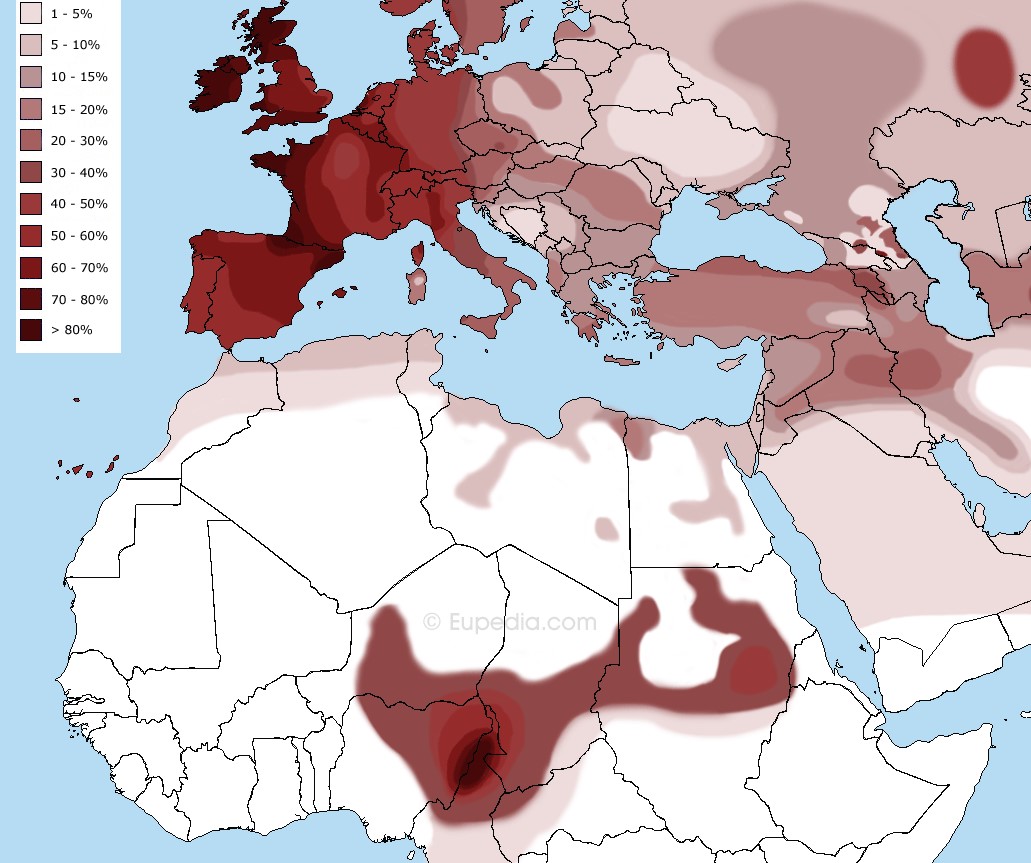
Genetic studies have established a connection between some populations of Genesis 10 and some populations of Noah’s homeland in the region of Lake Chad. This map shows the range of Y-DNA R1b peoples in red. However, the dispersion of the R1b populations took place long before the time of Noah and was complete by 40,000 years ago.


Towers Were Used for Astronomical Observations

Although the Tower of Babel story does not specifically mention astronomy, commentators on Genesis 10 often introduce speculation about astrology, an occult practice. This is based on a false belief that the science of sidereal astronomy had not yet developed. However, astronomy was familiar to the Nilotic Hebrew, as noted by Plato who studied under a Nilotic priest for 13 years. Plato claimed that the Africans had been tracking the heavens for 10,000 years. He knew about Earth's Great Year, also called the "Platonic Year." This is the duration of time that it takes for Earth to complete the cycle of axial precession (approximately 25,000 years). This precession was known to Plato who defined the "perfect year" as the return of the celestial bodies (planets) and the diurnal rotation of the fixed stars to their original positions.

In 241 B.C., the priest Manetho reported that Nilotes had been “star-gazing” as early as 40,000 years ago. By 4245 BC, the priests of the Upper Nile had established a calendar based on the appearance of the star Sirius and had been tracking this star for thousands of years, connecting it to seasonal changes affecting the Nile Valley. Doubtless, the Hebrew priests living in Mesopotamia were recognized for their astronomical observations from fortified high places and towers.


Related reading: An Anthropologist Looks at Genesis 9; Noah's Sons and Their Descendants; Nimrod and the Nile-Indus Connection; Haplogroups of Interest to Biblical Anthropologists; Was Akkadian the Language of the Indus Valley Civilization?; Our African Ancestors


Sunday, December 12, 2021

The Horite Hebrew of Eden


Biblical Eden had forests, grasslands, marshes, rivers and lakes to sustain early humans, large herds, fish, and birds. The region was well watered by extensive inter-connected water systems including the Nile, Lake Victoria, the Tigris and the Euphrates.


Alice C. Linsley

Recently, I was asked how the history of the biblical Horites connects to Eden. The Horites were a group of priests who believed in God Father and God Son. The Nilotic Horites referred to the son of God as Horus. Thus, their name Horite, which can be written also as Horim. Jews refer to their parents and ancestors as their "horim." The Ancient Pyramid Texts make it clear that the Horite and the Sethite Hebrew worshiped the same God and served the same king.

There are texts in the Bible that come from the Horite and Sethite Hebrew. Genesis 3:15 and Psalm 91 refer to the trampling of the serpent. Psalm 91:12-13 - "They will bear you up in their hands, that you do not strike your foot against a stone. You will tread upon the lion and cobra, the young lion and the serpent you will trample down."

In Srimad Bhagavatam 10:16 we find a parallel to Genesis 3:15 where we are told that the serpent's head will be crushed under the feet of the Woman's Son. The Hindu text reads: "The Ancient Man danced on the serpent, who still spewed poison from his eyes and hissed loudly in his anger, and he trampled down with his feet whatever head the serpent raised, subduing him calmly..." (Cited in Andrew Wilson, Ed. World Scriptures, p. 449.)

The same is expressed in the earlier Horite Hebrew texts from 4200 years ago. Utterance 388 of the Pyramid Texts speak of how the Son of God, Horus "has shattered (crushed) the mouth of the serpent with the sole of his foot."

The root of the word Horus is HR. It means "Most High One" in ancient Egyptian. The faith of the Horite Hebrew is older than that of the Jews. Genesis 36:31 says that the Horite kings who ruled Edom and Seir reigned before there was any king in Israel.

How does this relate to Eden? 

The oldest known site of Horite Hebrew worship is Nekhen, located in Eden. Nekhen was a flourishing shrine city 5800 years ago. Genesis describes Eden as a vast well-watered region that extended from the Gihon and Pishon rivers at the source of the Nile in Uganda and Ethiopia to the Tigris and Euphrates in Mesopotamia. 

The phrase "east of Eden" in the Hebrew is quimat-Eden, an ancient Nilotic reference to a place of bulrushes. Quimat is derived from the root qma, an ancient Egyptian word that refers to bulrushes. 

The term "Eden" derives from the Akkadian term edinu, which refers to a fertile plain. Akkadian is the oldest known Semitic language.

It is evident that belief in God Father and God Son has deep roots among Abraham's Nilotic ancestors. He was a descendant of Nimrod, a son of Kush (Gen. 10). Kush/Cush refers to a region and population of the Nile Valley. 

The Nilotic Hebrew looked for a Righteous Ruler who would overcome death and lead His people to immortality. They produced the oldest known resurrection texts.


Friday, April 17, 2020

The Genesis 10 Ethnography


Alice C. Linsley

Genesis 10, called a “Table of Nations,” represents an early attempt at ethnography. In his commentary of Genesis, E.A. Speiser described this table “as a pioneering effort among the ethnographic attempts of the ancient world.” (Speiser, The Anchor Bible Commentary on Genesis, p. 71.) The table lists 70 biblical populations with their own lands and nations.

This chapter does not describe nations as we think of them, but rather territories governed by local and regional chiefs who formed alliances for mutual defense. There were a few high kings who ruled larger territories from their royal fortifications. The fortified settlements contained palaces, temples, garrisons, and royal treasuries. These “high places” were the political centers of emerging city-states.

Chapter 10 continues the theme of an eastward movement out of Africa. Adam and Eve went east. Cain went east, and now we read about the dispersion of biblical populations into geographical areas outside of Africa. This is especially evident in the segment about the Kushite kingdom builder Nimrod (Gen. 10: 8-12).

Nimrod is also spelled Nimrudj or Nimrwd. His name, and the name “Lot” are names found among the rulers of the Nile. At least two Nilotic rulers have the name Lot: Takelot I (885–872 BC) and Takelot II (860-835 BC), and at least two Nilotic rulers were called Nimlot. An inscription on the statue of Nimlot B describes him as “Nimlot true of voice,” meaning justified.

In 2010, the 4400-year tomb of a purification priest named Rwd-Ka (Rudj-ka) was found at Giza. It dates to between 2465 and 2323 B.C. His high status is evident in the quality of his stone tomb. He served Pharaoh Khafre who ruled from 2520 to 2494 BC, well before the time of Abraham. The ancient Egyptian word rwd/rudj means ball, sphere, or the Earth. The term “ka” in this context refers to a ruler-priest.


Painting of Rudj-ka and his wife on the wall of his tomb. 


This 2800-year fragment was found at the ancient city of Nimrud in modern Iraq. It gives Malku (Melek) as a synonym for Šarru (Sar/Sharru). Both words mean king. (British Museum ND 5434)

Genesis 10 places Nimrod in this area of the Tigris River Valley. It seems that he was a sent-away son of Kush. Likely, his brother Ramah was the proper heir to Kush’s throne.


Genesis 10:7 names Dedan (DD - red one) as a grandson of the Nilotic ruler Kush. Dedan’s father was Ramah, the brother of Nimrod. Abraham was a descendant of Nimrod by his cousin wife, a daughter of Asshur. Here we see further evidence of endogamy between the lines of Ham and Shem. Genesis 11 introduces Abraham’s ancestors descending from Shem.

The various translations of Genesis 10 reveal a discrepancy about a people called Rodanim or Dodanim. Some versions have Rodanim, and others have Dodanim (both plural forms). This discrepancy has been explained by the apparent confusion of the Hebrew letters “resh’ and “dalet” which are similar. The discrepancy also surrounds the place called “Riblah” in some texts and called “Diblah” in others (Ezekiel 6:14).

Here we find evidence for a red population that might be identified with the Horite Hebrew of Edom (Gen. 36). Esau of Edom is described as red, and David, who had Edomite blood, is also described as red or ruddy.

It has been suggested that Rodanim refers to the island of Rhodes (E.A. Speiser), but it is more likely that Genesis 10:4 refers to a population associated with red skin and possibly red hair. The words Dodanim and Dedan refer to the color red. The biradical DD is related to the Ancient Egyptian didi (red fruit) and the Yoruba diden (red).


Tuesday, January 30, 2018

The Proto-Saharan Rulers Cain and Seth


Alice C. Linsley


The social structure of the biblical Hebrew is explored in detail in a 7-part series. The first in the series is here.

In this post, we investigate the earliest Proto-Saharan rulers named in Genesis. These rulers had two wives, as did their descendants Terah, Abraham, Jacob, Amram, Moses, and Samuel's father, Elkanah.

© 2010 Alice C. Linsley
Segment I: The Half-Sister Bride and the ruler Enoch/Enosh/Enos

The ruler first bride was his half sister, as Sarah was to Abraham. The half-sister’s first-born son rules in place of his father. Thus Isaac was Abraham's proper heir and ruled over Abraham's territory in Edom. Likewise, Enoch ruled over the territory of his father Seth.


        Enoch  ∆  =  O  Half-sister bride
___|___
                        Kain   ∆         O  =   ∆   Seth   Gen. 5
                     |
                                                                 ∆  Enosh/Enoch the Younger


Segment II: The Cousin Bride’s Naming Prerogative and the ruler Seth/Seti

The ruler's second wife, taken later in life, was a patrilineal cousin bride. The cousin bride’s first-born son became a high official (vizier) in the kingdom of his maternal grandfather. So Seth was a ruler-priest in the territory of Seth the Elder, a Proto-Saharan Nilote. 

These ancestors are often called "Kushites," though the name Kush/Cush does not appear in the Genesis King Lists until Genesis 10:6-9, where we are told that one of Cush's sons was Nimrod, a Kushite kingdom builder in Mesopotamia.


    Seth/Seti, the Elder
 ∆
 |
                                       O  =   ∆  Enoch the Elder
                            |                                      
                          Seth the Younger  ∆   Gen. 5                                    


The pattern is evidence in this diagram. Lamech the Elder (Gen. 4) has a grandson named Lamech. Lamech the Younger is listed in Genesis 5 as the son of Methusaleh by his cousin bride, Naamah.


The Kushite movement out of Africa has been verified by genetic studies. Research verifying the Genesis record of Kushite migration from Africa into Eurasia can be found here: http://maxwellsci.com/print/crjbs/v2-294-299.pdf

Current Research Journal of Biological Sciences 2(5): 294-299, 2010
ISSN: 2041-0778© Maxwell Scientific Organization, 2010

The Kushite Spread of Haplogroup R1*-M173 from Africa to Eurasia
Clyde A. Winters, Ph.D

The marriage and ascendancy pattern of these early Proto-Saharan rulers drove their movement out of Africa. As the younger son of Kush, Nimrod was probably a "sent away son" who was expected to establish a kingdom of his own. Kingdom building brought honor to their fathers and extended their influence, including the spread of their religious beliefs and practices.

In Genesis 25:1-7 we read that Abraham gave gifts to all his sons and sent them away from Isaac who became the ruler over Abraham's territory in Edom. 

Likewise, Kush gave gifts to Nimrod and sent him away from his older brother Ramah who ruled a Kushite territory. (Ramah, between Bethel and Jerusalem, is also the name of Samuel's hometown.)

The sent-away sons named in the Bible faced struggle and hardship, but ultimately they prospered with God's help. Nimrod’s territory extended the length of the Tigris-Euphrates Valley, and within this territory the principal cities of Erech and Akkad (Gen.10:10) became famous urban centers. The script used in Nimrod’s kingdom was “Akkadian” and it preserves many of the roots and phonemes found in the Nilo-Saharan languages.

In Nigerian lore, Nimrod is known as Sharru-Kin which means “the righteous king.” Nimrod's Akkadian name was Šarru-kīnu, which is usually translated “the true king.”


Monday, July 24, 2017

The Historicity of Noah's Flood


Alice C. Linsley

The historicity of the flood in Genesis is highly probably once we determine when and where Noah lived, using the data of Scripture. One of Noah's grandsons is called "Kush" (Gen. 10) which is also a place name associated with the Nile Valley. This is a clue that Noah lived in Africa, not the Middle East.

Noah lived c. 4200 BC, at a time when the water systems of Central Africa were larger. There was a seaway through the Sahara, and the Benue Trough connected to Lake Chad and to rivers and lakes of the east which in turn connected to the Nile.

Analysis of the kinship pattern of the rulers listed in Genesis chapters 4, 5, 10, 11, 25 and 36 reveals that these rulers have a common ancestry. This is because the Hebrew ruler-priests were a caste and typical of caste, they took the marriage partners from members of the caste (caste endogamy).

The Hebrew ruling lines intermarried. In the diagram below, the intermarriage of the lines of Ham and Shem is evident. Cain's daughter married her cousin and named their firstborn sone Kenan, after her father. Irad's daughter married her cousin and named their firstborn son Jared/Yared/Irad, after her father. Consistent with the cousin bride's naming prerogative, Lamech's daughter, Naamah, named her firstborn son Lamech, after her father.


Genesis 10:8 tells us that Nimrod was a Kushite kingdom builder who established his territory in Mesopotamia. He married a cousin, a Hebrew princess of Sumeria who named their firstborn son Asshur after her father. Abraham is one of Nimrod's descendants. Nimrod was one of Noah's great grandsons. This is a clue that Noah was not Mesopotamian. His homeland was in Africa.


This identical pattern of intermarry (endogamy) is evident between the lines of Cain and Seth. In the diagram below, note that Lamech, a descendant of Cain, had two wives. By his wife Zillah, he had a daughter named Naamah. Naamah married her patrilineal cousin Methuselah. Methuselah is a descendant of Seth. Naamah named her first born son Lamech, after her father. Lamech the Younger is the great grandfather of Noah.


We may logically wonder if Noah might have lived in the Nile Valley (Kush) or perhaps in the region of Lake Chad which connected to the Nile in the period of the African Aqualithic.

The region of Lake Chad was called Borno or Benue, meaning "Land of Noah." Even today the natives of that region consider it to be Noah's homeland. The local Kanuri people call Lake Chad Buhar Nuhu, meaning "Sea of Noah." This is the only place on earth that is claimed by the native population to be Noah's homeland. Since Abraham's early ancestors (4200 BC and before) came out of Africa this should not surprise us.

The Lake Chad Basin is relatively flat and prone to monsoonal flooding. It is ringed by mountains from which water drained into the Basin. The Chad River Basin is shown in this map outlined in red.


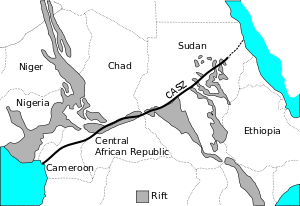
At the time Noah lived, the Sahara was much wetter. There was an extensive system of interconnected lakes and rivers. The western Nile watershed extended well into the Sudan. Hydrological studies indicate many periods of flooding from the Nile to the Atlantic coast of Nigeria. Noah lived in the region of Lake Chad. The gray shaded areas show the ancient water ways in the African Sheer Zone.


There was an abundance of reeds. According to Genesis 6:14, Noah's ark was constructed of גפר (gofer/gopher), which is the word used to describe the basket in which Moses floated on the Nile. In other words, the ark was constructed of reeds. The hollow reeds were extremely buoyant. Such vessels are still constructed by the marsh Arabs of Iraq and East Africans.


There is a great deal of evidence that boats were once prevalent in the Sahara. The black mahogany Dufuna dugout (shown below) was found in the Sudan buried 16 feet under clays and sands whose alternating sequence showed evidence of deposition in standing and flowing water. The dugout is 8000 years old. By comparison, Egypt's oldest boat is only about 5000 years old. Peter Breunig (University of Frankfurt, Germany) has written this description of the Dufuna boat: “The bow and stern are both carefully worked to points, giving the boat a notably more elegant form”, compared to “the dugout made of conifer wood from Pesse in the Netherlands, whose blunt ends and thick sides seem crude”. Judging by stylistic sophistication, Breunig reasons that, “It is highly probable that the Dufuna boat does not represent the beginning of a tradition, but had already undergone a long development, and that the origins of water transport in Africa lie even further back in time.”


Boats appear on prehistoric rock paintings in the Sahara. Many show people transporting long horn cows by boat. The Proto-Saharan were cattle-herding. Here are examples of the sickle, incurved sickle, square, incurved square, and flared boat types found on the prehistoric rock art of the Central Eastern Desert of Egypt.


The historicity of Noah’s concern for animals is supported by the discovery that Proto-Saharan rulers kept royal menageries of exotic animals. The oldest known zoological collection was found during the 2009 excavations at the shrine city of Nekhen on the Nile. The royal menagerie dates to about 3500 BC and included hippos, elephants, baboons and wildcats. Noah would have known about the shrine city of Nekhen. It was one of the earliest worship centers for the Horite Hebrew. This painting was found on the wall of a tomb in Nehken.


At Nekhen archaeologists discovered a mummified ruler with red hair and a red beard. Although most of the hair found in the graves at Nekhen was of a dark brown color, natural red hair was discovered in association with the male in Burial no. 79. (Nekhen News, page 8)

Noah and his descendants appear to be in Y-DNA Haplogroup R1b. The R1 rulers were the "mighty men of old" who dispersed into southern Europe, the Tarim Valley of China, and eventually into the British Isles. About 70% of native British men are in Haplogroup R1b. The dark red spot in Central Africa is Noah's homeland near Lake Chad.


Populations of the Lake Chad region before Noah

The oldest known cemetery in the Sahara dates to 7500 B.C., about 3500 years before the time of biblical Noah. The material evidence indicates a settled population at the edge of a very large lake or trough, possibly Lake Mega-Chad which connected to the Benue Trough.

The initial discovery was made by National Geographic photographer Mike Hettwer in 2000, and the excavation work was led by University of Chicago archaeologist, Paul C. Sereno, famous for his discovery of dinosaurs.

About 7500 B.C., at the time that this graveyard was used, Lake Chad had an area of about 249,000 miles. It is likely that the graveyard that Paul Sereno uncovered was originally at the edge of Lake Mega-Chad.

According to a recent report about the cemetery site, "The burial density, tool kit, ceramics, and midden fauna suggest a largely sedentary population with a subsistence economy based on fishing and on hunting of a range of savanna vertebrates."


This Gobero skeleton measures 6 feet.
Photo (c) Mike Hettwer, courtesy Project Exploration


According to Sereno, the Early Holocene people left when it became arid, but the area was repopulated by a taller people around 4600 B.C. when humid conditions returned. That is the time of Noah whose descendants are described as tall in the Bible.

The region was much wetter than today and the inhabitants of the area experienced flooding. There was flooding on and off over a long period, and wet conditions prevailed from 7700-6200 (phase 2).

Sereno states, "The darkened bone color of all human skeletons in phase 2 burials is indicative of sustained inundation." (Read about Sereno's findings here.)

Another wet period corresponds to the time that Noah would have lived in the region of Lake Chad, between 4200 and 3800 B.C.