Followers

Showing posts with label Judah. Show all posts

Saturday, July 18, 2026

Was Tamar Judah's Wife?


Dr. Alice C. Linsley


Tamar is usually presented as a Canaanite woman with no Hebrew ancestry. This is clearly not the case because the Hebrew took only Hebrew marriage partners (caste endogamy). It is more likely that Tamar was a daughter of a Hebrew priest who maintained a water shrine along the road between Adullam and Timnah and that she was a shrine-dedicated virgin before her marriage. She was qedeshah, that is a holy woman. Judah’s friend Hirah went to find Tamar, asking for the qedeshah (Gen. 38:21).

Concerning such women, Bible scholar Edward Lipinski noted, “Contrary to the claims of some 20th-century scholarship, the Hebrew Bible never refers directly to cult prostitutes. Many modern Bible translations are simply misleading in this respect. Much of the confusion results from a misunderstanding of a few Biblical texts that mention qedeshot, the plural of qedeshah, which is related to qodesh, “holy place.”

In his “Akkadian Lexical Companion for Biblical Hebrew” Hayim Tawil notes that qedeshah or kedeshah is derived from the root K-D-Sh which can mean “separation” or “elevation” of a holy woman. It can refer to a woman dedicated to the service of a temple or a water shrine.

If we remove the narrative about Judah’s sons Er and Onan we are left with a coherent picture of Judah as a Hebrew clan chief with two wives. One wife was the daughter of a Hebrew man named Shua and the other, mentioned in rabbinic writings, was either the daughter of Asuel (or Bat-Asuel) or, if one credits the Book of Jubilees (34:20), a woman named Aliyah. High-ranking Hebrew chiefs typically had two wives living in separate settlements.

It is strange that the Bible provides so little information about someone as prominent as Judah. Afterall, the words Jew and Judea are derived from his name. Judah was a Hebrew chief who, by the time of the events described in Genesis 38, would have been an older man with two wives. Tamar was probably one of them. The detail about God killing Judah’s sons seems to come from the Deuteronomistic Historian, a source from about 1000 years after the time of Judah and Tamar. The narrative reflects the legal and theological frameworks of the Deuteronomistic history, the taboo of onanism, and the practice of levirate marriage as codified in Deuteronomy 25:5–10. The theology of the Deuteronomist entails a God who directly punishes and sometimes ends the lives of those who violate the Law.

When we extract this source from the picture Judah emerges as the father of three living sons: Shelah, Perez, and Zerah by two different wives. These Hebrew sons form a typical three-clan confederation. It was common for the descendants of two of the sons of a confederation to intermarry. The intermarriage between the descendants of Zerah and Perez explains why they are linked in the Book of Ruth and counted among the ancestors of King David and Jesus.

Typically, the Bible traces descent from two half-brothers and their wives. Consider these sibling sets in which a common father is acknowledged, but there are at least two different mothers.

Jubal, Jabal, Tubal-Cain – Lamech’s sons by two wives (Gen. 4).

Ham, Shem, Japheth – Noah’s sons by different women.

Nahor, Abraham, Haran – Terah’s sons by two wives.

Isaac, Joktan, Ishmael - Abraham’s sons by two wives and a concubine.

Moses, Aaron, Korah – Amram’s sons by two wives.

Numbers 26:20 explicitly identifies the three-clan confederation of Judah. “The descendants of Judah by their clans were: through Shelah, the Shelanite clan; through Perez, the Perezite clan; through Zerah, the Zerahite clan.”

Typically, only two of the three sons of a Hebrew confederation are ascendant, meaning that their roles as firstborn sons are prescribed. The firstborn of the first wife is his father’s heir and when the father dies, he rules over the father’s territory. The firstborn of the second wife serves the household of his maternal grandfather or becomes an official in that territory. The third is a son of a concubine and he is sent away with sufficient resources to become established in an area away from the two other sons. This custom drove the dispersion of the early Hebrew into far reaches on the ancient world.

Evidence that Judah married Tamar

Around the time that Joseph was serving his uncle Potiphar in Egypt, Judah left Hebron and went to Timnah for a sheep shearing with his Hebrew kinsmen Hirah of Abdullum. On the way, Judah stopped at Enaim where he married Tamar. The priest overseer of the Enaim water shrine was Tamar’s father.

Enaim means “Two Wells” and it was common for marriages to be formalized at such places. Abraham married Keturah who lived at the Well of Sheba (Beersheba). Moses married Zipporah who he met at the well of her father Jethro. Caesarius Archbishop of Arles explained that Isaac, Jacob, and Moses are types of Jesus Christ, "for this reason they found their wives at wells, because Christ was to find His church at the waters of baptism."

Note that when Judah arrived with a gift for his bride, she was veiled. This was a common practice. In Genesis 24:65 we read that Rebekah covered her face with a veil when she learned that the man walking toward them in the field was her future husband, Isaac.

Note also that Judah gave Tamar a kid from his flock and promised her a goat. This sounds very much like a bride price.


Monday, April 18, 2016

Discrepancies are Evidence of Authenticity


…but sanctify Christ as Lord in your hearts, always being ready to make a defense to everyone who asks you to give an account for the hope that is in you, yet with gentleness and reverence… (1 Peter 3:15)


Alice C. Linsley

Supposed "contradictions" are one of the excuses people sometimes offer for rejecting the claims of Jesus Christ. Often these same people have little first-hand acquaintance with the Bible. They are uncritically repeating a lie.

When we consider the Gospel accounts of Jesus' birth, ministry, death and resurrection we do not encounter contradictions. We find discrepancies that result from different perspectives. In fact, if the accounts of Matthew, Mark, Luke, and John agreed in every minute detail, we would have evidence of collusion among the witnesses. We would have reason to be suspicious.

J. Warner Wallace is a cold-case homicide detective and a Christian case maker at Stand to Reason.  He applied his expertize in forensic investigation to the Gospels and concluded that the testimonies are authentic. Wallace writes, "The Christian life is a rational and reasonable life that is rooted and grounded in the evidence of the Resurrection and the truth of the Bible. Christians are saved by placing their trust in Jesus, but Christians become a powerful force in their world when they commit themselves to being 'case makers' for what they believe."

My father was an attorney who handled criminal cases. He knew how to cross-examine witnesses and how to detect collusion. He was impressed after reading the different Gospel accounts by how they agree on the main events but note different details. Had they all given exactly the same testimony he would have reason to doubt them, as that is a sign of collusion or conspiracy.

That there are different accounts of an event does not mean the event was invented, nor does it indicate fabrication on the part of the witnesses. Recognition of the different contexts of Biblical writers is also recognition that they represent real people in history. Consider how this is so.

Genesis 46:27 in the Septuagint says, "Thus all the souls of Jacob's house who went to Egypt were seventy-five" but the Masoretic says, "....all the persons of the house of Jacob, that came into Egypt, were seventy." There is no contradition here, but rather a significant discrepancy that testifies to different contexts. For the Masoretes 70 represented fullness and was not intended to be taken as an exact number of people. The Sanhedrin, for example, consisted of 70 men, never more and never less. Further, the number 70 referenced the number of appointed ones in their tradition and implies that those who went down into Egypt were appointed.

Numbers in the Bible are usually symbolic and reflect a specific contexts. For example, the number 40, as in the phrase "40 days and 40 nights" has a Nilotic context. The Nile flooded for 40 days and the people who had left their homes waited another 40 nights before returning home. It took "40 days and 40 nights" for the waters to recede. Though the book of Daniel is rich in number symbolism it is significant that the number 40 does not appear in that book. The context of Daniel is Babylonian rather than Nilotic and the Babylonian number symbolism is different.

The Masoretes were Temple scholars of the 6th–10th centuries AD, long after the time of Moses. They had been greatly influenced by the theology and number symbolism of their ancestors who had been in Babylon. For the Masoretes 7 was a sacred number. The number is associated with the ancient Habiru/ Hebrew priesthood. This is evident in the priestly account of Noah's flood where Noah to told to take 7 sets of "clean" animals onto the ark. Contrast this with the older account in which Noah is told to take 1 set: male and female. (Note the binary feature; male-female, a distinguishing mark of the older version of the flood).

What I find most provocative about this discrepancy is the suggestion in the Masoretic text that not all the Habiru went with Jacob down to Egypt. This is certainly the case since many Hebrew clans besides Jacob's remained in Canaan. Among them were the clans of Seir, Elon, Esau and Uz. Uz was Job's clan.

Genesis 38 tells us that Judah, who had gone down to Egypt with his father, came back to Canaan where he had relations with Tamar. It appears that the ruling men of Jacob's clan continued to interact with kinsmen and business associates in Judah, Edom and Beersheba.

When we dig deeply into the Bible we find that discrepancies reveal different perspectives and traditions, but they also point to a shared religious tradition that can be traced to the dawn of human existence. The features of this shared tradition have been of great interest to Biblical anthropologists.

Related reading: Number Symbolism in the Bible; The Life Spans of Methuselah and Lamech; Who Is Jesus Christ?; Noah's Ark; Levi-Strauss and Derrida on Binary Oppositions; Binary Sets

Friday, July 24, 2015

Mother's House and Father's House


East African village seen through the cattle kraal.

Dr. Alice C. Linsley

Some scholars have wondered why Rebecca ran to her mother's house to announce the marriage proposal from Isaac (Gen. 24:28). One explanation is that the mother's house was responsible for the necessary arrangements to set up a new household for the bride-to-be. The father's house was responsible for the legalities involving dowry, inheritance, and property. Running to her mother's house expressed Rebecca's willingness and eagerness to be married.

In the Bible the "mother's house" and the "father's house" represent distinct right and responsibilities. The mother's house is where women gather to plan weddings and ceremonies for the girls. coming of age. The father's house is where the elders of the village gather to deliberate on matters such as hunting, defense of territory, marriage alliances and dowries. However, the women take care of the practical arrangements for weddings and the necessities to set up a new household.

A woman who was forbidden to marry or remarry was told to return to her father's house. This is what Judah told Tamar when he refused to provide her with another son. On the other hand, Naomi hoped that her two daughters-in-law would remarry, and she sent them back to their mothers (Ruth 1).

The Bible is pointing us to a village arrangement in which the women gathered in the house of the chief's principal wife and the men gathered in the house of the chief. The custom is found even today among Africans and in some Eurasian villages.

Among African peoples, rites of passage included circumcision, scarification, naak, and the building of small huts. Before girls come of marriage age (13-15 years) they build their own huts next to the huts of their mothers. They mimic female adulthood until they marry, at which point they take down their small hut and move into a larger hut built by their husband and located with his kinsmen (patrilocal residence).

Similarly, young men celebrate their approaching manhood by building a small hut next to their father's hut until they take a wife, at which time they build a larger hut in the kraal.


South African women preparing the bride
Credit: Monica Dart


This Xhosa bride wears a sheet to cover her secrets.

A blanket or sheet covering is an ancient practice associated with marriage.
Ruth sought marriage to Boaz by covering herself with his blanket.


This practice of building up a house is more than building a place to live. It is about building a lineage. The book of Ruth alludes to this. Naomi tells her widowed daughters-in-law to return to their "mother's house" so that they can prepare to remarry and have families.

Contrast this to the story of Judah and Tamar (Gen. 38). Judah's sons who were married to Tamar die one after the other. He refuses to fulfill the law of levirate marriage, fearing that he might lose another son. Judah tells Tamar to return to her "father's house" which is to say, "You will remain a widow and childless."


Sunday, November 16, 2014

Joseph and Judah as Instruments of Deliverance


Then Judah said to Israel his father, “Send the lad with me, and we will arise and go, that we may live and not die, both we and you and also our little ones. I myself will be surety for him; from my hand you shall require him. If I do not bring him back to you and set him before you, then let me bear the blame forever. For if we had not lingered, surely by now we would have returned this second time.”

And their father Israel said to them, “If it must be so, then do this: Take some of the best fruits of the land in your vessels and carry down a present for the man—a little balm and a little honey, spices and myrrh, pistachio nuts and almonds. Take double money in your hand, and take back in your hand the money that was returned in the mouth of your sacks; perhaps it was an oversight. Take your brother also, and arise, go back to the man. And may God Almighty give you mercy before the man, that he may release your other brother and Benjamin. If I am bereaved, I am bereaved!”
(Genesis 43:8-14)


Alice C. Linsley

Old Jacob struggled during an extended famine in Canaan to sustain his family. He sent his older sons to Egypt to buy provisions and there they encountered a powerful Egyptian who was their own brother Joseph. Joseph became an instrument of deliverance for his family.

Joseph married Asenath, daughter of the "priest of On" (Gen. 41:45).  Asenath's father was Putiphar or Potiphera. This is a title composed of the words pu and tifra. Putifra in ancient Egyptian means "this order" and likely relates to the order of Horite priests. The stela of Putiphar speaks of Putiphar as the "son of Horus, may He live forever."

On, called "Heliopolis" by the Greeks, was one of the most prestigious shrine cities of the archaic world. It was an Anu city. The pyramids of Giza, Saqqara and Abusir were aligned to the obelisk of Heliopolis. The Pharaoh held the title of "Ruler of Heliopolis" and his symbol was the scepter-hq. The scepter and the flail became the symbols of the Pharaoh's absolute authority.


There were Anu/Ainu among Abraham's ancestors. Asenath was related to Joseph, probably a patrilineal cousin. According to Genesis 41:50, she gave birth to two sons before the time of famine. Her first born son was named Manesseh and he would have been dedicated to (belonged to) the Heliopolis shrine, whereas Ephraim, the younger son, belonged to the House of Jacob. This explains why Jacob gave him the blessing that pertained to the first born (Gen. 48:14).

Manesseh and other Habiru/Hebrew clans related to the Horites of Egypt and Edom settled in the region of Galilee. The Horites of Nazareth constituted the sixteenth division of priests, the order of Hapi-tsets. The word is of Egyptian origin. Hapi is an ancient reference to the Nile. T-sets refers to the One who rules the wind, waves and currents (cf. Jesus' calming of the wind and waves on the Sea of Galilee.)


Judah's role

When Joseph's brothers discussed killing him (Gen. 37), it was Judah who came up with a suggestion that preserved Joseph's life, and it was Judah who offers to "be surety" for Benjamin's safe return to Jacob (Gen. 43).  Is it any wonder that Jacob grants a special blessing to this son? In the tribal lists, Judah is sometimes replaced by Ephraim and Manesseh, but Jacob's deathbed blessing of his sons favors Judah and Joseph above the others. Here is part of the blessing given to Judah: The scepter shall not depart from Judah, nor the ruler's staff from between his feet [nor a lawgiver from his loins], until Shiloh comes, and to him shall be the obedience of the peoples. (Gen. 49:10)

This relates to Christ who is the long-expected Righteous Ruler and the Lawgiver because every law that comes from God is given through Him. He is a descendant of both Joseph and Judah. Judah had two wives, as was the custom for the Horite rulers. One was Shua, one of Jacob's daughters. She was Judah's first wife and his half-sister (as was Sarah to Abraham). By his two wives Judah had two firstborn sons: Er and Onan. Their names represent two Horite territories. Er (Ur) is the eastern territory of the Mesopotamian Horites in Ur, and Onan (Onn) is the western Horite territory centered at Heliopolis (biblical On) on the Nile. All of these Horites were ethnically Kushite.

"The scepter will not depart from Judah..." is generally taken to mean that the Messiah would come from Judah, but it is possible that it refers to a historical reality; namely, that some of Jesus' ancestors were never captives in Babylon. Jacob's holdings extended to Beersheba and the Babylonians were not interested in engaging warriors in the Negev.

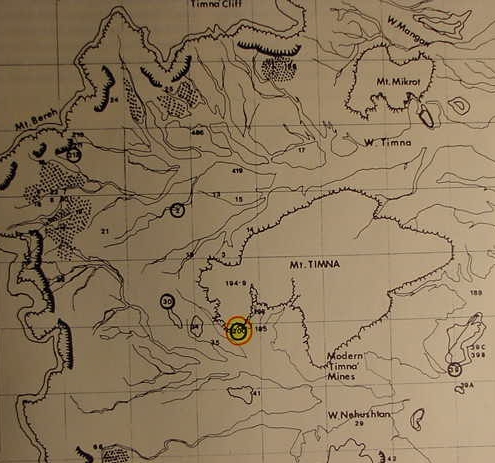
One of the oldest shrines in the Negev has been found at Timnah where copper was mined from very ancient times. Some of the mines are at least 6000 years old. This was a Horite shrine as evidenced by the presence of a statue of Hathor, the mother of Horus and the patroness of metal workers. A temple dedicated to Hathor was discovered at the southwestern edge of Mt. Timnah by Professor Beno Rothenberg of Hebrew University.

The Chalcolithic metal works at Timnah were found at the Wadi Nehushtan in the foothills along the western fringe of the southern Arabah Valley. The smelting works, slag and flints at this site were found to be identical to those discovered near Beersheba where Abraham spent his old age. This is why Rothenberg concluded that the peoples living in the area were "partners not only in the work but in the worship of Hathor." (Timna, p. 183)

It is appears that Tamar was from this region. She bore Judah twin sons after Judah refused to provide her another husband from among his sons. Judah praised her as "more righteous” than himself (Gen. 38:26) because she fulfilled the levirate marriage law. The younger of Tamar's two sons was Perez, an ancestor of Jesse of Bethlehem, David, and Jesus Christ.


Mary's Ancestry

Mary’s parents were Joachim and Anna. Joachim was a shepherd-priest of Bethlehem Ephrath. Throughout the Bible, Ephrath is a reference to Judah. His wife was Anna, a daughter of a priest. Hippolytus of Thebes records that Mary’s mother was one of three daughters of a priest named Matthan (Matthias/Mattai). The eldest sister, Mary, was the mother of Salome; the second sister, Sobe, was the mother of Elizabeth whose son was John the Baptist. The third sister was Anna, Mary’s mother. Elizabeth and Mary were cousins, and both were daughters of priests.

Herod the Great deposed the High Priest Matthias after the priest removed the Golden Eagle from the Temple. Matthias was the second to the last High Priest before the destruction of the Temple in 70 AD.  Matthias' father was the High Priest Theophilus, the brother-in-law of Joseph Caiaphas, the High Priest before whom Jesus appeared after his arrest. Theophilus' family was a ruler-priest family from Edom. They were descendants of Abraham and Seir the Horite (Gen. 36). The Horite ruler-priest lineage was very ancient and was recognized by Herod the Great who also was from Edom/Idumea.

The ancestral family of Jacob ben Mattat, once a favorite of Herod the Great, came to have limited influence with the House of Zadok, as this lineage of King David’s descendants appears to have been increasingly ostracized after Herod's death in 4 BC. In light of historical events, it appears that the ancestral scepter would have departed from Judah had the Christ not appeared when He did. With Christ's appearance the scepter passed to him, the eternal King. In 70 AD, the temple was destroyed as Jesus had predicted and the solemn ceremonies, as well as the blasphemies, ceased. Jesus came out from the temple and was going away when His disciples came up to point out the temple buildings to Him. And He said to them, "Do you not see all these things? Truly I say to you, not one stone here will be left upon another, which will not be torn down." (Matt. 24:1-2)

Related reading: The Enigma of Joseph; The Significance of Galilee in Matthew's Gospel; The Nazareth-Egypt Connection; The Moral Code of Ani

Friday, July 1, 2011

The Religion of Timna


3000 year old fibers found at Timna
(Read more about this discovery in Edom.)

Alice C. Linsley


Seeds produce plants when they fall to the ground. Human semen produces humans. The seed that should fall to the earth is the seed of plants, which spring forth from the earth. The seed of man should fall on his own type (the womb), from which man comes forth. Clement of Alexandria wrote, “Because of its divine institution for the propagation of man, the seed is not to be vainly ejaculated, nor is it to be damaged, nor is it to be wasted” (The Instructor of Children 2:10:91:2 A.D. 191). In the Biblical worldview, onanism represents a violation of the divine order in creation.

This takes us to the strange story of Judah and his cousin wife, a daughter of Shua "a Canaanite" (Gen. 38:1-11). Shua's daughter bore Judah two sons: Er and Onan. The name Onan is Onn (Heliopolis), a Horite shrine on the Nile. Joseph married Asenath, the daughter of the "priest of Onn" (Gen. 41:45). It is likely that Joseph’s brother Judah also married into this prestigious priestly line. The first born of Shua was Er, but Onan was likely the first born of Judah's cousin-wife. If so, she named her firstborn after her father, following the custom of the Horite Hebrew of Edom.

Er was married to Tamar, the daughter of a Horite priest, but he "offended Yahweh and Yahweh killed him."  Following the levirate law, Onan then married Tamar to produce an heir for his dead brother.  Here we encounter a clue that this story is a late interpolation intended to slur the Canaanites. It falls in the same category as the curse of Ham and the incest of Lot.  It clearly represents a time well after the people named in the story because it fails to recognize that Er already had an heir.


That Er's line continued is evident from the appearance of his name.  One of Joshua's sons was a descendant of Er by Joshua's cousin-wife.

Onan's motivation in not impregnating Tamar appears to be the security of his heir by his sister-wife. Tamar was his cousin/niece wife and her firstborn son would ascend to the throne of her father, who isn't named in the Biblical text. Apparently, Onan's spilling of his seed was motivated by fear of a son who might rule in competition to his heir. At this time Horite land holdings were smaller than those of the great Kushite kingdom builders such as Nimrod (Sargon the Great). Evidently, there was greater competition between ruling sons.

Onan's denial of a son to Tamar was serious because the anticipated "Seed" of Genesis 3:15 might come by a cousin/niece wife. Indeed David's ancestry is traced to Tamar and Judah as is that of the Son of God.

The key to understanding this story lies with the identity of Tamar's father.  He appears to have been connected to the shrine of Hathor at Timna. Hathor was the virgin mother of Horus who was called "son of God.'  Here is a celestial archetype to make note of because it is the pattern whereby Abraham's Jewish descendants would come to recognize the identity of Jesus, the only begotten Son of God who was born of the Virgin Mary.

Hathor was the patroness of metal workers. Timna was famous for its copper mines.  It was at the entrance to this shrine that Judah had intercourse with Tamar (Gen. 38:12-30). This strongly suggests that Tamar was the daughter of the Horite ruler-priest at Timna. This suggestion is strengthened by what happened after Judah discovered that Tamar was pregnant. He called for her execution according to the law pertaining to the daughters of priests (Lev. 21:9). She was to be burned alive.

Judah is not presented in a positive light in this story, but Tamar is. Judah ends up praising her initiative whereby she fulfilled the requirement of the law. Judah says about her "She was more righteous than I." (Gen. 38:26)


The Horite Shrine at Timna

Timna is the site of some of the world's oldest copper mines. The mines are at least 6,000 years old and there are newer ones as well, totaling about 10,000 shafts. The oldest mines were worked almost continuously by Kushite and Horite metal working clans until the Roman Period. There are ancient rock carvings showing Kushite warriors in chariots, holding axes and shields. A temple dedicated to Hathor was discovered at the southwestern edge of Mt. Timna by Professor Beno Rothenberg of Hebrew University.

The highlighted circle marks the location of the Hathor Shrine.

The Chalcolithic metal works at Timna were found at the Wadi Nehushtan in the foothills along the western fringe of the southern Arabah Valley. The smelting works, slag and flints at this site were found to be identical to those discovered near Beersheba where Abraham spent much of his time.  The metal workers of Timnah and the metal workers of Beersheba were kin and the patroness of their mining and smelting operations was the mother of Horus who was venerated or worshipped by the Horites. In other words, these were Horite metal workers. In his book Timna, Rothenberg concluded that the peoples living in the area were "partners not only in the work but in the worship of Hathor." (Timna, p. 183)

During the early Iron Age, a Canaanite tent-sanctuary replaced the Hathor temple of the Timna mining area. However, according to Nissim Amzallag, "the metallurgical character of this shrine was maintained."


So it appears that Judah brought forth twin sons by the daughter of the priest of Timna, one of the oldest Horite shrines known to exist outside of Kush. She was a woman of high social rank whose people patterned every aspect of their lives on the celestial archetype of God Father (Re) and God Son (Horus). They believed that Horus was born at the winter solstice because from that day forward the Sun grows in strength. The ancient Egyptian ritual involved placing a male baby before the image of Hathor, and the "divine son" was presented with gifts by the priests.

The Horites observed the death of Horus in a 5-day festival. The first 3 days were marked by solemnity (as Plutarch noted in Isis and Osiris, 69). The last 2 days were a time of feasting and rejoicing. Horus is said to have died on the 17th of Athyr. His death was commemorated by the planting of grain. On the third day, the 19th of Athyr, there was a celebration of Horus’ rising. It is no coincidence that Jesus alludes to the Horite narrative when describing his passion and resurrection. “Truly, truly, I say to you, unless a grain of wheat falls into the earth and dies, it remains alone; but if it dies, it bears much fruit." (John 12:24) He identifies himself as the "Seed" of Genesis 3:15.

The Horite Hebrew believed in the "second death" (Rev. 21:8) and prayed that this would be avoided. They offered sacrifice for and prepared the bodies of their dead in the hope that their bodies might rise to life at a future time.


Related reading: Timna Valley Mines Linked to House of David; The Afro-Asiatic Metalworkers; The Peoples of Canaan; Edom and the Horites;  The Ra-Horus-Hathor Narrative; Joseph and Judah as Instruments of Deliverance; Jacob Dunn on Timna


Sunday, April 19, 2009

The King is Risen!

Jesus Christ is the promised Messiah who rose from the dead. He is the Eternal King whose reign is foretold by the prophets and priests of old. Let us trace the signs that verify this.

His name means "Savior" and his birth was predicted by prophets and foreseen by seers.

His cross is the most basic symbol of the cosmology of the people of Abraham and the sign of Reality.

He was born in David's city of Bethlehem, of the Tribe of Judah, of the Virgin Mary.

His coming was marked by the alignment of Regulus, the King star with Jupiter, the King planet in the constellation of Leo at the beginning of the Jewish New Year in 3 BC. The conjunction produced the appearance of a single extraordinarily bright star.

In Genesis 49:9-10, we read: "You are a lion's cub, O Judah; you return from the prey, my son. Like a lion he crouches and lies down, like a lioness-- who dares to rouse him? The sceptre will not depart from Judah, nor the ruler's staff from between his feet, until he comes to whom it belongs and the obedience of the nations is his."

The association of Messiah with the tribe of Judah and the lion clarifies Jupiter's triple conjunction with Regulus within the constellation of Leo, The Lion.

The Messiah-King was visited by wise men from the East who brought gifts fit for a king.

Like Abraham and Moses, both princes yet regarded as foreigners, King Jesus' noble lineage was not recognized by the Jewish authorities.

When the people used palm fronds to greet Jesus as he entered Jerusalem, they greeted him as one to be enthroned. Fresh palm tree fronds were used ceremonially at the installation of rulers. Even today fresh palm tree leaves are “employed on occasions of installation to the position and rank of a sovereign, and to the office of a priest of high rank.” Fresh palm tree fronds are used ceremonially at the installation of rulers even today. (For more on this, go here.)

When He appeared before Pilate he did not deny that he was the King of Israel.

Mocking Him, the soldiers crowned him with thorns and dressed Him in royal purple.

While on the Cross, many read the sign that named his crime: "King of the Jews."

In death, His body was layed in the tomb of Joseph, the Aramathean. "Aram" is an old word meaning ruler or exalted. Sarah's people were Aramatheans and the blood line of Messiah is traced through the mothers. When we consider Sarah's story we recognize her as a type of Israel. To her the promise of a son was given. Initially, she laughed at the promise because she thought only in natural terms and she was beyond the age of child bearing. Then in her later days, she received the promised son and even insisted that he alone was to rule over his father’s territory. This is what happened to the Jews. They were given the Messianic promise and they laughed at Him. Long after the promise was made, Messiah was born and made known in Israel, but many of the leading Jews wanted Him dead. However many more followed Him and insisted that He was the King who was to rule over His Father’s kingdom.

Before he died at age 108, Israel's leading rabbi, Yitzhak Kaduri, left a signed note indicating Messiah's identity: Yeshua - Jesus.

A few months before, Rabbi Kaduri had surprised his followers when he told them that he met the Messiah in dreams and visions. His manuscripts, written in his own hand, have crosses painted by Kaduri all over the pages.

Many Jews have attempted to explain away the crosses, arguing that the great Rabbi Kaduri was not a Christian. Of course not! However, he was wise and prayerful, and he knew the tradition and cosmology of his people. Those combined to lead him to Jesus, Messiah and King.

Monday, November 24, 2008

Judahite Fortress

Hebrew University archaeologist Yosef Garfinkel believes the discovery of the two fortified gates at Elah Fortress not only proves the existence of Sha'arayim named three times in the Bible in connection with David, but also suggests that the fortified city was part of a centralized government administered by King David.

Elah Fortress is the oldest known fortress of the biblical period. It dates to the tenth century B.C. The fortress is southwest of Jerusalem on what was the border between the Kingdom of Judea and the coast lands of the Philistines. The massive stone gate faces Jerusalem.

Garkinkel's team also found a 3,000-year-old pottery shard with five lines of text at the Elah Fortress. He believes the text provides evidence for the existence of a vast kingdom under David's rule. Garfinkel believes the site was the westernmost outpost maintained by the Kingdom of Judea, which controlled land in southwest Asia and Palestine before the Kingdom of Israel.

Read more here and here.