Followers

Showing posts with label Hathor. Show all posts

Wednesday, November 9, 2022

The Adam and Eve of History


Sethite Hebrew priest of Nekheb on the Nile with authority over the palace.


Dr. Alice C. Linsley

Taken together, the biblical data indicates that Adam and Eve were historical persons. Their descendants listed in Genesis chapters 4, 5, 10, 11, 25, and 36 are the early Hebrew organized into two ritual groups (moieties): the Horites and the Sethites. The biblical data, and existing texts written by the early Hebrew, provide a great deal of information about the Hebrew ruler-priest caste.

As Adam is the founding father of the early Hebrew, so Eve is their founding mother. The term “Hebrew” comes from the ancient Akkadian word for priest – Abru. (Akkadian is the oldest known Semitic language.) The Hebrew ruler-priest caste was called Abrutu in Akkadian.

Adam is the father of Cain and Seth. Cain is described as an early “city” builder, and Seth is the founding father of the Sethite Hebrew who are mentioned in texts from as early as 2600 B.C. This means that the historical Adam lived before 4500 B.C.
 
The historicity of Adam is demonstrated by analysis of the kinship data found in the king lists of Genesis chapters 4 and 5. Adam’s sons Cain and Seth married their cousins, the daughters of Enoch, a contemporary of Adam. Enoch/Enosh/Enos is a royal title derived from the ancient Akkadian first-person pronoun: anāku. Likely, this is a reference to the royal first person.

Among the Igbo of Nigeria, anochie means “a replacer” or “to replace”, and among the Ashante of Ghana ano kyi means "Ano Junior." Here we find the idea of succession, suggesting royal lineages. A Nigerian philologist friend reports that anochie also means "direct heir to a throne." Therefore, the biblical name "Enoch" is associated with royal ascendancy among the early Hebrew. This may explain why the words enoch and adam are paralleled in Psalm 8:4.

“What is man [enosh] that you are mindful of him,

the son of man [ben adam] that you care for him?”

The diagram below shows the practice of “bride exchange” between the clans of Cain and Seth. The diagram shows Cain’s line on the left. This data is found in Genesis 4. Seth’s line is found in Genesis 5. Circles represent females. Triangles represent males. This symbol = represents the marriage bond.

Chapters 4 and 5 should be studied together to understand the marriage and ascendancy pattern of these early Hebrew rulers. Analysis of the king lists reveals that the early Hebrew practiced endogamy, that is, they married exclusively within their ruler-priest caste.

The wives of Cain and Seth were the daughters of Enoch. They named their first-born sons after their father. This custom is called the “cousin bride’s naming prerogative” and the pattern is consistent throughout the diagram. Kenan is named after Kain. Jared is named after Irad, and Lamech the Younger is named after his maternal grandfather Lamech the Elder.


The first-born sons of the early Hebrew ruled over territories in the region of Lake Chad, the Nile Valley, Canaan, Mesopotamia, and Southern Turkey. Eve’s first-born son was called Cain/Kain which refers to a ruler. Variants of the word include king, khan, kenan, and qayin. 

Cain’s brother was Seth (Genesis 5) who ruled in the “Land of Seti” in the Nile Valley. Genesis 4 states that Cain was banished from his homeland and that he went east of the Nile. We find his descendants the Kenites living in the land of Canaan. The word “Canaan” is related to the word Cain. The Kenites were itinerant metal workers. In Genesis 4, metal work is mentioned in association with Tubal-Cain.

Eve’s status among the early Hebrew is evident in her exclamation upon giving birth to her first-born son, Cain. In Genesis 4:1, she claims to have acquired a man, or more accurately a ruler with God's help. She declares “qanitti”. Note the royal affix -itti that appears in rulers’ names and in reference to kings. For example, the Akkadian itti šarrim means "with the king." Itti appears in royal names such as Nefertitti. Even today among the Oromo of East Africa the affix designates persons of high social standing: Kaartuumitti, Finfinneetti and Dimashqitti.

It appears that Cain's mother believed that she gave birth to a ruler. Indeed, Cain is the archetypal earthly ruler throughout the Bible. The Book of Jude warns those who might fall prey to false teachers that God punishes those who rebel against Him. He uses these examples: Cain the ruler, Balaam the prophet, and Korah the priest.


The Virgin Mary and Jesus Among Eve's Descendants

One of Eve’s descendants is the Virgin Mary, who according to Tradition, had been dedicated to the Temple. Her father was Joachim, a priest. Mary is among the Hebrew wives and daughters of social influence, prestige, and wealth. Some of their names are preserved in the Hebrew matronymics.

A matronymic (or matronym) is a personal name based on the given name of one's mother, grandmother, or a female ancestor. Female ancestors of especially high social standing were remembered through matronymics. Matronyms are not as common among the Hebrew as patronyms, but they do appear in the cases of high-status Hebrew women.

The Virgin Mary’s full name was "Miriam Daughter of Joachim, Son of Pntjr". Pntjr or Pa-Netjer refers to Joachim’s mother. She must have been of high social status for a matronymic to be employed. That Panetjer is a matronymic is evident from a limestone stela (1539-1291 B.C.) at the Brooklyn Museum bearing the names of Governor Pekhty-nisu and his wife Panetjer. It is certain that Mary’s ancestors were high ranking ruler-priests because even those who hated her admit this in the Talmud which claims: “She who was the descendant of princes and governors played the harlot with carpenters.” (Sanhedrin 106a)

Some editions of the Jerusalem Talmud specifically name Jesus as the son of Pandera/Panther. In this case "son" would mean descendant.


Long before Judaism emerged, the Hebrew believed in God Father, God Son, and the Spirit of God that generates life. They expected a woman of their ruler-priest caste to conceive the Son of God by divine overshadowing (cf. Luke 1). Hathor, the mother of Horus, is the archetype. Ancient images show her overshadowed by the Sun.


This expectation of the incarnation of the Son of God was fulfilled when the Virgin Mary brought forth Jesus, a direct descendant through his mother of the early Hebrew ruler-priests. In Christian iconography Mary is often shown overshadowed by a dove, a symbol of the Holy Spirit.


Tuesday, March 31, 2020

Hathor Veneration at Timna


3000 year old fibers found at Timna
(Read more about this discovery in Edom.)


Timna was a copper-rich region associated with the Horite Hebrew and protected by Egyptians, Edomites, and Midianites. It held a shrine dedicated to Hathor the mother of Horus, and a copper serpent was found there (p. 109). The copper serpent was the totem of the Horite Hebrew metal workers.

The way the serpent coiled around the staff of Moses reflected the sun's radiance, symbolic of purity. The sun was the emblem of God among the Horite Hebrew. The coiled solar serpent on the staff indicated that Moses was God's appointed leader of the people. Even today, this image appears on the croziers of some bishops in the Church.

The association of copper with serpent is evident is the relationship between the Akkadian words: sibbu - serpent and siparru - copper. The words Hittite and Het share the same primitive root HT. HT is the Hebrew and Arabic root for copper - nahas-het. As an adjective, HT means shining bright, like burnished copper. Nahash (NS) refers to a serpent. The HT copper smiths apparently ranged from Timna to Anatolia in Turkey. The serpent image was sacred for them, just as it was for Moses the Horite Hebrew ruler who fashioned a bronze serpent and set it on the standard (Numbers 21:9).

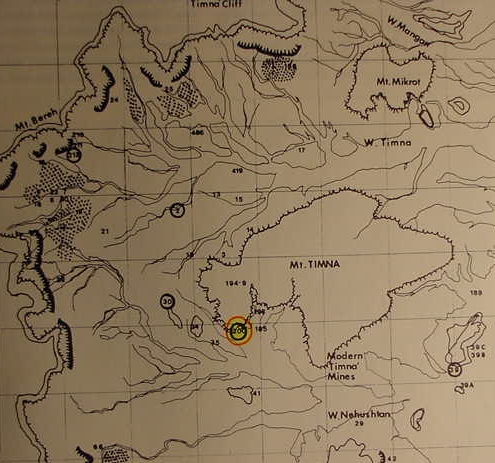
The mines at Timna are at least 6,000 years old and there are newer ones as well, totaling about 10,000 shafts. The oldest mines were worked almost continuously until the Roman Period. There are ancient rock carvings showing warriors in chariots, holding axes and shields. A temple dedicated to Hathor was discovered at the southwestern edge of Mt. Timna by Professor Beno Rothenberg of Hebrew University.

The highlighted circle marks the location of the Hathor Shrine.


The Chalcolithic metal works at Timna were found at the Wadi Nehushtan in the foothills along the western fringe of the southern Arabah Valley. The smelting works, slag, and flints at this site were found to be identical to those discovered near Beersheba where Abraham spent much of his time. The metal workers of Timna and the metal workers of Beersheba were kin, and the patroness of their mining and smelting operations was the mother of Horus who was venerated or worshiped by the Horites. In other words, these were Horite metal workers. In his book Timna, Beno Rothenberg concluded that the peoples living in the area were "partners not only in the work but in the worship of Hathor." (Timna, p. 183)

During the early Iron Age, a tent-sanctuary appeared at the Hathor shrine. However, according to Nissim Amzallag, "the metallurgical character of this shrine was maintained."


Related reading: "Egyptian Timna - Reconsidered" by Uzi Avner (ANE Studies, Unearthing the Wilderness, edited by Juan Manuel Tebes); The Ra-Horus-Hathor Narrative; The Substance of Abraham's Faith; The Serpent on Moses's Staff


Tuesday, September 11, 2018

The Ra-Horus-Hathor Narrative


The following is a conversation I had with a friend and a reader of Just Genesis. I provide a conclusion at the end which summaries some of the key ideas. There are related articles linked at the bottom also.


David Dickens: I was going to ask you about non-Biblical Horite/Proto-Saharan texts. You've talked about a lot of how Genesis lines up with the culture and some of archaeological work in Africa, but I was wondering if there are other sources of narrative. I'm looking for the Nilo-Saharan equivalent of Beowulf, I suppose.


Alice Linsley: The older Horus-Set narrative may be a close parallel. Horus, as the son of the Creator, comes to vanquish Set and claims the kingdom for the Creator God/High King. Not quite the same elements as in Beowulf. Set means bow, and the land of Nubia was called Ta-Seti, the "land of the bow." The Nubians were famous for archery. This narrative dates to around 5000 BC.


David:  At least that gives me a good place to start. I've seen a lot of anti-Horus propaganda lately whereas I'm perfectly happy with a typological interpretation of the Horus myths. (But then I'm no expert so my opinion is no better than most of the critics.)


Alice: There is much ignorance about Horus. Also, a great deal of nonsense on the internet about ancient Egyptian beliefs and magic. You might find this piece helpful: Ha'piru, Ha'biru, 'Apiru or Hebrew?


David: There's certainly all the pieces there, but the narrative is missing. I can read the first few chapters of Genesis, Ramayana, Epic of Gilgamesh, legends of the Eight Immortals, Beowulf... there are so many ancient stories (some with meticulous detail, but all with unifying themes) but there doesn't seem to be one for Horus or the Ha'biru peoples. It seems almost all we have is archeological evidence and some descriptions from ancient historians.


Alice:  The Bible is the narrative of the Horite Hebrew/Ha'biru. It is the only consistent source of the Righteous Ruler narrative. Unfortunately, there are competing narratives in Genesis that produce contextual incongruities. Nevertheless, we know which is the older tradition. It is the one which speaks of the "Seed" of God (Gen. 3:15) coming into the world and trampling down the serpent. The work published at JUST GENESIS attempts to reconnect Christianity to that older Tradition.

A late editorial hand, the Deuteronomist Historian (700-250 BC), introduced a new idea of God in YHWY. YHWY represents a rabbinic version in which there is no divine son. John's Gospel seeks to correct this. John explains that his purpose in writing is "that you may believe that Jesus is the Messiah, the Son of God." (John 20:31) Likewise, Martha professes that Jesus is Messiah, the Son of God (John 11:27), and John the Baptist bears witness that Jesus is the Son of God (John 1:34).


David:  So nothing extra-Biblical remains of the myths and legends of a people who touched three continents, spanned thousands of years and had a hand in every ancient civilization in the eastern hemisphere? I just doesn't sound right.

I'm not saying the Bible isn't the bees-knees, I'm just surprised that its all that remains (besides a few hieroglyphs on some temple wall).


Alice: Oh, there is much that pertains to the narrative outside the Bible. The Ancient Egyptian Coffin Texts and Pyramid Texts provide a great deal of information about Horus, the divine son of Ra. This is expressed in the Ancient Egyptian Pyramid Texts. In the priest's prayer to the King, he says, "Horus is a soul and he recognizes his Father in you..." (Utterance 423)

There are Akkadian artifacts and texts that testify to the belief in a Divine Father with a Divine Son. In Akkadian texts the father is called Ani and the son is called Enki.

Also there is the evidence of burial practices among rulers who were served by Horite Hebrew priests. The righteous rulers who were buried in pyramids from the Nile to the Tarum Valley of China hoped for bodily resurrection. That is why their bodies were mummified. It appears that their hope rested in the one who was pierced in the side, and died and rose from the dead on the third day.

The Nilotic Horites held an annual a 5-day festival in which they mourned the death of the son of God. On the third day, the priests lead the people to the fields where they planted seeds of grain to symbolize his rising to life.

Jesus told them, “This is what is written: The Messiah will suffer and rise from the dead on the third day..." (Luke 24:46) Where is it written? Scholars cannot find this in the canon. However, a reference to the third day resurrection is found in the Pyramid Texts: "Oh Horus, this hour of the morning, of this third day is come, when thou surely passeth on to heaven, together with the stars, the imperishable stars." (Utterance 667)


David: I'll have to hunt them down then. I've never seen that sort of collection.


Alice:  As an anthropologist I am aware of the dangers of constructing parallels without substantial evidence from all of these disciplines. I have no interest in exaggerating trifling resemblances. My first impulse is to regard the similarities between Horus and Jesus as yet an example of parallelomania. This is the initial reaction of most people until the evidence is set before them that Ra and Horus express the Father-Son relationship that is the basis of the Messianic Faith.

The Horite expectation that the Righteous Son would not remain in the grave is expressed in Psalm 16:10: For thou wilt not leave my soul in hell; neither wilt thou suffer thine Holy One to see corruption.

My assertion that the Ra-Horus-Hathor story from the ancient Nile Valley is a form of the Proto-Gospel has been labeled as an example of parallelomania. Such a claim reveals ignorance of what I have written. The Messiah is not a human invention patterned on the Horus myth. Horus is the pattern by which the Horite Hebrew expected a divine Son who would rule as Messiah, and Jesus is the only figure of history who fits the pattern.

Further, Jesus is a direct descendant of the Horite ruler-priests, some of whom lived in Bethlehem and others of whom lived in Nazareth, the home of the 18th priestly division, ha·pi·TSETS (Happizzez). Jesus' Horite ancestry is demonstrated by the distinctive Horite marriage and ascendancy pattern as evident in scientific analysis of the Genesis King Lists. He is the "Seed" of the Woman, the long-expected Immortal Mortal who tramples down death and receives the eternal kingdom.

Hathor conceived Horus by divine overshadowing of the Sun, the emblem of Re.

The angel answered, "The Holy Spirit will come on you, and the power of the Most High will overshadow you. So the holy one to be born will be called the Son of God."Luke 1:35

Hathor is shown at the Dendura Temple holding her newborn son in a manger or stable. The stable was constructed by the Horite priest Har-si-Atef. Atef was the crown worn by deified rulers. The Arabic word atef or atif means “kind.” The ruler who wore the atef crown was to embody kindness and he was to unite the peoples, as Horus unites the peoples of the Upper and Lower Nile.

The rulers of the two regions wore different crowns, but Horus was called "Horus of the Two Crowns" because he wore both. This is what stands behind the account of Yeshua/Joshua, the priest, receiving the "crowns" in Zechariah 6:11: "Take the silver and gold, and make crowns, and set it upon the head of Joshua the son of Jehozadak, the high priest..."

Of course, "Yeshua" is the Hebrew for Jesus. Horus is the only mythological figure in ancient Egypt who was understood to be a man, and as a man he wears the two crowns.

Christianity is not an invented religion based on the Horus myth. It is a faith that emerges organically from a received tradition. A closer look at the details of that sacred and very ancient Tradition speak of life beyond the grave through the agency of a divine ruler, the Son of God, who overcomes death and leads his people to immortality. The details of the narrative are extremely important. One such detail is the third-day resurrection described in Pyramid Texts Utterance 667: Oh Horus, this hour of the morning, of this third day is come, when thou surely passeth on to heaven, together with the stars, the imperishable stars.

Consider how Horus describes himself in the Coffin Texts (148):
I am Horus, the great Falcon upon the ramparts of the house of him of the hidden name. My flight has reached the horizon. I have passed by the gods of Nut. I have gone further than the gods of old. Even the most ancient bird could not equal my very first flight. I have removed my place beyond the powers of Set, the foe of my father Osiris. No other god could do what I have done. I have brought the ways of eternity to the twilight of the morning. I am unique in my flight. My wrath will be turned against the enemy of my father Osiris and I will put him beneath my feet in my name of ‘Red Cloak’.

This text is at least 800 years older than the words of Psalm 110:1, a clear messianic reference: The Lord says to my Lord: “Sit at My right hand until I make your enemies a footstool for your feet.”

The reference to the cloak reminds me of this from Proverbs 30:4:
Who has ascended to heaven and come down? Who has gathered the wind in His hands? Who has bound up the waters in His cloak? Who has established all the ends of the earth? What is His name, and what is the name of His Son--surely you know!

Conclusion

The expectation of a Righteous Ruler who would overcome death and lead his people to immortality has been found to be a wide spread and rooted in deep antiquity. It can be traced to the Nilotic belief in the bodily resurrection. In the Coffin Texts, the king is to be immortal in his flesh, expressed by his eating and drinking. Egyptologist Louis Vico Žabkar argues that the Nilotic concept of the "ba" is not a part of the person but is the person himself. The idea of a purely immaterial existence was entirely foreign to the Horite Hebrew. They were confident that the body and spirit could be united after death and thus the "second death" could be avoided.

This reality is lost in translation. The Septuagint borrowed the Greek word ψυχή psychē to describe the soul instead of the term ba to describe body. Žabkar concludes that the concept of the ba is so essential to ancient Egyptian thought that it would be better to used the exact term or explain the distinction in a footnote or parenthetically.

According to St. Augustine "the Egyptians alone believe in the resurrection, as they carefully preserved their dead bodies." ("Death, burial, and rebirth in the religions of antiquity", Jon Davies, Routledge, 1999, p. 27)

In The Pyramid Texts, dating from the beginning of the 4th dynasty, we read: "O Hunger, do not come for me; go to the Abyss, depart to the flood! I am satisfied, I am not hungry because of this kmhw bread of Horus which I have eaten." (Utterance 338) The Egyptian word km means to bring to an end, to complete, or fulfill, and hw refers to the heavenly temple or mansion of the firmament above. The Akkadian variant is khenfu cakes which are mentioned in the ancient Code of Ani.

It appears that the "kmhw bread of Horus" is what the Church Fathers call "the bread of immortality." Concerning himself, Jesus said that "unless you eat the flesh of the Son of Man and drink his blood, you have no life in you. Whoever feeds on my flesh and drinks my blood has eternal life, and I will raise him up on the last day" (John 6:53-54).

Certainly, there are messianic elements found among peoples who were not Horite Hebrew. In Hrothgar's view Beowulf is divinely appointed to save his people and he "was led like a lamb to the slaughter" (Is. 53), being betrayed by one of his own inner circle. There are other messiah-like figures in history and literature. The American mythologist, Joseph Campbell, called this the "Monomyth." In his fourth "Eclogue" (written between 42 and 27 BC) Virgil prophesied that a child would be born who would bring peace to the whole world.

These are relatively recent, however. The hope of a righteous ruler who overcomes death and leads his people to immortality can be traced to at least 5000 BC. Messianic expectation predates Abraham and appears to have originated among the Horite Hebrew priest caste that served in the Sun shrines that were found from ancient Nubia to Anatolia and from Edom to the Indus Valley.

The Horus narrative is a form of the Proto-Gospel. Here we find a central truth of the Messianic Faith: that the divine Father has a divine Son. Allusions to the Father-Son relationship appear in ancient Nilotic texts and in the Psalms.

Here is another Messianic passage that speaks of Him trampling the serpent:
"They will bear you up in their hands, That you do not strike your foot against a stone. You will tread upon the lion and cobra, The young lion and the serpent you will trample down." (Psalm 91:12,13)

This expectation was expressed about 1000 years before Psalm 91 in the Pyramid Texts.
"Horus has shattered (tbb, crushed) the mouth of the serpent with the sole of his foot (tbw)" Utterance 388 (681)

Jesus’ Horite ancestry is attested by analysis of his ancestry using the king lists of Genesis and the genealogical data of the Matthew and Luke. These reflect the Horite Hebrew marriage and ascendancy pattern. We are not speaking here of trifling resemblances between the myth of Horus and the historic Jesus. Scripture itself indicates that Abraham and his people were a caste of ruler-priest devotees of Horus. The Horus name appears among many Hebrew figures. Hathor was venerated among the Horite Hebrew metal workers. A temple dedicated to Hathor was discovered at the southwestern edge of Mt. Timnah by Professor Beno Rothenberg of Hebrew University. This is the site of some of the world's oldest copper mines.

Some of the Horite Hebrew rulers are listed in Genesis 36. They ruled in Edom, the same territory that God gave to Abraham. The Horite Hebrew expected a woman of their blood lines to bring forth the "Seed" of God in accordance with the biblical promise in Genesis 3:15. The Proto-Gospel upholds the Father-Son relationship, but this theme is later suppressed by the YHWH cult. YHWH has no son.

Messianic expectation involves the crushing of cosmic forces that oppose the Creator. He who crushes receives in His divine and sinless person the suffering that sinners deserve. He was pierced, scourged, and crowned with thorns. Four centuries before Jesus was born, Plato describes an ancient belief concerned the "Just One"who would be "scourged, bound and crucified." (Republic ii, Chapters 4 and 5). He did not learn this from the Jews. Rather, it was an expectation held among the Nilotic priests, one of which was Sechnuphis, under whom Plato studied for 13 years at Memphis.

The ancient accounts surrounding Horus have many parallels to the story of Jesus. Some skeptics claim that the early Christians borrowed the idea of a dying-rising deity from the ancient Egyptians or from the Roman Dionysus cult. That claim has no historical substantiation, however. It fails to take into consideration that the New Testament writers were biological descendants of and the heirs of the Horite Hebrew, and they saw Jesus as the fulfillment and embodiment of the descriptions of the long-expected Son, born miraculously by divine overshadowing. This is how the Virgin Mary conceived the Son, by the overshadowing of the Holy Spirit. (Luke 1:35).

The word “Serapis” is a fusion of the names Osiris/Horus and the long-horn Apis bull. The Apis bull was the totem of Hathor, Horus’ mother. Her crown of horns cradles the Sun as a sign of her appointment by divine overshadowing.

Though the main library in Alexandria was destroyed, ancient scholars were still able to access a "daughter library" at the Serapis temple located in another part of the city. Around AD 197, Tertullian wrote: "To this day, at the temple of Serapis, the libraries of Ptolemy are to be seen, with the identical Hebrew originals [the Septuagint] in them" (Apology, XVIII).

In a 134 AD letter to his brother-in-law, Emperor Hadrian wrote, “Egypt, which you commended to me, my dearest Servianus, I have found to be wholly fickle and inconsistent, and continually wafted about by every breath of fame. The worshipers of Serapis (here) are called Christians, and those who are devoted to the god Serapis, call themselves Bishops of Christ.” It is evident that the early Nilotic Christians recognized the Messianic symbolism of the Ra-Horus-Hathor narrative.


Related reading: The Social Structure of the Biblical Hebrew (Part 1 of 7); Who is Jesus?; The Urheimat of the Canaanite Y; Fundamentalism and Syncretism in Hebrew History; Ha'piru, Ha'biru, 'Apiru or Hebrew?; The Priests of Nazareth; Righteous Rulers and the Resurrection; The Virgin Mary's Horite Ancestry; Was the Virgin Mary a Dedicated Royal Woman?

Monday, July 17, 2017

Christianity is the One True Messianic Faith


Hathor, the mother of the son of God is shown overshadowed.

The Ra-Horus-Hathor Narrative

Alice C. Linsley

It is popular to describe Judaism, Christianity, and Islam as "Abrahamic" faiths, but it is inaccurate and the cause of much confusion. Only Christianity adheres to the beliefs of Abraham, the Horite Hebrew. Judaism cannot claim to believe as Abraham believed. Abraham rejoiced at to see the day of Jesus Messiah whose appearing fulfilled the Messianic hope of Abraham and his Horite Hebrew ancestors. Jews reject Jesus as the fulfillment of the Messianic hope. Jews and Muslims alike reject the idea of God Father and God Son. The Quran denies that God has a son, a key feature of the Messianic hope of the Horite Hebrew.

The oldest known Messianic text is not found in the Bible. However, the Bible alludes to the text in Genesis 3:15 where we are told that the divine Seed will trample the enemy, a Messianic reference. Psalm 110:1 alluded to the same: The Lord says to my Lord: “Sit at My right hand until I make your enemies a footstool for your feet.”

This expectation was expressed in the Pyramid Texts about 1000 years before the Psalm.
"Horus has shattered (tbb, crushed) the mouth of the serpent with the sole of his foot (tbw)" Utterance 388 (681)
Some will argue that this has nothing to do with the Seed of God who was born of Mary. Jesus himself claims otherwise. He identified Himself as the Seed when he told his disciples that he was going to Jerusalem to die.
"The hour has come for the Son of Man to be glorified. I tell you the truth, unless a kernal of wheat falls into the ground and dies, it remains only a single seed. But if it dies, it produces many seeds." (John 12:23)

Among the ancient Horite Hebrew the sun was the emblem of the Creator and it was believed to inseminate by overshadowing. When Mary asked the angel how she as a virgin would conceive (virginal conception), Gabriel told her:
 "The Holy Spirit will come on you, and the power of the Most High will overshadow you. So the holy one to be born will be called the Son of God." (Luke 1:35)

The Horites of Edom 

The rulers of Edom were devotees of Ra, Horus and Hathor. Shrines to Hathor have been found in the region of Beersheba, the southern boundary of Abraham's territory. A temple dedicated to Hathor was discovered at the southwestern edge of Mt. Timnah by Professor Beno Rothenberg of Hebrew University. In his book Timna, Rothenberg concluded that the peoples living in the area were "partners not only in the work but in the worship of Hathor." (Timna, p. 183)

Hathor's animal totem was a cow. She is shown at the Dendura Temple holding her newborn son in a cattle stall. The stable was constructed by the Horite priest Har-si-Atef.

Horite belief in a Righteous Ruler who would be God incarnate on earth found fulfillment in Jesus Messiah, a descendant of the Horite Hebrew ruler-priests. He is the divine son of the Virgin Mary, daughter of the priest Joachim of the line of Nathan. Jesus Christ is the fulfillment of the promise made to Abraham's Horite ancestors in Eden (Gen. 3:15). This is why Frank Moore Cross cannot avoid the conclusion that the God of Israel is the God of the Horites of Edom.

Consider how Horus, the mythical archetype of Christ, describes himself in the Coffin texts (passage 148):
"I am Horus, the great Falcon upon the ramparts of the house of him of the hidden name. My flight has reached the horizon. I have passed by the gods of Nut. I have gone further than the gods of old. Even the most ancient bird could not equal my very first flight. I have removed my place beyond the powers of Set, the foe of my father Osiris. No other god could do what I have done. I have brought the ways of eternity to the twilight of the morning. I am unique in my flight. My wrath will be turned against the enemy of my father Osiris and I will put him beneath my feet in my name of 'Red Cloak'." 

Here we find the Messianic reference in Psalm 110:1 - "The Lord says to my Lord: 'Sit at My right hand until I make Your enemies a footstool for Your feet.'"

Likewise, Psalm 2:7,8 declares: "I will surely tell of the decree of the Lord: He said to Me, ‘Thou art My Son, today I have begotten Thee. Ask of Me, and I will surely give the nations as Thine inheritance, and the very ends of the earth as Thy possession."

The correspondence between the Horus Myth and the story of Jesus can be explained in two ways. Either Christians borrowed the Horus myth to invent a new religion, or Christianity emerges in an organic way from the belief system of Abraham and his Horite Hebrew ancestors.

It is evident that the Hebrew Scriptures reflect a Messianic hope that predates the Bible. The authority of the Scriptures rests on adherence to the Tradition of the Horim, the Horite Hebrew. It is important that Christians acknowledge the great antiquity of our faith.


Related reading: The Substance of Abraham's Faith; The Theotokos and Weaving; The Virgin Mary's Ancestry; The Bible as the Woman's Story; The Ra-Horus-Hathor Narrative


Wednesday, July 10, 2013

Why cows were sacred in the ancient world


Alice C. Linsley

Remains of domesticated cattle in Africa have been found at Capeletti, Algeria (c. 6500 BC), and at Nabta Playa and Bir Kiseiba (4000 BC). Early cattle remains have also been found at Wadi el-Arab (8500-6000 BC) and El Barga (6000-5500 BC).

The Ankole Longhorn (shown right) is a breed of cattle native to Africa. The name Ankole is possibly derived from the Nilotic cattle herders of southern Sudan and Uganda who are called Acholi. The Acholi are related to the East African Shilluk, another Nilotic people.

The Ankole's large horns can reach up to 8 feet (2.4 m) from tip to tip, and are used for defense. The horns also serve to cool the beast with the movement of blood through a honeycomb system of vessels.

The ancient Proto-Saharans venerated such cows. They imagined that the Y of the horns was a cradle for the sun, and they regarded the sun as the Creator's emblem.

The veneration of cows in Hinduism can be traced to the earlier Harappa civilization that recognized Horus as father. Har-appa means "Horus is father" in Proto-Dravidian. Images of Horus and cattle have been found as far east as Cambodia.

The Y also indicated the divinely appointed ruler. That is way the following Biblical figures have names with the initial Y (a solar symbol): Yaqtan (Joktan), Yishbak (son of Abraham by Keturah), Yitzak (Issac); Yishmael (Ishmael), Yosef (Joseph), and Yeshua (Joshua/Jesus).

The archetype of the Virgin Mary was called Hathor-Meri. Her totem was the longhorn cow. According to Horite mythology, she conceives Horus, the Seed of the Creator, by the overshadowing of the sun. This is why she is shown with the sun cradled between her horns.

Hathor-Meri

In Nile shrines Hathor (later called Isis) is shown with her infant in a stable. In Eastern Orthodox icons the Virgin Mary is shown with the newborn Christ in a cave. This is a very ancient tradition based on the historical reality that the Horites of Edom (Gen. 36) kept their livestock in caves.

The Shilluk Kingdom in East Africa is situated along the banks of the White Nile. The Shilluk of southern Sudan call the Creator Jo-Uk. They believe that Jo-Uk made white people out of white sand and the Shilluk of out black dirt. When the Creator came to Egypt, he made the people there out of the Nile mud which is why the Egyptians are red-brown. Much of the soil of the Nile Valley is red or reddish brown due to the high levels of chromic cambisols which produce a strong brown or red color.

The sacred cow is an ancient motif among the Proto-Saharans, Nilotes, Kushites and many Sudanese tribes. Jo-Uk brought forth his only begotten son, Kola, by the Sacred White Cow. Kola was the father of Uk-wa who had two wives. One of Uk-wa's son's was Nyakang who became the first ruler.

Here we find a messianic idea of the Creator having an only begotten son who is to rule over a kingdom. We also find the practice of the ruler having two wives, as did all the ruler-priests among Abraham's Horite people.

Wednesday, August 8, 2012

The Horite Ancestry of Jesus Christ


Recommended before reading this: The Horite High Places, The Ra-Horus-Hathor Narrative; Hebrew Priests in Judah, Aram, Edom, and Moab; Horite Mounds; The Substance of Abraham's Faith


Alice C. Linsley

After 35 years of “anthropological sleuthing of pre-Abrahamic origins” I have come to conclusions which are not well understood and rightly questioned. Readers should pursue the truth of this research because it will strengthen you spiritually and intellectually, and equip you for the work of Christian apologetics and evangelism.

The concern most often expressed has to do with Abraham’s Horite Hebrew caste and the Horite antecedents of Messianic expectation and Christianity. In a recent online conversation with a Messianic Jew I was asked:

Alice:

Why are you so persuaded by the theory that a priest class of devotees to Horus are the predecessors of Israel’s religion? You do know this belief of yours about history is not shared by many other people and has nothing to do with Judaism or Christianity, right? You seem like a great thinker and an articulate person.


My response was:

Horus (HR), was called “son of God,” but HR was actually a title or address. HR in ancient Egyptian means "Most High One." Abraham's Horite Hebrew ruler-priest caste believed in God Father and God Son. In a priestly prayers on behalf of the king in the Pyramid Texts (2000 BC), we find this: "Horus is a soul and he recognizes his Father in you..." (Utterance 423)


Horus was born of a royal woman who was overshadowed by the sun, the Creator’s emblem. Her totem was a cow and images of her show her wearing the solar crown with the bull's horns.

Since the king lists of Genesis reveal a Horite marriage and ascendancy pattern, it is logical to assume that the Horite belief is the origin of Messianic expectation. In other words, Christianity emerges in an organic way from the faith of Abraham and his Horite ruler-priest caste. In this sense, it is a received tradition of very great antiquity, not a copy-cat religion as many agnostics and atheists claim.

The Horites were a caste of ruler-priests who served at the ancient temples and water shrines. They can be traced back to the cattle-herding Proto-Saharans whose oldest known shrine (about 4000 BC) was Nekhen on the Nile. When they were not serving at the temples and shrines, they worked as metalworkers, tanners, scribes, stone masons, carpenters, shepherds, and warriors.

Another Horite shrine was Heliopolis. The Harris papyrus speaks of 'apiru of Re at Heliopolis, the shrine of the Sun. Joseph married into this royal priest line when he married Asenath, the daughter of the priest of On. On is Heliopolis. The terms 'Apiru and Habiru are derived from the ancient Akkadian word for priest, Abru.

The Horite Hebrew priests of Heliopolis were known for their meticulous devotion to the Creator and his son, and for their sobriety and purity of life. Plutarch wrote that the “priests of the Sun at Heliopolis never carry wine into their temples, for they regard it as indecent for those who are devoted to the service of any god to indulge in the drinking of wine whilst they are under the immediate inspection of their Lord and King. The priests of the other deities are not so scrupulous in this respect, for they use it, though sparingly.”

The Horites believed that heavenly recognition of a people depended on the righteousness of their ruler-priest.

The Horites did not worship the Sun. They regarded the Sun as the emblem, boat, or chariot of the Creator. The six spoke wheel of God's solar chariot, called "merkaba" is found on the ossuary boxes of such prominent Jews as the High Priest Caiaphas and his granddaughter Miriam.

Ossuary of Miriam, daughter of the priest Yeshua, granddaughter of the Caiaphas

Solar imagery for the Lord is common in both Horite and Biblical texts. Horus is described as “The Good God, Golden [Horus], Shining in the chariot, like the rising of the sun; great in strength, strong in might…” (Tablet of Victory of Amenhotep III, J.H. Breasted, Ancient Records of Egypt, Part Two, p. 854). Psalm 92:2 describes the Lord as “a sun and a shield.”

The mother of Horus was called Hathor. She is shown at the Dendura Temple holding her newborn son in a manger or stable. The stable was constructed by the Horite priest Har-si-Atef. Atef was the crown worn by deified rulers. The Arabic word atef or atif means “kind.” The ruler who wore the atef crown was to embody kindness and he was to unite the peoples, as Horus was credited with united the Upper and Lower Nile populations. The rulers of the two regions wore different crown, but Horus wore both, which is why he was called "Horus of the Two Crowns."[2]

In his infancy Horus was depicted as either a calf or a lamb and in his maturity as a bull or a ram.[3] Horus is the only mythological figure in ancient Egypt who was understood to be a man and only as a man does he wear the two crowns.

Hathor was the patroness of Horite metal-workers, such as Aaron. Mining operations were under the auspices of Hathor, as at the Timna Valley copper mines near Eilat. At an ancient city in southern Iraq there is a place called Bad-tibira, which means "Wall of the Copper Worker." This ancient site appears among antediluvian cities in the Sumerian King List. Its Akkadian name was Dûr-gurgurri, meaning "Fortress of the Horite traders."

Hathor's solar headdress represents the belief that she conceived by the overshadowing of the sun. Deified rulers were said to be born by such a miraculous means. Sargon claims this for himself. His claim to divinity was disproved when he died and did not rise from the grave.[4]

Hathor (cow totem) and Horus (falcon totem) flank the ruler, Ra's representative on Earth.

Horite belief in a deified son who would embody kindness and unite the peoples found fulfillment in Jesus Christ, a descendant of the Horite ruler-priests, the divine son of the Virgin Mary, daughter of the shepherd-priest Joachim of the line of Nathan. Jesus Christ is the fulfillment of the promise made to Abraham’s Horite ancestors in Eden (Gen. 3:15). This is why Frank Moore Cross cannot avoid the conclusion that the God of Israel is the God of the Horites.

The Horite ruler-priests were regarded as deified “sons” of God. They are often called “gods” (elohiym) as in Exodus 22:28: “Thou shalt not revile the gods (elohiym), nor curse the ruler of thy people.” They served in the temple on a rotating schedule and purified themselves before the time of service. It is from the Horite priesthood that the priesthood of Israel developed. Moses’ brothers Korah and Aaron were Horite priests before the nation of Israel existed. This is confirmed by the distinctive Horite marriage and ascendancy pattern of Moses’ father.

The Horite Hebrew worshiped the supreme Creator when other peoples were worshiping lesser deities. They anticipated the coming of the Seed of God (Gen. 3:15) and believed that He would be born of their royal-priest bloodlines. That is why the lines of priests intermarried exclusively and why unchaste daughters of priests were burned alive (Lev. 21:9). Sexual impurity was not tolerated.

Messianic passages of the Bible have parallels in ancient Horite texts. Consider how Horus, the archetype of Christ, describes himself in the Coffin texts (passage 148):

“I am Horus, the great Falcon upon the ramparts of the house of him of the hidden name. My flight has reached the horizon. I have passed by the gods of Nut. I have gone further than the gods of old. Even the most ancient bird could not equal my very first flight. I have removed my place beyond the powers of Set, the foe of my father Osiris. No other god could do what I have done. I have brought the ways of eternity to the twilight of the morning. I am unique in my flight. My wrath will be turned against the enemy of my father Osiris and I will put him beneath my feet in my name of ‘Red Cloak’.” (Myth and Symbol in Ancient Egypt by R.T. Rundle Clark, p. 216)

Note the similarity to Psalm 110:1, a messianic reference: The Lord says to my Lord: “Sit at My right hand until I make Your enemies a footstool for Your feet.”

Today there is adequate information available to gain a clearer picture of the pre-Abrahamic origins of the Messianic faith. It is not sufficient in this age of empiricism and skepticism to say that the Biblical record is true. People want to see that it is verified by the evidence in the sciences. That is why my research is valuable.


Part 1: The Question of Joseph’s Father

Matthew traces Joseph's ancestry through King Solomon and lists Joseph's father as Jacob, while Luke gives a line through Nathan and says Joseph is the son of Heli. Jacob and Heli are the same person. Heli was an honorific title that meant God, helper or strength. It is Nilotic in origin. The Egyptian cry to the Creator whose emblem was the Sun began “Helie!” Here we see the polysemic quality of the ancient Afro-Asiatic biradicals.[5] HL has multiple yet related meanings.

Heli is equivalent to Eli and appears to indicate the chief priest as personification of God. This precedes the establishment of Israel’s monarchy. This was a common notion among Abraham’s Horite people. The ruler was expected to become a deified son. Eli was the chief priest at Shiloh. He acted as a seer in foretelling Hannah’s miraculous conception of Samuel (I Sam. 1:9-18).
Heli and Eli are derived from El and Al in the North and Southern Arabian dialects, and related to Eloi in Aramaic, ‘Alahy in Syriac and Ηλει in Greek. The transliteration of Heli Heli (my God, my God) in Matthew 27:46 as Eloi, Eloi follows the Codex Sinaiticus and Vaticanus.

The priestly line of Joseph is evident in both Matthew and Luke. Consider this list in Matthew: Zadok, Eleazar, Matthan, Yaqob, all names associated with the priesthood of Israel. The priest Zadok (Tzadok צדוק, meaning "Righteous") was descended from Eleazar, one of the sons of Aaron (Harun). Zadok was the first chief priest to serve in Solomon’s temple. David addressed him as ha-Kohen ha-ro'eh attah, meaning "You are the seer-priest" in II Sam. 15:27. The sons of Zadok are praised by the prophet Ezekiel as staunch defenders of the true faith. Ezekiel was himself a Horite, the son of Buz (Buzi in Akkadian).[6] Ezekiel 42:13 and 43:19 suggests that the priestly descendants of Zadok would serve in the future Third Temple, which Ezekiel envisions along the lines of an ancient Horite archetype.

The antiquity of the priestly ancestry of the Virgin Mary’s husband is evident in these names, Melchi, Levi, Matthat, and Heli. Melchi-Tzadok (Melchizedek) is the first named ruler-priest of Yerusalem in the Bible (Gen. 14:17-20). His name means “Righteous King.” Levi was a son of Jacob. His descendants, the Levites, served in the temple. As was characteristic of the Horites, they were dispersed among the peoples.[7] Matthat and Heli are Nilotic names pertaining to the Horite ruler-priest caste. The royal hat is found in the names of Egyptian rulers such as Amen-em-hat, Hat-shep-sut, Merytre-Hat-shep-sut and in the name of one of Isreal’s great rulers, Yeho-shep-hat/Jehoshephat (Matt. 1:8). One of Yehoshephat’s sons was Shep-hat/Shephatiah (II Chron. 21:2).


Part 2: The Question of Divergent Spellings

There was no J in Biblical Hebrew. The J only appears in English and German translations of the Bible after the 16th century. That being the case, Jacob was Yaqob; Joseph was Yosef; Judah was Yahuda, and Jorim was Yorim or Horim.

Different versions of the Bible have different spellings for the same person. There are many examples, including Asa/Asaph; Hophni/Ophni and Phinehas/ Phinees. The spellings Mattatha, Matthat and Mattathias are the same name, though they do not refer to the same person in Luke’s genealogy. This name appears 4 places in Luke’s list and elsewhere in the Bible as Mattai, Mattan and Matthew.

Another variant of the name is Hara-mathea. In the Masoretic Text the name of Samuel's city is hara-matatyim zophim.[8] Samuel’s father Elkanah was a Horite priest of the line of Matthew/Matthat. Hara-matatyim is the priestly line of Joseph of Arimathea, the maternal grandfather of Mary’s husband Joseph the Younger. He was the member of the Sanhedrin who requested the Lord's body in order to bury Him. Consider the following diagram.


Part 3: The Question of Different Genealogical Lists

Luke’s list is longer than Matthew’s because it reflects the cousin bride’s naming prerogative, which suggest that Luke received this information from Mary, Joseph’s cousin bride. The cousin bride named her firstborn son after her father. This is evident in Luke’s list in the repetition of the names Matthew, Joseph and Melchi. The repetition of names in lists of rulers indicates that the cousin bride named her firstborn son after her father. The pattern is first found in Genesis 4 and 5. Consider the following diagram.

In Luke’s list, there are forty-two names after David and in Matthew's genealogy there are only twenty-seven names after David. Luke places Joseph and his brothers Judah, Simeon and Levi in sequence, creating 4 generations.  However, Joseph, Judah, Simeon and Levi represent one generation. It is immediately after this insertion of Jacob’s four sons that Luke’s list becomes very interesting, as demonstrated in the following chart.


Matthew’s List                                                 Luke’s List

Jehoshep-hat (Matt. 1:8)                                   Matta-hat (Luke 3:29)
Joram (Yoram)                                                 Jorim (Yorim/Horim)
Uzziah                                                              Eleazar
Jotham                                                             Yeshua/Jesus
Ahaz                                                                Er
Hezekiah                                                          Elmadam
Manasseh                                                         Cosam
Amon[9]                                                           Addi
Josiah                                                              Melchi
Jechoniah                                                         Neri
Shealtiel                                                           Shealtiel
Zerubbabel                                                       Zerubbabel
Abiud                                                               Rhesa
Eliakim                                                             Joanan
Azor                                                                 Joda
Zadok                                                              Josech
Achim                                                              Semein
Eliud                                                                 Mattahias
Eleazar                                                             Joseph
Matthan                                                            Jannai
Jacob (Heli)                                                      Melchi
Joseph, husband of Mary                                   Levi
                                                                        Matta-hat
                                                                        Heli (Jacob)
                                                                        Joseph, husband of Mary


Conclusion

It is evident that Joseph and Mary were patrilineal cousins, that is, they had common male ancestors. This is true of all the Horite Hebrew lines presented in the Bible. The lines of Cain and Seth intermarried (as per diagram above).  The lines of Ham and Shem intermarried. The lines of Abraham and Nahor intermarried. This was the custom of the Horites (Horim) and the lists in Matthew and Luke indicate that the practice continued to the time of Jesus.

Though it appears that Luke inserts names for his own editorial purposes, we can assume that the families of Joseph and Mary understood how these records were organized. They understood the marriage and ascendancy pattern of their Horim.

The Horite marriage and ascendancy pattern remained unchanged from the Neolithic period of Genesis 4 and 5 to the time of Joseph and Mary. The pattern can be traced through various parts of the Bible, and it is an impossibility that this pattern could have been written into the text at a late date. The various books that convey information about the Horite marriage and ascendancy structure were scribed by different writers over more than 1000 years.

Using kinship analysis, a tool of cultural anthropology, I have demonstrated the veracity of the Christian claim that Jesus is the long anticipated Son of God and the fulfillment of the first Biblical oracle concerning a Horite Hebrew virgin who would bring forth the Seed (Gen. 3:15). Jesus claimed to be that Seed when he told His disciples that He was going to Jerusalem to die. He explained his death using the analogy of a seed. "Timeless truth I speak to you: Unless a grain of wheat falls and dies in the ground, it remains alone, but if it dies, it yields much fruit.” (John 12:24, translation from the Aramaic)

The Virgin Birth is as central to our Messianic faith as Jesus Christ's death and resurrection. The Gospel is of one piece and cannot be torn apart. I agree with Dr. Albert Mohler who wrote, "It is conceivable that someone might come to Christ and trust Christ as Savior without yet learning that the Bible teaches that Jesus was born of a virgin. A new believer is not yet aware of the full structure of Christian truth. The real question is this: Can a Christian, once aware of the Bible’s teaching, reject the Virgin Birth? The answer must be no." (From here.)

Christianity is a Tradition of very great antiquity, received from Abraham's Horite ancestors and passed by them as they lived in expectation of the coming of the Seed who would crush the serpent's head, free Adam from the curse of death, and restore Paradise. He is the true divine Son to whom the eternal kingdom will be delivered. For God's promise in Psalm 110 is sure: The Lord says to my Lord: "Sit at My right hand until I make Your enemies a footstool for Your feet."

Likewise, Psalm 2 declares: I will surely tell of the decree of the Lord: He said to Me, "Thou art My Son, today I have begotten Thee. Ask of Me, and I will surely give the nations as Thine inheritance, and the very ends of the earth as Thy possession."


NOTES

1. In the Song of Songs the ruler's sister bride is described as having been "made white" like the moon (6:10) while her beloved has skin as dark "as the tents of Kedar" because, as with David, he was made to work in the sun by his older brothers. Kedar was a son of Ishmael by his Egyptian wife (Gen. 25:13). The tents were woven of the hair of desert black goats of North Sinai and Egypt.

2. In Zachariah 6, the priest Joshua/Yeshua/Jesus is crowned with a double crown. "Take the silver and gold, and make crowns, and set it upon the head of Joshua the son of Jehozadak, the high priest..." Zechariah 6:11

3. Horus was called the Lamb in his weaker (kenotic) existence and he was called the Ram in his glorified strength. Both are associated with the death and resurrection symbolism of the vernal equinox. This sheds light on the story of Abraham's offering of his son. As they ascended Mount Moriah, Isaac asked Abraham "where is the lamb" for the sacrifice. Abraham replied that God would provide the lamb, but God didn't provide a lamb, but rather a ram.

4. The Dravidian east-facing temple was termed O-piru, meaning “Sun House” or “House of the Sun.” Those who served in the Sun tempels were called Ha-piru or Habiru (Hebru?). Sargon I is said to have been the son of a virgin queen who was overshadowed by the High God. He was born in an O-piru. His home city was called Azu-piranu, meaning House of God (Azu in Akkadian, Asa in Chadic, Asha in Kushitic, Ashai in Hebrew; a Jerusalem priest was named Am-ashai in Neh. 11:13). The Dravidian shrine cities in southern Pakistan are referred to as the "Har-appa" civilization. Har refers to Horus and "appa" is the Dravidian word meaning father. The origin of Dravidian religion was apparently Egypt and ancient Kush from which the Horites came.” Har-appa might refer to Horus as father, just as today a Jew might refer to his father as horeh.

5. A polyseme is a word or phrase with multiple related meanings. The Afro-Asiatic languages have this characteristic, as do Dravidian and Hindi. For example, the phrase a-laya-vijña-na is the seed of the receptacle-world, or literally, the receptacle of the seed. There is a relation to the word va-gina. In Vedic tradition, karmic seeds laid down in one A-laya-vijña-na produce karmic fruition. Prajña means "wisdom of the great house." The title Pharaoh comes from pr-aa which means "great house.” Likewise the biradical TR in the various cognate languages can mean blood, purity, rain, holy and God. The Hebrew root thr = to be pure, corresponds to the Hausa/Hahm toro = clean, to the Amarigna (Ethiopia) anatara = pure, and to the Tamil tiru = holy. All are related to the proto-Dravidian tor = blood. In some Kushitic languages mtoro means rain and toro refers to God. Here we find a relationship to the Ancient Egyptian ntr = deity. The Virgin Mary was "Miriam Daughter of Joachim Son of Pntjr (Panther) Priests of Nathan of Beth Lehem." From the earliest pre-dynastic times among the Horites, ntjr designated the king. The name Panther or p-ntjr meant "God is King."

6. Buz, Huz and Uz formed a three clan Horite confederation. Uz was the name of Job’s homeland. Uz was associated with the Dedanite traders of Arabia and the Horites in the hill country of Edom/Seir. Job also was a Horite, as were Abraham, Moses and Samuel.

7. The word Horite takes many forms: Khar, Gur, Hur, Horonaim, Horoni, Horowitz, Horim, and Hori. Hori was the son of Lotan son of Seir whose descendants were the "lords of the Horites in the land of Seir" (Gen. 36:20-29 and 1 Chronicles 1:38-42). Lot, Lotan, and Nim-Lot are Egyptian titles. Nimlot C was the High Priest of Amun at Thebes during the latter part of the reign of his father Osorkon II. Horite does not refer to the ethnicity of the people, but to their caste. The ancient world had a caste structure. This explains why Horites are found among many peoples across the Afro-Asiatic Dominion. For more information see the related readings below.

8. See The Anchor Bible Commentary on I Samuel by P. Kyle McCarter, Jr., p. 51

9. Amen/Amon is a name for God that originated in the Upper Nile. Amen-hotep means "the Peace of Amen." 


Wednesday, April 11, 2012

Is Nehesi Related to the Name Nahor?


Alice C. Linsley


A reader from Torrence, California has asked if the name Nehesi might be the same as the Biblical name Nahor. On the surface this seems a possibility since the vowels are not certain and the root is the same. Removing the vowels, we have NH as a common root. Na-Hor means the Na of Horus, that is to say "One who serves Horus." In the Akkadian, Na is a modal prefix indicating service to, affirmation, or affiliation. Nahor was apparently a Horite ruler-priest, as was his father Terah. Terah means priest. Terah and Nahor are not names. They are titles.

Nehesi is also a title. It means One who serves Hesi.  Hesi refers to wisdom. There is a relationship between the Nehesi and Nahor in that both appear to be dedicated to Horus and his mother Hathor-Meri, the patroness of smiths and an ancient symbol of wisdom (sophia). Shrines were dedicated to both Horus and Hathor throughout ancient Canaan, Syria and Lebanon. These were mound cities with water sources. Tell-Hesi is an example. Other mound shrines included Hazor and Beersheba.

Nahor was Abraham's older brother. He was named after his maternal grandfather. Nahor the Younger ascended to the throne of his father Terah in the region of Aram Naharaim, between the western Tigris and the Euphrates. This territory was ruled by Nimrod, one of Nahor's ancestors (Gen. 10:8-12).

Nehesi refers to people of the Upper Nile, a region called Ta-Nehesi, meaning "Land of Nehesi." This was earlier called Wawat. The Upper Nile appears to be the point of origin of the features of religion that are associated with Moses and his people. This includes animal sacrifice, the burning of incense, circumcision, ruler-priests, the Holy Name YHWH, and the solar imagery of the Habiru/Hebrews.

Red and black Nubians

Terah is a title found among the ancient Nubians. Tera-neter designated a nobleman of the Ainu people, pre-dynastic inhabitants of the Upper Nile. Neter refers to ruler or a deified king. Neter was retained in the Coptic language as Nuti.


The Line of Nahor the Elder


Nahor the Elder was Abraham's maternal grandfather. He was a descendant of Nimrod, the great Kushite kingdom builder. Erech (Uruk), Accad (Akkad or Agade) and Calneh were centers of Nimrod's initial territory. From there he went north and conquered or founded Asshur, Nineveh, Rehoboth-Ir, Calah, and Resen. All these city-states were united by a common script, the Akkadian cuneiform. The language of Nimrod's territory was related to Elamite, Dravidian, Chadic and Kushite languages. This should not surprise us since Nimrod was a son of Kush (Gen. 10:8-12).


Related reading:  God's African Ancestors; Issues in the Historical Phonology of Chadic Languages; Abraham's Kushite Ancestors; Tomb of Nubian Priest Found; Terah's Nubian Ancestors