The facial features of this Mohenjo-daro terracotta resemble the later Nok figurines of Nigeria.
Dr. Alice C. Linsley
Long before Judaism the early Hebrew dispersed out of the Nile Valley into Mesopotamia, Anatolia, and the Indus River Valley. This explains why there are similarities between religious beliefs of primitive Hinduism and the early Hebrew. One of those beliefs involves fire altars in the shape of a falcon, the totem of HR, (Horus in Greek), the son of God to whom the Horite Hebrew were devoted. This is why the Shulba Sutras state that "he who desires heaven is to construct a fire-altar in the form of a falcon."The symbol of the High God and HR was the sun. The Dravidian east-facing temple was termed O-piru, meaning Sun House or House of the Sun. The word piru has a variant spelling - biru. The sun's rising was viewed as the rising power of God. The Arabic yakburu means “he is getting big” and with the intensive active prefix: yukabbiru means "he is enlarging." Likely this is a reference to the morning ritual of the early Hebrew priests at Nekhen who greeted the rising sun and watched as it expanded across the horizon. Nekhen on the Nile is the oldest known site of Hebrew worship. This practice is reflected in the sun blessings in Hinduism (the Agnihotra morning ritual) and in Judaism (the Birka Hacama, or “Sun Blessing” ritual performed every 28 years).
The Hebrew were a ruler-priest caste with a moiety system. The two ritual groups were the Horites and the Sethites. They maintained separate temples and shrine along the Nile River.
The Akkadian Hebrew
The early Hebrew in Mesopotamia spoke Akkadian, the language of the territory of Nimrod, a Kushite kingdom builder (Gen. 10). The Indian scholar Malati J. Shendge has concluded that the language of the Harappans of the Indus Valley was Akkadian. (Read more here.)
The early Hebrew in Mesopotamia spoke Akkadian, the language of the territory of Nimrod, a Kushite kingdom builder (Gen. 10). The Indian scholar Malati J. Shendge has concluded that the language of the Harappans of the Indus Valley was Akkadian. (Read more here.)
The Indian linguist Ajay Pratap Singh explains, "Comparisons of Akkadian and Sanskrit words yielded at least 400 words in both languages with comparable phonetic and semantic similarities. Thus Sanskrit has, in fact, descended from Akkadian."
The early Hebrew ruler-priest caste had a moiety social structure. The two ritual groups that comprised the caste were the Horites and the Sethites. The Horite Hebrew were also known as Hurrians. Tablets from c.1500 BC found in Syria were etched in a language called Hurrian. Some people claim these to be written in Sanskrit. The documents refer to a treaty signed by the kings of the ‘Mitanni’ Kingdom that lasted for just 200 years in Syria.
In Srimad Bhagavatam 10:16 we find a parallel to Genesis 3:15 where we are told that the serpent's head will be crushed under the feet of the Woman's Son/Seed. The Hindu text reads: "The Ancient Man danced on the serpent, who still spewed poison from his eyes and hissed loudly in his anger, and he trampled down with his feet whatever head the serpent raised, subduing him calmly..." (Cited in Andrew Wilson, Ed. World Scriptures, p. 449.)
The same Messianic idea is found in Psalm 91:12-13 - "They will bear you up in their hands, that you do not strike your foot against a stone. You will tread upon the lion and cobra, the young lion and the serpent you will trample down."
This expectation was expressed about 1000 years before Psalm 91 in the Pyramid Texts. "Horus has shattered (tbb, crushed) the mouth of the serpent with the sole of his foot (tbw)". (Utterance 388)
Scholars from India acknowledge the very early Nile-Indus connections. The Indian archaeologist B.B. Lal (1963) believed that the Dravidians of India belonged to the C-Group people who dispersed from Nubia into Arabia, Iran and India as evidenced by the presence of Black-and-Red Ware (BRW) in those regions. Lal believed that the Dravidians' ancestors came from the Upper Nile (Nubia/Kush). Lal wrote: "At Timos the Indian team dug up several megalithic sites of ancient Nubians which bear an uncanny resemblance to the cemeteries of early Dravidians which are found all over Western India from Kathiawar to Cape Comorin. The intriguing similarity extends from the subterranean structure found near them. Even the earthenware ring-stands used by the Dravidians and Nubians to hold pots were identical."
Michael Petraglia and his team found stone tools at Jwalapuram in Andhra Pradesh in southern India. These were above and below a thick layer of ash from the Toba super eruption (74,000 years ago). Petraglia noted that the tools found in southern India are like those from the African Middle Stone Age about 100,000 years ago. He states, “Whoever was living in India was doing things identical to modern humans living in Africa.”

Further evidence of the connection between the Nile and Indus Valley is demonstrated by comparing early Egyptian and Indus pottery inscriptions. Note that 17 figures under the headings "Indus Valley" and "Egyptian" are almost identical.


Descendants of that original Haplogroup R ancestor migrated, and accrued additional mutations that formed the major sub-branches: R1a and R1b, around 20,000 years ago. The movement is out of Africa.

According to this report, the third-most abundant haplogroup found in India is R, accounting for an average frequency of 15.7%. The high incidence of this haplogroup appears to be restricted to the Indo-European and Dravidian-speaking groups. Within these populations, Indo-European-speakers exhibit an average frequency of 29.5% of R1a1, whereas Dravidian-speakers account for 22.6% of R2 sub-haplogroup.
The early Hebrew ruler-priest caste had a moiety social structure. The two ritual groups that comprised the caste were the Horites and the Sethites. The Horite Hebrew were also known as Hurrians. Tablets from c.1500 BC found in Syria were etched in a language called Hurrian. Some people claim these to be written in Sanskrit. The documents refer to a treaty signed by the kings of the ‘Mitanni’ Kingdom that lasted for just 200 years in Syria.
In Srimad Bhagavatam 10:16 we find a parallel to Genesis 3:15 where we are told that the serpent's head will be crushed under the feet of the Woman's Son/Seed. The Hindu text reads: "The Ancient Man danced on the serpent, who still spewed poison from his eyes and hissed loudly in his anger, and he trampled down with his feet whatever head the serpent raised, subduing him calmly..." (Cited in Andrew Wilson, Ed. World Scriptures, p. 449.)
The same Messianic idea is found in Psalm 91:12-13 - "They will bear you up in their hands, that you do not strike your foot against a stone. You will tread upon the lion and cobra, the young lion and the serpent you will trample down."
This expectation was expressed about 1000 years before Psalm 91 in the Pyramid Texts. "Horus has shattered (tbb, crushed) the mouth of the serpent with the sole of his foot (tbw)". (Utterance 388)
Scholars from India acknowledge the very early Nile-Indus connections. The Indian archaeologist B.B. Lal (1963) believed that the Dravidians of India belonged to the C-Group people who dispersed from Nubia into Arabia, Iran and India as evidenced by the presence of Black-and-Red Ware (BRW) in those regions. Lal believed that the Dravidians' ancestors came from the Upper Nile (Nubia/Kush). Lal wrote: "At Timos the Indian team dug up several megalithic sites of ancient Nubians which bear an uncanny resemblance to the cemeteries of early Dravidians which are found all over Western India from Kathiawar to Cape Comorin. The intriguing similarity extends from the subterranean structure found near them. Even the earthenware ring-stands used by the Dravidians and Nubians to hold pots were identical."

This bronze statuette dubbed the "Dancing Girl" is about 4,500 years old. It was found in 'HR area' of Mohenjo-daro in 1926. She resembles Nubian dancing girls.

Out of Africa
Y-DNA haplogroup R has three branches: R1b, R1a, and R2. The sub-haplogroup of R2 is present in Mongolic-speaking Buryats and Kalmyks and has a predominant distribution in India and Pakistan. It is also found in China (Uygurs, Han, and Hui) and in Central Asia (Tajiks and Kyrgyz) and in some Siberian populations.
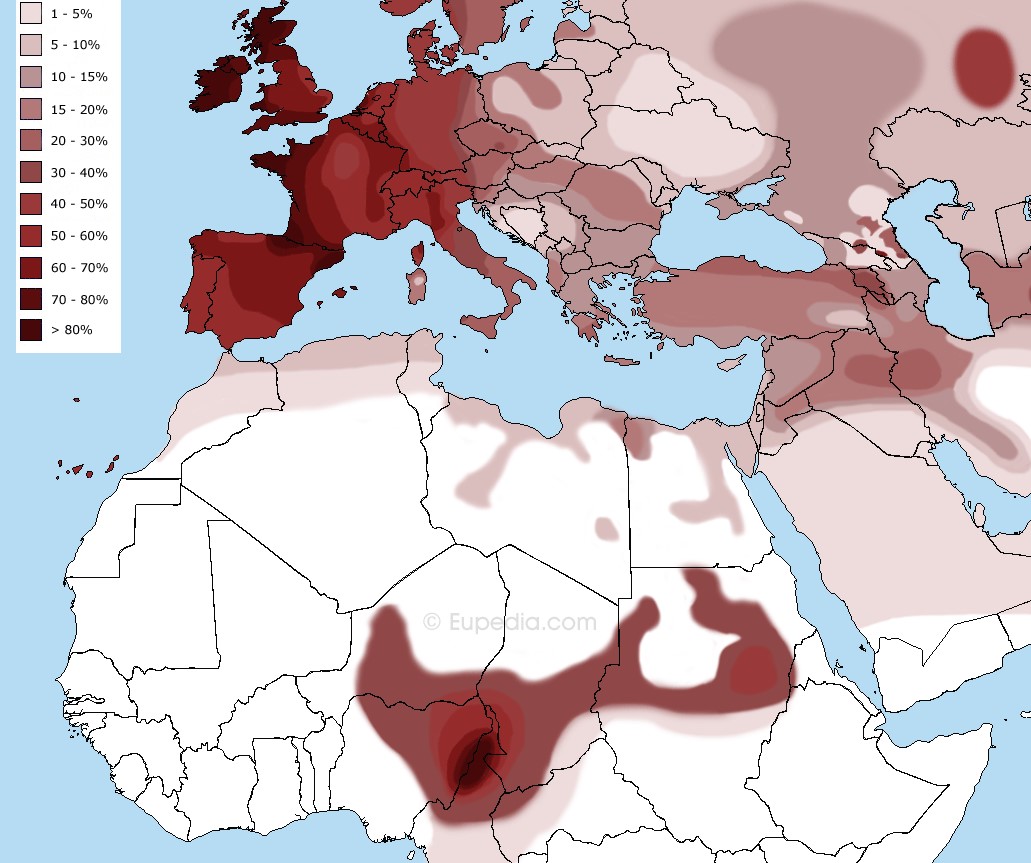
Y-DNA R1b, R1a and R2 descended from the same common ancestor, but these made a "home" in different areas of the world since branching. The red areas on this map show the areas in Africa and Europe with the highest density of Y-DNA haplogroup R1b. About 70% of native British men have R1b ancestry.

Descendants of that original Haplogroup R ancestor migrated, and accrued additional mutations that formed the major sub-branches: R1a and R1b, around 20,000 years ago. The movement is out of Africa.

According to this report, the third-most abundant haplogroup found in India is R, accounting for an average frequency of 15.7%. The high incidence of this haplogroup appears to be restricted to the Indo-European and Dravidian-speaking groups. Within these populations, Indo-European-speakers exhibit an average frequency of 29.5% of R1a1, whereas Dravidian-speakers account for 22.6% of R2 sub-haplogroup.
Related reading: Deep history from the genomes of India - John Hawks; The Hebrew Were a Caste; Nimrod and the Nile-Indus Connection; ANCIENT EGYPTIAN DANCE | Facts and Details; False Correlations; Is It Possible to Speak of the Proto-Gospel?; Why Nekhen is Anthropologically Significant



.jpg)