Followers

Showing posts with label Genesis 10. Show all posts

Thursday, March 24, 2022

An Anthropologist Looks at Genesis 10


Dr. Alice C. Linsley


The author of Genesis 10 connects the populations of his time period to the three sons of Noah. He proposes how Earth came to be repopulated after a worldwide flood (Gen. 10:32). Though a naïve conception of human history and diversity, this early ethnography is remarkable. E.A. Speiser described the Table of Nations “as a pioneering effort among the ethnographic attempts of the ancient world.” (The Anchor Bible Commentary on Genesis, p. 71.)

The names listed in Genesis 10 represent ethnicities, city-states, kingdoms, and regional populations. The populations may generally be classified as Nilotic, Arabian, Mesopotamian, Eurasian, and Levantine. The table artificially lists seventy populations. However, none of the populations are identified as castes and the ancient world had many castes: tanners, metalworkers, priests, etc.

It is assumed that Eber (Gen. 10:21-3) is the eponymous father of the Hebrew people. This represents an attempt to narrow the scope of the narrative, as is done later with Jacob who is identified as the eponymous father of the Israelites. It is clear, however, that there were many Hebrew clans other than Jacob's clan.

The English word “Hebrew” is derived from the ancient Akkadian word for priest abru, and the ruler-priest caste was called Abrutu. Variant spellings include Habiru, Hapiru, and ‘Apiru. There is no reason to dismiss Noah and his sons as Hebrew. Genesis 4-11 chronicles the Hebrew caste’s dispersion out of Africa in the service of kingdom builders and high kings. Hebrew were living in Africa, Arabia, Mesopotamia, and Southern Europe before the time of Abraham. There is evidence that some Hebrew settled in the Indus Valley, and that their influence extended as far east as present-day Cambodia. Horite symbolism has been found at Angkor Wat. "Anghor Wat" refers to the settlement or temple complex dedicated to Horus. Ankh-Hor means "May Horus Live!" or "Life to Horus!"


This Anghor Wat relief depicts Ra's solar boat with Horus perched as a falcon on the mast.


The Indian archaeologist B. B. Lal contends that several megalithic sites of ancient Nubians resemble the cemeteries of early Dravidians found all over Western India. The similarities extend from the subterranean structures found near them to the identical earthenware ring-stands used by the Dravidians and Nubians to hold pots.

The connection between the riverine civilizations of the Nile Valley and the Indus Valley is indicated by comparing the Nilotic and Indus pottery inscriptions in which 17 figures are virtually identical.


The Hebrew Movement Out of Africa  

Genesis chapter 10 continues the theme of an eastward movement out of Africa. Adam and Eve went east. Cain went east, and now we read about the dispersion of Noah’s descendants into areas outside of Africa. This aligns with genetic studies of peoples coming out of Africa through the Middle East, a staging area for the Neolithic Agricultural Revolution, and the region where the earliest known kingdoms were established. This is especially evident in the case of the Kushite kingdom builder Nimrod (Gen. 10: 8-12).

Nimrod is also spelled Nimrudj or Nimrwd. In 2010, the 4400-year tomb of a purification priest named Rudj-ka or Rwd-Ka was found at Giza. It dates to between 2465 and 2323 B.C. His high status is evident in the quality of his stone tomb. He served Pharaoh Khafre who ruled from 2520 to 2494 B.C., before the time of Abraham. The ancient Egyptian word rwd/rudj means ball, sphere, or the Earth.

Likewise, the name “Lot” is found among the Libyan rulers of the Nile: Takelot I (885–872 B.C.) and Takelot II (860-835 B.C.), and at least two were called Nimlot. An inscription on the statue of Nimlot B describes him as “Nimlot true of voice,” meaning justified. The ancient Egyptian is Maa Kheru (mꜣꜥ ḫrw), a typical epithet applied to the righteous deceased who Horus presents to the Heavenly Father.

Nimrod, a son of Kush, built a kingdom in Mesopotamia. He is the connection between the Proto-Saharan ruler Noah and Abraham. We first meet Abraham in Mesopotamia because he is a descendant of Nimrod.


A Genetic Mosaic

After the Last Glacial Maximum (LGM) population movements created a striking genetic mosaic with distinct sex-based genetic differentiation. Y-DNA traces genetic inheritance through the paternal line and mitochondrial (mt) DNA traces genetic inheritance through the maternal line. Were it possible to study DNA from the different peoples listed in Genesis 10, we would find that the majority could be classified in Y-DNA Haplogroups R1a, R1b, and J, and mtDNA Ls, M, N, H, and R.
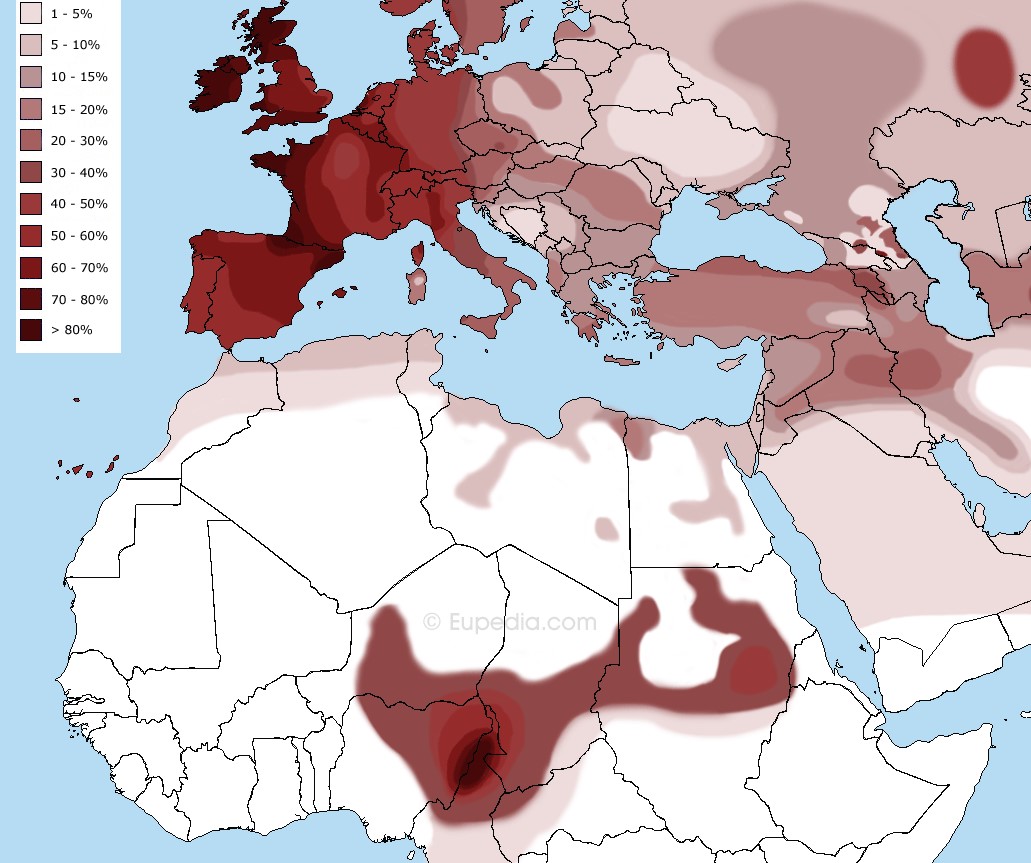


Genetic studies have established a connection between some populations of Genesis 10 and some populations of Noah’s homeland in the region of Lake Chad. This map shows the range of Y-DNA R1b peoples in red. However, the dispersion of the R1b populations took place long before the time of Noah and was complete by 40,000 years ago.


Towers Were Used for Astronomical Observations

Although the Tower of Babel story does not specifically mention astronomy, commentators on Genesis 10 often introduce speculation about astrology, an occult practice. This is based on a false belief that the science of sidereal astronomy had not yet developed. However, astronomy was familiar to the Nilotic Hebrew, as noted by Plato who studied under a Nilotic priest for 13 years. Plato claimed that the Africans had been tracking the heavens for 10,000 years. He knew about Earth's Great Year, also called the "Platonic Year." This is the duration of time that it takes for Earth to complete the cycle of axial precession (approximately 25,000 years). This precession was known to Plato who defined the "perfect year" as the return of the celestial bodies (planets) and the diurnal rotation of the fixed stars to their original positions.

In 241 B.C., the priest Manetho reported that Nilotes had been “star-gazing” as early as 40,000 years ago. By 4245 BC, the priests of the Upper Nile had established a calendar based on the appearance of the star Sirius and had been tracking this star for thousands of years, connecting it to seasonal changes affecting the Nile Valley. Doubtless, the Hebrew priests living in Mesopotamia were recognized for their astronomical observations from fortified high places and towers.


Related reading: An Anthropologist Looks at Genesis 9; Noah's Sons and Their Descendants; Nimrod and the Nile-Indus ConnectionHaplogroups of Interest to Biblical Anthropologists; Was Akkadian the Language of the Indus Valley Civilization?; Our African Ancestors


Friday, April 17, 2020

The Genesis 10 Ethnography


Alice C. Linsley

Genesis 10, called a “Table of Nations,” represents an early attempt at ethnography. In his commentary of Genesis, E.A. Speiser described this table “as a pioneering effort among the ethnographic attempts of the ancient world.” (Speiser, The Anchor Bible Commentary on Genesis, p. 71.) The table lists 70 biblical populations with their own lands and nations.

This chapter does not describe nations as we think of them, but rather territories governed by local and regional chiefs who formed alliances for mutual defense. There were a few high kings who ruled larger territories from their royal fortifications. The fortified settlements contained palaces, temples, garrisons, and royal treasuries. These “high places” were the political centers of emerging city-states.

Chapter 10 continues the theme of an eastward movement out of Africa. Adam and Eve went east. Cain went east, and now we read about the dispersion of biblical populations into geographical areas outside of Africa. This is especially evident in the segment about the Kushite kingdom builder Nimrod (Gen. 10: 8-12).

Nimrod is also spelled Nimrudj or Nimrwd. His name, and the name “Lot” are names found among the rulers of the Nile. At least two Nilotic rulers have the name Lot: Takelot I (885–872 BC) and Takelot II (860-835 BC), and at least two Nilotic rulers were called Nimlot. An inscription on the statue of Nimlot B describes him as “Nimlot true of voice,” meaning justified.

In 2010, the 4400-year tomb of a purification priest named Rwd-Ka (Rudj-ka) was found at Giza. It dates to between 2465 and 2323 B.C. His high status is evident in the quality of his stone tomb. He served Pharaoh Khafre who ruled from 2520 to 2494 BC, well before the time of Abraham. The ancient Egyptian word rwd/rudj means ball, sphere, or the Earth. The term “ka” in this context refers to a ruler-priest.


Painting of Rudj-ka and his wife on the wall of his tomb. 


This 2800-year fragment was found at the ancient city of Nimrud in modern Iraq. It gives Malku (Melek) as a synonym for Šarru (Sar/Sharru). Both words mean king. (British Museum ND 5434)

Genesis 10 places Nimrod in this area of the Tigris River Valley. It seems that he was a sent-away son of Kush. Likely, his brother Ramah was the proper heir to Kush’s throne.


Genesis 10:7 names Dedan (DD - red one) as a grandson of the Nilotic ruler Kush. Dedan’s father was Ramah, the brother of Nimrod. Abraham was a descendant of Nimrod by his cousin wife, a daughter of Asshur. Here we see further evidence of endogamy between the lines of Ham and Shem. Genesis 11 introduces Abraham’s ancestors descending from Shem.

The various translations of Genesis 10 reveal a discrepancy about a people called Rodanim or Dodanim. Some versions have Rodanim, and others have Dodanim (both plural forms). This discrepancy has been explained by the apparent confusion of the Hebrew letters “resh’ and “dalet” which are similar. The discrepancy also surrounds the place called “Riblah” in some texts and called “Diblah” in others (Ezekiel 6:14).

Here we find evidence for a red population that might be identified with the Horite Hebrew of Edom (Gen. 36). Esau of Edom is described as red, and David, who had Edomite blood, is also described as red or ruddy.

It has been suggested that Rodanim refers to the island of Rhodes (E.A. Speiser), but it is more likely that Genesis 10:4 refers to a population associated with red skin and possibly red hair. The words Dodanim and Dedan refer to the color red. The biradical DD is related to the Ancient Egyptian didi (red fruit) and the Yoruba diden (red).


Thursday, March 6, 2014

Making Sense of Genesis 10


Alice C. Linsley


Genesis 10 is one of the most fascinating chapters of Genesis from an anthropological perspective. It is mistakenly called the “Table of Nations” by Young Earth Creationists who believe that the peoples named here are the first peoples to populate the earth after Noah's worldwide flood.  Rather, we have an account of the dispersion of Nilotic peoples across the ancient Afro-Asiatic Dominion. Among these were the Nilotic Ainu who have been identified through DNA studies as "first nation" peoples.

Genesis 10 provides a picture of how the descendants of Noah were linguistically related people whose point of origin was the Nile valley at a time when the Sahara was wet. All the peoples of Genesis 10 spoke “the same language, with the same vocabulary” (Gen.11:1). These languages are in the Afro-Asiatic group and can be traced back to the Nile Valley. Modern languages developed from the phonemes that were used among these peoples.

DNA studies have confirmed the Kushite migration out of Africa. However, there were already human populations scattered across the earth. Some of those populations resulted from earlier migrations out of Africa. The first took place about 120,000 years ago and the second about 70,000 years ago. The Kushite expansion coincided with the spread of the Horite religion by the Hapiru. In the proto-Saharan languages p is replaced by b so Hapiru also appears as Habiru. Habiru is rendered as "Hebrew" in English Bibles.

Their languages are now largely extinct, but the lexemes can be reconstructed through comparative linguistics. For example, the symbol Y is a solar cradle that represents a whole complex of related ideas including divine appointment, overshadowing, the ruler, the ruler's territory, the ruler's tent, and the ruler's people and herds. This lexeme is reduplicated in the Holy Name YHWH (of Nubian origin).

The linguistic relationship of the clans and castes is evident n the correspondence of their names. So we must look for a third familial phoneme to help us identify units. Consider, for example, this confederation:  Lehab, Lesha  and Letushim (Gen. 25:3). But wait! There may be a fourth: Leummim (Gen. 25:3). Le is a very ancient lexeme. There is also the confederations of Jubal, Jabal and Tubal, and Og, Gog and Magog.

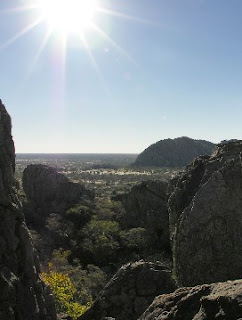
Tsodila Hills of Botswana
Photo credit: S. Coulson
These people comprised a sophisticated network of clans and castes governed by great rulers. They forged the ancient Afro-Asiatic Dominion which extended from Nigeria to India. Noah descendants did spread out of Africa. Genesis 10:8-12 tells us that Noah's great grandson Nimrod built an empire in the Tigris-Euphrates Valley. These rulers were "the mighty men of old" or gibboriym (powerful ones) of Genesis 6:1-4.


Archaic Industry

The evidence of archaic human industry, religion, ritual burial, and domesticity in Africa, Arabia and China creates a more accurate picture of the earlier populations. On the Arabian Peninsula, the Qafzeh population was using tools 125,000 years ago at Jebel Faya.

Humans were making reed mattresses 77,000 years ago in South Africa. That is where the oldest mattress, made from compacted grasses and leafy plants, was discovered at the Sibudu Cave site in KwaZulu-Natal. In this same region a stone carving of a python has been found that dates to 70,000 years.

There is the evidence of mining in South Africa between 80,000 to 100,000 years ago. These are major mining operations that included quarries and tunnels. It is estimated that a million kilos of red ocher ore was excavated from several mines. At one mine half a million stone-digging tools were found. The red ocher was ground to power and was used globally to bury rulers. Anthropologists agree that the red ocher symbolized blood. Apparently, it was connected to the people’s hope or expectation that the ruler might rise from the dead and lead his faithful people to immortality.

The Pengtoushan culture thrived along the Yangtze River between BC. 7500–6100, and the Yangshao culture flourished along the central Yellow River between BC. 5000 and 3000. Yangshao nobles wore silk garments.

About 4000 years before Noah people were using dugouts to navigate the rivers of the Sahara. This is attested by the discovery of an 8000-year old black mahogany dugout in Dufuna in the Upper Yobe Valley along the Komadugu Guna River in Northern Nigeria. At the time when this boat was used the major water systems of Central Africa and the Nile interconnected.


8000 year old dugout found in the Sahara

Cemeteries were established which reveal ritual burial. Paul Sereno unearthed 10,000 year old skeletons at Gobero in Niger. These were buried on the edge of a paleolake on the northwestern rim of the Chad Basin. The Gobero site is the earliest known cemetery in the Sahara and the skeletons found there indicated that some were at least 6 feet tall.


Gobero skeleton (G3B8) measures 6 feet 6 inches
Photo (c) Mike Hettwer, courtesy Project Exploration


At the time of the Gobero populations (9700-4400 years ago), humans were dispersed globally, and during the time of Noah these populations were not destroyed. Consider the following population estimates by urban center between 2400 and 2200 BC, the time when Noah's flood would have occurred:

Memphis, Egypt - 32,000 inhabitants

Lagash, Iraq - 60,000 inhabitants

Mohenjo-daro, Pakistan - 40,000 inhabitants

Mari, Syria -50,000 inhabitants

Baodun settlements, China - Baodun is the largest settlement, covering an area of about 373 miles. There is no evidence of destruction by flooding though all six Baodun settlements straddled the Min River in central Sichuan province. The Min is a tributary of the upper Yangtze River.

There is no evidence that any of these peoples were wiped out by a worldwide flood. The evidence simply does not support the interpretation that all the peoples of the earth were destroyed in a catastrophic global flood and that the earth was repopulated by Noah's descendants.

The Hapiru were a caste of priests who served in the temple. A temple was considered the house or pirû of the deity, so Ha-piru referred to priests who served at the temple or water shrine. In the case of Abraham's people this referred the Horite priests (Horim), devotees of Horus, the "son" or "seed" of the Creator God. His emblem was the sun. The ancient Dravidians referred to their east-oriented temples as Opiru, meaning "Sun House."

Some of these priests were called tera among the Ainu. This is the origin of the name or title of Abraham's father Terah. Among the Ainu of Japan tera refers to a temple. The Ainu people of Japan are in haplotype D (Y-chromosome) and haplogroup X (mitochondrial chromosome). Their elders are bearded and have a red skin tone similar to Abraham's Horite people. Genesis 36 names Seir the Horite as a ruler of Edom = red. The red skin tone Ainu migrated from the Nile to Japan and Eastern Canada, and the dark skin tone Onges and Jarawas (also Haplotype D) migrated to the Maldives, India and parts of Southeast Asia.


Related reading:  From the Nile to The Philippines: Tracing the GurjarsWas the Earth Repopulated After Noah's Flood?; The Nubian Context of YHWY; The Nile-Japan Ainu Connection; The Afro-Asiatic Dominion; Boats and Cows of the Nilo-Saharans; Scientific Verification of the Genesis 10 Dispersion; Noah's Flood: Where and When?