Followers

Showing posts with label Ham. Show all posts

Thursday, March 10, 2022

An Anthropologist Looks at Genesis 6


Alice C. Linsley
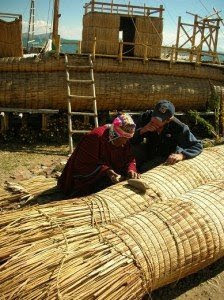
Reed boat construction

Genesis chapter 6 opens with a recognition that humans had multiplied upon the earth and “sons of God” married fair women. The biblical Hebrew would have regarded sexual relations between supernatural beings and humans as a sign of a wicked generation. However, the phrase “sons of God” likely refers to deified rulers. Deification or apotheosis of rulers is first attested in ancient Egypt. Djedi, Mehu, Kagemni, Heqaib, Isi, and Wahka are examples of deified Egyptian rulers. The historical King Osiris took a mythical “god” status during the Middle Kingdom.

These powerful rulers usually had multiple wives. This also would appear decadent to the early Hebrew ruler-priests who had one, or only two wives.
                                                                                                          
In Genesis 6:6-7, the Creator regrets making humans and he decides to blot out mankind from the face of the earth. He explains this to Noah and gives Noah instructions for the construction of a reed ship sealed inside and out with pitch. A reed boat coated with bitumen was found at the site of H3 at As-Sabiyah in Kuwait. The boat dates to c.5000 B.C. 

Neanderthal hafting with tar is evident at Gura Cheii-Râsnov Cave (Romania) and Hummal and Umm el-Tlel in Syria. At these sites archaeologists found tools and weapons with bitumen adhesive to fasten handles to tools and blades to spears. The adhesive helped to strengthen and waterproof bindings made of sinew, hide, or plant fibers used to attach bone or stone tools and weapons to handles.


The Covenant with Noah and his Sons

Noah, a descendant of both Cain and Seth, is described as a righteous man living among people of an unrighteous generation. God establishes a covenant with Noah that extends to his three sons Ham, Shem, and Japheth. The naming of Noah’s three sons is the third suggestion in the Bible of the three-clan confederations of the biblical Hebrew. The first is represented by the three sons of Adam and Eve: Cain, Abel, and Seth. The second with the naming of Jubal, Jabal and Tubal-cain in Genesis 4. Tubal-cain is described as a forger of all instruments of bronze and iron (Gen. 4:22). One of the oldest known iron-smelting sites in the world is in the village of Lejja in southeastern Nigeria. 

The covenant language of Genesis chapter 6 is elaborated in Genesis 9:8-17 where the covenant is extended further to Noah’s descendants and to all living creatures (Gen. 9:9). The rainbow is said to be the sign of the covenant. It is assumed by this source that Noah was not circumcised. However, ritual flint knives found at Nekhen could have been used for circumcision and these date to the time of Noah (C. 4000 BC). The covenant language indicates that this narrative comes from a source that wrote long after the time when Noah lived.

In the Genesis 6 account, Noah is to bring one set of each type of animal onto the ark: a male and a female. Nothing is said about clean and unclean animals, a priestly concern.

The ark which Noah is to build is made of reeds (gopher). The word that appears in Genesis 6:14 is the same word that describes the reed basket in which baby Moses floated (Ex. 2:3). As a ruler in the Lake Chad region, Noah would have had a fleet of reed ships.

The flood of Noah occurred in the region of Lake Chad during the African Aqualithic, a term coined by the British archaeologist John Sutton (“Journal of Africa History”, 1974; “Antiquity”, 1977). The years of wetness were due to monsoonal patterns that brought extended rainy seasons to the Lake Chad Basin. The ancient Basin was ringed by mountains to the northwest (Ahaggar Mountains) and to the north (Tibesti Mountains) from which the water drained into the Basin. The Shebshi Mountains are to the southwest in Adamawa State and the Mandara Mountains extend along the northern part of the Cameroon–Nigeria border. 

Before 4500 years ago the climate was characterized by several wet phases with an optimum in the Sahara region at around 8500-6500 years ago. These were interrupted by short dry periods. Photographs taken from satellites reveal an extensive paleolake bed. At its maximum extent Lake Chad was larger than any lake that exists on earth today. From 7500-6950 B.C. the lake had a depth of 586 feet. Lake Chad has stretched or retreated many times in the past, but from the time of Noah (c.4,200 BC to date), the lake water has continuously diminished. The last great period of inundation appears to have occurred during Noah’s time and from Noah’s perspective all the land (eretz) was covered with water.

The mention of Ararat in the Genesis 8 account leads people to believe that Noah’s ark came to rest in the region of Armenia. That idea is based on the supposition that Ararat corresponds to Urartu, the Assyrian name for a kingdom in the region of Lake Van. However, the biblical account of the flood does not mention Armenia. The section on Genesis chapter 8 looks at the many place names (toponyms) found in Mesopotamia that have equivalent place names in Nigeria. The correspondence between ancient place names in both regions necessitates a closer look at the biblical data surrounding Noah and the flood.


Friday, April 17, 2020

The Genesis 10 Ethnography


Alice C. Linsley

Genesis 10, called a “Table of Nations,” represents an early attempt at ethnography. In his commentary of Genesis, E.A. Speiser described this table “as a pioneering effort among the ethnographic attempts of the ancient world.” (Speiser, The Anchor Bible Commentary on Genesis, p. 71.) The table lists 70 biblical populations with their own lands and nations.

This chapter does not describe nations as we think of them, but rather territories governed by local and regional chiefs who formed alliances for mutual defense. There were a few high kings who ruled larger territories from their royal fortifications. The fortified settlements contained palaces, temples, garrisons, and royal treasuries. These “high places” were the political centers of emerging city-states.

Chapter 10 continues the theme of an eastward movement out of Africa. Adam and Eve went east. Cain went east, and now we read about the dispersion of biblical populations into geographical areas outside of Africa. This is especially evident in the segment about the Kushite kingdom builder Nimrod (Gen. 10: 8-12).

Nimrod is also spelled Nimrudj or Nimrwd. His name, and the name “Lot” are names found among the rulers of the Nile. At least two Nilotic rulers have the name Lot: Takelot I (885–872 BC) and Takelot II (860-835 BC), and at least two Nilotic rulers were called Nimlot. An inscription on the statue of Nimlot B describes him as “Nimlot true of voice,” meaning justified.

In 2010, the 4400-year tomb of a purification priest named Rwd-Ka (Rudj-ka) was found at Giza. It dates to between 2465 and 2323 B.C. His high status is evident in the quality of his stone tomb. He served Pharaoh Khafre who ruled from 2520 to 2494 BC, well before the time of Abraham. The ancient Egyptian word rwd/rudj means ball, sphere, or the Earth. The term “ka” in this context refers to a ruler-priest.


Painting of Rudj-ka and his wife on the wall of his tomb. 


This 2800-year fragment was found at the ancient city of Nimrud in modern Iraq. It gives Malku (Melek) as a synonym for Šarru (Sar/Sharru). Both words mean king. (British Museum ND 5434)

Genesis 10 places Nimrod in this area of the Tigris River Valley. It seems that he was a sent-away son of Kush. Likely, his brother Ramah was the proper heir to Kush’s throne.


Genesis 10:7 names Dedan (DD - red one) as a grandson of the Nilotic ruler Kush. Dedan’s father was Ramah, the brother of Nimrod. Abraham was a descendant of Nimrod by his cousin wife, a daughter of Asshur. Here we see further evidence of endogamy between the lines of Ham and Shem. Genesis 11 introduces Abraham’s ancestors descending from Shem.

The various translations of Genesis 10 reveal a discrepancy about a people called Rodanim or Dodanim. Some versions have Rodanim, and others have Dodanim (both plural forms). This discrepancy has been explained by the apparent confusion of the Hebrew letters “resh’ and “dalet” which are similar. The discrepancy also surrounds the place called “Riblah” in some texts and called “Diblah” in others (Ezekiel 6:14).

Here we find evidence for a red population that might be identified with the Horite Hebrew of Edom (Gen. 36). Esau of Edom is described as red, and David, who had Edomite blood, is also described as red or ruddy.

It has been suggested that Rodanim refers to the island of Rhodes (E.A. Speiser), but it is more likely that Genesis 10:4 refers to a population associated with red skin and possibly red hair. The words Dodanim and Dedan refer to the color red. The biradical DD is related to the Ancient Egyptian didi (red fruit) and the Yoruba diden (red).


Saturday, August 8, 2015

The Curse of Ham Falls Also on Shem


My botanist friend Ann recently wrote to me:

In my agricultural work in Africa, I met African Christians that believe they are cursed still because of the story of Noah and Ham. They are very sad. I was surprised to encounter that idea. God seems so active in Africa-- he has so many believers there! Surely the work of Christ liberates Africa too from that curse, --whether one believes it is literal or symbolic? Does your work give any insights about that?


Alice C. Linsley

The so-called "curse of Ham" has been used to justify racism by people who are ignorant of what Genesis tells us about fathers who curse their children out of anger, something that greatly displeases our Heavenly Father.

Noah, a man of the soil, proceeded to plant a vineyard. When he drank some of its wine, he became drunk and lay uncovered inside his tent. Ham, the father of Canaan, saw his father's nakedness and told his two brothers outside. But Shem and Japheth took a garment and laid it across their shoulders; then they walked in backward and covered their father's nakedness. Their faces were turned the other way so that they would not see their father's nakedness. When Noah awoke from his wine and found out what his youngest son had done to him, he said, "Cursed be Canaan! The lowest of slaves will he be to his brothers." He also said, "Blessed be the LORD, the God of Shem! May Canaan be the slave of Shem. May God extend the territory of Japheth; may Japheth live in the tents of Shem, and may Canaan be his slave. (Gen. 9:20-27)

To understand this in the proper biblical context we must investigate the pattern. In the following account, we find two themes: the anger of the father and the ranking of sons. We notice also that it is not Ham that is cursed, by Canaan. This supplies a clue as to when this story entered the biblical narrative. It comes from the later Deuteronomist Historian who is anxious to assert Shem's right over his brothers.


However, since the rulers of the lines of Ham and Shem intermarried, the curse of Ham would have to fall on Shem's descendants as well. In this sense, Noah’s curse falls upon both his Hamitic and Semitic descendants, which is what happens when a father acts out of self-loathing.


Noah’s cursing and blessing of his three sons parallels Jacob’s cursing and blessing of his twelve sons at the end of Genesis. The two accounts highlight the reality that fathers are often displeased by the actions of their sons. In both narratives there may also be an element of self-loathing.

There are other interesting similarities as well. Noah was angry because his son Ham had looked upon his nakedness. Jacob was angry because his son Reuben has slept with his concubine. In both cases we find the idea of exposing the father's nakedness. Noah’s curse falls on Canaan, Ham’s son, which is a deflection of guilt. Jacob’s blessing of Joseph’s sons falls on the youngest, a deflection of blessing. The excuse given for Jacob’s behavior is that he was blind. The excuse given for Noah’s behavior is that he was drunk. (The theme of drunken fathers bringing disgrace upon their children is taken up here.)

Another parallel exists between the curse of Canaan and the curse of Cain (Gen. 4:11). Cain’s curse involves his being expelled from his homeland. The curse of Canaan is clearly intended to justify Israel’s conquest of the land of Canaan by the driving out of the inhabitants know as the Canaanites. Although it is clear that some Habiru/Hebrew married Canaanites. Rahab’s marriage to Salmon, of the tribe of Judah, is one example. More importantly, the Genesis genealogical information makes it clear that the descendants of Ham intermarried with the descendants of Shem.


The fact that the lines of Ham and Shem intermarried underscores the stupidity of claiming the curse involves only black people of black. Further, we know today from molecular genetics that these peoples were diverse in their appearance, some having a red skin tone and waving dark hair, and some having a black skin tone with wooly hair.

Red and black Nubians
Detail from a Champollion drawing
These red Nubians resemble the Nabatean warriors of Edom
Image: Dr. Arthur Brack

There is no justification of racism in the book of Genesis. Race itself is a non-starter, anthropologically and genetically speaking. What people looked like has no bearing on their intelligence, their technological development, or their way of life. If a white person lives a simple country life, this is viewed by whites as "simplicity" but if black person chooses the same way of life, whites are likely to regard that person as lacking ambition.

Related reading:  Seligman's Legacy;  Who Were the Kushites?; Abraham's Kushite Ancestors; The Seven Bowls of Revelation 16; Edo, Edom, Idumea

Monday, December 10, 2012

What Do Young Earth Creationists Fear?


The NATURAL HISTORIAN on Ken Ham's Blog in which Ham shares a Letter from a "Concerned Church Member"

This week, on his blog, Ken Ham shared a letter (Chicago church compromiser) sent to him from a concerned church member about his churches hiring of a non 6 day creation pastor especially in light of their creationist history. In that letter the author recounts a discussion with the pastor and includes this comment:

The Lost World of Genesis One
“The Lost World of Genesis One” by John Walton
He then handed me a book to read written by John Walton who is a professor of Old Testament at Wheaton College in Illinois.  The book entitled “The Lost World of Genesis”  claims that by studying  ancient Near Eastern cultures we are able, for the first time, to know what God was trying to tell us in Genesis and what it all means.  I politely left the book on his desk when I left.
He then states that he searched from reviews about the book and makes some rather distorted statements about Walton’s conclusions. He criticizes the pastor for not being able to support his position but then when he is given a book he leaves it behind. This is exactly what Ken Ham wants his followers to do – not to even give the other side a hearing. I’m not sure that Walton’s book would be the best choice but a full appreciation for the issues involved in the creation debate is not suited for short discussion. Reading several books is necessary to get a fuller understanding of the issues. This author admits that the creation science literature have answered all his questions. Ham constantly warns against listening to any compromiser and so the reaction by YECs is often to simply rely on the reviews of books like this by Ham himself to get the “other” side. I expect this author has also heard a creation seminar in which the salty sea was provided as a scientific evidence for a young earth. He will never read Davis Young’s book or 20 other Christian scientists books, or my blog, that refute that argument because we are labeled compromisers. As I state in my first part of my salt series, there is a confidence bias at work and this person is demonstrating how effectively it can be by simply only listening to once source and dismissing all others out of hand.

Read more here.


Alice C. Linsley

Why do Young Earthers run away from discussions of the cultural-historical context of Biblical texts? Why should they fear that the Bible emerges from a specific cultural context?  Will facing the evidence cause them a crisis of confidence in the Bible's authority? Doesn't this reveal a lack of confidence in the truth of Scripture?

If the Bible is true, it will stand up to the most stringent analysis. This writer is dedicated to demonstrating the veracity of the Bible through an anthropological approach. Today people want to know that there are solid scientific reasons to take the Biblical texts seriously. This is the time in which we live.

Young Earth Creationism is destined to fade away because the younger generation thinks empirically and rationally about the Bible. Under leaders like Ken Ham, YEC fails to explore the Bible scientifically and imposes quasi-science that misrepresents what the Bible makes clear. Their condensing of Earth's history to 6000 years based on Bishop Ussher's miscalculations is an artifact of historical interest, but not a Biblical position. People should be shown that the Biblical timeline is fully supported by the sciences.

Perhaps Young Earth Creationists recognize that a serious investigation of the cultural-historical context of the Bible will tilt their worldview so drastically that they will never recover their comfortable interpretations. They will have to recognize the Nilotic and Proto-Saharan context of Genesis and that the people listed in Genesis 4 and 5 were rulers, not the only people on earth. They are the first of the rulers than can be traced from Eden to Jesus. To neglect this means missing how it is that the Bible from Genesis to Revelation is about one thing: Jesus Christ.

In holding to their idol of Young Earth Creationism, fundamentalists will also misunderstand the wisdom literature that reflects Horite beliefs. They will neglect that Abraham's ancestors were Kushites, and that Abraham was Ha-piru, not a Jew. They will fail to see the profound historical implications of Jesus Christ as a direct descendant of Cain, Seth, Ham and Shem because their lines intermarried. Yes, that means that Cain's line survived the Flood. Noah was one of his ruler-priest descendants. Tilt! Tilt! Tilt!


Friday, October 12, 2012

The God of Shem is the God of Ham


Alice C. Linsley

Shem is an honorific title, not a name. Jews call God HaShem (השם) which means "the Name"as in Leviticus 24:11. Some interpret this to mean the God of Shem, implying that the God of Shem is a different God than the God of his brother Ham. Presumably, this assumption is based on this verse: "He also said, "Blessed be the LORD, the God of Shem! May Canaan be the slave of Shem." (Gen. 9:26)

The lines of Ham and Shem intermarried. Further evidence is found with the names Lud and Ludim (Ludites). In Genesis 10, Lud is named as a son of Shem and in Genesis 10:13, the Ludim are said to be of Ham.

Bible passages that speak about “the Canaanites” reflect authors who lived well after the time of the Patriarchs. In Genesis 10 the peoples who descend from Noah through his grandsons Sidon and Het (Heth) are said to be the original inhabitants. The Canaanites were blood-related Afro-Arabian peoples whose ancestry can be traced back to the Nile Valley and to ancient Kush. Israelites married Canaanites. Rahab’s marriage to Salmon, of the tribe of Judah, is but one example.  Analysis of the marriage and ascendancy pattern of Abraham's Horite caste makes it clear that the descendants of Ham intermarried with the descendants of Shem, and Jesus Christ is a descendant of both lines.

As far as the evidence goes, Shem and Ham had the same God and their ruler-priest lines intermarried, as shown in the diagram.  The daughter of Sheba the Elder married Joktan (Yaqtan) and named their first born son Sheba after her father, according to the cousin bride's naming prerogative.


The association of Shem, the Father of Eber, with the Hebrews does not mean that Ha-Shem is the God of the Hebrew people alone. This view rests on an flawed etymological assumption.  Shem is considered “the father" of all the Hebrew people, assuming that the word Hebrew comes from Eber. However, it is more likely that it comes from the word Habiru (Hapiru). The Horite ruler-priests were Habiru.  HBR is the root of the words Habiru and Hebrew.

Eber was the father of two firstborn sons by his two wives. His sons were Joktan (Yaqtan) and Peleg. Joktan was the son of his cousin wife and the heir to the throne of Eber's father-in-law in Southern Arabia. Joktan was the founder of the Joktanite clans of Arabia. Abraham's firstborn son was named Joktan after this famous ancestor.

Peleg, in whose time the "earth" was divided, was the heir to Eber's throne in Northern Arabia and probably ruled part of Mesopotamia. He was the son of Eber's half-sister wife. This aligns with the marriage and ascendancy structure of Abraham's Kushite ancestors.

Eber's sons became the founding patriarchs of two linguistically distinct Afro-Asiatic groups: the Afro-Arabians and the Afro-Asians. Apparently, the Kushites became divided linguistically after the time of Eber's death around 2303 B.C.

Other honorific titles

Shem is one of many honorific titles found in the Genesis King Lists.  Others include Cain, Enoch, and Lamech.

The words king and Khan are related to the word Kain (Cain). The related word for queen is Kandake (rendered "Candace" in English Bibles). The Bible tells us many details about Cain, all of them pointing to his rank as a ruler. When he was born his mother declared kan-itti. E.A. Speiser noted that Qany(ty) or Qan itti shows close affinity to the Akkadian itti, as in itti šarrim, which means "with the king". Akkadian was the language of the empire during Nimrod's time (BC 2290-2215). Genesis 10 tells us that Nimrod was a Kushite, so it is not surprising to find that Akkadian shares many words with Nilotic languages. Among the Oromo of Ethiopia and Somalia, itti is attached to names. Examples include Kaartuumitti, Finfinneetti and Dimashqitti. That itti is associated with Nilotic rulers is evident in the name Nefertitti.

Enoch is also a royal title. It is related to the word Anochi which means "heir to the throne" or "one who ascends."

Lamech is a variant of the Egyptian la-melech, which has been found on hundreds of seals. La-melech means "of the King." The la-melech seal typically had the image of a scarab or a sun disc, the emblem of the Creator. The sun disc was used as a royal seal by the Kings of Judah who were direct descendants of Cain and Seth whose lines intermarried.

Tuesday, June 19, 2012

About Race, Human Populations, and the Purpose of Mankind

Alice C. Linsley


Part 7: Answers to Questions about Race and Population
This continues the series "Answers to Hign Schoolers' Questions About Genesis."

Part 1: About God
Part 2: About Adam and Eve
Part 3: About the Serpent
Part 4: About the Flood
Part 5: About the Earth
Part 6: High Schoolers Wonder "Why Abraham?"


Q:  How did the different races come about?

A:  The modern conception of race is not biblical. This explains why the term "race" does not appear in the Bible. All humans share common ancestry and our point of origin is Africa millions of years ago.

Instead of race, the Bible speaks of ethnicities. In fact it mentions many ancient populations and cultures.

In Genesis 25, we find the words goyim and leumim (peoples) to describe two peoples who descend from Jacob by Rebekah. 

In the New Testament, the Greek word ethnos is used for peoples or nations. The Hebrew goyim is used to distinguish non-Jews from Jews. Both goyim and ethnos refer to peoples or nations, not to races.

The term "race" is misleading. Today molecular genetics classifies populations by "haplogroups" and people who look very different can be in the same haplogroup.

Haplogroups characterize the early migrations of human populations and can be used to connect ancestry with a geographical region or regions. A haplogroup identifies the descendants of a single individual who first showed a particular single nucleotide polymorphism, or SNP. An SNP is a point on the DNA where a single base changes. This SNP change is passed through generations of the family, clan or caste, and can be used to genetically define populations. Individuals with the same genetic SNP mutation or "marker" can be linked back to the population where the marker first made an appearance. 

Y-chromosome and mitochondrial DNA haplogroups have different haplogroup designations. The Y-chromosome traces paternal ancestry and the mt-DNA traces maternal ancestry.

Genesis does not tell us about all the haplogroups. It tells us about the peoples in Y-DNA haplogroup A, the lineage of all human males. 


It also tells us about the dispersion of the Y-DNA R1 populations out of Africa, shown on this map.


The dark red spot in central Africa is Noah's homeland, the region of Bor-No.


Mitochondrial Eve


"Mitochondrial Eve" lived about 200,000 years ago. She is the most recent female common ancestor. Found in the energy-producing centers of cells, mitochondrial DNA is passed down the maternal line, and can be traced back to one woman. Both males and females inherit the Mt-DNA from their mothers, but only females pass it on to their children. The people of Genesis are grouped according to their clan mothers: J1, N, X and L1, L2 and L3. 

In these haplogroups we find every "racial" feature: black, white, yellow, and red skin tones; brown, blue, and green eyes; woolly, wavy, and straight hair; facial hair and no facial hair; slanted almond-shaped eyes, round eyes, heavy lids; high foreheads and low foreheads, thick lips and thin lips, prominent noses and flat noses, and every head shape.

The fact that the lines of Ham and Shem cannot be separated linguistically or genetically underscores that their lines intermarried. It also testifies to the biblical assertion of Genesis 11:1 that all the peoples listed in the Table of Nations were one people with common ancestry. The lines of Ham and Shem intermarried as demonstrated by analysis of the marriage and ascendancy pattern of Abraham's ancestors.


Q:  If Adam and Eve's children married each other, isn't that the sin of incest?

A:  Incest is universally defined as sexual relations between parent and child, not between siblings. In the culture of Abraham's Horite Hebew people, the preferred marriage arrangement for the first wife was a half-sister. Sarah was Abraham's first wife and his half-sister. Jochebed was Amram's half-sister and his first wife. However, sex between parent and child was taboo and forbidden. Such perversion was regarded as so despicable that it was used to slander Lot's Ammonite and Moabite descendants (Gen. 19: 30-38).


Q:  How did the whole earth's population come from just Adam and Eve?

A:  The Bible does not say that all human populations came from Adam and Eve. It does state that all who live today are of "one blood." 

It also is not possible to say that the whole earth's population came from Noah's descendants after the flood. Noah lived about 3490-2800 BC when the Sahara experienced a wet period (the African Aqualithic). He lived at the same time as the Horite Hebrew shrine city of Nekhen.


Q:  Did other families exist on earth at the same time that Adam and Eve lived?

A: In the Bible, Adam and Eve are present different ways. Adam is posed as the archetypal first father and Adam and Eve as the original couple. This is an archetype, not to be taken as historical.

However, Adam and Eve are also presented as historical in the Bible. They are the parents of Cain and Seth who married the daughters of Enoch, a contemporary of Adam. The data of Genesis suggests that Adam and Enoch are the ancestors of the rulers listed in Genesis 4, 5 and 11. This may explain why the names Adam and Enoch are parallel in Psalm 8:4:

What is man (Enoch) that you are mindful of him,
or the son of man (ben adam) that you care for him?


The Apostle Paul speaks of Adam analogically. He draws and analogy between Adam by whom sin and death entered and Jesus Christ, the Second Adam, who overturns the curse, defeats death and restores paradise.


Q:  Did all the peoples of the earth come from Noah's three sons after the flood?

A:  No. Humans were already dispersed into Europe and Asia by 100,000 years ago, long before Noah's time. They were in the New World by 11,000 years ago.


Q:  How many generations are from Adam and Eve to Abraham?

A:  That is impossible to answer this because we cannot know when Adam and Eve existed. We also cannot say exactly how many generations from Cain to Abraham since the Genesis Kings lists do not correspond to generations, but to the reign and succession of the Horite Hebrew rulers.

Between 100,000 and 500 BC the average man lived less than 40 years and the average woman lived less than 38 years. These life spans would have been longer for rulers due to their superior diets and access to medical resources. So it is conceivable that the rulers named in Genesis lived relatively long lives, with the exception of those who died by assassination or in battle. We might estimate their life spans to be between 60 and 80 years (average would be 70). This would mean that a dynastic line of a depth of 10 rulers would represent between 300 and 400 years. 

One factor that must be considered is whether a ruler is the firstborn of the sister-bride or the cousin/niece bride. The sister-bride was the first wife and the wife of the ruler's youth. The cousin/niece bride was the wife that the heir married before ascending the throne. For the sister-wife's firstborn son, the father's age would be between 18 and 25 (median would be 21). So we can estimate that generally the firstborn son of the sister-wife would have been born when his father was about 21. For the cousin/niece bride's firstborn son the father's age would be between 45 and 60 (median would be 52). So we can estimate that the cousin-bride produced an heir or priest (for her father, not her husband) when her husband was about age 52.

We do not know how long the rulers of Genesis lived. Noah is said to have lived 950 years. Methuselah lived 969 years. Methuselah's son, Lamech the Younger, lived 777 years. Abraham's father, Terah, lived longer than Jacob by 58 years. The numbers assigned to the Genesis rulers are symbolic and some are linked to astronomical observations. Clearly, symbolic numbers cannot be used to determine actual life spans. 


Q:  Why were the men in Genesis so old?

A. The life spans assigned to the kings of Genesis are symbolic. Ancient clay tablets have been discovered that recount the greatness ofassign as much as a thousand years to some Sumerian and Akkadian rulers. However, all these lived normal live spans for rulers of the time. The average life span for rulers was between 73 and 75 years.

Paleontology indicates that the average lifespan of commoners was shorter. The life span of peoples living in the Nile Valley, Turkey and Mesopotamia during the time of the Genesis rulers was about 35 years for males and 30 years for females. This data corresponds to peoples in the Late Paleolithic (BC 30,000 to 9,000) when males lived about 34 years and females about 30 years. During the Mesolithic (BC 9,000 to 7,000) males lived about 33 years and females about 31 years. During the Early Neolithic (BC 7,000 to 5,000) males lived about 34 years and females about 30 years.

St. Jerome notes: "I am reviewing carefully the places in Scripture where I might find old age mentioned for the first time. Adam lived for 930 years, yet he is not called an old man. Methuselah's life was 969 years, and he is not called an old man. I am coming down all the way to the flood, and after the flood for almost three thousand years, and I find no one who has been called old. Abraham is the first, and certainly he was much younger than Methuselah." (Homilies on the Psalms 21)

Jerome observes that Abraham is the first man described as "old" in Genesis. Those who lived before him are not called old because the numbers assigned to them are symbolic. 


Q:  Why did God create Mankind?

A: The answer to this question varies from religion to religion. Islam teaches that Mankind was created to live in submission to Allah and for the purpose of worshipping Allah. Qur'an 51:56 states, "I have created the jinn and humankind only for My worship."

The Jinn are divided into followers of Islam and followers of the abased Iblis (a sort of fallen angel). The Jinn were commanded to bow down before Adam, but Iblis refused. God said, "What prevented you from prostrating when I commanded you?" He replied, "I am better than him. You created me from fire and You created him from clay." God said, "Descend from heaven. It is not for you to be arrogant in it. So get out! You are one of the abased." Surah 7 (al-A`raf), 11-13.

In Judaism, Man exists at God's pleasure and has liberty to obey or not to obey God's commands. The rabbis say that "Adam was created from the dust of the place where the sanctuary was to rise for the atonement of all human sin," and this means that sin should not be a permanent or inherent part of man's nature. 

Genesis 1 claims that humans are a special creation, fashioned in the image of the God. Christians believe that Mankind was created to enjoy perfect fellowship with God in Three Persons (the Trinity), in whose image and likeness we were made. When we seek God, we are renewed in our intended nature through Jesus Christ, and grow more like Him by the in-dwelling Holy Spirit. 


Related reading: Three Portraits of Adam; The Historicity of Noah's FloodThe Marriage and Ascendancy Pattern of Abraham's People; Thoughts on Calculating the Dates of the PatriarchsLifespans of Archaic Peoples: John Calvin on God's Motive in Creation


Wednesday, May 30, 2012

Was Earth Repopulated After Noah's Flood?


Alice C. Linsley


Noah lived in the region of Lake Chad (Borno/Benue - "Land of Noah") approximately 5500-4500 B.C, when the Sahara experienced a wet period. Humans had already dispersed globally by 12,000 B.C. 

Some of those dispersed populations were from earlier migrations out of Africa. There have been multiple migrations out of Africa, probably as early as 500,000 years ago. 

Abraham was a descendant of the Kushite kingdom builder Nimrod who established his territory in the Tigris-Euphrates valley. This explains why in the Bible we first meet Abraham in Mesopotamia.


8000-year dugout found in the Sahara


About 4000 years before Noah people were using dugouts to navigate the rivers of the Green Sahara. This is attested by the discovery of an 8000-year-old black Mohagany dugout in Dufuna in the Upper Yobe valley along the Komadugu Guna River in Northern Nigeria. This region was much wetter at the time that Noah and his sons ruled there.

The oldest known zoological collection was discovered during excavations at Nekhen on the Nile in 2009. This royal menagerie that dates to 3500 B.C. and included hippos, hartebeest, elephants, baboons and wildcats. The story of the Proto-Saharan ruler Noah preserving a collection of animals is based on historical reality.

Nekhen is the oldest known site of Horite Hebrew worship (4200 B.C.). Noah probably knew of this place.


What was happening before Noah?

The evidence of archaic human industry, religion, ritual burial, and domesticity in Africa, Arabia and China creates a more accurate picture of the earlier populations.

On the Arabian Peninsula, the Qafzeh population was using tools 125,000 years ago at Jebel Faya and burying their dead in red ochre.

Humans were making reed mattresses 77,000 years ago in South Africa. That is where the oldest mattress— made from compacted grasses and leafy plants— was found at the Sibudu Cave site in KwaZulu-Natal. In this same region a stone carving of a python has been found that dates to 70,000 years.

There is the evidence of mining 80,000 to 100,000 years ago. These major mining operations in southern Africa included quarries and tunnels. It is estimated that a million kilos of red ocher ore were excavated from several mines. At one mine half a million stone-digging tools were found. The red ocher was ground to power and was used globally to bury rulers. Anthropologists agree that the red ocher symbolized blood. Apparently, it was connected to the people’s hope that the ruler might rise from the dead and lead his faithful people to immortality.

The Pengtoushan culture thrived along the Yangtze River between BC. 7500–6100, and the Yangshao culture flourished along the central Yellow River between BC. 5000 and 3000. Yangshao nobles wore silk garments. 

Cemetaries were established which reveal ritual burial. Paul Sereno unearthed 10,000-year skeletons at Gobero in Niger. These were buried on the edge of a paleolake on the northwestern rim of the Chad Basin. The Gobero site is the earliest known cemetery in the Sahara and the skeletons found there indicated that some were at least 6 feet tall.


Gobero skeleton (G3B8) measures 6 feet 6 inches
Photo (c) Mike Hettwer, courtesy Project Exploration

At the time of the Gobero populations (9700-4400 years ago), humans were dispersed globally, and during the time of Noah these populations were not destroyed. 

There is no evidence pf a worldwide flood that led to extinction of humans and animals. Human settlements in Europe, the Americas, Asia, and the Near East were along major water systems and prone to flooding. Flood stories often appear in ancient texts. A late source (Deuteronomist Historian) used the Noah story to promote his theology of God's wrath upon sinful humanity. 

Noah's flood was a large regional flood. The term "eretz" which appears in the Genesis flood stories can mean earth, land, or territory. The Lake Chad region was Noah's territory and is the only place on earth claimed to be Noah's homeland by the local populations. The local Kanuri people refer to Lake Chad as "Buhar Nuhu", meaning Sea of Noah.

Noah's three sons were Hebrew clan chiefs whose descendants intermarried (caste endogamy). Those descendants dispersed widely and carried their beliefs wherever they lived. However, they did not repopulate the earth after a catastrophic worldwide flood.


Thursday, February 16, 2012

Who Were the Canaanites?


Alice C. Linsley


Canaan became the father of Sidon his firstborn, and Heth and the Jebusites, the Amorites, the Girgashites, the Hivites, the Arkites, the Sinites, the Arvadites, the Zemarites, and the Hamathites. (Gen. 10:15-18 NRSV)

The Bible passages that speak about “the Canaanites” reflect authors who lived well after the Patriarchal Period (2200-1800 BC). In the Canaan that Abraham knew, there were many peoples and castes living in settlements and in shrine cities such as Hazor. Egypt was the dominant political power and the socio-religious context of the Canaanites was Afro-Arabian, Kushite and Nilo-Saharan. This has been demonstrated by scientific analysis drawing on the disciplines of anthropology, linguistics, archaeology and molecular genetics.

In Genesis 10 the peoples who descend from Noah through his grandsons Sidon and Het (Heth) are said to be the original inhabitants. Noah was a Proto-Saharan chief living in the region of Lake Chad. He lived approximately 2490-2415 BC, when the Sahara experienced a wet period (Karl W. Butzer 1966). This is the period of the Old Kingdom, a time of great cultural and technological achievement.Two of his sons were Ham and Shem. The ruler-priest lines of Ham and Shem can be traced throughout the Bible. Their lines intermarried.

According to Genesis 9:20-26, Noah's curse fell upon the Canaanites. This transparent attempt to obfuscate the Kushite origins of Israel clearly entered the text long after the time of Moses the Horite. Noah's three sons were Shem, Ham and Japheth and their lines intermarried. Therefore, if Noah cursed his grandson Canaan, the curse fell upon all his descendants.


Israelites and Canaanites are related peoples

In II Chronicles 8:7 and I Kings 9:20 the term “Canaanite” is used to distinguish the Israelites from the other clans living in the land. However, it is clear that the Israelites were related to these Canaanite clans. The Canaanites were blood-related Afro-Arabian peoples whose ancestry can be traced back to the Nile Valley. They were ruled by chiefs who maintained mound-city shrines throughout the land of Canaan.

The Kushite peoples included Edomites, red and black Nubians, Nilotes, Egyptians, Sudra, Horites, and the Ainu. The Ainu are often regarded as the First Nation people who built Heliopolis and spread across the ancient Afro-Asiatic Dominion.

Migration routes of the Nilotic Proto-Saharans

Genesis 10 attempts to establish Canaan as the eponymous ancestor of the Canaanite clans who spread, according to Genesis 10:19, from "Sidon to Gerar near Gaza, and all the way to to Sodom, Gomorrah, Admah and Zeboiim near Lesha."  All of the Canaanite clans named in Genesis are also listed as the original inhabitants of the land in Exodus 3:8; Deuteronomy 7:1; Joshua 3:10; 24:11 or in extant texts of the period.

Melchizededk, the high priest of Jerusalem, was a Jebusite.  He ministered to Abraham after the bloodshed between the kings. (Gen. 14)  The Jebusites were a Kushite people.

The Hivites were likely a Horite clan (Genesis 14:6).  It is not surprising then that Abraham the Horite was living among them and was buried among them at Machpelah.

The Arvadites (residents of Arvad) and Arkites (Gen. 10:15-18) were clans of royal scribes and related to the Amorites. During Abraham's time, the Amorites were centered in Engedi, a large oasis on the western shore of the Dead Sea bounded on the south by the Wadi Arnon.

The terms “Amorites” and "Canaanites" are synonymous in Genesis 15:15-16 and Joshua 24:15, 18. The Amorites were the Am-Ar, meaning the people/tribe/caste of Ar. They are called the Aro among the people living at the confluence of the Benue and Niger Rivers in Nigeria. Some migrated to this well-watered region before the time of Abraham. The Nigerian historian, Dr. Catherine Acholonu, claims that they were a caste of scribes.

The Amorites were living in Palestine as early as 2300 B.C., 260 years before the time of Abraham (c. 2039-1964). The first biblical ruler of this name is Ar-pacshad, who lived four generations after Noah. He was a descendant of both Ham and Shem.

Ar appears in the titles of many ancient rulers, including Ar-Shem, Arsames, Artix, and Araxes.  Ar also is found in the names of places, such as Wadi Arnon. Ar-non (originally Ar-nxn) means the Ar of Onn. Onn is another name for Heliopolis, the City of the Sun. Joseph married the daughter of the high priest of Heliopolis, a Horite shrine city.


A time of kingdom building

The rulers named in Genesis 4, 5. 10 and 11 controlled the major water systems of Lake Chad, the Nile, and the Tigris and Euphrates. The interconnected waterways were their roads. Noah would have been familiar with boats and likely had a fleet.

These ancient rulers imposed taxes on cargo that moved through their territories. They used the rivers to expand their kingdoms and to spread their Afro-Asiatic worldview. Nimrod is an example. His father was Kush, a ruler who controlled a vast region of the Upper Nile. Nimrod left the Nile region and built his kingdom along the Tigris in Mesopotamia (Gen. 10:8-12). He was a sent-away son. Most of the great heroes of the Old Testament were sent-away sons: Kain, Nimrod, Abraham, Jacob, Joseph, Moses, etc.

Sent-away sons were the great kingdom builders of the ancient world. Genesis is one of the most significant sources of information about these ancient rulers.


The Kushite Connection

Noah's other grandson was Kush, the father of Nimrod.  From ancient Kush Abraham's ancestors spread far and wide as rulers in the ancient Afro-Asiatic Dominion. Genesis is the most reliable record of Horite rule.

Some scholars believe that "Canaan" is derived from an Aramaic word meaning “to be low.” William F. Albright suggested that "Canaan" originally meant “a merchant” because the people who lived there, called "Phoenicians" by the Greeks, were merchants.

The word kinah-hu, found in the Nuzi tablets, refers to the Canaanites and to the color red. This aligns with what is known about Abraham's Annu ancestors, who had a red skin tone. Some equate the word "Canaan" with the red purple dye used to make the garments of Tyrian rulers. However, it is more likely that kinah-hu relates to the Horites of Edom (red), to whom Abraham was related and from whom Moses descended.  This is substantiated by Joshua 15:21,22 which reports that, "The southernmost towns of the tribe of Judah in the Negev toward the boundary of Edom were: Kabzeel, Eder, Jagur, Kinah, Dimonah, Adadah..."

Kinah is related to the name Kenan. Genesis 5 lists Kenan as Cain's grandson by his un-named daughter. The name Kenan is a variant of Kain and Ghayin. Geoffrey W. Bromiley (2007) writes that ghayin lies behind the word kinah-hu at Nuzi.  In the Canaano-Akkadian, "hu" is a pronominal suffix.


To speak of Canaan as the eponymous ancestor of the Canaanites makes less sense than to speak of Kenan as their eponymous ancestor. Kenan lived six generations before Noah. That being the case, it is evident that the Canaanite or Kenanite people existed before Noah's time. Nor can it be argued that they were wiped out by a worldwide flood.

Around 3500 BC urban centers around deltas grew. Consider the following population estimates by population center between 3200 and 2200 BC.

Memphis, Egypt - 32,000 inhabitants

Lagash, Iraq - 60,000 inhabitants

Mohenjo-daro, Pakistan - 40,000 inhabitants

Mari, Syria -50,000 inhabitants

Baodun settlements, China - Baodun is the largest settlement, covering an area of about 373 miles. There is no evidence of destruction by flooding though all six Baodun settlements straddled the Min River in central Sichuan province. The Min is a tributary of the upper Yangtze River.

There is no evidence that any of these peoples were wiped out by a worldwide flood The evidence simply does not support the interpretation that all the peoples of the earth were destroyed in a catastrophic global flood and that the earth was repopulated by Noah's descendants.

As a fascinating side note, the oldest known zoological collection was discovered during excavations at Nekhen (Hierakonpolis) in Sudan in 2009. This royal menagerie dates to about 3500 BC and included hippos, hartebeest, elephants, baboons and wildcats. The story of Noah preserving a collection of animals is based on historical reality.


Related reading: The Urheitmat of the Canaanite YScientific Verification of Genesis 10 DispersionPetra Reflects Horite BeliefsThe Peoples of Canaan; The Amorites: caste of royal scribes?; The Descendants of Noah; The Nioltic Origin of the AinuMoses and Abraham: Different Origins of Israel?; Jebusites: An Extant Biblical Tribe; The Edomites and the Color Red; Eden: A Well-Watered Region

Tuesday, April 12, 2011

Interesting Conversation at Amazon.com


Alice C. Linsley


My Amazon review of the book Coming to Grips with Genesis: Biblical Authority and the Age of the Earth (May 29, 2010) led to an interesting conversation with someone who posts by the name spfdgreg (hereafter “Greg”). He concluded that I have distorted Genesis. Here is the conversation.


Greg: Would you care to tell us where the Bible says that Cain and Seth married the daughters of this Nok fellow?

Alice: Nok is the Hamitic form of the Hebrew Enoch. Analysis of the Genesis genealogies reveals a unique kinship pattern in which the cousin brides name their firstborn sons after their father. Cain and Seth married sisters, the daughters of Enoch. That is why Cain and Seth's firstborn sons are named Enoch. Likewise, Lamech's daughter Naamah (Gen. 4) married her patrilineal cousin Methuselah (Gen. 5) and named their firstborn son Lamech, after her father. This Lamech (the Younger) is the father of Noah.

The anthropological tools of kinship analysis applied to the Genesis genealogies have demonstrated that the men listed are indeed historical persons. All this research is available to read online. Best wishes to you.


Greg: I am looking at Genesis right now, and there is no mention of either Cain or Seth marrying cousins. It says nothing about their wives, who could not have been cousins anyway, as that would mean the boys had aunts and uncles. But since Adam and Eve were the first humans the second generation did not have aunts and uncles. So the two must have married two of their sisters. Also, Methuselah's wife's name is not given, so why do you think he married Naamah? Yes, they were of the same generation, but the text gives the impression that Cain's clan did not live in the same area as Seth's. It is possible that the two never even met. Also, Seth's firstborn was named Enosh, not Enoch.


Alice: Enoch and Enosh are linguistically equivalent names as are Irad and Jared, and Elkanah and Elkaniah. Compare the spelling of names that come from the Masoretic text vs the Septuagint. You will see differences like these. All the men listed are rulers. Do a search for The Genesis Kings Lists and you will see the diagrams of the Genesis genealogies. Much easier to study the kinship pattern when looking at a diagram.
http://biblicalanthropology.blogspot.com/2011/02/genesis-king-lists.html

Also, http://biblicalanthropology.blogspot.com/2011/03/sister-wives-and-cousin-wives.html

Anthropological science shows that the Genesis genealogical information is authentic.


Greg: I have looked at your website, and would like to know where you get this stuff. I have taken seminary-level classes on the Old Testament, and nothing like this was mentioned, either in class, or in our textbooks. You are obviously using extra-biblical sources. Are you sure they are reliable?


Alice: I'm an anthropologist by training and hold a Master of Divinity degree. I believe that the Bible is true. My research is based on 32 years of study.


Greg: If you believe the Bible, why are you distorting what it says? It clearly says that Adam and Eve were the first two humans. On what grounds do you reject that?


Alice: In biblical parlance Adam and Eve ARE the archetypal first ancestors. Now the question is "Whose ancestors?" Genesis answers that question - Abraham's. As Abraham is our Father in the Faith, we must try to understand what this meant to his people. We can do that once we place Abraham in the correct cultural context. The Bible does that for us. We are told that he is a descendant of the ruling lines that originated in the Nile region of Africa (Kush/Cush). Are there similar origin stories to the Adam and Eve story in that part of the world? Indeed, ONLY in that part of the world. See the story of Kikuyu and Mumbi.
Perhaps this will clarify: http://jandyongenesis.blogspot.com/2010/09/abrahams-kushite-ancestors.html


Greg: I wonder if you are reading the same Bible I am. Adam and Eve are not the archetypal first ancestors, they are the ACTUAL first ancestors, of the entire human race. Abraham was not from the Nile region, he was from Ur of the Chaldeans, which was in Mesopotamia, not Egypt.


Alice: The archetype among Nilotic peoples does not require that we read the Adam and Eve story as historical. History is only one way of speaking about Truth.

Genesis makes it very clear that Abraham's ancestors came out of Africa. He is a descendant of Kush. The link I provided will show you how that is so. I don't invent the diagrams. They are diagrams of the information found in Genesis.

I recognize that this is all new, and that it feels as if I'm distorting, but that is not so. It appears that you are seeking to draw closer to the God of Abraham, so I hope that you will pursue this.

Greg: I appreciate your prompt replies to my questions, but I see a major problem with your theory. Cush [as the NKJV spells his name] was a son of Ham (Gen 10:6), but Abraham was a descendant of Shem (Gen 11:10-26), and was from Ur of the Chaldeans (Gen 11:27-31), not Africa. Your diagrams are in error.

Yes, I am seeking to draw closer to the God of Abraham, and I am doing so by the only means He has provided, His Son Jesus.


Alice: You fail to recognize that the ruler-priest lines intermarried exclusively, which is a trait of castes. Abraham's Horite people were a ruler-priest caste. Cain and Seth's lines intermarried exclusively, as did the lines of Ham and Shem. Therefore Abraham is a descendant of both Cain and Seth and Ham and Shem. That's what the Genesis genealogies reveal.

What the Bible shows about the intermarriage between Cain and Seth's lines is here: http://jandyongenesis.blogspot.com/2007/05/lamech-segment-analysis.html

What the Bible shows about intermarriage between Ham and Shem's lines is here:
http://jandyongenesis.blogspot.com/2009/03/sheba-lines-of-ham-and-shem.html

The lines of Abraham and his brother Nahor intermarried according to this identical pattern. The evidence is here: http://jandyongenesis.blogspot.com/2010/09/abrahams-nephews-and-niece.html

Abraham was living in Ur-Haran region because he is a descendant of Nimrod, the son of Cush. Nimrod was a great kingdom builder. His name is Nilotic. (See the Egyptian ruler Nimlot, as an example.) The Kushites spread their worldview across the ancient Afro-Asiatic Dominion as they moved north and eastward out of Africa. This has been verified by DNA studies, migration studies, and archaeological and anthropological findings.

I apologize for being short with you. We do agree that Jesus Christ, the Son of God, is the ONLY way to the Father.


Related reading: The Genesis King Lists; Moses' Horite Family; Samuel's Horite Family; The Horite Ancestry of Jesus Christ; The Marriage and Ascendancy Pattern of Abraham's Horite People; Lamech Segment Analysis


Thursday, February 3, 2011

What Color Was Abraham?


Alice C. Linsley

A question that is often asked concerns Abraham's appearance. The best answer, based on the biblical data, is that Abraham resembled his Nilo-Saharan cattle-herding ancestors whose skin tone was reddish brown. Further, he was a descendant of Adam, a red man. God formed the man "Adam" from the red clay which swept down into the Nile Valley from the Ethiopian highlands.

Abraham was a Hebrew. That means he was a member of the Hebrew ruler-priest caste. The point of origin of the Hebrew ruler-priest caste was the Nile Valley, a place of great genetic diversity. “Africans have the broadest spectrum of variability, with rarer versions at either end of the bell curve distribution. If everyone in the world was wiped out except Africans, almost all human genetic variability would be preserved.” (From here.)

Geneticist Kenneth Kidd further explains, “In almost any single African population or tribe, there is more genetic variation than in all the rest of the world put together."

However, the Hebrew caste practiced endogamy so there would have been a frequent recurrence of the reddish skin tone. Endogamy is a trait of all castes.

Abraham ruled in ancient Edom which the Greeks called "Idumea". The words Edom and Idumea refer to the color red. The Greeks referred to Idumea as a land of red people. Abraham's territory was entirely in the region of Edom. It extended between the settlements of his two wives, Sarah and Keturah. Sarah resided in Hebron in the north and Keturah resided in Beersheba in the south.


Edo, Edomite, Idoma and Idumea are related words. A variant of Edo is Idu. Idu was the progenitor of the Edo or Idoma of Benin. The ruler of the Edo is called Oba and the first ruler of Petra in Edom was Obodas. Among the red, bearded Ainu of Hokkaido, the regional ruler is called obito and the original name of Tokyo was Edo. There is evidence that the Ainu of Japan and eastern Canada share common ancestry, but much more research needs to be done. Might there be a relationship to the Nilotic Annu?

One of Abraham's descendants was Esau who is described in Genesis as red and hairy. One of his wives was Oholibamah, a great granddaughter of Seir the Horite Hebrew (Gen. 36). 

Abraham's grandson Esau inherited his grandfather's red skin tone. We do not know Jacob's coloring, but he may have been darker skinned than Esau. King David is described as ruddy, and as a boy he may have looked like this young man. David's skin tone was probably reddish brown like that of Egyptians who work in the sun (1 Sam. 16:12; 17:42). 

Having a red skin tone indicates a very ancient genetic lineage, going back at least 18,000 years. The biblical writers appear to have been aware of this. The term "red' involves a range of tones from red-brown to brown-red.

In his later years, after he was very wealthy and had many servants and sons and had retired to Beersheba, Abraham's skin tone was probably lighter, though still reddish. He may have appeared like this Nilotic official:


Egyptian high official and his wife


That said, none can be certain as to Abraham's skin tone, but it is evident that he was not a white European. He was a descendant of Cain and Seth, and Ham and Shem, and Nimrod the Kushite. 


Abraham's Hebrew People Spread Far and Wide

The point of origin of the biblical Hebrew was the Nile Valley. The oldest known site of Horite Hebrew worship is Nekhen (4000 BC). From there, the Hebrew dispersed widely, and wherever they went they influenced the populations among whom they lived.


The Hebrew people spread across areas of Africa, the Middle East, the Levant, Southern Europe, and as far as India, Nepal and Cambodia. Kushites also came to live in Mindanao in the Philippines.

Genesis 17:5 says that Abraham means “father of many” or “father of a multitude.” Abraham was indeed the father of many since he had many children by his two wives and his two concubines.

As the Nilotic peoples spread across the ancient Near East, and married with other populations the genetic variation became less. The farther the population is from Africa, the less genetic diversity. This is not necessarily true, however, for the biblical Hebrew because they married only within their caste (endogamy).  


Hebrew Social Structure

The social structure of the Hebrew ruler-priests is complex. It is characterized by these features: endogamy, the Horite and Sethite moieties, two wives, a hierarchy of sons, the cousin bride's naming prerogative, and the sending away of non-ascendant sons.

Among Abraham's people social status and occupation were passed from father to son, but the son's ethnicity was that of his mother. All the mothers were Hebrew since Hebrew men married only within their caste.  

By Sarah, Abraham became the father of Isaac. Isaac was Abraham's proper heir, and he became a wealthy ruler in Edom. Isaac's proper heir was Esau. Isaac's son Jacob was sent away to serve the household of his maternal uncle (avuncular residence). Jacob was the head of the Israelites, but the Israelites were only one of many Hebrew clans. 

By Keturah, Abraham had six sons. One was Joktan. The Joktanite clans of Arabia are his descendants.


By his concubine Hagar, Abrahan had Ishmael, an Egyptian, and by his other concubine Mesek, Abraham had Eliezar. Mesek was Keturah's maidservant, just as Hagar was Sarah's maidservant.

We are not told how many daughters Abraham had, but it is certain that he had daughters as well as sons. His daughters are not named because the Genesis king lists list only first-born sons. Though a few especially important females are also named. Lamech' daughter Naamah is an example. She married her cousin Methusaleh and named their firstborn son Lamech, after her father, Lamech the Elder.