Alice C. Linsley
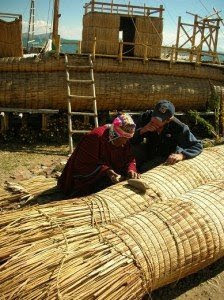 |
| Reed boat construction |
Genesis chapter 6 opens with a recognition that humans had multiplied upon the earth and “sons of God” married fair women. The biblical Hebrew would have regarded sexual relations between supernatural beings and humans as a sign of a wicked generation. However, the phrase “sons of God” likely refers to deified rulers. Deification or apotheosis of rulers is first attested in ancient Egypt. Djedi, Mehu, Kagemni, Heqaib, Isi, and Wahka are examples of deified Egyptian rulers. The historical King Osiris took a mythical “god” status during the Middle Kingdom.
These powerful rulers usually had multiple wives. This also would appear decadent to the early Hebrew ruler-priests who had one, or only two wives.
In Genesis 6:6-7, the Creator regrets making humans and he decides to blot out mankind from the face of the earth. He explains this to Noah and gives Noah instructions for the construction of a reed ship sealed inside and out with pitch. A reed boat coated with bitumen was found at the site of H3 at As-Sabiyah in Kuwait. The boat dates to c.5000 B.C.
Neanderthal hafting with tar is evident at Gura Cheii-Râsnov Cave (Romania) and Hummal and Umm el-Tlel in Syria. At these sites archaeologists found tools and weapons with bitumen adhesive to fasten handles to tools and blades to spears. The adhesive helped to strengthen and waterproof bindings made of sinew, hide, or plant fibers used to attach bone or stone tools and weapons to handles.
The Covenant with Noah and his Sons
Noah, a descendant of both Cain and Seth, is described as a righteous man living among people of an unrighteous generation. God establishes a covenant with Noah that extends to his three sons Ham, Shem, and Japheth. The naming of Noah’s three sons is the third suggestion in the Bible of the three-clan confederations of the biblical Hebrew. The first is represented by the three sons of Adam and Eve: Cain, Abel, and Seth. The second with the naming of Jubal, Jabal and Tubal-cain in Genesis 4. Tubal-cain is described as a forger of all instruments of bronze and iron (Gen. 4:22). One of the oldest known iron-smelting sites in the world is in the village of Lejja in southeastern Nigeria.
The covenant language of Genesis chapter 6 is elaborated in Genesis 9:8-17 where the covenant is extended further to Noah’s descendants and to all living creatures (Gen. 9:9). The rainbow is said to be the sign of the covenant. It is assumed by this source that Noah was not circumcised. However, ritual flint knives found at Nekhen could have been used for circumcision and these date to the time of Noah (C. 4000 BC). The covenant language indicates that this narrative comes from a source that wrote long after the time when Noah lived.
In the Genesis 6 account, Noah is to bring one set of each type of animal onto the ark: a male and a female. Nothing is said about clean and unclean animals, a priestly concern.
The ark which Noah is to build is made of reeds (gopher). The word that appears in Genesis 6:14 is the same word that describes the reed basket in which baby Moses floated (Ex. 2:3). As a ruler in the Lake Chad region, Noah would have had a fleet of reed ships.
The flood of Noah occurred in the region of Lake Chad during the African Aqualithic, a term coined by the British archaeologist John Sutton (“Journal of Africa History”, 1974; “Antiquity”, 1977). The years of wetness were due to monsoonal patterns that brought extended rainy seasons to the Lake Chad Basin. The ancient Basin was ringed by mountains to the northwest (Ahaggar Mountains) and to the north (Tibesti Mountains) from which the water drained into the Basin. The Shebshi Mountains are to the southwest in Adamawa State and the Mandara Mountains extend along the northern part of the Cameroon–Nigeria border.
Before 4500 years ago the climate was characterized by several wet phases with an optimum in the Sahara region at around 8500-6500 years ago. These were interrupted by short dry periods. Photographs taken from satellites reveal an extensive paleolake bed. At its maximum extent Lake Chad was larger than any lake that exists on earth today. From 7500-6950 B.C. the lake had a depth of 586 feet. Lake Chad has stretched or retreated many times in the past, but from the time of Noah (c.4,200 BC to date), the lake water has continuously diminished. The last great period of inundation appears to have occurred during Noah’s time and from Noah’s perspective all the land (eretz) was covered with water.
Noah, a descendant of both Cain and Seth, is described as a righteous man living among people of an unrighteous generation. God establishes a covenant with Noah that extends to his three sons Ham, Shem, and Japheth. The naming of Noah’s three sons is the third suggestion in the Bible of the three-clan confederations of the biblical Hebrew. The first is represented by the three sons of Adam and Eve: Cain, Abel, and Seth. The second with the naming of Jubal, Jabal and Tubal-cain in Genesis 4. Tubal-cain is described as a forger of all instruments of bronze and iron (Gen. 4:22). One of the oldest known iron-smelting sites in the world is in the village of Lejja in southeastern Nigeria.
The covenant language of Genesis chapter 6 is elaborated in Genesis 9:8-17 where the covenant is extended further to Noah’s descendants and to all living creatures (Gen. 9:9). The rainbow is said to be the sign of the covenant. It is assumed by this source that Noah was not circumcised. However, ritual flint knives found at Nekhen could have been used for circumcision and these date to the time of Noah (C. 4000 BC). The covenant language indicates that this narrative comes from a source that wrote long after the time when Noah lived.
In the Genesis 6 account, Noah is to bring one set of each type of animal onto the ark: a male and a female. Nothing is said about clean and unclean animals, a priestly concern.
The ark which Noah is to build is made of reeds (gopher). The word that appears in Genesis 6:14 is the same word that describes the reed basket in which baby Moses floated (Ex. 2:3). As a ruler in the Lake Chad region, Noah would have had a fleet of reed ships.
The flood of Noah occurred in the region of Lake Chad during the African Aqualithic, a term coined by the British archaeologist John Sutton (“Journal of Africa History”, 1974; “Antiquity”, 1977). The years of wetness were due to monsoonal patterns that brought extended rainy seasons to the Lake Chad Basin. The ancient Basin was ringed by mountains to the northwest (Ahaggar Mountains) and to the north (Tibesti Mountains) from which the water drained into the Basin. The Shebshi Mountains are to the southwest in Adamawa State and the Mandara Mountains extend along the northern part of the Cameroon–Nigeria border.
Before 4500 years ago the climate was characterized by several wet phases with an optimum in the Sahara region at around 8500-6500 years ago. These were interrupted by short dry periods. Photographs taken from satellites reveal an extensive paleolake bed. At its maximum extent Lake Chad was larger than any lake that exists on earth today. From 7500-6950 B.C. the lake had a depth of 586 feet. Lake Chad has stretched or retreated many times in the past, but from the time of Noah (c.4,200 BC to date), the lake water has continuously diminished. The last great period of inundation appears to have occurred during Noah’s time and from Noah’s perspective all the land (eretz) was covered with water.
The mention of Ararat in the Genesis 8 account leads people to believe that Noah’s ark came to rest in the region of Armenia. That idea is based on the supposition that Ararat corresponds to Urartu, the Assyrian name for a kingdom in the region of Lake Van. However, the biblical account of the flood does not mention Armenia. The section on Genesis chapter 8 looks at the many place names (toponyms) found in Mesopotamia that have equivalent place names in Nigeria. The correspondence between ancient place names in both regions necessitates a closer look at the biblical data surrounding Noah and the flood.
Related reading: An Anthropologist Looks at Genesis 1; An Anthropologist Looks at Genesis 2; An Anthropologist Looks at Genesis 3; An Anthropologist Looks at Genesis 4; An Anthropologist Looks at Genesis 5; An Anthropologist Looks at Genesis 7


.jpg)