Followers

Showing posts with label Lake Chad. Show all posts

Monday, March 14, 2022

An Anthropologist Looks at Genesis 7


3500 B.C. Nilotic pottery showing a reed ship.

Alice C. Linsley


In the Genesis 7 narrative Noah is told to bring seven pairs of “clean” animals onto the ark. This reflects the priestly concern for ritual purity and differs from the Genesis 6 account in which Noah is told to bring one pair of each animal onto the ship. However, the archaeological evidence suggests that Noah was not concerned with ritual purity. His concern appears to have been the preservation of the animals in his royal zoo.

Proto-Saharan rulers such as Noah kept ménageries of prized bulls, hippos, elephants, baboons, and wildcats. The account of Noah saving animals aligns well with the archaeological and anthropological evidence.

The oldest known ménagerie (c.3500 B.C.) was discovered at Nekhen where rulers provided burials for their animals. The animals exhumed in the city’s elite cemetery received similar mortuary treatment as humans. These animals had been well tended, as evidenced by bone fractures that would have required medical care to heal properly. Nekhen has more animal burials than any early Nile Valley urban center.

It is believed that the rulers kept exotic animals as symbols of their power and wealth. Syrian bears were brought to Egypt during the 5th Dynasty. Athenaios of Naucratis reports that a white bear was housed by Ptolemy II in his private zoo at Alexandria. At his royal estate in Nubia, Akhenaten kept lions in domed buildings, antelopes in pens, and cattle in an enclosure made of sticks and branches. 

Only eight humans were on the ark. The source of this account would have us believe that Noah had only one wife, and each of his sons had only one wife. This is not consistent with the evidence of early Hebrew rulers with two wives.

The waters are said to have covered all the high mountains, destroying all living beings except the creatures on the ark. This reflects the Deuteronomist Historian’s belief that God destroyed all the unrighteous and ritually unclean. This source is from the Neo-Babylonian Period (700-530 B.C.), 3000 years after the time of the historical Noah. 

Ancient accounts of righteous heroes who alone are saved in a time of divine judgment on their people include the Gilgamesh Epic. Gilgamesh lived about 2000 years after the time of biblical Noah. The the Gilgamesh Epic the hero Utnapishtim sends out birds and offers animal sacrifice which the “gods smelt” as a sweet savor (cf. Gen. 8: 6-21). Utnapishtim’s ship lands on a mountain called Ni'mush, which means "the serpent." In ancient Near Eastern cultures the serpent was a symbol of life, health, and immortality. Here we find a trace of this belief. Archaeological evidence and ancient literary texts indicate that a snake staff, such as the one held by Moses in the wilderness, was associated with healers and healer-priests.

In the “Eridu Genesis” (c.1600 B.C.) the High God An and his son punish the regional Near Eastern population by bringing a destructive flood. Enki helps the ruler-priest Ziusudra to escape.

These later flood stories are patterned on the earlier narrative of Noah, a Proto-Saharan ruler. Since Noah's descendants dispersed widely across the Ancient Near East, it is not surprising to find similar tales among the Mesopotamian and Babylonian populations.


Thursday, March 10, 2022

An Anthropologist Looks at Genesis 6


Alice C. Linsley
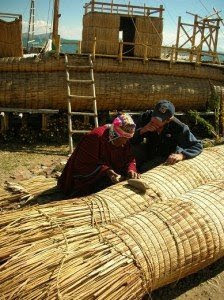
Reed boat construction

Genesis chapter 6 opens with a recognition that humans had multiplied upon the earth and “sons of God” married fair women. The biblical Hebrew would have regarded sexual relations between supernatural beings and humans as a sign of a wicked generation. However, the phrase “sons of God” likely refers to deified rulers. Deification or apotheosis of rulers is first attested in ancient Egypt. Djedi, Mehu, Kagemni, Heqaib, Isi, and Wahka are examples of deified Egyptian rulers. The historical King Osiris took a mythical “god” status during the Middle Kingdom.

These powerful rulers usually had multiple wives. This also would appear decadent to the early Hebrew ruler-priests who had one, or only two wives.
                                                                                                          
In Genesis 6:6-7, the Creator regrets making humans and he decides to blot out mankind from the face of the earth. He explains this to Noah and gives Noah instructions for the construction of a reed ship sealed inside and out with pitch. A reed boat coated with bitumen was found at the site of H3 at As-Sabiyah in Kuwait. The boat dates to c.5000 B.C. 

Neanderthal hafting with tar is evident at Gura Cheii-Râsnov Cave (Romania) and Hummal and Umm el-Tlel in Syria. At these sites archaeologists found tools and weapons with bitumen adhesive to fasten handles to tools and blades to spears. The adhesive helped to strengthen and waterproof bindings made of sinew, hide, or plant fibers used to attach bone or stone tools and weapons to handles.


The Covenant with Noah and his Sons

Noah, a descendant of both Cain and Seth, is described as a righteous man living among people of an unrighteous generation. God establishes a covenant with Noah that extends to his three sons Ham, Shem, and Japheth. The naming of Noah’s three sons is the third suggestion in the Bible of the three-clan confederations of the biblical Hebrew. The first is represented by the three sons of Adam and Eve: Cain, Abel, and Seth. The second with the naming of Jubal, Jabal and Tubal-cain in Genesis 4. Tubal-cain is described as a forger of all instruments of bronze and iron (Gen. 4:22). One of the oldest known iron-smelting sites in the world is in the village of Lejja in southeastern Nigeria. 

The covenant language of Genesis chapter 6 is elaborated in Genesis 9:8-17 where the covenant is extended further to Noah’s descendants and to all living creatures (Gen. 9:9). The rainbow is said to be the sign of the covenant. It is assumed by this source that Noah was not circumcised. However, ritual flint knives found at Nekhen could have been used for circumcision and these date to the time of Noah (C. 4000 BC). The covenant language indicates that this narrative comes from a source that wrote long after the time when Noah lived.

In the Genesis 6 account, Noah is to bring one set of each type of animal onto the ark: a male and a female. Nothing is said about clean and unclean animals, a priestly concern.

The ark which Noah is to build is made of reeds (gopher). The word that appears in Genesis 6:14 is the same word that describes the reed basket in which baby Moses floated (Ex. 2:3). As a ruler in the Lake Chad region, Noah would have had a fleet of reed ships.

The flood of Noah occurred in the region of Lake Chad during the African Aqualithic, a term coined by the British archaeologist John Sutton (“Journal of Africa History”, 1974; “Antiquity”, 1977). The years of wetness were due to monsoonal patterns that brought extended rainy seasons to the Lake Chad Basin. The ancient Basin was ringed by mountains to the northwest (Ahaggar Mountains) and to the north (Tibesti Mountains) from which the water drained into the Basin. The Shebshi Mountains are to the southwest in Adamawa State and the Mandara Mountains extend along the northern part of the Cameroon–Nigeria border. 

Before 4500 years ago the climate was characterized by several wet phases with an optimum in the Sahara region at around 8500-6500 years ago. These were interrupted by short dry periods. Photographs taken from satellites reveal an extensive paleolake bed. At its maximum extent Lake Chad was larger than any lake that exists on earth today. From 7500-6950 B.C. the lake had a depth of 586 feet. Lake Chad has stretched or retreated many times in the past, but from the time of Noah (c.4,200 BC to date), the lake water has continuously diminished. The last great period of inundation appears to have occurred during Noah’s time and from Noah’s perspective all the land (eretz) was covered with water.

The mention of Ararat in the Genesis 8 account leads people to believe that Noah’s ark came to rest in the region of Armenia. That idea is based on the supposition that Ararat corresponds to Urartu, the Assyrian name for a kingdom in the region of Lake Van. However, the biblical account of the flood does not mention Armenia. The section on Genesis chapter 8 looks at the many place names (toponyms) found in Mesopotamia that have equivalent place names in Nigeria. The correspondence between ancient place names in both regions necessitates a closer look at the biblical data surrounding Noah and the flood.


Friday, April 3, 2020

The Flood Waters Rose


Alice C. Linsley

Genesis chapter 7 speaks of water levels so high that they covered all the mountains under the heavens (7:19). If this is hyperbole it doesn’t matter where Noah was living. However, if this is an account from Noah’s perspective, it would be helpful to know where Noah lived. There is only one place on earth that is claimed by the natives to be Noah’s homeland and that is Bor’Nu (Land of Noah) in the region of Lake Chad.

A black mahogany dugout was excavated in Bornu in 1987. The 8000-year Dufuna dugout (shown below) was buried at a depth of 16 feet under clays and sands whose alternating sequence showed evidence of deposition in standing and flowing water.


According to Peter Breunig (University of Frankfurt, Germany), “The bow and stern are both carefully worked to points, giving the boat a notably more elegant form”, compared to “the dugout made of conifer wood from Pesse in the Netherlands, whose blunt ends and thick sides seem crude”. Judging by stylistic sophistication, Breunig reasons that, “It is highly probable that the Dufuna boat does not represent the beginning of a tradition, but had already undergone a long development, and that the origins of water transport in Africa lie even further back in time.”

The Lake Chad Basin is the largest inland drainage system in Central Africa, and it is surrounded by mountains. Between 41,000 and 2,300 years ago it experienced four high water periods. The period has been called the African Humid Period, and the African Aqualithic. The latter term was coined by the British archaeologist John Sutton (Journal of Africa History 1974; Antiquity 1977). Noah would have lived during the last high water period. Around 4000 BC, when Noah would have lived, Lake Chad is estimated to have covered an area of 248,548 miles (400,000 km).

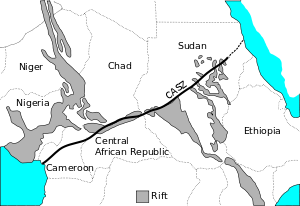
During the African Aqualithic much of the Sahara was wet and the waters systems along the African rift interconnected. It was possible to travel by small boats between the Nile and Lake Chad. This explains the common plant and animal species found in both water systems.


The gray areas on this map show the ancient water ways. The solid black line shows the rift line. Lake Chad is where the countries of Niger, Chad, Nigeria and Cameroon meet.


The map shows the African Sheer Zone.

From Noah's perspective in an ark floating on Lake Chad the waters would have appeared to cover all the ridges that would be visible in drier periods. This elevation data indicates the highest ridges visible to Noah would have had an elevation of about 1083 feet (330 meters). With higher water levels these ridges would have appeared to be submerged.


Saturday, July 4, 2015

Climate Studies and the Book of Genesis


Alice C. Linsley


Plato recounts that "Many great deluges have taken place during the nine thousand years" since Athens and Atlantis were preeminent. In these floods, water rose from below, and only those who lived on the mountains survived. He reports that the third great flood before Deucalion washed away most of Athens' fertile soil. [Timaeus 22; Critias 111-112]

The ancient Egyptians believed that flooding represented divine punishment of rebellion against Ra/Atum's appointed ruler. "People have become rebellious [lawless]. Atum said he will destroy all he made and return the earth to the Primordial Water which was its original state." (Genesis 1:2)


The African Humid Period

Noah was a Proto-Saharan ruler at a time when the Sahara was wet. According to Dr Kevin White, “Over the last 10,000 years, there have been two distinct humid phases, separated by an interval of highly variable but generally drying conditions between roughly 8,000 and 7,000 years ago. Another drying trend took place after about 5,000 years ago, leading to today’s parched environment.”

Noah lived during the time of wetness in the region of Lake Chad during the “Aqualithic" or African Humid Period (8000-4000 BC), also known as the Holocene Wet Period. This was before the rise of the first dynasty of Egypt. This places Noah and his sons in relatively recent history, not at the dawn of human existence.

The word Chad/Tchad is related to the Nilotic Luo word chaddhoreh, meaning a wound or a bruise. In Isaiah 1:6 the King James Version translates chabbarah as "bruises." The Luo word also refers to a depression where something has been cut out, plucked out, or bruised. A depression of this type is called chaddhoreh in Luo. The word "Chad" describes the basin which filled with water during the prolonged period of wetness.

About 7500 years ago Lake Chad was 130 feet deeper than it is today and covered an area of about 135,000 square miles (350,000 sq km). The footprint of ancient Mega-Chad has been confirmed by satellite photography. 

During the African Humid Period the Nile waters swelled from increased rainfall and cut a deeper and wider floodplain, extending well into Sudan to the west. There was then water access to the Giza Pyramids and both Nekhen and Nekheb (Elkab) were on the banks of that great north-flowing river.


Fortified oasis of Djado in Niger along the banks of a dry riverbed.
The ruins are about 1000 years old.


The Djado Plateau lies in the Sahara, in northeastern Niger. It is known for its cave art, but is now largely uninhabited, with abandoned towns and forts still standing. Ancient rivers cut deep canyons in the red rocky landscape. The many archaeological sites are a testament to the fact that the climate was once favorable to human habitation. There is evidence of widespread human settlements in the region over 50,000 years ago.

Ancient water systems connected the Nile and Central Africa. This is evident in the map below showing the African Sheer Zone.


Rifting, combined with prolonged rains, caused this entire region to flood. Lake Chad is located at the boundary of Niger, Nigeria, Chad, and Cameroon.


Mega-Nile

The eastern Sahara Desert was once home to a large lake in the White Nile Valley floor. This is likely the western boundary of Biblical Eden, a vast watery world that extended to the Tigris-Euphrates Valley and the Indus River Valley. According to this report, the mega lake was probably formed more than one hundred thousand years ago in the White Nile River Valley in Sudan.


Between 10 and 12 thousand years ago the Nile system filled with waters from the Angolan Highlands, the result of geological uplift which created Lake Victoria and directed its excess flow north in the White Nile. The White Nile provides most of the Nile's water during the dry season. During this period, there were water routes between the Nile and the Chadic and Niger water systems through a series of shallow lakes in the Sahara. This explains the common plant and animal species found in all three water systems.

As the Sahara dried out, human populations and their cattle found it necessary to move toward the major water systems of the Benue Trough, Lake Chad, and the Nile. The Sahara became increasingly depopulated. In the words of Leviticus 26:19, the heavens became like iron and the earth like brass.

The now dry Botswanan basin was once a sea filled with water from the Angolan Highlands. Some of Africa's earliest human populations lived on the edges of this great lake and evidenced by thousands of man-made stone tools found there. The tools include mace heads and date to between 80,000 and 100,000 years.


Arid Phase in the Southern Levant

A core drilled from the Sea of Galilee was subjected to high resolution pollen analysis for the Bronze and Iron Ages. The detailed pollen diagram (sample/~40 yrs) was used to reconstruct past climate changes and human impact on the vegetation of the Mediterranean zone of the southern Levant. The chronological framework is based on radiocarbon dating of short-lived terrestrial organic material. The results indicate that the driest event throughout the Bronze and Iron Ages occurred ~1250–1100 BC, at the end of the Late Bronze Age. This likely was one factor among many that contributed to the so-called "Iron Age Collapse". Read the full report here.

Wednesday, September 5, 2012

Noah's Homeland in Historical Perspective


A ship made of gopher (Gen. 6:14). Noah's ark would have looked like this.


Alice C. Linsley


There is a time honored tradition that associates Noah with the region of Lake Chad. Here we find the territory of Bor-No which means "Land of Noah." It is sometimes spelled Bor-Nu which means "Land of Gold" because Proto-Saharan kings such a Noah had access to the mineral resources of the Upper Nile.

The Sahara known to Noah was a wet place. According to Dr Kevin White, “Over the last 10,000 years, there have been two distinct humid phases, separated by an interval of highly variable but generally drying conditions between roughly 8,000 and 7,000 years ago. Another drying trend took place after about 5,000 years ago, leading to today’s parched environment.”

When Noah lived, approximately 2490-2415 BC, the Sahara experienced a wet period (Karl W. Butzer 1966). This is the period of the Old Kingdom, a time of great cultural and technological achievement. This places Noah and his sons in relatively recent history, not at the dawn of human existence.

The oldest known zoological collection was found in this region during excavations at Nekhen (Hierakonpolis) in 2009. The royal menagerie dates to ca. 3500 BC and included hippos, hartebeest, elephants, baboons and wildcats. Proto-Saharan rulers, like Noah, kept personal menagerie and in a time of flood would have made provision for the animals.

Nekhen is the oldest known site of Horite Hebrew worship. It was a shrine city as early as 4000 BC.

At least 3,500 years before Noah people were using dugouts to navigate the rivers of the Sahara. This is attested by the discovery of an 8000 year old black mahogany dugout in Dufuna in the Upper Yobe valley along the Komadugu Guna River in Northern Nigeria.

The 8000-year Dufuna boat was found in Nigeria.

Sir Harry Johnston
(1858-1927), an agent of British colonial system in West Africa, wrote several books on the history and linguistics of Africa. He makes the earliest reference to Bornu as a version of Borno and connects this region to biblical Noah.

In his 1836 monograph Anacalypsis: An Inquiry into the Origins of Languages, Nations and Religions, Godfrey Higgins noted that the reference to Noah's ark landing in the mountains of Ararat in "Armenia" could mean simply that it landed on "mount of Meru… that is, Ar or Er-Meni-ia, the country of mount Meru or Meni."

Higgins noted the linguistic similarity between Meru and Meni. Meru is spelled Meri in Egyptian and Meri is sometimes spelled Meni, with the n taking the place of the r, in Southeastern Asian languages like Siamese, where the Virgin Mary is called Mania.

Noah's mountain became Meru, the sacred mountain of  Hinduism and Buddhism. According to Buddhist tradition, the island of Sri Lanka broke off from Meru. Many Hindu temples have been built as symbolic representations of Mount Meru with its seven seas and seven surrounding mountain walls.

In the Bhagvad Gita, Lord Krishna says, "Among the mountains, I am Meru", that is the spinal cord of the world. The Vishnu Purana (c. 200 BC) details how there are seven continents ringed by seven oceans. This cosmology was a mirror image of the seven planets/bowls above. Here we have an example of the celestial archetypes about which Mircea Eliade writes in the Myth of the Eternal Return.

The Hindu story may contain a kernel of history. Noah may have settled on Mount Meru, Africa’s fifth highest mountain, located in northern Tanzania. It stands at 15,000 feet and is 42 miles west-southwest of Mount Kilimanjaro, near the Kenyan border. 

The Nigerian philologist Modupe Oduyoye observed the Noah-Borno connection in his book The Sons of Gods and the Daughters of Men (1984, Orbis Books). Oduyoye has written here about the African background of Genesis.


Proto-Saharan Climate

New evidence from satellite images reveals that the Nile flooded more extensively than previously thought. The waters spread nearly 100 miles west of the river and created "mega-lakes" in what is today the Sahara desert. (Read more here.)

The Chadic Sea in turn connected to the Benue and Niger River Troughs so that travel and commerce was possible on the major water systems from the Atlantic coast of modern Nigeria to the Nile, the Red Sea, The Arabian Ocean and Indian Ocean. At the time of Noah and his ancestors Cain and Seth, the Sahara was Green. 

This is how the historian Roland Oliver has described the Green Sahara: "[In] the highlands of the central Sahara beyond the Libyan desert,... in the great massifs of the Tibesti and the Hoggar, the mountaintops, today bare rock, were covered at this period with forests of oak and walnut, lime, alder and elm. The lower slopes, together with those of the supporting bastions — the Tassili and the Acacus to the north, Ennedi and Air to the south — carried olive, juniper and Aleppo pine. In the valleys, perennially flowing rivers teemed with fish and were bordered by seed-bearing grasslands."

In Noah's time boating and fishing industries were active on Lake Chad. The average fishermen used canoe dugouts which they could carve themselves, but nobles, such as Noah, used boats constructed of marsh reeds lashed together and sealed with pitch. It is likely that Noah had a fleet of such boats.

Proto-Saharan rulers were known to keep ménageries. The animals were kept in pairs so that they would reproduce. Likely these were the animals that Noah preserved by moving them on boats.

Lake Chad was at least 130 feet deeper than it is today and covered an area of about 135,000 square miles (350,000 sq km). The footprint of ancient Mega-Chad has been confirmed by satellite photography. The Nile waters swelled from increased rainfall and cut a deeper and wider flood plain, extending well into Sudan to the west. The area attracted merchants from southern Africa who moved their cargo along the rivers and paid tariffs to the chiefs who controlled the river junctions.


Evidence of the Holocene Wet Period

The Holocene Wet Period has be called the "Gurian Wet Period" and the "African Aqualithic."  The latter term was coined by British archaeologist John Sutton (Journal of Africa History 1974; Antiquity 1977).

Between 10 and 12 thousand years ago the Nile river system filled with waters from the Angolan Highlands, the result of geological uplift which created Lake Victoria and directed its excess flow north in the White Nile. The White Nile provides most of the Nile's water during the dry season.

The Holocene Wet Period owes the abundance of water to climate cycles related to Earth's Great Year, to monsoons off the Indian Ocean, and to the African rifts that created great watersheds or troughs.

Rifting combined with prolonged rains caused this entire region to flood.
Lake Chad is located at the boundary of Niger, Nigeria, Chad and Cameroon. 

Between 12 and 10 thousand years ago, the Nile connected to the Chadic and Niger water systems through a series of shallow lakes in the Sahara Desert. This explains the common plant and animal species found in all three water systems.

The now dry Botswanan lake basin was once a sea filled with water from the Angolan Highlands. Some of Africa's earliest human populations lived on the edges of this great lake and evidenced by thousands of man-made stone tools found there. The tools include mace heads and date to between 80,000 and 100,000 years.


Ancient Accounts of a Wet Period

Plato recounts that "Many great deluges have taken place during the nine thousand years" since Athens and Atlantis were preeminent. In these floods, water rose from below, and only those who lived on the mountains survived. He reports that the third great flood before Deucalion washed away most of Athens' fertile soil. [Timaeus 22; Critias 111-112]

The ancient Egyptians believed that flooding represented divine punishment of rebellion against Ra/Atum's appointed ruler. "People have become rebellious [lawless]. Atum said he will destroy all he made and return the earth to the Primordial Water which was its original state." (Genesis 1:2)

The chaotic waters is called tehom (Hebrew: תְּהוֹם‎) in Genesis 1 and has a Nilotic origin. It refers to is an ancient concept of a disordered deep God put in order by His Word (Egyptian hu or hut). Tehom is subdued by Tehut. The oldest known moral code is the Law of Tehut which dates to about 5,000 BC.

In Genesis 6:9-11, we are told that Noah was God's favored ruler on earth; "an upright man among his contemporaries." God saw that the earth was corrupt and full of lawlessness and determined to destroy the lawless ones by a great flood.

Genesis 2:10-14 says that Abraham's ancestors lived in a vast wet region which the Bible calls "Eden." It was watered by the Tigris, the Euphrates, the Pishon and the Gihon. The first two are in Mesopotamia and the last two are in Africa. This is the heart of the Afro-Asiatic Dominion which extended from Niger to Pakistan, India, Nepal and Cambodia. This is the place of origin of Abraham's ruler-priest ancestors and of "him that holds the scepter from the house of Eden." (Amos 1:5)

Genesis 2:11 states that the Pishon "flows through the whole land of Havilah." Ha-vilah refers to the head waters or place where the waters originate. It is also the territory of Havilah, a son of Kush (Gen. 10:7). The Kushites lived in the upper Nile region and the Sudan. Kushite kings were the early rulers of Egypt. The Upper and Lower Nile regions were first united by the Kushite warrior-king Menes.

Noah was the great grandfather of Kush. Kush's first born sons by his two wives were Nimrod (Gen. 10:8) and Raamah (Gen. 10:6). They ruled over separate territories in the ancient Afro-Asiatic Dominion. Nimrod ruled in the Tigris River valley. Raamah and his son Dedan controlled the eastern coastal area of the Yam Suph (Red Sea).

DNA studies have confirmed the Kushite migration out of Africa. However, there were already human populations scattered across the earth, especially at the more temporate zones. Some of those populations resulted from earlier migrations out of Africa. The first took place about 120,000 years ago and the second about 70,000 years ago. The Kushite expansion coincided with the spread of the Horite Hebrew religion. In Akkadian texts these priests were called "Abru" which is "Hebrew" in English Bibles.
 
The climate change that brought gradually drier conditions to what was once a vast wet world is explained in various sacred texts. The dry land swallowed the excess waters. The Koran [11:25-48] refers the earth swallowed the water, and says that Noah's boat came to rest on the mountain Al-Judi." 

In Revelation 12 the devil-dragon spews a flood of water to destroy the sun-clothed Woman who bore the Divine Son, but the earth protected the Woman and Child by swallowing the flood. This recapitulates the Genesis 3:15 reference to Woman giving birth to the Divine Seed.


The Extent of the Flooding During Noah's Time

Paul Sereno unearthed 10,000 year old skeletons at Gobero in Niger. These were buried on the edge of a paleolake on the northwestern rim of the Chad Basin. The Gobero site is the earliest known cemetery in the Sahara and the skeletons found there indicated that some were at least 6 feet tall.


Gobero skeleton (G3B8) measures 6 feet 6 inches
Photo (c) Mike Hettwer, courtesy Project Exploration

According to Sereno, these earlier Holocene people left when it became arid, but the area was repopulated by a taller people around 4600 B.C. when humid conditions returned. Flooding occurred on and off over a long period. Wet conditions prevailed from 7700-6200 (phase 2). Sereno states, "The darkened bone color of all human skeletons in phase 2 burials is indicative of sustained inundation." (Read about Sereno's findings here.)

Another wet period corresponds to the time that Noah would have lived in the region of Lake Chad, between 3000 and 2500 B.C.

At the time of the Gobero populations (9700-4400 years ago), humans were dispersed globally, and during the time of Noah these populations were not destroyed. Consider the following population estimates by urban center between 3000 and 2200 BC, around the time when Noah's flood would have occurred:

Memphis, Egypt - 32,000 inhabitants
Lagash, Iraq - 60,000 inhabitants
Mohenjo-daro, Pakistan - 40,000 inhabitants
Mari, Syria -50,000 inhabitants

Baodun settlements, China - Baodun is the largest settlement, covering an area of about 373 miles. There is no evidence of destruction by flooding though all six Baodun settlements straddled the Min River in central Sichuan province. The Min is a tributary of the upper Yangtze River.

There is no evidence that any of these peoples were wiped out by a worldwide flood. The evidence simply does not support the interpretation that all the peoples of the earth were destroyed in a catastrophic global flood and that the earth was repopulated by Noah's descendants.