Followers

Showing posts with label Noah. Show all posts

Tuesday, June 25, 2024

The Dispersion of the Early Hebrew


       Map produced by Daniel Todd


Dr. Alice C. Linsley


The Hebrew were widely dispersed before Abraham's time (c.2000 BC). They were in the region of Lake Chad, the Nile Valley, Arabia, Mesopotamia, Anatolia, Eurasia, and the Indus Valley.

Nekhen on the Nile is the oldest known site of Horite Hebrew worship. It is marked on the map by a star. Nekhen's sister city, Nekheb, sat on the opposite side to the Nile River. Both were shrine cities with Hebrew priests. A great deal is known about the Horite and Sethite mounds from texts dating to as early as 4200 years ago.

The historical Adam and Eve lived around 5000-4800 BC in a vast well-watered region called Eden. Genesis 2 describes Eden as a lush riverine region that extended from the sources of the Nile in Ethiopia and Uganda to the Tigris and Euphrates in Mesopotamia (C on the map). The early Hebrew lived throughout Eden.

The firstborn son of Adam and Eve was Cain (Gen. 4). He was sent away and established a settlement "east of Eden" (Gen. 4:16). He named that settlement for his son Enoch, a royal title. Cain's descendants, the Kenites, are found in the land of Kenan which is the land of Canaan כנען, pronounced kena'an.

Noah was one of the descendants of Adam and Eve. Different accounts of Noah are given in Genesis chapter 6-8. He probably ruled in the region of Lake Chad (A on the map). This is the only place on earth that the natives call Noah's homeland - Bornu (Borno/Benue), meaning "land of Noah." The local Kanuri people call Lake Chad Buhar Nuhu, meaning "Sea of Noah." When Noah lived the Sahara was wet and green. The Lake Chad Basin was prone to flooding. The oldest known canoe, the "Dufuna boat," was found in this region. This is a photograph of that 8000-year mahogany dugout.


One of Noah's descendants was Nimrod (Gen. 10), a son of Kush. Nimrod left Kush (modern day Sudan) and established his territory on the Euphrates River around 3500 BC (Gen. 10). He married a Sumerian princess, the daughter of King Asshur.


The practice of marrying high-status women to form political alliances and to become established in a new territory is illustrated by Nimrod’s marriage to a Sumerian princess. Nimrod was a Kushite kingdom builder and his marriage to Asshur’s daughter is evidence of the close connection between the rulers of the Nile Valley and the rulers of Mesopotamia, two early riverine civilizations.

Another of Noah's descendants was Heth (Gen. 10). The Hittites of Canaan and Anatolia (C on the map) are Heth's Hebrew descendants.

Abraham was one of Nimrod’s descendants. Around 2000 BC, Abraham controlled the water systems at Hebron and Beersheba and the wells that he dug in Gerar. His proper heir was Isaac and Isaac's proper heir was Esau. Jacob was sent to serve his maternal uncle, a common practice among the early Hebrew. The sending away of non-ascendant sons drove the Hebrew dispersion into many regions.

The clans of Joktan and Sheba were also Hebrew. They settled in southern Arabia. This map shows the Joktanite clans of Arabia.


The widely dispersed Hebrew ruler-priests controlled commerce on sections of the major water systems. They traded as far as Pakistan and the Indus River Civilization. By the time Nimrod married a daughter of Asshur, long-distance trade had become a source of wealth for the Mesopotamian lords and ladies. Ships coming from Bahrain (Sumerian "Dilmun") brought wool, gold, copper, lapis lazuli, and carnelian to the Sumerian cities of Ur, Nippur, and Uruk (Erech). Archaeologists discovered a 4,000-year-old boat at Uruk. The boat was constructed of organic materials, probably marsh reeds, and covered in bitumen, a tar-like substance used for waterproofing. This technique was used in the construction of Noah’s ark (Gen. 6:14).

As early as 7000 BC, the island of Bahrain (F on the map) served as a major trade depot with its own commercial seal. Ancient documents speak of Dilmun's trade in gold, silver, ivory, sesame oil, wool, carnelian beads, lapis lazuli, and copper. One document details a cargo of eighteen tons of refined copper purchased in Dilmun. Dilmun was a maritime connection between Mesopotamia and the Indus Valley.

Sumerian ships brought cargo to Dilmun and to port cities in the Indus Valley (G on the map). Ships sailed southeast on the Tigris or Euphrates to the Persian Gulf, making stops at the port of Dilmun, passing the Oman Peninsula, and entering the Arabian Sea. From there the ships sailed northeast on the Indus River to Mohenjo-Daro and Harappa. Trade in lapis lazuli and carnelian beads ran between Egypt, Mesopotamia, India, and Afghanistan as early as 4000 B.C. Indus seals with Harappan inscriptions have been found in Mesopotamia. Indus pottery and seals have been found along the maritime routes between the Indian subcontinent and Mesopotamia. Note the close resemblance of Indus Valley and Nilotic inscriptions found on pottery.


The early Hebrew rulers sent their merchants along ancient trade routes that ran from the Nile to Arabia and Canaan, and from Mesopotamia to modern Bahrain. Routes extended into the Indus Valley and as far north as China. There is considerable evidence that the religious beliefs of the early Hebrew influenced the populations among whom they lived. This explains the common religious practices and solar symbolism among the diverse populations of the Fertile Crescent and the Ancient Near East.

The term "Hebrew" is derived from the ancient Akkadian word for priest - abru. They were a ruler-priest caste that married only within their caste (caste endogamy). The caste structure of the early Hebrew meant that wherever they lived they were identifiable as Hebrew. It is possible to speak of Egyptian Hebrew, Canaanite Hebrew, Kushite Hebrew, and Mesopotamian Hebrew. The Hebrew living in the Nile Valley were kin to the Hebrew living in Canaan, Mesopotamia, and Anatolia.

The Hebrew priests were in the service of the early kingdom builder which are described in Genesis as the "mighty men of old" and "heroes of renown." As new territories were established and as older territories expanded, the Hebrew went where they were appointed to serve at royal temples and river shrines. Many Hebrew women ministered to women at the river shrines which were places of healing, purification, and prayer, especially for women struggling with infertility.

All this movement happened long before Judaism emerged as a world religion after about 580 BC. None of the people mentioned above were Jews. They were Hebrew, and there were many Hebrew clans.


Monday, March 21, 2022

An Anthropologist Looks at Genesis 9


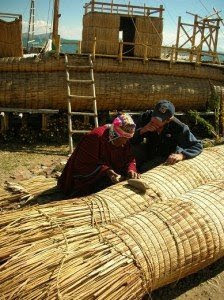
German built reed boat.


Dr. Alice C. Linsley


The Covenant with Noah

Genesis chapter 9 reiterates the terms of the covenant stated in chapter 6. God blessed Noah and his sons and established his covenant with them and with their descendants. In chapter 9 we find an additional element: a promise that never again will all flesh be destroyed by inundation. The rainbow is the sign of that promise.

In Genesis chapter 9 we find an explicit prohibition against consuming blood. Adam and Eve were not to eat of the fruit of the forbidden tree, and Noah and his early Hebrew people are not to eat flesh with the blood in it (Gen. 9:4-6). This echoes the prohibition of Leviticus 17:10-12: “If anyone from the house of Israel or a foreigner living among them eats any blood, I will set My face against that person and cut him off from among his people. For the life of the flesh is in the blood, and I have given it to you to make atonement for your souls upon the altar; for it is the blood that makes atonement for the soul. Therefore, I say to the Israelites, ‘None of you may eat blood, nor may any foreigner living among you eat blood.’”

Some writers (Leon Kass, Yoram Hazony) have suggested that the purpose of Genesis 1-11 is to present a general theory of human nature. However, the matter of blood which both purifies and pollutes has not be explored sufficiently in connection to the early Hebrew. The antecedents of blood anxiety and blood as a symbol of life extend back to a time long before Noah. For at least 100,000 years humans buried their loved ones in red ocher, a symbolic blood covering. The hope for life after death had long been attached to blood and blood symbolism.


Noah, a Drunken Father

Noah is described as a tiller of the ground and a grower of grape vines. This describes a neolithic ruler, not a paleolithic hunter-gatherer.

In the ancient world, wine was consumed mainly by rulers, and it was used by priests in religious rituals. It was offered by kings as a "drink offering" to the High God, and it was consumed at feasts that involved the ratification of treaties. The High God was believed to be the Witness to these treaties. In a Ugaritic text, the God El became drunk at such a feast and had to be carried home by his sons. Here we find a parallel to the story of Noah's drunken state and his sons' attempt to "cover" for him. However, in the Genesis 9 account, Noah became drunk and cursed one of his descendants, negating the covenant of blessing on his descendants (Gen. 9:20-25).

The curse falls on Canaan. This narrative suggesting sexual perversion is imposed by a later anti-Canaanite source. Shem is blessed and Canaan is to be his slave. The source of this account fails to recognize that the lines of Ham and Shem intermarried so that the curse on Ham’s descendants necessarily falls also on Shem’s descendants.


The outcomes of Noah's and Lot's drunken stupors were not good. Genesis presents criticism of excessive wine consumption as this was considered improper for Hebrew ruler-priests. Plutarch wrote that the “priests of the Sun at Heliopolis [biblical On] never carry wine into their temples, for they regard it as indecent for those who are devoted to the service of any god to indulge in the drinking of wine whilst they are under the immediate inspection of their Lord and King. The priests of the other deities are not so scrupulous in this respect, for they use it, though sparingly.”


Abraham's Territory  

Another covenant is established with Abraham in Genesis chapter 17. This covenant becomes the basis for later Zionist claims. The narrative that informs Jewish identity as historically connected to the Land of Israel (“Eretz Israel”) begins with the calling of Abraham who is portrayed as the first Jew. However, the Bible designates Abraham as Hebrew, and the biblical evidence indicates that Abraham’s early Hebrew ancestors came out of Africa. By Abraham’s time they were dispersed among many ethnicities and living in city-states and kingdoms, some of which are named in Genesis chapter 10.

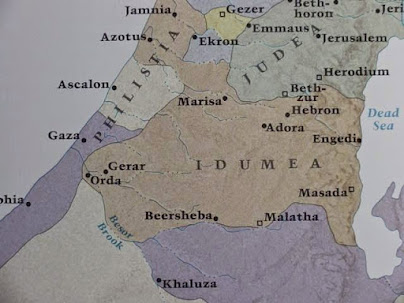
Abraham's north-south territorial boundaries were marked by his wives' settlements. Sarah resided in Hebron and Keturah resided in Beersheba. His water rights appear to have extended on an east-west axis from Ein Gedi to Gerar.


Note that both Hebron (Sarah's settlement) and Beersheba (Keturah's settlement) are in Idumea/Edom. Abraham's territory extended between the settlements of his two wives and in Greek was called Idumea, meaning "land of red people." The region was called Adamu in ancient Egyptian, a reference to the color of blood.


Thursday, March 17, 2022

An Anthropologist Looks at Genesis 8


Dr. Alice C. Linsley

Genesis 8 states that Noah had cattle, and during Noah's time cattle were often transported by boats. Petroglyphs of prehistoric reed boats carrying cattle have been found in the eastern desert of Egypt. The various types: sickle, incurved sickle, square, incurved square, and flared are shown above.

Grave goods from the Naqada period have the same images as are found on these petroglyphs which leads archeologists to conclude that many of these petroglyphs can be dated to the Naqada period (4500-3100 B.C.)

The black mahogany Dufuna dugout (shown below) was found in 1987 in Yobe State (Nigeria) buried 16 feet under clays and sands which alternating sequence showed evidence of deposition in standing and flowing water. The dugout is 8000 years old. By comparison, Egypt's oldest boat is 5000 years old. 

Peter Breunig (University of Frankfurt) specializes in African archaeology. He has written this description of the Dufuna boat: “The bow and stern are both carefully worked to points, giving the boat a notably more elegant form”, compared to “the dugout made of conifer wood from Pesse in the Netherlands, whose blunt ends and thick sides seem crude”.

Judging by stylistic sophistication, Breunig reasons that, “It is highly probable that the Dufuna boat does not represent the beginning of a tradition, but had already undergone a long development, and that the origins of water transport in Africa lie even further back in time.”


Dufuna canoe being excavated in Yobe State, Nigeria.


Where did the Ark land?

The Genesis accounts of Noah's flood do not specify a mountain and may not refer to Armenia. That idea is based on a supposition that the word Ararat corresponds to Urartu, the Assyrian name for a ninth century B.C. kingdom in the region of Lake Van.

This view is based on what Josephus wrote in “Antiquities of the Jews” which was cited by Jerome:

“…the ark rested on the top of a certain mountain in Armenia ... However, the Armenians call this place, αποβατηριον 'The Place of Descent'; for the ark being saved in that place, its remains are shown there by the inhabitants to this day. Now all the writers of barbarian histories make mention of this flood, and of this ark; among whom is Berossus. For when he is describing the circumstances of the flood, he goes on thus: "It is said there is still some part of this ship in Armenia, at the mountain of the Cordyaeans; and that some people carry off pieces of the bitumen, which they take away, and use chiefly as amulets for the averting of mischiefs."  (I.3.5-6, translated by William Whiston, 1737)

Berossus was a Babylonian historian and priest (330–250 B.C.) who would have been familiar with ancient flood accounts. Since the early settlements were by major waterways stories of inundations are found among the early civilizations.

Citing late sources such as Berossus, Hieronymus the Egyptian, Mnaseas, and Nicolaus of Damascus, Josephus claimed that the "ark rested on the top of a certain mountain in Armenia, . . . over Minyas, called Baris."

Though Armenia is not mentioned in the Genesis flood account, some claim to have found remnants of Noah’s ark on a mountain in Armenia. Given that the ark was constructed of bundles of reeds, finding it after 6000 years in the damp seasonal changes of the Ararat Mountains is extremely unlikely.

Given the African context of the material in Genesis chapters 1-6 and the fact that Lake Chad is called the “Lake of Noah” by the local people, it is reasonable to consider alternative theories.


Theory 1: The term ararat (Tiberian Hebrew: hārê 'Ǎrārāṭ) is related to the Somali/East African word harada, meaning lakeside. According to this theory, Noah's ark is associated with a lake, not a mountain. These 6 rivers flow into Lake Chad, the probable homeland of biblical Noah: Hadejira, Jama'are, Yobe, Komadogu Gana, Ngadda, and Yedseram. These are on the southwestern side of the Lake Basin. As the flood waters receded, ships on those rivers would have moved closer to Lake Chad. Some would have come to ground at lakeside (harada).

Jerome introduced the idea of Armenia in his Vulgate translation of the Greek Bible. He translated Genesis 8:4 to read: requievitque arca . . . super montes Armeniae ("and the ark rested . . . on the mountains of Armenia.")

In the ancient Elamite language, Armenia was called "Harminuya" which suggests a mountain because the word har means hill, mountain, or hill country in Hebrew, but it can refer to a lake in East Africa. In other languages the same meaning is given for kar, referring to a high elevation settlement or a fortified rock shelter. The term kar is related to the ancient Akkadian word kur which is a reference to land owned or to a settlement. The Akkadian word kurtum means territory. 

In Dravidian car means "sheltered together" and in Manding kara means "to assemble." Among the Nilotic Luo, kar specifies a place with boundaries.

Since these high places were places of burnt offerings, the term kar is often associated with charcoal and soot. The Turkish kara means "black." In Magyar, korom refers to soot, as does the Korean word kurim.

Many rock shelters (kar) have been identified in the Carpathian range. The range is called Karpaty in Czech, Polish, and Slovak, and Карпати in Ukrainian and Bulgarian, Carpați in Romanian, Karpaten in German, Kárpátok in Hungarian, Karpati in Serbian, and in Albanian, karpë means "rock."

The identification of Noah's ark with a mountain in Armenia is insubstantial. The biblical text does not identify a mountain. At best, it alludes to a range of mountains or to high country.

Theory 2: The mountain is a metaphor for the new creation. Throughout the Bible God interacts with people at moments that mark new beginnings. Abraham finds provision and assurance on Mount Moriah. Moses’s meeting with God in the fiery bush on Mount Horeb involves his appointment to bring the people out of Egypt. The people of Israel receive the law when Moses meets with God on Mount Sinai. Jesus’s transfiguration on the mountain signals the coming of the eternal kingdom.

The word ararat is formed from the triradical RRT in which the T symbolizes a mountain. The reduplicated R symbolizes a high-ranking ruler, or the High God. This archaic symbolism is preserved in the Ugaritic creation story of the twin mountains are indicated by the sign T. The mountains Trgzz and Trmg emerged from a universal ocean and held up the firmament at the beginning of creation.

Noah’s ark comes to rest on a high mountain and there he builds an altar upon which he offers clean birds and clean animal in blood sacrifice to the High God (Gen. 8:20). This fits the overall theme of Noah’s flood as the beginning of a new world and a new covenant.

The motif of mountains as the connection between God and Man, between Heaven and Earth is found in many religious texts. In the Bhagvad Gita, Krishna says, "Among the mountains, I am Meru", that is, the spinal cord of the world. The Vishnu Purana (c.200 B.C.) speaks of seven peaked continents ringed by seven oceans. This cosmology was a mirror image of the seven celestial planets/bowls, following the ancient belief "as in the Heavens, so on Earth."

Given the physics of flood drainage, it is unlikely that a reed ship would come to rest at a high elevation as the waters recede. Stream flows vary depending on the contour and size of the channels, but the draining waters carry floating debris to the lower elevations. Therefore, it would be natural for the Ark to come to rest near a river or lakeside of lower elevation. This also seems to support the mountain as metaphor for a connection between the Creator and Noah as a new Adam.


Theory 3: Place names are conflated or confused due to the passage of many millennia. In his 1874 monograph “Anacalypsis: An Inquiry into the Origins of Languages, Nations and Religions” Godfrey Higgins noted that Ar’menia could mean "mount of Meru… that is, Ar or Er-Meni-ia, the country of mount Meru or Meni." 

Josephus quoted Nicolas of Damascus, where he wrote in his ninety-sixth book: "There is a great mountain in Armenia, over Minyas, called Baris, upon which it is reported that many who fled at the time of the Deluge were saved; and that one who was carried in an ark came on shore upon the top of it; and that the remains of the timber were a great while preserved."

The word meni appears only twice in the Bible. In Isaiah 65:11 it is paralleled with the word gad, meaning good fortune. There appears to be a connection between meni and sacrifices at high places because the word gad appears in a context of sacrifices on mountains. Perhaps Noah’s burnt offering was on a mountain or elevated place called Meni.

A variant spelling of Meni appears in Jeremiah 51:27 where God calls on the armies of Ararat, Minni, and Ashkenaz to attack Babylon. Here we note that Ararat and Minni/Meni are regarded distinct regions or ethnicities. Ashkenaz is listed as an ethnicity in Genesis chapter 10.


Theory 4: Noah’s ark was in Nigeria. This possibility appears more likely when we note the correspondence between place names (toponyms) in Mesopotamia and Nigeria.

Eridu is an archaeological site in southern Mesopotamia. The place name corresponds to Eridu/Eredo in Ogun State of Nigeria.

The Sumerian name for Eridu was Nun ki. Nun also is a place name in Nigeria. The Nun River flows through Rivers State.

Nimrod, a son of Kush, is said to have established a city in Mesopotamia called Erek/Erech. This corresponds to the place names Uruk and Urik in Nigeria.

The Mesopotamian city of Akkad is also known as Akkade or Agade and corresponds to the city of Agade in the Cross River region of Nigeria.

The biblical place name Meni/Minni corresponds to Minni/Minna, the capital of Niger State in Nigeria. Archaeological finds confirm human habitation here beginning as early as 47,000 years ago. Minna is at a low elevation and bounded on the south by the Niger River. The main tributary of the Niger River is the Benue River. Benue means "land of Noah."

The city of Minna is 588 miles (946 km) from Lake Chad, but that distance would have been less in Noah’s time when Lake Chad extended farther to the west. The blue area shows the area of Mega Chad. The green is the present area of the Lake. The Niger River flows from Lake Chad southwest toward Minna.


Theory 5: The ancient name for the Nile River in time of flooding was Ar. Instead of Ararat, we should probably read Ar-Ar-T which is a reduplication suggesting an enhancement, enlargement, or intensification. The T is a common ancient symbol for something that rises, as in mountains, pillars, the heavens, or rising waters.

Monday, March 14, 2022

An Anthropologist Looks at Genesis 7


3500 B.C. Nilotic pottery showing a reed ship.

Alice C. Linsley


In the Genesis 7 narrative Noah is told to bring seven pairs of “clean” animals onto the ark. This reflects the priestly concern for ritual purity and differs from the Genesis 6 account in which Noah is told to bring one pair of each animal onto the ship. However, the archaeological evidence suggests that Noah was not concerned with ritual purity. His concern appears to have been the preservation of the animals in his royal zoo.

Proto-Saharan rulers such as Noah kept ménageries of prized bulls, hippos, elephants, baboons, and wildcats. The account of Noah saving animals aligns well with the archaeological and anthropological evidence.

The oldest known ménagerie (c.3500 B.C.) was discovered at Nekhen where rulers provided burials for their animals. The animals exhumed in the city’s elite cemetery received similar mortuary treatment as humans. These animals had been well tended, as evidenced by bone fractures that would have required medical care to heal properly. Nekhen has more animal burials than any early Nile Valley urban center.

It is believed that the rulers kept exotic animals as symbols of their power and wealth. Syrian bears were brought to Egypt during the 5th Dynasty. Athenaios of Naucratis reports that a white bear was housed by Ptolemy II in his private zoo at Alexandria. At his royal estate in Nubia, Akhenaten kept lions in domed buildings, antelopes in pens, and cattle in an enclosure made of sticks and branches. 

Only eight humans were on the ark. The source of this account would have us believe that Noah had only one wife, and each of his sons had only one wife. This is not consistent with the evidence of early Hebrew rulers with two wives.

The waters are said to have covered all the high mountains, destroying all living beings except the creatures on the ark. This reflects the Deuteronomist Historian’s belief that God destroyed all the unrighteous and ritually unclean. This source is from the Neo-Babylonian Period (700-530 B.C.), 3000 years after the time of the historical Noah. 

Ancient accounts of righteous heroes who alone are saved in a time of divine judgment on their people include the Gilgamesh Epic. Gilgamesh lived about 2000 years after the time of biblical Noah. The the Gilgamesh Epic the hero Utnapishtim sends out birds and offers animal sacrifice which the “gods smelt” as a sweet savor (cf. Gen. 8: 6-21). Utnapishtim’s ship lands on a mountain called Ni'mush, which means "the serpent." In ancient Near Eastern cultures the serpent was a symbol of life, health, and immortality. Here we find a trace of this belief. Archaeological evidence and ancient literary texts indicate that a snake staff, such as the one held by Moses in the wilderness, was associated with healers and healer-priests.

In the “Eridu Genesis” (c.1600 B.C.) the High God An and his son punish the regional Near Eastern population by bringing a destructive flood. Enki helps the ruler-priest Ziusudra to escape.

These later flood stories are patterned on the earlier narrative of Noah, a Proto-Saharan ruler. Since Noah's descendants dispersed widely across the Ancient Near East, it is not surprising to find similar tales among the Mesopotamian and Babylonian populations.


Thursday, March 10, 2022

An Anthropologist Looks at Genesis 6


Alice C. Linsley
Reed boat construction

Genesis chapter 6 opens with a recognition that humans had multiplied upon the earth and “sons of God” married fair women. The biblical Hebrew would have regarded sexual relations between supernatural beings and humans as a sign of a wicked generation. However, the phrase “sons of God” likely refers to deified rulers. Deification or apotheosis of rulers is first attested in ancient Egypt. Djedi, Mehu, Kagemni, Heqaib, Isi, and Wahka are examples of deified Egyptian rulers. The historical King Osiris took a mythical “god” status during the Middle Kingdom.

These powerful rulers usually had multiple wives. This also would appear decadent to the early Hebrew ruler-priests who had one, or only two wives.
                                                                                                          
In Genesis 6:6-7, the Creator regrets making humans and he decides to blot out mankind from the face of the earth. He explains this to Noah and gives Noah instructions for the construction of a reed ship sealed inside and out with pitch. A reed boat coated with bitumen was found at the site of H3 at As-Sabiyah in Kuwait. The boat dates to c.5000 B.C. 

Neanderthal hafting with tar is evident at Gura Cheii-Râsnov Cave (Romania) and Hummal and Umm el-Tlel in Syria. At these sites archaeologists found tools and weapons with bitumen adhesive to fasten handles to tools and blades to spears. The adhesive helped to strengthen and waterproof bindings made of sinew, hide, or plant fibers used to attach bone or stone tools and weapons to handles.


The Covenant with Noah and his Sons

Noah, a descendant of both Cain and Seth, is described as a righteous man living among people of an unrighteous generation. God establishes a covenant with Noah that extends to his three sons Ham, Shem, and Japheth. The naming of Noah’s three sons is the third suggestion in the Bible of the three-clan confederations of the biblical Hebrew. The first is represented by the three sons of Adam and Eve: Cain, Abel, and Seth. The second with the naming of Jubal, Jabal and Tubal-cain in Genesis 4. Tubal-cain is described as a forger of all instruments of bronze and iron (Gen. 4:22). One of the oldest known iron-smelting sites in the world is in the village of Lejja in southeastern Nigeria. 

The covenant language of Genesis chapter 6 is elaborated in Genesis 9:8-17 where the covenant is extended further to Noah’s descendants and to all living creatures (Gen. 9:9). The rainbow is said to be the sign of the covenant. It is assumed by this source that Noah was not circumcised. However, ritual flint knives found at Nekhen could have been used for circumcision and these date to the time of Noah (C. 4000 BC). The covenant language indicates that this narrative comes from a source that wrote long after the time when Noah lived.

In the Genesis 6 account, Noah is to bring one set of each type of animal onto the ark: a male and a female. Nothing is said about clean and unclean animals, a priestly concern.

The ark which Noah is to build is made of reeds (gopher). The word that appears in Genesis 6:14 is the same word that describes the reed basket in which baby Moses floated (Ex. 2:3). As a ruler in the Lake Chad region, Noah would have had a fleet of reed ships.

The flood of Noah occurred in the region of Lake Chad during the African Aqualithic, a term coined by the British archaeologist John Sutton (“Journal of Africa History”, 1974; “Antiquity”, 1977). The years of wetness were due to monsoonal patterns that brought extended rainy seasons to the Lake Chad Basin. The ancient Basin was ringed by mountains to the northwest (Ahaggar Mountains) and to the north (Tibesti Mountains) from which the water drained into the Basin. The Shebshi Mountains are to the southwest in Adamawa State and the Mandara Mountains extend along the northern part of the Cameroon–Nigeria border. 

Before 4500 years ago the climate was characterized by several wet phases with an optimum in the Sahara region at around 8500-6500 years ago. These were interrupted by short dry periods. Photographs taken from satellites reveal an extensive paleolake bed. At its maximum extent Lake Chad was larger than any lake that exists on earth today. From 7500-6950 B.C. the lake had a depth of 586 feet. Lake Chad has stretched or retreated many times in the past, but from the time of Noah (c.4,200 BC to date), the lake water has continuously diminished. The last great period of inundation appears to have occurred during Noah’s time and from Noah’s perspective all the land (eretz) was covered with water.

The mention of Ararat in the Genesis 8 account leads people to believe that Noah’s ark came to rest in the region of Armenia. That idea is based on the supposition that Ararat corresponds to Urartu, the Assyrian name for a kingdom in the region of Lake Van. However, the biblical account of the flood does not mention Armenia. The section on Genesis chapter 8 looks at the many place names (toponyms) found in Mesopotamia that have equivalent place names in Nigeria. The correspondence between ancient place names in both regions necessitates a closer look at the biblical data surrounding Noah and the flood.


Monday, October 4, 2021

Rulers and Royal Menageries


These petroglyphs found in the Eastern Desert of Egypt show cattle being transported on reed boats.
Boat types include sickle, incurved sickle, square, incurved square, and flared.


Dr. Alice C. Linsley

The early Nilotic rulers kept personal menageries. Syrian bears were brought to Egypt during the 5th Dynasty. These bears were generally docile and kept on leashes. Athenaios of Naucratis reports that a white bear was housed by Ptolemy II in his private zoo at Alexandria.

At his royal estate in Nubia, Akhenaten kept lions in domed buildings, antelopes in pens, and cattle in an enclosure made of sticks and branches. It is believed that the rulers kept exotic animals as symbols of their power and wealth.

The Proto-Saharan ruler Noah would have known of Nekhen. He likely lived in the region of Lake Chad. The region is called Bornu or Benue by the peoples who live there. Both words mean "land of Noah". The animals that Noah saved were likely those of his personal ménagerie. This would have included prized bulls, hippos, elephants, baboons, and wildcats. The account of Noah saving animals aligns well with the archaeological and anthropological evidence. 

Royal zoos were common among rulers during the period when Noah lived. Animals were kept in male-female pairs so that they would reproduce. According to Genesis 6:19, Noah brought only a male and female of the species onto the ark. However, Genesis 7:2 says that he saved seven pairs of only "clean" animals. This account comes from a different source that stressed ritual purity.

The oldest known zoo was at Nekhen (Hierakonpolis) on the Nile. The temple there was dedicated to the High God and his son, Horus. The priests who served there were Horites. The Nekhen ménagerie existed in the middle of the second millennium BC. 

The rulers of Nekhen kept menageries and provided royal burials for the animals that died. The animals exhumed in the city’s elite cemetery had received similar mortuary treatment as humans. There was some evidence that these animals had been well tended, including a few bone fractures that would have required medical care to heal properly. Nekhen has more animal burials than any early Nile Valley urban center.


Sunday, February 28, 2021

Genesis and Inerrancy


Alice C. Linsley


From the perspective of anthropology, Genesis 1-11 is rich in data that enables us to identify the cultural contexts of Abraham’s ancestors. Though the material is not to be taken as a scientific account, it nonetheless contains data about Abraham’s ancestors that anthropology, archaeology, linguistics, and DNA studies can confirm.

Noah was one of Abraham’s ancestors. Noah’s great grandson was Nimrod, a Kushite kingdom builder who left Africa and established a territory for himself in Mesopotamia. This explains why we first meet Abraham in Mesopotamia. However, his cultural context appears to be Kushite. (DNA studies have confirmed the Kushite migration out of Africa.)

We overcome most of the supposed contradictions between Science and Scripture once we identify the context of Abraham’s ancestors as Proto-Saharans and Nilotes living during the African Humid Period (African Aqualithic) when the Sahara was green and wet. Saharan petroglyphs dating to 4300-2900 BC depict boats transporting cattle. It is also significant that the only place on earth which is claimed by the natives to be Noah’s homeland is Bor-no (“land of Noah”) in the region of Lake Chad.

Noah would have lived in the Lake Chad area around 6000 years ago. At that time, God Father (Re) and God Son (Horus) were worshipped at the Horite Hebrew shrine city at Nekhen (Hierakonpolis) on the Nile. This was a very prestigious city as has been shown through archaeological discoveries there. The votive offerings and mace heads were larger than have been found elsewhere. There are numerous burial sites of high-ranking persons, some of whom had long wavy red hair (Burial 79). These are the likely ancestors of the Horites of Edom (Genesis 36). An Edomite chief named Esau is described as red and hairy. 

Some of the graves at Nekhen had painted ostrich eggs, symbols of the hope of resurrection. The earliest texts that speak of bodily resurrection are found among the Horite and Sethite Hebrew.

Using kinship analysis, a tool of cultural anthropology, the king lists of Genesis 4, 5, 10, 11, 25 and 36 have been shown to be authentic. They speak of historical persons. These were Horite and Sethite Hebrew rulers. They were a moiety, that is, one people divided into two ritual groups. We have writings from these ruler-priests that date to 4400 BC, roughly Noah’s time.

The Ancient Egyptian Pyramid Texts (2400-2000 BC) tell us that the Horites and the Sethites maintained separate settlements. Utterance 308 of the Pyramid Texts addresses them as separate but related groups: "Hail to you, Horus in the Horite Mounds! Hail to you, Horus in the Sethite Mounds!"

Utterance 470 contrasts the Horite mounds with the Sethite mounds, designating the Horite Mounds "the High Mounds.”

The Horite and Sethite Hebrew shared religious practices and beliefs, and they worshiped the same God and served the same king.

Though separate ritual groups, the Horites and the Sethites served the same king. Utterance 213 says: "O King, you have not departed dead, you have departed alive...The Mounds of Horus serve you, the Mounds of Seth serve you."

In his resurrection body the king is to "traverse the Mound of Horus of the Southerners" and "traverse the Mound of Horus of the Northerners" (PT Utterances 536 and 553). The risen king restores his settlements and cities, and opens doors to the Westerners, Easterners, Northerners and Southerners (Pt Utterance 587). He is to ascend to the heavens (PT Utterance 539).

The risen king unites the peoples, restores the former state of blessedness, and unites heaven and earth. When seen from this perspective, the Horite Hebrew religion appears to be the foundation of the Messianic hope that is fulfilled in Jesus of Nazareth. This expectation was expressed about 1000 years before Psalm 91 in Utterance 388 of the Pyramid Texts. "Horus has shattered (tbb, crushed) the mouth of the serpent with the sole of his foot" (cf. Genesis 3:15).


The Question of Inerrancy

Once we identify Noah’s cultural context, we may investigate further. The Lake Chad region was constantly threatened by floods during Noah’s time. The Lake Chad Basin is relatively flat and prone to monsoonal flooding. It is ringed by mountains from which water drains into the Basin. During the African Humid Period there was an extensive system of interconnected lakes and rivers across the Sahara. The western Nile watershed extended well into the Sudan. Hydrological studies indicate many periods of flooding from the Nile to the Atlantic coast of Nigeria.

The archaeological discovery that Proto-Saharan rulers kept menageries of exotic animals is especially pertinent to Genesis 7-9. It is likely that these rulers attempted to rescue their prized creatures when threatened by inundation.

One of the oldest known zoological collections was found during the 2009 excavations at Nekhen. The menagerie dates to about 5500 years ago and included hippos, elephants, baboons, and wildcats.

The Hebrew term for "earth" in the flood stories is eretz, which also means territory. From Noah's perspective in a flooded lake area, it would have appeared that his entire territory was under water.

Biblical scholars agree that Genesis 1-11 is a complex and layered body of material. It contains data that pertains to the earliest Hebrew ancestors and material that appears to have been redacted by at least two later sources: the Deuteronomist Historian, and Jewish Rabbis. The Deuteronomist writes from the context of the Neo-Babylonian Period (c. 700-300 BC), about 1500 years after Abraham. The Rabbinic insertions reflect an even later period. They date from the first century AD to c. 600 AD.

A contextual incongruity is evident in Genesis 6:4 which poses the Nephilim as fallen angels (a Rabbinic notion) while also presenting them as historical “heroes of days gone by, men of renown.” "Nephilim" is derived from the same root as the Aramaic npyl which means giant, as in great. This is equivalent to the Arabic nfy, meaning hunter. Noah’s great grandson Nimrod is described as a “mighty hunter” or a “mighty man” before the Lord.

The perspectives of Noah and the post-exilic Jews present contextual incongruities. It is a matter of different cultural contexts, and yet the significant data has been preserved in the Genesis Prehistory. Understanding the material requires unraveling the interwoven elements and paying attention to textual and contextual incongruities. Contextual incongruities are not errors.

It is best to read the biblical texts with some skepticism, but since God is truthful and He has superintended the Scriptures, they tell us truth. We should read them as if they were law briefs: there is a majority opinion and a minority opinion. To gain a better understanding of Genesis 1-11 we need to be aware of the different perspectives.

Related reading: The Historicity of Noah's Flood; The Genesis King Lists; Abraham's Faith Lives in Christianity; Righteous Rulers and the Resurrection; Contextual Incongruities in Genesis


Friday, October 9, 2020

YEC's Silence on Anthropology


The Grand Canyon at dawn.

Dr. Alice C. Linsley

Young-earth creationists believe that the days of Genesis 1 were six consecutive 24-hour days, which occurred 6,000–12,000 years ago. They believe that about 4,300 years ago the surface of the earth was radically rearranged by a worldwide flood. Some sea creatures, and all land animals and birds not in Noah’s Ark perished and were subsequently buried in the flood sediments. Therefore, young-earth creationists believe that the catastrophic global flood was responsible for most of the rock layers and fossils. They believe that some rock layers and some fossils were deposited before the Flood and other layers and fossils were produced in localized sedimentation events or processes.

Geologists agree that the age of the rock layers that make up the walls of the Grand Canyon range between 270 million years and 1.8 billion years. YEC argues that the Grand Canyon was created with the appearance of age. This begs the question: "Why would God create a deception?"

Notice that YEC focuses on geology. The YEC literature avoids anthropological data, such as the fact that humans were burying their dead in red ocher for at least 100,000 years as a symbolic blood covering in the hope of life after death. (See "On Blood and the Impulse to Immortality".) YEC fails to address the substantial evidence that reveals that humans had already populated most of the globe by 20,000 years ago.

The YEC explanation for the extinction of creatures is a worldwide flood. They believe that more than 50% of all the types of land vertebrate animals that God created have been lost to extinction. This is pure speculation intended to address a weakness in the YEC teachings. But notice again, that YEC avoids discussion of the very ancient human fossils around the world that show no evidence of violent deaths such as drowning or being battered by raging waves and winds. 

Consider the Gobero cemetery finds. Paleoanthropologist Paul Sereno unearthed 10,000-year skeletons at Gobero in Niger. These were buried on the edge of a paleolake on the northwestern rim of the Chad Basin. The Gobero site is the earliest known cemetery in the Sahara and the skeletons found there indicated that some were at least 6 feet tall. Sereno reports that most of the humans buried there appear to have died of natural causes.


What was happening before Noah?

The evidence of archaic human industry, religion, ritual burial, and domesticity in Africa, Arabia, and China creates a more accurate picture of the earlier populations.

On the Arabian Peninsula, the Qafzeh population was using tools 125,000 years ago at Jebel Faya and burying their dead in red ochre.

Humans were making reed mattresses 77,000 years ago in South Africa. That is where the oldest mattress— made from compacted grasses and leafy plants— was found at the Sibudu Cave site in KwaZulu-Natal. In this same region a stone carving of a python has been found that dates to 70,000 years.

There is the evidence of mining 80,000 to 90,000 years ago. These major mining operations in southern Africa included quarries and tunnels. It is estimated that a million kilos of red ocher ore were excavated from several mines. At one mine half a million stone-digging tools were found. The red ocher was ground to power and was used globally to bury rulers. Anthropologists agree that the red ocher symbolized blood.

The Pengtoushan culture thrived along the Yangtze River between BC. 7500–6100, and the Yangshao culture flourished along the central Yellow River between BC. 5000 and 3000. Yangshao nobles wore silk garments.

The YEC literature largely avoids examination of the artifact evidence of human existence on earth. It also ignores the genomic evidence of human ancestry as early as 250,000 years before the present (YBP). 

The dispersion of Abraham's early ancestors out of Africa is never discussed. (Nimrod the Kushite was one of them). In fact, Africa rarely enters YEC literature because Noah is cast as a Middle Easterner whose ship landed on a mountain in Turkey. And YEC folks mistakenly assume that Africa is the home of black people, and they are under divine judgement. The modern assumption that African = black is false. (See this discussion.)

This last fact reveals the unbiblical and racist nature of YEC dogma. At the back of YEC books such as Terry Mortenson's Coming to Grips with Genesis, one finds the Twelve Affirmations and Denials. Affirmation XII claims that the diversity of languages and skin color came about as a result of divine judgment at the Tower of Babel.

XII. We affirm that all people living and dead are descended from Adam and Eve...and that the various people groups (with their various languages, cultures, and distinctive physical characteristics, including skin color) arose as a result of God's supernatural judgment at the Tower of Babel..."

There is no denying that the oldest human fossils have been found in Africa. Not surprisingly, the oldest material in Genesis connects to early Hebrew populations living in Africa. The oldest known site of Horite Hebrew worship was at Nekhen on the Nile. This was a settlement in Noah's time (c. 4000 BC). The oldest preserved beard (c.3400 BC) was found there in burial no. 79, and it is the beard of a redhead. 

The themes of Genesis 1-3 find their closest parallels in African creation and origin stories. So much so, that it can be argued that the Gospel has roots in Africa.


Noah was a Neolithic Proto-Saharan ruler.

It hardly matters if the days of creation were 24-hour days or thousands of years each. The earth's creation predates the time of Noah by millions of years. Noah lived during the African Aqualithic, when the Sahara was wet. Noah was a Proto-Saharan ruler who lived about 6000 years ago in the region of Lake Chad. This is the only location on earth that is claimed to be Noah's homeland by the native populations. The place names of that region tell us so: Borno and Benue mean "Land of Noah" in different dialects. The Kanuri speak of Lake Chad as Buhar Nuhu, meaning "Sea of Noah."

Young Earth Creationism either ignores the human artifacts that are many thousands, even millions of years old, or it attempts to discredit the dating by saying that carbon dating is inaccurate. Of course, scientists use many dating methods. When you are talking about artifacts that are 500,000-800,000 years, even if the dating is off by 50%, the ages are still well beyond the YEC estimate of the Earth's age at 10,000 years. Many thousands of human artifacts have been found that date to over 200,000 years. See this list of some of the more significant finds.

Biblical anthropology is a relatively new science, but it helps us to see the parallels between the Genesis origin stories and similar African narratives. The parallels include speaking of the High God as Father who has a Son; estrangement from the Creator because of the disobedience of the first parents, and the belief that diversity of human appearance is due to the soil from which the first parents were formed. Thus, Adam is described as a red man being formed from the red earth of the Nile Valley. The autochthonous origin of humans is found in many African narratives. It is expressed in the Shilluk creation story. The Shilluk of Sudan call the Creator Jouk. Jouk made white people out of white sand and the Shilluk out of black soil. When the Creator came to Egypt, he made the people there out of the red silt of the Nile. 

The great challenge is to help people read Genesis more empirically so they avoid dismissal of the truth of the myths and avoid a literal reading where it is not intended. (See Between Biblical Literalism and Biblical Illiteracy.)


Tuesday, June 23, 2020

Discovering the Historical Noah


Dr. Alice C. Linsley


Noah lived between 5000-3800 B.C. in the region of Lake Chad. This is the only place on earth that the natives call Noah's homeland - Bornu (Borno/Benue), meaning "land of Noah". The local Kanuri people call Lake Chad Buhar Nuhu, meaning "Sea of Noah". 

His ark is described as being constructed of reeds (gofer), a typical boat material in that region. Reeds boats are still used there. 


Sickle shape reed boat

The word in the Bible that describes Noah's boat is the same word used to describe the reed basket in which the baby Moses floated.

When Noah lived the Sahara was wet and green. Much has been written about the African Humid Period (African Aqualithic), but rarely has a connection been made to Noah's flood.

It is common to place Noah and his ark in the area of the Black Sea, yet there is little data in the Bible to support this theory. However, there is much data to support the picture of Noah as a Proto-Saharan ruler who kept a royal menagerie. One of Noah's great grandsons was Nimrod, a Kushite (Gen. 10) who left Africa and established his territory in Mesopotamia.


Saharan petroglyphs dating to between 4300 and 2900 BC show boats and cattle. These have been found in the Eastern Central Desert of Egypt and Sudan. Examples of these images are shown above.

Noah would have been a contemporary of the 7th-8th Dynasty rulers in Egypt. This was a time of great cultural and technological achievement and the celebrated Horite shrine city of Nekhen (4000 BC). Nekhen's sister city, Nekheb (El-Kab) sat on the opposite side to the Nile. Both were shrine cities with priests. We might speculate that if Nekhen was a Horite Hebrew city, Nekheb was likely a Sethite Hebrew city.

The tomb of Horemkhawef in Nekhen and the tomb of the Sobeknakht in Nekheb were painted by the same artist. Hormose, the chief priest of Nekhen, requested material goods from the temple at Nekheb for use at the temple at Nekhen. Nekhen and Nekheb were typical twin cities of the ancient world.

Though separate, the two shrine cities shared common religious practices and beliefs. It is clear in the Ancient Egyptian Pyramid Texts (2400 -2000 BC) that the Horites and the Sethites maintained separate settlements. Utterance 308 addresses them as separate entities: "Hail to you, Horus in the Horite Mounds! Hail to you, Horus in the Sethite Mounds!"

PT Utterance 470 contrasts the Horite mounds with the mounds of Seth, designating the Horite Mounds "the High Mounds."

A great deal is known about the beliefs of Noah's culture from the 4200 year documents that have been studied by scholars, in particular the Ancient Pyramid Texts that speak of the Horite and Sethite moiety. ("Moiety" refers to one people or one caste divided into two ritual groups.)


The Green Sahara appears to be the time, place, and cultural context of Noah and his sons. This places them in relatively recent history, not earlier than 5000 B.C.

By 12,000 humans were already dispersed globally and there is no evidence that these dispersed human populations were destroyed by a catastrophic global flood. Humans


About 4000 years before Noah people were using dugouts to navigate the rivers of the Sahara. This is attested by the discovery of this 8000-year mahogany dugout in Dufuna in the Upper Yobe valley along the Komadugu Guna River in Northern Nigeria.


Noah's animals

Noah’s concern for animals is supported by the discovery that Proto-Saharan rulers kept royal menageries of exotic animals. The oldest known zoological collection was found during the 2009 excavations at the Nekhen on the Nile. The royal menagerie included hippos, elephants, baboons and wildcats. Noah would have known about the shrine city of Nekhen. It is the oldest known site of Horite Hebrew worship. 


Friday, April 3, 2020

The Flood Waters Rose


Alice C. Linsley

Genesis chapter 7 speaks of water levels so high that they covered all the mountains under the heavens (7:19). If this is hyperbole it doesn’t matter where Noah was living. However, if this is an account from Noah’s perspective, it would be helpful to know where Noah lived. There is only one place on earth that is claimed by the natives to be Noah’s homeland and that is Bor’Nu (Land of Noah) in the region of Lake Chad.

A black mahogany dugout was excavated in Bornu in 1987. The 8000-year Dufuna dugout (shown below) was buried at a depth of 16 feet under clays and sands whose alternating sequence showed evidence of deposition in standing and flowing water.


According to Peter Breunig (University of Frankfurt, Germany), “The bow and stern are both carefully worked to points, giving the boat a notably more elegant form”, compared to “the dugout made of conifer wood from Pesse in the Netherlands, whose blunt ends and thick sides seem crude”. Judging by stylistic sophistication, Breunig reasons that, “It is highly probable that the Dufuna boat does not represent the beginning of a tradition, but had already undergone a long development, and that the origins of water transport in Africa lie even further back in time.”

The Lake Chad Basin is the largest inland drainage system in Central Africa, and it is surrounded by mountains. Between 41,000 and 2,300 years ago it experienced four high water periods. The period has been called the African Humid Period, and the African Aqualithic. The latter term was coined by the British archaeologist John Sutton (Journal of Africa History 1974; Antiquity 1977). Noah would have lived during the last high water period. Around 4000 BC, when Noah would have lived, Lake Chad is estimated to have covered an area of 248,548 miles (400,000 km).

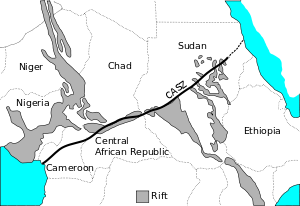
During the African Aqualithic much of the Sahara was wet and the waters systems along the African rift interconnected. It was possible to travel by small boats between the Nile and Lake Chad. This explains the common plant and animal species found in both water systems.


The gray areas on this map show the ancient water ways. The solid black line shows the rift line. Lake Chad is where the countries of Niger, Chad, Nigeria and Cameroon meet.


The map shows the African Sheer Zone.

From Noah's perspective in an ark floating on Lake Chad the waters would have appeared to cover all the ridges that would be visible in drier periods. This elevation data indicates the highest ridges visible to Noah would have had an elevation of about 1083 feet (330 meters). With higher water levels these ridges would have appeared to be submerged.


Friday, March 20, 2020

Hebrew Rulers from Cain to Jesus


"They are Israelites, and to them belong the sonship, the glory, the covenants, the giving of the law, the worship, and the promises. To them belong the patriarchs, and from their race, according to the flesh, is the Christ, who is God over all, blessed forever. Amen." (Rom. 9:4-5)


Alice C. Linsley

The Hebrew ruler-priests caste dispersed out of the Nile valley in the service of great kingdom builders such as Nimrod, a Kushite ruler (Gen.10) who established his territory in the Tigris-Euphrates region.

The movement of the Nilotic peoples out of Africa has been verified by DNA studies, linguistic studies and migration studies. Some Nilotic peoples left Africa around 70,000 years ago.


Y-DNA Haplogroup D


Another genetic trail out of Africa traces Y-DNA Haplogroup R with two subgroups: R1a and R1b.


Likely beginning of the R dispersion is c. 27,000 years ago.


This map from Clyde A. Winters' Study of Haplogroup R-M173 shows the spread of the Proto-Saharan peoples. Among them were Hebrew rulers such as Ham, Shem, and Japheth. The idea that these sons of Noah repopulated the earth after a catastrophic global flood is partially true. The human populations that were already scattered by 20,000 years ago survived many climatic changes. The descendants of Noah were dispersed mainly in the Fertile Cresent and the Ancient Near East.

The marriage and ascendancy pattern of the early Hebrew ruler-priests helped to drive their dispersion out of Africa. According to that pattern, the proper heir of the ruler took control of his father's territory, and other sons were sent away. Some sent-away sons such as Jacob went to serve in the territories of their maternal grandfathers. It was common for non-ascendant sons to serve their maternal uncles (avuncular residence).

These were among Jesus' ancestors: Adam and Eve, Cain, Seth, Noah, Nimrod and his Sumerian wife, Sheba the Elder, Nahor the Elder, Terah, Abraham and Sarah, Keturah, Jacob, Judah, Boaz and Ruth, Salmon and Rahab, and David. All these persons were Hebrew though they lived in different regions. Judaism did not yet exist.

Cain, a royal descendant of the historical Adam and Eve, is designated as one who has dominion, like Adam. In the context of Cain's late Neolithic culture his rule would have been seen as divine appointment. This may be why the biblical writer mentioned God's protection of Cain as he wanders away from his home.


Hathor amulet found at Hazor in Israel.


Divine appointment and protection of rulers was portrayed on ancient Nilotic monuments as divine overshadowing of the sun, the emblem of the Creator. This status pertained to rulers who were expected to enforce ancient moral codes. The solar orb resting in the horns of the celestial bull also represented the divine appointment of the woman who would conceive the son of God by overshadowing (cf. Luke 1:35). In the image above, Hathor, an archetype of the Virgin Mary, is overshadowed.

Among Abraham's Proto-Saharan ancestors, status and occupation were received from the father. As the "son" of Adam, Cain hold the status and occupation of a king ruling over a territory. Among the Proto-Saharan rulers, bloodline was traced through the mother (as even today among Jews). In claiming that Cain was the offspring of Eve, his bloodline is traced back to Eden. As a ruler of Eden, Cain's status in the Bible cannot be overlooked or denied.

If Adam is the first to rule on earth, then Cain is the second ruler. That the Bible grants Cain ruler status is evident from a study of what Cain symbolizes in Scripture. When Jude warns early followers of Jesus not to abandon Christ because of their sufferings, he uses three men as examples: Cain the ruler, Balaam the prophet, and Korah the priest. These were the three most sacred offices among Abraham’s people, and they sometimes were filled by people corrupted by the world.

Genesis 3-5 is about a specific group of rulers, the ancestors of the Horite Hebrew. Genesis 4 lists the kings descended from Cain by his cousin wife, the daughter of Enoch/Nok. Genesis 5 lists the kings descended from Seth by his cousin wife, another daughter of Enoch/Nok. These two ruler lines intermarried (endogamy) and because Abel apparently did not survive to the age of marriage, the clans of Cain and Seth appear to be a matrimonial moiety.

This is supported by the evidence of ancient texts in which the Sethites and Horites maintain separate shrines (mounds) as separate ritual groups yet one people serving the same God.

Utterance 308 of the Pyramid Texts addresses the Horites and Sethites as separate groups: "Hail to you, Horus in the Horite Mounds! Hail to you, Horus in the Sethite Mounds!"

Utterance 470 of the Pyramid Texts contrasts the Horite and Sethite mounds, designating the Horite mounds "the High Mounds."

The two groups are separate yet related, suggesting a moiety. The term "moiety" refers to two social or ritual groups into which a people is divided. The distinction between the two groups is evident in PT Utterance 424: "O King, a boon which the King grants, that you occupy the Mounds of Horus, that you travel about the Mounds of Seth..." Here we find a suggestion that the Horite Hebrew were named for their devotion to the son of God who the Nilotes called Horus (HR- Most High One). Among the Horites of Mesopotamia he was called Enki.

That both groups serve the same king is evident from PT Utterance 213: "O King, you have not departed dead, you have departed alive...The Mounds of Horus serve you, the Mounds of Seth serve you."

Utterance 424 of the Pyramid Texts continues, "that you [King] sit on your iron throne and judge their affairs at the head of the Great Ennead which is in On." Though separate, the Horites and the Sethites are judged by a common king.


The Historical Noah

The historical Noah emerges more clearly when we place him in the context of a Proto-Saharan ruler who lived approximately 5500 years ago when the Sahara experienced a wet period (African Humid Period). This is the period of the Old Kingdom, a time of great cultural and technological achievement in Egypt. The population of Egypt under the first dynasties was between 1 and 2 million inhabitants. Edward S. Ellis put the New Kingdom population at 5 million. The author of the Royal Ontario Museum website gives an estimate of between 1.5 and 5 million Egyptians during the Pyramid Age.

Noah was a descendant of the Proto-Saharan rulers named in Genesis 4 and 5. Likely, he ruled in the region of Bor-Nu (Land of Noah) near Lake Chad. This is the only place on Earth where the natives claim to live in Noah's homeland. This part of Africa was much wetter in Noah's time.

Proto-Saharan rulers kept menageries of exotic animals. These animals were greatly prized as they were brought from great distances and and were a source of amusement to the royal court. Likely the animals taken by Noah onto the ark were animals from his personal zoo.

The lords of the old world collected taxes on cargo that moved through the water systems of their territories. They used the interconnected lakes and rivers to expand their kingdoms and to spread their religious practices. The Kushite kingdom builder Nimrod is an example. His father Kush controlled a region of the Upper Nile. According to Genesis 10:8-12, Nimrod left the Nile Valley and built his kingdom along the Tigris in Mesopotamia. The language of his territory was Akkadian. In Akkadian the term for ruler-priest is Abru, from which the term Hebrew is derived.

Noah was the grandfather of Kush, so we should not be surprised to find him in Africa. Cain, Noah, Kush, Nimrod, Abraham, Moses, David are the ancestors of Mary's family and that she too was of the ruler-priest lineage was admitted even by those who hated her. In the Talmud it is said about Mary: “She who was the descendant of princes and governors played the harlot with carpenters.” (Sanhedrin 106a)


The Sons and Descendants of Noah

The sons of Noah continued the matrimonial moiety. The lines of Ham and Shem intermarried. Their descendants were great rulers also. One of the greatest was Nimrod, a Kushite kingdom builder, whose territory in the Tigris-Euphrates Valley was extensive. Abraham is a descendant of these early Hebrew rulers. Their ruler-priest caste was called abrutu in Akkadian, the language of Nimrod's territory in Mesopotamia. They represent the oldest known order of priests and Jesus Christ is a descendant of these ruler-priests who were committed to building kingdoms. Their earthly kingdoms rose and fell, but the kingdom of the Christ is an eternal kingdom. His dominion lasts forever.