Followers

Showing posts with label marriage and ascendancy pattern. Show all posts

Sunday, February 11, 2024

Understanding "Biblical" Marriage Practices


Dr. Alice C. Linsley


This recently came across my Facebook feed. It is misleading and reveals ignorance of the social structure of the biblical Hebrew and their Jewish descendants.


The Hebrew persons listed in Genesis 4, 5, 10, 11, 25 and 36 were rulers, not commoners. These are king lists similar to the Sumerian king lists, only more easily authenticated using kinship analysis.

None of the marriages of the Hebrew rulers can be called "biblical" and therefore cited as models for Bible believers because this pattern pertains only to Hebrew ruler-priests, the "first lords of the earth". It is not a biblical pattern for marriage. It is a pattern for royal Hebrew persons beginning long before Judaism emerged. These were regnal marriages involving a bride and a groom from related Hebrew clans or between half-siblings (endogamy). Royal marriages are prone to irregularities because of the necessity of a proper heir, and political complexities.

That these were rulers is evident in the fact that they had a distinctive marriage and ascendancy pattern that involved two wives. The firstborn sons of the two wives had different rights according to the Hebrew hierarchy of sons. 

Jacob's marriage to two "sisters" is the single example in the Bible, and it is more likely that Leah was his half-sister and Rachel is cousin. A proper marriage arrangement of a Hebrew ruler-priest was with a half-sister (as was Sarah to Abraham) and with a patrilineal cousin (as was Keturah to Abraham). Leah and Rachel fit the pattern. Jacob was a sent-away son, and those sons usually went to live with their maternal uncles.

Solomon is criticized for taking many wives and concubines in order to forge political alliances. However, that was a common practice, and his father David did it also.

The payment of dowries was a widespread practice among the many diverse biblical populations. It is still the custom in Africa and among Hindu and Muslim populations. Dowries are not to "purchase" a bride. They are gifts given to the bride by her family to secure some personal wealth for her when she marries. The bride and her dowry contribute to the building up of a new household.

Levirate marriage was a custom among the Hebrew and their Jewish descendants. Levirate marriage is an extremely ancient practice in which the widow of the deceased brother marries one of his brothers. Levirate marriage is practiced by societies with strong clan and caste structures in which exogamous marriage is forbidden. Such a marriage arrangement is intended to preserve the deceased husband's lineage and inheritance. 

Hebrew rulers over territories maintained their two wives in geographically separate settlements. Territorial boundaries were marked by the wives' settlements. Sarah's settlement was in Hebron and Keturah's settlement was in Beersheba. Abraham's territory extended on a north-south axis between the settlements of his wives. 

Hebrew rulers with two wives include Lamech, Terah, Abraham, Esau, Jacob, Amram, Moses, Elkanah (Samuel's father), Ashur (1 Chronicles 4:5), Mered (1 Chronicles 4); and Joash (2 Chronicles 24:1–3). Caleb fathered children by his two wives Azubah and Jerioth.


Wednesday, February 2, 2022

The Hebrew Hierarchy of Sons


Alice C. Linsley


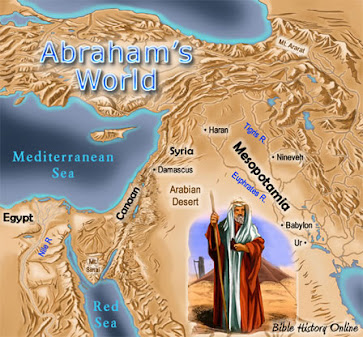
The kinship structure of the early Hebrew ruler-priests indicates a hierarchy based on genetic distance. The ruler's proper heir is the offspring of siblings who had the same father but different mothers. (See Hebrew Ruler's with Two Wives.) Isaac was Abraham's proper heir as Sarah was Abraham's half-sister. Their father was Terah and their other siblings were Haran who died in Ur, and Nahor, Terah's first-born son by his sister bride and his proper heir. After Terah died in Haran (see map), Nahor ruled over Terah's territory in Aram. It was to that territory that Abraham's servant went to fetch a cousin bride for Isaac.


If Isaac adhered to the marriage and ascendancy pattern of his forebearers, Rebecca would have been his second wife. His first wife would have been a half-sister, a daughter born to Abraham and Keturah. That first wife would have been living in the Negev which is where Isaac was living before he married Rebecca. 


Abraham became a sent-away son who eventually established himself in a territory that extended between Hebron and Beersheba. Isaac became the ruler over Abraham's territory and was a wealthy man.


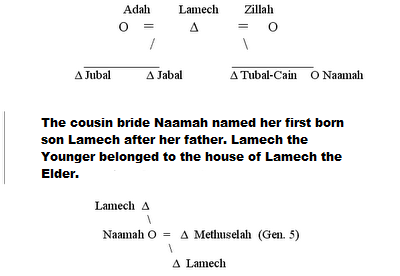
The next highest in rank is the first-born son of the cousin wife. This was probably Joktan/Jokshan, Abraham's first-born son by his cousin wife Keturah (Gen. 25). This son belonged to the household of his maternal grandfather. This first-born son often has the name of his maternal grandfather. This explains why two men separated by one generation have the same name. This is evident in the diagram of two rulers named Lamech. 


Lamech the Elder had two wives. His daughter Naamah (Gen. 4) married her cousin Methuselah and named their first-born son Lamech, after her father (Gen. 5). This is called the cousin-bride's naming prerogative.


The first-born sons of concubines posed the potential for territorial expansion of the Hebrew. These sent-away sons drove the expansion of the Hebrew into many parts of the Ancient Near East and Southern Europe. Before he died, Abraham gave gifts/grants to the sons of his concubines and sent them away from Isaac (Gen. 25:6).


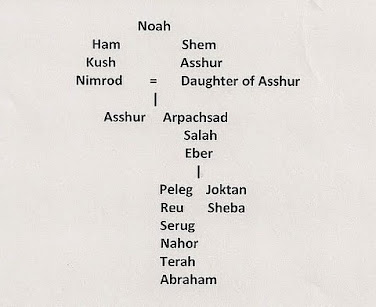
The dispersion of the Hebrew rulers began long before the time of Terah, however. Genesis 10 explains that Nimrod, a son of Kush, left the Nile Valley and established his territory in Mesopotamia which is where we meet Abraham nine generations later. 


It appears that Eber divided his territory between two sons. Perhaps Peleg and Joktan were twins.


Analysis of the kinship pattern of the early Hebrew rulers indicates segmentary lineages. The first loyalty is to the lineage of father and his principal (half-sister) wife and their son, the heir. The second loyalty is to the father and his second (cousin) wife and their son who belongs to the household of his maternal grandfather. The third loyalty is to the household and clan of the cousin.


A Bedouin proverb summarizes the philosophy behind segmentary lineages:

I against my brother
I and my brother against my cousin
I, my brother, and my cousin against the world


Related reading: Royal Sons and Their Maternal Uncles; Sent-Away Sons; The Marriage and Ascendancy Pattern of Abraham's People; Isaac's Wealth; Hebrew Rulers with Two wives


Tuesday, January 30, 2018

The Proto-Saharan Rulers Cain and Seth


Alice C. Linsley


The social structure of the biblical Hebrew is explored in detail in a 7-part series. The first in the series is here.

In this post, we investigate the earliest Proto-Saharan rulers named in Genesis. These rulers had two wives, as did their descendants Terah, Abraham, Jacob, Amram, Moses, and Samuel's father, Elkanah.

© 2010 Alice C. Linsley
Segment I: The Half-Sister Bride and the ruler Enoch/Enosh/Enos

The ruler first bride was his half sister, as Sarah was to Abraham. The half-sister’s first-born son rules in place of his father. Thus Isaac was Abraham's proper heir and ruled over Abraham's territory in Edom. Likewise, Enoch ruled over the territory of his father Seth.


        Enoch  ∆  =  O  Half-sister bride
___|___
                        Kain   ∆         O  =   ∆   Seth   Gen. 5
                     |
                                                                 ∆  Enosh/Enoch the Younger


Segment II: The Cousin Bride’s Naming Prerogative and the ruler Seth/Seti

The ruler's second wife, taken later in life, was a patrilineal cousin bride. The cousin bride’s first-born son became a high official (vizier) in the kingdom of his maternal grandfather. So Seth was a ruler-priest in the territory of Seth the Elder, a Proto-Saharan Nilote. 

These ancestors are often called "Kushites," though the name Kush/Cush does not appear in the Genesis King Lists until Genesis 10:6-9, where we are told that one of Cush's sons was Nimrod, a Kushite kingdom builder in Mesopotamia.


    Seth/Seti, the Elder
 ∆
 |
                                       O  =   ∆  Enoch the Elder
                            |                                      
                          Seth the Younger  ∆   Gen. 5                                    


The pattern is evidence in this diagram. Lamech the Elder (Gen. 4) has a grandson named Lamech. Lamech the Younger is listed in Genesis 5 as the son of Methusaleh by his cousin bride, Naamah.


The Kushite movement out of Africa has been verified by genetic studies. Research verifying the Genesis record of Kushite migration from Africa into Eurasia can be found here: http://maxwellsci.com/print/crjbs/v2-294-299.pdf

Current Research Journal of Biological Sciences 2(5): 294-299, 2010
ISSN: 2041-0778© Maxwell Scientific Organization, 2010

The Kushite Spread of Haplogroup R1*-M173 from Africa to Eurasia
Clyde A. Winters, Ph.D

The marriage and ascendancy pattern of these early Proto-Saharan rulers drove their movement out of Africa. As the younger son of Kush, Nimrod was probably a "sent away son" who was expected to establish a kingdom of his own. Kingdom building brought honor to their fathers and extended their influence, including the spread of their religious beliefs and practices.

In Genesis 25:1-7 we read that Abraham gave gifts to all his sons and sent them away from Isaac who became the ruler over Abraham's territory in Edom. 

Likewise, Kush gave gifts to Nimrod and sent him away from his older brother Ramah who ruled a Kushite territory. (Ramah, between Bethel and Jerusalem, is also the name of Samuel's hometown.)

The sent-away sons named in the Bible faced struggle and hardship, but ultimately they prospered with God's help. Nimrod’s territory extended the length of the Tigris-Euphrates Valley, and within this territory the principal cities of Erech and Akkad (Gen.10:10) became famous urban centers. The script used in Nimrod’s kingdom was “Akkadian” and it preserves many of the roots and phonemes found in the Nilo-Saharan languages.

In Nigerian lore, Nimrod is known as Sharru-Kin which means “the righteous king.” Nimrod's Akkadian name was Šarru-kīnu, which is usually translated “the true king.”