Followers

Showing posts with label early Hebrew. Show all posts

Wednesday, April 16, 2025

The Archetypal Eve


Creation of Eve, marble relief by Lorenzo Maitani on the Orvieto Cathedral, Italy.


Dr. Alice C. Linsley


To understand the Messianic or Christological Faith that we received from the biblical Hebrew we must distinguish two different threads concerning Eve: the archetypal Eve and the historical Eve. Much theological speculation surrounds the archetype of the woman beguiled by the Serpent, and too little attention is given to the historical Eve, the mother of Cain, a Hebrew city builder.

Theological approaches do not distinguish the historical Eve from the archetypal Eve. On the other hand, an anthropological approach identifies significant data that helps to identify Eve as one of the founders of the Hebrew ruler-priest caste. Because the earliest known Hebrew presence is in the Nile Valley, it helps to consider what Eve represented to her Nilotic Hebrew descendants.

It is evident that the early Hebrew believed in a hierarchical order of creation. God is outside and above that hierarchy. At the pinnacle of the created order are humans, created male and female. Other created beings exist as servants and messengers of the High God. These lesser spirits or angelic beings are venerated but not worshiped. This devotion to a Supreme God while accepting the existence of other lesser divine beings is called “henotheism.” The term was coined by Max Müller (1823-1900) who specialized in Oriental religions. He applied the term to the schools of Hinduism that acknowledge a High God as well as other lesser deities.

In Traditional African religions (TAR) and in the biblical view, God is intimately involved in the affairs of humans as a devoted father. Humans are to their Creator what children are to their biological parents.

The late Dr. Abraham Akrong (McCormick Theological Seminary) explains: "God in Africa is a relational being who is known through various levels of relationship with creation. In relationship to humanity, God is the great ancestor of the human race. Therefore, all over Africa God is portrayed more in terms of a parent than as sovereign."

C. L. Crouch made this observation about the relationship of humans to our Creator. He wrote, "The linguistic and cultural background of the words םלצ [image] and תומד [likeness] supports a reading of Gen. 1:26–7 as a statement of humanity’s divine parentage. As such it is intended to evoke the responsibilities of child to parent and of parent to child in the minds of its readers. Such an interpretation accommodates both the semantic range of the key terms םלצ and תומד and the sense that the statement is meant to be theologically significant."

This clarifies the early Hebrew conception of Eve who disobeyed the command of the Father and succumbed to the temptation of the Serpent. By heeding the Serpent’s voice, the archetypal Eve set aside her moral obligation to her Heavenly Father. Those who wish to be conformed to the image and likeness of the Father must be like Jesus whose priority was always to please his Father. That is summed up in the first and great commandment: “Thou shalt love the Lord thy God with all thy heart, and with all thy soul, and with all thy mind.” (Matt. 22:37-39)

In the early Hebrew conception of the order of creation humans are at the pinnacle over which the Creator rules as a loving Father. As the last of God’s creations, Eve is the crown of the created order. As such, she is the prime target of the Serpent who wishes to invert the pyramid, placing himself at the pinnacle. That is the closest the Serpent can get to the level of God since the archetypal Serpent (the Devil) is also a creature.

Eve’s submission to the belly-crawler exchanged her exalted position for the serpent's dust and surrendered her glory for a baser image. In submitting to the serpent's will, the pyramid of God’s design was inverted. The serpent now reigns over the fallen world. This is why Satan is called “the prince of this world” in John 12:31.

In the scheme of redemption, a daughter of Eve is appointed to bring forth the Son of God. In this sense, the Bible is the Woman’s story; beginning with Eve’s failure and climaxing with the Woman who brings forth the Son of God who crushes the Serpent’s head (Gen. 3:15). This is the theological thrust from Genesis to Revelation and it involves historical people. The narrative suggests that women were held in higher regard by the early Hebrew than is generally recognized. Certainly, women play a significant role in God’s plan of salvation.

The archetypal Eve is wrapped in theological speculation about the origin of sin and death, the presence of evil, and the necessity of divine intervention. Theological speculation rarely connects to historical realities. However, considerable data is available to gain an accurate picture of the historical Eve. She was the Hebrew mother of at least one surviving son, Cain. Cain had a brother, Seth, who may have been the firstborn of Adam’s second wife (assuming that Adam observed the marriage and ascendancy pattern of the biblical Hebrew). Both Cain and Seth were clan chiefs and rulers over territories. Their descendants intermarried (caste endogamy) according to a marriage pattern that was already well established. Their heirs ascended to positions of authority. They established settlements, built fortifications, navigated rivers, patronized skilled craftsmen, engaged in commerce, observed and recorded celestial patterns, pioneered medical treatments, and enforced sacred law. 

The biblical data makes it clear that Eve and her Hebrew people were not the first humans on earth. As far as the material evidence goes, the first humans lived in Africa between three and four million years ago.


Friday, August 30, 2024

Five Features of the Hebrew Social Structure


Dr. Alice C. Linsley


The application of kinship analysis has proven extremely useful in identifying the following features of the social structure of the biblical Hebrew.

1. The Hebrew ruler-priests were a caste. The most significant feature of a caste is the practice of taking marriage partners only from members of the caste (caste endogamy).

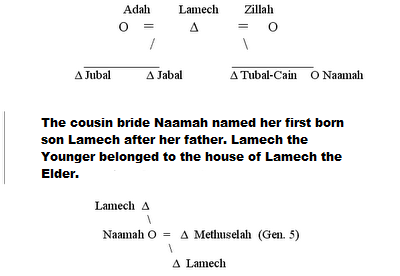
2. The Hebrew caste is characterized by cognatic double descent or bilateral descent. (See diagram above.) The individual’s descent is traced through both the father’s line and the mother’s line. With bilateral descent, there is a doubling of ancestors. Lamech the Younger could claim descent from both Cain and Seth since his father and mother had Cain and Seth as common ancestors. Nimrod could claim descent from both Ham and Shem and their wives since the descendants of Ham and Shem intermarried.

Tamar’s two sons Zerah (the firstborn) and Perez and their wives were the principal cognatic ancestors of the people of Judah. Judah was Hebrew, not Jewish, because Judaism did not exist in the time of Judah. Jesus is a descendant of Tamar and Judah. The wives of Zerah and Perez are the principal female ancestors of the people of Judah. This story is told in Genesis 38 and the cognatic feature is reintroduced in Ruth 4 where we are told that these men and women are associated with Bethlehem, an ancient Horite Hebrew settlement.

Descent from Hebrew cousin wives can be traced for especially high-ranking Hebrew by the cousin bride's naming prerogative. The diagram shows the pattern. Lamech the Elder's daughter Naamah (Gen. 4) married her cousin Methusaleh (Gen. 5) and named their firstborn son Lamech after her father.


The firstborn son of the cousin wife was not the proper heir of his biological father. Methuselah's proper heir was the firstborn son of his first wife, probably a half-sister, as was Sarah to Abraham.


3. In the Hebrew cognatic double descent system, caste members receive some rights and obligations from the father’s side and some from the mother’s side. Those rights and responsibilities depend on the parent’s status and the order of marriage. The rights and responsibilities of the firstborn son of the first wife (usually a half-sister) are different than those of the firstborn son of the second wife (usually a cousin).

4. Hebrew men who ruled over territories maintained two wives in separate settlements. These settlements marked the boundaries of the ruler’s territory. The wives’ settlements were usually on a north-south axis. The settlements were guarded by warriors. The wives of high-ranking Hebrew ruler-priests were served by handmaids, metal workers, potters, shepherds, weavers, brewers, and farmers.

5. Only males offered blood sacrifice at the altars. Women were not permitted in the area where animals were sacrificed. Likewise, men were not permitted in the birthing chambers where women shed blood in childbirth. These distinct types of blood work speak of death and life and the two were never to be confused. Therefore, the blood work of the Hebrew priests and the blood work of the Hebrew women never shared the same space.

Because the Hebrew caste resisted innovations, their customs persisted among Abraham’s numerous Hebrew descendants. Some of Abraham’s ancestors lived in the Nile Valley, some lived in Canaan, and others lived in Mesopotamia and Anatolia. That is why it is possible to speak of Kushite Hebrew, Canaanite Hebrew, and Anatolian Hebrew.

Jacob and Esau were both Hebrew rulers as they were members of the Hebrew ruler-priests caste. A trait of castes is endogamy, the custom of marrying only members of the caste or blood relatives. Jacob and Esau married Hebrew women, including women of the clan of Seir the Horite Hebrew (Gen. 36), and women of the clan of Nahor the Younger of Padan-Aram ("Plain of Aram") otherwise known as Aram-naharaim ("Aram of the two rivers"). The town of Haran was there. The word Haran is derived from the Ancient Akkadian word harranū, meaning "road" or "caravan route." That is where Abraham’s father died and Nahor, Abraham’s older brother, assumed rule of Terah’s household and territory.

One of Esau's wives was the daughter of the Hittite Hebrew ruler, Elon. The Hittites were descendants of Heth, a Hebrew ruler listed in Genesis 10:15. Some of his descendants lived in Hebron (Gen. 23:3,7) which was in Abraham's territory.


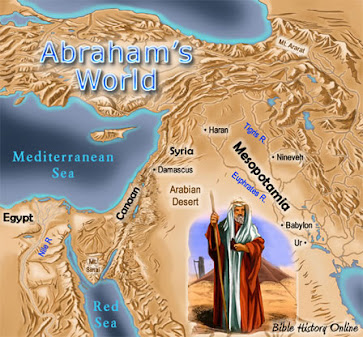
Abraham's territory extended between the settlements of his wives in Hebron and Beersheba Shown on the map). Both settlements were in ancient Edom (Greek: Idumea). The place names Edom and Idumea refer to a land of red people. Some of Abaham’s descendants are described as "red" or "ruddy "in the Bible.

After David became king, he brought the Ark "from the house of Abinadab, that was in Gibeah” (Saul's hometown) to Jerusalem (2 Sam. 6:1-12). However, for three months the Ark rested in David’s hometown of Bethlehem on the property of Obed-Edom.

Genesis 36:31 states that there were kings in Edom long before there was a king in Israel. This suggests the antiquity of David's royal lineage. That lineage is traced back to Abraham whose territory was entirely in ancient Edom.


Saturday, May 11, 2024

The Hebrew Rulers of Genesis


Naamah named her firstborn son Lamech after her father, Lamech the Elder (Gen. 4). Lamech the Younger was one of Methuselah's sons (Gen. 5). 


According to the Bible scholar Umberto Cassuto, the name "Lamech" is related to the Akkadian word lumakku, meaning “priest” (Commentary on Genesis, Vol. 1, p. 233). Further, Lamech is related to the Akkadian word malku (ruler-priest). It also is related to the Hebrew word melek, meaning “king”. 


Dr. Alice C. Linsley

The men listed in the Genesis “begats” were of high social standing in the ancient world. They were rulers, priests, and kingdom builders. Their successors ruled according to a long-established ascendancy pattern. Having an heir was extremely important, and two wives increased the likelihood of having a male heir. The Hebrew rulers who controlled territories maintained two wives in separate settlements usually on a north-south axis.

The marriages of the Hebrew rulers cannot be considered "biblical" and cited as models for Bible believers today. The Hebrew marriage pattern pertains to kingdom builders long before Judaism emerged. These were regnal marriages involving a bride and a groom from related Hebrew clans or between half-siblings. Royal marriages are not like the marriages of commoners because of political complexities and the need for an undisputed heir. Further, the kingdom to which Christians are committed is the Kingdom of Christ our God.

The firstborn sons of the two wives had different rights according to the Hebrew hierarchy of sons. The firstborn son of the first wife was the proper heir to his father’s holdings. The firstborn son of the second wife (usually a cousin) was to serve in the territory of his maternal grandfather.

The two-wife pattern pertained to rulers only, not to lower status Hebrew men. Two wives helped to "build up the house" of the ruler and strengthened the house of the cousin bride's father. The firstborn son of the first wife (usually a half-sister) ascended to rule in place of his father, and the firstborn son of the second wife (usually a patrilineal cousin) became a high official in the service of his maternal grandfather.


The early Hebrew regarded territorial expansion and many children as a sign of the Creator’s blessing upon them. This is evident in Abraham’s petition before God concerning his need for a proper heir (Gen. 15) to rule over his territory in ancient Edom. That territory extended between the settlements of his two wives, Sarah in Hebron and Keturah in Beersheba. Both locations are shown on the map above. 

Friday, November 11, 2022

Abraham's Proper Heir


Dr. Alice C. Linsley


The Hebrew inheritance laws are complex because high-ranking rulers such as Abraham had two first-born sons. Abraham's first-borns sons were Joktan (born of Keturah, Gen. 25) and Ishmael, but neither of these sons were Abraham's proper heir. 

Among the early Hebrew the proper heir was the first-born son of the first wife, usually a half-sister, as was Sarah to Abraham (Gen. 20:12). This explains the deep sorrow of Abraham and Sarah that she was unable to bear children. It also sheds light on the story of Hagar and Ishmael’s banishment. Having provided a proper heir for Abraham after years of barrenness, Sarah became angry when she thought that Abraham’s love for both Ishmael and Isaac might lead him to divide his territory between them, as Eber did for his sons Peleg and Joktan.

Genesis 10:25 reports: “To Eber were born two sons: the first was called Peleg, because it was in his time that the earth [eretz] was divided, and his brother was called Joktan.”

The word eretz has multiple meanings: earth, land, soil, and territory. Since this passage deals with royal sons, the most appropriate word choice in this context is “territory”. It the appears that Eber divided his territory into two, assigning separate regions to each royal son. Peleg ruled over one territory and Joktan over the other. Abraham was a descendant of Peleg, and his half-brother Haran likely was a descendant of Joktan.


The clan of Jacob (Israel) went into Egypt, but they were not the only Hebrew clan. Clearly, some Hebrew were never in Egypt. The story of the Exodus does not apply to them. It is also likely that some Hebrew people remained in Egypt as they had deep roots in the Nile Valley.


In the Hebrew social structure, provision was made for the sons of high-ranking rulers to receive an inheritance, and grants were made to the sons of concubines. The value of the grants likely depended on the dowery of high-status concubines and on the generosity of the patriarch. Grants included land, servants, herds, camels, linen, leather goods, and articles of gold, copper, silver, and bronze.

However, only one son could assume control over the territory of his father and that was the first-born son of the principal wife. In Abraham's case, that was Isaac. He received the bulk of Abraham's wealth and assumed control over Abraham's territory which extended between Hebron and Beersheba. Abraham’s other sons received gifts and were sent away from Isaac (Gen. 25:6). The gifts helped the sent-away sons to become established in their own territories. This practice preserved Abraham’s territory intact and led to the wide dispersion of the Hebrew ruler-priests even before Abraham's time.

The Hebrew practice of endogamy played a role in amassing and preserving wealth. Their distinctive marriage and ascendancy pattern allowed for a smooth transition of power among the ruler-priests. It also made it possible to keep territories intact and to preserve wealth. Wealth among the early Hebrew involved herds, servants, gold, copper, and water resources. Some Hebrew controlled commerce on the rivers and major water systems. This provided income from cargo taxes. A major trade route between Egypt and Mesopotamia ran through part of Abraham’s territory and this likely provided him with a source of income. He also held the water rights to wells he dug in Gerar (Gen. 26:15).

It is evident from the biblical data that Abraham's clan observed an ancient code or tradition that pertained to rights of inheritance. His authority was attached to the ruler-priest caste into which he was born and was reinforced by his observation of this code. The early Hebrew believed that the tradition received from their ancestors was not to be changed. They preserved their religion heritage, ethnic identity, and wealth by marrying exclusively within their caste (endogamy).


Wednesday, June 22, 2022

Terah's Two Wives


Dr. Alice C. Linsley


Abraham's father was Terah. Terah is an ancient word meaning "priest" among the Nilotic Hebrew. Terah was a descendant of Nimrod, a Kushite kingdom builder.

The tile above shows a Tera (priest) of the Sethite Hebrew (a moiety) who served at a temple in a city of the Anu. The Tera-neter tile was found by British Egyptologist W.M. Flinders Petrie (1853-1942) in the early temple at Abydos underneath the dynastic temple. 

The figure has the drooped chin of the same type seen in the ivory king from Abydos, and the Scorpion king of Nekhen, the oldest known site of Horite Hebrew worship.

Keeping with the custom of his Hebrew ancestors, the ruler-priest Terah had two wives. One wife was the mother of Nahor and Abraham, and the second wife was the mother of Haran and Sarah. Nahor was Terah's proper heir. Abraham was a sent-away son. Haran's mother was a cousin bride as is evident by the cousin bride's naming prerogative. She named her first-born son Haran after her father, the chief of Haran, shown on this map. 


Haran is shown on this map.

The first-born son of the cousin bride was not his father's proper heir. He was to serve as a high official in the territory of his maternal grandfather after whom he was named. Haran's death in Ur suggests that he was not yet serving in that capacity. Haran probably died at a fairly young age. He had only one son, Lot.

Terah's proper heir was Nahor, the first-born of his principal wife who was a half sister. They had the same father but different mothers. This was also the case with Abraham and Sarah (Gen. 20:12).

Terah took Abraham, Sarah, and Lot from Ur to Haran where Terah died. Nahor assumed control of Terah's considerable holdings in the territory designated as Paddan-Aram on this map.


Paddan Aram designates the region of Harran in upper Mesopotamia. "Paddan Aram" and "Haran" relate to the Akkadian words paddanū and harranū meaning "road" or "caravan route." This gives a sense of the prosperity enjoyed by Nahor who, as regional chief, would have controlled commerce in and through his territory.

Nahor's high status is also indicated by his Horus title. Na'Hor is a Horus title that ran in the family. Terah's father was Na'Hor also. In Akkadian, "na" is a modal prefix indicating service to, affirmation, or affiliation. The name Na'Hor would indicate a servant of HR (Horus), further evidence that Terah and his sons were Horite Hebrew rulers.

After Nahor assumed control of their father's territory, Abraham received gifts and was sent away from Paddan-Aram. This constituted his call by which God would establish him in a territory of his own. Abraham adhered to the same custom. Before he died, he gave gifts to the sons of his concubines and sent them away from Isaac his heir (Gen. 25:6).

Abraham speaks of Paddan-Aram as his "own country" in Genesis 24:4. He sent his servant there to fetch a cousin bride for his heir Isaac. If Isaac upheld the marriage and ascendancy pattern of his Hebrew ancestors, she would have been a cousin bride. Rebekah was indeed his patrilineal cousin.

Wednesday, February 2, 2022

The Hebrew Hierarchy of Sons


Alice C. Linsley


The kinship structure of the early Hebrew ruler-priests indicates a hierarchy based on genetic distance. The ruler's proper heir is the offspring of siblings who had the same father but different mothers. (See Hebrew Ruler's with Two Wives.) Isaac was Abraham's proper heir as Sarah was Abraham's half-sister. Their father was Terah and their other siblings were Haran who died in Ur, and Nahor, Terah's first-born son by his sister bride and his proper heir. After Terah died in Haran (see map), Nahor ruled over Terah's territory in Aram. It was to that territory that Abraham's servant went to fetch a cousin bride for Isaac.


If Isaac adhered to the marriage and ascendancy pattern of his forebearers, Rebecca would have been his second wife. His first wife would have been a half-sister, a daughter born to Abraham and Keturah. That first wife would have been living in the Negev which is where Isaac was living before he married Rebecca. 


Abraham became a sent-away son who eventually established himself in a territory that extended between Hebron and Beersheba. Isaac became the ruler over Abraham's territory and was a wealthy man.


The next highest in rank is the first-born son of the cousin wife. This was probably Joktan/Jokshan, Abraham's first-born son by his cousin wife Keturah (Gen. 25). This son belonged to the household of his maternal grandfather. This first-born son often has the name of his maternal grandfather. This explains why two men separated by one generation have the same name. This is evident in the diagram of two rulers named Lamech. 


Lamech the Elder had two wives. His daughter Naamah (Gen. 4) married her cousin Methuselah and named their first-born son Lamech, after her father (Gen. 5). This is called the cousin-bride's naming prerogative.


The first-born sons of concubines posed the potential for territorial expansion of the Hebrew. These sent-away sons drove the expansion of the Hebrew into many parts of the Ancient Near East and Southern Europe. Before he died, Abraham gave gifts/grants to the sons of his concubines and sent them away from Isaac (Gen. 25:6).


The dispersion of the Hebrew rulers began long before the time of Terah, however. Genesis 10 explains that Nimrod, a son of Kush, left the Nile Valley and established his territory in Mesopotamia which is where we meet Abraham nine generations later. 


It appears that Eber divided his territory between two sons. Perhaps Peleg and Joktan were twins.


Analysis of the kinship pattern of the early Hebrew rulers indicates segmentary lineages. The first loyalty is to the lineage of father and his principal (half-sister) wife and their son, the heir. The second loyalty is to the father and his second (cousin) wife and their son who belongs to the household of his maternal grandfather. The third loyalty is to the household and clan of the cousin.


A Bedouin proverb summarizes the philosophy behind segmentary lineages:

I against my brother
I and my brother against my cousin
I, my brother, and my cousin against the world


Related reading: Royal Sons and Their Maternal Uncles; Sent-Away Sons; The Marriage and Ascendancy Pattern of Abraham's People; Isaac's Wealth; Hebrew Rulers with Two wives


Sunday, September 3, 2017

Abraham's Authority and Ancient Law Codes


Tera-neter, priest of the Nilotic Annu, pre-dynastic inhabitants of the Nile River Valley. 
Abraham’s father, Terah, bears this title. Tera/Terah means priest. 


Alice C. Linsley

Abraham was a Hebrew, the sent-away son of his father Tera. The Hebrew practice of sending away non-ascendant sons drove the Hebrew dispersion into many regions of the ancient world. Other Hebrew sent-away sons include Cain, Nimrod, Jacob, and Joseph, Jacob's firstborn son by his cousin wife. Proper heirs, such as Abraham's older brother Nahor, and Abraham's son Isaac, received the territories of their fathers. Sent-away sons were to establish themselves in territories away from the ascendant sons.

Abraham's power as a ruler extended over his territory. His realm extended on a north-south axis between Hebron and Beersheba and on an east-west axis between Engedi and Gerar (see map below). Abraham's authority and exercise of power was based on loyalty between the Hebrew clans and the mutual support of the separate households of his wives, Sarah and Keturah. Both of the wives' households had warriors, servants, craftsmen, and herdsmen.

Abraham's territory was in the land of Edom (Greek: Idumea, meaning "land of red people"). Jacob separated the households of his wives when we approached Edom, fearing that his brother Esau might attack. Esau was Isaac's proper heir.


In Abraham's time, Edom was under the high king of Egypt. Abraham was of sufficiently high rank that he was recognized by the Egyptian king. Abraham's personal audience with him testifies to Abraham's adherence to a purity code that was consistent with that of the Egyptian high king, who was regarded as a "son" of God on earth.

It is evident from the biblical data that Abraham's Hebrew clan observed an ancient moral code that pertained to ritual purity, dietary laws, water rights, rights of inheritance, endogamous marriage, and animal sacrifice. Abraham's authority pertained to the Hebrew ruler-priest caste into which he was born and was reinforced by his adherence to the moral code of his Hebrew people.

By Abraham's time (c.2000 BC), the Hebrew priests were already widely dispersed in the service of rulers. This is why we find common religious practices among the related R1b peoples. An example is the belief that God can release a people from their debt. In the Hurrian/Horite Song of Debt Release, the High God instructs the ruler to release the people of Ebla from their debt.

"If you take a debt release in Ebla, I will exalt your weapons. Your weapons will begin to conquer your enemies. Your plowed land will prosper in glory. But if you do not make a debt release for Ebla, the city of the throne, in the space of seven days, I will come upon you. I will destroy Ebla, the city of the throne. I will make it like a city that never existed. I will break the surrounding wall of Ebla's city like a cup. I will knock flat the surrounding wall of the upper city like a garbage dump..."

Social controls function at many levels. Written law codes governed the kingdoms that arose before and after Abraham's time. These codes reflect the layered fabric of ancient societies. They incorporate folk traditions, regional practices, and controls based on kinship, and the notion of the deification of the ruler.

Among the early Hebrew, the tradition received from their ancestors was not to be changed. It was regarded as immutable and was to be passed unchanged from generation to generation. The moral codes that would have been familiar to Abraham included the Law of Tehut and the negatively worded Code of Ani (c.2500 BC). Both codes reflect the religious context of Abraham's Nilotic ancestors. He also would have been familiar with the Mesopotamian codes which differ little from those of the Nilotic rulers.


Written Codes

At the royal sun cities there were Hebrew ruler-priests with the authority to enforce the moral code on behalf of the king they served.

Moral codes were written on stone and oven-baked clay tablets. They were also inscribed on papyrus. These ancient codes appealed to the highest authority for their validity. They were to be considered the "law" of the Supreme God who appointed rulers on earth by divine overshadowing.

The Code of Hammurabi was engraved on a stele more than 7 feet high. An image of King Hammurabi appears at the top of the stone, standing reverently before the seated Shamash, the god of justice. Shamash is shown dictating the law to his earthly representative.

These royal documents typically had colophons. Colophons are statements at the end of the document that identify the source and purpose of the document. Thus, the Code of Hammurabi closes with the statement, "The righteous laws which Hammurapi, the wise king, has established . . .." Similarly, Leviticus closes with this statement: “These are the commandments which YHWH commanded Moses for the children of Israel . . ." and the colophon of Numbers states: “These are the commandments and the ordinances which YHWH commanded by the hand of Moses unto the children of Israel . . ." (36:13)

Percy J. Wiseman (1888-1948) observed that the colophon coming at the end serves two purposes: it is a title page and a marker to connect one tablet to the next narrative in a sequence. Wiseman’s theory of the composition of Genesis is presented in his book, New Discoveries in Babylonia about Genesis (1936). The book has undergone several editions, and the most recent appeared with the title Ancient Records and the Structure of Genesis (Thomas Nelson, 1985), and was edited by Wiseman’s son, Donald J. Wiseman (University of London). There is merit to Wiseman's theory, and I recommend the book. He concludes that Moses is the central figure around whom the Genesis material came together. I agree, in as much as that is what the Deuteronomist Historian (700-300 BC) intended in the final redaction of Genesis.

Following Wiseman’s method of comparing ancient Near Eastern texts, I would expand our sights to include the ancient Hindu or Vedic literature, which also employed colophons and told of the founders of the world in a similar manner. It appears that portions of these texts and the ancient Near Eastern texts share a common Nilotic cultural milieu. The interaction of peoples from the regions shown on this map is evident in artifacts and written communication. Mesopotamian cuneiform was understood in Egypt and Canaan, as testified by the Akkadian Tell el-Amarna letters (c.1400-1353 BC).

One of Wiseman’s most interesting observations is the stylistic change in the sequence after the colophon of Tablet VI which is "the history of Terah" (11:27a). The colophon appears to end the previous section but does not connect to what follows. At this point the Deuteronomist Historian wants to take the narrative in a direction that neglects Terah as a great patriarch of the Hebrew clans of Abraham, Nahor, Lot, and their descendants, the Hebrew of Moab, the Hebrew of Midian, and the Hebrew of Canaan. 

Related reading: The Hebrew Hierarchy of Sons; Hebrew Sent-Away Sons; Akkadian Lexicon; Hebrew Ruler-Priests at the Ancient Sun Cities; The Law of Tehut, Ancient Moral Codes; Fundamentalism and Syncretism in Hebrew History; Competition Between the Horites and the Sethites


Sunday, December 21, 2014

When is the Evidence Sufficient?


Dr. Alice C. Linsley

I recently had a conversation with a man named Toshio who wanted to know how I came to the conclusion that Abraham was a descendant of Nimrod. He was not satisfied by my answers.

Toshio wants me to show him where in the Bible it says that Abraham is a descendant of Nimrod. He will not be satisfied unless I can cite chapter and verse. This highlights a common misconception about the Hebrew king lists of Genesis 4 and 5, mistakenly called "genealogies." They do not represent simple linear descent from a ruling male to a group of descendants. These are lists of rulers in succession and they present a complex kinship pattern. Analysis of the data in Genesis 4, 5, 10, 11, 25 and 36 reveals a distinctive marriage and ascendancy pattern among Abraham's Hebrew people. They were a ruler-priest caste that practiced endogamy.

The complexity and consistency of the pattern throughout the biblical texts indicates an authentic pattern and adds weight to the hypothesis that the early Hebrew (4000-2000 BC) married only members of their caste. Because of the practice of endogamy, Abraham must be recognized as a descendant of both Cain and Seth (whose lines intermarried), and a descendant of both Ham and Shem (whose lines intermarried).


Moving more directly to Toshio's first concern...

Analysis of the Lamech segment shows that the descendants of Cain and Seth intermarried, which means that Abraham is a descendant of both Hebrew rulers. The lines of Ham and Shem intermarried also, which means that Abraham is also a descendant of both those Hebrew rulers.

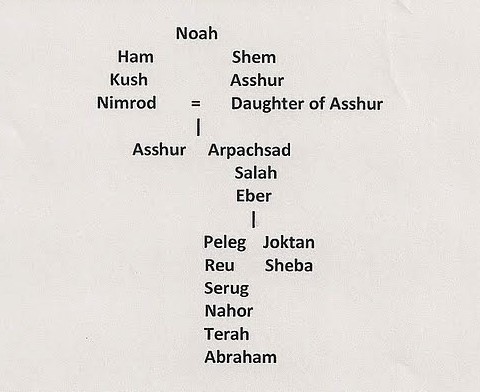
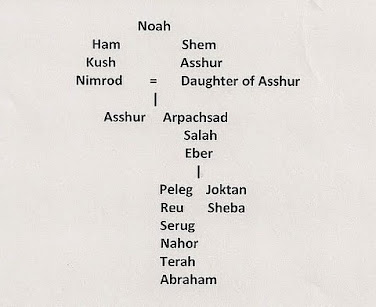
In Genesis 10 we read that the Cushite city builder Nimrod left the Nile Valley and became established in Sumer and later in northern Mesopotamia. He married the daughter of a Hebrew ruler named Asshur and she named their firstborn son Asshur, after her father. This distinctive feature of the marriage and ascendancy pattern of the early Hebrew is called the "cousin bride's naming prerogative" because it occurs only in cases where the ruler has taken a cousin wife.

Genesis 10 listed Nimrod as a son of Kush/Cush. He was a sent-away son like Abraham, Moses, Jacob, and Joseph. Nimrod was not Cush's proper heir. Nimrod and his brother Ramah (Gen. 10:6-12) established territories to the east of Kush (the Upper Nile). Ramah ruled in Southern Arabia. Nimrod built his cities in Mesopotamia. Nimrod's movement represents the dispersion of the early Hebrew out of the Nile Valley which is where we find the oldest known site of Hebrew worship at Nekhen on the Nile (c.4000 BC). The practice of sending away non-ascendant sons drove the dispersion of the early Hebrew out of Africa.  

The language of Nimrod's kingdom was Akkadian, the oldest known Semitic language. The roots have close affinity to biblical Hebrew and the languages of the Nile Valley, as has been demonstrated by Christopher Ehret study of the cattle-herding Nilotes as early as 9000 years ago. Among these Proto-Saharan or Saharo-Nubian peoples were some of Abraham's ancestors. Cattle were a source of wealth, and a symbol of divine appointment was the Sun resting in the long horns of the bull. 

The cousin bride's naming prerogative is first found among the early Hebrew rulers listed in Genesis 4 and 5. This is a necessary piece of information for those who want to understand the marriage and ascendancy pattern of the biblical Hebrew.

Analysis of the marriage and ascendancy pattern of Abraham's ancestors reveals a consistent pattern for the ruler who ascends to the throne. That pattern applies to Lamech the Elder, Nahor the Elder, Terah, Esau the Elder, Amram, and others. The pattern involves marriage to two wives.


Note that Lamech the Elder's daughter who is mentioned in Genesis 4 married her patrilineal cousin Methuselah (Gen. 5) and named their firstborn son Lamech, after her father.

We first meet Abraham in Mesopotamia because that is where his Hebrew ancestors settled. Nimrod's marriage to his cousin reveals the distinctive Hebrew naming custom as is found in the case of Lamech the Elder (Gen. 4) and Lamech the Younger (Gen. 5).


Toshia's second concern is that I cannot cite chapter and verse that says Nimrod married the daughter of Asshur. Perhaps he is a Bible "literalist" who accepts as true only what is explicitly stated. If this is true, kinship analysis means nothing to him, and the science of Biblical Anthropology offers him nothing of value. 

To delve deeper into the text, it helps to understand the relationships of the Hebrew rulers, priests and clans. This requires gaining a clearer understanding of their kinship pattern and their marriage and ascendancy pattern. The data is found in the Bible. I apply the tools of cultural anthropology to the biblical texts. Biblical Anthropology employs reliable methods and principles.

As a biblical anthropologist, I must consider the data that is available in the canonical texts. Taken as a whole, after over 36 years of research, there is sufficient evidence of a distinctive Hebrew marriage and ascendancy pattern throughout the Bible.

Science requires acute observation of details, record keeping, and critical thinking. There always is the possibility that the next experiment might not provide the same results or conform to the hypothesis as did earlier experiments.

This radical doubt poses a problem for scientists. It means that the scientific method cannot be said to ascertain beyond doubt. This is Hume's problem of induction. Inductive methods predict or infer and are essential in scientific reasoning. One cannot assume that something is immutable and necessary because it has always or usually been reliable in the past. Though 20 experiments produce the same results, we have no certainty that the results will be the same after experiments 21, or 32 or 45. Though the sun has risen daily on the eastern horizon for many millennia, we have no certainty that it will always do so.

In 1953, Richard Rudner published “The Scientist qua Scientist Makes Value Judgments,” in which he argued that since no hypothesis is ever completely verified, in accepting a hypothesis the scientist must make the decision that the evidence is sufficiently strong to warrant the acceptance of the hypothesis. The induction problem framed by Hume is a problem involving one's decision about which action to take, not proof of the fallibility of science in general.

I assure my readers and Toshio that I have not tried to impose on the text something that is not there. I begin with the biblical text, identify anthropologically significant data, apply an empirical method, and trust that what the texts give is reliable and truthful. Indeed, that is my working hypothesis.

Related reading: Understanding the Science of Biblical Anthropology; Cousin Brides; Hebrew Rulers With Two Wives; BIBLICAL ANTHROPOLOGY: Think like a biblical anthropologist!; Nimrod's Sumerian Wife; Reading the Bible in a Different Way; The Hebrew Hierarchy of Sons


Wednesday, March 7, 2012

Who was Melchizedek?


Alice C. Linsley


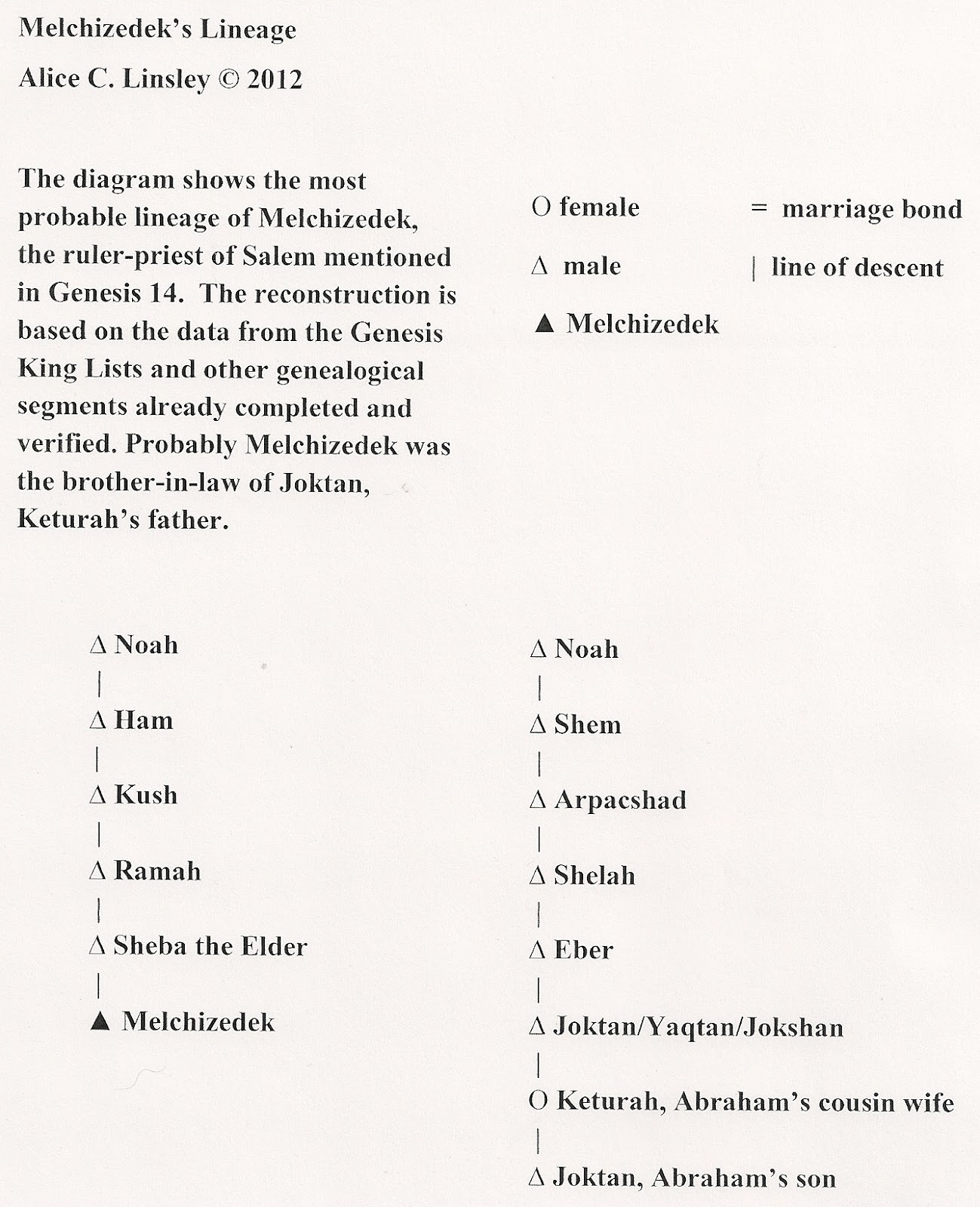
Melchizedek, the ruler-priest of Jerusalem (Salem), is one of the most fascinating figures of Genesis.  His Hebrew name is malkîtsedek, which means righteous king. He is mentioned in Genesis 14, Psalm 110:4 and in the book of Hebrews, where he is given much attention by the Apostle Paul. Melchizedek is also considered in the works of modern philosophers such as Soren Kierkegaard.

At the time Abraham lived, most rulers of a region were related by blood (consanguine bond) or by marriage (affinal bond), or both. According to Genesis 14 and Hebrews 7, Melchizedek was a were ruler-priest of "the Most High God" ("El Elyon"), suggesting that he and Abraham belonged to the same ruler-priest caste. Castes are characterized by endogamy. 

It is clear from Genesis 14 that Melchizedek and Abraham were well acquainted. They were likely kinsmen as the early Hebrew ruler-priests married only within their caste (endogamy). 

Based on what we know about the kinship pattern of the early Hebrew caste, we expect to find a familial relationship between these ruler-priests. I suspect that this is their relationship.


Melchizedek is claimed to have no parentage. This Jewish narrative is derived from midrash. Most midrashim come from the 2nd or 3rd century AD. There are many claims made about Melchizedek in Jewish texts that are not found in the Bible. Numbers Rabbah 4:8 says that Melchizedek handed down Adam's robes to Abraham/Abram. Another midrash claims that Melchizedek was so spiritually advanced that he was born circumcised. The rabbis taught that Melchizedek acted as a priest but was rejected by God and his priesthood was handed to the Jewish descendants of Abraham. Rabbi Zechariah said on the authority of Rabbi Ishmael: "The Holy One, blessed be He, intended to bring forth the priesthood from Shem" [not Shem and Ham whose lines intermarried]. Melchizedek was the priest of the Most High God but because he gave precedence in his blessing to Abraham over God, the LORD brought forth the priesthood of Israel from Abraham; as it is written, 'And he blessed him and said, Blessed be Abram of the Most High God, possessor of heaven and earth, and blessed be the Most High God' (Gen 14:19). Midrash claims that Abraham then said to Melchizedek, "Is the blessing of a servant to be given precedence over that of his master?" Straightway the priesthood was given to Abraham.

Melchizedek appears in 2 Enoch, and in the Dead Sea Scrolls he influences the demise of the Angel Belial and the wicked spirits in league with him. In 2 Enoch, he is taken by an angel to Eden. According to Rashi, a French medieval rabbi, Melchizedek was Shem. This is highly improbable since Melchizedek lived at least 300 years after Shem.

In Genesis 14, Melchizedek comes to Abraham after a great battle in which Abraham incurred blood guilt. Melchizedek's ministry in this situation would have been to perform the appropriate purification rites which included bread and wine. Ancient warrior societies had purification rites to help returning warriors deal with their blood guilt. In Genesis 14, Melchizedek performs the purification rite that absolves Abraham of blood guilt. In thanks, Abraham offers him the tithe.

In the book of Hebrews and in the writings of some Church Fathers, Melchizedek is a type of Jesus Christ. He is the righteous king and the prince of peace (Salem). This notion informs the Coptic view that Melchizedek was born of a virgin (2 Enoch). Jesus is the "priest after the order of Melchizedek" therefore, His priesthood is from of old, existing long before the time of Aaron. 

The Hebrew ruler-priests expected the Divine Seed (Gen. 3:15), the Son of God to come into the world. They believed that He would be born of one of their virgins by divine overshadowing (Luke 1).

Melchizedek's earthly father was probably Sheba the Elder whose ancient royal line rivaled the House of David (II Sam. 20). The omission of Melchizedek's ancestry in the Hebrew Scriptures is consistent with the common practice of eliminating elements of history that do not serve the Jewish narrative. Omissions about ancestry and kinship, and aspersions cast upon some of the early Hebrew rulers is motivated by political expediency. 

It is no coincidence that Jews begin their history with Abraham who they claim to be a Jew, though he is called a Hebrew. The Jewish narrative only works if one ignores the anthropological data of Genesis 4-11. When asked in this NOVA interview if Abraham was the first Jew, Dr. Shaye Cohen responded, "The biblical narrative gets going with Abraham in Genesis chapter 12. Abraham in turn Isaac, in turn Jacob, in turn Joseph and the twelve tribes, this brings us directly to the people of Israel and the covenant at Sinai. So Abraham is thought of as the first Jew, the archetype."

Dr. Cohen admits that his portrayal of Abraham as the first Jew lacks historical support. He says, "Historically speaking, of course, this doesn't make much sense. It's hard to talk about Jews living around the year 1800 B.C.E. or anytime near that." 

This is true. We can speak of Jews only after about 580 B.C. and Abraham the Hebrew lived closer to 2100 B.C. He had at least 9 sons and the clan of Jacob (Israel) represents a small portion of the early Hebrew caste.

Thursday, March 3, 2011

Binary Sets in the Ancient World


Alice C. Linsley


Ethical concerns of the early Hebrew rulers (4000-2000 BC) involved binary opposites or binary sets such as east-west, male-female, day-night, life-death, and heaven-earth. These sets are universally in the patterns of Nature. The early Hebrew rulers and priests were acute observers of those patterns. They recognized that seasons run in a cycle, the solar arc appears to move from east to west, and people bring forth people, not plants or other animals. In other words, there is a fixed quality to certain natural phenomenon. 

Not every set of opposites is a binary set. Consider that talented-untalented does not represent a binary set because this involves subjective judgement. Tall-short is not a binary set because this is relative to the observer. I am 5 feet 5 inches tall. Standing beside a Watusi warrior, I would appear to be short. However, were I to stand beside a Pygmy, I would appear to be tall.

The binary sets by which the early Hebrew made judgements were used to determine good and evil. Good recognized and honored the fixed boundaries observed in Nature. Evil violated the boundaries observed in Nature. Anomalies were noted, but excluded when forming judgements.

The opposites of Good and evil were not equal as in dualism. One member of the binary set is by its nature superior in some observable way to its partner. The sun as the greater light is superior to the Moon which merely reflected the sun's brightness (refulgence). The male as the larger and stronger member of the human species is superior to the female. Modern values and political correctness are irrelevant here. These distinctions are objective and universally obvious.

Maintaining the hierarchy of the binary opposites permitted the ancient priests to help their rulers make wise God-pleasing decisions. For example, the priests of Israel during Moses' time were to use the Urim and Thummim to receive divine guidance. These represent numerous binary sets. The Urim would have a number of associations which would be assigned the opposite meaning with the Thummim. Using these tools involved more than yes-no questions. It involved deriving meaning from the directional poles, gender, numbers and reversals. The morehs or ancient prophets apparently used the same approach when rendering counsel such as that given to Abraham by the moreh at the Oak of Mamre (Gen. 12:6).

Today astrophysicists study the heavens seeking answers to the origins of the universe. The ancients studied the heavens because they believed that the celestial pattern speaks of the Creator's nature and how we should order our lives on earth. This belief is expressed in the Lord's Prayer that says, "Thy will be done on earth as it is in heaven."

The binary sets also provide direction and guidance. Lacking a compass, we can watch where the Sun rises to determine east. Knowing east, we can determine the direction of west. Just as the directional poles help us to avoid disorientation, so the binary sets observed universally and objectively in Nature can help us to avoid ethical confusion.

For the ancients they also suggested that there was a center point at the intersection of the perpendicular lines connecting north-south and east-west. One can image the place where these lines intersect as the center of a cross. This is a metaphysical sacred center that took on physical form when Jesus was nailed to the cross at Calvary. The cross is a fundamental symbol in creation.

The world has not changed in any essential way. Nothing ever really changes. That is what Plato understood and why he is still the greatest of the philosophers. There is one reality and all people exist in that one reality. Things can only become more what they were created. They cannot become less what they were created without rebelling against God's design. 

Onanism was also regarded as a violation of the order of creation. The seed that should fall to the earth is the seed of plants, which spring forth from the earth. The seed of man should fall on his own type (the womb), from which man comes forth. Clement of Alexandria wrote, “Because of its divine institution for the propagation of man, the seed is not to be vainly ejaculated, nor is it to be damaged, nor is it to be wasted” (The Instructor of Children 2:10:91:2 A.D. 191).

Likewise, the prohibition against mixing types of seeds and types of fibers is intended that human should observe the order of creation and honor the way it is. The prohibition against mixing seeds, fibers, and blood, is a reminder to not confuse the holy and the unholy, or to blur the distinction between life and death, or between life-nurturing actions and life-destroying actions. This is one of the reasons why the Hebrews were forbidden to boil a baby goat in its mother's milk (Ex. 23:19; Ex. 34:26, Deut. 14:21).
1


Saturday, May 23, 2009

Peleg: Time of Division


Alice C. Linsley


To Eber were born two sons: the first was called Peleg, because it was in his time that the earth was divided, and his brother was called Joktan. (Genesis 10:25)

The Hebrew word for earth is "eretz" and should be rendered in this verse as "territory" because the account is about the Hebrew ruler Eber dividing his territory between two sons that may have been twins. It appears that Eber assigned to each royal son a portion of his territory.

This verse has perplexed readers for centuries. It has been suggested that the separation of the clans occurred after the Tower of Babel when God confused the languages. However, all of the languages spoken by the peoples listed in Genesis 4-12 are in the Afro-Asiatic family and it is believed they emerged from a common Proto-Afroasiatic source. Many of these early Hebrew rulers spoke Akkadian, the oldest known Semitic language.

Alexander Militarev, a Russian scholar of Semitic, Berber, Canarian, and Afroasiatic languages, linked proto-Afroasiatic to the Natufian people. He wrote that the "Proto-Afrasian language, on the verge of a split into daughter languages" (Cushitic, Omotic, Egyptian, Semitic and Chadic-Berber) "should be roughly dated to the ninth millennium B.C." That would be around 6000 years before the time of the biblical Noah.

Another view insists that this division pertains to tectonic activity. This view was espoused by the German scholar Alfred Wagener. However, analysis of Genesis 4 and 5 indicates that Peleg lived in the Bronze Age. The tectonic drift interpretation is impossible as humans were not on the surface of the earth until long after the separation of the continents. Wagener's interpretation ignores a vast body of data in Genesis about Noah and his descendants. Noah's homeland was in Borno or Benue (Land of Noah) in the region of Lake Chad. He lived during the wet period known as the African Aqualithic. 

The word "Peleg" has to do with separation and control of water. Genesis reveals that the early Hebrew rulers controlled major water systems of the ancient Fertile Crescent. 


Peleg's brother was Joktan whose descendants came to reside in Southern Arabia. The are known as the Joktanite clans.


Hebrew brothers often lived geographically distant. The line of Raamah, Nimrod's brother, resided in southwestern Arabia. The line of Nimrod settled in the Tigris-Euphrates region (Mesopotamia) where writing was the work of royal scribes. Overtime the geographical separation of Hebrew priestly lines led to the adoption of different languages. However, the Hebrew ruler-priest caste continued to intermarry (caste endogamy). They did not change the unique and distinctive marriage and ascendancy pattern of their ancestors. 

It is not entirely clear at what point the clans became geographically separated, but it is clear that their kinship pattern did not change. Apparently, the division of Eber's territory occurred about five generations before Abraham, but the separation should be understood as geographical, not social.

Genesis 10:25 is speaking of separate territories. Two sons cannot both rule over the father's land holding. According to the early Hebrew marriage and ascendancy pattern, the firstborn son of the first wife was heir to the father's kingdom. Other sons are sent away to establish territories of their own. This pattern drove the Hebrew dispersion out of the Nile Valley.


However, in the case of twin sons, the Hebrew rule might choose to divide his territory between the sons.

Note that the name "Peleg" doesn’t appear in the lines from which Abraham descends. Analysis of the data reveals that critical information is missing about the chiefs who were contemporaries of Reu, Serug and Nahor. (See chart below, using data from Genesis 10:24-30.)


The information that is missing concerns the descendants of the Hebrew ruler Sheba. The descendants of Sheba are traced through Abraham and his patrilineal cousin Keturah. Keturah was of the Hebrew clan of Sheba in whose territory there were many wells (Beer-Sheba means "Well of Sheba".) It seems that Peleg is an ancestor of the people of Sheba.

The Queen of Sheba probably did not rule over the same territory as Sheba the Elder, her powerful Hebrew ancestor. By the time of Solomon came to power, Sheba's territory was diminished. David likely took control of some of those lands in the south. David's claim to the throne was contested by a man named Sheba. That man lost his life when he took refuge in the city of Abel Beth Maacah where he was beheaded (2 Sam. 20:1-22).