Followers

Showing posts with label Melchizedek. Show all posts

Saturday, November 4, 2023

Melchizedek and Abraham Were Kinsmen


In this post I respond to a friend's question about Melchizedek's relationship to Abraham.


Alice, on your blog you stated, "Melchizedek's earthly father was probably Sheba the Elder whose ancient royal line rivaled the House of David (II Sam. 20). The omission of Melchizedek's ancestry in the Hebrew Scriptures is consistent with the common practice of eliminating elements of history that do not serve the Jewish narrative. Omissions about ancestry and kinship, and aspersions cast upon some of the early Hebrew rulers is motivated by political expediency."


Do you have any supporting evidence for the assertion that Melchizedek's father was probably Sheba the Elder?


The data required to understand the relationship of Melchizedek and Abraham is found in Genesis 14 and in an understanding of the social structure of the biblical Hebrew, a ruler-priest caste.


1. Melchizedek was the ruler-priest of the high place that came to be called Jerusalem. The Hebrew were a caste of ruler-priests and Melchizedek fits that description. Melchizedek means "righteous king". He is remembered because he was a high king over lesser regional rulers (vassals) such as Abraham. Abraham's relationship to Melchizedek fits the Suzerain-vassal pattern. A vassal holds land on conditions of homage and allegiance. For the Hebrew, the allegiance was based on blood ties.


2. As I show in my book The First Lords of the Earth: An Anthropological Study, the early Hebrew were widely dispersed in the service of kingdom builders who established strongholds at elevated sites near permanent water sources. That describes Jerusalem in Abraham's time.


3. The narrative about Melchizedek has as its background a battle between regional kings. After the battle Melchizedek comes to Abraham with bread and wine, and blessed Abraham in the name of the Most High God. It is likely that this activity represents a rite of cleansing from blood guilt.


4. In that narrative, Abraham presents Melchizedek with a tenth (tithe) of the booty. This suggests that Abraham was subject to Melchizedek. Melchizedek was likely the high king over many of the regional rulers such as Abraham.


5. Abraham's territory extended on a north-south axis between Hebron (Sarah's settlement) and Beersheba (Keturah's settlement). Hebron is only 19 miles south of Jerusalem. It is likely that the entire region was Hebrew territory since the early Hebrew land holdings were extensive at that time. Canaan was the crossroads by which these early Hebrew ruler-priests dispersed


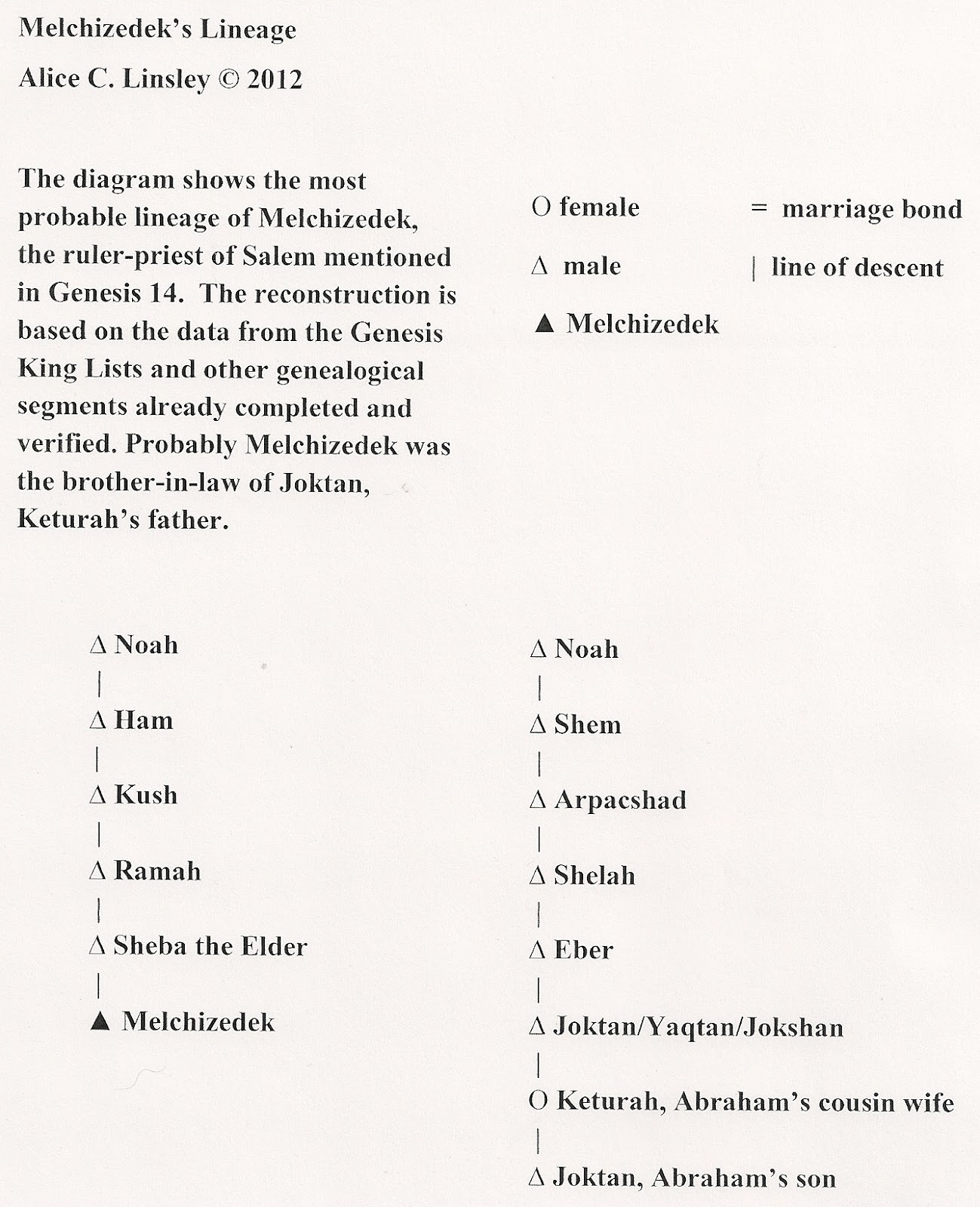
6. The Hebrew alliances were based on endogamous marriages. Therefore, it is not far-fetched to consider that Abraham and Melchizedek were kinsmen. The relationship of Abraham and Melchizedek appears to be through the very ancient royal house of Sheba. This is my hypothesis based on the marriage and ascendancy pattern of the biblical Hebrew which I have identified using kinship analysis.


Melchizedek was probably the maternal uncle of Abraham's cousin wife, Keturah. Keturah resided at the Well of Sheba and was of the royal house of Sheba. About a 1000 years later, a man called Sheba contested David's claim to the throne (2 Samuel 20).


The Bible makes it clear that the people of Sheba were Abraham's kinsmen. Genesis 10:7 identifies Sheba as a son of the Kushite ruler Raamah, one of Abraham's ancestors. Genesis 10:28 states that Sheba was a son of Joktan, a son of Eber who was a descendant of both Ham and Shem, since their lines intermarried (caste endogamy). Genesis 25:3 notes that Abraham and Keturah had a grandson named Sheba. 

Saturday, November 12, 2016

Does the Bible Advocate Genocide?


Alice C. Linsley

Some people have observed that God's willingness to use Israel to destroy its enemies is not unlike the ambitions of radicalized Muslims to destroy Jews and Christians. The pertinent passages are found in Leviticus and Joshua. Scholars have noted that the book of Joshua shares the theology of the Deuteronomist. This is evident in comparing the lists of people to be driven out of Canaan by Joshua's army.

In Joshua the people to be driven out are listed in chapter 3 and chapter 24.

Joshua 3:10: This is how you will know that the living God is among you and that he will certainly drive out before you the Canaanites, Hittites, Hivites, Perizzites, Girgashites, Amorites and Jebusites.

In Joshua 24:11 we find the same names in a different order: Then you crossed the Jordan and came to Jericho. The citizens of Jericho fought against you, as did also the Amorites, Perizzites, Canaanites, Hittites, Girgashites, Hivites and Jebusites, but I gave them into your hands.

The Joshua lists parallel the list of Israel's enemies in Deuteronomy 7:1-3:
When the Lord thy God shall bring thee into the land whither thou goest to possess it, and hath cast out many nations before thee, the Hittites, and the Girgashites, and the Amorites, and the Canaanites, and the Perizzites, and the Hivites, and the Jebusites, seven nations greater and mightier than thou; And when the LORD thy God shall deliver them before thee; thou shalt smite them, [and] utterly destroy them; thou shalt make no covenant with them, nor shew mercy unto them: Neither shalt thou make marriages with them; thy daughter thou shalt not give unto his son, nor his daughter shalt thou take unto thy son.

This list comes from a time long after Abraham and prohibits intermarriage between these peoples, yet the rulers of most of these peoples were related. The Jebusites were a Kushite people with whom Abraham had close interaction. They appear to have had common ancestry.

These passages are the work of the Deuteronomist Historian (DH) whose objective was to secure Judea as a unique place for Jews who returned from Babylon. The Deuteronomist Historian was not advocating the elimination of all non-Jews globally, as are some radical Jihadists. Consider these words of the Islamic theologian Syed Abul A’ala Maududi:
“Islam wishes to destroy all states and government anywhere on the face of the earth which are opposed to the ideology and program of Islam regardless of the country or the nation which rules it. The purpose of Islam is to set up a state on the basis of its own ideology and program.”

It was not the objective of the Deuteronomist Historian to destroy all who did not adhere to the Jewish/Hebrew faith. Rather the objective was to secure centralized worship at the Jerusalem temple, and to reshape national observances such as the Passover and Tabernacles.

The Deuteronomist Historian's concern is theological, religious and Zionist. The DH stresses rejection of images, exclusive devotion to the God called Yahweh, and obedience to his prophet Moses (Deut. 18:18; cf. Mark 6:125; Matt. 16:13-20; John 1:21). The DH also places emphasis on Jewish racial purity.

The DH is the final hand on the Genesis. This fundamentalism and iconoclasm attempts to recast Hebrew history away from the religious practices of Abraham and his ancestors who lived long before the  period of the Deuteronomist Historian  (Neo-Babylonian Period, about 700-300 BC). Abraham and his ancestors were not Jews and they maintained many shrines and called the Creator by many names.


Further, Abraham's territory was not in Judea. He ruled in Edom (called Idumea by the Greeks) and was related to the Edomite rulers listed in Genesis 36. His half-sister wife Sarah resided in Hebron and this patrilineal cousin wife Keturah resided in Beersheba (note the north-south axis of the wives). Abraham's watering rights extended from Engedi to Gezer (note the east-west axis of his water rights).

At the time of Abraham, Jerusalem was under Jebusite ruler and its ruler-priest, Melchizedek, was a kinsman of Abraham. This is why the high place there was called Yebu/Jebu. In Genesis 21:14 we read that "Abraham called that place...Yiru" and this is significant because the Y is a Canaanite sign that indicated divine appointment and the Ru is probably a reference to the Horite Habiru name for the Creator. Genesis 21:14 identifies Melchizedek as the "King" of Salem. He may have been the maternal uncle of Abraham's wife Keturah.

The DH is not advocating genocide of all non-Jews worldwide. There is not reason to link the Bible to Islamic radicalism.  Instead, we are to accept the whole canon as inspired and superintended by the Holy Spirit. We must use our God-given intelligence to sort through the Biblical material, context by context, to discover the various concerns of the Biblical writers.


Wednesday, March 7, 2012

Who was Melchizedek?


Alice C. Linsley


Melchizedek, the ruler-priest of Jerusalem (Salem), is one of the most fascinating figures of Genesis.  His Hebrew name is malkîtsedek, which means righteous king. He is mentioned in Genesis 14, Psalm 110:4 and in the book of Hebrews, where he is given much attention by the Apostle Paul. Melchizedek is also considered in the works of modern philosophers such as Soren Kierkegaard.

At the time Abraham lived, most rulers of a region were related by blood (consanguine bond) or by marriage (affinal bond), or both. According to Genesis 14 and Hebrews 7, Melchizedek was a were ruler-priest of "the Most High God" ("El Elyon"), suggesting that he and Abraham belonged to the same ruler-priest caste. Castes are characterized by endogamy. 

It is clear from Genesis 14 that Melchizedek and Abraham were well acquainted. They were likely kinsmen as the early Hebrew ruler-priests married only within their caste (endogamy). 

Based on what we know about the kinship pattern of the early Hebrew caste, we expect to find a familial relationship between these ruler-priests. I suspect that this is their relationship.


Melchizedek is claimed to have no parentage. This Jewish narrative is derived from midrash. Most midrashim come from the 2nd or 3rd century AD. There are many claims made about Melchizedek in Jewish texts that are not found in the Bible. Numbers Rabbah 4:8 says that Melchizedek handed down Adam's robes to Abraham/Abram. Another midrash claims that Melchizedek was so spiritually advanced that he was born circumcised. The rabbis taught that Melchizedek acted as a priest but was rejected by God and his priesthood was handed to the Jewish descendants of Abraham. Rabbi Zechariah said on the authority of Rabbi Ishmael: "The Holy One, blessed be He, intended to bring forth the priesthood from Shem" [not Shem and Ham whose lines intermarried]. Melchizedek was the priest of the Most High God but because he gave precedence in his blessing to Abraham over God, the LORD brought forth the priesthood of Israel from Abraham; as it is written, 'And he blessed him and said, Blessed be Abram of the Most High God, possessor of heaven and earth, and blessed be the Most High God' (Gen 14:19). Midrash claims that Abraham then said to Melchizedek, "Is the blessing of a servant to be given precedence over that of his master?" Straightway the priesthood was given to Abraham.

Melchizedek appears in 2 Enoch, and in the Dead Sea Scrolls he influences the demise of the Angel Belial and the wicked spirits in league with him. In 2 Enoch, he is taken by an angel to Eden. According to Rashi, a French medieval rabbi, Melchizedek was Shem. This is highly improbable since Melchizedek lived at least 300 years after Shem.

In Genesis 14, Melchizedek comes to Abraham after a great battle in which Abraham incurred blood guilt. Melchizedek's ministry in this situation would have been to perform the appropriate purification rites which included bread and wine. Ancient warrior societies had purification rites to help returning warriors deal with their blood guilt. In Genesis 14, Melchizedek performs the purification rite that absolves Abraham of blood guilt. In thanks, Abraham offers him the tithe.

In the book of Hebrews and in the writings of some Church Fathers, Melchizedek is a type of Jesus Christ. He is the righteous king and the prince of peace (Salem). This notion informs the Coptic view that Melchizedek was born of a virgin (2 Enoch). Jesus is the "priest after the order of Melchizedek" therefore, His priesthood is from of old, existing long before the time of Aaron. 

The Hebrew ruler-priests expected the Divine Seed (Gen. 3:15), the Son of God to come into the world. They believed that He would be born of one of their virgins by divine overshadowing (Luke 1).

Melchizedek's earthly father was probably Sheba the Elder whose ancient royal line rivaled the House of David (II Sam. 20). The omission of Melchizedek's ancestry in the Hebrew Scriptures is consistent with the common practice of eliminating elements of history that do not serve the Jewish narrative. Omissions about ancestry and kinship, and aspersions cast upon some of the early Hebrew rulers is motivated by political expediency. 

It is no coincidence that Jews begin their history with Abraham who they claim to be a Jew, though he is called a Hebrew. The Jewish narrative only works if one ignores the anthropological data of Genesis 4-11. When asked in this NOVA interview if Abraham was the first Jew, Dr. Shaye Cohen responded, "The biblical narrative gets going with Abraham in Genesis chapter 12. Abraham in turn Isaac, in turn Jacob, in turn Joseph and the twelve tribes, this brings us directly to the people of Israel and the covenant at Sinai. So Abraham is thought of as the first Jew, the archetype."

Dr. Cohen admits that his portrayal of Abraham as the first Jew lacks historical support. He says, "Historically speaking, of course, this doesn't make much sense. It's hard to talk about Jews living around the year 1800 B.C.E. or anytime near that." 

This is true. We can speak of Jews only after about 580 B.C. and Abraham the Hebrew lived closer to 2100 B.C. He had at least 9 sons and the clan of Jacob (Israel) represents a small portion of the early Hebrew caste.

Tuesday, June 16, 2009

The Order of Melchizedek

Right: Figure of an Egyptian priest with shaved head. Korah, Moses' half-brother, probably looked like this. Sarki means ruler among the people of Kano, which is where Noah’s ancestors came from. The Sarki are also a people group who live in the region of Orissa in India. Orissa is also a Nigerian word and Kano is in Nigeria. Sarki also live as ‘Haruwa’ in the Tarai region of Nepal. The word Haruwa is equivalent to the ancient Egyptian word ‘Harwa” meaning priest. It appears that priests played a leading role in the diffusion of the Afro-Asiatic worldview. It is interesting to note also that the word 'sarki' refers to red ochre which was ground into power and used almost universally in the burial of nobles as a symbol of blood between 20,000 and 80,000 years ago.

In this essay, I explore the connections between the priesthood identified with Melchizedek and the priesthood associated with Horus, one of the 3-God (baal shalisha), the source of light, and the Son of God.


Alice C. Linsley

The Priesthood begins with God who first shed the blood of animals to clothe Adam and Eve’s nakedness.[1]

It continues with Abel, a shepherd who offered acceptable sacrifice and was killed by his jealous brother.[2]

It is traced through Abraham’s ruler-priest ancestors who spread from west central Africa to the Indus River Valley. They are listed in the Bible and we know a good deal about their Afro-Asiatic worldview.

That the priesthood was already a fully developed office before the time of Abraham is evident in the person of Melchizedek, the Priest of Salem (Jerusalem). It is evident also in the presence of Neolithic fire altars throughout the Middle East.[3]

With Melchizedek, the priesthood of God comes to be associated with the Jebusite settlement of Jerusalem. Abdi-hepa was a Jebusite king who ruled Jerusalem three centuries before its conquest by David. This distinguishes the priesthood of God from other priesthoods that do not recognize the ancient prophecies concerning Mount Zion and the House of David. Interestingly, according to 2 Samuel 24, David built a fire altar at the threshing floor of Araunah, the Jebusite. Here David is shown as a ruler-priest and shepherd, the very roles that characterize the ruler-priests whose patrilineal lines intermarried, bringing us to the House of Joachim, Mary's father.

The antiquity of the priesthood is evident also when tracing the marriage pattern of Abraham’s Horite family in which the ruler-priests married the daughters of priests. The Horites were a particular group of priests whose worldview widely influenced Afro-Asiatic peoples and even the Indo-Europeans.[4]

Abraham's Horite ancestors believed in blood sacrifice for atonement of sin. They are likely the ones who spread the word about atonement through blood sacrifice. References to such redemption appear on a tablet titled "The Song of Debt Release," which was excavated in Hittite territory. The same practice was known to the Babylonians during Abraham's time.

The Horites take their name from the one they worship - Horus, the Son of God. They apparently believed that the Son of God would become incarnate from their bloodline. This is why they took great care that their priests married only patrilineal kin. (The priesthood was traced through the father. However, bloodline was traced through the mother.)

The Biblical record is so reliable that it can be used to reconstruct the priestly bloodline from Cain and Seth (whose lines intermarried) to Ham and Shem (whose lines intermarried) to Joktan and Sheba (whose lines intermarried) to the priest, Joachim, father of the blessed virgin Mary, Mother of the Promised Son of God.

The Priesthood as Fixed Order

It is evident that the priesthood that points to Jesus Christ, the Son of God, pertains exclusively to ruling men. This appears to be fixed by God from the beginning. To modern ears the idea that anything in the created order is fixed sounds improbable. We have been indoctrinated in the evolutionary insistence that things in the created order can change in essence. But this is a delusion. The order of creation is fixed. Created entities can and do change their form (what the Greeks called “flux”), but they do not change their essence. Such is the case with the priesthood.

So when the Episcopal Organization decided to call women “priests” that decision (motivated by politics rather than by truth) had no effect on the created order. TEC has no power to create new ontological categories. Women priests are not priests in “the order of Melchizedek”. The priesthood by its essence excludes women from this office. All the Episcopal Church managed to do was to create confusion and division. It isn’t difficult to track the Devil’s fire trails in this case.

The Order that Pertains Exclusively to Women

Analysis of the kinship pattern of Abraham’s people from Genesis 4 to the New Testament makes it clear that the order of creation excludes men from taking all the credit for working righteous on the earth. Only women would perform blood sacrifice in the form of birthing, and from the dawn of time it was foretold that a certain Woman would bring forth the Son of God.

The incarnation of the Son of God makes necessary the monthly cycle of women and the act of giving birth. Every women of the Scriptures who could not bear a child knew that she would not share in the bloodline of the Promised Son.

So Sarah cried out and when she received the promised son, she insisted that he alone should reign over the kingdom of his father. [5]

So Rachel became embittered because she had not borne Jacob a child, but God opened her womb and she brought forth Joseph, who shaved his head as a ruler-priest[6] and married the daughter of the priest of the shrine of On (Heliopolis) in Egypt.

So Hannah, the priest’s wife, lamented her barren state before the Lord and petitioned with tears until she bore Samuel, prophet of the Most High God.[7]

NOTES

1. As God is the first priest, Jesus is revealed as High Priest after the order of Melchizedek. This is used in scripture to establish the primal authority of His Priesthood, from which every true priest derives his authority.

2. Abel is a type of Jesus Christ who offered acceptable sacrifice and was killed by his own brethren. Just as Abel's blood cries to the Father from the ground, so the Blood of Jesus is ever before the face of the Father.

3. The fire altars were sometimes made of stones and sometimes of brick. They were constructed according to the cosmology of the people. Some were built in the form of a falcon. The falcon was the symbol of Horus, the Son of God. To see the geometry of a falcon altar, go here to page 5. Ur means "fire" and it appears in many Afro-Asiatic place names. It probably refers to the fire altars. Archaeological evidence of such altars has been found in the Indus Valley culture dating from the proto-Harappan age (3500 BC- 2500 BC) to the Harappan age (2500 BC - 1750 BC). There was probably a fire altar in Jerusalem (a Jebusite city) in the time of Melchizedek. Elijah's offering, and Jezebel's false prophets, were consumed by fire from heaven on a fire altar.

4. See the Rev. John Campbell's research on the Horites here.

5. Abraham had two wives: Sarah and Keturah. Jacob had two wives: Rachel and Leah.

6.The word "korah" means shaved head and refers to a ruler-priest. It is also the name of Moses' half-brother who was apparently a ruler-priest. No wonder he contested Moses' authority! Moses was likely the youngest of Amram's 3 sons. For more on why Joseph shaved, see Biblical Archaeology Review, July/Aug. 2007, pages 36-41.

7. Elkanah had two wives: Hannah and Peninnah. For more on the pattern of ruler-priests having 2 wives, go here.

Wednesday, September 3, 2008

The Messianic Priesthood of Jesus

Alice C. Linsley

For when God made a promise to Abraham, because He could swear by no one greater, He swore by Himself, saying, “Surely blessing I will bless you, and multiplying I will multiply you.” And so, after he had patiently endured, he obtained the promise. For men indeed swear by the greater; and an oath for confirmation is for them an end of all dispute. Thus God, determining to show more abundantly to the heirs of promise the immutability of His counsel, confirmed it by an oath, that by two immutable things, in which it is impossible for God to lie, we might have a strong consolation, who have fled for refuge to lay hold of the hope set before us. This hope we have as an anchor of the soul, both sure and steadfast, and which enters the Presence behind the veil, where the forerunner has entered for us, even Jesus, having become High Priest forever according to the order of Melchizedek. (Hebrews 6:13-20)

The promises God made to Abraham, to which all in God's Kingdom are heirs, are eternal and unchanging. They are fixed to God’s eternal and unchanging nature and God cannot lie. The writer of Hebrews presents a picture of Jesus' priesthood that helps us to understand how Jesus fulfills those promises. Hebrews explains that the promises are tied to a Messianic priesthood that existed in the time of Abraham and before. What can we say about this priesthood?

First, we can say that the priesthood is verifiably one of the oldest religious institutions in the world, traced back to at least 7000 BC. The priest emerges out of primeval perceptions of blood as a substance of life and purity or rightness. The Hebrew root "thr" = to be pure, corresponds to the Hausa/Hahm "toro" = clean, and to the Tamil "tiru" = holy. All are related to the proto-Dravidian "tor" = blood. These are cognate languages in the Afro-Asiatic language group and it is from these peoples that we received the institution of the priesthood.

Humans yearned for the death-defeating benefits of the Pleromic Blood as early as 80,000 years ago. Sophisticated mining operations in the Lebombo Mountains of southern Africa reveal that thousands of workers were extracting red ochre which was ground into powder and used in the burial of nobles in places as distant as Europe. Anthropologists agree that this red powder symbolized blood and its use in burial represented hope for the renewal of life.

Second, we know that the priesthood functioned to mitigate blood guilt. Anthropologists have noted that there is considerable anxiety about shed blood among primitive peoples. (This has been discussed in many of the great monographs: Benedict's Patterns of Culture, Lévi-Strauss' The Raw and the Cooked, and Turnbull's The Forest People). Among the Afro-Asiatics, the priesthood served to relieve blood guilt and anxiety and to perform rites of purity. Shamans serve a similar function among other linguistic groups, although the worldview of priests and shamans is different.

Observation of primitive peoples helps us to understand the context in which the blood of animals is used to purify, to discern the identity of offenders, and to protect homes, lifestock and children. The Mofu holy man (Cameroon) mixes python fat with the blood of a sacrificed goat when offering prayers for rain. The spirits of hunted animals are reverenced before their blood is shed and their flesh eaten to nourish humans. Warriors abstain from sexual intercourse before battle and purify themselves after battle. Women are purified after childbirth. This is the origin of "the churching of women", a custom that has virtually died out in the Western Churches. Among native peoples, brotherhood pacts are formed by the intentional mixing of bloods, uniting two of a kind, but binary distinctions such as male and female, or human and God are maintained.

Even today in the priests' manuals of the Eastern Churches there is concern about the mixing of bloods. If an Orthodox priest should cut himself while he is in the Holy Place, he must immediately leave. His blood cannot share the same space as the Pleromic Blood that is there by virtue of Christ's Priestly Presence. Eastern Orthodoxy speaks of Communion as a "bloodless feast" to distinguish the Eastern view from Transubstantiation, but the Pleromic Blood is the true Form of the bread and the wine. So it is that every Orthodox professes before receiving, "I believe that this is truly thine own immaculate Body, and that this is truly thine own precious Blood."

Abraham’s meeting with Melchizedek, "priest of the Most High God", was after battle (Gen. 14). This suggests that it had to do with relief of blood guilt. Abraham’s refusal to increase his fortune by war and his acceptance of the bread, wine and blessing offered to him by Melchizedek, show that he desired to be pure. It is noted that this meeting did not involve the sacrifice of animals, but only the offering of bread and wine. Melchizedek’s priesthood typifies the Messianic priesthood of Christ, who gives His own body and blood, prefigured by the bread and wine.

Third, we also know that no woman entered into the Holy Place where blood was offered through atoning death. The Afro-Asiatics, from whom we received the unique institution of the Priesthood, believed that the blood shed by men in war, hunting, execution, and animal sacrifice could not be in the same space as the blood shed by women in their monthly flow and in birthing. Sacred law prohibited the blood shed in killing (male) and the blood shed in giving life (female) to share the same space. God doesn't want confusion about the distinctions of life and death. The same distinction of life-taking and life-giving is behind the prohibition against boiling the young goat in its mother’s milk (Deut. 14:21).

So the author of Hebrews tells us, Christ came as High Priest of the good things to come, with the greater and more perfect tabernacle not made with hands, that is, not of this creation. Not with the blood of goats and calves, but with His own blood He entered the Most Holy Place once for all, having obtained eternal redemption. For if the blood of bulls and goats and the ashes of a heifer, sprinkling the unclean, sanctifies for the purifying of the flesh, how much more shall the blood of Christ, who through the eternal Spirit offered Himself without spot to God, cleanse your conscience from dead works to serve the living God? (Hebrews 9:11-14)


Related reading:  Who Was Melchizedek?

Monday, August 27, 2007

The Priesthood and Genesis

Alice C. Linsley


The priesthood is intrinsically linked to blood. The priest is the functionary who addresses the blood guilt that resulted from killing and the dread that accompanied the shedding of blood. In the ancient world blood was regarded as having mysterious power and there had to be an accounting for all shed blood.

There are two types of blood anxiety: blood shed by killing and bloodshed related to birthing. To archaic peoples both types were regarded as powerful and potentially dangerous, requiring priestly ministry to deal with bloodguilt through animal sacrifice and/or to deal with blood contamination through purification rites.

From earliest times man observed that when an animal or human bled heavily, death resulted. Blood was recognized as the liquid of life. Among the Hebrews and other people of the ancient Near East there was a prohibition against eating flesh that still had blood in it.

Blood represents both life and pollution. Because of this, it is the custom among many peoples that women about to give birth are isolated from the rest of the community, often remaining in a birthing hut until they are restored to the community. The period of isolation depends on the gender of the child, the condition of the mother and the preparations for the mother and child to be re-introduced to the community. This practice is observed in many cultures.

After her time of isolation, Blessed Mary presented herself for ritual purification according to Jewish law. The "churching of women" after childbirth is a vestige of this practice. While the churching of women is not observed much in the West because western women regard it as humiliating, it is still practiced among eastern Christians, who view the practice as following the example of Blessed Mary, the most honored woman in history.

This information on blood anxiety helps us to understand the primeval origins of the priesthood as it is developed in Genesis. Let us consider the pertinent passages.

Genesis 1:29

God also said, “Look, to you I give all the seed-bearing plants everywhere on the surface of the earth, and all the trees with see-bearing fruit; this will be your food.”

In Paradise there is no blood sacrifice because there is no bloodguilt. Adam does not need a priest because Adam enjoys perfect communion with God.


Genesis 4:3-6

“Time passed and Cain brought some of the produce of the soil as an offering to God, while Abel for his part brought the first-born of his flock and some of their fat as well. God looked with favor on Abel and his offering. But He did not look with favor on Cain and his offering…”

After losing Paradise, blood sacrifice with prayer became the acceptable way to commune with God. Here Abel is the archetypical priest whose offering is acceptable to God. Cain brings only a grain offering, which involves neither blood nor priestly action. This is not acceptable to God and Cain becomes angry. Cain represents all who seek communion with God on their own terms, instead of God’s terms.


Genesis 9:1-5

God blessed Noah and his sons and said to them, “Breed, multiply and fill the earth. Be the terror and the dread of all the animals on land and all the birds of heaven, of everything that moves on land and all the fish of the sea; they are placed in your hands. Every living thing that moves will be yours to eat, no less than the foliage of the plants. I give you everything, with this exception: you must not eat flesh with life, that is to say blood in it. And I shall demand account of your life-blood too. I shall demand it of every animal and of man.”

Here we see man as hunter who must account to God for the shedding of blood, not only the blood of animals, but also the blood of his fellow human being. Man is not excused from offering fruits and grain, as he had done from the beginning. It is just that where animals are killed in the hunt, there must be a priestly offering of sacrifice with prayer to address blood guilt according to the law.

This helps us to better understand the Cain and Abel story. Cain’s grain offering represents the old offering, which did not require a priest, because no blood was shed. Cain’s guilt for killing his brother, Abel, requires a new offering. The new offering requires a priest since there must be an accounting for the shed blood.

In Christian belief, an aspect of Jesus Christ’s uniqueness is his service as both sacrificed victim and priest. In the one person both roles are fulfilled.

Finally, we turn to the mysterious character, Melchizedek, the priest of Salem (Gen. 14:17-24) Melchizedek came to Abraham after Abraham and his allies routed their common enemy in battle. Melchizedek did not offer a blood sacrifice for Abraham to cover blood guilt. This suggests that blood sacrifice was not required by Abraham in this situation. Was Abraham without bloodguilt in this war?

Melchizedek brought bread and wine, a different kind of offering, and gave this blessing: "Blessed be Abram by God Most High, Creator of heaven and earth. And blessed be God Most High for putting your enemies into your clutches." The defeat of the enemy did not involve bloodguilt for Abraham since God delivered the enemy to Abraham. In recognition of this, Abraham gave to the priest a tenth of everything as a thank offering, but he refused to accept any booty for himself, as doing so would make him guilty of bloodguilt. The King of Sodom was greedy for all he could get, but Abraham refused to accept what was gained by bloodshed. In this account Abraham appears as one who is scrupulous about avoiding bloodguilt and conscious of God's intervention on his behalf.


Related reading:  Blood and Binary Distinctions; Mining Blood; The Blood of Jesus; Life is in the Blood