|
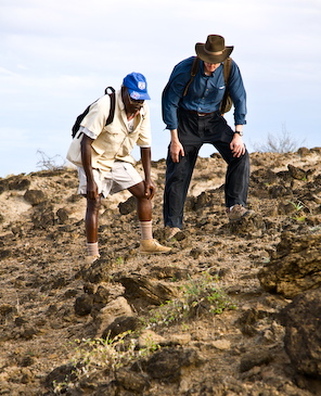
| This faux amphibolite formation, found at Nuvvuagittuq greenstone belt in northern Quebec, may be a portion of Earth's primordial crust. It dates to 4.28 billion years ago. Credit: Don Francis |
I am often asked if carbon 14 dating of fossils is reliable. People who make a habit of distrusting science point to this one method and claim that it is flawed. They seem unaware that there are many methods by which to date rocks, fossils and artifacts, and that carbon dating techniques are continuously refined. I recommend watching this video.
Even if C14 dating is wrong by 50%, we still have thousands of human artifacts that are 20 to 50 thousand years old. How can this be if the Earth is only 6000 years old? Obviously, the young earth theory has many flaws, not the least of which is the perpetuation of the idea that the Genesis creation accounts must be taken literally and Ussher's calculations using the Genesis King Lists can be used to establish the age of the earth.
Even if C14 dating is wrong by 50%, we still have thousands of human artifacts that are 20 to 50 thousand years old. How can this be if the Earth is only 6000 years old? Obviously, the young earth theory has many flaws, not the least of which is the perpetuation of the idea that the Genesis creation accounts must be taken literally and Ussher's calculations using the Genesis King Lists can be used to establish the age of the earth.
Carbon 14
Fossils and rocks are dated by chemical means that rely on
carbon dating which has a variance due to climate changes. Radiocarbon is
continuously produced in the upper atmosphere at fairly constant levels. The radiocarbon
from the atmosphere is incorporated into all living organisms on earth. Once the organisms die, the radioactive isotope decays at a known rate, so by
measuring the radiocarbon levels remaining in samples scientists can work out how
old things are. In the past this was done by burning a small sample of the
object. Today there is a better method involving plasma oxidation chambers used to oxidize the object’s surface. This slower method does less damage to the artifact.
When molten rock cools radioactive atoms are trapped inside the igneous rock. Afterwards, the atoms decay at a predictable rate. By measuring the quantity of unstable atoms left in a rock and comparing it to the quantity of stable daughter atoms in the rock, scientists can estimate the amount of time that has passed since that rock formed.
Tree rings are also helpful in dating, but the atmospheric carbon from tree rings only goes back to about 13,000 years. That is why scientists were very excited about the sedimentary cores extracted from Lake Suigetsu in Japan . These cores extend back to 52,800- 60,000 years ago. Dating of climate changes is tracked through terrestrial core samples and also the Greenland ice cores.
With carbon dating scientists provide as accurate a range as possible. Something might
be dated between 8,000 and 12,000 years old, for example. The range is because the initial amounts of
radiocarbon in the environment incorporated into growing organisms vary
slightly from year to year and between different parts of the carbon
cycle worldwide.
Other Dating Methods
Besides radiometric dating, scientists have techniques for
analyzing the breakdown of amino acids. Amino acid dating is used to estimate the age of a specimen in paleobiology, molecular paleontology, archaeology, forensic science, taphonomy, sedimentary geology and other fields. This technique relates changes in amino acid molecules to the time elapsed since they were formed.
All biological tissues contain amino acids. All amino acids except glycine are optically active, having a stereocenter at their α-C atom. This means that the amino acid can have two different configurations, "D" or "L" which are mirror images of each other. With a few important exceptions, living organisms keep all their amino acids in the "L" configuration. When an organism dies, control over the configuration of the amino acids ceases, and the ratio of D to L moves from a value near 0 towards an equilibrium value near 1, a process called racemization. Thus, measuring the ratio of D to L in a sample enables one to estimate how long ago the specimen died. The Amino Acid Racemization Dating Method has been around since the early 1970s.
Dating is also measured by changes in an object's magnetic field. When the magma from which igneous rocks form is still molten, iron-rich minerals can orient themselves in line with the local magnetic field in the same way that a compass needle does. As the magma cools, the iron crystals are frozen in their orientation in the solid rock. This provides a record of the orientation of the local magnetic field at that time. Paleomagnetics has identified 171 magnetic reversals in the last 76 million years. Geologists developed the paleomagnetic dating technique to measure the movements of the magnetic north pole over geologic time after World War II.
By using lasers researchers can measure parent and daughter atoms in extremely small amounts of matter. This Laser Ablation Spectrometer technique is being refined by NASA for use in dating rocks on Mars.
Another system of dating fossils is called “bracketing.” Fossils
are generally found in sedimentary rock rather than igneous rock. Sedimentary
rocks can be dated using radioactive carbon, but because carbon decays
relatively quickly, this only works for fossils less than about 50,000 years.
To date older fossils scientists look for layers of igneous rock or volcanic
ash above and below the fossils. By dating these surrounding layers, they can establish
the range.
This method requires understanding how the fossils are
affected by geological events like rifts, erosion, folds, etc. which
can disturb the layers. Scientists know what to look for to confirm
dating and they give as accurate as possible ranges. A certain marine fossil may be dated to between 130,000 and 124,000
years and because it is a marine fossils, we know that the area where it was recovered was once a sea.
To determine the ages of human fossils that are millions of years, scientists need an isotope with a very long half-life. Isotopes used for this purpose are uranium-238, uranium-235, potassium-40, horium-232 and rubidium-87, all found in the human body. Each of these isotopes has a half-life of more than a million years.
Dating of Humans
Two kinds of data are needed in order to obtain a date estimate from present-day Y chromosomes: information about the genetic diversity of the Y chromosomes, and a measure of the mutation rate of the loci used to determine the diversity. Over the last two decades, Y-chromosomal studies have increasingly used Y-STRs to measure genetic diversity. The commonly used Y-STRs are variable in all populations (http://www.yhrd.org/) and mutate quickly enough that their mutation rates can be measured in deep-rooting families or father–son pairs, and refined using information from levels of population variation. Thus Y-STR mutation rates are now estimated with some precision. (Read more here.)
Mitochondrial DNA L groups are extremely archaic. In human mitochondrial genetics, L is the mitochondrial DNA macro-haplogroup that is at the root of the human mtDNA phylogenetic tree. As such, it represents the most ancestral mitochondrial lineage of all currently living modern humans. All modern humans have ancestry that is traced to Africa.
To determine the ages of human fossils that are millions of years, scientists need an isotope with a very long half-life. Isotopes used for this purpose are uranium-238, uranium-235, potassium-40, horium-232 and rubidium-87, all found in the human body. Each of these isotopes has a half-life of more than a million years.
Dating of Humans
Two kinds of data are needed in order to obtain a date estimate from present-day Y chromosomes: information about the genetic diversity of the Y chromosomes, and a measure of the mutation rate of the loci used to determine the diversity. Over the last two decades, Y-chromosomal studies have increasingly used Y-STRs to measure genetic diversity. The commonly used Y-STRs are variable in all populations (http://www.yhrd.org/) and mutate quickly enough that their mutation rates can be measured in deep-rooting families or father–son pairs, and refined using information from levels of population variation. Thus Y-STR mutation rates are now estimated with some precision. (Read more here.)
Mitochondrial DNA L groups are extremely archaic. In human mitochondrial genetics, L is the mitochondrial DNA macro-haplogroup that is at the root of the human mtDNA phylogenetic tree. As such, it represents the most ancestral mitochondrial lineage of all currently living modern humans. All modern humans have ancestry that is traced to Africa.
Of special interest to biblical anthropologists is YDNA Haplogroup R1. YDNA R1b is found widely in Africa, the Middle East, Southern Europe, Spain, France, and the British Isles. The dispersion of R1b peoples took place over thousands of years, beginning about 20,000 years ago. Most biblical populations are in this haplogroup. Abraham's ancestors came out of central Africa near Lake Chad and the Upper Nile. Note the dark red spots in those places. The dark spot in central Africa is the region of Lake Chad, Noah's homeland.

Dating Scripture
Dating the Bible is as much a science as dating fossils and rocks. There are few methods that render absolute dates and scholars who study manuscripts likewise date material by
giving ranges. One attempt to scientifically date the Pentateuch relies on a chronology established through synchronisms dated by astronomy. The ranges of time for the older Biblical material tend to be greater than for the more recent material. The dating of New Testament books cannot be set with absolute confidence so scholars often give a range, but the range is a matter of a few years or a decade, not a thousand years as is more often the case with the material in Genesis and Exodus. For example, the book of Romans is typically given a range of A.D. 56-58. In the dating of the books and events described in the Bible scholars rely on data found in the Bible and on extra-Biblical sources to help narrow the range. Archaeology, anthropology and linguistics have been especially helpful sciences in the service of Biblical scholarship.


 Darwin's Doubt appeared in June 2013 and is available on

.jpg)