Followers

Showing posts with label History Channel. Show all posts

Sunday, March 31, 2013

Success of Bible Series Hard to Assess


Roma Downey, of Touched by an Angel Fame, and husband Mark Burnett said their "greatest hope" in making the History Channel series was that it would "affect a new generation of viewers and draw them back to the Bible."

The 5-episode series on the History Channel has moved from Adam and Eve to the second coming of Jesus Christ. According to the Bible scholar Peter Enns, Downey and Burnett were "focusing on the final stage of the Bible story, which is Christ’s appearance.”

He suggests that the choices they made were because they "take a celebrity approach to The Bible, and highlight the figures people know and present them in ways that make it seem that when you get to Jesus, you’ll feel that this was how it was meant to be all along.”

In a day when celebrities draw greater public attention than is healthy, the "celebrity approach" appears to be effective. However, it has yet to be seen whether the series affected "a new generation of viewers" and has drawn them "back to the Bible."

Read more reflections on the series.

How I would Have Plotted Out the Bible Series by Peter Enns

An Afterlife in Sequel Series from Mark Burnett and Roma Downey by David Hinckley

History Channel Bible Series Scores a C by Alice C. Linsley 

History Channel's Bible: Episode 2 by Alice C. Linsley

Episode 3: The Messiah Appears by Alice C. Linsley

Sunday, March 24, 2013

The Bible: Episode 4 - The King is Revealed


Alice C. Linsley


Episode four opens with Jesus healing a paralytic and a leper. He draws large crowds and the number of his disciples grows.

Among his followers is a woman named Mary. She is from Magdala near Tiberias, on the west shore of the Sea of Galilee. The notion that she was a prostitute comes from a Talmudic expression meaning "curling women's hair," which the Talmud applies to an adulteress. This is how the rumor began that Mary of Magdala was a prostitute.

Some Talmudic writings cast aspersions on the early Christian leaders. That Mary Magdalen, Jesus, and the Virgin Mary were hated by the Jewish authorities is a testimony to their prominence. All were slandered by the rabbis. Sanhedrin 106a says Jesus' mother was a whore: “She who was the descendant of princes and governors played the harlot with carpenters.” She is called "Charia" which means dung or excrement, and Jesus is called "Jeschu" which means "May his name be blotted out."

Many Jews believe that the Talmud contains truth of greater authority than the Bible. The Talmud itself encourages readers to place it above the authority of the Old Testament. We read this instruction: “My son, be more careful in the observance of the words of the Scribes than in the words of the Torah." (Talmud Erubin 21b)


The Jews divided over Jesus

With Jesus' appearing, a great conflict arose within Judaism. The Jewish rulers necessarily sought to avoid trouble with the Romans. Jesus was being hailed as the long-expected Messiah, the Seed/Son of God (Gen. 3:15) anticipated by the Patriarchs and Prophets of old. This caused division among the Jewish leaders. Some of the Jewish leaders became Jesus' followers. This is the case with Nicodemus and Joseph of Arimathea, both members of the Sanhedrin. Ari-Mathea refers to the Horite Hebrew priest line of Mathea (Mattai/Matthew).


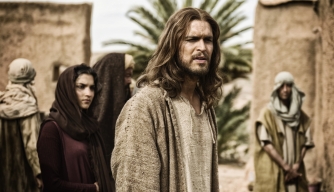
Jesus in a scene with Mary of Magdala

Even today Jews remain divided on Jesus' identity.


Jesus feeds the multitude in Galilee

A small boy gives Jesus five small barley loaves and two small fish. Jesus blessed these and fed five thousand men; not including women and children. The abundance of this provision is expressed in the twelve baskets of left over pieces. The number twelve is significant because it represents how Jesus will equip his disciples to go forward in ministry. Such feedings symbolize the Lord's power to satisfy physical and spiritual hunger.


Jesus returns to Nazareth

Jesus was born in Bethlehem, but grew up in Nazareth of Galilee. His closest followers were from Galilee and it was to Galilee that Jesus returned and met with His disciples after His resurrection. At the Last Supper He informed his disciples: "After I have been raised, I will go before you to Galilee.” (Matt. 26:32)

In 1962 excavators discovered in the ruins of a Caesarea synagogue a small 3rd to 4th century marble fragment with a list of the twenty-four priestly divisions. This lists names the places where four of the divisions resided, including Nazareth. Until the discovery of this fragment, there was no extra-biblical record of Nazareth's existence before the sixth century A.D and no identification of a priestly division at that town.

According to 1 Chronicles 24:15, Nazareth was the home of the eighteenth priestly division, ha·pi·TSETS (Happizzez). The name Happizzez is related to the ancient Egyptian word for water, specifically the life-sustaining Nile which was call Hap. Earlier in the episode Jesus walked on water and at his first public miracle he turned water to wine at a wedding in Cana.

While in Nazareth, Jesus reads from the scroll of Isaiah. He opens the scroll to Isaiah 61:1-3 and reads about the Messiah. Then he says, "Today this Scripture is fulfilled in your hearing."


Jesus raises Lazarus from the dead

Jesus' raising of his friend Lazarus in Bethany causes a furor. Bethany is a short distance from Jerusalem and the news traveled quickly to the Jewish leaders. One of the signs of the expected Messiah was that he would raise the dead.


Jesus triumphal entry into Jerusalem

When Jesus enters Jerusalem riding on a donkey he is greeted as a king according to the ancient Jebusite tradition. In the time of Abraham and David Jerusalem was a Jebusite city and it was the custom to enthrone rulers using palm branches.

To this day, the Ijebu (Jebusites) use fresh palm fronds when installing a ruler or priest. The supreme ruler of the Ijebu is called "Awujali” and his coronation ceremony involves palm branches. The present Awajali describes how the Ijebus are descended from ancient Nubians and Egyptians (Kushites), as were Abraham and David, from whom Jesus descended.

Fresh palm tree fronds are used ceremonially at the installation of chiefs and kings and are used to decorate places of worship. When the people of Jerusalem used palm fronds to greet Jesus, they hailed him as one to be enthroned according to the custom of his ruler-priest ancestors. One of those ancestors was Melchizedek, the ruler-priest of Jerusalem.


The Last Supper

Jesus gathers with his disciples to eat the Passover meal in the upper room. His words and actions express the true meaning of the Passover whereby the Lamb of God becomes the meal. Jesus takes the bread and after breaking it says, "This is my body." Then he takes the cup of wine and says, "This is my blood. Do this to remember me."

The association of blood and wine is made in the prophecies concerning Judah, who will be elevated above his brothers and from whom “the scepter shall not depart… nor a lawgiver until Shiloh comes; And to Him shall be the expectations of the nations…who will “wash his garments in wine, And his clothes in the blood of grapes” (Gen. 49:10-11).

Jesus gives Judas a fragment of bread and whispers instruction that Judas should do his deed quickly. Judas flees from the upper room and vomits in the alley under the watchful eye of Satan.


The Arrest

Jesus is arrested and condemned to death at a secret trial held contrary to the law of Israel. Nicodemus recognizes that Jesus might be the Messiah, as is being claimed by the people. The religious leaders are intent upon eliminating this threat to their power, but fear a riot that would bring down upon them the wrath of Caesar. They have no authority to execute Jesus, but persuade Pilate to punish him. When that does not satisfy Jesus' enemies, Pilate consents to Jesus' crucifixion.

In 70 A.D. the greatest fears of the Temple authorities were realized. The Temple was destroyed by the Romans, "leaving not a stone upon a stone." The distinctive and unique marriage and ascendancy pattern of Jesus' ruler-priest people also came to an end, having fulfilled its purpose in the divine Son, Jesus Christ.


Related reading:  The Genesis Begats Speak of Archaic Rulers and Jesus Christ; The Significance of Galilee in Matthew's GospelThe Talmud versus the Doctrine of the Lord; Matthew's Testimony Concerning the Empty Tomb; The Messianic Priesthood of Jesus; The Bible: Episode 3 - The Messiah Appears!; The Bible: Episode 2 ; The History Channel Scores a C; Success of Bible Series Hard to Assess


Sunday, March 17, 2013

The Bible: Episode 3 - The Messiah Appears!


Alice C. Linsley


Episode 3 is expected to see a ratings bump with the first appearance of Jesus, played by the Portuguese actor Diogo Morgado. Though Morgado does not look like a Middle Eastern Semite, the producers have the age right. Morgado is 33, the age of Jesus at his death.

Satan was played by Moroccan actor Mohamen Mehdi Ouazanni. Apparently some people believed this was President Barack Obama giving another performance.

The History Channel's third episode of the Bible takes huge leaps through history. It moves from the Babylonian captivity to the baptism of Jesus. It is dramatic and entertaining, but as with episodes 1 and 2, it lacks historical grounding and fails to present the cultural complexities of Abraham's Horite descendants, especially those taken to Babylon.


The Babylonian Captivity

The inhabitants of the southern kingdom of Judea were subjected to two deportations to Babylon. The first took place in 597 BC when Jerusalem was conquered by Nebuchadnezzar. According to II Kings 24:1-6, King Jehoiakim and the distinguished men of his kingdom were taken to Babylon, along with the treasures of the Temple and the palace.

The second deportation took place in 586 BC in the eleventh year of the reign of King Zedekiah, who was also named Mattaniah. He had formed an alliance against Babylon with the Edomites, Moabites, Ammonites, Sidonians and Tyrians. Jeremiah prophesied that all these would also experience divine judgment.  When the Babylonians entered Jerusalem, Zedekiah and his soldiers fled by night and were pursued by the Babylonians who overtook them near Jericho.

Nebuchadnezzar ordered that Jeremiah be freed from prison and treated well (Jeremiah 39:11-40:5). Jeremiah went to live in Egypt and never returned to Jerusalem.

The number of persons taken to Babylon is estimated between 14,000 to 18,000. Historians recognize that many people were not taken to Babylon. The Babylonians were mainly interested in the urban populations and the ruling classes who had skills which were useful to them. These included skills in medicine, mining, metal work, writing, languages, astronomy, prophesy and dream interpretation. In other words, skills for which the Horites were famous.

Among these distinguished men were Ezekiel and Daniel. Such men refused to compromise the truth in order to save their lives. They knew that Nebuchadnezzar was not the true deified son whose kingdom would never end (Ps. 145:13; Dan. 2:44; Dan. 4:34; Dan. 7:27). Daniel was thrown into the lions' den because he refused to worship the Babylonian king.

Later, in the time of Joseph and Mary, some of the wise Horites who remained in Babylon came to Bethlehem seeking the King who was born under the celestial sign which their wisdom enabled them to read.

 
The Scepter will not depart from Judah

In Genesis 49:10 Jacob states, "The scepter will not depart from Judah..." This is generally taken to mean that the Messiah would come from Judah, but it is possible also that it refers to an historical reality; namely, that some of Jesus' ancestors were never taken to Babylon. Jacob's holdings extended to Beersheba and the Babylonians were not interested in engaging warriors in the Negev.

The Virgin Mary's father was the Horite shepherd-priest Joachim. Amram, Moses' Horite father, married according to the Horite pattern also. He was a shepherd-priest with water sources to provide for his flocks. His daughter, Miriam, grew up around her father's water shrine and she married another Horite chief, Hur.

The name Joachim appears with these variants: Jehoiachin and Joaquin. It is a family name which reoccurs among Jesus' ancestors.

From David to the Babylonian captivity, the following ancestors are listed in Matthew 1:1-12: David, Solomon, Rehoboam, Abijah, Asa, Jehoshaphat, Jehoram, Uzziah, Jotham, Ahaz, Hezekiah, Manasseh, Amon, Josiah, and Jehoiachin and his brothers.

From the time of the exile to the birth of Jesus, the following ancestors are listed: Jehoiachin, Shealtiel, Zerubbabel, Abiud, Eliakim, Azor, Zadok, Achim, Eliud, Eleazar, Matthan, Jacob, and Joseph, who married his cousin Mary, the daughter of another Jehoiachin. She was the mother of Jesus, who is called Messiah. Mary's ruler-priest lineage has been well established.

The recurrence of the name is consistent with the Horite marriage and ascendancy pattern whereby the cousin bride names her firstborn son after her father. The Horite lines intermarried, but this does not mean that all of them were taken to Babylon as captives. The Horite shepherd-priests maintained two wives in separate households. Mary's ancestors probably withdrew to the Negev where they had family and where the Babylonians did not pursue them. It appears that some of Mary's ancestors remained free, and Jacob's prophesy came true in a literal sense.


Return from Exile

The 538 BC Edict of Cyrus the King of Persia (Iran) authorized and encouraging the Jews to relocate to Israel and rebuild the temple destroyed by Nebuchadnezzar. Some Jews returned and some did not.  Jews were living in Persia in cities like Isfahan were they had been dispersed by Nebuchadnezzar. Cyrus was therefore familiar with Jewish religious practices.

The walls of Jerusalem were rebuilt under the leadership of Nehemiah, but the reconstruction of the Temple was not complete until 517 BC. 

The historian Josephus records that Herod the Great completely rebuilt the Temple, and even replaced the foundation stones of the Temple Mount. This renovated Temple became known as Herod's Temple and was a symbol of his power. He hoped to impress the Jews by this show of piety since, as an Edomite, he was not accepted by the dominant Pharisaic group. The Edomites were Horites and well aware of the expectation of the coming King. Herod was quickly informed that Bethlehem was to be the new King's birth place and Herod's insecurities led him to destroy every threat to his power.

This is the Scripture that Herod's wise men were frantically seeking:  “But thou, Bethlehem Ephrath, though thou be little among the thousands of Judah, yet out of thee shall he come forth unto me that is to be ruler in Israel; whose goings forth have been from of old, from everlasting.”

Ephrath was the wife of Caleb and the mother of Hur (I Chron. 2:19, 50). She was a Horite.


Horite Bethlehem and Jesus' Horite Ancestry

Joseph takes Mary, his cousin wife, to Bethlehem for the census as required by the Romans. Jesus is born in Bethlehem because he is Horite through his mother. Horite does not refer to the ethnicity of the people, but to their caste. The ancient world was characterized by a caste structure. Horites were widely dispersed among many peoples across the Afro-Asiatic Dominion.

Jesus' mother's name was Miriam daughter of Joachim Son of Pntjr (Panther) Priests of Nathan of Beth Lehem. From predynastic times, ntjr designated the ruler among the Kushites. The name Panther or p-ntjr meant "God is King."

It is certain that Mary was of the ruler-priest caste because even those who hated her admit this. Sanhedrin 106a says: “She who was the descendant of princes and governors played the harlot with carpenters.”

Mary is the blessed "Woman" of Genesis 3:15.

After Jesus' birth, Joseph is warned in a dream that Herod is seeking the Child's life. Joseph takes Mary and the Child to safety in the desert and on to Egypt.

The Church Fathers saw this as a fulfillment of the prophesy "Out of Egypt have I called my Son" (Hosea 11:1). While the Christians sees Jesus as the fulfillment of this prophesy, Jewish interpretation insists that the "son" is Israel and this verse refers to the Exodus. The Evangelists John and Matthew clearly believe that Hosea 11:1 pertains to Jesus because Jesus is the fulfillment of the Edenic Promise made to their Horim.

Further, they would have known that Jesus' mother was the daughter of  the shepherd-priest Joachim and a descendant of David and Abraham. Jesus' bloodline was traced through his mother and she was Horite by blood. Bethlehem was an ancient Horite shrine city. 1 Chronicles 2:55 which says that Caleb's sons were Kenites. They were of Kenaz, a son of Eliphaz by Timna, daughter of Seir the Horite. Caleb's son Salma is designated the "founder" of Bethlehem in I Chronicles 2:51. 

The word "Horite" takes many forms: Khar, Gur, Hur, Horonaim, Horoni, Horowitz, Horim, and Hori. Hori was the son of Lotan son of Seir whose descendants were the "lords of the Horites in the land of Seir" according to Genesis 36:20-29 and 1 Chronicles 1:38-42. Lot, Lotan, and Nim-Lot are Egyptian titles. Nimlot C was the High Priest of Amun at Thebes during the latter part of the reign of his father Osorkon II.


Foretaste of Paradise Restored: The Waters Restored

Jesus' baptism in the Jordan is surrounded by a great deal of very ancient symbolism. When John baptized Jesus, the Trinity was made manifest. Up to this moment, there are only hints or glimpses of the Trinity. Abraham was visited by the Three Person God (Baal Shalisha) before the destruction of Sodom.

There is also the image of the chaotic waters at the beginning of creation being subdued again. The chaotic deep that conceal the great serpent is restored to order, and the serpent is given warning of his impending doom. The Apocalypse of St. John identifies the dragon as "that ancient serpent called the devil, or Satan, who leads the whole world astray" (Rev. 12:9, 20:2).

In Genesis 1 we read that the primal substance covering the earth was water and it was disordered, that is, it had no boundaries. God’s breath (Ruach/Logos) created order from the chaos, separating the waters above from the waters below, and the dry land from the seas. The chaotic waters are called Tehom and the ordering word of God is called Tehut. In the cosmic struggle, Tehut is victorious over Tehom. The oldest known law code is the Law of Tehut (c. 3500 B.C.) and it was said to express the wisdom of God by which boundaries were established and fixed.

This is why there are some many stories about Jesus and water. His first miracle was to turn water to wine at a wedding. He gives Peter a great catch of fish. He calms the wind and the waves. At his baptism Christ our God enters the waters which must obey him.

Jesus' Baptism marks the beginning of the promised restoration of Paradise, that is, perfect communion with God. This is why the Orthodox hold an annual blessing of the waters on the Feast of the Baptism of Christ our God.

Orthodox bishop blessing the waters

The ancient symbolism is seen in this Orthodox prayer:

That these waters may be sanctified by the power, and effectual operation, and descent of the Holy Spirit, let us pray to the Lord.

That there may descend upon these waters the cleansing operation of the super-substantial Trinity, let us pray to the Lord.

That he will endue them with the grace of redemption, the blessing of Jordan, the might, and operation, and descent of the Holy Spirit, let us pray to the Lord.

That Satan may speedily be crushed under our feet, and that every evil counsel directed against us may be brought to naught, let us pray to the Lord.

That the Lord our God will free us from every attack and temptation of the enemy, and make us worthy of the good things which he hath promised, let us pray to the Lord.

That he will illumine us with the light of understanding and of piety, and with the descent of the Holy Spirit, let us pray to the Lord.

That the Lord our God will send down the blessing of Jordan, and sanctify these waters, let us pray to the Lord.

That this water may be unto the bestowing of sanctification; unto the remission of sins; unto the healing of soul and body; and unto every expedient service, let us pray to the Lord.

That this water may be a fountain welling forth unto life eternal, let us pray to the Lord.

That it may manifest itself effectual unto the averting of every machination of our foes, whether visible or invisible, let us pray to the Lord.

For those who shall draw of it and take of it unto the sanctification of their homes, let us pray to the Lord.

That it may be for the purification of the souls and bodies of all those who, with faith, shall draw and partake of it, let us pray to the Lord.

That he will graciously enable us to perfect sanctification by participation in these waters, through the invisible manifestation of the Holy Spirit, let us pray to the Lord.

Sunday, March 10, 2013

History Channel's Bible Series: Episode 2


Alice C. Linsley


The second episode of the History Channel's Bible series is likely to have as many viewers as the first episode, which broke all 2013 records for cable programs with 13.1 million viewers.

The second segment covers the "tribes of Israel" returning to the "homeland" under the leadership of Joshua (Yeshua/Jesus). These Israelites were Horites and they were fighting other Horites to gain control of important cities in Canaan. The Horites (Horim in Hebrew) were a caste of ruler-priests who were in charge of the shrines in Canaan. These shrines were in the important cities that the warriors of Joshua attacked.


Samson

The Samson segment pointed out that some Horites took Nazarite vows to refrain from wine and beer and to leave their hair uncut. In some African languages "delila" means troublesome flirt. This story highlights the conflict with the Philistines, but belongs in the category of nationalistic literature, not history. Other stories in this category include the heroines Susanna and Esther. The Samson story sets up the story of David as a warrior who is victorious over the Philistine giant Goliath.


The Judges

Life under the "judges" (morehs) is passed over as the story moves to Saul and David. This was another missed opportunity, as here we might have learned about the authority of women in the ancient world. The judges included women such as Deborah. Judges 4:4-6 tells us, “Deborah, the wife of Lappidoth, was a prophet who was judging Israel at that time. She would sit under the Palm of Deborah, between Ramah and Bethel in the hill country of Ephraim, and the Israelites would go to her for judgment." Deborah is associated with a tamar at the sacred center between the important shrines of Ramah to the south and Bethel to the north. Ramah was the hometown of the prophet Samuel.

Abraham consulted the moreh at the oak tree in Shechem (Gen. 12:6) and likely consulted another between the shrines of Bethel to the west and Ai the the east (Gen. 12:8).

There continued to be judges after the establishment of the monarchy. Huldah is an example. She lived approximately 655 years after Deborah. We read in 2 Kings 22:14 that King Asaiah sent his priests to consult the “prophetess” Huldah. She was living in Jerusalem, in the new section. Her name indicates that she belonged to the Horite clan of Hul, a son of Aram (Gen. 10:23).

From the information available, it appears that the judges were good regional rulers. People traveled great distances to confer with them in matters pertaining to marriage, sickness, and fertility. The rulers especially relied on them in making decisions about war and alliances.The judges, unlike the ruler-priests, resided at water sources located midway between the shrine cities. This "between" position marked a sacred center, just as the tree of life was in the middle of the garden.


Missing the Horites in front of our faces

The History Channel's first episode (which I reviewed here) missed the Nilotic cultural context of Abraham and his Horite ancestors, and the second episode also fails to tell the story of the Horites. Both Abraham and Moses were Horites, as has been definitively demonstrated in analysis of the common marriage and ascendancy pattern of their ruler-priest fathers Terah and Amram.

The Horites originated in ancient Kush so Moses' marriage to a Kushite woman was consistent with the endogamous marriage pattern of the Horite rulers. The lines of Cain and Seth intermarried, as did the lines of Ham and Shem, and the lines of Abraham and Na-Hor (Horus is exalted). The marriage and ascendancy pattern of these lines remained unchanged from the earliest days of Horite rule to the time of Jesus (The Horite Ancestry of Jesus Christ).

Anthropological analysis demonstrates that Moses was indeed a direct descendant of Terah through the line of Nahor and his younger brother Abraham. The following diagram, based on biblical data, shows that Moses' father was a descendant of Seir the Horite who is named in Genesis 36.


Seir's Horite clan resided in the area of Edom. Petra was an Edomite shrine city and rivaled Jerusalem in grandeur, size and importance. It had underground water systems similar to those under Jerusalem.

The Edomites, to whom David was related, were said to have a reddish skin tone. (Edom, edo, odum, and ido are variations of Nilo-Saharan and Akkadian words for red.) 1 Samuel 17:42 describes David as ruddy or red-skinned. He is one of the descendants of the red Nubian Horites.

Red and black Nubians
reflect the great genetic diversity of Africa


Seir the Horite was the son of Dishan and the brother-in-law of Esau the Younger. Uz the Younger was Seir's grandson.


Two of Abraham's nephews were Huz and Buz (Gen. 22:20). Uz the Elder is mentioned in Genesis 10:23. His grandson, Uz the Younger, is shown in the diagram above. He is the son of Dishan (I Chron. 1:42). These are the sons and grandsons of Abraham's older brother Na-Hor. Nahor inherited Terah's kingdom in the region of the Tigris-Euphrates. 

According to I Chronicles 5:14 Buz had a son named Jahdo, and Jahdo's son was Yeshishai, the Aramaic form of Joshua (Yeshua/Jesus). This connects the name Jesus with the Horites. 


The entire Bible is about Jesus and his Horite ancestors

From Genesis to Revelation we have one story. It is about Jesus, the Seed of God first promised in Genesis 3:15, and his Horite people. The prominence of the Horites is attested by the detail provided in Genesis 36 and I Chronicles. Bethlehem, Jesus' birth place, was a Horite settlement.

Before the Exodus Horites were dispersed throughout Canaan. They served at shrines and temples throughout the ancient Afro-Asiatic dominion which extended from the Lake Chad Basin to the Indus River Valley.

The Horites are ignored in the History Channel's Bible series, and regarded as distantly related to Abraham in Bible commentaries, when in fact they are Abraham's people. Even today Jews call their ancestors "Horim".

Horite men married the daughters of Horite priests whose shrines were at rivers, oases, and wells. This is why there are many stories about men meeting their future wives at wells. Isaac and Jacob married Horite brides. Genesis 36 tells us that Esau the Younger married a Oholibamah, another Horite bride. (Oholibamah means most high tent or tabernacle, and she is a type of the Virgin Mary.) Joseph married Asenath, the daughter of a Horite priest of the Nile shrine city at Onn (Heliopolis), to which the great pyramids were aligned.

From study of the Heliopolitan cosmogony expressed in the Pyramid and Coffin texts, it is apparent that Heliopolis was both the city of the Sun and the sacred center of the primeval ocean which was called Nun. The many pillars that comprised the temple complex symbolized the connection between the waters below and the waters above (Gen. 1:7). Joshua, son (bin) of Nun, was of a ruler-priest family associated with this prestigious complex. This connection to Egypt is evident in the fact that Joshua is the only spy in Numbers 14:4-16 for whom the Arabic bin is used instead of the Hebrew ben.


Horites fighting Horites in Canaan

The Hebrews who came out of Egypt are called "Israelites" because they are descendants of Jacob who was called Israel. Jacob and his descendants were Horites. The word "Hebrew" comes from the word Ha-biru. The word also appears in ancient records as Ha-piru and O-piru. In all the texts it refers to shrine priests and temple attendants. The Hebrews who came out of Egypt were not the only Hebrews. Habiru were living dispersed among the Canaanites before the time of the Exodus. They were the priests, warriors and metalworkers who enjoyed relatively high status in the Canaanite shrine settlements.

The shrine cities in which Horites lived included Hazor, Ramah, Bethel, Jerusalem, Hebron and Beersheba. They were built on high ground and are therefore called "mound settlements" or tells. They had good water sources and were organized with separate neighborhoods for the ruling class and the commoners. Extended families lived in close proximity, usually with a common courtyard. The ruler's complex was on higher ground and included quarters for residential staff such as cooks, craftsmen, warriors and priests. The most holy shrine or small temple was often within the royal complex. The Habiru coming out of Egypt sought to displace their Habiru brethren from these cities

Joshua bin Nun led bands of Horites in forays against towns and cities in Canaan. Probably the first to be attacked was Hazor, the administrative center of an ancient territory. This is attested in Joshua 11:10: "Hazor in olden days was the capital of all these kingdoms."

Grain and other commodities were brought as tribute to Hazor and were stored there. Excavations have uncovered huge storage facilities there. These and tunnels to the subterranean water pits testify to the importance of the city.

Hazor is mentioned in 14th century BC diplomatic correspondence between the Egyptian administration and its representatives in Canaan and Amurru (Amorites) during the New Kingdom. These are called the Amarna Letters. Hazor is also mentioned in earlier Execration texts, and in 18th century BC documents found in Mari on the Euphrates River.

From the Upper Egyptian Amarna letters come evidence that the king of Hazor was under the rule of the Egyptian Pharaoh. Other rulers mentioned in the Letters include Lib'ayu of the shrine city of Shechem and Abdi-Heba who ruled in the shrine city of Jerusalem in the mid-1330s BC. Abdi-Heba hired some Apiru/Habiru (Hebrew) to serve as mercenaries. Among the Habiru were clans known for their skill in spying and combat. Others were known for their skill in metal work some of which was done at the shrine cities since these had sufficient water, and metal articles such as jewelry, mirrors, tools, weapons and sacred vessels were crafted for the rulers.

It is possible that Hazor was burned by the Egyptians with the help of Horite warriors such as Joshua and Caleb. Seti I claimed to have destroyed Hazor in a military campaign around 1300 BC. It is plausible that Horite warriors were among Seti's destroyers of Hazor and that event is remembered in the Hebrew Bible.

Archaeologists know that Hazor was destroyed by a large fire between 1400 and 1100 BC, but they do not agree on the cause of the fire. Israeli Archaeologist Amnon Tor-Ben believes that the Israelites conquered Hazor and burned it as described in Joshua 11:11- "None of the cities that stood on mounds did Israel burn, except Hazor only; that Joshua burned."  Joshua 8:28 contradicts this, reporting that Joshua also burned Ai, which was a Horite shrine in Abraham's time. Joshua 6:24 further reports that Joshua burned Jericho.

Jericho is where a second passover took place, the symbol of which is the scarlet cord. The scarlet cord is used in a priestly ritual to restore people to the community (Lev. 14:4-6; 49-52). Rahab and her household were passed over when the Horites attacked Jericho. She tied a scarlet cord outside her house so that she and all her family would be saved when the Israelites swept through that city. God redeemed their lives from destruction, and from Rahab and Salman came King David and a greater king - Jesus.

Concerning Rahab, St. Ambrose wrote that she "uplifted a sign of her faith and the banner of the Lord's Passion; so that the likeness of the mystic blood, which should redeem the world, might be in memory. So, outside, the name of Joshua [Jesus] was a sign of victory to those who fought; and inside, the likeness of the Lord's passion was a sign of salvation to those in danger." (On the Christian Faith, Book V, no. 127)


Caleb, another Horite warrior

Another great Horite leader who waged war against Canaanite cities was Caleb son of Jephunneh. Jephunneh was a descendant of Kain which is why he was called a ‘Kenizzite’ הַקְּנִזּי haKenizi (cf. Gen. 15:19). The Kenizzites were a Horite clan according to Gen. 36:11 - "And the sons of Eliphaz were Teman, Omar, Zepho, Gatam, and Kenaz.” Caleb's connection to the Kenites is made explict in 1 Chronicles 2:55 which says that Caleb's sons were Kenites. Kenaz was a son of Eliphaz by Timna, daughter of Seir the Horite (See green diagram above).

One of Caleb's grandsons was named Korah (I Chron. 2:43), which refers to the Horite priesthood. Moses' half-brother was Korah. The name means "shaved one" as Horite priests shaved their bodies before their terms of service.

From this information we may infer that Caleb also was associated with the Horites. His family settled in Bethlehem, a Horite settlement. Caleb's son Salma is designated the "founder" of Bethlehem in I Chronicles 2:51.


Better the rule of judges than the rule of Saul

Saul was from Giba (Gibeah), where they raped the Horite priest's concubine and practiced homosex. The Priest cut his concubine's body into pieces and sent pieces to the tribes saying, "Never has such a thing [homosex] been known among the Israelites." (Judges 19:30)

God told Samuel to go along with the elders' wish to have a king, but Saul was a disaster. The judges showed greater wisdom and righteousness than Saul. Saul practiced shamanic religion in that he prophesied in a frenzied state (1 Sam. 10). This is attributed to an evil spirit in 1 Sam. 18:10 - "The next day an evil spirit from God came forcefully upon Saul. He was prophesying in his house...".  Horite prophets (morehs/judges) were forbidden to prophesy in trace states. Saul also consulted mediums (1 Sam. 28:4-25), another practice forbidden to Horites.

Saul was the son of Kish/Kush (1 Sam. 14:51) and a descendant of Abraham through Jacob, Rachel and Benjamin. In Judges 1:21, we read that the men of Benjamin did not force the Jebusites out of Jerusalem. The Jebusites were their kinsmen, both being sons of Kish (Kushites). The Jebusites eventually accepted David as the new ruler in Jerusalem, and with the consecration of David of Bethlehem there was a renaissance of Horite wisdom. Much of this wisdom was consolidated and codified and is reflected in the Psalms, the Proverbs and the book of Job the Horite.


Horite Wisdom 

The wisdom of the Horites extended to medicine, astronomy, writing, commerce, navigation, natural sciences, and architecture. They were the inventors of the earliest known writing systems. They were the early scribes and wise men or prophets. 

The wisdom of the Horites was so extensive that it was unrivaled in the ancient world before the rise of Greece and much of the wisdom ascribed to the ancient Greeks was borrowed from the Horites. Iamblichus wrote that Thales of Miletus insisted that Pythagoras go to Memphis to study because the priests there were esteemed for their knowledge and wisdom. Plato studied for 13 years in Egypt under the priest Sechnuphis and his conception of the eternal Forms was based on Horite metaphysics.

The Greek word for boundaries in creation is oros or horos, a reference to the celestial archetype of Horus who was said to be the marker of boundaries. Horus was born of Ra by the Virgin Queen Hathor-Meri who became pregnant when overshadowed by the Sun, the emblem of the Creator. Hathor's totem was a cow and temple images show her holding her son in a manger. This is an early expression of Messianic expectation and it is based upon the Edenic promise that a Woman of the Horite lines would bring forth the "Seed" who would crush the serpent's head and restore Paradise (Gen. 3:15). Jesus identified Himself as that Seed in John 12:24 when he told his disciples, "Truly, truly, I say to you, unless a grain of wheat falls into the earth and dies, it remains alone; but if it dies, it bears much fruit."

In the works of Plato and Aristotle horos or horismos refers to landmarks, boundaries and categorical limits. From Horus come the words hour, horoscope, horologion, horotely and horizon. The association of Horus with the horizon is evident in Har-ma-khet, meaning "Horus of the Horizon". Horus was said to control the winds and to establish the cardinal points. The stars, planets and constellations were fixed in place by Horus, and as Ben Sira reminds us, not one of the heavenly bodies "has ever got in the way of another, and they will never disobey his word." (Ecclesiaticus 16:24)

Horus shrines and temples were located at major water systems and Horus ruled the waters. This is why the Horus name appears in the word for river in Hebrew and Arabic (nahar/nahr) and in Aramaic (nehar). Abraham’s older brother controlled commerce on the Tigris River between Ur and Haran. His Horus name is Na-Hor (Gen. 22:20).

Monday, March 4, 2013

History Channel Scores a C


Alice C. Linsley


Dramatic and conventional in its portrayal... that's how I characterize the History Channel's presentation of Genesis and Exodus. Did it present Abraham's Horite people faithfully? Not at all. This was a rehash of old interpretations that fail to tell the whole story. In other words, a missed opportunity.

The program clearly stirred interest because after it aired this blog had over 300 reads in less than 30 minutes. The higher traffic continued the following day. People arrived from different search engines with questions like "Who was Abraham's firstborn son?" and "What color was Abraham?"

If you watched the program, try to imagine these changes:

Cain establishes a city and so does his brother Seth. These are great rulers over fertile lands in what is today the Sudan and central Nile Valley.

Noah's ark has a wooden frame and is covered with bundles of reeds. No Siberian tigers on the ark. The ark floated in the area of Lake Chad and came to rest on a mountain in East Africa.


Abraham, the youngest of Terah's three sons does not look like a European Jew, but instead has a reddish brown to black skin tone because he is of Kushite ancestry. Lot, Abraham's nephew, would have a similar look.

Lot's choice to move to the plain was motivated by greener pastures for his flocks, but it was regarded as a bad decision because it broke with the pattern of his Horite ancestors who inhabited the higher terrain. This was not a conflict between rural and urban dwellers, as presented in the dialogue.  Horites also lived in the shrine cities which were on hills or mounds (tells).

Abraham and Sarah are much richer than portrayed. He is recognized as a "prince" among the Canaanites (Gen. 23:6). They are of the ruling class.  Hagar and Masek, though concubines, are royal handmaids.


JOE ALBLAS / © LIGHTWORKERS MEDIA / HEARST PRODUCTIONS INC.
Abraham is played by Gary Oliver and Sarah by Josephine Butler


Abraham is not a nomad. He does not move seasonally with his entire tribe. His two wives reside in semi-permanent settlements on a north-south axis. Sarah resides in Hebron and Keturah in Beersheba to the south. These settlements mark the northern and southern boundaries of Abraham's territory. The wives, children, and herds rarely move location. Abraham and his personal band of warriors are the ones who move within the territory.

Before Sarah loses hope and gives Hagar to Abraham, he has already married his second wife, Keturah. She gives birth to Abraham's first born son Joktan (Yaqtan). Joktan is the "father" of the Dedanite traders and scribes.


God's promise that Abraham will have descendants more numerous than the stars finds fulfillment through his 9 sons, some of whom are Egyptians (through his concubine Hagar), Arabians (through his cousin wife Keturah), Arameans (through his concubine Masek) and Jews (through his half-sister wife Sarah).

Here is a list of the sons born to Abraham by his two wives and his two concubines:

Sarah, daughter of Terah (Gen. 20:12)
Isaac (Yitzak)

Hagar the Egyptian
Ishmael (Yismael), who was Egyptian since race/ethnicity was traced through the mother, as is true even today among Semitic peoples.

Keturah, daughter of Joktan the Afro-Arabian (Gen. 25)
Yishbak
Joktan (Yaqtan) – probably Keturah’s first born son
Midian
Zimran
Medan
Shuah

Masek, the Aramean
Eliezar of Damascus


The Sign of the Cross

One detail that the producers did get right is the T-shaped mark on Sarah's forehead. These are called Tilakam, Tikuli, Tilak, Tikli, and Tilaka among Kannada, Tamil and Telugu peoples and were worn by married Dravidian and Afro-Arabian women in Abraham's time. However, because of Sarah's high status her mark would not have been a smudge, but a well executed scar raised on the forehead by applying ashes to the original wound. (Dravidian is related to the languages of Chad, Sudan, Egypt and Somalia. Read more here.)

The T was a sacred symbol of the oversight of the Creator. The Tau and the cross are already evident among Abraham's Horite people who expected a woman of their blood lines to conceive by the overshadowing of the Creator whose emblem was the Sun. She would bring forth the "Seed" of God in fulfillment of the Edenic Promise (Gen. 3:15). This is the origin of Messianic expectation.

Another mark on the married woman's forehead was a solar tattoo. The oldest evidence of this is found on the mummy of Amunet, devotee of Hathor (2160-1994 BC). Hathor was the virgin mother of Horus. As Abraham and Sarah were Horites, it is likely that Sarah's mark was like that of Amunet. This mark on Sarah, their Horite beliefs, and the miraculous events surrounding Isaac's birth, suggest that Abraham may have believed Isaac to be the promised Seed. Here again we glimpse the solar imagery of the Proto-Gospel.


Related reading:  History Channel's Bible: Episode 2; Episode 3: The Messiah AppearsThe Ethnicity of Abraham and DavidWhat Language Did Abraham Speak?Reality is Cross Shaped; The Pattern of Two WivesKushites WivesAbraham's Sons; Was Keturah Abraham's Wife?; The Afro-Arabian Dedanites; The Conversion of Hagar; Lot's Story; Sarah's Story