Followers

Showing posts with label Noah's sons. Show all posts

Thursday, March 24, 2022

An Anthropologist Looks at Genesis 10


Dr. Alice C. Linsley


The author of Genesis 10 connects the populations of his time period to the three sons of Noah. He proposes how Earth came to be repopulated after a worldwide flood (Gen. 10:32). Though a naïve conception of human history and diversity, this early ethnography is remarkable. E.A. Speiser described the Table of Nations “as a pioneering effort among the ethnographic attempts of the ancient world.” (The Anchor Bible Commentary on Genesis, p. 71.)

The names listed in Genesis 10 represent ethnicities, city-states, kingdoms, and regional populations. The populations may generally be classified as Nilotic, Arabian, Mesopotamian, Eurasian, and Levantine. The table artificially lists seventy populations. However, none of the populations are identified as castes and the ancient world had many castes: tanners, metalworkers, priests, etc.

It is assumed that Eber (Gen. 10:21-3) is the eponymous father of the Hebrew people. This represents an attempt to narrow the scope of the narrative, as is done later with Jacob who is identified as the eponymous father of the Israelites. It is clear, however, that there were many Hebrew clans other than Jacob's clan.

The English word “Hebrew” is derived from the ancient Akkadian word for priest abru, and the ruler-priest caste was called Abrutu. Variant spellings include Habiru, Hapiru, and ‘Apiru. There is no reason to dismiss Noah and his sons as Hebrew. Genesis 4-11 chronicles the Hebrew caste’s dispersion out of Africa in the service of kingdom builders and high kings. Hebrew were living in Africa, Arabia, Mesopotamia, and Southern Europe before the time of Abraham. There is evidence that some Hebrew settled in the Indus Valley, and that their influence extended as far east as present-day Cambodia. Horite symbolism has been found at Angkor Wat. "Anghor Wat" refers to the settlement or temple complex dedicated to Horus. Ankh-Hor means "May Horus Live!" or "Life to Horus!"


This Anghor Wat relief depicts Ra's solar boat with Horus perched as a falcon on the mast.


The Indian archaeologist B. B. Lal contends that several megalithic sites of ancient Nubians resemble the cemeteries of early Dravidians found all over Western India. The similarities extend from the subterranean structures found near them to the identical earthenware ring-stands used by the Dravidians and Nubians to hold pots.

The connection between the riverine civilizations of the Nile Valley and the Indus Valley is indicated by comparing the Nilotic and Indus pottery inscriptions in which 17 figures are virtually identical.


The Hebrew Movement Out of Africa  

Genesis chapter 10 continues the theme of an eastward movement out of Africa. Adam and Eve went east. Cain went east, and now we read about the dispersion of Noah’s descendants into areas outside of Africa. This aligns with genetic studies of peoples coming out of Africa through the Middle East, a staging area for the Neolithic Agricultural Revolution, and the region where the earliest known kingdoms were established. This is especially evident in the case of the Kushite kingdom builder Nimrod (Gen. 10: 8-12).

Nimrod is also spelled Nimrudj or Nimrwd. In 2010, the 4400-year tomb of a purification priest named Rudj-ka or Rwd-Ka was found at Giza. It dates to between 2465 and 2323 B.C. His high status is evident in the quality of his stone tomb. He served Pharaoh Khafre who ruled from 2520 to 2494 B.C., before the time of Abraham. The ancient Egyptian word rwd/rudj means ball, sphere, or the Earth.

Likewise, the name “Lot” is found among the Libyan rulers of the Nile: Takelot I (885–872 B.C.) and Takelot II (860-835 B.C.), and at least two were called Nimlot. An inscription on the statue of Nimlot B describes him as “Nimlot true of voice,” meaning justified. The ancient Egyptian is Maa Kheru (mꜣꜥ ḫrw), a typical epithet applied to the righteous deceased who Horus presents to the Heavenly Father.

Nimrod, a son of Kush, built a kingdom in Mesopotamia. He is the connection between the Proto-Saharan ruler Noah and Abraham. We first meet Abraham in Mesopotamia because he is a descendant of Nimrod.


A Genetic Mosaic

After the Last Glacial Maximum (LGM) population movements created a striking genetic mosaic with distinct sex-based genetic differentiation. Y-DNA traces genetic inheritance through the paternal line and mitochondrial (mt) DNA traces genetic inheritance through the maternal line. Were it possible to study DNA from the different peoples listed in Genesis 10, we would find that the majority could be classified in Y-DNA Haplogroups R1a, R1b, and J, and mtDNA Ls, M, N, H, and R.
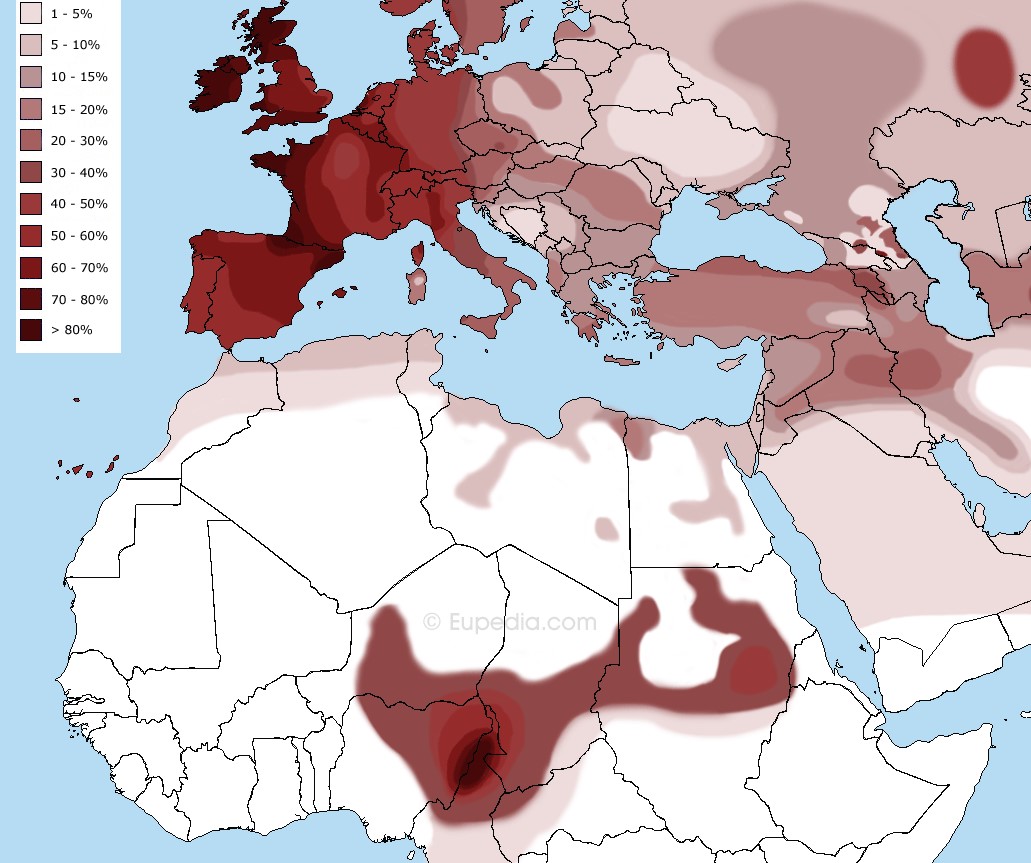


Genetic studies have established a connection between some populations of Genesis 10 and some populations of Noah’s homeland in the region of Lake Chad. This map shows the range of Y-DNA R1b peoples in red. However, the dispersion of the R1b populations took place long before the time of Noah and was complete by 40,000 years ago.


Towers Were Used for Astronomical Observations

Although the Tower of Babel story does not specifically mention astronomy, commentators on Genesis 10 often introduce speculation about astrology, an occult practice. This is based on a false belief that the science of sidereal astronomy had not yet developed. However, astronomy was familiar to the Nilotic Hebrew, as noted by Plato who studied under a Nilotic priest for 13 years. Plato claimed that the Africans had been tracking the heavens for 10,000 years. He knew about Earth's Great Year, also called the "Platonic Year." This is the duration of time that it takes for Earth to complete the cycle of axial precession (approximately 25,000 years). This precession was known to Plato who defined the "perfect year" as the return of the celestial bodies (planets) and the diurnal rotation of the fixed stars to their original positions.

In 241 B.C., the priest Manetho reported that Nilotes had been “star-gazing” as early as 40,000 years ago. By 4245 BC, the priests of the Upper Nile had established a calendar based on the appearance of the star Sirius and had been tracking this star for thousands of years, connecting it to seasonal changes affecting the Nile Valley. Doubtless, the Hebrew priests living in Mesopotamia were recognized for their astronomical observations from fortified high places and towers.


Related reading: An Anthropologist Looks at Genesis 9; Noah's Sons and Their Descendants; Nimrod and the Nile-Indus ConnectionHaplogroups of Interest to Biblical Anthropologists; Was Akkadian the Language of the Indus Valley Civilization?; Our African Ancestors


Tuesday, May 19, 2020

The Messy Transition of Genesis 6


Alice C. Linsley

Genesis chapters 1-3 are creation and origin stories that are capped by the king lists of Genesis 4 and 5. Genesis chapter 6 is a messy transition from the king lists to the flood narratives of Genesis 7-9. A detailed reading of chapter 6 calls attention to contextual incongruities. Contextual incongruities are evidence of layers of interpretation from different cultural and historical contexts. Here are some examples:

1. God promises to wipe out all people on earth except for Noah’s immediate family, yet Genesis 9 lists Noah’s many descendants and Genesis 10 lists some populations older than the time of Noah.

2. Noah is presented as having only one wife, yet the rulers of Noah’s lineage had two wives.

3. The “covenant” language of Genesis 6:18 reflects a theological development of a much later period than Noah.

4. Historical persons of the archaic world are recast as mythical beings (“Nephilim”) by a late hand on the material. Fallen angels are said to have had sexual relations with humans. This indicates that this chapter has been shaped by a third-century rabbinic source. The historical significance of deified sons is disguised by rabbinic mysticism. The incongruity is evident in Genesis 6:1-4. Here the Nephilim are posed as fallen angels and at the same time they are described as “heroes of days gone by, men of renown.”

The high kings of the ancient Nile were called “sons of God” and this expression is parallel to the “daughters of men.” Such parallelism is typical of Semitic literature. Apparently, the opening material was originally a continuation of the accounts of the ruling lines of Cain and Seth.

The attempt to portray the archaic rulers as an alien supernatural element called “Nephilim” fails because the Bible makes it clear that these are mortal men whose descendants were living with the Horite Hebrew in Hebron. Number 13:33 identifies the Nephilim with the people of Anak. Anak was a ruler, and his “Anakim” people are associated with Kiriath Arba, an ancient name for Hebron, where Sarah resided. Her settlement marked the northern boundary of Abraham’s territory in ancient Edom.

Unfortunately, most Bibles translate Nephilim as “giants” when it should read “great ones.” Nephilim comes from the same root as the Aramaic npyl (naphil) which means great. This is equivalent to the Arabic nfy, meaning hunter. It is said concerning Nimrod that he was a “mighty hunter” or a “mighty man” before the Lord (Gen. 10).

If the word nephilim came from Hebrew naphal, it would not be spelled as we find it. The word nephilim to mean "fallen ones" would be spelled as nephulim. Likewise, nephilim does not mean "those who fall" or "those who fall away" - that would be nophelim. The only way in Hebrew to get nephilim from naphal by the rules of Hebrew morphology would be to presume a noun spelled naphil and then pluralize it. However, this noun does not exist in biblical Hebrew.

However, in Aramaic the noun naphil does exist. It means "giant," making it easy to see why the Septuagint translated nephilim as gigantes ("giants"). The period of 300-200 BC includes the Greek Old Testament (Septuagint) and the First Book of Enoch, both of which gave rise to the idea of fallen angels mysteriously mixing with humans.

The Books of Enoch are 1 Enoch, also known as the "Ethiopic Apocalypse of Enoch" and the Slavonic version that is referred to as 2 Enoch or "The Book of the Secrets of Enoch." 1 Enoch was originally written in Hebrew or Aramaic (probably both), but the only complete copy known today is in Ge'ez, a language of Ethiopia. 1 Enoch dates to no earlier than around 200 BC. The pertinent chapters are 1-36 (The Watchers) and chapters 72-82 (The Astronomical Writings). These books fit Risto Santala's description of literature that, like "the esoteric Qabbalah wandered off the right track in creating a very extensive literature on doctrines of angels and mysteries..."

As for the historically significant elements in chapter 6, we have the three-clan confederation of Noah’s sons: Shem, Ham and Japheth (Gen. 6:10). However, the rabbinic editor seems aware of the marriage and ascendancy pattern of these descendants of Cain and Seth. Noah is assigned but one wife, as are his sons. Yet the rulers among Abraham's ancestors had two wives.

Noah is said to be a good man, whose righteousness exceeds all his contemporaries. Yet he is heartless when it comes to his grandchildren. He saves animals, but his grandchildren are left to die in the flood. Apparently, not all died because in Genesis 9:25 we read that Noah curses Canaan, one of his grandchildren.

It is true that during the time that Noah lived (5000-3000 BC) there were periods of flooding. This has been confirmed by the discovery of boats and boat images in the Sahara. The period is called the “African Humid Period” or “the African Aqualithic.”

Archaeologists have also found evidence that the Proto-Saharan rulers like Noah kept royal menageries of exotic animals. The oldest known zoological collection was found during the 2009 excavations at the shrine city of Nekhen on the Nile. It dates to c. 3800 BC.

If we extricate the historical from the later mystical interpretation, we find that Genesis 6:1-4 describes the early kingdom builders as the “mighty men of old, as “heroes” and “men of renown.” They constructed temples, palaces, fortified shrine cities ("high places"), great stone monuments, and pyramids. They were patrons of the arts, science, agriculture and architecture. They controlled commerce on the major water systems and collected taxes and tribute. The estimated wealth of the High Kings of Egypt exceeds the combined estimated wealth of Andrew Carnegie (1835-1919) and J. P. Morgan (1837-1913) at the time of their deaths, which is 675 million. Gold mined by the Egyptians was used to make precious objects found as far from Egypt as Southern China and Ireland.

Evidently, Noah was a ruler during the African Humid Period, a time of flooding across the Fertile Crescent. As a ruler he had access to more than one boat. He and his royal household would have been the first to be saved in the event of a catastrophic flood. He had the resources to save the animals of his royal menagerie. These elements of the flood narratives can be verified by anthropological and archaeological research.


This photo is of a boat constructed of bundles of hollow marsh reeds over a wood frame. Genesis 6:14 states Noah's ark was constructed of גפר (gofer/gopher), which is the word used to describe the reed basket in which Moses floated on the Nile. The hollow reeds make the boat extremely buoyant. Such vessels are still constructed by the marsh Arabs of Iraq and by Nilotic fishermen.


Tuesday, July 24, 2018

Where Dwelleth Japheth


"God shall enlarge Japheth, and he shall dwell in the tents of Shem." Genesis 9:27


Tent dweller in Turkey

Alice C. Linsley

"May God enlarge Japheth, and let him dwell in the tents of Shem, and let Canaan be his servant.” (Gen. 9:27) As the tents were the possession of the wives, and Jewish ethnicity is traced by the maternal line, the people of Japheth are counted among the Jews' ancestors.

Hebrew “his tent” is written as אָהֳלוֹ (ahalo) in Genesis 31:25. This provides a significant anthropological clue. As the Hebrew linguist Jeff Benner notes,
"The tents of the Bedouin were not the property of the men, but instead the wives. In their culture, it is not 'his tent,' it is 'her tent.' Assuming this is not only true for the modern day nomads, but also the Hebrew nomads of the Bible, it would explain the spelling of אָהֳלֹה (ahaloh). The vowel pointings, which are the dots and dashes above and below the Hebrew letters, were invented only 1,000 years ago. So if we remove these vowel pointings we have the word אהלה (ahalah), which means 'her tent.' Noah was not sleeping off his drunken stupor in 'his tent,' because he did not own a tent. He was sleeping in 'her tent,' the tent owned by his wife. Genesis 24:67 reads, “And Isaac brought her [Rebekah] into his mother Sarah's tent…”
Of the three sons of Noah named in the Bible we are given more information about Shem and Ham, whose lines intermarried, than about Japheth/Yaphet. It is widely held that he represents Noah's non-Jewish descendants or that he is the progenitor of the Gentile peoples. However, it is more likely that the people of Japheth are Hebrew Europeans whose ancestors are in Haplogroup R1b.

Noah's three sons formed a 3-clan confederation. That was how alliances for mutual defense were formed before the time of the first Temple. Other 3-clan confederations include Jubal, Jabal and Tubal; Abraham, Nahor and Haran; Moses, Korah and Aaron, and Uz, Buz and Huz. One of the more revealing confederations involves these names: Og, Gog and Magog.

Deuteronomy 3:10 speaks of an Amorite ruler named Og. His territory included "the cities of the plateau, all Gilead, and all Bashan as far as the cities of Salecah and Edrei."

The Magyar of Hungary claim to be related to Noah through Japheth. They claim a relationship to Mag-Og, meaning son/seed of Og. In the Turkish language, oğul means son.

The Hungarian poet, Endre Ady, begins one of his poems: "I am the son of Góg and Magóg..." and there is a linguistic relationship between ancient Akkadian words and Hungarian words. Akkadian was the script of Nimrod's kingdom. Abraham was a descendant of Nimrod, a son of Kush (Gen. 10).

The name Og appears in Scottish history. There was a ruler called Angus Og (1299-1330). During the 1200's the Star of David appeared on Scottish coins. The Scotch-Irish term for son - Mac/Mc - is the equivalent of the Hungarian mag.

The peoples of the British Isles have a custom of naming twins in a similar way. C.S. Lewis mentions this in The Horse and His Boy. There is Dar and his brother Daren, and Cor and his brother Coran.

The names of these three sons tells us a great deal about them. SHM is related to the word for Sun (Hebrew - shemesh; Arabic - shams). HM refers to dark color, or skin burnt by the Sun, and his name in the Masoretic text is Cham which is related to the feminine word for the Sun in Hebrew: chammah. Yaphet has the initial Canaanite Y, a solar symbol that indicates divine appointment. All three sons of Noah are thereby identified with the solar symbolism of the Proto-Gospel

The Sun was the symbol of the Creator (Ra/Ani) and his son (Horus/Enki). So, it appears that the three sons shared a common religion and an aspect of that religion was the belief in a Father God who shares his glory with his son.

In Genesis 9:27, we are told that "God shall enlarge Japheth, and he shall dwell in the tents of Shem." This doesn't support the view that Japheth and Shem were separated by great distances. It appears that the two lineages dwelt together and intermingled. The descendants of both Japheth and Shem are found in Europe, Turkey (ancient Anatolia), Pakistan, Bactria, Mongolia and the Upper Nile. This explains the linguistic similarity between some Afro-Asiatic/Semitic names and names/titles in Turkish, Pashtun and Mongolian, including Jochi (Joktan/Yaqtan), Beri, Malik and Khan. Khan was originally a title, meaning king. Today it is a common surname in Turkey, Afghanistan, Pakistan, India and Mongolia. The biblical equivalent is Cain or Qayan. Some of the Pashtun tribes adopted Malik as the ruler's title instead of Khan. Malik is equivalent to the Afro-Asiatic/Semitic Melek, meaning king.


Is this a descendant of Japheth on a Bactrian camel?


Another look at the peoples listed in Genesis 10 reveals that the conception of Japheth as the progenitor of the Gentile nations is erroneous. Genesis 10:2-5 tells us that the sons of Japheth were:
"Gomer, and Magog, and Madai, and Javan, and Tubal, and Meshech, and Tiras. And the sons of Gomer; Ashkenaz, and Riphath, and Togarmah. And the sons of Javan; Elishah, and Tarshish, Kittim, and Dodanim. By these were the isles of the Gentiles divided in their lands; every one after his tongue, after their families, in their nations."
Here the Ashkenazi are listed and they are regarded as Jews. Riphath is mentioned in reference to Og, the king of Bashan, who the Deuteronomist describes as the last of the rulers of Riphath (called Rephaites in some texts). All of these peoples are in Haplogroup R1a which dispersed widely across Eurasia and Central Europe between 5000 and 1000 years ago.

Before that, their ancestors in Haplogroup R1b widely dispersed, and this before the time of Noah (c. 4000 BC). Among the R1 rulers were the "mighty men of old" who dispersed into southern Europe, the Tarim Valley of China, and eventually into the British Isles.


The dark red spot in Central Africa is Noah's homeland near Lake Chad.The density there (60-100%) is about the same as in the British Isles. About 70% of native British men are in Haplogroup R1b and share an genetic ancestry with the Proto-Saharan ruler Noah.

I suggest that the movement of Noah's sons is to be associated with one of the later movements out of Africa associated with the Kushites. The term is anachronistic, since the first Kush we encounter in the Bible is Noah's grandson, the father of Nimrod, and this ruler would have lived after his Proto-Saharan ancestors had already begun to move out of central Africa into the Nile and the Levant.

It also appears that it was the marriage and ascendancy pattern of the Proto-Saharan and Kushite rulers that drove their expansion out of Africa.

Earlier movements out of Africa can be explained by the presence of genetically related peoples in Europe long before Noah's time. Between 20–50 thousand years ago there appears to have been "a robust recovery of non-Africans from extremely low values of male effective population size during the OA bottleneck (Lippold et al. 2014)." This from a study of the Human Y chromosome flow which states:

Consistent with generally higher genetic diversity in African populations, the highest number of deeply splitting branches of human Y chromosome tree can be found in African populations (Cruciani et al. 2011; Mendez et al. 2013; Poznik et al. 2013; Wei et al. 2013). The extant variation in other continents is mainly restricted to three branches of the M168 clade: D, C and F (Hallast et al. 2015; Karmin et al. 2015; Poznik et al. 2013, 2016; Scozzari et al. 2014; Wei et al. 2013). Genetic variation within each of these three clades coalesces to a single founding lineage within 40–60 KYA time depth, consistent with the Out of Africa (OOA) dispersal model (Stringer 2002). In addition to these three clades, the populations of Near East and Europe also show the presence of young sub-clades of haplogroup E which are likely to reflect recent episodic gene flow from Africa within the last 25 KYA and a range expansion of a sub-clade E2a1-V13 in Europe within the last few thousand years (Cruciani et al. 2007)

A closer look at the biblical data explains why Japheth is thought of as the “Father of the Europeans” or the founder of the "Japhetic" nations. However, he and his offspring are relatively late comers to Eurasia and Central Europe. The peoples who come to be called "Gentiles" were already in Europe about 40,000 years ago. Genesis 9:27 refers to the later spreading out of the territory of Japheth in the tents of Shem. The relationship of the lines of Japheth and Shem reflects the complex and intricate connection between the earlier history of the R1b and R1a peoples. And it should not be forgotten that the lines of Shem and Ham also dwelt together and intermarried.


Related reading: Three-Clan ConfederationsCain as Ruler; Sub-Saharan DNA of Modern Jews; The Lines of Ham and Shem Intermarried; Noah's Descendants; The Solar Symbolism of the R1 Peoples