Followers

Showing posts with label Ruth. Show all posts

Monday, January 20, 2020

The Extent of Edomite Territory


Alice C. Linsley

The terms Edom and Idumea refer to the same territory; the "land of red people." The extend of that territory was much larger than is generally shown on maps.

Note that Idumea and Edom are shown on this map as separate territories. However, they were one territory in Abraham’s time and Edom extended as far north as Hebron, where Sarah resided.

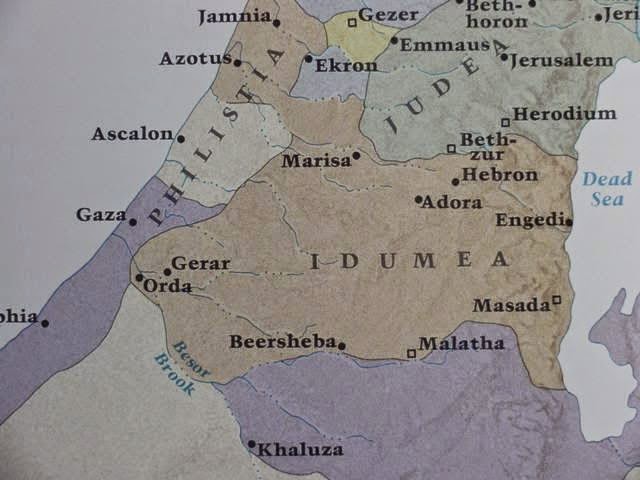


Compare the map above to this map which shows Idumea extending as far north as Hebron.


Data from the book of Ruth indicates that the territory of the Edomites extended even to Bethlehem where Boaz lived.


Boaz is derived from the Akkadian Bu-Uz-Kir which means “being of the land belonging to Uz.” Job was of the clan of Uz. According to Genesis 36, the clan was named for Uz, the grandson of Seir the Horite Hebrew ruler of Edom (see diagram above). This is significant because it means that the Hebrew clans of Edom held land in Bethlehem.

The word Bo, Bu or Ba is found many Afroasiatic languages. For example, BoSede in Yoruba means “Born on Sunday” or “Being of Sunday.” Ba is a Fula prefix indicating a person's homeland or point of origin.


Related reading: The Chiefs of Edom; Horite Hebrew Territory; Aaron was Buried in Edom; Hebrew Priests in Aram, Edom, Judah, and Moab


Friday, July 24, 2015

Mother's House and Father's House


East African village seen through the cattle kraal.

Dr. Alice C. Linsley

Some scholars have wondered why Rebecca ran to her mother's house to announce the marriage proposal from Isaac (Gen. 24:28). One explanation is that the mother's house was responsible for the necessary arrangements to set up a new household for the bride-to-be. The father's house was responsible for the legalities involving dowry, inheritance, and property. Running to her mother's house expressed Rebecca's willingness and eagerness to be married.

In the Bible the "mother's house" and the "father's house" represent distinct right and responsibilities. The mother's house is where women gather to plan weddings and ceremonies for the girls. coming of age. The father's house is where the elders of the village gather to deliberate on matters such as hunting, defense of territory, marriage alliances and dowries. However, the women take care of the practical arrangements for weddings and the necessities to set up a new household.

A woman who was forbidden to marry or remarry was told to return to her father's house. This is what Judah told Tamar when he refused to provide her with another son. On the other hand, Naomi hoped that her two daughters-in-law would remarry, and she sent them back to their mothers (Ruth 1).

The Bible is pointing us to a village arrangement in which the women gathered in the house of the chief's principal wife and the men gathered in the house of the chief. The custom is found even today among Africans and in some Eurasian villages.

Among African peoples, rites of passage included circumcision, scarification, naak, and the building of small huts. Before girls come of marriage age (13-15 years) they build their own huts next to the huts of their mothers. They mimic female adulthood until they marry, at which point they take down their small hut and move into a larger hut built by their husband and located with his kinsmen (patrilocal residence).

Similarly, young men celebrate their approaching manhood by building a small hut next to their father's hut until they take a wife, at which time they build a larger hut in the kraal.


South African women preparing the bride
Credit: Monica Dart


This Xhosa bride wears a sheet to cover her secrets.

A blanket or sheet covering is an ancient practice associated with marriage.
Ruth sought marriage to Boaz by covering herself with his blanket.


This practice of building up a house is more than building a place to live. It is about building a lineage. The book of Ruth alludes to this. Naomi tells her widowed daughters-in-law to return to their "mother's house" so that they can prepare to remarry and have families.

Contrast this to the story of Judah and Tamar (Gen. 38). Judah's sons who were married to Tamar die one after the other. He refuses to fulfill the law of levirate marriage, fearing that he might lose another son. Judah tells Tamar to return to her "father's house" which is to say, "You will remain a widow and childless."