Followers

Showing posts with label Edom. Show all posts

Saturday, May 11, 2024

The Hebrew Rulers of Genesis


Naamah named her firstborn son Lamech after her father, Lamech the Elder (Gen. 4). Lamech the Younger was one of Methuselah's sons (Gen. 5). 


According to the Bible scholar Umberto Cassuto, the name "Lamech" is related to the Akkadian word lumakku, meaning “priest” (Commentary on Genesis, Vol. 1, p. 233). Further, Lamech is related to the Akkadian word malku (ruler-priest). It also is related to the Hebrew word melek, meaning “king”. 


Dr. Alice C. Linsley

The men listed in the Genesis “begats” were of high social standing in the ancient world. They were rulers, priests, and kingdom builders. Their successors ruled according to a long-established ascendancy pattern. Having an heir was extremely important, and two wives increased the likelihood of having a male heir. The Hebrew rulers who controlled territories maintained two wives in separate settlements usually on a north-south axis.

The marriages of the Hebrew rulers cannot be considered "biblical" and cited as models for Bible believers today. The Hebrew marriage pattern pertains to kingdom builders long before Judaism emerged. These were regnal marriages involving a bride and a groom from related Hebrew clans or between half-siblings. Royal marriages are not like the marriages of commoners because of political complexities and the need for an undisputed heir. Further, the kingdom to which Christians are committed is the Kingdom of Christ our God.

The firstborn sons of the two wives had different rights according to the Hebrew hierarchy of sons. The firstborn son of the first wife was the proper heir to his father’s holdings. The firstborn son of the second wife (usually a cousin) was to serve in the territory of his maternal grandfather.

The two-wife pattern pertained to rulers only, not to lower status Hebrew men. Two wives helped to "build up the house" of the ruler and strengthened the house of the cousin bride's father. The firstborn son of the first wife (usually a half-sister) ascended to rule in place of his father, and the firstborn son of the second wife (usually a patrilineal cousin) became a high official in the service of his maternal grandfather.


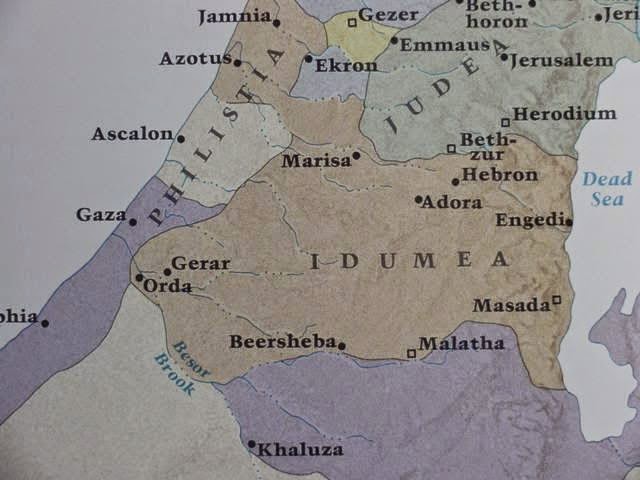
The early Hebrew regarded territorial expansion and many children as a sign of the Creator’s blessing upon them. This is evident in Abraham’s petition before God concerning his need for a proper heir (Gen. 15) to rule over his territory in ancient Edom. That territory extended between the settlements of his two wives, Sarah in Hebron and Keturah in Beersheba. Both locations are shown on the map above. 

Thursday, July 29, 2021

The Wives' Settlements Mark the Boundaries


Alice C. Linsley

Abraham is often portrayed as a nomad contrary to the evidence that he was a ruler over a territory in ancient Edom. His territory extended on a north-south axis between the permanent settlements of his two wives: Sarah and Keturah. Sarah resided in Hebron and Keturah in Beersheba. Both settlements are shown on this map.


The Greeks called ancient Edom Idumea, meaning "Land of Red People."
Note the location of Hebron and Beersheba on a north-south axis, 
and the water system of Engedi and the wells in Gerar on an east-west axis.


Abraham divided his time between the settlements of his two wives. Abraham appears to have spent his old age in Beersheba. Genesis 22:19 reports that after offering Isaac on Mount Moriah, Abraham did not return to Hebron. He went to live in Beersheba with his cousin-wife Keturah. There he built an altar and planted a terebinth. In other words, Beersheba was both a shrine and a border settlement. A terebinth marker grew at the north end of Abraham's territory in Mamre (Gen. 12:6) and after Abraham's formed a treaty with Abimelech at Beersheba, he planted a terebinth there at the southern end of his territory. Trees are often mentioned as territory markers in Genesis.

Abraham's settlements were guarded by trained warriors born to Abraham's household. Genesis 14:14 mentions an army of 318 warriors. The settlements included servants, herdsmen, hunters, stonemasons, tanners, potters, bakers, metal workers, physicians, and scribes. Abraham was a man of great wealth and prestige. The Hittites of Canaan recognized him as "a great prince among us" (Gen. 23:6).

Settlements required permanent water sources. The major water systems of Abraham's territory included the Well of Sheba (Beersheba), the Spring of Abraham in Hebron, Ein Gedi, and wells in Gerar. Genesis 26:18 reports that Isaac, Abraham's heir, had to reopen the wells in Gerar.


Entrance to the Spring of Abraham in Hebron


Dr. Avi Ofer of Tel Aviv University investigated the site (1984-1986) and reported that a massive thick wall inside the spring may have closed off an underground aqueduct that would have carried water from the pit to the upper level of Tel Hebron.


Abraham's Spring in Hebron


The biblical data suggests that Abraham controlled a sizeable territory that extended between Hebron and Beersheba and Ein Gedi and Gerar. This corresponds to ancient Edom, a territory associated with the Horite Hebrew (Gen. 36).


The Placement of Two Wives

The rulers of Abraham's people marked their northern and southern boundaries by their wives' settlements. Abraham's father Terah maintained two wives in separate households. One resided in Haran (to the north in southern Turkey), and the other resided in Ur of Chaldees (to the south in modern Iraq).


Terah was a powerful ruler-priest (Terah means "priest".) His territory was the fertile land between the Tigris and Euphrates rivers. His son Nahor ruled after Terah died (Gen. 11:32). Nahor was Abraham's older brother.

In Akkadian, "na" is a modal prefix indicating service to, affirmation, or affiliation.The name Na-Hor indicates a servant of Hor/Horus; further evidence that Terah and his sons were Horite Hebrew rulers.

For the Horite Hebrew the Sun was the symbol of the High God. The east-west solar arc was perceived as the High God's territory. Therefore, the Horite Hebrew did not settle their wives on an east-west axis. To do so would be to pose as equal to God. 

The Bible scholar Theodore H. Gaster noted that the east-west arrangement is suggested by the names of Lamech the Elder's two wives. Gaster noted that the wives' names - Adah and Tzillah - relate to the words for dawn and dusk. Lamech the Elder is posed in Genesis 4 as a braggart.

What we should note about the two-wife patternThe marriage and ascendancy pattern of the early Hebrew kingdom builders (4000-2000 BC), Jesus' ancestors, has relevance to the question of justification. Jesus said that he had more than one flock. Among the early Hebrew, flocks belonged to the ruler's two wives. Two wives made a kingdom. The two wives are not the Church and Israel. The two wives are the faithful justified of the Old Covenant and the faithful justified of the New Covenant. That is what the story of Abraham on Mount Moriah teaches us. For the early Hebrew, the ram was a symbol of the Son of God. They called him HR, meaning "Most High One" in proto-Egyptian.

Related reading: What Abraham Discovered on Mt. MoriahAaron Was Buried in EdomThe Antiquity of the Edomite Rulers; The Chiefs of Edom; The Pattern of Two Wives; Hebrew Rulers With Two Wives; The Marriage and Ascendancy Pattern of Abraham's People; Concubinage Among the Biblical Hebrew


Tuesday, August 25, 2020

Parsing Genesis 36


Alice C. Linsley


Recently a reader asked if Isaac's son Esau was the founding father of the people known as Edomites. The answer is no. The text is speaking of a different Esau and the term "father" indicates a chief, not a founder.

"This is the account of the family line of Esau the father of the Edomites in the hill country of Seir." (Gen. 36:9)

Here Esau the Elder is associated with the Edomites in the hill country of Seir. Verse 10 tells us about his two wives and his two first born sons Eliphaz and Reuel.

Verse 10: "These are the names of Esau’s sons: Eliphaz, the son of Esau’s wife Adah, and Reuel, the son of Esau’s wife Basemath."

Adah was the daughter of a chief named Elon.

Eliphaz married a daughter of Seir the Horite. She was probably his cousin.

This kinship diagram illustrates these relationships.


The name Esau appears more than once among the Horites of Edom (probably due the the cousin bride's naming prerogative) which is why Isaac's son Esau is not the "father" of the Edomites. 

The term "father" in the Old Testament can mean chief, elder, founder, or biological father. In Genesis 36:40, Esau the Elder (not Esau the son of Isaac) is designated the eponymous founder of the Edomites (as Romulus was claimed the founder of Rome). 

It is clear, however, that this designation is not intended to mean that Esau the Elder was the founding father of the Edomites of Seir. That designation pertains to Seir the Horite. These were the sons of Seir the Horite, who were living in the region: Lotan, Shobal, Zibeon, Anah (female), Dishon, Ezer and Dishan. These sons of Seir in Edom were Horite chiefs. (Gen. 36:19-29)

Esau the Elder and Esau the Younger were chiefs, not founders. Consider how the term "father" is used in 1 Chronicles 2:50-52 - "These were the descendants of Caleb. The sons of Hur the firstborn of Ephrathah: Shobal the father of Kiriath-jearim, Salma the father of Bethlehem, and Hareph the father of Beth-gader. These were the descendants of Shobal the father of Kiriath-jearim: Haroeh, half the Manahathites,…" (Note the Horite names: Hur, Hareph, and Haroeh.)

Here it is clear that these are chiefs over settlements, just as it says in Gen. 36:40: "according to their settlements." Similarly, I Chronicles 4:4 lists Hur as the "father" of Bethlehem, another Horite settlement.

Archaeological investigation of settlements in Jordan that were part of ancient Edom have led to the view that this region had multiple settlements ruled by local chiefs. See The Edom Survey Project.


Thursday, July 16, 2020

Architecture Links Petra and the Nilotic Hebrew


Temple of Horus at Edfu


I have shown that Abraham's Horite Hebrew caste dispersed into many territories. Nahor the Elder's territory extended virtually the length on the Euphrates. Other Horite Hebrew chiefs controlled a territory from Mt. Hor northeast of Kadesh-barnea to Mt. Harun at Petra. So ,it should not surprise us that the temple of Horus (above) resembles the architecture at Petra (below).

It can be argued that this architecture shows the influence of Egyptian culture on a non-Egyptian people, but that doesn't explain why Petra was built in that style. It is more likely that temple construction was overseen by Horite Hebrew ruler-priests who followed the tradition of their ancestors who established shrines and temples in many parts of the ancient world, including Nekhen on the Nile,the oldest known site of Horite Hebrew worship (4000 BC).

“Horite” does not refer to ethnicity, but to the caste's belief that the Creator God Re (meaning "father" in Ancient Egyptian) had a son named Horus/HR (HR means Most High One in Ancient Egyptian). His totem was the falcon, and he is connected to the all-seeing eye, the Sun, and Jupiter. Minutius Felix, an early Christian apologist, wrote, “Those who make Jupiter the sovereign deity, err only in name; they are one with us as to the unity of the power.”

Some Nabataean kings, such as Harithath IV, bear the Horus name. King Harithath is called King Aretas in 2 Corinthians 11:32. Coins have been found bearing the image of Aretas, and inscriptions have been found in the Nabataean town of Avdat with his name and the names of other Nabataean rulers. Aretas was called "King of the Nabatu, who loves his people" (Philopatris), and during his reign the greatest of Petra's tombs were created.

Petra is in modern day Jordan or ancient Edom. The connection to Egypt is evident in the name of Petra's central temple: Qasr al-Bint al-Faroun which means "The Fortress of the Daughter of Pharaoh." Its walls rise to over 75 feet. The temple was built between the late first century BC and the first century AD. Its precinct covers about 81,376 square feet or 7,560 square meters. A large open plaza was lined with 120 columns adorned with Asian elephant-head capitals, evidence of connections between ancient Edom and India and other lands of the ancient Near East. At its height of glory, Petra rivaled the grandeur of Herod's Jerusalem.

The word Nabataean is likely related to Naba or Nabu, the patron or guardian of scribes and prophets. This is the origin of the Hebrew word nabi, meaning prophet. Many early scribes were Hebrew priests. Babylonian kings sometimes bore the name Nabu, as with Nabu-shum-libur, Nabu-aplu-iddina, Nabo-polassar, Nebu-chadnezzar II, and Nabo-nidus.

In ancient times this region was the home of the Horite Hebrew chiefs listed in Genesis 36. The land was called "Idumea" by the Greeks which means "land of red people" because, like Esau of Edom (and King David), the people had a distinctive red skin tone.


Abraham's territory was entirely in ancient Edom. His northern and southern borders were marked by the settlements of his two wives. Sarah resided in Hebron to the north, and Keturah resided in Beersheba to the south. Those locations are shown on the map.


(Robert Bewley/APAAME) An aerial view of Baydha, north of Petra. The site
contains archaeological evidence spanning more than 10,000 years.


This region holds great interest for biblical archaeologists and biblical anthropologists. People were living in this region since Paleolithic times. Early farmers were settled here in 7000 BC.


Friday, February 21, 2020

Two Named Esau


Dr. Alice C. Linsley


This kinship diagram shows that there are two named Esau in Genesis. Esau the Elder was a contemporary of Seir the Horite (Gen. 36). As with most high-ranking Hebrew rulers, Esau had two wives. Sorting out their names is a challenge since Genesis 36:1-5 gives the impression that there was only one Esau and that he had four wives. Knowledge of the two-wife marriage pattern of the early Hebrew helps to sort out the confusion.

Esau the Elder married Adah, a daughter of Elon the Hittite. Esau the Younger married Oholibamah, the daughter of Anah, a female chief of the clan of Seir. One of the rulers named Esau married Judith, a daughter of Berri or Beerah (Gen. 26:34).

Both Esau the Elder and Esau the Younger are related to the Horite Hebrew of Edom. The "sons of Esau" who dwell in Seir are designated as kinsmen to the Israelites in Deuteronomy 2:4. The Greeks called Edom Idumea which means "land of red people". Esau is described as hairy and red. The Horite Hebrew of Edom were known to have a reddish skin tone. King David also was described as reddish, owing to his Edomite blood. 

David's father Jesse had a son named Jerimoth. Jerimoth married an Edomite princess named Mahalath (2 Chron. 11:18). Mahalath is the name of a wife of one of the rulers named Esau. The repetition of male and female names reflects the practice of endogamy among the Hebrew, a ruler-priest caste of great antiquity.


Naming practices of the early Hebrew

We often find two Horite Hebrew persons with the same name in the Bible. There are two early Hebrew rulers named Enoch, two named Lamech, two named Nahor, two named Esau, two named Joktan, and two named Korah. When we find two with the same name separated by a generation, we have evidence of the cousin bride's naming prerogative by which the second wife of the ruler named her first born son after her father.

The pattern is shown in this diagram. Lamech the Elder is shown with his two wives at the top. His daughter Naamah married her cousin Methuselah and named their first-born son Lamech after her father.


The cousin bride's naming prerogative was already a custom in the time of Lamech (Gen. 4). Naamah's first-born son Lamech was named after his maternal grandfather in whose territory he would one day serve as a high-ranking official.


Familiarity with the cousin bride's naming prerogative enables us to recover the names of some chiefs who have been given symbolic names, that is, names that are etiological etymologies. For example, Leah's first-born son was called Reuben. One theory says that his name derives from raa beonyi, meaning "Yahweh has seen my misery." A second explanation relates the name to Leah's hope of winning Jacob's love by bringing forth a son. In this case, the name derives from yeehabani, meaning "he will love me." It is more likely that Reuben is ra'a ben, meaning "behold, a son."

However, Jacob's first-born son by Leah is named Reu. That name appears in the Hebrew king lists of Genesis 11. Reu is the son of Peleg, the son of Eber. Reuben's first-born son is called Hanock which is a variant spelling of the name Enoch (Gen. 4:17; Gen. 5:18) and Anak.

Esau's name is explained as referring to the color red: Edom (Gen. 36:2). This could as easily be translated "ruddy", an adjective applied to King David who had Edomite blood through Tamar. The same source relates the name to an abundance of hair: “The first to be born was red, altogether like a hair cloak; so they named him Esau.” (Gen. 25:25)

What is the origin of the name Esau and what connection does it have to the central message of the Bible? Cheyne associates the name with "Usu" of Tyre. (Stade's "Zeitschrift," 17.189) Hiram, the king of Tyre, was allied by kinship to David. Hiram has the ancient Egyptian root HR which mean most high one. It is the same root that appears in the name Hur, Moses’ brother-in-law. Hur’s grandson was one of the builders of the Tabernacle. I Chronicles 4:4 lists Hur as the "father" of Bethlehem, a Horite Hebrew settlement. In other words, the Hiram of Tyre and David of Bethlehem had common Horite Hebrew ancestors. The Genesis king lists and Ezekiel 28:11-19 indicate that the Hebrew lineage can be traced back to Eden.

The Horite Hebrew believed in God Father and God Son. They believed that the Son of God would be born of their ruler-priest bloodlines and that He would reveal himself to his people. This was fulfilled when Jesus, the Son of God, visited Tyre (Matt. 15:21-28; Mark 7: 24).

David had Edomite blood through Tamar and was descended from the most ancient priestly line through Oholibamah and the Horite Hebrew chief Zibeon. This is why II Samuel 8:18 speaks of David's sons as being priests. They were of the priestly line from which Jesus came. So, we find a parallel between Oholibamah and the Virgin Mary. Oholibamah means the High Tent/elevated Tabernacle. She is an ancestor of Messiah through David, and her mother's name is Anah. Likewise, the Virgin Mary's womb became the tabernacle of the Christ our God, and her mother’s name was Ana.


Related reading: Cousin BridesHorite and Sethite MoundsHebrew Names and TitlesThe Substance of Abraham's FaithSeats of WisdomChiefs of Edom; The Pattern of Two Wives


Monday, January 20, 2020

The Extent of Edomite Territory


Alice C. Linsley

The terms Edom and Idumea refer to the same territory; the "land of red people." The extend of that territory was much larger than is generally shown on maps.

Note that Idumea and Edom are shown on this map as separate territories. However, they were one territory in Abraham’s time and Edom extended as far north as Hebron, where Sarah resided.


Compare the map above to this map which shows Idumea extending as far north as Hebron.


Data from the book of Ruth indicates that the territory of the Edomites extended even to Bethlehem where Boaz lived.


Boaz is derived from the Akkadian Bu-Uz-Kir which means “being of the land belonging to Uz.” Job was of the clan of Uz. According to Genesis 36, the clan was named for Uz, the grandson of Seir the Horite Hebrew ruler of Edom (see diagram above). This is significant because it means that the Hebrew clans of Edom held land in Bethlehem.

The word Bo, Bu or Ba is found many Afroasiatic languages. For example, BoSede in Yoruba means “Born on Sunday” or “Being of Sunday.” Ba is a Fula prefix indicating a person's homeland or point of origin.


Related reading: The Chiefs of Edom; Horite Hebrew Territory; Aaron was Buried in Edom; Hebrew Priests in Aram, Edom, Judah, and Moab


Wednesday, January 8, 2020

Hebrew Priests in Aram, Edom, Judah, and Moab


Alice C. Linsley

The Hebrew (Akkadian Abru) priests of the ancient world were found among numerous biblical populations, especially the Judahites, the Arameans, the Edomites, and the Moabites. According to the biblical data, these populations were related by blood (consanguine) and marriage (affinty).

The Hebrew priests of Judah were related to the priests of Aram, Edom and Moab. All these priests share a common male ancestor in Terah. The Moabites are descended from Terah through his deceased son Haran and his grandson Lot.

The Arameans are difficult to define ethnically because of their diversity and wide geographic dispersion. They populated a region extending from the Iranian steppes east of Damascus to the rich agriculture zones of southern Mesopotamia. Their language, West Semitic Aramaic, became the lingua franca of the ancient Near East until the arrival of Greek. Palmyrene Aramaic inscriptions have been found on Hadrian's Wall in England. Palmyrene is a West Aramaic dialect, along with Nabataean and Judeo-Aramaic.

Terah's oldest son was Nahor. His Akkadian name means "Devoted to HR, the Most High God," and he was Terah's proper heir. After Terah died, Nahor ruled over Terah's holding in Aram. Abraham became a sent-away son and, by God's direction, came to Canaan from Aram.

Jacob was also Aramean by virtue of his mother, Rebecca, who Abraham’s personal servant fetched from Aram to marry Isaac (Genesis 24). As a sent-away son, Jacob lived in Aram for 20 years while working for Laban. There he married two wives and gradually gained wealth before being reconciled to his brother Esau. Because of his unsettled state, Jacob is sometimes referred to as a "Wandering Aramean."

When Jacob left to stay with relatives in Aram, he fled from his brother Esau, Isaac's proper heir and the man who ruled in Edom after Isaac death. Hebrew priests practiced endogamy, that is, they married only within the Hebrew clans wherever they might be dispersed. The marriage between Isaac of Edom and Rebecca of Aram shows that the priests of both regions were kinsmen. Jacob's marriage to two Aramean women fits the pattern.

This is the back story for Naomi and Ruth, the wives of Hebrew priests who were living in Moab.

Some Hebrew priests of Bethlehem resided in Moab. When Ruth returned to Bethlehem with her mother-in-law Naomi, she became the wife of Boaz, a ruler of Bethlehem. Boaz fathered Obed, but by levirate marriage law, Obed was the heir of Ruth's late husband whose holding was probably in Moab, not Bethlehem. This means that David's family had kin in Moab which explains why David sent his parents to the citadel of the king of Moab for protection while he was being pursued by Saul (1 Samuel 22:3).

The book of Ruth presents anthropologically significant data about the House of David's link to Bethlehem. Bethlehem was a Horite Hebrew settlement according to I Chronicles 2:54 and I Chronicles 4:4. The priests who resided there believed in God Father and God Son to whom they made grain and oil offerings and offered blood sacrifice. This is verified by 2 Samuel 8:18 which states that David’s sons were priests.

After David became king, he brought the Ark "from the house of Abinadab, that was in Gibeah” (Saul's hometown) to Jerusalem (II Sam. 6:1-12). However, for three months the Ark rested in David’s hometown of Bethlehem in the house of Obed-Edom. This indicates the great antiquity of David's royal lineage. Genesis 36:31 states that there were kings in Edom long before there was a king in Israel. In fact, Abraham's territory was entirely in the region of ancient Edom, and Edom is where Aaron was buried.

Tuesday, October 22, 2019

The Water Shrine of Lahai Roi


Hagar gave this name to the LORD who had spoken to her:“You are the God who sees me,” for she said, “Here I have seen the One who sees me!” Therefore the well was called Beer-lahai-roi. It is located between Kadesh and Bered." (Genesis 16:13-14)


Alice C. Linsley

In the Bible, Beer Lahai Roi is mentioned in connection to Hagar, one of Abraham's concubines, and Isaac, Abraham's heir. Genesis 25:11 explains, "After Abraham’s death, God blessed his son Isaac, who then lived near Beer Lahai Roi." Presumably, Isaac lived near Beer Lahai Roi with Rebekah who he had married before Abraham died.

Beer Lahi Roi refers to an oasis in the wilderness between Kadesh and Bered, two sites that have not been definitively identified. The oasis was south of Beersheba. It may be the sacred fountain on the way to Shur mentioned in Genesis 16:7 where the angel of YHWH found Hagar. Likely, it was a water shrine frequented by women when they were troubled.

As Abraham's heir, Isaac ruled over territory in Edom (shown below). Abraham's territory extended between Hebron and Beersheba (north-south axis) and between Ein Gedi and Gerar (east-west axis).

This region was called "Idumea" by the Greeks, meaning "land of red people." One of the rulers of Edom was Esau who is described as red and hairy. Esau was one of Isaac's sons, and his proper heir.


As the ruler, Isaac traveled from place to place within his territory. He spent time in Gerar repairing wells that had been dug by Abraham (Gen. 26:1), and he spent time in Beersheba where Abraham's cousin wife Keturah dwelt. Isaac had half-siblings living there.

Isaac also spent time at Beer Lahai Roi (Gen. 25:11), especially after his father died. Genesis 24:62 reports that Isaac traveled from the way of Beer Lahai Roi, for he lived in the "land of the South," a reference to Edom, the region south of Judah. Perhaps Isaac lived for a time in Beer Lahai Roi with Rebekah because his new wife had kin there. In Isaac's time, all of this area was within the territory controlled by the Horites of Edom.

Isaac married Rebekah shortly before Abraham's death. Genesis 25:20 says that Isaac was forty years old when he married Rebekah. The marriage and ascendancy pattern for the rulers among Abraham's Horite Hebrew caste indicates that Rebekah was Isaac's second wife. He probably had married a half-sister when he was much younger.

Isaac had half-sisters where Abraham spent the last years of his life in the "wildernesss of Beersheba" (Gen. 21:14). It is likely that Isaac's first wife was a half sister, as was Sarah to Abraham.

Once Isaac ascended to rule over Abraham's territory in Edom, Isaac's two wives would have lived in separate households on a north-south axis. These settlements would then have marked the northern and southern boundaries of Isaac's territory.


Related reading: The Chiefs of Edom; Abraham's Concubines; Abraham's Sons; A Woman at a Well; Ishmael Was Not Abraham's First Born Son


Monday, September 23, 2019

Chiefs of Edom and Seir


Alice C. Linsley


Genesis 36 provides a list of the chiefs of Edom. One of the patriarchs of the Edomites was called Seir the Horite. The Horites, as well as the Sethites, were a moiety of the Hebrew ruler-priest caste. The caste was characterized by endogamy, cognatic descent, high ranking rulers with two wives, and the prerogative of the second wife, usually a cousin, to name her firstborn son after her father. That is why there are two named Korah in the diagram above. This "cousin bride's naming prerogative" is found with the firstborn sons of Cain and his wife, Naamah and Methuselah, and Nimrod and his Sumerian wife, a daughter of Asshur.


Edom and Seir are linked in the Song of Deborah and Barak in Judges 5:3-4:
"Listen, O kings! Give ear, O princes! I will sing to the LORD; I will sing praise to the LORD, the God of Israel. O LORD, when You went out from Seir, when You marched from the land of Edom, the earth trembled, the heavens poured out rain, and the clouds poured down water."
Deuteronomy 68:8 declares, "The LORD came from Sinai and dawned upon us from Seir; He shone forth from Mount Paran and came with myriads of holy ones, with flaming fire at His right hand."

As is seen in the diagram above, Moses and Aaron were descendants of Seir, the Horite ruler. The Hebrew clans of Seir and Edom apparently intermarried. In the Septuagint, (LXX 42:17d) Job is said to be a ruler of Edom. He was a descendant of Seir's grandson Uz, in whose territory Job resided.

The antiquity and prestige of the Edomite rulers and of Teman of Edom is expressed in Jeremiah's reference to these as ancient seats of wisdom (Jeremiah 49:7). Genesis 36 explains, "These are the kings who reigned in the land of Edom, before any king reigned over the children of Israel."

Genesis 36 lists the chiefs also: Bela, the son of Beor; Jobab, the son of Zerah of Bozrah; Husham of the land of the Temanites; Hadad, the son of Bedad, and Samlah of Masrekah."

Genesis 36:15 lists four chiefs born to Esau's son, Eliphaz: Teman, Omar, Zepho, and Kenaz. One of Seir's royal daughters was named Timna. Timna married Eliphaz.


The Edomite chief Teman likely served as a ruler-priest at the shrine of Teman, a site excavated in 1975 by the Tel Aviv University archaeologist Ze’ev Meshel and his team. The site is known as Horvat Teman. In the Bible is is called Teman of Edom. The Bedouin call the place Kuntillet 'Ajrud which means “the solitary hill of the water source.” That is the perfect description of an ancient Horite Hebrew high place.

The finds from Horvat Teman are fascinating and have stirred much debate. Among the finds are two large storage jars that weighed about 30 pounds each. The jars are painted with images believed to be deities, humans, and animals. There are symbols and a number of inscriptions, including three that refer to Yahweh.

The drawings reveal an ancient Egyptian context indicating that Nilotic peoples lived in the Sinai. One image is a sophisticated mural of an Egyptian ruler (reconstruction shown below).


King Hezekiah in the late eighth century BC initiated a campaign in Judah to destroy all the ancient images. “He removed the high places, broke down the pillars, and cut down the sacred pole. He broke in pieces the bronze serpent that Moses had made, for until those days the people of Israel had made offerings to it” (2 Kings 18:4).

In doing so, explains the Bible, Hezekiah “did what was right in the sight of the Lord.” But was Hezekiah motivated only by “the commandments that the Lord commanded Moses”? Or was his iconoclasm an attempt to impose a new religion for political purposes? Iconoclasts seek to rewrite the prevailing narrative by destroying the old.


Evidence of an ancient and prosperous kingdom

Edom had a large copper ore zone with industrial scale copper production. Radiocarbon analysis of charred wood, grain and fruit in several sediment layers revealed two major phases of copper processing, first in the 12th and 11th centuries, and later in the 10th and 9th BC.

Dr. Thomas E. Levy stated, "Only a complex society such as a paramount chiefdom or primitive kingdom would have the organizational know-how to produce copper metal on such an industrial scale." 

In the early 2000's, led by Dr. Levy lead an archaeological survey that yielded earlier dates than had been assigned to the Edomite kingdom. The team uncovered scarabs, ceramics, metal arrowheads, hammers, grinding stones, and slag heaps.

Evidence was found of fortifications and over 100 building complexes. Khirbat en-Nahas, 30 miles north of Petra, was an ancient Edomite site. Khirbat en-Nahas means "ruins of copper" in Arabic. Nahash means serpent in Hebrew. As an adjective it means shining bright, like burnished copper. The ruins of Khirbat en-Nahas spread over 24 acres, and the fortifications enclose an area 240 by 240 feet.


Abraham was a chief of Edom. His territory extended between the settlements of his two wives. Sarah resided in Hebron and Keturah resided in Beersheba. Both settlements are shown on the map above.

The Greeks called Edom "Idumea" which means "land of red people." Esau of Edom is described as red and hairy. King David, who had Edomite blood, is also described as red or ruddy. The Hebrew were a caste and as such married only members of their caste (endogamy). This means that the Hebrew were ethnically and genetically more homogeneous than non-caste populations. To speak of the Hebrew social structure as "tribes" is a late development. The ethnic and genetic makeup of castes and tribes are very different.

Sunday, August 12, 2018

The Shechem Abraham Never Knew


Aerial view of the ruins of Tell Balata or ancient Shechem. On the right is the Middle Bronze fortification wall dating to 1500–1200 BC, about 500 years after Abraham. The temple is seen in the upper center. (Holy Land Satellite Atlas, 1999, p. 100.)


Alice C. Linsley

Many of the incongruities of Genesis are contextual; posing a contrast between the earlier context of Abraham and the latter context of the Deuteronomist who narrates Israel's history through Moses. The Deuteronomist stresses rejection of images, exclusive devotion to the God Yahweh, and obedience to his prophet Moses (Deut. 18:18; cf. Mark 6:125; Matt. 16:13-20; John 1:21). The Deuteronomist writes from the context of the Neo-Babylonian Period, about 700-300 BC. This is about 1500 years after the time of Abraham.

The Deuteronomist seeks centralized worship at the Jerusalem temple, and the reshaping of the Passover and Tabernacles into national observances. This perspective does not align with the historical, archaeological, linguistic, and anthropological data concerning Abraham and his Nilo-Saharan ancestors.

The Deuteronomist may be responsible for reporting that Abraham visited a prophet (moreh) at a tree in Shechem. Shechem was the first capital of the Northern Kingdom of Israel. That the Deuteronomist is speaking of the remote past is evident in the phrase "at that time..."
Abram traveled through the land as far as the site of the great tree of the moreh at Shechem. At that time the Canaanites were in the land. The Lord appeared to Abram and said, “To your offspring I will give this land.” So he built an altar there to the Lord, who had appeared to him. (Gen. 12:6,7)

In Genesis 12, Shechem is described as a place with a prophet, and prophets sat under trees outside of the urban areas. The moreh who Abraham visited sat under an oak between Ai and Bethel. The tamar palm under which Deborah sat was between Bethel and Ramah (north-south axis). So we may assume that Shechem is a region as well as a city. When Abraham was there it was open land. Yet when Jacob arrived, it is described as a city. We are told that Jacob “camped within sight of the city" (Gen. 33). Either a city appeared within two generations or the description of Shechem as a city is another anachronism of the Deuteronomist, a late hand on the Genesis material.

In Genesis 12 we find language typical of the Deuterononist Historian. The Deuteronomist would have us believe that God promised Abraham the land of Canaan, or at least land that belonged to the Canaanites. Actually, Genesis 12 tells of a promise, not a covenant. God promises to show Abraham a territory which he will possess. The promise involves Abraham becoming a famous man and a being a blessing to many. Shechem is then introduced in Genesis 12:6 as the place where Yahweh said, "I shall give this country to your progeny." Was this a direct communication? Or was the communication made through the moreh at the great tree of Shechem?

In reality, Abraham's land was limited to ancient Edom or what the Greeks called Idumea, meaning land of red people. It extended on a north-south axis between Hebron and Beersheba and on an east-west axis between Ein-Gedi and Gerar. These places are shown on the map below.


Note that Shechem is not in the territory that Abraham controlled and which Isaac inherited. The Deuteronomist attempts to correct this omission. Since Shechem was the first capital of the Northern Kingdom it must also have been part of the covenant. For the Deuteronomist Historian Shechem is the most sacred city of Israel. This is evident in the books of Deuteronomy, Joshua and Judges. However, in Genesis, Abraham is associated primarily with the shrine of Mamre, which was near Hebron (Kiriath Arba). Edomites lived in Hebron.

In Jewish tradition, the Hebrew word shékém refers to a shoulder or a saddle of rock. However, the Ancient Egyptian hieroglyph pronounced 'Sekem' refers to vitality or life. The area was known for the production of grapes, olives, wheat and for livestock. Genesis 37:12 speaks of Jacob's sons pasturing their flocks at Shechem.

Genesis 33:18 tells of Jacob's arrival in Shechem after his reunion with his older brother Esau, a ruler of Edom. The reunion came after Jacob left Paddan-Aram. There he bought land from the sons of Hamor, who is called "father" of Shechem (Gen. 33:19). This is typical of "sent-away" sons. They left the territories of the ruling son in order to become established as rulers in their own territories. Jacob was sent away to Paddan-Aram, but if he is to be the "father" of Israel a connection must be made between Jacob and Shechem. Thus, the Deuteronomist's vague assertion that "Jacob settled in the land where his father had stayed, the land of Canaan." (Gen. 37:1)

In Genesis 34 we are told Shechem was ruled by a Hivite named Hamor. His son who is named Shechem desired to marry Dinah, one of Jacob's daughters. This affection became the provocation for the murder of the male citizens of the city by two of Jacob's sons, Simeon and Levi. Jacob was displeased by their actions. He tells them, "You have brought trouble on me, making me odious among the inhabitants of the land, the Canaanites and the Perizzites; my men are few in number, so that if they unite against me and attack me, I and my house will be destroyed." (Gen. 34:30).

The biblical data makes it evident that Abraham, Isaac and Jacob did not control the territory of Shechem. Abraham and Isaac may have sojourned there, but they never resided permanently in that region. Jacob's wanderings brought him there for a time, but he never ruled over the territory in which Shechem was a fortified city. Given all that came to pass, Jacob may have been wiser to accept the hospitality of his brother Esau and to have lived in peace in Edom, the ancestral home of his fathers. Edom, after all, is noted in the Bible as a seat of wisdom.


Related reading: How the Deuteronomist Changes the Genesis Narrative; Contextual Incongruities in Genesis


Tuesday, October 17, 2017

Dark Sky and Howling Wind

Bronze bull head

Alice C. Linsley

The Peshitta is a version of the entire Bible read by Syrian Christians.This is the Bible that St. Ephrem the Syrian knew.

In the Peshitta, Noah's Ark landed in the “mountains of Quardu” (Gen. 8:4). Quardu or Kardu is formed from two Akkadian words: kur - land of, and  - hill. Note the similarity to the Arabic Đū Shará (ذو شرى‎) which means "Lord of the Mountain."

These people of Quardu are described as hill people or cave dwellers. They appear to be related to or associated with the Jats of Punjab, the Gutians (bull people) and the ancient Horites of Edom. Edom was called "Idumea" by the Greeks, meaning "land of red people."

The horns of the bull were a sacred symbol for the Horites. They formed a solar cradle that indicated divine appointment by overshadowing. In this image from Dendura, the sun rests in the horns of the sacred bull.


Images of Hathor, the mother of Horus, show her overshadowed. This amulet was found at Hazor. It shows the sun cradled in the bull's horns and rays of light radiating from the sun.


Divine appointment of the Horite Hebrew rulers was indicated by the solar cradle Y at the beginning of the ruler's name. Examples include: Yaqtan (Joktan); Yishmael (Ishmael); Yishbak; Yitzak (Isaac); Yacob (Jacob); Yosef (Joseph); Yetro (Jethro); Yeshai (Jesse), Yonah (Jonah), Josedech (Yosedech), and his son Yeshua (Joshua) who wore the double crown (Zechariah 6:11).

The rulers of Quardu are known to have had red hair, like the Horites of the hill country of Edom. Esau the Red, lived in the hill country of Seir the Horite (Gen. 36). Archaic populations lived along the ridges in rock shelters (kar or kur) and later in fortified shrine cities called "high places" in the Bible. These mountain peoples were in the R1b Haplogroup. The Horite high places are called "Horite Mounds" in the ancient Pyramid Texts

The dark red spot in Central Africa is Noah's homeland.
This is the region of Lake Chad.

The Peshitta appears to have preserved the connection between the R1b peoples who had dispersed into Turkey and Iran. This represents the eastern tradition of the older African account of Noah, a ruler in the region of Lake Chad.

There appears to be traces of the older account in Arabic. The identification of Noah's Ark with Ararat probably represents a misreading of the Arabic word herarat - حرار  - which means vehemence.  Har-arat, better translated, would mean Mountain of Vehemence. This fits the story of divine wrath expressed in extensive catastrophic flooding.


Armenia is likely a corruption of Har Meni, or Mount Meni which means Mountain of God or Mountain of Destiny. Har Meni appears to parallel the term Ararat, which is not a place name, but rather a description of an unknown mountain. The term "ararat" in Arabic means vehemence. Likely, a parallel was intended between har-meni and har-arat; that is between the Mountain of God and the Mountain of Vehemence.

The word "meni" appears in Isaiah 65:11, where it is paralleled with the word gad, meaning good fortune. This suggests a connection between meni and encounters with God on mountain tops because where the word gad appears in the context of sacrifice offered on mountains. We recall that Noah offered burnt sacrifice on the mountain in thanksgiving for his deliverance (Gen. 8:20) and that God established a covenant with Noah and his descendants.

The Gikuyu of East Africa tell this story of the experience of their first parents, Gikuyu and Mumbi:
There was wind and rain. And there was also thunder and terrible lightening. The earth and the forest around Mount Kerinyaga shook. The animals in the forest whom the Creator had recently put there were afraid. There was no sunlight. This went on for many days so that the whole land was in darkness. Because the animals could not move, they sat and moaned with the wind. The plants and trees remained dumb. 
It was, our elders tell us, all dead except for the thunder, a violence that seemed to strangle life. It was this dark night whose depth you could not measure, not you nor I can conceive of its solid blackness, which would not let the sun pierce through it. 
The wording is like that of an Akkadian flood. The 1646 to 1626 BC account begins with the creation of man and quickly moves to the flood. The saga gives this description: "The flood roared like a bull, Like a wild ass screaming, the winds howled.The darkness was total, there was no sun."

The Gikuyu story continues:
But in the darkness, at the foot of Mount Kerinyaga, a tree rose. At first it was a small tree and it grew up, finding a way even through the darkness. It wanted to reach the light and the sun. This tree had Life. It went up, sending forth the rich warmth of a blossoming tree - you know, a holy tree in the dark night of thunder and moaning. This was Mukuyu, God's tree. 
Now you know that at the beginning of things there was only one man (Gikuyu) and one woman (Mumbi). It was under this Mukuyu that He first put them. And immediately the sun rose and the dark night melted away. The sun shone with a warmth that gave life and activity to all things. The wind and the lightening and thunder stopped. The animals stopped moaning and moved, giving homage to the Creator and to Gikuyu and Mumbi. And the Creator, who is also called Murungu, took Gikuyu and Mumbi from his holy mountain to the country of the ridges near Siriana and there stood them on a big ridge.

Here we have language reminiscent of Abraham's encounter on a wild and windy mountain where salvation through the promised Son was revealed to him. William H. Willimon wrote: "The sky darkens, the wind howls and a young man walks up another Moriah, driven by a God who demands everything and who stops at nothing. He carries a cross on his back rather than sticks for a fire, but like Abraham, he is obedient to a wild and restless God who is determined to have his way with us, no matter what the cost."


Related reading: The Substance of Abraham's FaithAfrica in the Days of NoahPeaks and Valleys; Sacred Mountains and PillarsThe Animals on Noah's Ark; The Historicity of Noah's Flood; What Abraham Discovered on Mt. Moriah


Saturday, June 11, 2016

Was Abraham a Black Man?


Alice C. Linsley

"Was Abraham a black man?" 

People often ask that question once they recognize that Abraham's ancestors came out of Africa. The question reveals some misconceptions that should be addressed.

Misconception: Black populations are genetically unrelated to other populations.

Molecular genetics has demonstrated that all humans living today have common ancestry and the point of origin of our first ancestors is Africa. From the beginning of human existence, there has been genetic diversity. Even today, Africa has the greatest genetic (and linguistic) diversity of any continent.


Misconception: Africa is populated by "black" people.

Human populations in Africa always have had a great range of physical appearance. Even today Africa has the greatest genetic diversity of anywhere on Earth. For example, in antiquity there were both red and black Nubians. They preserved their distinctive color by marrying within their own type, but the red and black Nubians were one people, a moiety. A moiety refers to each of two social or ritual groups into which a people is divided, especially among Australian Aborigines, some American Indians, and the ancient Nubians.


Red and black Nubians
Detail from a Champollion drawing


Even among the red and black Nubians there was a range of skin tone. These red Nubian warriors are an example. Their wavy black hair and feathers resemble the Nabatean warriors of Edom. The Edomites were known to have a reddish skin tone.


Image: Dr. Arthur Brack

Note that siblings, even twins, could have been born with quite different skin color and hair types.

The Book of Genesis indicates that Abraham was a descendant of Adam, a red man. Abraham's territory was in Edom, what the Greeks called Idumea, meaning "land of red people."

Since Abraham was a ruler in Edom, it is likely that he had a red skin tone. That is how one of Abraham's great grandsons is described. Esau is listed in the Edomite ruling line in Genesis 36. These were Horite Hebrew chiefs, many of whom were descendants of Seir the Horite Hebrew.


Abraham's Territory


Abraham's territory extended on a north-south axis between the settlements of his two wives. Hebron Sarah lived in Hebron, and Keturah lived in Beersheba. Both were in ancient Idumea/Edom. High-ranking Hebrew rulers commonly had two wives, and their settlements marked the northern and southern boundaries of the ruler's territory. 


Abraham's Ancestry

This answer to the question "Was Abraham a black man?" we must consider the biblical data. Abraham was a descendant of Adam, a red man. He is a descendant of Noah who ruled over a territory in the region of Lake Chad. That region is named for Noah: Borno or Benue. The local Kanuri people refer to Lake Chad as Buhar Nuhu, meaning "Sea of Noah." The Lake Chad area is one of two regions in Africa where a strong strain of Haplogroup R1b (Y-DNA is found. 


Haplogroup R1b, also known as haplogroup R-M343, is the most frequently occurring Y chromosome haplogroup in Western Europe, some parts of Russia (the Bashkir minority), Central Asia, the region of Lake Chad (Noah's homeland), and along the Upper Nile. The oldest known site of Horite Hebrew worship was at Nekhen on the Nile (c. 4000 BC).

Wednesday, January 20, 2016

Dispersion of the Ruler-Priests

Father of Jose Calcis Bulang of Bohol, the Philippines

What follows is a recent communication with Mr. Jose C. Bulang who has been following my research for several years and using it to trace his ancestry.


My name is Jose Calsis Bulang. I keep on reading historical materials which may help me trace my descent both from my mother and father side.

One entry that kept me wondering is about King Herod Agrippa II which can be read in the Acts of the Apostles Chapter 24: verse 24. In a Cebuano translated Bible of the New Covenant version there was an entry in the Glossary which said: "Agrippa II - Son of the grandson of Herod the Great. King of Calsis, a small nation north (Amihanan) of Palestine. He ruled also the adjacent lands. It was before Agrippa II and his sister Berenice that Paul defended himself Acts 24:24)"

In that same book it said that Drusila, the wife of Roman Governor Felix who ruled Judea from 50-62 A. D. was King Agrippa II sister and she was Jewish. It was before Roman Governor Felix of Judea that Apostle Paul defended himself concerning the faith in Christ.

I wonder now why my mother's family have carried the family name Calsis, which according to glossary in that New Covenant Bible translated from Greek version in 1935 was a "small nation north of Palestine" and ruled by a Jewish King Agrippa II in the period estimated from 50-62+ A.D. Can it be possible that my mother's bloodline was Jewish?

Was there really such nation Calsis that existed that time, madame? Anyway, I hope I am not disturbing you and taking much of your time.

Thank you and may God Bless always.

Very sincerely yours,

JOSE CALSIS BULANG


Greetings, Mr. Bulang.

This is very exciting news! Josephus reports that Emperor Claudius gave Herod of Chalcis the Syrian kingdom of Chalcis at the foot of Mt. Hermon in the Lebanese mountains (ca. 42 CE). Though he never ruled Judea, Herod was granted authority over the temple with the hereditary right to appoint high priests. With that authority he would certainly be regarded as an appropriate dignitary for the installation of a king.

The DNA Profile you sent me traces your Y-chromosome ancestry, or your patrilineal ancestry. The profile indicates that your male ancestors did not originate in East Asia. The primitive Iberian ancestry is really Paleo-North African. This might include ancient Nilo-Saharan peoples, some of whom went to Palestine, Syria and India.

Is it possible that your family name was originally Calsi? The name Calsi is found in Spain, Italy and other parts of Europe, but the name appears to have originated in Palestine and the region of the Nile Valley. Originally, it was probably spelled Kalsi. That spelling is found among Indian traders in Egypt. There is a region of India called Kalsi-Chakrata. Here is a video about one of the Kalsi Rock Edicts of the ruler Ashoka.

Ashoka was the third monarch of the Mauryan dynasty in India, reigning from around 269 BC. His rock edicts were a way to reform the abuses of Hinduism. King Ahoka wanted to eliminate the excessive sacrifice of animals which benefited the Hindu priests financially and made it possible for the people to eat lots of curried meat.

The name Amihanan is found in the Philippines. There is a lake area by this name on Malalison Island. The place name may be related to the word for the northeast monsoon which is "amihan."

Here is a photo of a coin of Herod of Chalsis. It shows Herod with his brother Agrippa of Judaea crowning Roman Emperor Claudius I.


Coin showing Herod of Chalcis with brother Agrippa of Judaea
crowning Roman Emperor Claudius I.
This indicates that Herod of Chalsis was indeed a very important man. Jewish identity is traced through the mother, so it appears that your mother's family might be Jewish, or at least related to the Herodians, who were Horites. The Herodians were originally from the kingdom of Edom. They ruled after the time of Abraham, one of the earlier ruler of Edom. The Edomite rulers were famous for their water works, temples, rock shelters and tombs.

Herod the Great's father was Antipater, was an Edomite of great influence and wealth who increased both by marrying the daughter of a noble from Petra. At that time Petra was the capital of the rising Nabataean kingdom. The Nabataeans were related to the Red Nubians, who long before the time of Herod the Great, had dispersed widely. Some were called Saka. They ruler in northern India and dispersed widely.

I have written about the Edomites in these articles:

Edo, Edom, Idumea
Petra Reflects Horite Belief
The Edomites and the Color Red

Best wishes to you.

Alice C. Linsley


Madame Linsley,

My observation concerns the grandson of Herod the Great, Herod V or Herod of Chalcis, who held the office of priestly line of the house of Herod consistent with the Nilotic family practice of appointing the eldest as the kingly line thus sending them away to established kingdom while the younger stays as the priestly line to minister the kingdom of her mother, am I correct in this? Thus, Herod of Chalcis as the highest priest of the family of Herod the Great installed emperor Claudius, using the installation ceremony on "raising from the dead" to become king, which installation ritual for a king started with king Sargon who was rose from the dead to become king of kings thus SARGON. Am I correct on this, Madame?

Very sincerely yours,

JOSE CALSIS BULANG


Mr. Bulang,

The priestly caste that we are considering had a unique and distinctive kinship and marriage and ascendancy pattern that involved two wives. Only the first born son of the first wife – usually a half-sister – ruled over his father’s territory. That is why Isaac, born to Abraham's half-sister Sarah, ruled over Abraham's territory, though he was not the first son to be born to Abraham.

Herod of Chalcis does not fit this pattern, as far as I can tell. As the grandson who is named after his maternal grandfather, he fits the pattern of the first born son of the second wife – usually a cousin or a patrilineal niece. This son served as a high official in the kingdom of his maternal grandfather, or as a representative of that royal house. If this is the case, Herod of Chalcis would not have acted as his grandfather's representative at the installation of Claudius I because Herod died in 4 BC and Claudius I reigned from 41-54 A.D.  Herod's kingdom was divided as follows:

  Tetrarchy (Judea) under Herod Archelaus, also ruled Edom from 4 BC to 6 AD 
  Territory under Herod Antipas
  Territory under Herod Philip II
  Salome I (cities of Jabneh, Azotas, Phaesalis)
  Autonomous cities (Decapolis)

It is possible that Herod of Chalcis is a reference to Herod of the Ar clans, that is, the ruling clans of the ancient world. Archelaus means "master of the people" in Greek. Perhaps Chalcis is derived from the Greek word Ar-chelaus?  I am speculating here. The Ar/Aro caste of priest-kings were highly militarized and dispersed widely.

Many ancient Hebrew are associated by their names with the Ar patrimony. Two examples are Aroch (1 Chr 7:39, Ezr 2:5, Neh 6:18, Neh 7:10) and Ariel (Ezr 8:16, Isa 29:1, Isa 29:1, Isa 29:2, Isa 29:2, Isa 29:7). Ariel means “Scribe/Messenger of God.” It appears that the Ar clans were known as royal scribes, messengers or prophets. This is further suggested by the name Ar-vad. Vad means “to speak” in Sanskrit. The root is vd, which also refers to seeing. In Ancient Egyptian vidjet refers to the Eye of Horus, the son of the Creator. In Serbian, vidjet means "to see." There are many connections between ancient Nilotic words and those found in Serbia and Northern India were the Kushite Saka ruled for many thousands of years.

The association of the name Ar with the scribal caste is further demonstrated by the discovery of Aramaic scrolls from Arsames, the satrap, who wrote to his Egyptian administrator Psamshek, and to an Egyptian ruler named Nekht-Hor. (A.T. Olmstead, History of the Persian Empire, Chicago, 1948, pp.116-117) Numerous historical persons are identified as Ar: Ar-Shem, Arsames, Artix, Araxes, and a Jebusite ruler called Araunah who sold King David a threshing floor upon which David constructed an altar. One of Jesus' close kinsmen was Joseph Ar-Mathea. He was of the Matthean ruling line.

Priests certainly were involved in the installation of kings and emperors. Often more than one. This practice goes back to before the time of the Pharaohs.

Sargon means “King of Kings” or “Most High King” and is a title that applied to more than one person. It is difficult to connect Sargon the Great with the house of Chalcis. However, since rulers tend to marry persons of royal birth, it would not be surprising to find a connection.

Best wishes to you and your loved ones in the New Year!

Alice C. Linsley


Related reading: Sun Symbolism and Blood GuiltKushites in Mindanao; Pythons Used for Sea Navigation; More on Mr. Bulang's Family Research; Kushite Shrines; Joseph of Arimathea: Fact and Fiction; Religion of the Archaic Rulers; Was Constantine a Saka Ruler?; Solving the Ainu Mystery; The Kushite-Kushan Connection; Royal Names in Genesis; Genesis on the Ancient Kingdom Builders; INDEX of Topics at Just Genesis