Followers

Showing posts with label Timna. Show all posts

Tuesday, March 31, 2020

Hathor Veneration at Timna


3000 year old fibers found at Timna
(Read more about this discovery in Edom.)


Timna was a copper-rich region associated with the Horite Hebrew and protected by Egyptians, Edomites, and Midianites. It held a shrine dedicated to Hathor the mother of Horus, and a copper serpent was found there (p. 109). The copper serpent was the totem of the Horite Hebrew metal workers.

The way the serpent coiled around the staff of Moses reflected the sun's radiance, symbolic of purity. The sun was the emblem of God among the Horite Hebrew. The coiled solar serpent on the staff indicated that Moses was God's appointed leader of the people. Even today, this image appears on the croziers of some bishops in the Church.

The association of copper with serpent is evident is the relationship between the Akkadian words: sibbu - serpent and siparru - copper. The words Hittite and Het share the same primitive root HT. HT is the Hebrew and Arabic root for copper - nahas-het. As an adjective, HT means shining bright, like burnished copper. Nahash (NS) refers to a serpent. The HT copper smiths apparently ranged from Timna to Anatolia in Turkey. The serpent image was sacred for them, just as it was for Moses the Horite Hebrew ruler who fashioned a bronze serpent and set it on the standard (Numbers 21:9).

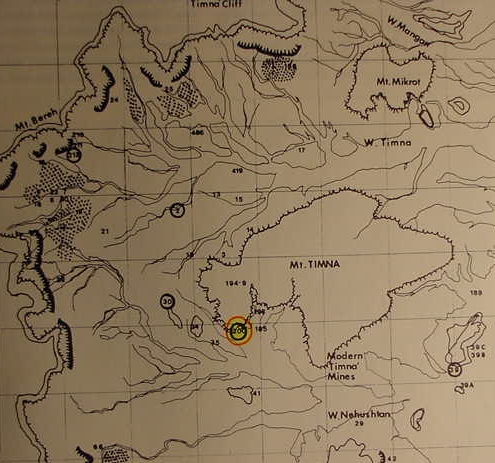
The mines at Timna are at least 6,000 years old and there are newer ones as well, totaling about 10,000 shafts. The oldest mines were worked almost continuously until the Roman Period. There are ancient rock carvings showing warriors in chariots, holding axes and shields. A temple dedicated to Hathor was discovered at the southwestern edge of Mt. Timna by Professor Beno Rothenberg of Hebrew University.

The highlighted circle marks the location of the Hathor Shrine.


The Chalcolithic metal works at Timna were found at the Wadi Nehushtan in the foothills along the western fringe of the southern Arabah Valley. The smelting works, slag, and flints at this site were found to be identical to those discovered near Beersheba where Abraham spent much of his time. The metal workers of Timna and the metal workers of Beersheba were kin, and the patroness of their mining and smelting operations was the mother of Horus who was venerated or worshiped by the Horites. In other words, these were Horite metal workers. In his book Timna, Beno Rothenberg concluded that the peoples living in the area were "partners not only in the work but in the worship of Hathor." (Timna, p. 183)

During the early Iron Age, a tent-sanctuary appeared at the Hathor shrine. However, according to Nissim Amzallag, "the metallurgical character of this shrine was maintained."


Related reading: "Egyptian Timna - Reconsidered" by Uzi Avner (ANE Studies, Unearthing the Wilderness, edited by Juan Manuel Tebes); The Ra-Horus-Hathor Narrative; The Substance of Abraham's Faith; The Serpent on Moses's Staff

Monday, September 23, 2019

Chiefs of Edom and Seir


Alice C. Linsley


Genesis 36 provides a list of the chiefs of Edom. One of the patriarchs of the Edomites was called Seir the Horite. The Horites, as well as the Sethites, were a moiety of the Hebrew ruler-priest caste. The caste was characterized by endogamy, cognatic descent, high ranking rulers with two wives, and the prerogative of the second wife, usually a cousin, to name her firstborn son after her father. That is why there are two named Korah in the diagram above. This "cousin bride's naming prerogative" is found with the firstborn sons of Cain and his wife, Naamah and Methuselah, and Nimrod and his Sumerian wife, a daughter of Asshur.


Edom and Seir are linked in the Song of Deborah and Barak in Judges 5:3-4:
"Listen, O kings! Give ear, O princes! I will sing to the LORD; I will sing praise to the LORD, the God of Israel. O LORD, when You went out from Seir, when You marched from the land of Edom, the earth trembled, the heavens poured out rain, and the clouds poured down water."
Deuteronomy 68:8 declares, "The LORD came from Sinai and dawned upon us from Seir; He shone forth from Mount Paran and came with myriads of holy ones, with flaming fire at His right hand."

As is seen in the diagram above, Moses and Aaron were descendants of Seir, the Horite ruler. The Hebrew clans of Seir and Edom apparently intermarried. In the Septuagint, (LXX 42:17d) Job is said to be a ruler of Edom. He was a descendant of Seir's grandson Uz, in whose territory Job resided.

The antiquity and prestige of the Edomite rulers and of Teman of Edom is expressed in Jeremiah's reference to these as ancient seats of wisdom (Jeremiah 49:7). Genesis 36 explains, "These are the kings who reigned in the land of Edom, before any king reigned over the children of Israel."

Genesis 36 lists the chiefs also: Bela, the son of Beor; Jobab, the son of Zerah of Bozrah; Husham of the land of the Temanites; Hadad, the son of Bedad, and Samlah of Masrekah."

Genesis 36:15 lists four chiefs born to Esau's son, Eliphaz: Teman, Omar, Zepho, and Kenaz. One of Seir's royal daughters was named Timna. Timna married Eliphaz.


The Edomite chief Teman likely served as a ruler-priest at the shrine of Teman, a site excavated in 1975 by the Tel Aviv University archaeologist Ze’ev Meshel and his team. The site is known as Horvat Teman. In the Bible is is called Teman of Edom. The Bedouin call the place Kuntillet 'Ajrud which means “the solitary hill of the water source.” That is the perfect description of an ancient Horite Hebrew high place.

The finds from Horvat Teman are fascinating and have stirred much debate. Among the finds are two large storage jars that weighed about 30 pounds each. The jars are painted with images believed to be deities, humans, and animals. There are symbols and a number of inscriptions, including three that refer to Yahweh.

The drawings reveal an ancient Egyptian context indicating that Nilotic peoples lived in the Sinai. One image is a sophisticated mural of an Egyptian ruler (reconstruction shown below).


King Hezekiah in the late eighth century BC initiated a campaign in Judah to destroy all the ancient images. “He removed the high places, broke down the pillars, and cut down the sacred pole. He broke in pieces the bronze serpent that Moses had made, for until those days the people of Israel had made offerings to it” (2 Kings 18:4).

In doing so, explains the Bible, Hezekiah “did what was right in the sight of the Lord.” But was Hezekiah motivated only by “the commandments that the Lord commanded Moses”? Or was his iconoclasm an attempt to impose a new religion for political purposes? Iconoclasts seek to rewrite the prevailing narrative by destroying the old.


Evidence of an ancient and prosperous kingdom

Edom had a large copper ore zone with industrial scale copper production. Radiocarbon analysis of charred wood, grain and fruit in several sediment layers revealed two major phases of copper processing, first in the 12th and 11th centuries, and later in the 10th and 9th BC.

Dr. Thomas E. Levy stated, "Only a complex society such as a paramount chiefdom or primitive kingdom would have the organizational know-how to produce copper metal on such an industrial scale." 

In the early 2000's, led by Dr. Levy lead an archaeological survey that yielded earlier dates than had been assigned to the Edomite kingdom. The team uncovered scarabs, ceramics, metal arrowheads, hammers, grinding stones, and slag heaps.

Evidence was found of fortifications and over 100 building complexes. Khirbat en-Nahas, 30 miles north of Petra, was an ancient Edomite site. Khirbat en-Nahas means "ruins of copper" in Arabic. Nahash means serpent in Hebrew. As an adjective it means shining bright, like burnished copper. The ruins of Khirbat en-Nahas spread over 24 acres, and the fortifications enclose an area 240 by 240 feet.


Abraham was a chief of Edom. His territory extended between the settlements of his two wives. Sarah resided in Hebron and Keturah resided in Beersheba. Both settlements are shown on the map above.

The Greeks called Edom "Idumea" which means "land of red people." Esau of Edom is described as red and hairy. King David, who had Edomite blood, is also described as red or ruddy. The Hebrew were a caste and as such married only members of their caste (endogamy). This means that the Hebrew were ethnically and genetically more homogeneous than non-caste populations. To speak of the Hebrew social structure as "tribes" is a late development. The ethnic and genetic makeup of castes and tribes are very different.

Monday, June 3, 2013

Hagar's Journeys


Alice C. Linsley


Hagar was one of Abraham's two concubines and Sarah's handmaid. Abraham's son by Hagar was Yishmael (Ishmael) an Egyptian chief, as is evident by the initial Vav, a solar symbol designating a ruler. The Y indicates that he was a clan chief, as were these men: Yaqtan, Yisbak, Yitzak, Yacob, Yisra-el and Yeshua.

Yishmael's ethnicity was traced through his Egyptian mother, just as Jewish ethnicity is traced through the mothers. The idea that the Arabs come from Abraham by Ishmael is simply wrong. The Ar clans existed before the time of Abraham, and Abraham's Arabian descendants are traced through his first born son Yaqtan (Joktan). This is Yaqtan the Younger. He is named for his maternal grandfather in whose territory he would serve as a sort of Prime Minister.


Hagar's status

Hagar was a strong and sophisticated woman whose status actually increased once she left Sarah's service. She contracted marriage for her son with an Egyptian. This means that Yishmael's children were also Egyptian. 

After leaving Sarah, Hagar had other offspring known as the Hagarites. They are mentioned in Psalm 83:6. It is evident from this psalm that the Hagarites and the Ishmaelites were regarded as distinct clans and Hagar, like Anah and Oholibamah, was a clan chief.

This information provides an answer to the question raised by the angel: And the angel of the Lord found her by a fountain of water in the wilderness, by the fountain in the way to Shur. And he said, "Hagar, Sarai's maid, from where came you? and where will you go?" (Gen. 16:7-8)

Upon leaving Sarah's service, Hagar was at a pivotal point in her life. She needed to review her past and consider her future. She appears to have made the most of all the opportunities God presented her.


Hagar's route

Hagar fled from Hebron to Beersheba. Abraham had made this journey many times as he journeyed between the settlements of his two wives. Sarah resided in Hebron and Keturah resided in Beersheba. Abraham spent his old age in Beersheba.

The well at Sheba was very ancient. It was a water shrine under the control of Sheba, a Horite ancestor of both Abraham and Keturah. (Gen. 10:7) Sheba was the son of Ramah whose anceint priestly line was living in Ramah, the hometown of Elkanah and his two wives: Hannah and Penninah. Hannah was the mother of Samuel the Prophet. Penninah was the mother of Am-asi (I Chron. 2:25, 35). Am-asi is a Kushite name.

Beersheba and Kadesh were major water stations on the way to Egypt, so it appears that Hagar was returning to Egypt. The angel found her on "the way to Shur" (Darb el-Shur) which led from Beersheba to Kadesh-Barnea. From prehistoric times this route took travelers by year round water supplies. Flintstone tools dating between 80,000 and 16,000 BC have been found scattered around the area of Beerotayim (two wells). This is likely where the angel spoke to Hagar.

Archaeological surveys of the region have identified remains of structures on the eastern and western hills dating from the early and Middle Bronze Age. Hagar's route is indicated on the map as a dashed line.


Hagar's dismissal

Hagar apparently heeded the angel's advice and returned to serve Sarah. There she remained until Abraham agreed to send her and his son away. She second journey away from Hebron took her in a different direction. She headed to the desert of Paran where she lived with Ishmael who became a master archer. As with all sent-away sons, Ishmael receives his own territory.

It is likely that Abraham made provision for Hagar and Ishmael to join his kinsmen in the area of Timna, shown on the map at the bottom.

Timna or Tema plays an important role in early Biblical history. Known by Arabs as Taima, this water source lies about 70 miles north-east of Dedan. During the Chalcolithic Period, Kushite artisans settled in Paran where they lived in subterranean dwellings carved out of the limestone with metal tools. The Bible refers to these cave-dwellers as Dedanites. Dedan, Tema and Buz comprized a Horite confederation.

The oldest Arabic texts have been found around the North Arabian oases of Tema and Dedan. An ivory workshop was discovered in one of these dwellings at Bir es-Safadi.

Tema, Dedan and Dumah were caravan stops along the trade route from southern Arabia to Babylon. To this day, Joktanite clans reside in southern Arabia and Yemen.

Joktan is a variant of the name Jonathan, meaning "God gives." Joktan lived about 1987-1912 B.C. That he was a ruler is evident by the solar symbol Y at the beginning of this name. In early Arabian scripts, such as Thamudic, symbols represented complex ideas and experiences including names, attributes and worldview. A solar symbol such as Y or T or O represented a deified or divinely appointed ruler, his territory, his people, and his resources such as water and gold. This is why the Horite ruler-priests names begin with the solar symbol: Yaqtan, Yishmael, Yitzak, Yisbak, Yacob, Yosef, Yeshua, etc.


Related reading: Hagar's Conversion; The Pattern of Two Wives; The Afro-Arabian Dedanites; Abraham's Complaint; The Status of Women in Ancient Egypt and Arabia; Hagar in Targum Pseudo-Jonathan by Florentino Garcia Martinez