Followers

Showing posts with label Horites. Show all posts

Saturday, March 23, 2024

The Historical Eve


Badarian Eve (mortuary figurine), housed at the Louvre.


Dr. Alice C. Linsley


The historical Eve was not the first woman on earth. Instead, she was a founding mother of the early Hebrew ruler-priest caste. She was a high-status woman with servants and resources. She would have influenced the style of dress and adornments of women of lesser status. She probably sought high status wives for her sons from among her Hebrew people.

Analysis of the kinship pattern of the rulers listed in Genesis 4 and 5 indicates that two of Eve’s daughters-in-law were the daughters of a ruler named Enoch/Enosh (Enos in the Septuagint). Enoch is a royal title. The word is derived from the ancient Egyptian anochi, pertaining to the first-person singular. The term is related to the ancient Akkadian anaku which is a reference to the royal first person. The title also relates to royal succession. Among the Igbo, anochie means “a replacer” or “direct heir to a throne.”

Eve was the mother of Cain and Seth who married their cousins, the daughters of a ruler named Enoch. Eve’s firstborn Cain is described as an early city builder and Seth is the founder of the Sethite Hebrew who are mentioned in texts from 2400 BC. This means that the historical Eve probably lived between c.5000-4500 BC.

The historical Eve lived in the vast well-water region called Eden. The term Eden derives from the Akkadian term edinu, which refers to a fertile plain or a flood plain. According to the description in Genesis 2:10-14, Eden extended from the Pishon and Gihon at the sources of the Nile to the Tigris and Euphrates. The region is described as rich in gold and bdellium. Bdellium is a semi-transparent oleo-gum resin extracted from Commiphora wightii and from Commiphora africana. These trees grow in Ethiopia, Eritrea, and other parts of sub-Saharan Africa.

Given the biblical data, it is likely that Eve lived in the Nile Valley. That is where her son Seth was established as a regional chief. Later this region became known as Ta-Seti, meaning “Land of the Bow.” That was the Egyptian description of Nubia (Nub - gold) where hunters used bows and arrows. They are shown on Nubian rock art dating to 4000-2500 BC.


Eve's Sons  

Eve’s firstborn son was Cain (Gen. 4). He left his homeland and settled “east of Eden” (Gen. 4:16-26), probably on the east side of the Red Sea. That would be the land of Canaan where Cain’s metal working descendants lived. They are known as the “Kenites.” The names Cain, Canaan, Kenan, and Kenite are linguistically equivalent.

One of Cain’s daughters married her cousin Enosh and named their firstborn son Kenan, after her father. This is an example of the cousin bride’s naming prerogative, a feature of the marriage and ascendancy pattern of the early Hebrew.

Eve's other living son was Seth (Gen. 5). He was a son in the image of his father Adam (Gen. 5:3), meaning he was a red man. The Hebrew language scholar, Jeff A. Benner, explains: Dam is the "red" blood, adamah is the "red" ground, edom is the color "red" and adam is the "red" man. Adam is a reference to the color of blood (dam in Hebrew). That means at least some of Seth’s descendants, known as the Sethite Hebrew, were also red.

The Sethites ranged from the Nile to the Eastern Desert of Egypt, and some were living in the land of Canaan. The ancient Egyptians referred to a man of the Nubian Desert as An-ti Set. They called the dwellers in the Eastern Desert of Egypt An-tiu Sett, according to the archaeologist E. A. Wallis Budge. Budge claims in his Egyptian Hieroglyphic Dictionary (1920) that the An-tiu Sett lived as far north as the land of Canaan. This is not surprising because Seth’s descendants living in Canaan would have intermarried with Cain’s descendants living in Canaan.

Many Sethites served at the sacred high places (mounds) along the Nile and are mentioned in the Ancient Pyramid Texts (2400-2200 BC). One of those places was Nekhen where this figurine of red Seth was found. He has the head of a hippo and the body of a man. Perhaps the hippo was the totem of the Sethite Hebrew, and the falcon was the totem of the Horite Hebrew.


Seth as a red hippo


Nekhen is the oldest known site of Horite worship (c.4200 BC). At Nekhen archaeologists found hippos buried in the elite cemeteries (Nekhen News, Vol. 25, 2013, p. 20). They also found numerous carved and sculpted figurines of hippos, some with red coloration. They concluded that hippo imagery is "linked to local elites" (Nekhen News Vol. 27, 2015, pp. 8-9).


Eve’s Cultural Milieu

Eve’s cultural context would have been like that of the Badarian culture (5000-4000 BC). The Badarian culture extended at least as far as between El Badari in the Lower Nile south to Nekhen in the Upper Nile.

The Nilotic culture of that period was agricultural and cattle-herding. The contents of storage facilities included wheat, barley, lentils, and tubers. Fishing provided a substantial source of protein. Reed boats were used to transport produce and livestock. Dogs were used for hunting, and hunting was mainly the sport of the upper class.

Water resources were more than sufficient to sustain the Nilotic populations of Eve’s time. The Nile supplied a year-round water supply of water. In addition to that, there was seasonal rainfall draining from the mountains into the lower elevations. There were many wadi systems terminating in or near the Nile floodplain with water-retaining Pleistocene sands and gravels that supported vegetation, small trees, and shrubs. The local populations were able to draw water from natural springs fed by the Nubian Aquifer which runs under the Sahara west of the Nile.

The burial practices reveal social stratification with separate elite cemeteries. Burial sites of the more wealthy contained grave goods such as green malachite palettes, shells, flint tools, amulets in the shape of the antelope and hippopotamus, ostrich eggshell vessels, hippo tusks, and jewelry made of ivory, quartz, or copper.

The Badarian rulers traded with people of other regions. The turquoise and glazed steatite beads found in the Badarian territory were imported. Upper class Badarian men wore beaded belts. Some rulers had ripple knapped knives with decorative handles.


Mythical Eve versus Historical Eve

The person of Eve is surrounded by the observations of Bible commentators and theologians making it difficult to separate the historical Eve from the Eve of the Genesis creation stories. The mythical Eve is wrapped in profound theological speculation about the origin of sin and death, the presence of evil, and the necessity of divine intervention. The implications of Eve's disobedience have probably been plumbed to the depth. It is time to investigate her historicity using an empirical method. Strangely, most who regard Adam and Eve as historical figures never inquire about the historical Eve. It is as if they were afraid to discover the truth.

The historical Eve was the Hebrew mother of two surviving sons, Cain and Seth. Both sons were clan chiefs and rulers over territories. Further, their descendants intermarried according to an endogamous marriage pattern that was well established before Eve's time. Clearly, Adam, Eve, and their offspring were not the first humans on earth.

Thursday, August 25, 2022

The Sethites and the Red Hippo


Seth as a hippo. 

This figurine was found at Nekhen, the oldest known site of Horite Hebrew worship.


Dr. Alice C. Linsley


At Nekhen (Hierakonpolis), the oldest known site of Horite Hebrew worship, archaeologists found hippos buried in the elite cemeteries (Nekhen News, Vol. 25, 2013, p. 20). They also found numerous carved and sculpted figurines of hippos, some with red coloration. They concluded that hippo imagery is "linked to local elites" (Nekhen News Vol. 27, 2015, pp. 8-9). Cain's brother Seth/Seti is often shown in ancient images as a red hippo. The hippo figurines likely indicate that there were Sethite Hebrew at Nekhen as well as Horite Hebrew.

That Sethites were living among the Horites of Nekhen is not surprising given that these two groups represent a moiety structure of the Hebrew ruler-priest caste. The term "moiety" refers to one people organized into two ritual groups. Analysis of the marriage and ascendancy pattern of the lines of Cain and Seth indicate that their descendants intermarried (endogamy). This diagram shows the pattern of cousin marriage in which the cousin bride names her first-born son after her father.


The Adam of Genesis is the father of three sons: Cain/Kain, Abel, and Seth. Seth is said to be in the image of his father Adam (Gen. 5:1). This likely means that he had a red skin tone. The word “Adam” refers to blood ("dam" in Hebrew, "dammu" in Ancient Akkadian) and the color red. Adam is derived from the root אדם (A.D.M), meaning "to be red or ruddy" (Strong’s #119).

The rulers listed in Genesis 4, 5, 10, 11, 25 and 36 practiced endogamy and certain genetic traits were inherited by their descendants. Apparently, a red skin tone was one of those traits. Seth is a founder of the Sethite Hebrew who are mentioned in texts from 2400 BC. This means that the historical Adam probably lived between c.4600-4000 B.C.

Seth is often portrayed in ancient images as a red hippo. Seth’s homeland is the land of Seti, at the northern edge of the Upper Nile. This region is sometimes referred to as the land of red earth. The connection between "adam" and "adamah" (soil) is evident in Genesis 2:7 which states that "the adam" (human) was formed out of the "adamah". The region of the Nile under consideration has a cambic B horizon. Chromic cambisols have a strong red brown color. Before Egypt and Sudan became political entities, the homeland of Seth included part of the Green Sahara, an area prone to flooding. Later, the Egyptians referred to that region as Deshret (dshrt) or the "Red Land". Today deserts comprise most of Egypt and Sudan, but that was not the case in Adam’s time.

The autochthonous origin of humans is a common theme in the creation stories of Africa. It speaks of humans being made from the soil (humus) of the region where their first parents were created. It is an explanation for why people look different. The genetic diversity of humans was explained by a connection between the people and the land where they resided. There are as many skin tones among humans as there are soil colors.


The autochthonous origin of humans is expressed in the Shilluk creation story. The Shilluk of Sudan call the Creator Jouk. Jouk made white people out of white sand and the Shilluk out of black soil. When the Creator came to Egypt, he made the people there out of the red silt of the Nile.

The rulers listed in Genesis 4, 5, 10, 11, 25 and 36 practiced endogamy and certain genetic traits were inherited by their descendants. Apparently, a red skin tone was one of those traits.


The Geographical Range of the Sethites

The Sethites ranged from the Upper Nile Valley (Nubia) to the land of Canaan. The ancient Egyptians referred to a man of the Nubian Desert as An-ti Set. They called the dwellers in the Eastern Desert of Egypt An-tiu Sett, according to the archaeologist E. A. Wallis Budge. Budge claims in his Egyptian Hieroglyphic Dictionary (1920) that the An-tiu Sett lived as far north as the land of Canaan. This is not surprising because Seth’s descendants living in Canaan would have intermarried with Cain’s descendants living in Canaan.

Eve’s son Cain left his homeland and settled “east of Eden” (Gen. 4:16-26), probably on the east side of the Red Sea. That would be the land of Canaan where Cain’s metal-working descendants lived. They are known as the “Kenites.” The names Cain, Canaan, Kenan, and Kenite are linguistically equivalent.

One of Cain’s daughters married her cousin Enosh and named their firstborn son Kenan, after her father. This is an example of the cousin bride’s naming prerogative, a feature of the marriage and ascendancy pattern of the early Hebrew.

Tuesday, June 23, 2020

Discovering the Historical Noah


Dr. Alice C. Linsley


Noah lived between 5000-3800 B.C. in the region of Lake Chad. This is the only place on earth that the natives call Noah's homeland - Bornu (Borno/Benue), meaning "land of Noah". The local Kanuri people call Lake Chad Buhar Nuhu, meaning "Sea of Noah". 

His ark is described as being constructed of reeds (gofer), a typical boat material in that region. Reeds boats are still used there. 


Sickle shape reed boat

The word in the Bible that describes Noah's boat is the same word used to describe the reed basket in which the baby Moses floated.

When Noah lived the Sahara was wet and green. Much has been written about the African Humid Period (African Aqualithic), but rarely has a connection been made to Noah's flood.

It is common to place Noah and his ark in the area of the Black Sea, yet there is little data in the Bible to support this theory. However, there is much data to support the picture of Noah as a Proto-Saharan ruler who kept a royal menagerie. One of Noah's great grandsons was Nimrod, a Kushite (Gen. 10) who left Africa and established his territory in Mesopotamia.


Saharan petroglyphs dating to between 4300 and 2900 BC show boats and cattle. These have been found in the Eastern Central Desert of Egypt and Sudan. Examples of these images are shown above.

Noah would have been a contemporary of the 7th-8th Dynasty rulers in Egypt. This was a time of great cultural and technological achievement and the celebrated Horite shrine city of Nekhen (4000 BC). Nekhen's sister city, Nekheb (El-Kab) sat on the opposite side to the Nile. Both were shrine cities with priests. We might speculate that if Nekhen was a Horite Hebrew city, Nekheb was likely a Sethite Hebrew city.

The tomb of Horemkhawef in Nekhen and the tomb of the Sobeknakht in Nekheb were painted by the same artist. Hormose, the chief priest of Nekhen, requested material goods from the temple at Nekheb for use at the temple at Nekhen. Nekhen and Nekheb were typical twin cities of the ancient world.

Though separate, the two shrine cities shared common religious practices and beliefs. It is clear in the Ancient Egyptian Pyramid Texts (2400 -2000 BC) that the Horites and the Sethites maintained separate settlements. Utterance 308 addresses them as separate entities: "Hail to you, Horus in the Horite Mounds! Hail to you, Horus in the Sethite Mounds!"

PT Utterance 470 contrasts the Horite mounds with the mounds of Seth, designating the Horite Mounds "the High Mounds."

A great deal is known about the beliefs of Noah's culture from the 4200 year documents that have been studied by scholars, in particular the Ancient Pyramid Texts that speak of the Horite and Sethite moiety. ("Moiety" refers to one people or one caste divided into two ritual groups.)


The Green Sahara appears to be the time, place, and cultural context of Noah and his sons. This places them in relatively recent history, not earlier than 5000 B.C.

By 12,000 humans were already dispersed globally and there is no evidence that these dispersed human populations were destroyed by a catastrophic global flood. Humans


About 4000 years before Noah people were using dugouts to navigate the rivers of the Sahara. This is attested by the discovery of this 8000-year mahogany dugout in Dufuna in the Upper Yobe valley along the Komadugu Guna River in Northern Nigeria.


Noah's animals

Noah’s concern for animals is supported by the discovery that Proto-Saharan rulers kept royal menageries of exotic animals. The oldest known zoological collection was found during the 2009 excavations at the Nekhen on the Nile. The royal menagerie included hippos, elephants, baboons and wildcats. Noah would have known about the shrine city of Nekhen. It is the oldest known site of Horite Hebrew worship. 


Thursday, March 26, 2020

The Horite Descendants of Cain


Alice C. Linsley ©1981
The Royal Descendants of Adam and Enoch


Alice C. Linsley

The diagram shows that the clans of Cain and Seth intermarried. Genesis 4:22 identifies Tzillah as the mother of Tubal-Cain, "an instructor of every artificer in copper and iron" and his sister was Naamah, Methusaleh's cousin wife. The descendants of Cain, Tubal-Cain, and others of this clan are associated with the Kenite metal workers.

The metalworking descendants of Cain shared common ancestry with the descendants of Seth (Sethites), and preserved recognition of their close blood bond. Judges 1:16 identifies Jethro as a Kenite. His daughter Zipporah was Moses's cousin wife. King Saul sought to protect the Kenites by warning them to move away from the city that his army was about to attack (1 Samuel 15:6).

Though the clans of Cain and Seth intermarried and recognized their blood bond and responsibility for mutual defense, they clearly maintained distinct identities. Extra-biblical sources indicate that they also maintained separate shrines and temples, though they worshiped the same God. They were to be governed and judged by the same king. "O King, you have not departed dead, you have departed alive...The Mounds of Horus serve you, the Mounds of Seth serve you." (Utterance 213 of the Ancient Pyramid Texts)

In the Ancient Pyramid Texts (dating to 2400-2000 BC) the Sethites and the Horites form a moiety. The term "moiety" refers to two social or ritual groups into which a people is divided. The distinction between the two groups is evident in PT Utterance 424: "O King, a boon which the King grants, that you occupy the Mounds of Horus, that you travel about the Mounds of Seth..."

Utterance 308 also addresses the Sethites and Horites as separate entities: "Hail to you, Horus in the Horite Mounds! Hail to you, Horus in the Sethite Mounds!"

PT Utterance 470 contrasts the Horite mounds with the mounds of Seth, designating the Horite Mounds "the High Mounds." Here we find a suggestion that the Horite Hebrew were named for their devotion to Horus (HR). In the Ancient Egyptian language HR means the Most High One.

Utterance 424 continues, "that you [King] sit on your iron throne and judge their affairs at the head of the Great Ennead which is in On." On is mentioned in Genesis 41:45. Joseph married Asenath, a daughter of the High Priest of On.

The extent of the King's authority is considerable, and without limits were he to rise from the dead. In his resurrection body he is to "traverse the Mound of Horus of the Southerners" and "traverse the Mound of Horus of the Northerners." (PT Utterances 536 and 553) The risen king is expected to restore his settlements and cities, and open doors to the Westerners, Easterners, Northerners and Southerners (Pt Utterance 587). He is to "betake himself to the Mansion of the Most High (HR) which is in the firmament" (PT Utterance 539).

The risen king unites the peoples, restores the former state of blessedness, and unites heaven and earth. When seen from this perspective, the Horite religion appears to be the foundation of the Messianic hope that is fulfilled in Jesus of Nazareth.

If the Sethites are descendants of Seth, might we assume that the Horites are descendants of Cain?

In this 1924 paper published by Hebrew Union College, Dr. E. Taubler noted that ancient Egyptian inscriptions make it clear that the Horites were scattered over the whole land of Canaan (p. 7).

Josephus reported that the Horites were descendants of Abraham and his cousin wife, Keturah, and, quoting an ancient historian, he portrays them as "conquerors of Egypt and founders of the Assyrian Empire." Keturah was from the region of Beersheba.

Genesis 36 identifies Edom (Idumea) as another territory under Horite rule. Abraham's territory was entirely in the region of ancient Edom.

Friday, February 21, 2020

Two Named Esau


Dr. Alice C. Linsley


This kinship diagram shows that there are two named Esau in Genesis. Esau the Elder was a contemporary of Seir the Horite (Gen. 36). As with most high-ranking Hebrew rulers, Esau had two wives. Sorting out their names is a challenge since Genesis 36:1-5 gives the impression that there was only one Esau and that he had four wives. Knowledge of the two-wife marriage pattern of the early Hebrew helps to sort out the confusion.

Esau the Elder married Adah, a daughter of Elon the Hittite. Esau the Younger married Oholibamah, the daughter of Anah, a female chief of the clan of Seir. One of the rulers named Esau married Judith, a daughter of Berri or Beerah (Gen. 26:34).

Both Esau the Elder and Esau the Younger are related to the Horite Hebrew of Edom. The "sons of Esau" who dwell in Seir are designated as kinsmen to the Israelites in Deuteronomy 2:4. The Greeks called Edom Idumea which means "land of red people". Esau is described as hairy and red. The Horite Hebrew of Edom were known to have a reddish skin tone. King David also was described as reddish, owing to his Edomite blood. 

David's father Jesse had a son named Jerimoth. Jerimoth married an Edomite princess named Mahalath (2 Chron. 11:18). Mahalath is the name of a wife of one of the rulers named Esau. The repetition of male and female names reflects the practice of endogamy among the Hebrew, a ruler-priest caste of great antiquity.


Naming practices of the early Hebrew

We often find two Horite Hebrew persons with the same name in the Bible. There are two early Hebrew rulers named Enoch, two named Lamech, two named Nahor, two named Esau, two named Joktan, and two named Korah. When we find two with the same name separated by a generation, we have evidence of the cousin bride's naming prerogative by which the second wife of the ruler named her first born son after her father.

The pattern is shown in this diagram. Lamech the Elder is shown with his two wives at the top. His daughter Naamah married her cousin Methuselah and named their first-born son Lamech after her father.


The cousin bride's naming prerogative was already a custom in the time of Lamech (Gen. 4). Naamah's first-born son Lamech was named after his maternal grandfather in whose territory he would one day serve as a high-ranking official.


Familiarity with the cousin bride's naming prerogative enables us to recover the names of some chiefs who have been given symbolic names, that is, names that are etiological etymologies. For example, Leah's first-born son was called Reuben. One theory says that his name derives from raa beonyi, meaning "Yahweh has seen my misery." A second explanation relates the name to Leah's hope of winning Jacob's love by bringing forth a son. In this case, the name derives from yeehabani, meaning "he will love me." It is more likely that Reuben is ra'a ben, meaning "behold, a son."

However, Jacob's first-born son by Leah is named Reu. That name appears in the Hebrew king lists of Genesis 11. Reu is the son of Peleg, the son of Eber. Reuben's first-born son is called Hanock which is a variant spelling of the name Enoch (Gen. 4:17; Gen. 5:18) and Anak.

Esau's name is explained as referring to the color red: Edom (Gen. 36:2). This could as easily be translated "ruddy", an adjective applied to King David who had Edomite blood through Tamar. The same source relates the name to an abundance of hair: “The first to be born was red, altogether like a hair cloak; so they named him Esau.” (Gen. 25:25)

What is the origin of the name Esau and what connection does it have to the central message of the Bible? Cheyne associates the name with "Usu" of Tyre. (Stade's "Zeitschrift," 17.189) Hiram, the king of Tyre, was allied by kinship to David. Hiram has the ancient Egyptian root HR which mean most high one. It is the same root that appears in the name Hur, Moses’ brother-in-law. Hur’s grandson was one of the builders of the Tabernacle. I Chronicles 4:4 lists Hur as the "father" of Bethlehem, a Horite Hebrew settlement. In other words, the Hiram of Tyre and David of Bethlehem had common Horite Hebrew ancestors. The Genesis king lists and Ezekiel 28:11-19 indicate that the Hebrew lineage can be traced back to Eden.

The Horite Hebrew believed in God Father and God Son. They believed that the Son of God would be born of their ruler-priest bloodlines and that He would reveal himself to his people. This was fulfilled when Jesus, the Son of God, visited Tyre (Matt. 15:21-28; Mark 7: 24).

David had Edomite blood through Tamar and was descended from the most ancient priestly line through Oholibamah and the Horite Hebrew chief Zibeon. This is why II Samuel 8:18 speaks of David's sons as being priests. They were of the priestly line from which Jesus came. So, we find a parallel between Oholibamah and the Virgin Mary. Oholibamah means the High Tent/elevated Tabernacle. She is an ancestor of Messiah through David, and her mother's name is Anah. Likewise, the Virgin Mary's womb became the tabernacle of the Christ our God, and her mother’s name was Ana.


Related reading: Cousin Brides; Horite and Sethite Mounds; Hebrew Names and Titles; The Substance of Abraham's Faith; Seats of Wisdom; Chiefs of Edom; The Pattern of Two Wives


Friday, December 28, 2018

Horite Hebrew Expectation and the Star of Bethlehem


Alice C. Linsley

Sidereal astronomy is real science based on observation of the arrangement and movement of the fixed stars and planets. This science originated among Abraham's Nilotic ancestors who had recorded information about the fixed stars and clock-like motion of the planets for thousands of years.

By 4245 BC, the priests of the Upper Nile had established a calendar based on the appearance of the star Sirius. Apparently, Nilotes had been tracking this star for thousands of years and connecting it to seasonal changes affecting the Nile Valley. In 241 BC, the priest Manetho reported that Nilotes had been “star-gazing” as early as 40,000 years ago. Plato claimed that the Africans had been tracking the heavens for 10,000 years.

Plato studied with an Egyptian priest for 13 years and knew about Earth's Great Year, also called the "Platonic Year." This is the time of between 25,000 and 28,000 years that it takes for Earth to complete the cycle of axial precession. This precession was known to Plato who defined the "perfect year" as the return of the celestial bodies (planets) and the diurnal rotation of the fixed stars to their original positions.

The ancients were motivated to understand the celestial pattern because they believed that the order in creation was fixed by the Creator and they were concerned about trespassing boundaries or violating the order in creation. They believed "As in the heavens, so on earth."

For the ancient Nilo-Saharans and Egyptians the stars in the constellation of Leo were especially important because the Nile rose when the Sun passed through the constellation of Leo. Therefore, they associated the arousal of the Lion with the arousal of the waters. The lion was the totem of the tribe of Judah. In Genesis 1, we read that the Spirit of God hovered over the watery deep at the beginning. In John's Gospel we are reminded that the Son was with the Father and the Spirit before the world was made and that all things were made through Him.

The Magi were sidereal astronomers who lived east of Israel, likely in Babylon or Persia. They were heirs of the same astronomical knowledge as the ancient Egyptians, and like Daniel they were of Judah (Jews). They recognized the sign of a triple coronation of two royal celestial bodies in the constellation of the Lion, the totem of Judah. They knew it was connected to the ancient Horite Hebrew expectation concerning the Woman of their people who would bring forth the Seed, the Son of God (Gen. 3:15). Further, they believed Messiah would be born of the royal house of David.

When the Magi appeared before Herod they were told that the King of the Jews was to be born in David's city, the Horite Hebrew settlement of Bethlehem. Abraham and David were of the Horite Hebrew ruler-priest lines. Joseph and Mary, both descendants of Abraham and David, went there to register for the census.

The Magi were aware of God's promise concerning the Righteous Ruler whose kingdom would endure through all the ages because reference to the Messianic promise of Psalm 145:13 is found repeatedly in Daniel. It punctuates the rise and fall of kingdoms and proclaims the coming of an eternal kingdom. As astronomers, the Magi recognized the singular event of Jupiter's triple spiral that brought it in close proximity to Regulus in the constellation Leo, the Lion. The Babylonians called Regulus Sharu, which means king. The word is related to the Persian word Shir, meaning lion.

In his translation of the eighth-century AD Syriac manuscript "The Revelation of the Magi," Brent Landau describes the Magi as those who “pray in silence,” and he proposes that they were a small group of monk-like mystics from a mythical land called Shir. However, there is no such place. Shir refers to the lion, the totem for the Horite Hebrew clans that resided in Judah. The Magi are the descendants of those who were deported. They held the received tradition concerning the coming of Messiah. This explains their recognition of the Messianic symbolism of the alignment of the King Planet and the King Star.

Using Starry Night, a software program that tracks celestial events at any time in history, Rick Larson discovered that sidereal astronomy suggests clues about biblical events. He discovered that the king planet Jupiter met the king star Regulus at the beginning of the Jewish New Year in 3 BC. The conjunction of the Jupiter and Regulus produced the appearance of an extraordinarily bright star. Larson believes this is when Gabriel announced to Mary that she was chosen to bear the Son of God.
(Rick Larson's Star of Bethlehem)

When Mary asked how this could be, the Angel explained that she would be "overshadowed." This divine overshadowing is what the Horite Hebrew expected. In ancient iconography the mother of Horus is shown overshadowed by the sun, the emblem of the Creator. In Christian iconography, the sun is usually replaced by the image of a dove hovering over Mary.

The Horite Hebrew commemorated the death and resurrection of Horus in a 5-day festival. Horus (HR) in ancient Egyptian means "Most High One." As Plutarch noted in Isis and Osiris, 69, the first three days were marked by solemnity and mourning for the death of Horus. His death was commemorated by the planting of seeds of grain. On the third day, the 19th of Athyr, there was a joyful celebration of Horus’ rising to life.

The Horite Hebrew expectation that the Righteous Son would not remain in the grave is expressed in Psalm 16:10: "For thou wilt not leave my soul in hell; neither wilt thou suffer thine Holy One to see corruption." Jesus said, “This is what is written: The Messiah will suffer and rise from the dead on the third day..." (Luke 24:46)

Where is it written? Scholars cannot find this in the canon. However, a reference to the third day resurrection is found in the Pyramid Texts: "Oh Horus, this hour of the morning, of this third day is come, when thou surely passeth on to heaven, together with the stars, the imperishable stars." (Utterance 667) Jesus' third-day resurrection fulfilled that Horite Hebrew expectation in every detail.

Skeptics claim that Christianity is based on the ancient myth of Horus. Christians have done a poor job of responding to this assertion. It takes more faith to believe that Christianity is the Horus myth reworked than to accept the substantial evidence that that Abraham and his ancestors were Horite Hebrew who believed in God Father and God Son. They were people of faith who believed the promise that a woman of their ruler-priest lines would bring forth the Son of God, the Messiah. They believed that he would be born in Bethlehem of Judah and that God would make known his wonderful appearing.


Related reading: The Ra-Horus-Hathor Narrative;  Ancient Wisdom, Science and Technology; Who Were the Wise Men?; Mary's Ruler-Priest Lineage; The Substance of Abraham's Faith; Using Totems to Trace Ancestry

Wednesday, November 8, 2017

Abraham's Maternal Line


Alice C. Linsley


Abraham's mother is not identified in the Bible. This seems a strange oversight since Jewish identity is traced through the mother. The oversight may be intentional if the ethnicity of Abraham's mother did not serve the later narrative of Jewish identity.

It is supposed that Abraham's mother was the wife of Terah named in Jasher 7:50 which states, "Terah took a wife and her name was Amsalai, the daughter of Karnevo; and the wife of Terah conceived and bare him a son in those days." There appears to be a connection to a high place near Jericho. Kar refers to a high place or a mountain. Nevo is a variant of Nebo; Kar-Nebo or Mount Nebo is הַר נְבוֹ‎ (Har Nevo) in Hebrew. The oldest known settlement in this area is Jericho which had ramparts as early as 4000 B.C.E. 

Jasher 7:22 states that, "...Terah was 38 years old, and he begat Haran and Nahor." These were probably Terah's firstborn sons by two wives. Haran may have been Terah's proper heir, but he died before Terah died. Nahor took governance of Terah's territory. Nahor is named after his maternal grandfather, Nahor the Elder. (Here we see further evidence of the cousin-bride's naming prerogative.) Abraham became a sent-away son who eventually established his territory between Hebron and Beersheba.

I have found 3 spellings of the name of Terah's wife: Amthelo, Amsalai, and Amtlai, but no definitive statement that this woman was Abraham's mother. Amsalai is the only female named in connection to Terah, but it isn't clear is she was the mother of Abraham, or the mother of Nahor, or the mother of Haran. 

The name Amsalai means the "sweet fragrance of the people." Am refers to people, and salai refers to frankincense derived from the Boswellia serrata, a deciduous tree that grows in dry, mountainous areas. The name suggests that this woman was of the "hill people" and known by various names: Amurru/Amorite, Edomite/Seir, and Horite Hebrew.

Analysis of the marriage and ascendancy pattern of Abraham's Hebrew people indicates that Abraham's mother was either his father's half-sister, or his patrilineal cousin, or one of Terah's concubines. Terah had two wives, following the typical marriage pattern of his ancestors. It is likely that Nahor the Younger was the son of Terah's cousin bride and Haran was the son of Terah's half-sister bride. Both brothers were older than Abraham.


Suggestion of avunculocal residence

Abraham's older brother Nahor ruled over Paddan-Aram upon Terah's death in Harran. This was the pattern among the Horite Hebrew. The firstborn son of the half-sister bride was the proper heir. Other sons born to that bride were sent away either to serve in the realms of their maternal uncles, or to establish their own territories. 

Sent-away sons, like Abraham and Jacob, often lived with or near their maternal uncles. This is called "avunculocal residence" and it appears that Abraham's trip to Mamre and Hebron was directed by his maternal uncle who ruled that territory. From Mount Nebo his sentries would have been able to survey all of Palestine.

When Abraham arrived from Mesopotamia he likely visited his maternal uncle at Mount Nebo and went from there to consult the prophet (moreh) at the Oak at Mamre near Hebron. Hebron is about 40 miles (65 kilometers) from Mount Nebo. Mount Nebo and Edom are in the modern state of Jordan. 


This was the land of the Horite Hebrew rulers who are listed in Genesis 36. Abraham's mother and father were kin to these rulers. Among Abraham's Horite Hebrew ancestors, one's ancestry was traced by double descent, along both the maternal and paternal lines. However, the ethnicity of a child depended on the ethnicity of the mother. This is still true for Jews today. One is a Jew by two means: either by proper conversion, or if one's mother is Jewish.


Sunday, March 12, 2017

The Relationship of John the Baptist and Jesus Messiah


Alice C. Linsley

Kinship analysis provide insight into the relationship of John the Forerunner and Jesus Messiah. It helps us to identify the relationship between of the priestly lines from which both are descended. Understanding how Jesus and John were related helps us to grasp more fully John's testimony concerning Jesus Messiah.

There have been many attempts to reconcile the genealogical information given in Matthew 1 and Luke 3. These lists are used by the writers for different narrative purposes. Nevertheless, once we understand the marriage and ascendancy pattern of the Horite Hebrews we can recognize the historical validity of the biblical claim that John and Jesus were blood relatives and both of the Horite Hebrew priestly lines.

A fruitful approach to investigating the relationship of Jesus and John is to look for the repetition of patterns such as two wives, three sons, the cousin-bride's naming prerogative, etc. The first step to understanding the marriage and ascendancy pattern of John and Jesus is to diagram the Biblical data, such as I have done in the diagram of Moses's ancestry.

John and Jesus come from the priestly lines that descend from Amram. One line is traced through Aaron, Moses's full-brother, and the other is traced through Korah, Moses' half-brother. According to Numbers 26, Korah's claim to be priest was supported by the Hanochites (descendants of Jacob's first born son, Reuben). Korah the younger is named by his mother Ishar after her father, according tot he cousin-bride's naming prerogative. Ishar is derived from the Hebrew isha, meaning "woman." Women are sometimes listed as "sons" in Genesis and Exodus if the ruling line is traced through them, which is the case with Ishar (Ex 6:17), and Anah and Oholibamah (Gen. 36). The last two women are Horites of Edom, of the house of "Seir the Horite."

The priestly lines of Aaron and Korah were ruler-priest clans before they became divisions. One division, the line of Matthew (Mattai/Mattan) resided in Bethlehem. Joseph of Ari-mathea was in the priestly line, something that qualified him to be a member of the Sanhedrin.

Following the kinship pattern of his ruler-priest forefathers, Amram had two wives. One was a half-sister, as was Sarah to Abraham, and the other was a patrilineal cousin, as was Keturah to Abraham. Ishar was Amram's cousin bride, and Jochebed was his half-sister.

According to Holy Tradition, John was a cousin of Jesus through his mother Elizabeth who was sister to Ana (Anah). Ana was Christ's maternal grandmother (as the Anah shown in the diagram was Korah's maternal grandmother). In the relationship of John and Jesus, we find intermarriage between lines of priests according to the ancient pattern of their ruler-priests forefathers. John’s mother Elizabeth was of the “daughters of Aaron,” meaning that she was the daughter of a priest. According to Holy Tradition, Mary was also a daughter of the priest, Joachim. According to the custom of the Horite Hebrew ruler-priests, she married into a priestly line when she married Joseph, grandson of Mattenai (Matthew 1:16).

John's father was a priest of the division of Abijah (Luke 1:5, 8). Abijah's was the eight division of priests which apparently resided in Bethlehem. Bethlehem was a Horite settlement according to I Chronicles 4:4 which names Hur (Horite) as the "father of Bethlehem" and Rahab's husband Salmon, the son of Hur is called the "father of Bethlehem" in 1 Chronicles 2:54. Nazareth was also a Horite Hebrew settlement.
The eighteenth division of ruler-priests, called ha·pi·TSETS (Happizzez), resided in Nazareth. In 1962 excavators discovered a small piece of a list of the twenty-four priestly divisions. This third to fourth-century marble fragment is inscribed with the names of the places where four of the divisions resided, including Nazareth, the residence of Happizzez. The name of the division is of Nilotic origin. Happizzez is related to the ancient Egyptian word for the life-sustaining Nile which was Happi.

John's mother, Elizabeth, married into the priestly line of Amram when she married Zechariah, a descendant of Abijah. Mary married into the line of Amram/Korah when she married Joseph, son of Asaph. I Chronicles 26:4-8 tells us that among "Korah's descendants there were Obed Edom's sons Shemaiah (the firstborn), Jehozabad (the second), Joah (the third), Sachar (the fourth), Nethanel (the fifth), Ammiel (the sixth), Issachar (the seventh), and Peullethai (the eighth). God had blessed Obed of Edom. His son Shemaiah had sons who ruled their families because they were soldiers. Shemaiah's sons were Othni, and Othni's skilled brothers Rephael, Obed, Elzabad, as well as Elihu and Semachiah. All of these people were Obed Edom's descendants. They, their sons, and their relatives were skilled and had the ability to perform the service. Obed Edom's family included 62 men."


"Obed-Edom" refers Korah's descendants who were rulers in Edom. These Horite Hebrew rulers are listed in Genesis 36. Seir the Horite ruled in the territory where Abraham lived between Hebron and Beersheba. Seir's granddaughter is Anah, the maternal grandmother of Korah the Elder, whose daughter Ishar married her patrilineal cousin Amram, the father of Moses, Aaron, Miriam and Korah.

There were twenty-four priestly divisions after the construction of the Second Temple. Nineteen of these divisions are listed in Nehemiah 12:10-22. In this list we find these names of particular interest: Eber, Joachim, Joseph, Abijah, and Mattenai. These are the names of priests who married the daughters of priests and from these lines came John the Baptist, Joseph, Mary and Jesus, the Incarnate Son of God.

John the Forerunner's testimony concerning Jesus as "the Lamb of God that takes away the sin of the world" (John 1:29) springs from direct knowledge of the tradition of his Horite Hebrew forebearers among whom Messianic expectation originated.


Related reading: Edom and the Horites; Who Were the Horites?; The Genesis Record of Horite Rule; Matthew's Testimony Concerning the Empty Tomb; The Cousin Bride's Naming Prerogative; Samuel's Horite Hebrew Family

Saturday, October 1, 2016

Archaic Nes Peoples


Alice C. Linsley

Much research needs to be done to gain a better understanding of the ancient Nes peoples who appear to have dispersed widely. Likely these were a caste of metal workers in the service of rulers and chiefs. One of their totems was the serpent and their signs appear to have been were NS and HT.

Goran Pavolic reports that in Serbian "nas" means us and "naši" means ours, or one of us. Nas and Nes share the same archaic root NS. In Akkadian, "na" is a modal prefix indicating service to, affirmation, or affiliation. The name Na-Hor would then indicate a servant of Horus. I have a suspicion that Na-S refers to archaic metal workers for whom the serpent was a sacred symbol and their totem.

The association of copper with serpent is evident is the relationship between the Akkadian words: sibbu - serpent and siparru - copper. The words Hittite and Het share the same primitive root HT. HT is the Hebrew and Arabic root for copper - nahas-het. As an adjective, HT means shining bright, like burnished copper. Nahash (NS) refers to a serpent. The HT copper smiths ranged from Timnah in Canaan to Anatolia in Turkey. The serpent image was sacred for them, just as it was for Moses the Horite Hebrew ruler who fashioned a bronze serpent and set it on the standard (Numbers 21:9).

The root NS appears in the variants Nes, Neshi, Nehesi, Nesli, and Nuzi. Nuzi was a Horite administrative center on the Tigris. The Horite Hebrew were devotees of Horus and his mother Hathor, the patroness of metal workers. Documents from the household of a Nuzi official named Tehiptilla record grants of food, clothing, and shelter to a number of Hebrew in his service. One who likely served in a military role received a horse.

Nehesi is a name found in ancient Nubia. Hesi is a variant of Hathor, and she was the patroness of metal workers in the archaic world. The metal workers of Anatolia (modern Turkey) called themselves the Nes (NS) and their language was called Nesli. They are referred to as Hittites or Hivites (likely related clans) in II Chronicles and I Kings 9:20. The Nes/Neshi/Nehesi appear to be in the same R1 Haplogroup as Abraham. This haplogroup is both European and African.


These ancient stone masons built palaces, tombs and temples, and the metal workers fashioned weapons and symbols of royal authority. Many magnificent artifacts have been recovered from these tombs, including the magnificent sun disk from Alaca Hüyük shown above.

In southern Anatolia royal stone masons built Catalhoyuk beginning in 7500 BC. (The Turkish words catal means fork and hoyuk means mound.) This was a settlement built on two mounds (east and west) and a channel of the Çarşamba River once flowed between them. The houses excavated in Catalhoyuk date between 6800-5700 B.C. Recent excavations have identified a shrine or small temple on the eastern side. At Horoztepe, in northern Anatolia, they built royal tombs dating from 2400–2200 BC. These are richly furnished with finely crafted artifacts in bronze, gold, and silver.

Related reading: The Nuzi Tablets; Abraham and the Hittites; Hittite Religion


Tuesday, September 13, 2016

Noah's Birds


Alice C. Linsley

The historicity of Noah’s great flood is supported by findings in many disciplines. The key to the alignment of the data of the Bible and science is placing Noah in the correct location and time period. We can dismiss the idea that he lived in the region of the Black Sea and that the ark landed on Ararat. That idea dates from the 11th century A.D. when the Armenians began to identify Ararat as the ark's landing place. This was repeated in the two Catalan manuscripts known as the Ripoll and Roda Bibles written in Latin and illustrated at the beginning of the eleventh century in the monastery of Ripoll, during the time of Abbot Oliba (1008–1046). The Hebrew in Genesis 8: 4 states that the ark came to rest on hare 'ararat - hills of 'ararat. This is likely a pun on the Arabic word herarat - حرار - which means vehemence, a reference to God's wrath.

If we remove this very late gloss on the text, there is no longer any reason to assume that Noah lived in the region of the Black Sea. In fact, that suggestion runs contrary to all the other biblical data that indicates that Noah was a Proto-Saharan ruler and the grandfather of Kush (Gen. 10:6).

Noah was a ruler in the region of Lake Chad in central Africa. Climate studies reveal that the location of Lake Chad was much wetter in Noah's time than it is today. Noah lived between 4050 and 3800 BC, when the Sahara experienced a wet period called the Aqualithic or the African Humid Period). This places Noah in relatively recent history, not at the dawn of human existence.

Noah was one of the "might men of old" mentioned in Genesis 6. These rulers of the archaic period dispersed out of Africa into Mesopotamia, the Levant, and Southern Europe. Nimrod was one of the rulers who descended from Noah. He built his kingdom in the Tigris-Euphrates Valley. These great rulers were known as sar, meaning king. The word corresponds to the Sanskrit śāri and the Nilo-Saharan and Hausa word sarki. The Sumerian word for king is sar and the Chadic word for ruler is gon, so Sar-gon means "High King" or "King of Kings." The Elamite word for king was sunki, a variant of sarki. Another variant is the word šarka, found in the Lithuanian language.

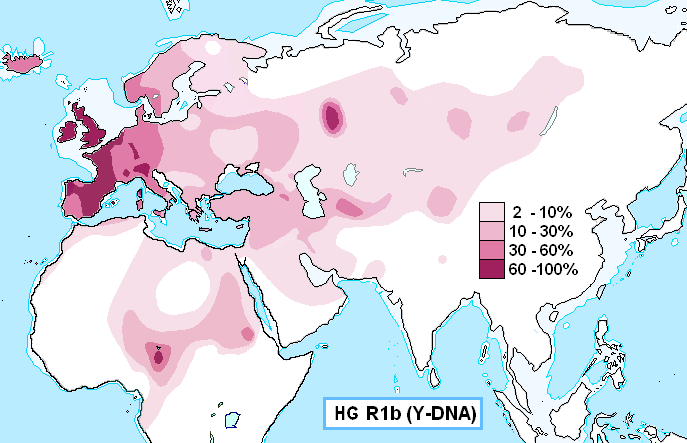
DNA studies that show that Noah's R1b peoples dispersed from Africa. The dispersion of the R1b group is shown on the map below. Note the bright red mark in central Africa. This is the region of Lake Chad, Noah's homeland.


In the story of Noah's ark, the Bible recounts how Noah released two birds after the rain stopped: a dove and a raven. In Africa the dove is a symbol of prophetic discernment so sending out a dove was Noah’s way of seeking guidance. Among the ancient Nilotes birds symbolized celestial wisdom.

Knowing the location of Noah's homeland helps us to narrow the species of doves and ravens. The most common dove in the part of Africa where the flood occurred is the Pink-bellied Dove. This species is abundant near water sources and and was associated with shrines located at rivers, springs and wells, so the idea of the Spirit hovering like a dove over the waters at the beginning of creation is consistent with empirical observation of these doves. The pink belly is suggestive of blood sacrifice which made peace between the penitent and God. This peace is symbolized by the olive branch which the dove brought to Noah.

The raven mentioned in Genesis is probably the Fan-tailed Raven, in the crow family. Its habitat extends across North Africa, Arabia, Sudan and Kenya. It also ranges across the Air Massif in Niger where it nests in crags. The red area shows the Fan-Tailed Raven’s habitat. This is the location of ancient Eden described in Genesis. Noah's descendants were rulers and priests in this red shaded area.


This is the natural habitat of both the Pink-bellied Dove and the Fan-tailed Raven, the birds that Noah might have released.

The raven was a symbol of the Creator and his son Horus. The root of the word is ḱoro- and koro is a variant of Horo or Horus. Koro is also an ancient term for war, suggesting a scavenger bird, similar to the falcon (Horus' totem) and the Egyptian vulture, both significant birds in the Bible.

The vulture, scorpion, horse and lion are found on stone pillars at the Gobekli Tepe site in Turkey which dates to about 9000 B.C. Here they appear to correspond to constellations at a time when Thuban was the pole star and they are likely clan totems. These creatures are commonly found on African images, which suggests that the structure at Gobekli Tepe was influenced by priests whose origins were in Africa. The vulture is especially important totem among the Nubians whose warrior deity was Yah/YHWH.


Saturday, March 19, 2016

Where Ahmed Osman Goes Wrong


Alice C. Linsley

Ahmed Osman (Arabic: أحمد عثمان‎) is an Egyptian-born author and Egyptologist. Drawing on the Bible, the Qur'an, and ancient Egyptian texts, he has put forward theories about Moses and Jesus that are largely rejected by most scholars. His work has a following among the "quirky" which is discrediting to him as a scholar. Osman has much to offer, but he has ignored the anthropologically significant data of Genesis and Exodus. Though his ideas are interesting, many cannot be supported by the evidence of history, linguistics, anthropology, and molecular genetics.

Osman_Ahmed-portrait
Ahmed Osman
In his book "Christianity: An Ancient Egyptian Religion" Osman posits that the roots of Christianity are found in ancient Egypt. He bases this conclusion, in part, on the variants of the name Jesus which include Yeshua, Joshua, Issa, Esau and Esse. Osman focuses on the variant Esse and attempts to connect Jesus and his followers to the Essenes, a Jewish ascetic sect of the 2nd century BC–2nd century AD who lived in structured communities in Palestine and held property in common. Certainly, the Essenes were influenced by theological ideas found in ancient Egypt.

Both the Essenes and the Pharisees held expectation of Messiah as a king who would restore the Davidic dynasty and restore Israel's former glory. This hope is expressed in Psalm 110:1: The Lord (YHWH) said to my Lord (L'adoni): "Sit at my right hand until I put your enemies under your feet. L'adoni is an address for a human master. The Essenes believed that master was David. Their view of Messiah was as a political agent who would fulfill their nationalistic and spiritual hopes. Probably this is why Jesus avoided using the word "Messiah" when speaking of himself. He told Pilate that his kingdom is not of this world. This world is passing away. His kingdom is eternal. "Your kingdom is an everlasting kingdom, and your dominion endures through all generations." Daniel 7:14 and Psalm 145:13

An eternal kingdom requires an immortal King. That is why Christians maintain that the bodily resurrection of Jesus is the ultimate proof of his identity as the long-awaited Son of God. Jesus' conception in the Virgin's womb by divine overshadowing is another proof of his identity. The angel explained to Mary: "The Holy Spirit will come on you, and the power of the Most High will overshadow you. So the holy one to be born will be called the Son of God."(Luke 1:35)

The oldest of these variants is likely Yeshua as it has the initial Y indicating divine appointment by overshadowing. This idea is found among Abraham's Proto-Saharan cattle-herding ancestors dating to at least 3500 BC. The Y depicted the long cattle horns that were worn as a solar crown. This Y mark appears in the names of many Horite Habiru/Hebrew rulers: Yaqtan (Joktan); Yishmael (Ishmael); Yishbak; Yitzak (Isaac); Yacob (Jacob); Yosef (Joseph); Yetro (Jethro); Yeshai (Jesse) and Yeshua (Joshua/Jesus).

However, the roots of Messianic expectation can be traced to one of the oldest known Horite temple at Nekhen (Sudan), a site of veneration of Horus that predates the first Egyptian dynasties. Discoveries at Nekhen continue to push back the dating of early civilizations. In May 2014, Dr. Mohamed Ibrahim announced the discovery of a Pre-Dynastic tomb at Nekhen (Hierakonpolis) that dates to about 500 years before King Narmer and the 1st Dynasty.

Nekhen is called the Falcon City as the falcon was one of the totems of Horus, the son of Ra. The Egyptian hr means "the one on high" and is a reference to the falcon that soars in the heavens. In the Coffin Texts, Horus claims, "I have brought the ways of eternity to the twilight of the morning.  I am unique in my flight." (Passage 148)

Nekhen was a large city with an estimated population of 20,000. It had markets, breweries and a large fishing industry. The city stretched nearly 3 miles along the Nile floodplain. Votive offerings at the Nekhen temple were ten times larger than the normal mace heads and bowls found elsewhere, suggesting that this was a very prestigious shrine. Horite priests placed invocations to Horus at the summit of the fortress as the sun rose.

The solar arc signified the rising of Horus from death to life. He rose as a lamb and set in mature strength as a ram. This conception is the background story of Abraham and Isaac on Mount Moriah. The expectation that the Righteous Son would not remain in the grave is expressed in Psalm 16:10: For thou wilt not leave my soul in hell; neither wilt thou suffer thine Holy One to see corruption.

Horus of Nekhen
Renée Friedman, who has direct knowledge of the excavations at Nekhen, has written that the "evidence of industrial production, temples, masks, mummies, and funerary architecture as early as 3500 B.C. is placing Nekhen at the forefront of traditions and practices that would come to typify Egyptian culture centuries later.


Osman on Moses, Monotheism, and the Ten Commandments

In his book The Hebrew Pharaohs of Egypt, Osman puts forth the theory that Moses and the Pharaoh Akhenaten are the same historical person. He writes that Moses “abandoned traditional Egyptian polytheism and introduced a monotheistic worship centered on the Aten… [and] erected his new temples open to the air facing eastward; in the same way as the orientation of the Heliopolis.”

Heliopolis is Biblical On (Iunu), an Annu shrine city. Osman does not seem to be aware of the Annu and their religious practices. Plato, who studied under a Horite priest of Heliopolis for thirteen years, wrote "Tell me of the God of On, which was, is and shall be." Heliopolis was the geodetic center of Egypt. The pyramid triads at Giza, Abusir and Saqqara were aligned to the obelisk at On. Baalbek (Heliopolis) in Lebanon also aligned to On.

Osman makes assumptions that should be questioned. He assumes that ancient Egyptian religion was polytheistic. However, the more we learn about the ancient Egyptians the more it appears that their religion is not a true example of polytheism. From pre-dynastic times there was only one Creator though he was identified by different names: YHWH, El, Amun, Amun-Re, Aten, Atum, Azu, Re, etc. This God has a son, Horus. The Father and the Son are inseparable and of one essence in the theology of Abraham's Horim. Horus knows the Father and the Father knows the Son. This is expressed in the Ancient Egyptian Pyramid Texts. In the priest's prayer to the King, he says, "Horus is a soul and he recognizes his father in you..." (Utterance 423)

While "gods" are mentioned in the Egyptian texts and in the Bible, both maintain that the One God is above all other gods. In the Ancient Egyptian Pyramid Texts this is explicit. In a prayer addressed to the Purified Horus of the East it is said, "For you are he who oversees the gods, There is no god who oversees you!" (Utterance 573)

Horus is the bread offered to mortals. Consider this from the Pyramid Texts, mortuary texts dating from the beginning of the 4th dynasty: "O Hunger, do not come for me; go to the Abyss, depart to the flood! I am satisfied, I am not hungry because of this kmhw-bread of Horus which I have eaten." (Utterance 338) The Egyptian word km means to bring to an end, to complete, or fulfill, and hw refers to the temple or mansion at the end of the water above. Genesis speaks of this: God made the vault [expanse above] and separated the water under the vault from the water above it (Genesis 1:7).

It appears that the "kmhw-bread of Horus" is what the Church Fathers call "the bread of immortality." Concerning himself, Jesus said that "unless you eat the flesh of the Son of Man and drink his blood, you have no life in you. Whoever feeds on my flesh and drinks my blood has eternal life, and I will raise him up on the last day" (John 6:53-54).

Osman assumes that Moses was a monotheist, which is incorrect. Moses and his Horite Habiru ancestors were henotheists, that is, they believed in one supreme uncreated Creator who is served by lesser created divine powers such as angels. Angelic or celestial beings were often portrayed as birds. Henotheism is much closer to monotheism than to polytheism.

The Creator's emblem was the Sun by which the Creator gives life to the world. The Sun was also called "Bull of bulls" because it inseminates the Earth. Consider this prayer from the Pyramid Texts: "Hail to you, Bull of bulls, when you arise!... As for my corpse, it is rejuvenated." (Utterance 336) This God has the power to give life to the dead.

The Creator overshadows those He appoints. Divine appointment applied to rulers and to the Woman (Gen. 3:15) who was to conceive the divine Seed or the Si-Re, "Son" of Re. Jesus refers to himself as the Seed in John 12:24. He tells his disciples that he is going to Jerusalem to die and when they object, he explains: "Truly, truly, I say to you, unless a grain of wheat falls into the earth and dies, it remains alone; but if it dies, it bears much fruit."

Osman notes that the Ten Commandments is clearly influenced by earlier Nilotic writings, such as Spell/Prayer 125 in the Egyptian Book of the Dead. He is correct in this. However, a much more significant influence is the Code of Ani which dates to about 2500 BC. There also is evidence of influence from the Law of Tehut which dates to about 3200 BC.

Portions of the Psalms are also found in earlier Nilotic writings. This should not surprise us since Abraham's Habiru ancestors came from the Nile Valley. The prayers of ascension in the Pyramid Texts and the Psalms of Ascent have much in common.

There are many parallels between the Psalms and the ancient Egyptian Coffin Texts, a collection of funerary prayers written on coffins beginning in the First Intermediate Period. Consider this poetic depiction of the soaring Horus from the Coffin Texts (Passage 148):
"I am Horus, the great Falcon upon the ramparts of the house of him of the hidden name. My flight has reached the horizon. I have passed by the gods of Nut. I have gone further than the gods of old. Even the most ancient bird could not equal my very first flight. I have removed my place beyond the powers of Set, the foe of my father Osiris. No other god could do what I have done. I have brought the ways of eternity to the twilight of the morning. I am unique in my flight. My wrath will be turned against the enemy of my father Osiris and I will put him beneath my feet in my name of 'Red Cloak'." 

Here we find a Messianic reference that appears in Psalm 110: The Lord says to my Lord: "Sit at My right hand until I make Your enemies a footstool for Your feet."


Biblical References to Horus and the Horites

Horus and the Horites are referenced throughout the Bible. The Horite rulers of Edom are listed in Genesis 36. Among them are Seir, Esau the Elder, Esau the Younger, Zibeon, Ezer, and Uz.

Biblical persons with Horus names include Hur, Moses's brother-in-law, and Aaron, Moses's brother. Aaron in Arabic is Harun.

In 1 Chronicles 7:36 we find the Horus name Har-nepher: "The sons of Zophah: Suah, Harnepher, Shual, Beri, Imrah..." Har-nepher (HR-ntr/ntjr) means Horus is King/God. The Virgin Mary's name reveals her Horite ancestry. She is Miriam Daughter of Joachim Son of P-ntjr Priests of Nathan of Bethlehem. From predynastic times, ntjr designated the king. It is likely that p-ntjr means "King's priest" or is a reference to a member of the Horite ruler-priest caste.

Joseph's family lived in Nazareth, the home of the eighteenth division of priests. This division was called "Happizzez" (1 Chronicles 24:15). The word happi is of Egyptian origin and designates the Nile River.

I Chronicles 4:4 names Hur/Hor as a "father" of Bethlehem, and 1 Chronicles 2:54 names Salmon, the husband of Rahab of Jericho, is called a "father" of Bethlehem. Mount Hor (Numbers 20:22-29) is near Petra in Edom. Edom was Horite territory.