Followers

Showing posts with label Bethlehem. Show all posts

Wednesday, April 13, 2022

Natufian Culture


Dr. Alice C. Linsley

Over a million years ago elephants, rhinoceros, giraffes, water buffaloes and lions roamed the Judean Hills around Jerusalem. Remains of some of these animals have been found in Bethlehem, less than 5 miles from Jerusalem. The bones date to between 1.4-1.8 million years. The butchered remains of some of these animals are the earliest signs of humans living near Jerusalem.

A small Natufian sculpture (the Ain Sakhri Lovers) representing sexual intercourse was found in a cave near Bethlehem. The artifact dates to 9,000 years. Bethlehem has a long association with the biblical Horite Hebrew. Hur is said to be a "father" of Bethlehem. Salmon, a son of Hur (Hor), is called a "father of Bethlehem" in 1 Chronicles 2:54. 

Natufian territory
The British archaeologist Dorothy Gerrod coined the term "Natufian" while studying remains from the Shuqba cave at Wadi an-Natuf in Palestine. The term is derived from the place, but Natufian ceramics and stonework have been found in many locations ranging from Turkey to the Sinai.

The Natufians are an early biblical population. Their area included parts of Western Egypt (Fayoum Oasis), Palestine (especially around Mount Carmel), Jordan, Syria, and Lebanon between 15,000 and 9,000 years ago. Natufian territory is in the heartland of biblical Eden which extended from the Upper Nile to the Tigris and Euphrates Rivers, according to Genesis 2:10-14.

When the Natufians lived in the Levant it received sufficient precipitation to sustain crops and orchards. Their diet consisted of meat, plants and fruits. They cultivated cereals which they harvested with sickle blades. Sickle blades are present at many sites within the Natufian heartland.

A human was buried with a juvenile dog at the Natufian site of Ein Mallaha (Davis and Valla, 1978; Tchernov and Valla, 1997). This is one of a relatively small number of Mesolithic burial sites indicating a close relationship between a human and a canine.

During the African Humid Period, the whole region from the Nile to the Jordan was wetter. There were abundant wadis, salt marshes, and swamps. This explains the abundance of tortoise shells found at Natufian burial sites.

The Natufians were baking bread 14,500 years ago. The bread was made from wild cereals such as barley, einkorn or oats, and tubers from an aquatic papyrus relative. These were ground into flour and baked in round fire pits made from flat basalt stones located in the middle of huts.

British Archaeologist, Graeme Barker, notes "the similarities in the respective archaeological records of the Natufian culture of the Levant and of contemporary foragers in coastal North Africa across the late Pleistocene and early Holocene boundary."[1]

Harvard Professor of Prehistoric Archaeology, Ofer Bar-Yosef, notes that microlithic forms such as arched backed bladelets and La Mouillah points, as well as the parthenocarpic figs found in Natufian territory, originated in the Sudan.[2]

The Natufians practiced the ritual removal of teeth, a trait of Nilotic peoples. Among the Nilotic Luo initiation involves the removal of six front teeth using the tip of a spear. This practice, called naak persists in some Luo clans, especially in Africanized Churches in Luoland, such as the Legio Maria sect. The Luo recognize “Kar-nak” to mean place of rituals.

It appears that the Natufians were originally a Nilotic people. This is further suggested by the fact that Natufian physiology indicates a Mediterranean type with negroid affinities. (See Marcellin Boule, Henri Vallois, and René Verneau, Les Grottes Palaeolithiques de Beni Séghoual, pp. 212—214.) [3]

Distinguished Research Professor at UCLA, Christopher Ehret, notes that the intensive use of plants among the Natufians was first found in Africa, as a precursor to the development of farming in the Fertile Crescent.[4]


Is there a relationship between the Natufians and the early Hebrew?

Bethlehem is associated with the Horite Hebrew in I Chronicles 4:4 which names Hur (Hor) as the "father of Bethlehem." Rahab of Jericho was the wife of Salmon, the son of Hur (Horite). Salmon is called the "father of Bethlehem" in 1 Chronicles 2:54. Rahab was the grandmother of Boaz who married Ruth. Salmon is a Horite name associated with Bethlehem in 1 Chronicles 2:51.

The Horite Hebrew were a caste of ruler-priests who were devotees of Horus and his mother Hathor. The oldest known Horite shrine city is Nekhen on the Nile and dates to 4000 B.C. The votive offerings there are ten times larger than those found elsewhere, attesting to the prestige of the shrine.

The prominence of the Horites is attested in Genesis 36 which gives the ruling line of Seir the Horite Hebrew. These people have been recognized as Abraham's kin, and the marriage and ascendancy pattern of the Horites of Seir is identical to the pattern of Abraham's Nilo-Saharan ancestors.

Decorated ostrich-egg vessels and ostrich shell beads have been found at Natufian sites and burial grounds. In ancient Kush, painted ostrich eggs were placed in the graves of children, symbolizing the hope of life after death.

Archaeologists working at Hilazon Tachtit, near the Sea of Galilee, believe that a Natufian woman buried there was a shaman. Here is the pertinent section of their report:

The goods accompanying the burial are also typical of shaman burials. Tortoises, cow tails, eagle wings, and fur-bearing animals continue to play important symbolic and shamanistic roles in the spiritual arena of human cultures worldwide today [e.g., (28)]. It seems that the woman in the Natufian burial was perceived as being in a close relationship with these animal spirits. Shamans are universally recorded cross-culturally, in hunter gatherer groups and small-scale agricultural societies (25). Nevertheless, they have rarely been documented in the archaeological record [but see (29)], and none have been reported from the Paleolithic of Southwest Asia. Perhaps, it is not surprising if clear evidence for a shaman comes from the Natufian, as the profound social and economic changes associated with the transition to agriculture [the Neolithization process (6)] surfaced during the Natufian and undoubtedly entailed equally substantial ideological changes (30, 31, 32). Whether the changes in the spiritual outlook preceded and triggered the economic changes (33) or vice versa, an inseparable interplay is clearly observed between ideological and socioeconomic change across the forager-to-farmer transition. The unique grave at Hilazon Tachtit Cave provides us with rare concrete evidence for those processes in their initial stages at the termination of the Paleolithic on the eve of the Neolithic transformation. (From here.)

The report assumes that the buried women held a shamanic worldview but makes no specific connections to shamanic practices. Shamanic practice involves mediation between the spirits of dead ancestors and the community. However, ancestor veneration, fetishes, and burial of animals also characterizes burials among populations that had priests. The offices of priest and shaman represent distinct and contradictory worldviews. Communication with spirits is a common practice among shamans. That practice was forbidden to priests, whose role was to mediate between the community and the Creator God.

If the Natufians moved into Galilee from the Nile Valley, it is likely that they had priests since that office originates in the Nile region. The practices associated with the priesthood of the ancient Hebrew include animal sacrifice, circumcision, concern about ritual purity, sacred moral codes, etc. 

It is interesting to note that the animals buried with the Natufian woman are mentioned in the book of Job and the genealogical information in the Bible reveals that Job was a Horite Hebrew. This woman's burial indicates that she was of high rank among her people. However, we should not assume that she was a shaman when the symbolism of the animals found in her grave is easily explained in the context of the religious beliefs of the Upper Nile. These animals were sacred to the ancient Nubians and Kushites who had priests, not shamans.

The two birds, which appear to be released from the woman's hand, likely represent the binary worldview of Abraham's ancestors and remind us of the two birds released by Noah. The leopard’s skin designated royalty and was worn over the shoulders by Kushite and Nilo-Saharan ruler-priests, with the paws crossed over the breast. The cow was the totem of the celestial mother who was called Hathor, the mother of Horus. Hathor's veneration spread throughout the ancient world with the dispersion of the Horite and Sethite Hebrew priests, her devotees.


Related reading: Natufian Burial Site in Galilee; World's Oldest Bread Found in Jordan; Shamanic Practice and the Priesthood; Boats and Cows of the Proto-Saharans


NOTES

1. Barker G, Transitions to farming and pastoralism in North Africa, in Bellwood P, Renfrew C (2002), Examining the Farming/Language Dispersal Hypothesis, pp. 151–161.

2. Bar-Yosef  O., Pleistocene connections between Africa and South West Asia: an archaeological perspective. The African Archaeological Review; Chapter 5, pp. 29-38; Kislev ME, Hartmann A, Bar-Yosef O, Early domesticated fig in the Jordan Valley. Nature 312:1372–1374.

3. The French School of Anthropology developed under the influence of Paul Broca. Boule studied the Peking Man fossils. Henri Vallois served as Chair of the Museum of Natural History in Paris from 1960 to 1967, and René Verneau studied paleolithic rock paintings in North Africa.

4. Ehret (2002) The Civilizations of Africa: A History to 1800. Charlottesville: University Press of Virginia


Tuesday, December 22, 2020

Luke's Nativity Dating is Correct


Alice C. Linsley


Luke's Gospel correlates the date of the nativity of Jesus to a census. "In those days a decree went out from Emperor Augustus that all the world should be registered. This was the first registration and was taken while Quirinius was governor of Syria."

Some scholars believe Luke is mistaken in saying that this was the "first registration" because the census of Jews in the Province of Syria, of which Judea was a part, was imposed later under Emperor Vespasian who ruled well after Jesus' death and resurrection.

The census was needed to collect the Jewish Tax (fiscus Judaicus), but the tax on Jews imposed by Vespasian came after the Jewish revolt of AD 66–73. To humiliate the Jews, the collection was used to support the Temple of Jupiter in Rome.

The first-century Jewish historian Josephus reports that the Jews reacted negatively to the tax census and some joined a movement led by Judas of Galilee, or Judas of Gamala. Judas led a resistance to the order of Governor Quirinius (Cyrenius) around 6 AD. Some Jews who did not to register had their houses burnt and their cattle stolen by his followers.

Josephus provides a clue as to what Luke meant when he wrote about the "first registration." Quirinius was under orders from Emperor Augustus who ruled from 27 BC until 14 AD. It is believed that Jesus was born in Bethlehem between 2-4 AD. 

Historians cite 4 BC as the time of the death of Herod the Great, so the story about the Magi visiting him in Matthew 2 only aligns with Luke's account if the Herod to whom Matthew refers is Herod Antipas who reigned from 4 BC- 39 AD.

Apparently, Joseph and Mary did not join the rebellion of Judas of Galilee, though they were living in Nazareth of Galilee. They went to Bethlehem to register for the census and to pay the tax. Given that it takes a while to organize a resistance movement, it is likely that the edict of Quirinius was issued between between 3-5 AD. Luke's account aligns well with the historical data.

A tax targeting Jews required identifying who was Jewish. The Code of Jewish Law states that a child of a Jewish mother is Jewish, regardless of the father's ethnicity and lineage. The Romans recognized this Law and used it to impose a tax selectively on Jews.

Jews were registered in their mother's ancestral town, which for Mary was Bethlehem. Joseph appears to have been from Nazareth, the home of the eighteenth priestly division, ha·pi·TSETS (Happizzez) and the hometown of Mary’s father, Joachim. (In 1962, a small piece of a list of the twenty-four priestly divisions was found in the ruins of a synagogue at Caesarea. This third-century marble fragment is inscribed with the names of the settlements of four of the divisions, including Nazareth of Galilee.)

The Jewish Law defining Jewish ethnicity and the tax targeting Jews required that Mary and Joseph return to Bethlehem, the hometown of Mary and her mother Anna. There the mother, her husband, and any children would be counted in the census, and the tax assessed and paid.


Related reading: The Priestly DivisionsBehold! A Virgin Shall Conceive; Was the Virgin Mary Dedicated to the Temple?


Monday, January 20, 2020

The Extent of Edomite Territory


Alice C. Linsley

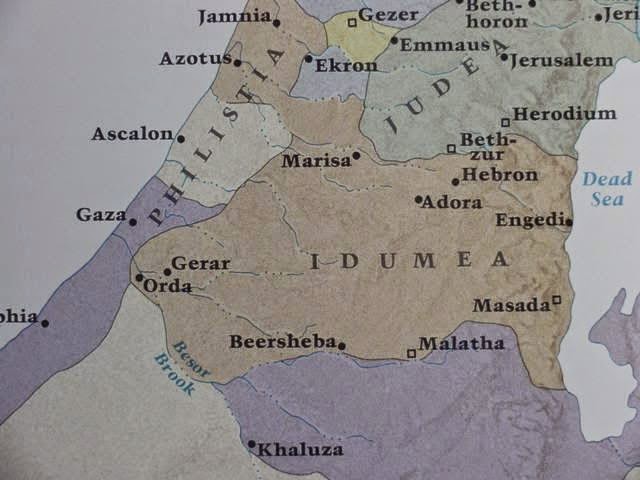
The terms Edom and Idumea refer to the same territory; the "land of red people." The extend of that territory was much larger than is generally shown on maps.

Note that Idumea and Edom are shown on this map as separate territories. However, they were one territory in Abraham’s time and Edom extended as far north as Hebron, where Sarah resided.


Compare the map above to this map which shows Idumea extending as far north as Hebron.


Data from the book of Ruth indicates that the territory of the Edomites extended even to Bethlehem where Boaz lived.


Boaz is derived from the Akkadian Bu-Uz-Kir which means “being of the land belonging to Uz.” Job was of the clan of Uz. According to Genesis 36, the clan was named for Uz, the grandson of Seir the Horite Hebrew ruler of Edom (see diagram above). This is significant because it means that the Hebrew clans of Edom held land in Bethlehem.

The word Bo, Bu or Ba is found many Afroasiatic languages. For example, BoSede in Yoruba means “Born on Sunday” or “Being of Sunday.” Ba is a Fula prefix indicating a person's homeland or point of origin.


Related reading: The Chiefs of Edom; Horite Hebrew Territory; Aaron was Buried in Edom; Hebrew Priests in Aram, Edom, Judah, and Moab


Friday, December 28, 2018

Horite Hebrew Expectation and the Star of Bethlehem


Alice C. Linsley

Sidereal astronomy is real science based on observation of the arrangement and movement of the fixed stars and planets. This science originated among Abraham's Nilotic ancestors who had recorded information about the fixed stars and clock-like motion of the planets for thousands of years.

By 4245 BC, the priests of the Upper Nile had established a calendar based on the appearance of the star Sirius. Apparently, Nilotes had been tracking this star for thousands of years and connecting it to seasonal changes affecting the Nile Valley. In 241 BC, the priest Manetho reported that Nilotes had been “star-gazing” as early as 40,000 years ago. Plato claimed that the Africans had been tracking the heavens for 10,000 years.

Plato studied with an Egyptian priest for 13 years and knew about Earth's Great Year, also called the "Platonic Year." This is the time of between 25,000 and 28,000 years that it takes for Earth to complete the cycle of axial precession. This precession was known to Plato who defined the "perfect year" as the return of the celestial bodies (planets) and the diurnal rotation of the fixed stars to their original positions.

The ancients were motivated to understand the celestial pattern because they believed that the order in creation was fixed by the Creator and they were concerned about trespassing boundaries or violating the order in creation. They believed "As in the heavens, so on earth."

For the ancient Nilo-Saharans and Egyptians the stars in the constellation of Leo were especially important because the Nile rose when the Sun passed through the constellation of Leo. Therefore, they associated the arousal of the Lion with the arousal of the waters. The lion was the totem of the tribe of Judah. In Genesis 1, we read that the Spirit of God hovered over the watery deep at the beginning. In John's Gospel we are reminded that the Son was with the Father and the Spirit before the world was made and that all things were made through Him.

The Magi were sidereal astronomers who lived east of Israel, likely in Babylon or Persia. They were heirs of the same astronomical knowledge as the ancient Egyptians, and like Daniel they were of Judah (Jews). They recognized the sign of a triple coronation of two royal celestial bodies in the constellation of the Lion, the totem of Judah. They knew it was connected to the ancient Horite Hebrew expectation concerning the Woman of their people who would bring forth the Seed, the Son of God (Gen. 3:15). Further, they believed Messiah would be born of the royal house of David.

When the Magi appeared before Herod they were told that the King of the Jews was to be born in David's city, the Horite Hebrew settlement of Bethlehem. Abraham and David were of the Horite Hebrew ruler-priest lines. Joseph and Mary, both descendants of Abraham and David, went there to register for the census.

The Magi were aware of God's promise concerning the Righteous Ruler whose kingdom would endure through all the ages because reference to the Messianic promise of Psalm 145:13 is found repeatedly in Daniel. It punctuates the rise and fall of kingdoms and proclaims the coming of an eternal kingdom. As astronomers, the Magi recognized the singular event of Jupiter's triple spiral that brought it in close proximity to Regulus in the constellation Leo, the Lion. The Babylonians called Regulus Sharu, which means king. The word is related to the Persian word Shir, meaning lion.

In his translation of the eighth-century AD Syriac manuscript "The Revelation of the Magi," Brent Landau describes the Magi as those who “pray in silence,” and he proposes that they were a small group of monk-like mystics from a mythical land called Shir. However, there is no such place. Shir refers to the lion, the totem for the Horite Hebrew clans that resided in Judah. The Magi are the descendants of those who were deported. They held the received tradition concerning the coming of Messiah. This explains their recognition of the Messianic symbolism of the alignment of the King Planet and the King Star.

Using Starry Night, a software program that tracks celestial events at any time in history, Rick Larson discovered that sidereal astronomy suggests clues about biblical events. He discovered that the king planet Jupiter met the king star Regulus at the beginning of the Jewish New Year in 3 BC. The conjunction of the Jupiter and Regulus produced the appearance of an extraordinarily bright star. Larson believes this is when Gabriel announced to Mary that she was chosen to bear the Son of God.
(Rick Larson's Star of Bethlehem)

When Mary asked how this could be, the Angel explained that she would be "overshadowed." This divine overshadowing is what the Horite Hebrew expected. In ancient iconography the mother of Horus is shown overshadowed by the sun, the emblem of the Creator. In Christian iconography, the sun is usually replaced by the image of a dove hovering over Mary.

The Horite Hebrew commemorated the death and resurrection of Horus in a 5-day festival. Horus (HR) in ancient Egyptian means "Most High One." As Plutarch noted in Isis and Osiris, 69, the first three days were marked by solemnity and mourning for the death of Horus. His death was commemorated by the planting of seeds of grain. On the third day, the 19th of Athyr, there was a joyful celebration of Horus’ rising to life.

The Horite Hebrew expectation that the Righteous Son would not remain in the grave is expressed in Psalm 16:10: "For thou wilt not leave my soul in hell; neither wilt thou suffer thine Holy One to see corruption." Jesus said, “This is what is written: The Messiah will suffer and rise from the dead on the third day..." (Luke 24:46)

Where is it written? Scholars cannot find this in the canon. However, a reference to the third day resurrection is found in the Pyramid Texts: "Oh Horus, this hour of the morning, of this third day is come, when thou surely passeth on to heaven, together with the stars, the imperishable stars." (Utterance 667) Jesus' third-day resurrection fulfilled that Horite Hebrew expectation in every detail.

Skeptics claim that Christianity is based on the ancient myth of Horus. Christians have done a poor job of responding to this assertion. It takes more faith to believe that Christianity is the Horus myth reworked than to accept the substantial evidence that that Abraham and his ancestors were Horite Hebrew who believed in God Father and God Son. They were people of faith who believed the promise that a woman of their ruler-priest lines would bring forth the Son of God, the Messiah. They believed that he would be born in Bethlehem of Judah and that God would make known his wonderful appearing.


Related reading: The Ra-Horus-Hathor Narrative;  Ancient Wisdom, Science and Technology; Who Were the Wise Men?Mary's Ruler-Priest Lineage; The Substance of Abraham's Faith; Using Totems to Trace Ancestry

Wednesday, January 8, 2014

The Virgin Mary's Ancestry


Alice C. Linsley

Mary, the most honored woman of the Bible and in the Church, is called "Theotokos" because she brought forth Jesus, who is Christ our God. He is the promised Son of God, the long-awaited Messiah. His mission, as God in the flesh, was and is to save sinners, to make void the curse of death, to destroy the powers of darkness, to make dead men live, and to restore Paradise.

Through Mary the promise of Genesis 3:15 is fulfilled. The Seed of the Woman crushed the serpent's head and death has been overcome. The ancient expectation of a divine royal son who would overcome death is found only among the Horite Hebrew priests, the Virgin Mary's ancestors. Nekhen on the Nile is the oldest known Horite Hebrew (Habiru) temple (3800 BC). Here we find the clue as to the beginnings of Messianic expectation.

Such religious expectation would have been preserved through the generations by priests and prophets. In the Genesis story of the Woman and the Serpent we have a type of the Theotokos through whom Eve's disobedience is reversed. Satan is defeated by the Woman’s Seed (Gen. 3:15). Christians believe that Jesus is the Son of God, conceived by the overshadowing of the Holy Spirit, as the Angel Gabriel declared (Luke 1).

The expectation of Messiah was preserved through a priestly lineage that was carefully guarded and preserved through generations within the priestly lines. Priests married the daughters of priest (endogamy). This is evident in the analysis of the marriage and ascendancy pattern of Abraham’s ancestors, a pattern that continued to the time of Jesus.

The endogamous practice is alluded to in Mishna Taanith: “Four-score pair of brethren-priests took to wife fourscore pair of sister-priestesses in Gophne, all in one night.” It is alluded to also in Matthew's Gospel where Jesus' brothers and sisters are mentioned.
"Is not this the carpenter's son? Is not his mother called Mary? And are not his brothers James and Joseph and Simon and Judas? And are not all his sisters with us? Where then did this man get all these things?"
These brothers are also His cousins (Jerome) since the biblical Hebrew practiced clan endogamy. The Jews who doubted Jesus' identity as the Messiah recognized that Joseph and Mary had common ruler-priest ancestors.

The terms "cousin" and "brother" are sometimes interchangeable because of the marriage and kinship pattern of the Hebrew ruler-priests who practiced clan endogamy. In Hebrews, Lot is called the "brother" (adelphos) of Abraham, but in fact Lot was Abraham's nephew, the son of Abraham's brother Haran who died in Ur.

The Hebrew priests took great care in the selection of wives since the offspring would trace their blood lines through their mothers. This kinship pattern enables us to understand the relationship of Mary and Joseph, both of priestly lines. Mary's father was a priest, as was the father of Mary's mother. Joseph was her patrilineal cousin. Some of their ancestors are listed in Nehemiah.

In Nehemiah 7:39-42 the priests that returned from exile are named. "The sons of Jedaiah of the house of Jeshua, the sons of Immer, the sons of Pashhur, and the sons of Harim."

Nehemiah 10 names the priests who signed a document: "Nehemiah the governor the son of Hacaliah, Zedekiah, Seriaiah, Azariah, Jeremiah, Pashhur, Amariah, Malchijah, Hattush, Shebaniah, Malluch, Harim, Meremoth, Obadiah, Daniel, Ginnethon, Baruch, Meshullam, Abijah, Mijamin, Maaziah, Bilgai, Shemaiah."

These names are associated mainly with the southern kingdoms of Judah and Edom. Harim is a Horus name. The name indicated the high rank of his priestly clan, which was said to have 320 adult males (Neh. 7:35). The root of the word is HRM which is also the root of "Horim." Jews call their ancestors the "Horim." 

Hattush is a Hittite name. The Hittites of Hebron (Kiriath-Arba) were kinsmen of Abraham (Gen. 23:5, 6). 

Malchijah is a variant of Melchi or Melki. This name appears twice in the ruler-priest ancestry of Mary (Luke 3:23–31). 

Abijah is the priest line of Zachariah who married Elizabeth (Luke 1). Abijah was the eighth priestly division. 

Obadiah is a royal name. It is related to Obodas, the first ruler of Petra in Edom. According to the Talmud, the prophet Obadiah was from Edom.


Mary’s Lineage

Mary’s parents were Joachim and Anne. Joachim was a shepherd-priest and his wife Anne was a daughter of a priest. Hippolytus of Thebes records that Mary’s mother was one of three daughters of a priest named Matthan (Matthias), probably of Bethlehem of Galilee. The eldest sister, Mary, was the mother of Salome; the second sister, Sobe, married a Levite and was mother of Elizabeth; the third sister was Anne, Mary’s mother. Mary’s cousin Elizabeth was the mother of John the Baptist. Elizabeth and Mary were cousins, and both daughters of priestly houses.

Herod had removed a High Priest named Matthias. He was the 61st High Priest and a descendant of David. The ancestral family of Jacob ben Mattat, once a favorite of Herod the Great, came to have limited political influence with the House of Zadok, as this lineage of King David’s descendants appears to have been ostracized from Jewish political life.

It is certain that Mary was of the ruler-priest class because even those who hated her admit this. Sanhedrin 106a says: “She who was the descendant of princes and governors played the harlot with carpenters.” It is said that she was so despised that some Jews tried to prevent the Apostles from burying her body. A legend tells of how "a certain Hebrew named Jephonias" tried to seize her burial bier and his hands stuck to it until he repented.

Mary is said to have been born in the grotto under the Church of St. Anne which would have been adjacent to the Temple, in an area where the Temple priests lived.

Mary's full name would be "Miriam Daughter of Joachim, Son of Pntjr, Priest of Nathan of Bethlehem." Some editions of the Jerusalem Talmud specifically name Jesus as the son of Pandera/Panther. In this case "son" would mean descendant. From pre-dynastic times among the Nilotic Hebrew, ntjr designated God or the king. The name Pntjr is likely Pa-Netjer, the name of Joachim’s mother. In this case, Joachim's mother must have been of high social status for a matronymic to be employed. A limestone stela (1539-1291 B.C.) bearing the names of Pekhty-nisu and his wife, Pa-netjer, is on exhibit at the Brooklyn Museum.

The connection between Bethlehem and the Horites is alluded to in I Chronicles 4:4, which lists Hur (Hor) as the "father of Bethlehem." The author of Chronicles knew that Bethlehem was originally a Horite settlement in the heart of Horite territory. The prophets foretold Bethlehem as the birth place of the Son of God.

Before his marriage to Mary, Joseph was either an elderly widower with children of his own or Mary was his second wife. The latter is the more likely since Mary was Joseph's cousin and the second wife was almost always a patrilineal cousin (as was Keturah to Abraham).

Joseph’s father was Heli (also spelled Eli), and he was a priest. Joseph's family lived in Nazareth which was the home of the eighteenth division of priests, that of Happizzez (1 Chron. 24:15). The words happi and ntjr originate in the Nile Valley, as do the names of many of the ruler-priests listed by Luke and Matthew. Melchi, a name that appears twice in Mary's ancestry, means "my image" in Amharic, a language spoken in the Upper Nile.


The New Testament Priest Lists

The expectation of Messiah, preserved through thousands of years by the Horites, focuses on the line of Judah. Matthew 1:1–6 and Luke 3:32–34 are in agreement on that.

Abraham
Isaac
Jacob
Judah
Perez – son of Tamar by Judah
Hezron
Ram (Aram)
Amminadab
Nahshon
Salma (or Salmon), married Rahab
Boaz, married Ruth
Obed
Jesse
David

Luke 3:23–31 continues the list as follows (notice the recurrence of names, marked with an asterisk).

David
Nathan
Mattatha *
Menna
Melea
Eliakim
Jonam
Joseph *
Judah – father of Er                                                          
Simeon
Levi
Matthat *
Jorim
Eliezer
Joshua
Er – descendant of Er
Elmadam
Cosam
Addi
Melki
Neri
Shealtiel
Zerubbabel – who returned to Judah from Babylonian captivity with Mordecai
Rhesa
Joanan
Joda
Josech
Semein
Mattathias *
Maath*
Naggae
Esli
Nahum
Amos
Mattathias *
Joseph *
Jannai
Melchi
Levi
Matthat *
Heli
Joseph *
Jesus

The name Matthan/Mattai and its variants appear six times in Luke’s list. The name derives from the word “gift” and can also refer to the “giving’ of Torah. Mattaniah means “gift of God” and is a name found among priests in I Chronicles.

Note the recurrence of names, suggesting cousin brides who named their first-born sons after their fathers. The name Er appears in the 7th generation from Judah. This suggests that Judah's son Er, who married Tamar, had another wife besides Tamar. This would be consistent the with Horite ruler-priest marriage pattern. This might explain Er's refusal to produce an heir by Tamar for his deceased brother (levirate marriage). Tamar must have been Er’s patrilineal cousin. The firstborn son of the cousin bride could potentially become a very powerful leader in the territory of his maternal grandfather.

The Protoevangelium of James says that Mary’s father had flocks. This is a characteristic of priests in the Bible. They kept cattle, sheep and goats. Moses tended the flocks of his father-in-law, Jethro, the priest of Midian. A common image of God in the Old Testament is as the Shepherd (Psalm 80:1) and the priests of Israel are referred to as “shepherds” who have a responsibility to tend the flock of Israel. What could be more natural than for priests to maintain herds of animals for sacrifice? They learned to be good priests by learning the skills of a good shepherd. A good shepherd must:

- watch for those who prey on the sheep

- defend the sheep from attackers

- heal the wounded and sick sheep

- find and save lost or trapped sheep

- call them by name and know their individual quirks

- and earn their trust

This is why Jesus is referred to as Good Shepherd, High Priest and “the Anointed [Messiah] of God”, the term applied to David, a king-shepherd who, according to 2 Samuel 24, offered acceptable burnt sacrifice at the threshing floor of Araunah, the Jebusite.

Through Mary the first Biblical promise was fulfilled (Gen. 3:15). Jesus is the Seed born to the Woman (not Eve, since she isn't named until 5 verses later). The promise was made to Abraham's royal Proto-Saharan ancestors of Eden. They were priests before Levi, related to the priest Melchizedek. In Genesis 36 their descendants are called "Horites" which is Horim/Harim. They expected a woman of their ruler-priests lines to conceive by the "overshadowing" of the Creator whose emblem was the Sun.

Mary is the woman appointed by God to bring forth Jesus, the High Priest, the Good Shepherd, the Messiah, the Eternal King, and the Son of God. When she asked the Angel Gabriel how she would conceive, seeing that she was a virgin, Gabriel explained "You shall be overshadowed..." (Luke 1).

Is it any wonder that the Blessed Virgin Mary is venerated in the Church?


Related reading: Who is Jesus?The Ark Rested in BethlehemJoseph's Relationship to Mary; Mount Mary and the Origins of Life; God's Word Never Fails, The Daughters of Horite Priests; The Significance of Galilee in Matthew's Gospel; Matthew's Testimony Concerning the Empty Tomb; The Pattern of Two Wives; Joseph's Relationship to Mary

Saturday, January 4, 2014

The Ark Rested in Bethlehem


Alice C. Linsley


Israel’s first king was Saul, from Gibeah. Israel's second king was David from Bethlehem. After David became king, he brought the ark "from the house of Abinadab, that was in Gibeah” to Jerusalem (2 Sam. 6:1-12). However, for three months the ark rested in David’s hometown in the house of Obed-Edom and was guarded by Jaar, a weaver.

There is a beautiful psalm of David concerning the Ark's removal to Zion. Not many are aware that the Ark rested in David's royal city of Bethlehem.  Psalm 132:1-7 makes this clear.

O Lord, remember in David's favor
his extreme self-denial,
how he swore to the Lord,
vowed to the Mighty One of Jacob,
'I will not enter my house, 
nor will I mount my bed, 
I will not give sleep to my eyes, 
or slumber to my eyelids
until I find a place for the Lord,
an abode [mishkanot- footstool] for the Mighty One of Jacob.'
We heard it was in Ephrath [Ephratha - Bethlehem]
we came upon it in the region of Jaar. (Hebrew Study Bible)


The parallelism of "Ephrath" and the "region of Jaar" require that we investigate further. Jaar is spelled Jair in the New Jerusalem Bible (p. 424) and Jaare-oregim in the Hebrew Study Bible (p. 660). The latter means "Jaare the weaver" and II Samuel 21:19 states that Jaare was from Bethlehem. So it appears that the Ark was guarded by the priests of Bethlehem until David was able to have it moved to "the city of David," a 12-acre ridge south of the Temple Mount (II Sam. 5:9). This area was inhabited continuously for 2000 years before David.

In place of the "region of Jaar" the King James Version has "we found it in the fields of the wood" and the New Jerusalem Bible has "Forest-Fields" instead of "fields of the wood." Both versions fail to trace Jaar's hometown in Scripture and miss this important clue concerning the Ark's resting place in Bethlehem.

The Bethlehem of David and Jesus is likely on the West Bank and not in Galilee. It is profound that the Ark rested in the same place where Messiah was born. Here we are presented with a Messianic typology similar to Jesus' claim that His Body is the true Temple (John 2:13-22).

Archaeological discoveries in the area of Bethlehem reveal ancient human habitation extending back 12,000 years.


Monday, December 30, 2013

David's Royal City


Make ready, O Bethlehem; for Eden hath been opened for all. Prepare, O Ephratha; for the Tree of life hath blossomed forth in the cave from the Virgin; for her womb did appear as a spiritual paradise, in which is planted the divine Plant, whereof eating we shall live and not die as Adam. Verily, Christ shall be born, raising the likeness that fell of old.

Alice C. Linsley

One of my favorite Christmas hymns is Once in Royal David's City. If I could do so, I would change the title to Once in David's Royal City to emphasize the important history surrounding Bethlehem of Galilee, Jesus' likely birthplace.

In the Masoretic Text, Samuel's city is called hara-matatyim zophim. (The Anchor Bible Commentary on I Samuel by P. Kyle McCarter, Jr., p. 51) This means that Samuel's father was a priest of the line of Matthew (or Mattai/Mattan). Hara-matatyim is also the priestly line of Joseph of Hara-mathea, one of Jesus' relatives, and the member of the Sanhedrin who requested Jesus' body for burial. Samuel's father and Jesus' mother had common Horite ancestors. The Horites were a caste of rulers who served as priests, prophets, scribes, warriors and metal workers. They were ethnically Kushite.

David and his father Jesse were of this Horite lineage also. Matthew's Gospel links Bethlehem and Ramah (Matt. 2:13-23); suggesting that Jesse's territory extended from Bethlehem "Ephratha" to Ramah. Throughout much of the Bible, Ephrath is a reference to Judah. This north-south extension would have been ruled by Jesse and would have been called "Judah" in Jesse's time. If David's city was the Bethlehem in Galilee, Jesse ruled over a territory extending about 180 miles. His status as a ruler is further supported by the Y solar cradle in his name - Yishai. Many of the great Horite rulers are designated by this symbol of divine appointment: Yismael, Yitzak, Yacob/Yisrael, Yetro, Yisbak, Yaqtan, Yoachim and Yeshua.

Samuel's Horite ancestry, and his kinship to Jesse, is further supported by the distinctive Horite marriage and ascendancy pattern that they shared. Samuel's father was a priest with two wives, Hannah and Peninnah. It was the custom for Horite ruler-priests to have two wives. The two wives lived in separate households on a north-south axis. One was a half-sister (as was Sarah to Abraham) and the other was a patrilineal cousin or niece (as was Keturah to Abraham). The first wife was the sister bride, married at a fairly young age. She was the wife of the man's youth. The second wife was taken close to the time of the heir's ascension to the throne.

Likely, one of Jesse's wives was located in Bethlehem of Galilee and the other in Ramah of the hill country to the south. Ramah has a long association with prophets; Samuel being one of the greatest. Judges 4:4-6 states that Deborah, “the wife of Lappidoth, was a prophet” who judged from her tamar (date nut palm) between “Ramah and Bethel in the hill country of Ephraim." Ramah was named for Kush's son Ramah (Gen. 10:7). Samuel's father was a priest of Ramah. Samuel anointed David as king over Israel.

Bethlehem of Galilee was known as a fruitful place and therefore called Bethlehem "Ephratha." This is the Bethlehem of David's ancestors Ruth and Boaz. It was a region known for fruit and grain. It was connected to the royal house of Tyre. Tyre was one of the ancient seats of wisdom. Hiram I of Tyre helped David build his palace. Tyrian craftsmen also helped Solomon build the temple. The rulers of Tyre were considered to have roots in ancient Eden.

Jesus went to Tyre and there His true identity was recognized, according to Mark's Gospel (cf. Matt. 15:21). Hiram I, David and Jesus share a common Horite ancestry that extends back to Eden. The Horites believed that the promised Seed of the Woman would be born of their ruler-priest lines and they expected Him to visit them. In Mark 7:24, this expectation was fulfilled when the Son of God visited Tyre. Mark explains that there Jesus “could not pass unrecognized.”

The prophet Ezekiel traces the rulers of Tyre back to Eden. "Son of Man, raise a lament over the king of Tyre and say to him: Thus says the Lord God: You were the seal of perfection, full of wisdom and flawless beauty. You were in Eden, in the Garden of God; every precious stone was your adornment... and gold beautifully wrought for you, mined for you, prepared the day you were created." (Ezekiel 28:11-18)

Related reading:  David's Bloodline; The Ethnicity of Abraham and DavidSamuel's Horite Family; Which Bethlehem was Jesus' Birthplace?; Who is Jesus?Why Jesus Visited Tyre; The Royal Priest Lines of Matthew; The Ark Rested in Bethlehem


Lyrics to Once in Royal David's City

Once in royal Davids city,
Stood a lowly cattle shed,
Where a mother laid her Baby,
In a manger for His bed:
Mary was that mother mild,
Jesus Christ, her little Child.

He came down to earth from heaven,
Who is God and Lord of all,
And His shelter was a stable,
And His cradle was a stall:
With the poor, and mean, and lowly,
Lived on earth our Saviour holy.

For He is our childhood's pattern;
Day by day, like us, He grew;
He was little, weak, and helpless,
Tears and smiles, like us He knew;
And He cares when we are sad,
And he shares when we are glad.

And our eyes at last shall see Him,
Through His own redeeming love;
For that Child so dear and gentle,
Is our Lord in heaven above:
And He leads His children on,
To the place where He is gone.


Saturday, September 28, 2013

Bethlehem in the time of Abraham


Alice C. Linsley

Many people are not aware that there are two settlements in Israel called Bethlehem. One is on the West Bank near Jerusalem and the other is in Galilee, near Nazareth. It is possible that the Bethlehem that Abraham knew was in Galilee. Bethlehem of Galilee was in a fertile region as attested by the book of Ruth. That is why it was called Bethlehem Ephratha, meaning "Bethlehem the Fruitful."

Bethlehem was a Horite Hebrew settlement. It is specifically associated with the Horite Hebrew in I Chronicles 4:4 which names Hur (Hor) as the "father of Bethlehem." Rahab of Jericho was the wife of Salmon, the son of Hur (Horite). Salmon is called the "father of Bethlehem" in 1 Chronicles 2:54. Rahab was the grandmother of Boaz who married Ruth. Salmon is a Horite name associated with Bethlehem in 1 Chronicles 2:51.

Bethlehem means either “House of Bread” or “House of Meat.” Jews give the first meaning, but the Arabic for Bethlehem is Bēt Lahm, meaning "House of Meat." This later interpretation makes sense since Bethlehem had a division of Horite shepherd-priests who took animals from their flocks to sacrifice. The meat was distributed to the needy. In Christian belief, Jesus is the "Lamb of God" who gave his flesh for the life of the world. He is also regarded as the "Bread of Life."


David was anointed first in Bethlehem and later anointed as king of Judah in Hebron (II Samuel 2:1-4). It is possible that his father had a wife in Bethlehem and another in Hebron, according to the practice of Horite shepherd-priests who maintained two wives in separate households on a north-south axis. It is also possible that Jesse's wives lived in Bethlehem of Galilee and Ramah, another Horite settlement.

Rachel was buried at Bethlehem and her grief is associated with Ramah. In Jeremiah 31:15, we read "A voice was heard in Ramah, lamentation and bitter weeping; Rachel, weeping for her children, refused to be comforted for her children, because they were no more.” Here we see Bethlehem and Ramah are connected.

Rachel gave birth to Joseph who married the daughter of the priest of Heliopolis in EgyptHeliopolis (called On in Genesis 41:45) was a Horite shrine city of great prominence in the ancient world. The great pyramids of Giza, Saqqara and Abusir were aligned to the obelisk at this Ainu shrine city.


Speaking about the recent discovery of a seal in Bethlehem dating to the First Temple, Eli Shukron of the Israel Antiquities Authority said, "This is the first time the name Bethlehem appears outside the Bible, in an inscription from the First Temple period (1006-586 B.C.), which proves that Bethlehem was indeed a city in the Kingdom of Judah, and possibly also in earlier periods."
Figurine found at Hazor

When the Magi appeared before Herod they were told that the Messiah was to be born in Bethlehem. Herod’s men found this in the book of Micah. The Horites believed that the Seed/Son of God was born at the winter solstice (December 24). The infant grew in stature from that day, even as from that day forward the Sun grows in strength as the days lengthen. In an ancient Egyptian ritual a male baby was placed before the image of Hathor-Meri and priests set gifts before the "divine son."

Abraham's Kushite ancestors were the first to unite the Upper and Lower Nile and their influence is seen on the earliest dynasties of Egypt. Kushite rulers were heirs of the Nilo-Saharan rulers who venerated cows. Elements of their religious beliefs and practices were borrowed by the ancient Egyptians. The image (right) of Horus' mother shows her overshadowed by the Sun. The Sun rests in the horns of a cow, a solar cradle (Y). The cow was Hathor's animal totem and she is shown at Nile shrines holding her child in a stable or manger.


Tracing Jesus' Bloodline

As Jews traced their blood lines through their mothers, it was necessary for Joseph to register both he and Mary in Bethlehem. Mary’s full name was "Miriam Daughter of Yoachim Son of Pntjr (Panther) Priest of Nathan of Bethlehem."  Long before the time of the Pharaohs the Horites designated the king ntjr. The name p-ntjr meant "God is King."

Abraham, David, Joseph and Mary were of the Horite ruler-priest lines associated with Bethlehem and Nazareth. Joseph went to Bethlehem to register for the census (Luke 1:26) because he was a descendant of David who was a descendant of Boaz and Ruth.

Bethlehem is where Ruth gave birth to Obed, the father of Jesse, the father of David. Ruth is praised and likened to Tamar who gave birth to Perez and Zerah. Judah gained these righteous sons by Tamar after losing unrighteous sons. His kingdom was amplified through Perez from whom Israel's greatest king and the promised Messiah came.

Bethlehem was King David’s hometown. He tended the sheep of his father, just as Moses tended the sheep of his priest father-in-law, Yetro (Jethro). Jesus comes from a long line of shepherd-priests, on both Joseph's and Mary's sides. Mary’s father Yoachim was a priest who kept flocks, according to the Protoevangelium of James.


Nazareth

Jesus was born in Bethlehem , and grew up in nearby Nazareth of Galilee. His closest followers were from Galilee and it was to Galilee that He returned and met with His disciples after His resurrection. At the Last Supper, He informed his disciples: "After I have been raised, I will go before you to Galilee.” (Matt. 26:32)

In 1962 excavators discovered in the ruins of a Caesarea synagogue a small 3rd to 4th century marble fragment with a list of the twenty-four priestly divisions. This lists names the places where four of the divisions resided, including Nazareth. Until the discovery of this fragment, there was no extra-biblical record of Nazareth's existence before the sixth century A.D and no identification of a priestly division at that town.

There were twenty-four priestly divisions after the construction of the Second Temple. Nineteen of these divisions are listed in Nehemiah 12:10-22. In the Nehemiah list we find these names of particular interest: Yoachim, Yoseph, and Mattenai (also spelled Mattai/Mattan/Matthew). These are the names of priests who married the daughters of priests and from these lines came John the Baptist, Joseph, Mary and Jesus (Yeshua), the Incarnate Son of God. This was the line of Joseph of Hari-mathea, a voting member of the Sanhedrin. He and Nicodemus, another member of the Sanhedrin, buried Jesus’ body in a cave tomb similar to those used by their Horite ancestors in Bethlehem and Hebron. Joseph and Nicodemus experienced first-hand Jesus' death. They buried him and sealed the tomb. They believed that He rose from the grave, and at great personal risk, they testified to His resurrection.

Yoachim is the name of Mary’s father, which is one reason that scholars believe that Mary was the virgin daughter of a priest. Writing in the third century, Hippolytus records that Mary’s mother was a daughter of a priest named Matthan. Mary was clearly of the Horite ruler-priest lines. Even those who hated Mary acknowledged her ruler status, as it is written in the Talmud: “She who was the descendant of princes and governors played the harlot with carpenters.” (Sanhedrin 106a)

According to 1 Chronicles 24:15, Nazareth was the home of the eighteenth priestly division, hapiTSETS (Happizzez). The name is related to the ancient Egyptian word for the life-sustaining Nile which was called Hapi. While in Nazareth, Jesus read from the scroll of Isaiah. He opened to Isaiah 61:1-3 and read about the long-expected Messiah. Then he declared, "Today this Scripture is fulfilled in your hearing."


Sunday, March 17, 2013

The Bible: Episode 3 - The Messiah Appears!


Alice C. Linsley


Episode 3 is expected to see a ratings bump with the first appearance of Jesus, played by the Portuguese actor Diogo Morgado. Though Morgado does not look like a Middle Eastern Semite, the producers have the age right. Morgado is 33, the age of Jesus at his death.

Satan was played by Moroccan actor Mohamen Mehdi Ouazanni. Apparently some people believed this was President Barack Obama giving another performance.

The History Channel's third episode of the Bible takes huge leaps through history. It moves from the Babylonian captivity to the baptism of Jesus. It is dramatic and entertaining, but as with episodes 1 and 2, it lacks historical grounding and fails to present the cultural complexities of Abraham's Horite descendants, especially those taken to Babylon.


The Babylonian Captivity

The inhabitants of the southern kingdom of Judea were subjected to two deportations to Babylon. The first took place in 597 BC when Jerusalem was conquered by Nebuchadnezzar. According to II Kings 24:1-6, King Jehoiakim and the distinguished men of his kingdom were taken to Babylon, along with the treasures of the Temple and the palace.

The second deportation took place in 586 BC in the eleventh year of the reign of King Zedekiah, who was also named Mattaniah. He had formed an alliance against Babylon with the Edomites, Moabites, Ammonites, Sidonians and Tyrians. Jeremiah prophesied that all these would also experience divine judgment.  When the Babylonians entered Jerusalem, Zedekiah and his soldiers fled by night and were pursued by the Babylonians who overtook them near Jericho.

Nebuchadnezzar ordered that Jeremiah be freed from prison and treated well (Jeremiah 39:11-40:5). Jeremiah went to live in Egypt and never returned to Jerusalem.

The number of persons taken to Babylon is estimated between 14,000 to 18,000. Historians recognize that many people were not taken to Babylon. The Babylonians were mainly interested in the urban populations and the ruling classes who had skills which were useful to them. These included skills in medicine, mining, metal work, writing, languages, astronomy, prophesy and dream interpretation. In other words, skills for which the Horites were famous.

Among these distinguished men were Ezekiel and Daniel. Such men refused to compromise the truth in order to save their lives. They knew that Nebuchadnezzar was not the true deified son whose kingdom would never end (Ps. 145:13; Dan. 2:44; Dan. 4:34; Dan. 7:27). Daniel was thrown into the lions' den because he refused to worship the Babylonian king.

Later, in the time of Joseph and Mary, some of the wise Horites who remained in Babylon came to Bethlehem seeking the King who was born under the celestial sign which their wisdom enabled them to read.

 
The Scepter will not depart from Judah

In Genesis 49:10 Jacob states, "The scepter will not depart from Judah..." This is generally taken to mean that the Messiah would come from Judah, but it is possible also that it refers to an historical reality; namely, that some of Jesus' ancestors were never taken to Babylon. Jacob's holdings extended to Beersheba and the Babylonians were not interested in engaging warriors in the Negev.

The Virgin Mary's father was the Horite shepherd-priest Joachim. Amram, Moses' Horite father, married according to the Horite pattern also. He was a shepherd-priest with water sources to provide for his flocks. His daughter, Miriam, grew up around her father's water shrine and she married another Horite chief, Hur.

The name Joachim appears with these variants: Jehoiachin and Joaquin. It is a family name which reoccurs among Jesus' ancestors.

From David to the Babylonian captivity, the following ancestors are listed in Matthew 1:1-12: David, Solomon, Rehoboam, Abijah, Asa, Jehoshaphat, Jehoram, Uzziah, Jotham, Ahaz, Hezekiah, Manasseh, Amon, Josiah, and Jehoiachin and his brothers.

From the time of the exile to the birth of Jesus, the following ancestors are listed: Jehoiachin, Shealtiel, Zerubbabel, Abiud, Eliakim, Azor, Zadok, Achim, Eliud, Eleazar, Matthan, Jacob, and Joseph, who married his cousin Mary, the daughter of another Jehoiachin. She was the mother of Jesus, who is called Messiah. Mary's ruler-priest lineage has been well established.

The recurrence of the name is consistent with the Horite marriage and ascendancy pattern whereby the cousin bride names her firstborn son after her father. The Horite lines intermarried, but this does not mean that all of them were taken to Babylon as captives. The Horite shepherd-priests maintained two wives in separate households. Mary's ancestors probably withdrew to the Negev where they had family and where the Babylonians did not pursue them. It appears that some of Mary's ancestors remained free, and Jacob's prophesy came true in a literal sense.


Return from Exile

The 538 BC Edict of Cyrus the King of Persia (Iran) authorized and encouraging the Jews to relocate to Israel and rebuild the temple destroyed by Nebuchadnezzar. Some Jews returned and some did not.  Jews were living in Persia in cities like Isfahan were they had been dispersed by Nebuchadnezzar. Cyrus was therefore familiar with Jewish religious practices.

The walls of Jerusalem were rebuilt under the leadership of Nehemiah, but the reconstruction of the Temple was not complete until 517 BC. 

The historian Josephus records that Herod the Great completely rebuilt the Temple, and even replaced the foundation stones of the Temple Mount. This renovated Temple became known as Herod's Temple and was a symbol of his power. He hoped to impress the Jews by this show of piety since, as an Edomite, he was not accepted by the dominant Pharisaic group. The Edomites were Horites and well aware of the expectation of the coming King. Herod was quickly informed that Bethlehem was to be the new King's birth place and Herod's insecurities led him to destroy every threat to his power.

This is the Scripture that Herod's wise men were frantically seeking:  “But thou, Bethlehem Ephrath, though thou be little among the thousands of Judah, yet out of thee shall he come forth unto me that is to be ruler in Israel; whose goings forth have been from of old, from everlasting.”

Ephrath was the wife of Caleb and the mother of Hur (I Chron. 2:19, 50). She was a Horite.


Horite Bethlehem and Jesus' Horite Ancestry

Joseph takes Mary, his cousin wife, to Bethlehem for the census as required by the Romans. Jesus is born in Bethlehem because he is Horite through his mother. Horite does not refer to the ethnicity of the people, but to their caste. The ancient world was characterized by a caste structure. Horites were widely dispersed among many peoples across the Afro-Asiatic Dominion.

Jesus' mother's name was Miriam daughter of Joachim Son of Pntjr (Panther) Priests of Nathan of Beth Lehem. From predynastic times, ntjr designated the ruler among the Kushites. The name Panther or p-ntjr meant "God is King."

It is certain that Mary was of the ruler-priest caste because even those who hated her admit this. Sanhedrin 106a says: “She who was the descendant of princes and governors played the harlot with carpenters.”

Mary is the blessed "Woman" of Genesis 3:15.

After Jesus' birth, Joseph is warned in a dream that Herod is seeking the Child's life. Joseph takes Mary and the Child to safety in the desert and on to Egypt.

The Church Fathers saw this as a fulfillment of the prophesy "Out of Egypt have I called my Son" (Hosea 11:1). While the Christians sees Jesus as the fulfillment of this prophesy, Jewish interpretation insists that the "son" is Israel and this verse refers to the Exodus. The Evangelists John and Matthew clearly believe that Hosea 11:1 pertains to Jesus because Jesus is the fulfillment of the Edenic Promise made to their Horim.

Further, they would have known that Jesus' mother was the daughter of  the shepherd-priest Joachim and a descendant of David and Abraham. Jesus' bloodline was traced through his mother and she was Horite by blood. Bethlehem was an ancient Horite shrine city. 1 Chronicles 2:55 which says that Caleb's sons were Kenites. They were of Kenaz, a son of Eliphaz by Timna, daughter of Seir the Horite. Caleb's son Salma is designated the "founder" of Bethlehem in I Chronicles 2:51. 

The word "Horite" takes many forms: Khar, Gur, Hur, Horonaim, Horoni, Horowitz, Horim, and Hori. Hori was the son of Lotan son of Seir whose descendants were the "lords of the Horites in the land of Seir" according to Genesis 36:20-29 and 1 Chronicles 1:38-42. Lot, Lotan, and Nim-Lot are Egyptian titles. Nimlot C was the High Priest of Amun at Thebes during the latter part of the reign of his father Osorkon II.


Foretaste of Paradise Restored: The Waters Restored

Jesus' baptism in the Jordan is surrounded by a great deal of very ancient symbolism. When John baptized Jesus, the Trinity was made manifest. Up to this moment, there are only hints or glimpses of the Trinity. Abraham was visited by the Three Person God (Baal Shalisha) before the destruction of Sodom.

There is also the image of the chaotic waters at the beginning of creation being subdued again. The chaotic deep that conceal the great serpent is restored to order, and the serpent is given warning of his impending doom. The Apocalypse of St. John identifies the dragon as "that ancient serpent called the devil, or Satan, who leads the whole world astray" (Rev. 12:9, 20:2).

In Genesis 1 we read that the primal substance covering the earth was water and it was disordered, that is, it had no boundaries. God’s breath (Ruach/Logos) created order from the chaos, separating the waters above from the waters below, and the dry land from the seas. The chaotic waters are called Tehom and the ordering word of God is called Tehut. In the cosmic struggle, Tehut is victorious over Tehom. The oldest known law code is the Law of Tehut (c. 3500 B.C.) and it was said to express the wisdom of God by which boundaries were established and fixed.

This is why there are some many stories about Jesus and water. His first miracle was to turn water to wine at a wedding. He gives Peter a great catch of fish. He calms the wind and the waves. At his baptism Christ our God enters the waters which must obey him.

Jesus' Baptism marks the beginning of the promised restoration of Paradise, that is, perfect communion with God. This is why the Orthodox hold an annual blessing of the waters on the Feast of the Baptism of Christ our God.

Orthodox bishop blessing the waters

The ancient symbolism is seen in this Orthodox prayer:

That these waters may be sanctified by the power, and effectual operation, and descent of the Holy Spirit, let us pray to the Lord.

That there may descend upon these waters the cleansing operation of the super-substantial Trinity, let us pray to the Lord.

That he will endue them with the grace of redemption, the blessing of Jordan, the might, and operation, and descent of the Holy Spirit, let us pray to the Lord.

That Satan may speedily be crushed under our feet, and that every evil counsel directed against us may be brought to naught, let us pray to the Lord.

That the Lord our God will free us from every attack and temptation of the enemy, and make us worthy of the good things which he hath promised, let us pray to the Lord.

That he will illumine us with the light of understanding and of piety, and with the descent of the Holy Spirit, let us pray to the Lord.

That the Lord our God will send down the blessing of Jordan, and sanctify these waters, let us pray to the Lord.

That this water may be unto the bestowing of sanctification; unto the remission of sins; unto the healing of soul and body; and unto every expedient service, let us pray to the Lord.

That this water may be a fountain welling forth unto life eternal, let us pray to the Lord.

That it may manifest itself effectual unto the averting of every machination of our foes, whether visible or invisible, let us pray to the Lord.

For those who shall draw of it and take of it unto the sanctification of their homes, let us pray to the Lord.

That it may be for the purification of the souls and bodies of all those who, with faith, shall draw and partake of it, let us pray to the Lord.

That he will graciously enable us to perfect sanctification by participation in these waters, through the invisible manifestation of the Holy Spirit, let us pray to the Lord.

Monday, December 24, 2012

Royal Babies


Alice C. Linsley


The royal couple William and Kate are going to have a baby next summer and the world rejoices. Bookies are taking wagers on the child's gender and name and people are discussing the prospect of a future king or queen.

Though the government will not be upon this child's shoulders, there is much ado about the birth of this royal baby. The birth of children to royal houses is not like the birth of children to common folk. It never has been.

Heirs to the throne are listed in Genesis 4 and 5. These are the oldest extant king lists, reflecting the Proto-Saharan kingdom builders who united the Upper and Lower Nile at the dawn of the Bronze Age. It was from their lines that the "Seed" of God was expected to be born (Gen. 3:15). They were awaiting a righteous king who would lead the people to immortality.

Rulers were very powerful in those days. Their greatness is recorded in Genesis and in extra-biblical documents. The description of Nimrod in Genesis 10 suggests that he was Sargon the Great who claimed that his mother miraculously conceived him while in the temple. However, Sargon died and remained in his grave, thus proving himself to be a mere mortal incapable of leading his people to eternal life.

While people speculate about William and Kate's royal offspring, none expect this ruler to be the savior of his or her people. The child is anticipated to be fully mortal, and unlike millions of commoner babies who are aborted daily, this child will be well protected. Measures are taken to protect potential heirs to the throne. History teaches that royal babies are often the targets of political enemies.

The birth of Jesus to the ruler-priest lines of Mary and Joseph was recognized by all the Wise Men of that time, both friends and foes (a biblical merism).

Wise Men who recognized His star in the East brought Him gifts. They were sidereal astronomers who recognized the significance of the conjunction of the king planet (Jupiter) and the king star (Regulus) in the constellation associated to Judah.

Herod's attempt to kill the royal child confirms that his Wise Men knew the prophesy concerning Messiah's birth place in the ancient Horite settlement of Bethlehem (1 Chronicles 4:4). Angels announced to the shepherd descendants of the Horites that the promise God made to their ancestors in Eden was fulfilled in that royal city.

Angels guided and protected the holy family because their lives were in danger. The newborn King of Israel was so great a threat to the government that He was safer in Egypt and more honored in Tyre than He ever was in Jerusalem.

This Christmas consider the evidence for Jesus as the Holy One promised of the Father and spread the Good News of His coming in the flesh.


Christmas meditations: The Horite Ancestry of Jesus ChristTracing the Horites in HistoryChristians are Christmas People; Egypt in the Christmas Narrative; Christmas Message From Genesis; The Virgin Birth and the Manger Too!; Genesis and the True Meaning of Christmas


Thursday, December 22, 2011

Bunk from BAR


Astonishing news!  The Magi's gifts were for medicinal purposes because baby Jesus had arthritis.

BAR must be hurting for real Christmas features since that journal consistently disclaims the Nativity of Jesus Messiah, the Son of God.

Researchers at Cardiff University in Wales studied uses of frankincense and found that this aromatic resin can relieve arthritis by inhibiting the inflammation that causes arthritis pain. This confirms the traditional use of frankincense to treat arthrtiis.  The trees that produce frankincense grow in Africa and Arabia and the trade in frankincense began there. The Afro-Arabian Dedanites were early to traders in frankincense according to Isaiah 21:13 and Ezekiel 27:20.  They traded in spice, ivory, incense, and textiles with lands as distant as India, Cambodia and China. They probably also traded in horses which were bred in Sheba. They traded in copper from the 4000 B.C. mines in the Air region of Niger.

Too bad BAR didn't dig a little deeper on this.  In ancient Egypt there the cippus were used for rites of healing.  It always shows the infant god Horus. Priests devoted to Horus (Horites) were known for their healing arts.

Water poured over the cippi of Horus was said to have curative power.  The vertical texts on either side of the central image of Horus suggest that this cippi was used to transform water into a curative libation.


BAR asks here, "Did the Magi “from the East” know of frankincense’s healing properties when they presented it to young Jesus?" 

Why not? Those Magi were lector priests who could read the ancient books kept in temples and palaces. They were descendants of the Horite ruler-priests who anticipated the coming of Horus in the flesh and who once ruled across the Afro-Asiatic Dominion.  In ancient Egypt, they were called hekau, which is related to the Egyptian word akhet, meaning horizon. They were sky watchers and experts in sidereal astronomyStrabo (XI, ix, 3) says that the Magian priests formed one of the two councils of the Parthian Empire. They knew that the Bethlehem star signaled the birth of the "King of the Jews" and they came to worship him. Now that's the story BAR ought be telling us!


Related reading:  Horite Expectation and the Star of Bethlehem; Abraham's Kushite Ancestors; What Language did Abraham Speak?; Thamudic Scripts