Followers

Showing posts with label Afro-Asiatic Dominion. Show all posts

Wednesday, March 27, 2013

Phoneme Study Pinpoints Origin of Modern Languages


Alice C. Linsley

Scientists agree that the point of origin of modern humans is Africa. Evidence in support of this theory is found in DNA studies, climate studies, and linguistics.


As early as 200,000 years ago humans began to move out of Africa. Another major movement came around 120,000 years ago. Subsequent movements happened between 80,000 and 70,000 years ago, and between 20,000-10,000 years ago. This last period involved Proto-Saharan Sumerians, Nilotes and Kushites. The most recent migration took place around 6000 years ago.

Genetic research indicates a common African ancestor for the Chinese about 80,000 years ago.

Quentin Atkinson of Auckland University in New Zealand believes that the point of origin of modern languages is somewhere in the southwest of Africa (the region of the Khoisan). The 2011 report, which appeared in Science, caused something of a sensation. Michael Cysouw published a commentary in Science which argues that this neat "Out-of-Africa" hypothesis for the origin of language is not adequately supported by the data presented. Atkinson's phoneme study can only be traced to about 10,000 years ago.


According to this theory, the phonemic complexity decreased as human populations dispersed farther from their point of origin in Africa. As can be seen in the map above, the further away from Africa a language is spoken, the fewer distinct phonemes it has.

Dr Atkinson believes that every language in the world developed from a prehistoric 'mother tongue' first spoken in Africa tens of thousands of years ago.
  • 500 languages traced back to Stone Age dialect
  • The further away from Africa a language is spoken, the fewer distinct sounds it has
  • English has around 46 sounds, while the San bushmen of South Africa use a staggering 200
  • Study finds speech evolved 'at least 100,000 years ago
The findings suggest that human speech was a reality at least 100,000 years ago, far earlier than previously thought.


Related reading: The Afro-Asiatic Dominion; A Scientific Timeline of Genesis; The Nile-Japan Ainu Connection; DNA Evidence of the Kushite Expansion; Is Hebrew an African Language?; Migrations Out of Africa

Thursday, November 10, 2011

The Genesis "Begats" Speak of Archaic Rulers, Jesus Christ

Alice C. Linsley


The “begats” of Genesis list ruler-priests of a vast territory that extended from Nigeria to India between10,000-3000 years ago when this part of the world was wet. The point of origin of these rulers and their people is biblical Eden, a well-watered region that extended from the Nile Valley to the Tigris-Euphrates Valley.
Waterways seen from space (NASA photo)

In Noah’s time (about 2,500 BC) this region was much wetter. Lake Mega-Chad had an area of 249,000 miles and connected several lakes and rivers. Lake Mega Chad was about 600 feet deep.

The water systems controlled by the rulers included the Nile, the Red Sea, the Jordan River and the part of the Sahara that was wet in the late Holocene. Southern Arabia was also much wetter. The region is called Ha-dhra-maut, derived from dhara which in the Dravidian referred to channels of water and maut which in Egyptian meant mother.

This 8000 year old dugout (shown right) was discovered 16 feet below the Saharan clays and sands in the Upper Yobe valley along the Komadugu Guna River in Northern Nigeria. (The oldest Egyptian boats are only about 4000 years.)

The rulers of this region expanded their territories and established new territories. One such ruler was Nimrod, known as Sargon the Great. He moved into the Tigris-Euphrates Valley and built great cities there. An earlier city builder was Kain (Cain) who lived at the western edge of Eden.
The great water systems were interconnected then, making movement between the land masses easier. The movement of Abraham’s Kushite people out of Africa has been confirmed by DNA studies, linguistics, archaeology and biblical anthropology.

The symbol of the ruler and his territory was the tent peg, represented by the vav in modern Hebrew (waw in ancient Hebrew and in Arabic).

The waw/vav orignally symbolized the crook/hook of the ruler or the tent peg of the ruler's tent. As a glyph this represented a cluster of related ideas including:
  • the ruler himself
  • the ruler's authority
  • the ruler's territory
  • the ruler's clan or tribe
  • the ruler's resources such as his flocks and water sources

The waw/vav speaks of an ancient world in which settlements near water were ruled by elders and a chief. Travelers moved from settlement to settlement and the ancient water laws were generally generous to those who wa-ndered. Wells were neutral ground for waring parties or enemies, but were fought over, as in the story of Moses driving away the intruder shepherds at the well of the Midianite ruler-priest Reu-el. (Exodus 2:16-19). It was common for the river, lake, oasis or well to have a shrine over which their was a priest. So it is not surprising to read that Moses' future father-in-law was a "priest of Midian." As such, he was a direct descendant of Abraham by Abraham's cousin bride, Keturah.

Many words in various languages today still reflect this ancient world. Consider these examples: wa-ter, wa-gon, va-gabond, va-grant, va-gar meaning "to wander" (Spanish), wa-kdar meaning "ruler" (Pashto), and ya-raki meaning "power" (Persian).

Those who needed water went from Y to Y, which is to say "from water settlement to water settlement."

The great chiefs of the biblical world were designated as such by the initial Y in their names. This is more evident in Hebrew than in English. Consider the following:

Yishmael - Ishmael (Abraham's son by Hagar)
Yitzak - Issac (Abraham's son by Sarah)
Yaqtan - Joktan (Abraham's firstborn son by Keturah)
Yishbak - Yishbak (another of Abraham's sons by Keturah)
Yacob - Jacob
Yeshua - Joshua/Jesus

Consider the importance of wells in the lives of these biblical figures. Ishmael's life was saved when an angel revealed a well or spring to his mother. Abraham's servant found Isaac a wife at a well. Moses met Zipporah at a well. Jesus met the Samaritan woman (Photini) at Jacob's Well.


Related reading: Egyptian Shrines on the Horus Way; Water Systems Connected the Nile and Central Africa; The Jordan River; Wells and Brides; The Migration of Abraham's Kushite Ancestors; A Woman at a Well; Susan Burns on Hadhramaut of Arabia

Thursday, June 23, 2011

The Afro-Asiatic Dominion


The Afro-Asiatic Dominion
(Image: Dr. Clyde A. Winters)


Alice C. Linsley

Archaeogenetics has shown conclusively that a vast dispersion of Proto-Saharan peoples dominated the archaic world. Their range extended from the Benue Trough and Lake Chad, to the Nile Valley, the Indus Valley, and Southern Europe during the African Aqualithic Period. I have termed this the “Afro-Asiatic Dominion” because the languages spoken by these peoples would be classified in the Afro-Asiatic language family.

The term "dominion" is appropriate because these territories were ruled by kingdom builders who shared a common religious tradition and common ancestors. They also had a common conception of divine appointment of rulers by the overshadowing of the sun, the emblem of the Creator God.

These are the earliest rulers on earth. They are called the "mighty men of old" in Genesis and are described as "heroes" and "men of renown." They built shrine cities at high elevations, temples, palaces, pyramids and circles of standing stones. Their burial practices reflect a common conception of the body and spirit, and the hope for immortality.

The Afro-Asiatic Dominion is older than the Vedic Age (1700-800 BC) and much order than the Axial Age. These peoples maintained settlements at sheltered high places (tamana or kar) near water sources. These settlements became the Sun Cities of the ancient world. At the center of these royal cities were the temple, the palace, housing for priests, and quarters for the royal guard. The temple typically was aligned to the solar arc, with the doors opening to the rising Sun. They were called O'piru, which means "Sun house" and the royal priests who served at these temples were called 'apiru, ha'piru or Ha'biru. The English word Hebrew is a variant of Ha'biru.

Abraham is called "Hebrew" (Ha'biru) in Genesis 14:13. The Harris papyrus speaks of 'apriu of Re at Heliopolis, the shrine of the Sun. Plato, who studied under a Horite priest at Memphis for thirteen years, wrote "Tell me of the God of On, which was, is and shall be."

The biblical data indicates that many peoples and clans comprised the Afro-Asiatic Dominion. Among them were Sumerians, Nubians, and other Nilotes, Sudra, Ainu, Canaanites, and peoples of Mesopotamia and the Indus River Valley. Linguistic and archaeological evidence suggests that the religion of the ancient Dravidian priests reflects Proto-Saharan beliefs and practices.

Abraham is a descendant of the Kushite kingdom builder Nimrod. In the Bible the term "Kushite" refers to Nilotic and Proto-Saharan peoples, and in particular to the ruler-priest descendants of Noah by his grandson Kush (Gen. 10:6-11). Kush was the father of Nimrod who established his kingdom in the Euphrates Valley and established the city of Akkad. This explains the linguistic connections between the Nile and Mesopotamia. The Akkadian script of Nimrod's kingdom is linguistically Afro-Sumerian and Sanskrit is closely related.

Václav Blažek believes that Elamite is an Afro-Asiatic language, and David McAlpin finds a genetic relation between the Elamite and Dravidian languages. Both are languages of the ancient Afro-Asiatic Dominion which extended from the Nile to the Indus River Valley and into ancient Anatolia and Bactria.

The Greek writer Homer alluded to the vastness, diversity, and unity of the Kushite empires when he wrote, “a race divided, whom the sloping rays; the rising and the setting sun surveys.” Before Homer's time (ca. 8th century BC) there was but one vast dominion that stretched from West Africa to India and it was dominated by rulers and priests who were ethnically Kushite.

A common worldview and religious practices related to the deity Horus are found from west central Africa to India and as far as Cambodia where they established Horite shrines at Anghor Wat (ankh-Hor means "May Horus Live!").

Proto-Saharan nobles were buried with red ochre at Nekhen in Sudan (3500 BC). Nekhen was a Horite shrine city dedicated to Horus whose totem was the falcon or hawk. Early dynastic Egypt adopted the Horite religion and never practiced cremation, as in the religions that seek to escape physical existence (samsara). Abraham's ancestors believed in the resurrection of the body and awaited a deified king who would rise from the grave and deliver his people from death.

Nekhen (Hierakonpolis) is the oldest known Horite shrine center. At the temple of Nekhen, votive instruments were ten times larger than the mace heads and bowls found elsewhere, suggesting that this was a very prestigious shrine. Horite priests placed invocations to Horus at the summit of the fortress as the sun rose. This is the likely origin of the sun blessings in Hinduism (the Agnihotra morning ritual) and in Judaism (the Birka Hachama or “Sun Blessing” ritual performed every 28 years).

There is evidence that the Horite priests dispersed throughout this ancient world. The word sarki designates a priestly ruler from Africa to Nepal. In ancient Egypt sarki and harwa referred to orders of priests. In Hausa sarki means king. The Horites were a caste of ruler-priests who spread their religious beliefs far and wide.

They were called Hapiru or Habiru (Hebrew). The Egyptians called these temple attendants ˁpr.w, the w being the plural suffix. This has been rendered '*wap'er' by the Afro-Asiatic expert Christopher Ehret. The *wap'er exercised significant authority alongside the high king. They presided over the rituals directed toward the High God and acted as intercessors and prophets. The Hapiru were devotees of Horus, whose worship originated in what is today Sudan.

The Dravidian east-facing temple was termed O-piru, meaning Sun House or House of the Sun. The sun was the emblem of the creator God. The Arabic yakburu means “he is getting big” and with the intensive active prefix: yukabbiru means "he is enlarging." Likely this is a reference to the morning ritual of the Horite priests who greeted the rising sun and watched as it expanded across the horizon.

Many Dravidian settlements and monuments are now submerged under the sea, but originally they were on a land bridge between the Arabian Peninsula and Southern Pakistan. This is sometimes referred to as the "Har-appa" civilization. Har refers to Horus and "appa" is the Dravidian word meaning father. The origin of Dravidian religion was apparently Egypt and ancient Kush. The Indian historian and anthropologist Bharatiya Vidya Bhavan has written: "We have to begin with the Negroid or Negrito people of prehistoric India who were the first human inhabitants. Originally they would appear to have come from Africa through Arabia and the coastlands of Iran and Baluchistan."  According to the Matsya, an ancient book from India, the world belonged to the Kushites (Saka) for 7000 years. 

In the ancient Afro-Asiatic world, a temple was considered the mansion—hâît, or the house—pirû—of the deity. The Horites and Hapiru maintained temples and shrines throughout the ancient Afro-Asiatic Dominion. Carol A. Redmont has noted that Hapiru influence was felt "from the Tigris-Euphrates river basins over to the Mediterranean littoral and down through the Nile Valley during the Second Millennium, the principal area of historical interest is in their engagement with Egypt." (Carol A. Redmount, 'Bitter Lives: Israel in and out of Egypt' in The Oxford History of the Biblical World, ed: Michael D. Coogan, Oxford University Press: 1999, p.98)


Comparative Linguistics Tells the Story

A comparison of the languages of Saharan Africa, Semitic languages, Sanskrit and Dravidian suggests that the Horites dispersed among many peoples and their presence cemented a vast Afro-Asiatic Dominion between 12,000 and 10,000 years ago. Afro-Asiatic languages include Accadian, Amharic, ancient Egyptian, Arabic, Aramaic, Assyrian, Babylonian, Berber, Chadic, Kushitic, Ethiopic, Hahm, Hausa, Hebrew, Omotic, Phoenician, and Ugaritic. These “cognate languages" appear to share a common ancestor language. Because this is so, linguists are able to compare the languages and draw conclusions about the older “proto” Afro-Asiatic language and dialects spoken before 10,000 years ago.

One expression of the common worldview of the Afro-Asiatics is the linguistic affinity of their languages. Consider the following examples:

The Hebrew rison adam = ancestral man is adamu orisa = ancestral Adam in Hahm/Hausa languages of Nigeria and Niger. The Hausa word for human being is dan adam. Related is the Babylonian word for blood: dhama. The Sanskrit word for male human is manu which resembles the African word adamu.

The Hebrew bara = to begin, is related to the Yoruba/Hahm word bere = to begin. There is a relationship between the verb "to begin" and the Hebrew word for Creator which is Bore and the African Twi dialect is Borebore = Creator. The Sanskrit kr = ‘to create/to make is related to the Igbo kere = created.

The Hebrew hay = “living being” is related to the Hausa/Hahm word aye = life, created world. Likewise, the Hebrew iya = mother, corresponds to the Dravidian ka ayi = mother, and the Hausa/Hahm eyi = gave birth.

The Hebrew hayah = "Let there be…" is rleated to the Igbo haa ya = "Let it be…/let there be"

The Hebrew amar = "commanded" is related to the Igbo hamara = "commanded"

The Hebrew abba = father, corresponds to the Hausa/Hahm baba = father, to the Dravidian appa/appan = father, and to the Mundari apu = father. The original root is likely AP.

The Hebrew ha’nock = the chief, corresponds to the Hahm word nok = “first ancestral chief”. The original root is likely NK.

The Semitic word wadi = river, corresponds to the Sanskrit nadi = river. The original root is likely AD.

The Semitic root mgn = to give, is the same as the Sanskrit mgn = to give.

The Hausa word for hunter is maharba. Compare this to the Hebrew word that appears in the Targum nah shirkan = hunter, and note the similarity to the Hausa word sarkin maharba = lead hunter.

The Sanskrit svah = sky or heaven, corresponds to the Semitic svam or samyim = sky or heavens. The Semitic resembles the Proto-Dravidian word van = heaven. The Arabo-Spanish desvan (attic or upper room) is likely related to the root SVN.

The Hebrew yasuah = salvation, corresponds to the Sanskrit words asvah, asuah or yasuah = salvation. Yashua means salvation in the Urdu language also.

The Hebrew root thr = to be pure, corresponds to the Hausa/Hahm toro = clean, to the Amarigna (Ethiopia) anatara = pure, and to the Tamil tiru = holy. All are related to the proto-Dravidian tor = blood. In some Kushitic languages mtoro means rain and toro refers to God. The Egyptian ntr = deity is probably related.

The Hebrew echad or ehat = one, corresponds to the Luo (Nilo-Saharan) achiel, the Syrian eka, the Sanskrit eca, and to the Gonga ikka. The Gonga languages are spoken in southeast Ethiopia. In the Proto-Saharan, ikki is a directional element, meaning toward or to, and has the Creator as the reference. In the ancient world, the first position or number one was reserved for or assigned to the deity. This is evident in the Luo word for one: achi-el. El is a very ancient reference to God.

The number six in Proto-Dravidian is caru. This correlates to koro in Proto-Saharan, a directional element (the cardinal poles were associated with numbers); to karkia in some Chadic Languages; and to korci in Meidob (a language of eastern Sudan). The most striking similarity is between the Kanembu (another language of Sudan) araku and the Dravido-Tamil aarru.

We can verify the connection between the Nile and Indus Valley by comparing the Egyptian and Indus pottery inscriptions in which 17 figures are virtually identical (see below).


In addition to the linguistic evidence for the spread of Kushite beliefs there is evidence from ethno-astrology, number symbolism, and in analysis of the kinship pattern of Abraham's Horite people, using the geneologies of Genesis. My research shows that the marriage pattern of Abraham’s Kushite people drove Kushite expansion and the diffusion of the proto-Gospel. Diffusion of the belief concerning the miraculous birth of an eternal King-Priest was driven by four historically identified factors: Kushite migration out of Africa, Kushite commerce, Kushite conquests, and marriage alliances between the Kushite ruler-priests.


Cultural Diffusion and the Afro-Asiatic Dominion

How is it that people living across this vast expanse share so many important words? Genesis 11:1 tells us that the descendants of Noah who are listed in the Table of Nations (Gen. 10) were one people and spoke one language. In fact, all the peoples listed in the Genesis 10 are Afro-Asiatics and at one time they used virtually the same words, that is to say, they spoke closely related languages that shared a common system of roots.

One explanation for this is cultural diffusion over a large area resulting in common features. Diffusion is the process of spreading knowledge, skills, and technology from one culture to another. Cultural diffusion explains the linguistic affinities between languages as different the Asian Tamil and the African Hausa. The diffusion process begins when different cultures initiate regular contact through migration, commerce, marriage alliances and conquests. Let us consider the evidence for each of these aspects of diffusion.


Kushite Migration

Archaeogeneticists employ genetics, archaeology and linguistics to examine the origin and spread of people groups. Haplogroup R-M173 is of particular significance because this pertains to the ancient Kushite and Nilotic peoples who are genetically related.

At least three migrations out of Africa have taken place in the past 120,000 years. The first that has been documented took place in the Late Pleistocene (120,000-12,000 B.C.). Here the movement was from the Upper Nile Valley and the Horn into the coastal areas of Arabia. Evidence indicates that Nilotic peoples moved out of Africa in several directions. Thomas Strasser and his team have found hundreds of stone Age tools of African origin on the island of Crete. Others have been found on the Iranian plateaus, helping experts trace the steps of an Nilotic tribe that passed through the region on their way to India where it settled in the Andaman Islands. The tribe has all the physical features of black East Africans. Their ancestors are believed to have migrated out of East Africa about 60,000 year ago. According to Hamed NasabVahdati, a member of the archeological society at Iran's Cultural Heritage Center, the Stone Age artifacts found in Iran are very similar to those found in East Africa.

Many moved across land as the sea level was lower during of the ice age. However, for many the final stage of the journey would have been by sea. Dr. Richard Klein, an archaeologist at Stanford University, believes that the population discovered at Lake Mungo, in southeastern Australia, was originally from Africa. The Lake Mungo site holds the remains of an adult man who was sprinkled with copious amounts of red ochre in a burial ritual common among early humans. These humans would have had to cross 50 miles of ocean between the nearest point of Southeast Asia and the landmass of New Guinea and Australia, which were then attached.

The most recent involved the African population known as Kushites. In a study conducted under the direction of Clyde A. Winters at the Uthman dan Fodio Institute in Chicago, data from archaeology, linguistics, genetics and craniometric studies were used to explore the role of the Kushites in the spread of haplogroup R from Africa to Eurasia. Here we find evidence of the Dravidian connection to the ancient Kushites:

There is genetic, linguistic and archaeological evidence pointing to the African origin of the Dravidian speakers in India (Aravanan 1980; Winters 2007). The Indian archaeologist B.B. Lal (1963) believes that the Dravidian speaking people may have belonged to the C-Group. The C-Group people spread culture from Nubia into Arabia, Iran and India as evidenced by the presence of Black-and-Red Ware (BRW). Although the Egyptians preferred the cultivation of wheat, many ancient C-Group people (Nubia/Kushite) were agro-pastoral people who cultivated millet/sorghum and maintained large herds of cattle which were used for sacrifice and food. Bovine skulls were used to decorate their graves.

The C-Group people lived in northern Nubia, southern Egypt, and southward to the modern Sudan between 2300-1500 B.C. Winters believes that the Dravidian speakers of C-Group took millet to India (C. Winters, 2008b). B. B. Lal contends that the Dravidians came from southern Egypt and Sudan (Nubia/Kush). This would explain their dark complexion. Lal writes: "At Timos the Indian team dug up several megalithic sites of ancient Nubians which bear an uncanny resemblance to the cemeteries of early Dravidians which are found all over Western India from Kathiawar to Cape Comorin. The intriguing similarity extends from the subterranean structure found near them. Even the earthenware ring-stands used by the Dravidians and Nubians to hold pots were identical."

The Nubian megaliths of which Lal speaks date to about 3000 years before the present.

There is evidence that ancient peoples of Africa migrated in many directions. The Ashante moved west from Sudan to what is today Ghana. Some went eastward to the Near East, to Iran, to India and to Indonesia. This explains the correspondence of names like Orissa in Nigeria and northern India and the correspondence between the wedding ceremony of the Agharias of Orisha, India and that described in Genesis among Abraham's people.


Kushite commerce

Diffusion is common among groups whose homelands are geographically contiguous. However, the land area of the Afro-Asiatic Dominion is so vast that the diffusion of the Afro-Asiatic worldview must have been driven by traveling merchants as well as migration. In other words, the Sahara was not a barrier to travel before 10,000 years ago because there were water routes to follow and the central part of the Sahara was wetlands (see map below).


Anne Osborne, lead author of a Bristol University paper on this topic has said: “Space-born radar images showed fossil river channels crossing the Sahara in Libya, flowing north from the central Saharan watershed all the way to the Mediterranean. Using geochemical analyses, we demonstrate that these channels were active during the last interglacial period. This provides an important water course across this otherwise arid region.”

Dr Derek Vance, senior author on the paper, added: “The study shows, for the first time, that monsoon rains fed rivers that extended from the Saharan watershed, across the northern Sahara, to the Mediterranean Sea. These corridors rivaled the Nile Valley as potential routes for early modern human migrations to the Mediterranean shores."

Cultural diffusion was aided by caravans that moved back and forth between west central Africa and Asia. This explains the appearance of ancient African artifacts in China. Wild donkeys were domesticated by the Kushites between 6500 and 4000 BC. The wild donkey was native to the Red Sea Hills and the arid Ethiopian highlands. Kushites used both camels and donkeys as beasts of burden. These hearty creatures enabled the transport of cargo across the Arabian Peninsula, Mesopotamia and Pakistan. As Roger Blench has noted, "The spread of the donkey across Africa was linked with the proliferation of long distance caravans."

The region of Sheba in southern Arabia was famous for horses. The people of Sheba were close kin to Abraham and ethnically Kushite. The high-spirited, high-stamina Arabian horse is one of the oldest breeds, dating back 4,500 years. They were valued for breeding across the ancient Middle East and among Japheth’s Magyar descendants. Today Arabian bloodlines are found in almost every modern breed of riding horse. The world's oldest saddles are from Nubia and the Upper Nile region.

The region of Dedan in northern Arabia was famous for trade and commerce. Isaiah 21:13 speaks of the “caravans of Dedanites” and Ezekiel 27:20 speaks of Dedan as supplying Tyre with precious things. They traded in spices, ivory, incense, and cotton with lands as distant as India, Cambodia and China. They traded in copper from the 4000 B.C. mines in the Air region of Niger where there are rock drawings of chariots, and evidence of early copper smelting and copper weapons. The Dedanites were ethnically Kushite and kin to the people of Sheba.

The Sudanese Kushites were the first to domesticate wild sorghum and millet. These became staple grains in Egypt and were taken to Pakistan and India between 3000 and 1000 BC, probably by the Dravidians. The Dravidians also mined gold in southern Africa in 1000 B.C. and it is likely that they transported both grain and gold by ship from northwestern Africa to India.

Migration and commerce do not sufficiently explain how peoples living across such a vast expanse of land should have a common worldview and linguistic heritage. The evidence suggests a more complex picture of migration, commerce, and alliances among peoples located around the Indian Ocean, the Arabian Peninsula and the Dead Sea.


The Kushite marriage pattern drove the Kushite expansion out of Africa

My research into the genealogical material in Genesis involves analysis of the Horite kinship pattern. This kinship pattern is unique and makes it possible to trace Kushite rulers.

The Horite pattern involved two wives and at least two concubines. The ruler's first wife was a half-sister and the second wife was a patrilineal cousin or niece. The marriages of firstborn sons contributed to the diffusion of Horite religion. The firstborn son of the half-sister wife ascended to the throne of his biological father. The firstborn son of the patrilineal cousin or niece bride ascended to the throne of his maternal grandfather. All other sons were given gifts of camels, jewelry, flocks, herds and servants and sent away to conquer settlements and build territories for themselves. The importance of these "sent-away sons" as a driving factor in Kushite expansion should not be overlooked.

This pattern is evident in the case of the Kushite kingdom-builder Nimrod. Nimrod, one of Abraham's ancestors, is an example. He was ethnically Kushite but was probably sent away from his older brother Ramah whose territory was in northern Arabia. This explains why he regarded his mother as "lowly." She would have been a woman of less wealth and status than the wife of Ramah, Kush's the firstborn son. After numerous conquests, Nimrod’s territory was far greater than his brother’s. It extended the length of the Tigris-Euphrates Valley and within this territory there were three principal cities: Babel, Erech and Akkad in the plain of Shinar (Gen. 10:10). The script used to communicate across Nimrod’s empire Akkadian is Afro-Sumerian.

The conquest of the Sumerian city states by Kushites rulers is well-documented. Sargon the Great lived from about 2290 to 2215 BC, which is when his son Rimush (Ramesh) by his sister-wife ascended the throne. Alternative dates for Sargon the Great are 2360-2279, but these dates likely refer to his maternal grandfather after whom he was named. It was Sargon the Elder, not Sargon the Great, who conquered Nippur in 2340 B.C. and established his capital in Accad.

Sar-gon is the name by which Nimrod of the Bible is remembered in history. Sargon is a title meaning High King or King of Kings. The Elamite word for king is sunki, a cognate of the Hahm/Hamitic sarki, meaning king. The Sumerian word for king is sar and the Chadic word for ruler - gon.

The researcher on African Culture, Dr. Catherine Acholonu, reports that in Nigerian lore Nimrod is known as Sharru-Kin which is interpreted to mean “the righteous King.” Nimrod's Accadian name was Šarru-kīnu, which is usually translated “the true king.”

Many of the place names of Sargon’s kingdom in Kur-gal match places names in ancient Kush. For example, Accad is Agade, which is the original name of a river settlement in Odukpani, Nigeria. (Its geographical coordinates are 5° 29' 0" North, 7° 58' 0" East.) The name Accad is also related to the name of the city of Agadez in Niger, with a long association with metalworkers. Sargon’s territory was called Kish, which is Kush. One of the cities of his territory was Mari which is the Egyptian word for Mary. Another was Yar-muti (Old Arabic) which means Obedient (muti) Friend (yar).

A seventh century Assyrian text says that Sar-gon's birthplace was a city on the banks of the Euphrates called Azu-piranu. It was a Horite shrine as evidenced by the word piranu. The Hapiru devotees of Horus called a temple O-piru, meaning "House of the Sun." Azu is an East African name for God - Asa. Azu-piranu means “House of God” and is equivalent to the Hebrew word Beth-el. Hur-azu was a title for Horus and the Babylonian word for gold.

Kushite rulers, like Egyptian rulers, did not name their biological fathers in their king lists. This is because they believed that the ruler-priest was the son of Re whose emblem was the sun. The Pharaoh was called "son of Re" which is why Egyptian texts never mention an earthly father of the king. Kingship was rather a manifestation of the solar deity's overshadowing of noble women. Sargon the Great (probably Nimrod) claimed not to know his father. He based his authority to rule on the suggestion that he was conceived according to the Horite myth of miraculous virgin conception.

The evidence is conclusive that the Afro-Asiatic Dominion was essentially Kushitic and a vehicle for the diffusion of Horite worship. Dr Christopher Ehret has expressed this succinctly in his treatise "History in Africa." He writes, "The linguistic, genetic, and archaeological evidence combine in locating the origins of this family far south in Africa, in Eritrea or Ethiopia, and not at all in Asia. A complex array of lexical evidence confirms that the Proto-Afrasian society belonged to the pre-agricultural eras of human history." (p.4)

Monday, February 7, 2011

Some Hapiru Were Devotees of Horus


Alice C. Linsley


The Greek writer Homer alluded to two Kushite empires, when he wrote "a race divided, whom the sloping rays; the rising and the setting sun surveys." By Homer's time, the Afro-Asiatic Dominion that had been forged by the great rulers of old had become fragmented. These "mighty men of old" were served by warriors, priests, metalworkers, stone masons, vintners, scribes and sages. In ancient texts the ruler-priest caste is known as "Habiru," and the rulers were associated with the seven visible planets. This is evident in the Luo (Nilo-Saharan) word for seven: abiriyo. The word abir is a cognate of ha'biru, and Y is a solar symbol, as in the names of Habiru (Hebrew) rulers: Yaktan, Yishmael, Yitzak, Yosef, Yetro, Yeshua, etc.

Among the Habiru there were many peoples, including the Shasu, the Ainu and the Anakim. The last two words are related. Anak and his people the Anakim dwelt in the region of Hebron, where Sarah resided. They are associated with the Nephilim (Num. 13:33), with the Raphaim (Deut. 2:10) and with the Calebites (Josh.15:13). Supposedly, Caleb drove the Anakim out of the region, but there is much evidence that they remained well established in Canaan after the time of Caleb. Other related peoples are the Zumim and the Emim. Shrine cities, such as Hazor, were governed by Ha'biru, so the attempts of Joshua and Caleb to take these settlements indicates a power struggle between kinsmen rather than strangers. The ethnicity of all these peoples is Proto-Kushite and Kushite.

Homer recognized the Kushite cultural continuity that stretched from the Nile Valley to India. The religion of this ancient world spread through the agency of ruler-priests known as 'Apiru, Hapiru or Habiru (Hebrew). They served rulers who controlled water systems at a time when the Sahara, Mesopotamia, Pakistan and India were wetter.

Some of these ruler-priests were known as "Horites" because they were devotees of Horus, the son of Re. They regarded the sun as the emblem or symbol of Ra and Horus. Ha-biru and Ha-piru are derived from O-piru, meaning house or temple of the sun. The Arabic yakburu means “he is getting big” and with the intensive active prefix: yukabbiru means "he is enlarging." Likely this is a reference to the morning ritual of the Horite priests who greeted the rising sun as it expanded across the horizon.

The Egyptians called the temple attendants ˁpr.w, the w being the plural suffix. The Dravidian east-facing temple was termed O'piru, meaning Sun House.

Many Dravidian settlements and monuments are now submerged under the sea, but originally they were on a land bridge between the Arabian Peninsula and Southern Pakistan. This is sometimes referred to as the "Har-appa" civilization.  Har refers to Horus and "appa" is the Dravidian word meaning father. The origin of Dravidian religion was apparently Egypt and ancient Kush.

The oldest known center of Horite worship is Nekhen (Hierakonpolis) in Sudan. Votive offerings at the temple of Horus were up to ten times larger than the normal maceheads and bowls found elsewhere, suggesting that this was a very prestigious shrine. Horite priests placed invocatins to Horus at the summit of the fortress as the sun rose.

In the ancient world, a temple was considered the mansion—hâît, or the house—pirû—of the deity. The Creator Râ lived in Heliopolis on the east side of the Delta; Hat-Hor, the virgin mother of Horus had her principal temple in Memphis to the south of Heliopolis and on the west side of the Nile. Horus, who was said to be one with his Father, lived further south in Hierakonpolis and Edfu on the west side of the Upper Nile.

Râ, Hathor-Meri and Horus represent the typical Egyptian triad, but to properly understand the relationship of the three, we must consider the relative locations of the temples. Hat-Hor represents the Feminine Principle, and as such is located to the south (the direction associated with birth).  Râ is to the north, and as his symbol is the Sun, his temple is on the east side of the Nile. Horus is to the southwest, the direction associated with the future and with birth. Against those who claim that Abraham's Horite ancestors were polytheists, we must note that only Horus and Hathor-Meri are ever shown in human form, and usually together.

The Horite ruler-priests were kingdom-builders, such as Nimrod, one of Abraham's ancestors. This meant they engaged in war, as did Abraham when he battled the kings who had fought against his Horite people (Gen. 14:6) and taken Lot captive (Gen. 14:12). One of Abraham's nephews was named Thahash or Tahash, meaning skins. Tahash probably tanned the hides of sacrificed animals.  Exodus 25:5 speaks of "five rams' skins dyed red, and tahash skins..." 

Diffusion of the Horite belief system was driven by three factors: migration out of ancient Kush, commerce, and the marriage alliances of the ruler-priests whereby each ruler had two first-borns sons. The son of the half-sister wife ascended to his father's throne, and the son of the patrilineal cousin bride ascended to the throne of his maternal grandfather. The pattern is one of double descent with bloodline traced through the wives, while the son's status as ruler came from his father.

Consider Abraham's two wives, by which he had seven sons. Isaac and Joktan both became rulers. Isaac ruled over Abraham's territory between Hebron and Beersheba when Abraham died. Joktan ascended to the throne of his mother's father, who was also called Joktan. If each son had two wives, the population of the Horite or Hapiru nobles would have expanded very quickly. Each chief had to locate where he could establish his own territory. Kush's two sons moved east of the Nile. Ramaah established a kingdom in northern Arabia and intermarried with the people of Dedan, where the largest number of Old Arabic texts have been found. These are the Afro-Arabians. Nimrod moved farther east to the region that would become the homeland of the Arameans. This eastward migration of first-born sons drove the expansion of the Afro-Asiatic Dominion.

This is why the Horites and Hapiru were found throughout the ancient Afro-Asiatic Dominion. Carol A. Redmont has noted that Hapiru influence was felt "from the Tigris-Euphrates river basins over to the Mediterranean littoral and down through the Nile Valley during the Second Millennium, the principal area of historical interest is in their engagement with Egypt."  (See Carol A. Redmount, 'Bitter Lives: Israel in and out of Egypt' in The Oxford History of the Biblical World, ed: Michael D. Coogan, Oxford University Press: 1999, p.98)

In ancient Egypt, some priests were called harwa, a word related to Horus.  The Harwa served in the temples and shrines along the Nile. They were clean shaven and lived rather ascetic lives. Moses's two brothers were harwa. Both were named for Horus. Aaron in Arabic is Harum, and Korah means shaved one, indicating that he was a Horite priest of the Nile. Later, both Jews and Arabs used kohen to designate a priest.

It appears that there were orders among the priests, some serving at higher levels than others. Some were called sarki. Sarki still live in the Orissa region of India. They are responsibile for flaying animals before the sacrifice. The word sarki also refers to red ochre which was ground into power and used as a symbol of blood in the burial of nobles as early as 60,000 years ago. Here we find a clear connection between the priesthood and blood, and between blood as a symbol of life and ritual burial. God acts as the first priest when He sacrifices animals to make coverings for the man and the woman (Gen. 3:21).

The work of the priest involved blood sacrifice for atonement. According to priestly law, the blood of a sacrificed animal was to be sprinkled seven places on the altar. Christians note that Jesus Christ bled from seven places and his blood is said to give “life to the world” (John 6:52-56).  The Christ is already present in ancient Nilotic mythology which holds that life is in the blood. The priesthood and circumcision also originated among the Nilotic peoples. Abraham's Kushite ancestors were the first to belief the Eden Promise that a woman of their ruler-priest lines would bring forth the Seed who would crush the serpent's head and restore Paradise.


Related reading:  Ha'piru, Ha'biru, 'Apiru or Hebrew?; The Re-Horus-Hathor NarrativeMoses' Wives and Brothers; Who Were the Horites?; Who Were the Hapiru?; The Christ in Nilotic Mythology, Christian Faith Emerges from the Faith of Abraham

Saturday, February 5, 2011

Egypt in the Book of Genesis


Alice C. Linsley


Grieving Egyptian. Note the reddish-brown skin tone

Egypt is mentioned more than 300 places in the biblical narratives. It is often the place to which people escape  trouble: famine, political persecution, and war. What was considered Egypt in Abraham's time has never been established. Egypt's cultural and political influence extended far beyond the borders of present-day Egypt.  

The Greek historian Herodotus (484-425 B.C.) used the Greek term for the Red Sea to encompass the Gulf of Suez, the Gulf of Aqaba, the Red Sea, and the Indian Ocean. This is because he understood that the major bodies of water were controlled by the Hamitic Afro-Arabian and Semitic Afro-Asiatic rulers. These rulers were related by marriage. The water ways were the great highways of that time and it was along these rivers that the Horite priests spread their religious beliefs concerning Horus, who was called "son of God."  Horus is the pattern by which Abraham's descendants recognized the Messianic identity of Jesus of Nazareth. The primitive shape of messianic expectation is found among the Nilotic peoples. Their sea (bahr) was the Nile, the longest river in the world.

As notes Egyptian author Galal Amin:  "... These villages were, by communications standards of that time, very far away from the sea [i.e. Mediterranean, Gulf of Suez and Red Sea]. Their inhabitants still sang the praises of the summer breeze, and went in search of it, finding the breeze that came from the direction of the sea available to them on the banks of the Nile and the many canals that branched out of it. As a matter of fact, when most Egyptians referred to the 'sea,' bahr, it was the Nile and its canals they were talking about. As for the real sea, they called it 'the salty one,' and it was something that inspired great awe, provoked presumably by ignorance of it and a lack of any direct experience with it, and no realistic hope of ever seeing it. (Galal Amin, Whatever Happened to the Egyptians, p. 121)

Amin is describing the average villager, not the rulers whose territories were much vaster than is generally recognized. Abraham's father, for example, controlled almost the entire length of the Euphrates since his principal cities were Haran at its extreme north and Ur at its extreme south.


The Horites and Ancient Egypt

Abraham and his ancestors were Horites, a caste of ruler-priests who were devotees of Horus, the Divine Seed of Ra. This is the origin of Messianic expectation. Jesus Christ fulfills the Horus myth. The  oldest Horite shrine was the city of Nekhen in Sudan. Abraham's Nilo-Saharan ancestors appear to have been associated with Nekhen.

It was the Proto-Saharan rulers who first united the peoples of the Upper and Lower Nile. The first Pharaohs were Kushite kingdom builders who venerated of cattle and Hathor-Meri whose totem was the cow. She is the archetype of the Virgin Mary who gave birth in a stable. Hathor was said to conceive when she was overshadowed by the Sun.

According to some stories Horus was killed by his brother and rose again. Horus is said to have died on the 17th of Athyr. His death was commemorated by the planting of grain. On the third day, the 19th of Athyr, there was a celebration of Horus’ rising to life. It is no coincidence that Jesus alludes to the Horite myth when describing his passion and resurrection. “Truly, truly, I say to you, unless a grain of wheat falls into the earth and dies, it remains alone; but if it dies, it bears much fruit" (John 12:24). He identifies himself as the "Seed" of Genesis 3:15.

Horite belief in a deified son who would embody kindness and unite the peoples found fulfillment in Jesus Christ, a descendant of the Horite ruler-priests, the divine son of the Virgin Mary, daughter of the priest Joachim of the line of Nathan. Jesus Christ is the fulfillment of the promise made to Abraham's Horite ancestors in Eden (Gen. 3:15). This is why Frank Moore Crosscannot avoid the conclusion that the God of Israel is the God of the Horites.

Consider how Horus, the archetype of Christ, describes himself in the Coffin texts (passage 148):

"I am Horus, the great Falcon upon the ramparts of the house of him of the hidden name. My flight has reached the horizon. I have passed by the gods of Nut. I have gone further than the gods of old. Even the most ancient bird could not equal my very first flight. I have removed my place beyond the powers of Set, the foe of my father Osiris. No other god could do what I have done. I have brought the ways of eternity to the twilight of the morning. I am unique in my flight. My wrath will be turned against the enemy of my father Osiris and I will put him beneath my feet in my name of 'Red Cloak'." (Myth and Symbol in Ancient Egypt by R.T. Rundle Clark, p. 216)

Here we find the words of Psalm 110:1, a messianic reference: The Lord says to my Lord: "Sit at My right hand until I make Your enemies a footstool for Your feet."


Tuesday, December 14, 2010

When the Sahara was Wet


Alice C. Linsley


Abraham lived at a time when the Sahara and Mesopotamia were drying out after the Holocene Wet Period which began about 12,000 years ago. Lakes filled basins throughout the region and the larger lakes reached levels sometimes 330 feet higher than their present levels. Around these bodies of water were spongy marshlands which provided channels for navigation for smaller boats. One such dugout, made of black mahogany, was discovered in 1987 in the region of Bor-nu at a depth of 16 feet under clays and sands whose alternating sequence indicated deposition in standing and flowing water. The dugout is 8000 years old. By comparison, Egypt's oldest boat is only about 5000 years old.

Historian and Africanist Roland Oliver has described the Green Sahara as follows:

"[In] the highlands of the central Sahara beyond the Libyan desert,... in the great massifs of the Tibesti and the Hoggar, the mountaintops, today bare rock, were covered at this period with forests of oak and walnut, lime, alder and elm. The lower slopes, together with those of the supporting bastions — the Tassili and the Acacus to the north, Ennedi and Air to the south — carried olive, juniper and Aleppo pine. In the valleys, perennially flowing rivers teemed with fish and were bordered by seed-bearing grasslands."

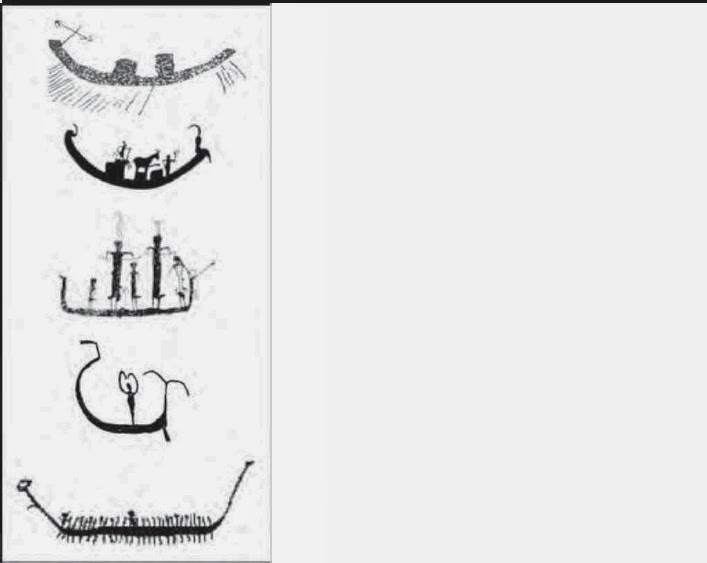
Petroglyphs of boats found in the Eastern Central Desert of Egypt and Sudan
They date to between 4300 and 2900 BC.

The Sahara saw considerable flooding during the Holocene Wet Period and some believe that this was the time of Noah’s flood. According to local tradition Noah lived in the region of Lake Chad. In fact, this is the only place of the surface of the Earth that claims to be his homeland: Bor-No, meaning “Land of Noah.”

In the time of Noah (about 5,500 years ago), Lake Chad was a much larger body of water. The various footprints of ancient Lake Chad have been confirmed by satellite photography. Petroglyphs of boats found in the Eastern Central Desert of Egypt and Sudan date to between 4300 and 2900 BC. and are a testament to the wet conditions during Noah's lifetime.

The Nile waters swelled from increased rainfall and cut a deeper and wider floodplain, extending well into Sudan to the west. The area attracted merchants from southern Africa who moved their cargo along the rivers and paid tariffs to the chiefs who controlled the river junctions. When the climate began to change and the waters receded, those in power found it more difficult to control larger territories. Afro-Asiatic kingdom builders such as Nimrod, who depended on the large water systems to control their territories, were faced with shrinking territories.

These archaic rulers appear to have been related by blood and intermarriage. The dominion of these ruling houses extended from Nigeria to India. This “Afro-Asiatic Dominion” is referred to in Genesis 11:1 where we are told that all the “world spoke one language.” They charged tariffs for commerce conducted on the parts of the rivers that they controlled and their priests maintained shrines at sacred sites along the rivers. We see this pattern of swollen river systems in the Niger-Benue in Nigeria, the Tigris-Euphrates in Mesopotamia, and the Indus-Sarawati Rivers in India. Some Nile shrines disappeared with the flooding in more recent centuries, but there is ample evidence of their existence, just as there is evidence of the existence of shrines, temples and urban centers under what is now the Bay of Bengal.

From these centers the Nilo-Saharan rulers conducted trade with distant territories. At Hierakonpolis (Nekhen) rulers acquired exotic goods and animals from central Africa and Afghanistan 4000 years ago. At Tomb 100 there are two boats painted on the walls.


Related reading: Boat Petroglyphs in Egypt's Central Eastern DesertGenesis and Climate Change; The Saharan Antecedants of Pharaonic Egypt; Sudan is Archaeologically Rich: The Buduma of Lake Chad by Guy Immega


Monday, June 28, 2010

Abraham's Ancestors Came Out of Africa


The Biblical writers recognized that the people among them with red skin were of an ancestral line of extreme antiquity. That is why the first man's name - Adam - is related to the words for blood and the color red: dam, odom and edom.

Jeff A. Benner, an expert on ancient Hebrew, explains:


By examing a few other words derived from the child root אדם we can see a common meaning in them all. The Hebrew word אדמה (adamah) is the feminine form of אדם meaning "ground" (see Genesis 2:7). The word/name אדום (Edom) means "red". Each of these words have the common meaning of "red". Dam is the "red" blood, adamah is the "red" ground, edom is the color "red" and adam is the "red" man. There is one other connection between "adam" and "adamah" as seen in Genesis 2:7 which states that "the adam" was formed out of the "adamah".  
(From here.)


Alice C. Linsley

To construct an accurate picture of the ancient world of Genesis we must examine the assumption that Abraham’s people originated in the Tigris-Euphrates area. The Genesis genealogies presents a different picture: that Abraham’s ancestors migrated out of Africa, and the evidence of anthropology, genetics, archaeology, DNA studies and linguistics supports this view.

Abraham's father was Terah the Ainu.  The Nilotic Ainu had a red skin tone and their rulers were bearded.  From the Nile they spread to Japan and to southern Siberia.  They traveled as far as Ireland and Finland and from there they moved into Greenland, Labrador and eastern Canada.  These first people are found at the center of Cavalli-Sforza's genetic distance chart, as would be expected of the First People.

These ancestors were great kingdom builders and their dominion extended from Africa to India. As evidence, consider the correspondence between the Hindu heroes Adimo, Heva, Sherma, Hama and Jiapheta and their Genesis counterparts Adam, Eve, Shem Ham, and Japheth. It is argued that this correspondence is due to a westward migration of Asiatics. However, this does not align with the evidence for the northeast migrations of peoples from Africa. Add the fact that Abraham’s kingdom-building ancestors were constantly searching for new territories, and a cogent picture of the people referenced in Genesis begins to emerge.

If the migration of Abraham’s ancestors was east and north and the stories reach as far as the Indus River Valley (even Nepal), these stories must be viewed as a seedbed of a widespread Afro-Asiatic worldview. In fact, they must be the stories told from Africa to India. This may explain the duplication of creation accounts, with the Adam and Eve story being older than Genesis 1. Its closest parallels are found in Africa, not Mespotamia. Consider, for example, the account of the first parents Gikuyu and Mumbi and the presence of a tree of life.

Long before the emergence of a people called Israel, ruler-priests controlled vast areas of the ancient world. They built kingdoms and at the center of their kingdoms they built temples and shrines where they worshiped the Maker of all things in heaven and on earth. They practiced animal sacrifice and offered prayers with incense. They regarded water as the element of purification. They observed sacred laws and spread across the earth. The biblical injunction to multiply and spread across the earth was apparently taken seriously by Abraham's ruler-priest ancestors.

These were ruler-priests who married the daughters of other ruler-priests and thereby preserved their priestly bloodlines through intermarriage (endogamy). The endogamous marriage pattern is consistent throughout the Bible and can be traced from Genesis 4 to Jesus, the Son of God. The pattern ends with Jesus’ appearance, having fulfilled its purpose and the purpose of the Bible.

There is a time in Israel’s history when this information was greatly valued: the reign of David, whose ancestry is goes back to Eden. This is why some scholars propose that Genesis was compiled during the time of the Davidic Monarchy. This makes sense when we consider that commerce and cultural exchange during David’s reign was directed toward both Africa and Mesopotamia. There was a good deal of interest in pedigree at that time to validate David’s claim to the throne, since he was the youngest son of Jesse of Bethlehem and “from the least of the clans of Judah”. The same prophet adds: “whose origins go back to the distant past, to the days of old.” (Micah 5:1)

To verify the truth of the biblical account we must look for clues to help us understand the relationship between the Mesopotamian and the African contexts of Abraham’s ancestors. Making those connections will enable us to understand the Bible better and to recognize how the Edenic Promise (Gen. 3:15) binds all 66 books into a single truly Great Story.
 
The prophets speak of the rulers who go back to Eden. Amos speaks of “him who holds the scepter from the house of Eden” (Amos 1:5). Ezekiel 28:11 says: “Son of Man, raise a lament over the king of Tyre and say to him: Thus says the Lord God: You were the seal of perfection, full of wisdom and flawless beauty. You were in Eden, in the Garden of God…” The king of Tyre was allied by kinship with David, which is why it was necessary for Jesus to be revealed in Tyre.  This explains why Hiram of Tyre sent skilled artisans to help David build a palace in Jerusalem. Hiram is also known as "Huram" and "Horam", which are versions of the shorter names Hur or Hor. According to Midrashic tradition, Hur was Moses’ brother-in-law, the husband of Miriam. Hur’s grandson was one of the builders of the Tabernacle. I Chronicles 4:4 lists Hur as the "father of Bethlehem", that is the patriarch of the place known as the "city of David". In other words, the king of Tyre and David were related. Their common ancestors were Horites, and as the Genesis genealogies indicate, the Horite lineage can be traced back to Eden.
 
The symbols of the ruler-priest’s authority were the shepherd’s crook and the flail. These were the symbols of the authority of the Pharaohs, but predate the Egyptian Dynasties. The crook and flail have been found on rock paintings dating to long before the Pharaohs. Hierakonpolis is the site of the most ancient temple in Egypt. It was dedicated to Horus. Of particular interest is the 4000 B.C. tomb painting of two men painted with red ochre. They carry crooked staffs with objects that look like flails, suggesting that they are ruler-priests.


Related reading:  Solving the Ainu MysteryAbraham's Kushite Ancestors; Who Were the Horites?The Migration of Abraham's Ancestors; The Christ in Nilotic Mythology

Wednesday, June 9, 2010

Was Genghis Khan the Last Afro-Asiatic Kingdom Builder?


Alice C. Linsley


Genghis Khan (c. 1162-1227) was born "Temujin" in Mongolia. He united warring clans to become leader of the Mongols in 1206. After his death, his descendants expanded his empire until it stretched from China to Hungary. His grandson Kublai Khan expanded the Mongol empire to southeast Asia and became the first emperor of China's Yuan Dynasty.

Genghis may have been the last Afro-Asiatic kingdom builder. Among his people, Genghis was known as a skilled smith. The nomads of Central Asia highly esteemed the trade of the metal smith. Genghis probably made metal arrow heads with holes.These holes made the arrows "sing" as they were launched through the air. The whistling arrows had the added benefit of frightening the enemies' horses.

There is a strong linguistic connection between the Yuan and the Nilo-Saharan languages. Y was a solar symbol among the Nilo-Saharans, some of whom were Anu (Ainu), so Y-an might refer to the Ainu who moved out of the Nile into Mongolia. This connection is confirmed by DNA studies. Genghis Khan and his descendants are in Haplogroup C-M217 which comprises more than ten percent of the total Y-chromosome diversity among the Manchus, Koreans, and Ainu. The ruling families of the Ainu of Northern Japan and the elders of the Ainu (Micmac) of Eastern Canada are kin, as I have demonstrated through my research.

Further, Khan is a variant of Kain/Cain or Kayan/Qayan, and it means king. The descendants of Cain are noted to have been metal smiths (Genesis 4). Genghis may be the last of the "mighty men of old" described in Genesis. These dispersed out of the Nile Valley and Southern Arabia and became the rulers over territories in the ancient Afro-Asiatic Dominion.

Genghis Khan followed the kingdom-building pattern of Nimrod and may have been a descendant of Nimrod. Hungarian origin stories suggest that he was a descendant of Noah through Japheth, and he was allied with the Keraits, a Jewish sect that rejected the authority of the Talmud (Oral Torah). Many Keraits became Christians. These may have been the only Christians native to Central Asia. Several Kerait women became influential in the Mongol court. Chinggis Khan’s mother had converted to Nestorian Christianity. Toghrul or Ong Khan was a Karait leader.

Sorghaghtani Beki married a son of Genghis Khan, and they had four sons. Two sons, Kublai Khan and Mongke Khan, were prominent leaders of the Mongolian Empire which formed a cultural and religious bridge between the East (especially Tibet) and the West. In their youth, these sons may have looked much as this Mongolian warrior.

His hair, red skin tone, and dress resemble that of the Nabataean warriors of Edom,
one of the ancestral homes of the Biblical Horites (Genesis 36).

Genghis Khan means King Genghis. Khan is related to the biblical words Kain and Kandake (Candace in English), meaning king/queen. He was like his namesake Cain in that he killed his half-brother Bekhter during a fight over hunting spoils. This incident cemented his position as head of the household.

Like Cain, Genghis Khan built an empire with settlements at sacred locations marked by stone structures and sacred heaps of stones. He named his first-born son Jochi which is a variant of the biblical name Joktan (Yaqtan), the name of Abraham’s first-born son.

Names common among the Uralic, Turkish, Pashtun and Mongolian peoples include Jochi, Beri, Malik and Khan. Today Khan is a common surname in Turkey, Afghanistan, Pakistan, India and Mongolia. It is equivalent to Kayan, a spelling that resembles Qayan in the Hebrew. Genghis Khan’s name is more accurately spelled Činggis Qaγan. Here we see a connection to the Arabic word for a metalworker, which is qayin.

Some of the Pashtun clans adopted Malik as the ruler's title instead of Khan. Malik is equivalent to the Afro-Asiatic Melek, meaning king.

At age 16, Genghis married a woman of the Olkut Hun, meaning Hun Tribe. (In the Mongolian language, Hun means adult male, or man, and Hunij means human being.) This marriage was arranged to consolidate an alliance between Genghis’s people and the Olkut Huns of Central Asia. Genghis’ mother encouraged him to form many alliances through marriage.

The word ogur also means clan, community or tribe, and appears to be equivalent to the Pashto word orkut, meaning community. So, the words ogurorkut and olkut seem to be linguistically related. Possibly Ogur Hun means the Hun clan or the Hun community of Og. Og is one of the clans in the three-clan confederation of Og, Gog and Magog. These names are found in Hungarian narratives, as well as in the Bible.

The languages of the Huns and Hungarians are classified in the Uralic group, not the Afro-Asiatic group. The Uralic family includes the languages of western Mongolia, Finnish and Hungarian. The Hungarian call themselves the "Magyar" and claim to be descendants of Noah through Noah's son Japheth.

Drawing found in Hungary showing the symbols of the Sun, Cattle and the Tree of Life

In the Hungarian origin stories, Nimrod had two sons: Magor and Hunor. Magor is the equivalent of the Afro-Asiatic name Magog. The word Magyar is linguistically related to Magog and is the name for the Hungarian people. Some Magyar still live in the Upper Nile area where they are called the Magyar-ab, the Magyar tribe. Typical of Nilotic people, important symbols among the Magyar are the Sun, cattle, and the Tree of Life.

Though Hungarian is a Uralic language, it has connections to the Afro-Asiatic language family, suggesting that Japheth’s descendants moved north toward the Ural Mountains. Here they developed a different religious practice – shamanism, which preserves some elements of the older Afro-Asiatic priest-religion, but which is significantly different. Priests and shamans serve similar functions in their communities but have different worldviews. (For the difference between priests and shamans, go here.)

While there is evidence of syncretism between the shamanic and priestly worldviews, the element of the Sun as an emblem of the Creator appears in both. Solar discs or solar boats are found on artifacts from ancient Egypt, Nubia, India and Mongolia.

Some rulers among these peoples are designated by an initial Y - a solar cradle indicating divine appointment. Yaqtan (Joktan), Yishmael (Ishmael), Yitzak (Isaac), Yetro (Jethro), Yacob (Jacob), Joseph (Yosef) and Yeshua (Joshua/Jesus) are examples. Solar symbols appears on the deer stones of western Mongolia shown below.

Deer stones mark burial ground at Ulan Tolgoi in Mongolia

Deer stone with Sun symbol in western Mongolia