Followers

Showing posts with label Seir. Show all posts

Friday, February 21, 2020

Two Named Esau


Dr. Alice C. Linsley


This kinship diagram shows that there are two named Esau in Genesis. Esau the Elder was a contemporary of Seir the Horite (Gen. 36). As with most high-ranking Hebrew rulers, Esau had two wives. Sorting out their names is a challenge since Genesis 36:1-5 gives the impression that there was only one Esau and that he had four wives. Knowledge of the two-wife marriage pattern of the early Hebrew helps to sort out the confusion.

Esau the Elder married Adah, a daughter of Elon the Hittite. Esau the Younger married Oholibamah, the daughter of Anah, a female chief of the clan of Seir. One of the rulers named Esau married Judith, a daughter of Berri or Beerah (Gen. 26:34).

Both Esau the Elder and Esau the Younger are related to the Horite Hebrew of Edom. The "sons of Esau" who dwell in Seir are designated as kinsmen to the Israelites in Deuteronomy 2:4. The Greeks called Edom Idumea which means "land of red people". Esau is described as hairy and red. The Horite Hebrew of Edom were known to have a reddish skin tone. King David also was described as reddish, owing to his Edomite blood. 

David's father Jesse had a son named Jerimoth. Jerimoth married an Edomite princess named Mahalath (2 Chron. 11:18). Mahalath is the name of a wife of one of the rulers named Esau. The repetition of male and female names reflects the practice of endogamy among the Hebrew, a ruler-priest caste of great antiquity.


Naming practices of the early Hebrew

We often find two Horite Hebrew persons with the same name in the Bible. There are two early Hebrew rulers named Enoch, two named Lamech, two named Nahor, two named Esau, two named Joktan, and two named Korah. When we find two with the same name separated by a generation, we have evidence of the cousin bride's naming prerogative by which the second wife of the ruler named her first born son after her father.

The pattern is shown in this diagram. Lamech the Elder is shown with his two wives at the top. His daughter Naamah married her cousin Methuselah and named their first-born son Lamech after her father.
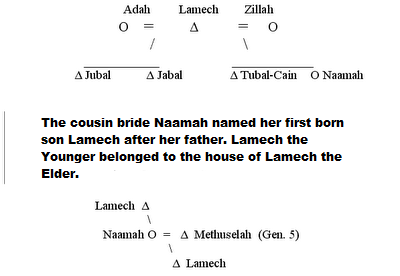


The cousin bride's naming prerogative was already a custom in the time of Lamech (Gen. 4). Naamah's first-born son Lamech was named after his maternal grandfather in whose territory he would one day serve as a high-ranking official.


Familiarity with the cousin bride's naming prerogative enables us to recover the names of some chiefs who have been given symbolic names, that is, names that are etiological etymologies. For example, Leah's first-born son was called Reuben. One theory says that his name derives from raa beonyi, meaning "Yahweh has seen my misery." A second explanation relates the name to Leah's hope of winning Jacob's love by bringing forth a son. In this case, the name derives from yeehabani, meaning "he will love me." It is more likely that Reuben is ra'a ben, meaning "behold, a son."

However, Jacob's first-born son by Leah is named Reu. That name appears in the Hebrew king lists of Genesis 11. Reu is the son of Peleg, the son of Eber. Reuben's first-born son is called Hanock which is a variant spelling of the name Enoch (Gen. 4:17; Gen. 5:18) and Anak.

Esau's name is explained as referring to the color red: Edom (Gen. 36:2). This could as easily be translated "ruddy", an adjective applied to King David who had Edomite blood through Tamar. The same source relates the name to an abundance of hair: “The first to be born was red, altogether like a hair cloak; so they named him Esau.” (Gen. 25:25)

What is the origin of the name Esau and what connection does it have to the central message of the Bible? Cheyne associates the name with "Usu" of Tyre. (Stade's "Zeitschrift," 17.189) Hiram, the king of Tyre, was allied by kinship to David. Hiram has the ancient Egyptian root HR which mean most high one. It is the same root that appears in the name Hur, Moses’ brother-in-law. Hur’s grandson was one of the builders of the Tabernacle. I Chronicles 4:4 lists Hur as the "father" of Bethlehem, a Horite Hebrew settlement. In other words, the Hiram of Tyre and David of Bethlehem had common Horite Hebrew ancestors. The Genesis king lists and Ezekiel 28:11-19 indicate that the Hebrew lineage can be traced back to Eden.

The Horite Hebrew believed in God Father and God Son. They believed that the Son of God would be born of their ruler-priest bloodlines and that He would reveal himself to his people. This was fulfilled when Jesus, the Son of God, visited Tyre (Matt. 15:21-28; Mark 7: 24).

David had Edomite blood through Tamar and was descended from the most ancient priestly line through Oholibamah and the Horite Hebrew chief Zibeon. This is why II Samuel 8:18 speaks of David's sons as being priests. They were of the priestly line from which Jesus came. So, we find a parallel between Oholibamah and the Virgin Mary. Oholibamah means the High Tent/elevated Tabernacle. She is an ancestor of Messiah through David, and her mother's name is Anah. Likewise, the Virgin Mary's womb became the tabernacle of the Christ our God, and her mother’s name was Ana.


Related reading: Cousin Brides; Horite and Sethite Mounds; Hebrew Names and Titles; The Substance of Abraham's Faith; Seats of Wisdom; Chiefs of Edom; The Pattern of Two Wives


Monday, September 23, 2019

Chiefs of Edom and Seir


Alice C. Linsley


Genesis 36 provides a list of the chiefs of Edom. One of the patriarchs of the Edomites was called Seir the Horite. The Horites, as well as the Sethites, were a moiety of the Hebrew ruler-priest caste. The caste was characterized by endogamy, cognatic descent, high ranking rulers with two wives, and the prerogative of the second wife, usually a cousin, to name her firstborn son after her father. That is why there are two named Korah in the diagram above. This "cousin bride's naming prerogative" is found with the firstborn sons of Cain and his wife, Naamah and Methuselah, and Nimrod and his Sumerian wife, a daughter of Asshur.


Edom and Seir are linked in the Song of Deborah and Barak in Judges 5:3-4:
"Listen, O kings! Give ear, O princes! I will sing to the LORD; I will sing praise to the LORD, the God of Israel. O LORD, when You went out from Seir, when You marched from the land of Edom, the earth trembled, the heavens poured out rain, and the clouds poured down water."
Deuteronomy 68:8 declares, "The LORD came from Sinai and dawned upon us from Seir; He shone forth from Mount Paran and came with myriads of holy ones, with flaming fire at His right hand."

As is seen in the diagram above, Moses and Aaron were descendants of Seir, the Horite ruler. The Hebrew clans of Seir and Edom apparently intermarried. In the Septuagint, (LXX 42:17d) Job is said to be a ruler of Edom. He was a descendant of Seir's grandson Uz, in whose territory Job resided.

The antiquity and prestige of the Edomite rulers and of Teman of Edom is expressed in Jeremiah's reference to these as ancient seats of wisdom (Jeremiah 49:7). Genesis 36 explains, "These are the kings who reigned in the land of Edom, before any king reigned over the children of Israel."

Genesis 36 lists the chiefs also: Bela, the son of Beor; Jobab, the son of Zerah of Bozrah; Husham of the land of the Temanites; Hadad, the son of Bedad, and Samlah of Masrekah."

Genesis 36:15 lists four chiefs born to Esau's son, Eliphaz: Teman, Omar, Zepho, and Kenaz. One of Seir's royal daughters was named Timna. Timna married Eliphaz.


The Edomite chief Teman likely served as a ruler-priest at the shrine of Teman, a site excavated in 1975 by the Tel Aviv University archaeologist Ze’ev Meshel and his team. The site is known as Horvat Teman. In the Bible is is called Teman of Edom. The Bedouin call the place Kuntillet 'Ajrud which means “the solitary hill of the water source.” That is the perfect description of an ancient Horite Hebrew high place.

The finds from Horvat Teman are fascinating and have stirred much debate. Among the finds are two large storage jars that weighed about 30 pounds each. The jars are painted with images believed to be deities, humans, and animals. There are symbols and a number of inscriptions, including three that refer to Yahweh.

The drawings reveal an ancient Egyptian context indicating that Nilotic peoples lived in the Sinai. One image is a sophisticated mural of an Egyptian ruler (reconstruction shown below).


King Hezekiah in the late eighth century BC initiated a campaign in Judah to destroy all the ancient images. “He removed the high places, broke down the pillars, and cut down the sacred pole. He broke in pieces the bronze serpent that Moses had made, for until those days the people of Israel had made offerings to it” (2 Kings 18:4).

In doing so, explains the Bible, Hezekiah “did what was right in the sight of the Lord.” But was Hezekiah motivated only by “the commandments that the Lord commanded Moses”? Or was his iconoclasm an attempt to impose a new religion for political purposes? Iconoclasts seek to rewrite the prevailing narrative by destroying the old.


Evidence of an ancient and prosperous kingdom

Edom had a large copper ore zone with industrial scale copper production. Radiocarbon analysis of charred wood, grain and fruit in several sediment layers revealed two major phases of copper processing, first in the 12th and 11th centuries, and later in the 10th and 9th BC.

Dr. Thomas E. Levy stated, "Only a complex society such as a paramount chiefdom or primitive kingdom would have the organizational know-how to produce copper metal on such an industrial scale." 

In the early 2000's, led by Dr. Levy lead an archaeological survey that yielded earlier dates than had been assigned to the Edomite kingdom. The team uncovered scarabs, ceramics, metal arrowheads, hammers, grinding stones, and slag heaps.

Evidence was found of fortifications and over 100 building complexes. Khirbat en-Nahas, 30 miles north of Petra, was an ancient Edomite site. Khirbat en-Nahas means "ruins of copper" in Arabic. Nahash means serpent in Hebrew. As an adjective it means shining bright, like burnished copper. The ruins of Khirbat en-Nahas spread over 24 acres, and the fortifications enclose an area 240 by 240 feet.


Abraham was a chief of Edom. His territory extended between the settlements of his two wives. Sarah resided in Hebron and Keturah resided in Beersheba. Both settlements are shown on the map above.

The Greeks called Edom "Idumea" which means "land of red people." Esau of Edom is described as red and hairy. King David, who had Edomite blood, is also described as red or ruddy. The Hebrew were a caste and as such married only members of their caste (endogamy). This means that the Hebrew were ethnically and genetically more homogeneous than non-caste populations. To speak of the Hebrew social structure as "tribes" is a late development. The ethnic and genetic makeup of castes and tribes are very different.

Tuesday, October 17, 2017

Dark Sky and Howling Wind

Bronze bull head

Alice C. Linsley

The Peshitta is a version of the entire Bible read by Syrian Christians.This is the Bible that St. Ephrem the Syrian knew.

In the Peshitta, Noah's Ark landed in the “mountains of Quardu” (Gen. 8:4). Quardu or Kardu is formed from two Akkadian words: kur - land of, and dû - hill. Note the similarity to the Arabic Đū Shará (ذو شرى‎) which means "Lord of the Mountain."

These people of Quardu are described as hill people or cave dwellers. They appear to be related to or associated with the Jats of Punjab, the Gutians (bull people) and the ancient Horites of Edom. Edom was called "Idumea" by the Greeks, meaning "land of red people."

The horns of the bull were a sacred symbol for the Horites. They formed a solar cradle that indicated divine appointment by overshadowing. In this image from Dendura, the sun rests in the horns of the sacred bull.


Images of Hathor, the mother of Horus, show her overshadowed. This amulet was found at Hazor. It shows the sun cradled in the bull's horns and rays of light radiating from the sun.


Divine appointment of the Horite Hebrew rulers was indicated by the solar cradle Y at the beginning of the ruler's name. Examples include: Yaqtan (Joktan); Yishmael (Ishmael); Yishbak; Yitzak (Isaac); Yacob (Jacob); Yosef (Joseph); Yetro (Jethro); Yeshai (Jesse), Yonah (Jonah), Josedech (Yosedech), and his son Yeshua (Joshua) who wore the double crown (Zechariah 6:11).

The rulers of Quardu are known to have had red hair, like the Horites of the hill country of Edom. Esau the Red, lived in the hill country of Seir the Horite (Gen. 36). Archaic populations lived along the ridges in rock shelters (kar or kur) and later in fortified shrine cities called "high places" in the Bible. These mountain peoples were in the R1b Haplogroup. The Horite high places are called "Horite Mounds" in the ancient Pyramid Texts

The dark red spot in Central Africa is Noah's homeland.
This is the region of Lake Chad.

The Peshitta appears to have preserved the connection between the R1b peoples who had dispersed into Turkey and Iran. This represents the eastern tradition of the older African account of Noah, a ruler in the region of Lake Chad.

There appears to be traces of the older account in Arabic. The identification of Noah's Ark with Ararat probably represents a misreading of the Arabic word herarat - حرار  - which means vehemence.  Har-arat, better translated, would mean Mountain of Vehemence. This fits the story of divine wrath expressed in extensive catastrophic flooding.


Armenia is likely a corruption of Har Meni, or Mount Meni which means Mountain of God or Mountain of Destiny. Har Meni appears to parallel the term Ararat, which is not a place name, but rather a description of an unknown mountain. The term "ararat" in Arabic means vehemence. Likely, a parallel was intended between har-meni and har-arat; that is between the Mountain of God and the Mountain of Vehemence.

The word "meni" appears in Isaiah 65:11, where it is paralleled with the word gad, meaning good fortune. This suggests a connection between meni and encounters with God on mountain tops because where the word gad appears in the context of sacrifice offered on mountains. We recall that Noah offered burnt sacrifice on the mountain in thanksgiving for his deliverance (Gen. 8:20) and that God established a covenant with Noah and his descendants.

The Gikuyu of East Africa tell this story of the experience of their first parents, Gikuyu and Mumbi:
There was wind and rain. And there was also thunder and terrible lightening. The earth and the forest around Mount Kerinyaga shook. The animals in the forest whom the Creator had recently put there were afraid. There was no sunlight. This went on for many days so that the whole land was in darkness. Because the animals could not move, they sat and moaned with the wind. The plants and trees remained dumb. 
It was, our elders tell us, all dead except for the thunder, a violence that seemed to strangle life. It was this dark night whose depth you could not measure, not you nor I can conceive of its solid blackness, which would not let the sun pierce through it. 
The wording is like that of an Akkadian flood. The 1646 to 1626 BC account begins with the creation of man and quickly moves to the flood. The saga gives this description: "The flood roared like a bull, Like a wild ass screaming, the winds howled.The darkness was total, there was no sun."

The Gikuyu story continues:
But in the darkness, at the foot of Mount Kerinyaga, a tree rose. At first it was a small tree and it grew up, finding a way even through the darkness. It wanted to reach the light and the sun. This tree had Life. It went up, sending forth the rich warmth of a blossoming tree - you know, a holy tree in the dark night of thunder and moaning. This was Mukuyu, God's tree. 
Now you know that at the beginning of things there was only one man (Gikuyu) and one woman (Mumbi). It was under this Mukuyu that He first put them. And immediately the sun rose and the dark night melted away. The sun shone with a warmth that gave life and activity to all things. The wind and the lightening and thunder stopped. The animals stopped moaning and moved, giving homage to the Creator and to Gikuyu and Mumbi. And the Creator, who is also called Murungu, took Gikuyu and Mumbi from his holy mountain to the country of the ridges near Siriana and there stood them on a big ridge.

Here we have language reminiscent of Abraham's encounter on a wild and windy mountain where salvation through the promised Son was revealed to him. William H. Willimon wrote: "The sky darkens, the wind howls and a young man walks up another Moriah, driven by a God who demands everything and who stops at nothing. He carries a cross on his back rather than sticks for a fire, but like Abraham, he is obedient to a wild and restless God who is determined to have his way with us, no matter what the cost."


Related reading: The Substance of Abraham's Faith; Africa in the Days of Noah; Peaks and Valleys; Sacred Mountains and Pillars; The Animals on Noah's Ark; The Historicity of Noah's Flood; What Abraham Discovered on Mt. Moriah


Saturday, September 14, 2013

Were the Shasu related to Moses?


Alice C. Linsley


It is evident from study of the tetragrammaton YHWH in Biblical references that the giving of the Divine Name at the burning bush does not represent a new development. It represents reaffirmation of received tradition from the Horim or Horites. Hagar the Egyptian recognizes her angelic helper as the angel of YHWH (Gen. 16:7). In Genesis 12:7, Abraham builds the altar at Shechem and offers sacrifice there. This was dedicated to YHWH. He bargains with YHWH over the fate of Sodom (Gen.18:1).  Abraham utters the Divine Name twice, in Genesis 24:3 and 24:7. In the latter instance he recognizes "YHWH Elohim" as the one who called him out of Mesopotamia. In Genesis Abraham's servant invokes the help of YHWH no less than ten times in his quest for Isaac's cousin bride.

Two hieroglyphic references dating to the New Kingdom (1550 BC–c. 1069) refer to “the land of the Shasu of YHWH.” These are the oldest references to YHWH outside the Bible. The "Shasu of Yhw" is found on inscriptions from the Nubian temples of Soleb and Amara West, and corresponds precisely to the tetragrammaton.

Reproduction of the hieroglyphic inscription of YHWH dated to 1400 BC.
Discovered in the temple at Soleb (Nubia) built by the Pharaoh Amenhotep III.
Credit: Benny Bonte
The Horites originated in the Nile Valley. One of the oldest Horite temples was built at Nekhen in modern Sudan. At that time, around 4000 BC, the city set on the banks of the Nile. Originally the shrine was probably at water's edge, but later it was moved to high ground. The Horites are the oldest known caste of priests. They are later identified as ethnically Kushite.

Shasu may be a variant of Saka, another word for Horite royal priests among the Kushites. As they dispersed out of Africa, they spread the Proto-Gospel across the vast Afro-Asiatic Dominion. The Matsya Purana claims that the Saka ruled the ancient world for 7000 years.

The Shasu are definitively connected to the Horites of Seir in Edom (modern Jordan). The Horites occupied Edom at least as early as 2000 BC. Lists of place names in Nubian temples of Soleb and Amara West record six toponyms located in “the land of Shasu.” A monument of Ramesses II claims that he “has plundered the Shasu-land, captured the mountain of Seir” in Edom; a 19th Dynasty letter mentions “the Shasu-tribes of Edom” and Ramesses III declares that he has “destroyed the Seirites among the tribes of the Shasu.” Clearly, the Egyptians regarded the Shasu as a prominent part of the Edomite population which is described in Genesis 36.


Association with Moses the Horite

The Divine Name is given at Mount Horeb, a mountain sacred to the Midianites. The narrative starts with Moses shepherding the flocks of his father-in-law Jethro, the priest of Midian, and ends with the theophany of the burning bush (Ex. 3:14) in which God declares from the bush, "I am that I am" (Ehye aser ehye). The entire narrative is limited to the location of this mountain sacred to the Horites living in that region, one of them being Moses' father-in-law Jethro. His ruler-priest status is designated by the spelling of his name with the initial solar symbol: Yetro. Jethro is a descendant of Abraham by his cousin wife Keturah.

Analysis of the marriage and ascendancy structure of Moses' family reveals the distinctive pattern of the Horite ruler-priest caste. Moses is a direct descendant of Seir the Horite who ruled in Edom.


It is evident that the Horite marriage and ascendancy pattern characterizes the great men of the Bible, including Samuel, Methuselah, Abraham, and Moses. The oldest layers of the Hebrew Scriptures appear to be a record of Horite rule in the ancient world.


Sunday, July 1, 2012

Petra Reflects Horite Beliefs


Alice C. Linsley

Sela was the capital of Edom. It is mentioned in Isaiah 16:1 and 2 Kings 14:7. Sela probably was not a major site in Abraham's time. Petra is the later name, when it came under the control of the Nabataeans who then controlled much of modern-day Jordan until the third century BC.

Petra reflects the pillared architecture of the Horite shrines of the Nile, and the first ruler of Petra, Obodas, took his name from the Edo/Edomite name for ruler which is Oba. The linguist Helene Longpre says that Nabataean Aramaic most closely corresponds to Meroitic or Old Nubian. (H. Longpre, "Investigation of the Ancient Meroitic Writing System", Rhode Island College, 1999.)

Red mountains of Edom (BAR photo)

Petra is the Greek name, and refers to the rocky location of the Nabataean capital in the red sandstone mountains of Edom. The Greeks called the Edomites the Idumea, meaning red people. Esau of Edom was described as having a red skin tone in Genesis 25:25.


Nabataean warriors


This suggests that the Edomites of the Bible may be related to the Edo or Idu of Nigeria and Benin whose rulers dress in red. The title of their rulers is further evidence. The ruler of the Edo is called "Oba" and the first ruler of Petra was King Obodas. (Likely, there is a linguistic connection to the Turkish word for ancestor or grandfather which is oboko and the Japanese word for a regional ruler which is obito.)

Edom was controlled by the Horite Hebrew, a caste of royal priests who spread from the Nile into Mesopotamia, Babylonia and beyond. Seir the Horite is listed as one of their kings in Genesis 36.


Job was of the clan of Uz. Uz was the son of Dishan. Dishan was the son of Seir the Horite. These chiefs were horse handlers and appreciated the power and beauty of the horse. In questioning Job, God asks, “Do you give the horse it’s strength or clothe it’s neck with a flowing mane?”

The Nabataean kings, such as Harithath IV, bear the Horus name. King Harithath is called King Aretas in II Corinthians 11:32. Coins have been found bearing the image of Aretas, and inscriptions have been found in the Nabataean town of Avdat with his name and the names of other Nabataean rulers. He was called "King of the Nabatu, who loves his people" (Philopatris), and it was during his reign that the greatest of Petra's tombs were created.

The connection to the kings of Egypt is evident in the name of Petra's central temple: Qasr al-Bint al-Faroun which means "The Fortress of the Daughter of Pharaoh." Its walls rise to over 75 feet. The temple was built between the late first century BC and the first century CE. Its precinct covers about 81,376 square feet or 7,560 square meters. A large open plaza was lined with 120 columns. The columns were adorned with Asian elephant-head capitals and provide evidence of connections between ancient Edom and India and other lands of the ancient Near East. At its height of glory, Petra rivaled the grandeur of Herod's Jerusalem.

The word Nabataean is likely related to Naba or Nabu, the guardian of scribes and prophets. This is the origin of the Hebrew word nabi, meaning prophet. The earliest scribes were Horite priests. The cult of Nabu was introduced into Mesopotamia and Babylon by the Kushites. Kushite kings sometimes bore the name Nabu, as with Nabu-shum-libur, an early Kushite king in Babylon and Nabu-aplu-iddina.

The Horites traced blood line through the mother while social status was based on the father's rank and occupation. Married women could hold and bequeath property and rule over their clans. Anah is listed as a "chief" in Genesis 36. Her name is also spelled Anat and Anath. Joseph married the daughter of a Horite priest. Her name was Asenath, a variant of Anath.


A Monumental Complex

Petra is a 400-acre complex cut from the rock well before the time of Jesus. It is called the "Rose City." The city reveals a sophisticated system of water management. There were aqueducts, piping systems and channels that directed water to the city center, to the temple, and to the homes and gardens of prominent citizens. Retention dams prevented flooding.


The Treasury at Petra

Note the three-portal design. Jordan has done restoration at this and other Petra edifices.


North-facing Petra temple

The Petra temple exhibits the typical Egyptian Divine Triad of Supreme God, the Divine Son (Horus, associated with Jupiter), and the Mother Goddess (Hathor). Generally, the architecture reflects the Egyptian three-part structure. Excavations at the foot of the Treasury reveal that there were three stories, not just the two shown in photographs.

Hundreds of rock-cut tombs have been found at Petra. The Tomb of the Obelisks is distinctively Egyptian in architectural style.


Nabataeans Related to Other Biblical Peoples

The Nabataeans are mentioned in historical records such as Diodorus Siculus' Bibliotheca (book 19), dating to 312 BC, and in an Egyptian papyrus dating to 259 BC. They are mistakenly classified as Arabs. However, in 1 Maccabees 5 (v. 25) we note that the Nabataeans were allied with Judas Maccabees while the Arabs are named as his enemies (v. 39).
The Nabataeans were involved in the lucrative South Arabian spice, incense and perfume trade and apparently were related to the royal House of Sheba.

The rulers of Sheba were descendants of Raamah and their territory extended from the southwestern part of Arabia northward to Beersheba (the well of Sheba). Sheba and Dedan were brothers (Gen.10:7) who ruled separate territories. The qiblahs in the oldest mosques in Cairo and in Baghdad point to Dedan, about 500 miles north-northwest of Mecca.


Dedanite Y

The largest collection of ancient Arabic texts have been found at the North Arabian oases of Tema and Dedan in the Hijaz. Tema is known by Arabs as Taima and lies about 70 miles north-east of Dedan. Tema, Dedan and Dumah were caravan stops along the trade route from Sheba to Babylon.


The Horite Hebrew Warriors and Horses

Sheba is credited with early domestication, breeding and export of Arabian horses. Likely the word "horse" is derived from Horus or Horite. The word horse appears as hors in Old English texts before the 12th century. Onager horses, (related to gur or khur?) were bred by Kushites along the Tigris before 3000 BC. Rock and cave images of horses in the Sahara predate the 1670 BC Hyksos invasion of Egypt, so the Hyksos cannot be credited with introducing horses to Egypt.

The Nabataean cavalry was camel mounted with two archers, one facing forward and one facing either front or back. The warriors wore ribbons in their long wavy hair. The camel was well suited to the desert environment in which they fought, but with their expansion into Syria, the Nabataeans adopted horses for war. They preferred fast lighter horses that could, in the words of Diodorus "… flee into the desert, using this as a stronghold."


The Nabataean warriors had long wavy hair and wore feathers. These Nabataean warriors appear to be related to the red Nubians shown below.


Petra's Last Days

The power and influence of Petra's rulers was subjugated to that of Rome when the emperor Trajan formally annexed the city in 106 A.D.

After the decline of the Roman Empire, Petra became a provincial capital under Byzantine rule.

Inn May 363 A.D., Petra sustained significant damage during an earthquake. The city sits near the boundary of the Arabian plate and has suffered from numerous quakes. The quake of 363 was especially devastating. It was reported that half the city was destroyed and the water system was disrupted. Archaeologists confirm damage to the main theater, the principal temple of Qasr al-Bint al-Faroun, and the Colonnaded Street.

Petra was in economic decline before the earthquake of A.D. 363 due to changes in trade. The flourishing land trade from East Africa and South Arabia to the Mediterranean and India had declined by the 2nd century A.D.


Related reading: Edo, Edom and Idumea Architecture Links Horites and Petra; The Genesis Record of Horite Rule; Who Were the Horites?; Abraham's Camels; 7000 BC Horse Burial Linked to Sheba; The Afro-Arabian Dedanites; The Arabian Horse and the Nabataeans; Who Was Oholibamah?; Some Jews and Some Arabs Have Common Horite Ancestry; New Petra Monument Spotted Through Satellites

Saturday, October 29, 2011

Frank Moore Cross: Israel's God is the God of the Horites


Alice C. Linsley


Frank Moore Cross believes the origins of Israel's conception of God is to be found in the region of Midian in northwestern Arabia. Cross argues that archaic biblical poetry locates Yahweh's movements in Edom/Seir/Teman/Midian and that these "are our most reliable evidence for locating Sinai/Horeb, the mountain of God."

Midian was one of Abraham's nine sons, and Tema was a Horite Hebrew chief. Seir is explicitly designated a "Horite" in Genesis 36, and he was a contemporary of Esau the Elder who was a ruler of the Edo (meaning red) people. The point of origin of YHWH is the Upper Nile from whence came Abraham's Horim who were called Habiru (Hebrew). The Horim are the Horites of Seir and Edom (Gen. 36). The Horite and Sethite Hebrew were a moiety from before 2400 BC.

According to Cross, Israel's earliest religious traditions about Yahweh, reflected in both the story of Exodus and archaic Biblical poetry like the Song of Deborah (Judges 5), indicate Yahweh came from Midian, a mountainous desert land in what is today southern Jordan and northwestern Saudi Arabia. This theory of Yahweh's Arabian origins, known by earlier scholars as the "Midianite hypothesis," has been augmented by recent archaeological discoveries that suggest a sophisticated urban culture thrived in this region at the end of the Late Bronze Age (1550-1200 B.C.E.), the period when most scholars place Moses and the Exodus tradition.

Given this evidence, Cross believes the biblical writers understood Mt. Horeb, the mountain of Yahweh, to be in Arabia, not Sinai. Cross notes that the belief that the 'mountain of God' was located in the Sinai Peninsula "has no older tradition supporting it than Byzantine times."

Order Cross' e-book here.

In a hymn to ʼĒl (published in Ugaritica V, text RS 24.278), God is called ’il brt and ’il dn which Cross takes as 'ʼĒl of the covenant' and 'ʼĒl the judge' respectively. The word dn in ancient Egyptian means religion and this may be a reference to Horite religion in which the ruler-priest symbolizes the covenant on earth and acts as God's judge on earth.

Thursday, April 1, 2010

Documents, Sources, and the Bible's Purpose


Alice C. Linsley

The Bible is inspired by the Holy Spirit and the Holy Spirit always points us to Jesus Messiah. Therefore, it is logical to conclude that the main purpose of the Bible is to help us understand who Jesus is and how His mission radically transforms all of life.

Twentieth century scholarship has failed to account for the purpose of the Bible. It has explored the texts from different disciples: text criticism, the documentary hypothesis, Near Eastern studies, and fundamentalist interpretations with their tendency to read Genesis as a literal account of the creation.

The Documentary Hypothesis proved to be of limited use, but it failed, as has most modern scholarship, to demonstrate the purpose of the Bible. Until we can answer that question we miss the larger picture.

The Documentary Hypothesis was the dominant approach in critical scholarship for most of the 20th century.  Its detractors were largely ignored, but some were too persuasive to dismiss, such an Hermann Gunkel. In his three commentaries on Genesis, Gunkel posed serious doubts about Wellhausen's hypothesis. Wellhausen regarded Genesis as a compilation of narratives projected back into pre-Mosiac times at the time of the Monarchy. He argued that the material reflects the life and times of the Monarchy and presents an erroneous picture of the earlier time of the Patriarchs. Gunkel, on the other hand, insisted that the Patriarchal sagas are a reliable oral transmission from before the time of Moses.

Wellhausen wasn't interested in the archaeological discoveries that shed light on the Afro-Asiatics living in Canaan, but Gunkel recognized that the finds of biblical archaeology revealed that Canaanite culture was not an anomaly. Rather it was consistent with the larger ethnological and linguistic heritage of the Afro-Asiatics who had been around for centuries before the time of Moses.

Both men failed to account for the purpose of the Bible, and especially for the uniqueness of Genesis, the account of Ha'biru (Hebrew) ruler-priests who preserved their bloodlines through endogamy. The intermarriage between fraternal priestly lines existed long before the emergence of the Jewish people. The pattern is consistent throughout the Bible and can be traced from Genesis to Jesus' mother, the Virgin Mary, the daughter of Joachim, a Hebrew priest. I have been unable to find the pattern muchbeyond Jesus' time, probably because the temple priests were either killed to forced to flee with the Roman destruction of Jerusalem in 70 AD. It is also possible that the pattern ended because with the incarnation of the Son of God, the marriage and ascendancy pattern of the Hebrew priest casts fulfilled its purpose, and that purpose is explained in the Bible.

The historical-critical method of Gunkel, R. H. Pfeiffer and Julian Morgenstern is helpful in identifying older sources. Pfeiffer identified the Seir Source (S) which brings forth the people of Edom whose history is linked to Abraham and his Horite ancestors. Morgenstern identified a Kenite Source (K) and explores the Kenite link to Moses through his bride, Zipporah. In both sources, we uncover important information about Jesus' ruler-priest ancestors. Pfeiffer and Morgenstern were scratching the more ancient level of the biblical material.

Having completed lengthy research on Genesis, I'm persuaded that the genealogical data provided is accurate, verifiable, and the account of historical people. This is the single conclusion that one could reach based on analysis of the marriage and ascendancy pattern of the rulers listed in Genesis 4, 5, 10, 11, 25 and 36. The analysis authenticates the data and proves that the rulers are historical persons.

The distinctive kinship pattern of the Horite Hebrew remains unchanged from Genesis to the New Testament. Some might assert that this pattern was written back into the text by a later editor. That would be impossible, given that the Bible consists of sixty-six books written by many different authors over a period of around 1300 years.

So how do we explain the consistent pattern of intermarriage between priestly lines from Genesis to the New Testament? There is only one explanation. The Bible is the account of the people whose story it claims to be: the ancestors of Jesus Christ our God. This provides a clue as to how the Bible came to be. Only God could have authored a book over 1300 years! Granted He used human agents, but they were agents who understood God’s purpose and who were attached to the ruler-priest lines from which Jesus would come.

Twentieth century scholarship has failed to account for the purpose of the Bible and for the uniqueness of Genesis. In part, this is due to the blind eye European scholars have turned to the African context of much of the earliest material.

Today it is impossible to ignore the African substrate, since the haplogroup of the biblical peoples has been identified and it includes peoples of Lake Chad and the Upper Nile. Genesis 10:8 tells us that Nimrod, the great kingdom builder, was a Kushite. Abraham is one of his descendants.


There were Habiru in Nimrod's kingdom. These ruler-priests married the daughters of other ruler-priests and thereby preserved their priestly bloodlines. Study of the Akkadian lexicon of Nimrod's kingdom tells us a great deal about these priests. They believed in a supreme Creator called Anu. Anu was said to have a son. The son of God was called En-Ki, which means "Lord over the Earth."

The endogamous marriage pattern of the Hebrew ruler-priests is consistent throughout the Bible and can be traced from Genesis to Jesus, the Son of God. The pattern ends with Jesus’ appearance, having fulfilled its purpose. The purpose of the Bible is to refresh the knowledge of the Gospel of Jesus Christ in our minds.

I wish all the readers of JUST GENESIS a blessed Holy Week. May you have joy in knowing that the Son of God has destroyed death and opened for us the way to Paradise.

Related reading: The Social Structure of the Biblical Hebrew (Part 1); Abraham's Ancestral Faith; The Virgin Mary's Ancestry; Marrying that Christ May be Born