Followers

Showing posts sorted by relevance for query Baal Shalisha. Sort by date Show all posts

Tuesday, July 7, 2009

Afro-Asiatic Religious Life


Alice C. Linsley

I've done a good deal of original research on the Afro-Asiatic Dominion, tracing the linguistic evidence for such. I have also written about the decline of the Afro-Asiatic Dominion, but I have yet to present the key features of ancient Afro-Asiatic religious life, of which I have identified eight. The features are: Triune God; the Sun as emblem of the Deity; concept of the Son of God; fixed order of creation; hereditary priesthood; blood sacrifice at altars, a common number symbolism, and prophets.

Let us consider each of these features separately.

1. Triune God
The Hindu Trinity (trimurti) consists of the TriGods - Brahma, the creator, Vishnu, the preserver and Shiva, the judge and destroyer.

The concept of a Triune God is found in the Hebrew Scriptures. We see the author of Genesis struggle to describe the appearance of the Lord (as 3 persons) to Abraham in Genesis 18. There is also an ancient Semitic name for the Triune God - Baal Shalisha – usually rendered ‘God of 3 powers’ or ‘the third idol’ which suggests a shrine dedicated to this God. ‘Baal’ means Lord and ‘shalisha’ is the number three, so it is possible that this could simply mean Triune God. If this is the case, the accusation that the Church invented the Trinity hardly seems justified by the evidence.

2. Sun as Deity’s Emblem or Chariot
In Hinduism, the sun is called 'Surya' and is regarded as the visible form of God that one can see every day. Devout Hindus offer prayers and morning sacrifice to the rising sun in the traditional Sūrya namaskāra or Sun Salutation.

The Hebrew Birkat Hachama ("Blessing of the Sun") is recited once every twenty-eight years, when the vernal equinox as calculated by tradition falls on a Tuesday at sundown (the sacred midpoint of the 7 day cycle). Jews recite a blessing to the Creator on the exact day, every 28 years. This year the blessing was recited on April 8, 2009. It was recited also on April 8, 1953 and on April 8, 1981. The next date of the blessing of the sun will be April 8, 2037.

We find the idea of the Sun as deity in Luke (New Testament). Here the priest Zechariah prophesies concerning the Forerunner of Jesus Christ, John the Baptist. He declares: “And you, little child, you shall be called Prophet of the Most High, for you will go before the Lord to prepare a way for Him, to give his people knowledge of salvation through the forgiveness of sins, because of the faithful love of our God in which the rising Sun has come from on high to visit us…” (Luke 1:76-78)


3. Concept of the Incarnate Son of God

In Hinduism Shani or Shanichar (Saturn) is believed to be the son of Surya the Sun-god. And Lord Rama, the most perfect avatar of God is at once the ideal son. Further, Hindus believe that Krishna was flesh and blood on earth as deity incarnate. Many Hindus accept Jesus as “a son of God’ since it is possible through ascetical practice to be divinized. This is similar to the kenotic or noetic tradition of Eastern Orthodoxy which holds that humans were created to enjoy God-ness and are restored to that original state through the death and resurrection of Jesus Christ, the Son of God.


4. Fixed Order of Creation

According to the Hebrew Scriptures God alone created the world and established a predictable fixed order to His creation (Genesis 1; Psalms 104:19-20, Jeremiah 33:19-36). This predictable order is referred to as ‘RTA’ in Hinduism. It is an order which we perceive foremost as having binary opposites: God-Man; Heaven-Earth; Male-Female; Sun-Moon; Night-Day, etc.

Because the order is fixed, there is no possibility of essential change. Entities can only be what they were created (as Aristotle recognized in his teleological conversations). What we often call 'change' is fluctuation in outward form but not change in essence. So water is always water (H2O) though its form fluctuates between liquid, vapor, and ice. (This is where the biblical worldview and convergence evolution knock heads. To read more on this go here.)

Likewise the social order is perceived as fixed. This is seen in Laws of Manu which speaks of four castes: Brahmanas, the priestly class; Ksatriyas, warrior class; Vaisyas, agriculturists; and Sudras, those who serve the other three classes. The Apostle Paul regarded the Church as having a fixed order established by God when he writes: “And those whom God has appointed in the Church are, first apostles, secondly prophets, thirdly teachers…” He lists other orders after them, including miracle workers and healers. (I Corinthians 12:28-30)


5. Hereditary Priesthood

In Jewish tradition all Kohanim (priests) are descendants of Aaron, who Jews consider to be the original Kohen. However, as my kinship research has demonstrated, the line of Kohanim was passed from father to first-born son without interruption from before the time of Aaron. This is evident in the intermarriage of the priestly lines descending from Kain and Seth, and from Ham and Shem, and from Aaron and his half-brother Korah, who was also a priest (‘harwa’). The descendants of these priestly lines intermarried, preserving the priests' bloodline to the time of the birth of Jesus Christ who is said to be the Priest Messiah of the ‘order of Melchizedek.’ Psalm 110:4 declares that “Yahweh has sworn an oath he will never retract, you are a priest forever of the order of Melchizedek.”

Over time the word ‘Kohen’ has come to mean "priest" but was probably an earlier designation of social position in the community. This suggests that the word relates more to the fact that the most ancient families (those who preserved their bloodlines) usually give guidance to the rest of the community. Thus ruler-priests, who married only within their priestly lines, influenced the spread of the Afro-Asiatic religion far and wide.


6. Blood Sacrifice at Altars

It appears that priests (called sarki or harwa and later kohen or brahman) played a leading role in the diffusion of the Afro-Asiatic worldview. The work of the priest involved blood sacrifice for atonement. According to priestly law, the blood of a sacrificed animal was to be sprinkled seven places on the altar. Christians note that Jesus Christ bled from seven areas of his body and his blood is said to give “life to the world” (John 6:52-56).

It is interesting to note that the word 'sarki' also refers to red ochre which was ground into power and used as a symbol of blood throughout the Afro-Asiatic world and beyond in the burial of nobles between 20,000 and 80,000 years ago. While mainstream Hinduism rejects animal sacrifice, Tantric practice involves something akin to the sacramental use of Bread (Flesh) and Wine (Blood) among Christians. The meat offered in Tantric ritual is called ‘Siva’ and the wine is called ‘Sakti’. Tantrics believe that sacrificial killing of approved animals pleases the forefathers and gods and is therefore permitted.


7. Common Number Symbolism

The significance of the number seven in reference to union or completion is seen in the first Genesis creation story which says that God's creative work lasted for six days and that God rested from all His work on the seventh day. The number seven in association with God at rest (sabbath) portrays the concept of completion or perfection of a relationship between Master and Servant, or between Creator and Creation, or between Husband and Bride.

In the temple dedicated to the sun in Upper Egypt (ruins of Babian) there were seven urns. 

Hindus also have held the concept of a 7-day week. According to Hindu law the new bride was to take seven steps around the altar during the wedding ceremony.

Likewise the marriage ceremony of the Agharias of Orissa (India), involves the number seven, as described here:

The bridegroom's father sends a present of a bracelet and seven small earthen cups to the bride. She is seated in the open, and seven women hold the cups over her head one above the other. Water is then poured from above from one cup into the other, each being filled in turn and the whole finally falling on the bride's head. This probably symbolizes the fertilizing action of rain. The bride is then bathed and carried in a basket seven times round the marriage-post, after which she is seated in a chair and seven women place their heads together round her while a male relative winds a thread seven times round the heads of the women.

In Jewish weddings the Sheva Brachot (seven marriage blessings) are recited under the huppah and the wedding feast lasts 7 days. Samsom gave the Philistines the full seven days of his wedding to work out his puzzle, which poses Delilah's betrayal of her husband as a very evil act.

The number seven was attached to weddings in ancient Babylon also as attested by Esther 1:5-11: And when these days were expired, the king made a feast unto all the people that were present in Shushan the palace, both unto great and small, seven days, in the court of the garden of the king's palace. On the seventh day, when the heart of the king was merry with wine, he commanded Mehuman, Biztha, Harbona, Bigtha, and Abagtha, Zethar, and Carcas, the seven chamberlains that served in the presence of Ahasuerus the king, to bring Vashti the queen before the king with the crown royal, to shew the people and the princes her beauty..."


8. Prophets
Prophecy and prophets were a common feature of the ancient Afro-Asiatic civilizations. Afro-Asiatic prophets resided near bodies of water or sacred springs, so we are not surprised to find that prophecy is attested at shrines along the Nile, at Hama on the Orontes (8th century B.C.), and at Mari on the Euphrates (18th century B.C.)


There were prophets and seers in the flourishing civilization of Sudan before the time of the Pharaohs. Some of them foretold the invasions of Africa from central Asia. The rulers of Egypt had their personal prophets. Pharoah recognized Abraham as a prophet (Gen. 20:7).  Joseph was elevated in Egypt because of his prophetic interpretation of Pharaoh’s dreams. Dream interpretation was one of the prophet’s tasks. In Deuteronomy 13, the prophet is called "a dreamer of dreams" (Dt. 13:2).

Prophets were connected to the Temple. Jeremiah tells us that a man of God, Ben-Johanan, resided in a room in the Temple. We remember Anna, who prophesied concerning Jesus at his presentation in the Temple. We are told that she lived in the Temple (Luke 2:36-38).


Before the Temple, it was customary for prophets to dwell at sacred places marked by great trees, springs or wells. Deborah, “the wife of Lappidoth, was a prophet” associated with a tamar (date nut palm) midway between two important shrines: “Ramah and Bethel in the hill country of Ephraim, and the Israelites would go to her for judgment” (Judges 4:4-6). Likewise Abraham consulted a prophet (moreh) when he arrived in Canaan. This prophet was associated with a sacred oak between Ai and Bethel (Gen. 13). It was here that God appeared to Abraham in three Persons (Gen. 18).

We find evidence that there were confraternities such as the one that was in touch with Elijah (2 Kings 2:3-18; 4:38ff; 6:1ff and 9:1) and alluded to in Amos 7:14. These companies of prophets appear to have had a good following. They performed symbolic mimes under the influence of music (1 Sam. 10:5). It is significant that the prophetic messages recorded in the Bible are NOT associated with groups of prophets, but with individual prophets whose lives exemplified holiness. The prophet is someone to whom God’s holiness and desires are an immediate experience through which the present and the future come into clear focus.


Conclusion

Collaborative research in linguistics, climate change, archaeology and cultural anthropology indicates that Afro-Asiatic ruler-priests are largely responsible for the diffusion of the Afro-Asiatic religious life that took root around the large water systems from west central Africa to the Indus River Valley and even beyond. It is a religious life that shares theses distinctive features, all of which are found in the Bible and which indeed frame the biblical worldview. They point to a God who desires Sabbath communion with us through the Blood of His Son and eternal Priest, Jesus Christ. All true prophets point to this Communion.

Tuesday, June 16, 2009

The Order of Melchizedek

Right: Figure of an Egyptian priest with shaved head. Korah, Moses' half-brother, probably looked like this. Sarki means ruler among the people of Kano, which is where Noah’s ancestors came from. The Sarki are also a people group who live in the region of Orissa in India. Orissa is also a Nigerian word and Kano is in Nigeria. Sarki also live as ‘Haruwa’ in the Tarai region of Nepal. The word Haruwa is equivalent to the ancient Egyptian word ‘Harwa” meaning priest. It appears that priests played a leading role in the diffusion of the Afro-Asiatic worldview. It is interesting to note also that the word 'sarki' refers to red ochre which was ground into power and used almost universally in the burial of nobles as a symbol of blood between 20,000 and 80,000 years ago.

In this essay, I explore the connections between the priesthood identified with Melchizedek and the priesthood associated with Horus, one of the 3-God (baal shalisha), the source of light, and the Son of God.


Alice C. Linsley

The Priesthood begins with God who first shed the blood of animals to clothe Adam and Eve’s nakedness.[1]

It continues with Abel, a shepherd who offered acceptable sacrifice and was killed by his jealous brother.[2]

It is traced through Abraham’s ruler-priest ancestors who spread from west central Africa to the Indus River Valley. They are listed in the Bible and we know a good deal about their Afro-Asiatic worldview.

That the priesthood was already a fully developed office before the time of Abraham is evident in the person of Melchizedek, the Priest of Salem (Jerusalem). It is evident also in the presence of Neolithic fire altars throughout the Middle East.[3]

With Melchizedek, the priesthood of God comes to be associated with the Jebusite settlement of Jerusalem. Abdi-hepa was a Jebusite king who ruled Jerusalem three centuries before its conquest by David. This distinguishes the priesthood of God from other priesthoods that do not recognize the ancient prophecies concerning Mount Zion and the House of David. Interestingly, according to 2 Samuel 24, David built a fire altar at the threshing floor of Araunah, the Jebusite. Here David is shown as a ruler-priest and shepherd, the very roles that characterize the ruler-priests whose patrilineal lines intermarried, bringing us to the House of Joachim, Mary's father.

The antiquity of the priesthood is evident also when tracing the marriage pattern of Abraham’s Horite family in which the ruler-priests married the daughters of priests. The Horites were a particular group of priests whose worldview widely influenced Afro-Asiatic peoples and even the Indo-Europeans.[4]

Abraham's Horite ancestors believed in blood sacrifice for atonement of sin. They are likely the ones who spread the word about atonement through blood sacrifice. References to such redemption appear on a tablet titled "The Song of Debt Release," which was excavated in Hittite territory. The same practice was known to the Babylonians during Abraham's time.

The Horites take their name from the one they worship - Horus, the Son of God. They apparently believed that the Son of God would become incarnate from their bloodline. This is why they took great care that their priests married only patrilineal kin. (The priesthood was traced through the father. However, bloodline was traced through the mother.)

The Biblical record is so reliable that it can be used to reconstruct the priestly bloodline from Cain and Seth (whose lines intermarried) to Ham and Shem (whose lines intermarried) to Joktan and Sheba (whose lines intermarried) to the priest, Joachim, father of the blessed virgin Mary, Mother of the Promised Son of God.

The Priesthood as Fixed Order

It is evident that the priesthood that points to Jesus Christ, the Son of God, pertains exclusively to ruling men. This appears to be fixed by God from the beginning. To modern ears the idea that anything in the created order is fixed sounds improbable. We have been indoctrinated in the evolutionary insistence that things in the created order can change in essence. But this is a delusion. The order of creation is fixed. Created entities can and do change their form (what the Greeks called “flux”), but they do not change their essence. Such is the case with the priesthood.

So when the Episcopal Organization decided to call women “priests” that decision (motivated by politics rather than by truth) had no effect on the created order. TEC has no power to create new ontological categories. Women priests are not priests in “the order of Melchizedek”. The priesthood by its essence excludes women from this office. All the Episcopal Church managed to do was to create confusion and division. It isn’t difficult to track the Devil’s fire trails in this case.

The Order that Pertains Exclusively to Women

Analysis of the kinship pattern of Abraham’s people from Genesis 4 to the New Testament makes it clear that the order of creation excludes men from taking all the credit for working righteous on the earth. Only women would perform blood sacrifice in the form of birthing, and from the dawn of time it was foretold that a certain Woman would bring forth the Son of God.

The incarnation of the Son of God makes necessary the monthly cycle of women and the act of giving birth. Every women of the Scriptures who could not bear a child knew that she would not share in the bloodline of the Promised Son.

So Sarah cried out and when she received the promised son, she insisted that he alone should reign over the kingdom of his father. [5]

So Rachel became embittered because she had not borne Jacob a child, but God opened her womb and she brought forth Joseph, who shaved his head as a ruler-priest[6] and married the daughter of the priest of the shrine of On (Heliopolis) in Egypt.

So Hannah, the priest’s wife, lamented her barren state before the Lord and petitioned with tears until she bore Samuel, prophet of the Most High God.[7]

NOTES

1. As God is the first priest, Jesus is revealed as High Priest after the order of Melchizedek. This is used in scripture to establish the primal authority of His Priesthood, from which every true priest derives his authority.

2. Abel is a type of Jesus Christ who offered acceptable sacrifice and was killed by his own brethren. Just as Abel's blood cries to the Father from the ground, so the Blood of Jesus is ever before the face of the Father.

3. The fire altars were sometimes made of stones and sometimes of brick. They were constructed according to the cosmology of the people. Some were built in the form of a falcon. The falcon was the symbol of Horus, the Son of God. To see the geometry of a falcon altar, go here to page 5. Ur means "fire" and it appears in many Afro-Asiatic place names. It probably refers to the fire altars. Archaeological evidence of such altars has been found in the Indus Valley culture dating from the proto-Harappan age (3500 BC- 2500 BC) to the Harappan age (2500 BC - 1750 BC). There was probably a fire altar in Jerusalem (a Jebusite city) in the time of Melchizedek. Elijah's offering, and Jezebel's false prophets, were consumed by fire from heaven on a fire altar.

4. See the Rev. John Campbell's research on the Horites here.

5. Abraham had two wives: Sarah and Keturah. Jacob had two wives: Rachel and Leah.

6.The word "korah" means shaved head and refers to a ruler-priest. It is also the name of Moses' half-brother who was apparently a ruler-priest. No wonder he contested Moses' authority! Moses was likely the youngest of Amram's 3 sons. For more on why Joseph shaved, see Biblical Archaeology Review, July/Aug. 2007, pages 36-41.

7. Elkanah had two wives: Hannah and Peninnah. For more on the pattern of ruler-priests having 2 wives, go here.

Tuesday, May 27, 2008

Yes, Georgia, there is a Kingdom!


Alice C. Linsley

In our study of The Biblical Theme of Two Sons we discovered that the number 2 symbolizes binary oppositions, territory and boundaries. This theme is fundamental to the Biblical worldview. It is found in the order of creation: night and day, waters above and waters below, seas and dry land, male and female. It is found in the theme of 2 sons, and it is reflected in the bi-consonantal languages of central Africa from which Abraham’s ancestors came.

Genesis reflects the ancient metaphysics and practices of Abraham's Horite ancestors. Their's was a world quite removed from our post-modern materialist world. As heirs of the Enlightenment and empiricism we want evidence to back up statements about the figures in the Bible. The fact that the text does not come out and tell us that all the rulers in Genesis 4, 5 and 11 had 2 wives might trouble us, but this would not have been a problem for Abraham’s Horite people, since it was customary for Horite rulers to have 2 wives. In fact, the neglect of mentioning Isaac's first wife would have stirred their interest. They would be compelled to investigate why this break in the generations long kinship pattern? Mysteries interest Semitic peoples, as do number symbolism, binary oppositions, and reversals. This is the basis of Jacques Derrida's method and also that of St. Ephrem, the Syrian.

In our study of the significance of The Theme of Hidden Sons we discovered that the number 3 symbolizes realities that are not readily apparent. Just as Abraham needed 2 wives to establish himself in the land, so Isaac needed 2 wives to maintain the territory. With 2 wives we are now able to see that Isaac had 3 sons: Jacob and Esau by Rebecca, and by his first wife a son who is not named in the text. Here the theme of a 'hidden son" appears for the first time. We had to dig into Scripture to find the hidden third. We had to discover the pattern before we even knew to look for the anomaly. Anomalies speak to us of mysteries such as The Incarnate Word, a Son begotten of God, death trampled down by death, the Trinity.

The number 3 is repeatedly found in connection to the most astonishing acts of God. Jonah was 3 days in the belly of the whale. Moses was hidden for 3 months (Ex. 2:2). Job's 3 friends struggled with the mystery of why the righteous suffer. Moses asked permission to go 3 days journey into the wilderness to worship. Abraham traveled 3 days to a mountain only God could reveal and upon which God provided His own sacrifice. The Covenant God made with Abraham involved cutting up 3 animals that were 3 years old. The visit by 3 "Men" to Abraham's tent. The 3 measures of flour made into cakes for those Visitors. The 3 gifts offered them: curds, milk and a calf. Abraham prayed 3 times for Sodom. Joseph had a dream of a vine with 3 branches (Gen 40:10-12). The “Son of Man” appeared with 3 men in the fiery furnace. Jesus rose on the third day. The Afro-Asiatics even had a trinitarian name for God -"Baal Shalisha" (The 3 God).

The number 3 also symbolizes unity in the Scriptures. This is represented in familial triads:

Cain Abel Seth (Gen. 4-5)
Ham Japeth Shem (Gen. 5-9)
Og Gog Magog (Gen. 10, Nu. 21:33)
Haran Nahor Abraham (Gen. 11-12)
Ishmael Jokshan Isaac (Gen. 16, 21, 25)
Jeush Jalam Korah (Gen. 36: 4-18)
Lehab Lesha Letu (Gen. 10:6-19, Gen. 25:3)
Dedan Tema Buz (Jeremiah 25)

The 3 sons have one father (or a common paternal ancestor). The husband and his 2 wives are one territory, one kingdom. All of this is about Christ's Kingdom and the revealing of the Hidden Son of Man.

Georgia (a reader of Just Genesis) has asked, "Does Christ presently have two wives?” The short answer is that Christ has 2 brides, not 1 divided bride. To express this another way: the Good Shepherd has two flocks grazing in different pastures, but both belong to Him. As He has said, "Other sheep I have which are not of this fold; them also I must bring, and they will hear My voice; and there will be one flock and one Shepherd." (John 10:16)

The Church is one flock and the other flock are those who died in expectation of Messiah's appearing. The last of that generation were Simeon, Anna and John the Baptist. They are the 3 witnesses to the Kingdom's appearing. Simeon, a priest, represents the Blood, Anna, a prophetess, represents the Spirit, and John the Forerunner represents the Water. These are the 3 witnesses to which John alludes when he tells us "This is He who came by water and blood - Jesus Christ; not only by water, but by water and blood. And it is the Spirit who bears witness, because the Spirit is truth. For there are three that bear witness in heaven: the Father, the Word, and the Holy Spirit; and these three are one. And there are three that bear witness on earth: the Spirit, the water and the blood; and these three agree as one." (1 John 5:6-8)


Related reading:  Did Jesus Have a Wife?The Kingdom of God in Genesis; No Kingdom By Deception


Tuesday, September 9, 2008

Patrick Henry Reardon on Genesis


Patrick Henry Reardon's commentary on Genesis, Creation and the Patriarchal Histories (Conciliar Press, 2008) is thoughtful, well referenced, and theologically sound. Father Reardon is pastor of All Saints Antiochian Orthodox Church in Chicago, and Senior Editor of Touchstone: A Journal of Mere Christianity. A former Anglican, he came to Orthodoxy in 1988.

Fr. Reardon was educated at Southern Baptist Theological Seminary (Kentucky), St. Anselm's College (Rome), The Pontifical Biblical Institute (Rome), the University of Liverpool (England), and St. Tikhon's Orthodox Seminary (Pennsylvania). In this book, he offers "Orthodox Reflections of the Book of Genesis", drawing on the writings of St. Augustine, Cyprian, and the Jewish historian Josephus, but he doesn't insist that there is an Orthodox approach to Genesis.

Fr. Reardon has written other excellent books, also available from Conciliar Press (800-967-7377). These include Christ in the Psalms and The Trial of Job. His latest volume, Creation and the Patriarchal Histories, is important reading for those seeking a readable commentary on Genesis. The book isn’t long and one need not hold a Doctorate in Biblical Studies to understand what is written.

I found the book to be fresh in many ways. It nods to Mosaic authorship but doesn’t insist on it. Fr. Reardon explicitly states that there is “strong evidence that the arrangement of the five books is later than Moses” (page 10). Based on internal evidence, I have argued that the Genesis material was brought together during the time of David and Solomon. This is the probable source of the strong Messianic material in the book, especially that touching on the ruler-priest, Melchizedek, and on the priority of the youngest sons over the first-born sons.

Fr. Reardon also doesn’t insist that the authority of Genesis is dependent on an original autograph, but instead upon the superintendence of the Holy Spirit throughout the centuries (page 11). It is refreshing that he values the Septuagint and the Hebrew texts equally.

He maintains that the Bible's understanding of history is "the key to its understanding of Genesis." He writes, "The human authors of Holy Scripture approached Creation itself through the path of salvation history. They arrived at the knowledge of the Creator through their knowledge of the Lord of history. It was Exodus that led them to Genesis!" (p. 26)

I'm not sure why he feels that it has to be one way. The Divine Author isn't restricted by the linear chronology of human scribes. In fact, this idea seems to undermine one of Fr. Reardon's most significant points: that creation is mediated through Christ, begotten of the Father from before time (pp. 28-30). Genesis reveals the timelessness of the Triune God.

Genesis speaks of events and people who lived by faith long before the Bible Canon was decided. Fr. Reardon recognizes this, pointing to the example of Enoch (pp. 55-56). Ultimately, Genesis is about the Kingdom of the Triune God. That Kingdom includes those who died in faith before the dispensation of the Church and those who are in Christ in the Church. This is typified by the rulers of Genesis having 2 brides in order to establish their kingdoms. (Fr. Reardon does not mention the practice of Afro-Asiatic chiefs maintaining 2 wives in separate households on a north-south axis, and he misses the significance of the "hidden" Son.)

Genesis makes it clear that Father Abraham experienced the Triune God as his Savior. These concepts are not back-written into the text at a latter date. Abraham actually experienced the Triune God in Genesis 18 as his Savior. (There is an ancient Semitic word for the Triune God - Baal Shalisha - usually rendered the 'God of 3 powers' or 'the third idol' which suggests a shrine dedicated to this God.) In Exodus, we are told that the nation of Israel shared this same experience of God. It is not necessary to assume discontinuity between Abraham's individual experience and the corporate experience of Israel, especially since Jacob's children are heirs of Abraham's Afro-Asiatic worldview, and God is always One and the Same.


The book would have been strengthened by an overview of the Afro-Asiatic worldview, about which there is now a good deal of information from Linguistics, Cultural Anthropology and Archaeology. For example, in his Ecursus on Exodus in Genesis (pp. 68-70), Fr. Reardon writes, "Doubtless the ancients loved those narratives in Genesis, but their major interest was in the rules and regulations that followed them. For them, the important thing was the Law, the Torah... revealed on Mount Sinai." Here Fr. Reardon fails to make a distinction between the practice of Torah and the Mosaic Law. The former was clearly in evidence among Abraham's people. Torah means "instruction" and Abraham received instruction at the Oak of Moreh, between Ai and Bethel, just a Deborah gave instruction - torah - at her palm tree between Ramah and Bethel.

By overlooking the geneological patterns in Genesis, Fr. Reardon has missed the similarity between Abraham and Moses, the similarity between Keturah and Tamar, and the scarlet cord that weaves through two passovers. The Church Fathers often noted these patterns, as did St. Paul, and used them to instruct in righteousness.

The devotional quality of Fr. Reardon's book is as remarkable as the scholarship. There are moments when he soars into worship. Here are some samples:

"After Sarah, Abraham would be buried in the same place, along with his son, his grandson, and their wives; all of them rest at Hebron still, awaiting the return of that One who, for a very short while, lay in the grave of the Arimathean." (p. 92)

"Contrary to the assertions of countless preachers, then, it is not the function of a Christian funeral to put someone in his "final resting place." On the contrary, the very wording of a Christian funeral should go out of its way to emphasize that burial itself is a purely temporary housing arrangement... This is our final affirmation that 'Jesus is Lord'; namely, that He is Lord of the land, the true Landlord, proprietor of the real estate bought with His blood. And affirmed in the proclamation is the godly guarantee that this Landlord will duly serve eviction notices on us all, on that final day when Israel goes forth from Egypt and the house of Jacob from a people of alien tongue." (p. 156)


Monday, April 13, 2015

The Barren and Grieving Rejoice


Alice C. Linsley

So Sarah laughed to herself, saying,“After I am worn out, and my lord is old, shall I have pleasure?” The Lord said to Abraham, “Why did Sarah laugh and say, ‘Shall I indeed bear a child, now that I am old?’Is anything too hard for the Lord? At the appointed time I will return to you, about this time next year, and Sarah shall have a son.” But Sarah denied it, saying, “I did not laugh,” for she was afraid. He said, “No, but you did laugh.” (Genesis 18)


This narrative comes after the arrival of the Three Person God (Baal Shalisha) before the destruction of Sodom. Sara laughed when she heard that she would bring forth a son in her old age. Her laughter proceeds from the disbelief of a woman past childbearing years and is a natural response. The Lord's promise caused Abraham to laugh as well.

Then Abraham fell upon his face, and laughed, and said in his heart, Shall a child be born to man who is one hundred years old? And shall Sarah, that is ninety years old, bear a child? (Gen. 17:17)

Sarah denied laughing because she was afraid. But the Lord presented her with the truth: "No, but you did laugh." Is it any wonder that the announcement of a promised son should make this old lady laugh? She had long before given up hope that she would bring forth Abraham's proper heir. Sarah's barren state would have been even more unbearable after Abraham took his second wife. Keturah bore Abraham six sons. Here we find echoes of the Rachel-Leah conflict, and the Hannah-Penninah conflict.

Abraham had other sons by Keturah, his cousin wife and by two concubines. However, none of these were his proper heir. The proper heir of a Horite ruler was the first-born son of his half-sister wife, in this case, Sara. This is why Abraham complained to the Lord about not having a proper heir. This is the nature of Abraham's complaint, and one that the Lord God understood. Abraham was a ruler, and as such he needed an heir. Isaac was Abraham's proper heir and he ruled over Abraham's territory in Edom. Abraham's territory extended between the settlements of his two wives.

When Isaac was born, Sara laughed again (Gen. 21:6). The basic sense of the verb that appears in the Hebrew is “to laugh.” The initial צְחֹק (in a rare participial form) refers to Sara's joyful laughter upon giving birth to a son. There is a suggestion that the word Sara is related to the African word saran, meaning joy. It may also be related to the word dara/daura, meaning laughter. The verb to laugh in the Chadic Hausa is dara. Dara and Sara may be regarded as cognates since the letters d and s are interchangeable in many African languages and in Dravidian.


Annunciations

The message of the promised son came to Sarah indirectly. She overheard this as part of a conversation between the divine visitors and her husband. Sara was not the direct recipient of the message. One the other hand, the Virgin Mary received the announcement of the Promised Son directly from the Angel Gabriel.

Announcements about promised sons appear throughout the Bible. Many of these related to David. The Akkadian form of David is Da-odu, which corresponds to the Yoruba Daw-odu. Da means ruler and Odu refers to Edom. David had Edomite blood. He was a descendant of the Horite rulers to whom God first made the promise of the divine Son who would crush the serpent's head (Gen. 3:15). 

David was a descendant of the Horite rulers of Edom, one of whom was Abraham. Abraham's territory extended on a north-south axis between Hebron and Beersheba, and on an east-west axis between Engedi and Gerar. Note that both Hebron (where Sarah lived) and Beersheba (where Keturah lived) are in Idumea. Abraham's territory extended between the settlements of his two wives and was entirely in the region the Greeks called Idumea.


Hebron was called Kiriath-Arba. This suggests that this territory belonged to the Ar clans. Genesis 10 speaks of the Ar rulers of Tyre and Arvad. There appears to be a 3-clan confederation, consisting of Ar, Arvd and Arkt. The last two clans are called “Arvadites” and “Arkites” in Genesis 10:15-18. The late Dr. Catherine Acholonu connected the Ar of Canaan to the Aro of Nigeria. She wrote, "In Nigeria the caste under reference is the Ar/Aro caste of Igbo Eri priest-kings, who were highly militarized in their philosophy."


The Saharan Sara

The Sara of Chad constitute the largest people group in that country. They make up to 30% of Chad's population. About a sixth of them are Christians and live in southern Chad. The Sara people include the Ngambaye, Mbaye, and Goulaye.

Sara society is organized by patrilineal descent from a common male ancestor. There is a 3-clan confederation such as characterizes Abraham's people. The qir ka are the eastern Sara, the qin ka are those living in central Chad, and the qel ka are the western groups. The Sara may be the descendants of an earlier 3-tribe confederation of warriors and kingdom builders. According to legend, there were giants among them. Were these the elohiym (deified rulers) who comprised the divine council spoken of in Genesis?

In ancient Chad and other parts of the green Sahara lived the Ariwa. They called their queen "Saraunia", and the word Sara is related to the word Daura. The Daura people preceded the Ariwa who are their grandsons. The Ar clans were known for keeping commercial records, and for their skill in metal and stone work. Jesus' kinsman Joseph was of the Ar line of Matthew. That is why he was called Joseph Ar-Mathea. He was a member of the Sanhedrin and an expert in mining and tomb construction. It was from Joseph's personal tomb that Jesus Christ rose and was received with great rejoicing and wonder as the Living Lord.


Sunday, September 5, 2010

Sodom's Death and the Birth of Sons


Alice C. Linsley

Sodom was a large city of the Plain well south of Mamre where Abraham pitched his tent between Ai (on the west) and Bethel (on the east).  Here in the heat of the day, Abraham was visited by the Three Person God (Baal Shalisha) who spoke to Abraham of the impending judgment of Sodom. The Septuagint adds Gomorrah to the narrative, but in the Masoretic Text, the focus is on Sodom because this is where Lot resided. Lot was Abraham's nephew, the son of Abraham's brother Haran.

The destruction of the city is described to Abraham in Genesis 18 and the city's is remembered by this description, which in Arabic is sdm, meaning "One who causes a collision with bad results".  Very likely the true name of the city has been lost. However, there is no reason to doubt that a major city existed in the area described. Canaan had many ancient shrine cities in the time of the Partiarchs. Some of these, such a Hazor, were overthrow in the time of Joshua.

The overthrow of the city and the angelic rescue of Lot and his family is described in chapter 19.  Chapters 18 and 19 have a chiastic structure (ABB'A').  The Jewish Study Bible gives this structure: 18:1-15, the annunciation of Issac's birth - A; 18:16-33, the annunication of Sodom's destruction - B; 19:1-29 the destruction of Sodom - B; and 19:30-38, the report of the birth of 2 sons to Lot.

This structure suggests that the narrative may originally have been from Lot's point of view rather than from Abraham's. Here Lot's two sons become the fathers of nations just as Abraham's son Isaac will become  the father of a nation. The theme of two sons for Lot and one son for Abraham seems to point to a tradition associated with Lot.

The suggestion that Lot's sons were the product of incest is likely a later addition to the text, intended to disgrace the Ammonite and Moabites. Or it may be that this carefully worded narrative is intended to deflect the drunken patriarch's sexual misbehavior upon his daughters. Genesis 19:8 says that Lot offered his daughters who "have never slept with a man" to the Sodomites. These were chaste young women. Sexually inexperienced.  It seems unlikely that they would have initiated sex with their father. This is not the first time that the drunken behavior of the father leads to a bad name for his children. We remember how Noah awoke from a drunken stupor and cursed Canaan (who wasn't born yet).  He did not curse his son Ham because Ham would become a ruler after Noah and the lines of Ham and Shem would intermarry.

Noah was angry because his son Ham had looked upon his nakedness. Jacob was angry because his son Reuben slept with his concubine. This "exposed" the father's nakedness.  Noah’s curse falls on Canaan, Ham’s son, which is a deflection of guilt. Jacob’s blessing of Joseph's sons places the youngest above the first-born. The excuse given for Jacob’s behavior is that he was blind. The excuse given for Noah’s behavior is that he was drunk. 

The curse of Canaan parallels the curse of Cain (Gen. 4:11). Cain’s curse involves his being expelled from his homeland. The curse of Canaan is intended to justify Israel’s driving out of the inhabitants of principal cities of the Canaanites. Many of these cities were shrine centers with Horite ruler-priests, also known as Ha-biru (Hebrew). Some of the Hebrew rulers married Canaanite woman who were also of the Horite ruler caste. This appears to be the case with Salmon, of the tribe of Judah, who married Rahab.

The chiastic structure place the destruction of the Sodomites between the promise of a son for Abraham and the birth of two sons to Lot.  Three sons represent a tribal confederation in Genesis, so the destruction of the cities of the Dead Sea Plain made way for these Horites to populate the area, which they did. Mount Harun was sacred to the Horites. (Har and Hur are related to the words Horim and Horite.)


The Cities of the Plain

The kingdoms of Moab and Ammon were in what is now central Jordan. Although not confirmed, the site of Sodom may be what remains of the ancient walled town of Numeira which was consumed by fire around 2350 BC. The town of Zoar, to which Lot fled, is south of Numeira.

Excavations over two seasons at Numeira uncovered the foundations of homes and the remains of a winery. Deuteronomy 32:32 refers to the vineyards of Sodom, "For their vine is of the vine of Sodom and of the fields of Gomorrah; their grapes are grapes of gall, their clusters are bitter."

The cities of the plain had relatively large populations, as evidenced by the cemeteries found there.  The cemeteries of Numeria and Khanazir have not been located. The Early Bronze Age burial grounds at Safi and Feifa are as large as those found at Bab edh-Dhra which contains 500,000 bodies, some in shaft tombs dating to 3200 B.C. The number of burials in this area of the Dead Sea is greater than 1,500,000 bodies, indicating that this was a heavily populated area in the time of the Patriarchs.

Monday, December 27, 2010

The Sun and the Moon in Genesis


Alice C. Linsley

A total eclipse of the moon occurred on Tuesday, December 21, 2010 slowly turning the silver moon into a crimson disk. A total lunar eclipse occurs when the Earth's tilt is such that it casts its shadow on the full moon and blocks the solar rays that reflect off the moon’s surface. This event also marked the winter solstice. It was the first total lunar eclipse to fall on a winter solstice in 372 years.

In the ancient world this celestial event would have been a portent. The principal "as in the heavens so on earth" is also part of the Christian worldview, though we usually don't consider this when we recite these words: "Our Father who art in heaven, hallowed be thy name; thy kingdom come, thy will be done on earth as it is in heaven."

Solar and lunar eclipses occur in cycles known as the Saros, and this was known in antiquity by peoples who kept records over a long period. (Neugebauer, The Exact Sciences in Antiquity. Brown University Press, p. 195)

For the ancient sky-watching priests, the eclipse of the moon was less significant than the eclipse of the sun because in their binary worldview the sun was regarded as superior to the moon. This was not an arbitrary preference for one over the other, but a description of reality since the sun gives light whereas the moon merely reflects the sun's light (refulgent). The sun's superiority is expressed in Genesis 1:16: "God made the two great lights: the greater to rule the day, the lesser light to rule the night."

In ancient Egyptian symbolism, the right eye is the Eye of Ra the Creator and represents the sun. The left is the Eye of Thoth and represents the moon. Together they are the Eyes of Horus, but the left (moon) is weaker than the right (sun). This is consistent with the binary worldview of Abraham's Afro-Arabian people and suggests why Abraham's father was accused of idol worship in Joshua 24:2: “In olden times, your forefathers – Terah, father of Abraham and father of Nahor – lived beyond the Euphrates and worshiped other gods.

The implication is that Terah, whose ancestors were Nilotic ruler-priests, fell into worshiping contrary to the tradition of his Horite Hebrew ancestors while living “beyond the Euphrates.” However, there is no evidence that Terah strayed from that tradition. The word "terah" refers to a Nilotic priest.

Abraham's Horite Hebew ancestors never worshiped the moon as a deity. To them, this was idolatry since the moon was regarded as the lesser celestial power.

The Horite Hebrew worldview was binary, unlike Asian dualism. Within this binary framework there is consideration of the heavenly and hidden Third, so the angelic Three appear to Abraham at the time of his visitation in Mamre. A shrine to the Three God was located at Baal Shalisha. Among the Horite Hebrew of ancient Mesopotamia the Three God was understood as God Father (Anu), God Son (Enki) and God Spirit (Enlil).


In the binary worldview the sun and the moon were male and female. This is why the male rulers of ancient Egypt appeared with darkened skin, but their queens appeared with whitened skin (as shown in these images).

The sun's rays were thought to inseminate the earth over which the sun has dominion. The moon was associated with feminine virtues as the sun's companion. Like a great queen of old, it reflects the ruler's glory. Ancient peoples recognized that the moon influences the woman's monthly cycle.

In the Song of Songs, there is possibly a gender reversal, suggesting a sacred mystery. The royal female is described as dark "as the tents of Kedar".  This was not the normal custom for the Horite Hebrew ruler-priest caste, and in 6:10 she is described as "fair as the moon."

The ancient Horite Hebrew were great observers of the celestial bodies. This was part of their work. Plato reported that the ancient Nilotes had been recording celestial events for 10,000 years.

They imagined a great battle in the heavens between the Light and the Dark. They viewed the Milky Way as the celestial path to immortality. This is why their rulers were buried with scarabs. The scarab is a stylized dung beetle, a creature that navigates at night by the Milky Way.

They believed that the Light is victorious, just as the sun is the greater light (Gen. 1). Solar eclipses were perceived as moments of combat, but Horus, the son of God, was believed to be the victor.

Temple architecture of ancient Egypt provides evidence that Egyptians observed solar eclipses over 4,500 years ago. The Zodiac of Dendera shows two disks in the constellation of Pisces. One is the moon and the other disk contains the Wadjet or Eye of Horus decorated with the markings of the eyes of a falcon, the totem of Horus. When the right eye is shown it indicates a solar eclipse.

David Smith explains that "a nearly total solar eclipse occurred on a date corresponding very closely to the actual depiction of the positions of the planets in the constellations and the position of the disk containing the Wadjet eye in 51 B.C. This symbolism reminds us of the myth of Horus losing an eye in his fight with Set and raises the possibility that this may have had its origins in a very early observation of a solar eclipse." (David G. Smith, Total solar eclipses in Ancient Egypt)

The solar eclipse also is portrayed in the ancient Egyptian myth of Apophis, the cosmic water serpent who attacks the Creator's solar boat in an attempt to devour it.  In ancient Egyptian mythology, Horus is victorious over the enemies of his Father.

The oldest known Messianic texts are not found in the Bible. However, the Bible alludes to them. In Genesis 3:15 where we are told that the divine Seed will trample the enemy, a Messianic reference. Psalm 110:1 alluded to the same: The Lord says to my Lord: “Sit at My right hand until I make your enemies a footstool for your feet.”

This expectation was expressed in the Pyramid Texts about 1000 years before the Psalm. "Horus has shattered (tbb, crushed) the mouth of the serpent with the sole of his foot (tbw)" Utterance 388

Some will argue that this has nothing to do with the Seed of God who was born of Mary. Jesus himself claims to be the Seed when he told his disciples that he was going to Jerusalem to die.

"The hour has come for the Son of Man to be glorified. I tell you the truth, unless a kernal of wheat falls into the ground and dies, it remains only a single seed. But if it dies, it produces many seeds." (John 12:23)


Among the ancient Horite Hebrew the sun was the emblem of the Creator and it was believed to inseminate by overshadowing. When Mary asked the angel how she as a virgin would conceive (virginal conception), Gabriel told her:

"The Holy Spirit will come on you, and the power of the Most High will overshadow you. So the holy one to be born will be called the Son of God." (Luke 1:35)

Biblical archaeologists have recognized for years that the ancient Horite Hebrew (Abraham's people) regarded the sun as The High God's emblem. They believed that the Moon was the lesser light and, though there was veneration for the Moon as a reflection of God's glory, the Sun was the most sacred symbol. (Read about that here.)

In ancient Horite Hebrew theology the Creator and his Son Horus were worshiped, and Hathor, the mother of Horus, was venerated much as the Virgin Mary is venerated today in Christianity.


Related reading: The Ra-Horus-Hathor NarrativeThe Substance of Abraham's FaithRoles Reversed in the Song of Songs?A Tent for the Sun; The Solar Imagery of the Proto-Gospel; Two Powers in Heaven


Saturday, July 17, 2010

Three-Clan Confederations to Twelve Tribes


Alice C. Linsley

Some groups in Genesis are three-clan confederations (such as Isaac's 3 sons) and others are described as twelve-tribe confederations. Nahor, Abraham's older brother, was the progenitor of twelve Aramean tribes through his twelve sons, of whom eight were born to him by Milcah and four by Reumah (Gen. 22.20-24).

Three clan confederations are fairly common. The Jebusite confederation is Yoruba, Egba and Ketu.  In Canaan, the 3-clan Jebusite confederation consisted of Sheba, Jebu and Joktan.

Among the Sara of Chad, Sudan and Somalia the confederation is comprised of the qir ka, the qin ka, and the qel ka. The Sara are descendants of the Sao, an earlier three-tribe confederation of warriors and kingdom builders. According to legend, there were giants among them.

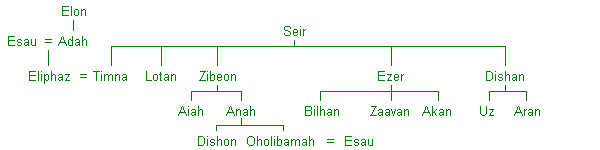
Three clan alignments lend themselves to a larger twelve clan alignment. There is an attempt to organize Esau into a 12-tribe confederation in Genesis 36:40 but only eleven chiefs are listed.  The attempt fails because there are two named Esau. Esau the Elder was the father of Eliphaz.  Esau the Younger married Basemath who bore Reuel, and Oholibamah who bore Jeush, Jaalam, and Korah (Genesis 36:1-9). These were the people of Seir, the Horite. They were Horite Hebrew (Habiru) clans. Their socio-political organization appears to be that of 3 clans.


Ishmael, Abraham's son by an Egyptian concubine, was the progenitor of twleve Nabatean tribes:  "Nebajoth; Kedar, Adbeel, Mibsam, Mishma, Dumah, Massa, Hadar, Tema, Jetur, Naphish, and Kedemah: These are the sons of Ishmael, and these are their names, by their towns, and by their castles; twelve princes according to their nations." (Genesis 25:13-16).

Jacob, a son of Isaac, is cast as the progenitor of twelve tribes: Reuben, Simeon, Levi, Judah, Issachar, Zebuln, Dan, Naphati, Gad, Asshur, Joseph and Benjamin. There is discrepancy on the number of Israelite tribes. Some count Dinah's line and some count Joseph's two sons Ephraim and Manassah.

The twelve-tribe organization appears to be the handiwork of a writer influenced by Babylonian thought. It represents an attempt to neatly classify the ruler descendants of Noah according to a celestial pattern. However, the Bible tells us that these rulers intermarried. The lines of Kain and Seth intermarried, as did the lines of Ham and Shem. The lines of Abraham and Nahor also intermarried. This means that socio-political affiliations were less formal than suggested by the twelve tribe organization. 

Further, there is evidence that the older organization comprised three sons of the same father. Where three sons appear in Genesis we have a code indicating a tribal unit of three clans.  Perhaps this is why Leah named her third son Levi, meaning "joining" (Gen. 29:34).  Likely, Leah hoped that she would be credited (and loved?) by providing Jacob with the three sons necessary to establish a tribe.

The 12-tribe organization is likely imposed upon an older order by a late source, such as the Deuteronomist Historian (c.700 BC - 250 BC). Abraham's ancestors never associated the Moon with the Creator. For them the Creator's emblem (boat or chariot) was the Sun. Veneration or worship of the Moon was characteristic of those who lived, not in Canaan, but "beyond the Euphrates." Joshua 24:2 says: “In olden times, your forefathers – Terah, father of Abraham and father of Nahor – lived beyond the Euphrates and worshiped other gods.” The implication is that Terah, whose ancestors came from Africa and Canaan, fell into worshiping contrary to his fathers’ tradition while living “beyond the Euphrates.” This is historically accurate since Abraham's Horite Hebrew ancestors never worshiped the Moon, as was done in Ur and Haran.

Martin Noth, in his seminal work "The Scheme of the Twelve Tribes of Israel" (1930), demonstrated that the Twelve Tribes of Israel did not exist prior to the covenant assembly at Shechem described in the book of Joshua.

The Joshua passage shares with the Deuteronomistic History a common concern about idolatry, and places the covenant at Shechem at precisely the location where God appeared to Abraham in 3
Three Persons (Gen. 18). Here in reference to the Godhead, the number three speaks of one-ness or unity; the God of Three: "Baal Shalisha."
  
There is more evidence in the Bible for the 3-clan organization than for the 12-tribe organization. Consider the Horite Hebrew confederations of Uz, Huz and Buz and Magog Og and Gog. Here are some of the three-clan confederations listed in Scripture:

Cain Abel Seth (Gen. 4-5)
Ham Japheth Shem (Gen. 5-9)
Og Gog Magog (Gen. 10 and Nu. 21:33)
Haran Nahor Abraham (Gen. 11-12)
Ishmael Jokshan Isaac (Gen. 16, 21, and 25)
Jeush Jalam Korah (Gen. 36: 4-18)
Korah Moses Aaron (Ex. and Nu.)
Dedan Tema Buz (Jeremiah 25)


Related reading: Three Clan Confederations of the Bible


Tuesday, March 24, 2009

Temple-Dedicated Daughters of Hebrew Priests


Alice C. Linsley


To understand the Bible we must look for patterns that first appear in Genesis. In this sense, Genesis is foundational to the whole of the Bible. The patterns are sometimes more evident when we focus on the women. This is true when considering blood lines among Abraham's Horite Hebrew people because blood line was traced through the mother. Social status was according to the father's status, which is why all the first-born sons listed in the Genesis genealogies are of noble status, like their fathers.

In this essay, we will look at a pattern involving three wives whose lives present interesting common features. The women are Tamar, Asenath, and Zipporah. The evidence suggests that these women grew up around shrines where their fathers served as priests. They apparently did not live pampered lives, if we consider that Zipporah was drawing water for livestock when she first met Moses, her future husband. On the other hand, they held a high status compared to girls who might have been indentured to the shrine. All of them had two sons, the younger of which was tagged as a pointer to Messiah.

The fulfillment of messianic expectation is found in the story of Photini, the Samaritan woman at Jacob's well. She is the only woman who Jesus is said to have met at a well.  He revealed Himself to her and she believed.  She repented and became the first evangelist, bringing many to faith in Jesus Christ. According to tradition, she died a martyr's death, as did most of her children. In a sense, Photini is the embodiment of the Church, the Bride of Christ.


Tamar, Who Builds Up the House of Jacob

Tamar was Judah’s daughter-in-law who bore him twin sons after he had intercourse with her at a Canaanite shrine. Possibly, this was the shrine of her "father's house" to which she was sent by Judah when he refused to provide her another of his sons.

Tamar's name means date nut palm, a symbol of fertility. Judah praised her as "more righteous” than himself in (Gen. 38:26) because she found a way to fulfill the levirate marriage law. The younger of Tamar's two sons was Perez, an ancestor of Jesus Christ.

According Targum Pseudo-Jonathan (Gen. 38:6), Tamar is a daughter of Shem who is also identified as Melchizedek. Since Shem-Melchizedek was a priest, Tamar's punishment as demanded by Judah was that set in Lev. 21:9 for a priest's daughter guilty of prostitution.


Asenath, Daughter of Potiphera, High Priest of Heliopolis

Asenath was Joseph’s Egyptian wife. She was a woman of high rank whose father was a Horite Priest of Heliopolis (City of the Sun). Her son Manasseh probably belongs to her father's house and Ephraim, the younger belonged to the house of Jacob, which explains why Jacob gave Ephraim the blessing of the first-born.

Asenath's father was Putiphar or Potiphera. This is a title composed of the word pu and tifra.  Putifra in ancient Egyptian means "this order." This may indicate the order of Horite ruler priests. The stela of Putiphar speaks of Putiphar as the "son of Horus, may He live forever."

Asenath's name means “holy to Anath” and she had "goddess" status throughout the Ancient Near East. She is sometimes called Mari-Anath. Many shrines were built to her. These had pools of water and were regarded as places where women could come to ask the High God for children. These were also places of healing (compare to the story in John 5).


Zipporah, Daughter of the Priest of Midian

Zipporah was Moses’ wife and a daughter of Jethro, Priest of Midian. Her name is derived from the word ציפור (tsipor, “bird”). Moses met Zipporah at a well, like a Midianite shrine. She bore Moses two sons: Gershom and Eliezer. The younger son was Eliezer. His Canaanite name means "God is my help”.

In all three cases, the younger sons were given priority over their older brothers. Tamar's son Perez is chosen over Zerah. Jesus Christ came from his line.

In Gen. 48, Jacob gives the blessing reserved for the firstborn to Asenath's younger son, Ephraim. Ephraim's descendants inhabited the principal settlements of Canaan, including Baal-shalisha which means the Three God, the God of Three, or the Three-person God.

In 1 Chronicles 23:17 we read this about Zipporah's youngest son: "The descendants of Eliezer: Rehabiah was the first. Eliezer had no other sons, but the sons of Rehabiah were very numerous.' Note that the name of Eliezer's first born son is a variant of the name Rehab. Rehab was another ancestor of Jesus Christ.


The Virgin Mary

Mary, the mother of Jesus Messiah, was a dedicated Temple virgin. The term "virginity" in Mary's case refers to her role as a priest's daughter who was dedicated to the temple, much as Hannah dedicated Samuel to the temple. In ancient times dedicated virgins led the people in singing. They played the timbrel and danced. There was a celibacy requirement for royal daughters dedicated to the temples and shrines. Temple virgins are described in the Old Testament as women who "watch [or wait] (צָבָא) at the door of the tabernacle.” In Exodus 38:8, we read that the laver of copper and its stand of copper were made “from the mirrors of the women who performed tasks at the entrance of the Tent of Meeting” (Hebrew Study Bible, p. 197).

Temple virgins performed many necessary tasks such as weaving. The connection between the Virgin Mary and weaving is found in non-canonical books as well as in canonical books. Chapter 9 of the Gospel of Pseudo-Matthew describes how Mary and the other virgins were spinning thread in the Temple compound. Carrying a pitcher, Mary went out to a fountain where the angel said to her, "Blessed art thou, Mary; for in thy womb thou hast prepared an habitation for the Lord." The next day the angel appeared to her again while she is spinning. This icon shows Mary, the Mother of God, weaving purple thread.


Joseph would have understood that Mary was consecrated to God, being a Temple-dedicated virgin. He also was aware through angelic intervention that she was to bring forth the long-awaited Messiah.
"This is how the birth of Jesus Christ came about: His mother Mary was pledged in marriage to Joseph, but before they came together, she was found to be with Child through the Holy Spirit." (Matt. 1:18)
Joseph became Mary's spouse protector rather than her sexual partner. As a righteous man, he did not presume to take that which rightfully belonged to God. Therefore, Mary remained a virgin both by virtue of her dedicated status and because of Joseph's righteous regard for her.


A Canaanite Shrine

The ancient mound of Tel Nahariyah is located in Israel south of the Lebanon border and north of the ancient maritime city of Akko. (Tel Akko is where an unusual sign of TNT has been found, showing an anchor.) The name Nahariyya means "River of God." Horite shrines were located a major water systems: rivers or an oasis or a well. This is why so many of the heros of Genesis and Exodus meet their brides at wells or river shrines.

The excavated remains of Tel Nahariyah have revealed it as an open-air Canaanite sanctuary. Like many such sites, it was established near a fresh-water spring. The shrine was founded about 2000 BC and was used as late as about 1250 BC.

Excavations have uncovered the remains of three buildings. The first was a small, square temple accompanied by a circular open-air stone altar. The other buildings were probably residences. Here there is a large standing stone. The third and most recent shrine building had auxiliary buildings and a smaller standing stone.

At the Nahariyah, archaeologists found evidence of offerings placed on the altar and oil oblations poured over the offerings. There was also considerable evidence that the sanctuary had been the location of sacrificial feasting (Pettey 1990: 179).

Excavators also found naked female figurines in silver and in bronze on the "high place" of the shrine, and in a pottery jar under the plaster pavement (Keel and Uehlinger 1998: 31; Negbi 1976: 64 and #1525-1534).

A mold was also found of a slim naked figure standing with her arms at her sides and hands framing her pubic area. She is small-breasted, and she has a protruding navel. Her hair flows about her shoulders. Her tall, conical hat has a horn sticking out on each side, suggesting that this may be an image of Hathor (shown below). Hathor was venerated by the Horite and Sethite Hebrew priests and she was the patron of the Hebrew metal workers at Timna. Her appointment as the mother of the son of God is depicted by the Sun resting over her head. This indicates divine overshadowing such as the Angel Gabriel described to the Virgin Mary (Luke 1).


Although two of the cut-out metal figures from Tel Nahariyah wear short skirts, the others are naked. One of the skirted figures was worn as a pendant, as evidenced by a loop on the back of the figure's head. The figurines were probably made in workshops at the shrine suggesting a connection between priests and metal-workers. This sheds light on the metal-working activities surrounding Aaron after the Israelites had left Egypt.


Such shrines are found in Africa

The Canaanite shrine has a contemporary counterpart in parts of West Africa. Osofo Ahadzi, spokemen for Africania Mission (Ghana), explains that women consult deities at the water shrines in order to have children. These children are sometimes pledged to the shrine or to the deity (as Hannah pledged Samuel to God in return for blessing her with a child). Ahadzi says that people who fail to redeem such pledges eventually lose those children.

People come to the shrines for other reasons as well. Ahadzi explains, “If there is a calamity befalling a family and they go back to the divinity or shrine and it is said that such a person should be trained in the shrine to learn the skills and acquire the power of divination to protect the family, that is when that person is devoted to the shrine."

In the ancient trosoki practice, the girls presented to serve at the shrines are usually young virgins. Sometimes their families are too poor to provide a marriage dowry. This is similar to the way that Catholic girls from poor families were sent to the convents during the Middle Ages.

Ofoso Ahadzi says that men may not marry a trokosi (indentured girl) without permission from the shrine. This is because the girls are also regarded as spirit wives of the deity. He said marrying a trokosi without going through the proper procedure will attract very severe punishment.

“There was a situation where the divinity asked one of the keepers not to marry this woman and he decided to go forward and marry. He thought that he was powerful and he went ahead and married. The mother died, he was going and the car had an accident. He died with his wife. In the traditional African religion the commandment is thou must not do this, if you do that you will get your punishment,” he said.

He says, “It is completely out of place for anybody to claim that the keeper of the shrine plays around with the girls. You can’t do that. When you go against any of the regulations, it is not human beings that will punish you. The deity will punish you because all the girls who go in there for training are the daughters and princesses of the divinity. So if you take liberties with them you will be punished,” he said.

Human rights groups oppose abuses of the trokosi system, claiming that some girls are sexually abused by the shrine priests, and that the arrangement is a form of slavery. However, Osofo Ahadzi reports that the girls have a good life at the shrine although they do not receive a formal Western education.

“I have a whole lot of problems about this so called formal school not because it does not promote development. But we are realizing that the formal education is actually foreign cultural mis-education. You see our people, they come out of the universities and they have no work to do. What we are being taught in the classroom is not what we need in our society. Look at our environment. You go to the villages and the villages are cleaner than the cities where the so-called intellectuals live. So the people who don’t go through our so called formal education are better off than those who go through the formal education,” he said.

Osofo Ahadzi said the girls are not taken advantage of even though they are used as free labor on the farms. He said the chores they perform can be likened to what students are made to do in boarding schools. Are the trokosi girls, some of whom are as young as two years, allowed freedom of movement like students receiving formal education? (Read more on trokosi shrines here.)


Virgins of the Shrine, Temple, and Convent

The sheltering of girls at shrines and temples was common in Africa, Canaan, India, ancient Egypt, and Mesopotamia. Some of the temple-dedicated virgins were the daughters of rulers and high priests. En-Heduanna, a daughter of Sargon (r. 2334-2284 BC), is an example. Sargon appointed Heduanna as the En (master, mistress, head official) of the shrine at Ur. This was a shrewd political move to secure power in the south of his kingdom. En-Heduanna served the Creator God Anu, at the House (pr) of Anu (Iannu). As with Roman Catholic nuns, she would have been considered “married” to the deity she served. En-Heduanna is credited with a large body of cuneiform poetry.

In Amarna letter EA 4, Amenhotep III is quoted by the Babylonian king Kadashman-Enlil I as firmly rejecting his request to marry one of Amenhotep's daughters: "From time immemorial, no daughter of the king of Egypt is given to anyone.” Amenhotep III's refusal was motivated by political concern and the concern to preserve his ruler-priest bloodline.

In ancient Egypt, some royal daughters were appointed to the two highest ranks a woman could hold: the positions of the God’s Wife (Hemet Netjer) and the Divine Adoratrice (Duat Netjer). These offices were held by women of high status, like the queen’s mother, or the wife of the high priest of the most favored royal temple. Pharaoh Ahmose I married his (half?) sister, Ahmose-Nefertiri, who became the God's Wife of Amun.

Ahmose I (reigned from c. 1550-1525 BC) controlled access to the throne by prohibiting princesses from marrying anyone except their royal brothers. This custom did not begin with him, however. Royal priests of the Nile had been marrying their half-sisters for at least 1000 years before the time of Ahmose I.

Ahmose’s principal wife was appointed to the office of the God’s Wife of Amun, and Ahmose endowed the office with more than adequate means, providing financial income, servants, real estate, and her own royal retinue. Many royal women attained high rank as priestesses in charge of Hathor shrines.


A religious option for unmarried girls and women

Royal virgins posed both potential opportunity for rulers. Their fathers could pledge them in marriage to form political alliances. In some cases, the virgins themselves appear to have sought the ruler’s protection from marriages they found displeasing. One of their few options was to be dedicated to a temple or to enter a convent.

In the Middle Ages, many royal daughters assumed the monastic life. The marriage of royal daughters was permitted only in circumstances of political advantage. Not surprisingly, female convents were founded in the regions were monarchs had residences. Some royal women lived saintly lives in the monasteries, and others enjoyed the same luxuries they knew in their palace homes.

In the Hindu context, the abuse of temple girls is regarded as a serious offense. Dr. Shabhash C. Sharma writes, "Regarding the treatment of people (including the young girls and widows) in shelters, temples and orphanages, Hinduism is quite emphatic in its opposition to any abuse and exploitation at the hands of those in positions of power and authority: 'He, who betrays one who has sought refuge, will meet destruction. The very earth will not let the seed, that he sows, sprout.' The Mahabarata (1, p. 181).

Dr Sharma explains: "Sometimes even if the parents of a young girl or boy are alive, they might not be in a good socio-economic condition to take care of their kid and thus could decide to send her/him to live in a temple thinking that the temple would do a better job in raising their child. Thus the temple might be considered by some people an ideal place to raise their child where free room, board and education (in spirituality, arts, music, dancing etc.) are available, perhaps in return for a small or light physical (manual) service (work) to the temple. "

Widows also may attach themselves to the shrine or temple once their husbands have died. This is likely what happened in the case of the Prophetess Anna (Luke 2:36-38) and happens in both west central Africa and in India. Dr. Sharma explains: "The same type of consideration, as indicated above for young girls, is generally applicable to adult women, especially the widows, when they decide to live in temples and religious places like Vrindavan. Note that even though the widows living in such places (temples etc.) might number in several thousand they still represent an extremely small minority relative to millions of Indian widows..."

Some believe that the Prophetess Anna is related to the priest Matthan who was the father of three daughters: Sobe (Salome's mother), Elizabeth (John the Baptist's mother) and Anne, the mother of Mary, the Theotokos. There is evidence that the Mary, the daughter of the Hebrew priest Joachim, was a temple-dedicated virgin who later married her patrilineal cousin Joseph. However, as Joseph was a righteous man who already had an heir by his first wife, he did not have sexual relations with Mary due to her vow. 

Mary probably was well-known to Simeon and Anna who greeted Mary when she came to the Temple to offer the prescribed sacrifice and fulfill the Mosaic purification requirement after childbirth.


Related reading: Denying Marriage: A cunning royal practiceWas the Virgin Mary a Dedicated Royal Woman?Wells and BridesA Woman at a WellWho Were the Horite Hebrew?; Mary's Priestly Lineage