Followers

Showing posts with label Bishop Ussher. Show all posts

Monday, May 13, 2013

YEC Dogma is NOT Biblical


Young Earth Creationism has been criticized for lacking a solid scientific basis. It also should be criticized for lacking a solid Biblical basis.


Alice C. Linsley

Young Earth Creationists use Archbishop James Usher’s chronology to date the age of the Earth. They believe that the genealogies in Genesis 5 and 11 are chronological and can be used to estimate when God created the Earth. They calculate the earth's age at 6000 years on the basis of lifespans assigned to the men named in Genesis 5 and 11. They ignore the line of Cain in Genesis 4 because they assume that his line became extinct in Noah's flood.

Biblical studies and discoveries in various sciences have left Usher's erroneous interpretation in the dust.

Usher lived before the development of molecular genealogy which has shed much light on human origins, and especially on the dispersion of the ancient Nilotes and Kushites. He also lived before the development of kinship analysis which makes verification of the Genesis King Lists possible. It can no longer be claimed that these rulers did not live in history. Their marriage and ascendancy pattern is authentic and can be traced from Genesis 4 to the New Testament records of Mary and Joseph's families. It is not possible that this aspect of Biblical history could have been written back into the texts since the 66 books of the Bible represent the contributions of numerous scribes and authors over about 1200 years.

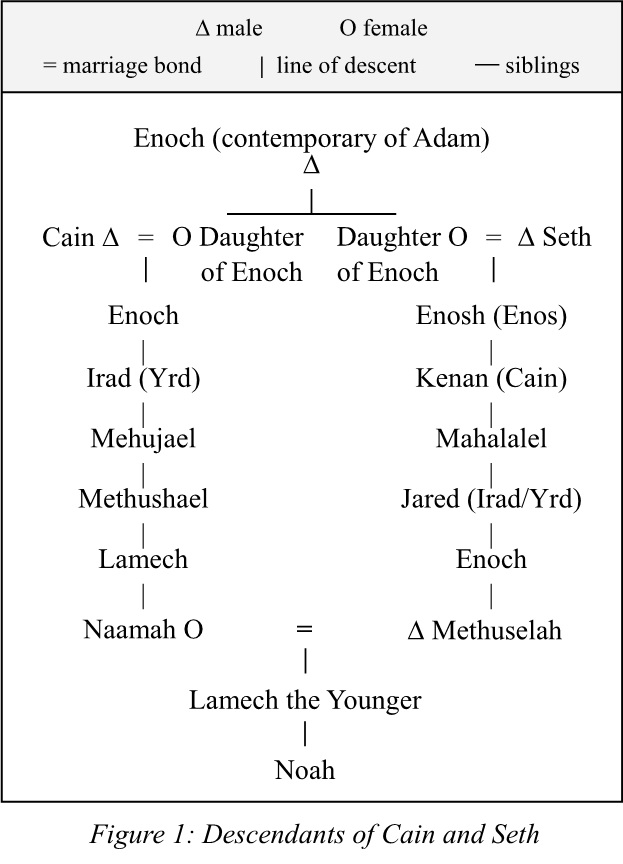
Usher's scheme is terribly flawed. He failed to recognize that the so-called "genealogies" are actually King Lists. These lists are not generational, but regnal, and the reigns of some kings coincided. Tubal-Cain (Gen. 4) and Methuselah (Gen. 5) ruled at the same time. Tubal-Cain's sister, Naamah, married Methuselah. (See diagram below.) This is an example of how people abuse Biblical lists.

Usher also missed the fact that the lines of Cain and Seth intermarried, and as St. John Chrysostom recognized, the line of Cain received great mercy. Not only 7 fold for Cain, but 77 fold for Lamech the Elder (Gen. 4:24), and 777 in the case of Lamech the Younger (Gen. 5:31).

Further, these men are not the first humans on earth, but rulers of the Afro-Asiatic Dominion. They were kingdom builders, like Nimrod the Kushite (Gen. 10:8). This was a time of  law codes such at the Law of Tehut, warriors, weapons, shrine cities such as Nekhen in Sudan, and numerous technologies associated with the Neolithic Period. These earliest rulers of Genesis lived between 6000 and 3000 B.C., millions of years after the appearance of archaic humans. The evidence of the Bible and the various sciences indicates that they lived in Africa or migrated out of Africa.

This last fact reveals the un-biblical and racist nature of YEC dogma. At the back of YEC books one finds the 12 Affirmations and Denials. Affirmation XII claims that the diversity of languages and skin color came about as a result of divine judgment at the Tower of Babel.

XII. We affirm that all people living and dead are descended from Adam and Eve...and that the various people groups (with their various languages, cultures, and distinctive physical characteristics, including skin color) arose as a result of God's supernatural judgment at the Tower of Babel..."

Africa always has had the greatest genetic and linguistic diversity of any continent. Long before the earliest Genesis rulers there already existed diversity of skin color. Here are images of red, black and brown Nubians.


Red and black Nubians
(Ippolito Rosellini)


Red and brown Nubians
They resemble the warriors of Petra who had long wavy hair and wore feathers.
(Dr. Arthur Brack)

The Habiru (Hebrew) marriage and ascendancy pattern

Usher's errors reflect ignorance of the marriage and ascendancy structure of Abraham's ancestors as it is revealed in Genesis 4, 5 and 11. This same pattern characterizes Moses' family and Samuel's family. It is the distinctive pattern of the ancient Habiru (Hebrew), a caste of ruler-priests.

Ussher did not understand that the rulers listed had two wives so there were two first born sons. The first born son of the half-sister wife was heir to his father's throne. So Isaac was heir to Abraham's territory between Hebron and Beersheba. The first born son of the patrilineal cousin wife was named after his maternal grandfather and served as a prime minister in his grandfather's territory. So Joktan, Abraham's first born son by Keturah, was not Abraham's heir. He would rule in the territory of Joktan the Elder.

Judah likely had two wives. In Genesis 46, we read that Judah went into Egypt with his brothers and presumably settled in the land of Goshen with his wife and children. In Genesis 38, we read that Judah had sons by Shua who lived in the region of Adulla, Mareshah and Chezib in Horite territory.

Some lists provide the names of the first born sons of half-sister brides. Other lines are traced through the cousin bride who named her first born son after her father. This is the case with Methuselah's wife, Naamah, who named their first born son "Lamech" after her father (see bottom of diagram).


Let us examine in greater detail the problems with Ussher's scheme.

Ussher did not recognize that the Genesis genealogies are regnal, not generational. They cannot be used to count generations because they are king lists and some kings ruled simultaneously. Others ruled for short periods, and still others ruled for longer than a generation (40 years).

Usher insisted on reading Genesis as chronology, and therefore missed that some rulers were contemporaries. Lamech the Elder was a contemporary of Enoch, Methuselah's father. Abraham was a contemporary of Job. Nahor's son Tahash was a contemporary of Isaac.

None lived the lifespans assigned to them. These numbers are symbolic, with Kabalistic meanings coming from a later period. (Kabal is derived from the Egyptian words ka and ba which in modern parlance would "body and soul.")

Ussher did not recognize that some of the Biblical lists are telescopic. Telescopic lists leave out some names. Such lists give the names of only the most famous rulers. This means that we cannot use the king lists to date the earth.

Ussher ignored the later king lists, such as the Horite rulers in Genesis 36 and their royal kinsmen in Genesis 22:20-24. Here we find the identical marriage and ascendancy pattern as among the Genesis 4 and 5 rulers.

Ussher did not recognize that the lines of Cain and Seth intermarried, as did the lines of Ham and Shem and the lines of Abraham and Nahor.  Each ruler had two wives. The cousin bride named her first born son after her father. Thus we find Esau the elder and Esau the Younger, Joktan the Elder and Joktan the Younger,   Kenan is a variant of Kain, and could be called Cain the Younger. Likewise, Irad is a variant of Jared and could be called Jared the Younger.

In the case of Lamech's daughter, Naamah, the pattern is quite clear. She married her cousin Methuselah and named her first-born son Lamech after her father. This pattern of marriage can be traced from Genesis 4 and 5 to the lines of Joseph and Mary in the New Testament, demonstrating that Jesus is a direct descendant of the people to whom God made the first promise of the Bible that a woman of their ruler-priest lines would bring forth the "Seed" of God (Gen. 3:15).

Jesus' mother's name was Miriam daughter of Joachim Son of Pntjr (Panther) Priests of Nathan of Beth Lehem. From predynastic times, ntjr designated the ruler among the Kushites. The name Panther or p-ntjr meant "God is King." It is certain that Mary was of the ruler-priest caste because even those who hated her admit this. Sanhedrin 106a says: “She who was the descendant of princes and governors played the harlot with carpenters.”

Ussher didn't know about the cousin bride's naming prerogative which meant that the cousin bride's father and her first born son had the same name. This explains the recurrance of names skipping a generation. There are two named Enoch; two named Lamech; two named Joktan, and two named Sheba. There are also two named Esau, as shown below.

Here we see that Esau the Elder married Adah. Esau the Younger married Oholibamah, a prefigurement of the Virgin Mary.


Seir is identified as a Horite in Genesis 36. The names Esau, Dishon, Uz, Lot/Lotan and Timna are Horite names. The name "Adah" can be traced back to Lamech the Elder. One of his wives was named Adah (Gen. 4:23).


Related reading: Facebook Conversation on CreationismEvidence of an Old EarthSmoking Gun Evidence of an Ancient EarthGenesis on the Ancient Kingdom BuildersCain as RulerLamech's Story and Horite KingshipBishop Ussher GoofedDNA Research Confirms Kushite Migrations; Biblical Anthropology...the Science, not speculative theology; Calculating the Dates of the Patriarchs; The Genesis King ListsTwo Named Esau; Abraham and Job, Horite Rulers; The Cousin Bride's Naming Prerogative; Objections to the Fundamentalist Reading of Genesis


Monday, May 14, 2012

False Assumption #3 of Young Earth Creationists


Dr. Alice C. Linsley


This continues the series on "False Assumptions of Young Earth Creationists." To date we have considered False Assumption 1: Genesis is history and should be read as a chronological account, and False Assumption 2: The Genesis “begats” list the first people living on Earth


False Assumption 3:  Bishop Ussher's timeline is reliable and can be used to calculate the age of the Earth. 

Ussher did not recognize that the Genesis genealogies are regnal, not generational. The begats cannot be used to count generations because they are king lists and some kings ruled simultaneously.

Ussher was unaware of the marriage and ascendancy pattern of the Hebrew rulers whereby the ruler had two wives and two firstborn sons. Ussher's timeline is flawed because he failed to take this into consideration.

The early Hebrew marriage and ascendancy pattern was well established among these powerful rulers, indicating that they had been in power long before Noah's time. The oldest known site of Horite Hebrew religion at Nehken dates to about 4200 B.C. and reflects a high level of technological and cultural achievement. This is 6200 years ago, the time when the earth was created according to Ussher.

Menes is credited with first uniting the Upper and Lower Nile peoples into one Kingdom. He wore the double crown to show that he was sovereign over both regions. The serekh surrounding his name is surmounted by the falcon, the totem of HR (Horus). Horus was called “son of God” and in ancient Egyptian HR means "Most High One".

At the Horus temple of Nekhen, votive instruments were ten times larger than the mace heads and bowls found elsewhere, suggesting that this was a very prestigious shrine. Horite priests placed invocations to the Creator at the summit of the fortress as the sun rose. Likely, this is the origin of the sun blessings in Hinduism (the Agnihotra morning ritual) and in Judaism (the Birka Hachama, or “Sun Blessing” ritual performed every 28 years).

Young Earth Creationists are wrong to use Archbishop James Ussher’s chronology to date the age of the Earth. Ussher assumed that the "begats" of Genesis chapters 4 and 5 refer to the first people on earth and he concluded that the earth's age is between 6000-8000 years. Today the anthropological tool of kinship analysis reveals the flaw in Ussher's approach. The diagram below shows that the lines of Cains and his brother Seth intermarriage according to a long-standing marriage and ascendancy pattern that is characteristic of the early Hebrew ruler-priest caste.


Cain and Seth married patrilineal cousins who were the daughters of a ruler named Enoch. These wives named their firstborn sons after their father, according to the cousin bride's naming prerogative. Lamech the Elder's daughter Naamah married her cousin Methuselah and named their firstborn son Lamech after her father.

This shows that the historical Adam had a contemporary called Enoch, which is a royal title referring to one who ascends to the throne of his father. 

Ussher did not take into consideration is that Kushite rulers, like Egyptian rulers, did not name their biological fathers in their king lists. This explains why many of the names that appear in the Genesis 4 and 5 lists are titles of royal persons rather than proper names.

The Kushites believed that the ruler-priest was the son of Re whose emblem was the sun. (Re in ancient Egyptian means "father".) The Pharaoh was called "son of Re" which is why Egyptian texts never mention the king's earthly father. Kingship was a manifestation of the High God's overshadowing of noble women. 

Sargon the Great claimed not to know his father. He based his authority to rule on the suggestion that he was conceived according to the Horite Hebrew myth of miraculous virginal conception. However, any ruler could make that claim. The true proof of the ruler's deity was resurrection from the dead.  Sargon stayed dead, as did all the rulers of Egypt and Mesopotamia. However, Jesus Christ, a descendant of their royal lines, did indeed rise from the dead and his rising was verified by many eye witnesses


Dating more accurately

The early Hebrew rulers of Genesis 4 and 5 lived and reigned within the periods of early Egyptian history.


First Intermediate Period
2475-2445 BC: 7th - 8th Dynasties Noah, Shem, Ham, Japheth and Kush

2445–2160 BC: 9th -10th Dynasties Nimrod, Arpachshad, Salah, Eber and Peleg and Joktan


Middle Kingdom
2160-2000 BC: 11th Dynasty Nahor, Terah and Abraham

2000-1788 BC: 12th Dynasty Jacob, Esau, Joseph


The early Kushite expansion into ancient Sumer/Chaldea has been well-documented. In Sumerian inscriptions the Kushites were called Meluha Kasi. The dispersion of the early Hebrew out of the Nile Valley is evident in Genesis 10 which speaks of the Kushite kingdom builder Nimrod who built a great empire in the Tigris-Euphrates Valley. 


The Pattern of Two Wives and Two Sons

Horite and Sethite Hebrew rulers maintained two wives in separate households on a north-south axis. The ruler's first wife was a half-sister (as was Sarah to Abraham) and the second wife was a patrilineal cousin (as was Keturah to Abraham). The firstborn son of the half-sister wife ascended to the throne of his biological father. As Abraham's proper heir, Isaac ruled over Abraham's territory in ancient Edom (Idumea).

The firstborn son of the patrilineal cousin wife served as a high official in the territory of his maternal grandfather after whom he was named. Joktan, Abraham's son by his cousin wife Keturah, served in the kingdom of Joktan the Elder, his maternal grandfather. The Joktanite clans resided in Arabia.


There was a hierarchy of Hebrew chiefs, vassals, and kings. Analysis of the kinship pattern of the early Hebrew rulers indicates segmentary lineages. The first loyalty is to the lineage of father and his principal (half-sister) wife and their son, the heir. The second loyalty is to the father and his second (cousin) wife and their son who belongs to the household of his maternal grandfather. The third loyalty is to the household and clan of the cousin.

A Bedouin proverb summarizes the philosophy behind segmentary lineages:

I against my brother
I and my brother against my cousin
I, my brother, and my cousin against the world

 
Sons who were not the firstborn were given gifts of camels, jewelry, flocks, herds, and servants and sent away to establish settlements of their own. The importance of these "sent-away sons" as a driving factor in the Kushite expansion out of the Nile Valley.

This pattern is evident in the case of the Kushite kingdom-builder Nimrod. Nimrod, one of Abraham's ancestors, was sent away from his older brother Ramah whose territory was in northern Arabia. After numerous conquests, Nimrod’s territory was far greater than his brother’s. It extended the length of the Tigris-Euphrates Valley, and the principal cities were Babel, Erech, and Akkad (Gen. 10:10). The language of Nimrod’s empire was Akkadian, the oldest known Semitic language. It has close affinity to the languages of the Nile Valley.


Related reading:  The Hebrew Were a Caste; Hebrew Rulers with Two WivesHorite and Sethite Mounds; Abraham's Kushite Ancestors; Kushite Kings and the Kingdom of God; Hebrew Names and Titles; The Welcome Demise of American Fundamentalism

Sunday, April 1, 2012

False Assumption #1 of Young-Earth Creationists

Alice C. Linsley


As I have written here, the false assumptions of Young-Earth Creationists present the greatest obstacles to understanding Genesis. Their assumptions are the most pervasive cause of confusion and their doctrines are contrary to what Genesis reveals.

In this essay, we consider the first of five Young-Earth assumptions and evaluate its veracity in light of relevant texts.


Assumption 1: Genesis is history and should be read as a chronological account.

Genesis contains historical details that can be verified through disciplines such as archaeology, anthropology, linguistics, molecular genealogy and climate studies. However, the book should not be read as a chronology of past events. That is not how Abraham's ancestors recounted their tribal histories and stories.

It is often repeated that the Hebrews viewed events as moving along a straight line, but Abraham and his ancestors were not Hebrews. They were Nilotic peoples who tended toward binary tensions expressed in parallel accounts.  The parallel stories highlight similarities such as the moral lapses of Noah and Lot while drunk.  Noah's misbehavior led him to blame ("curse") his grandson. Lot's drunkeness led to incest with his daughters.

Sometimes the parallel stories contrast the character of two figures, as in the accounts of Abraham and Isaac attempting to pass off their wives as their sisters. Sarah was Abraham's half-sister whereas Rebecca was Isaac's patrilineal cousin. In other words, Abraham did not lie and Isaac did.

Other parallel accounts include the two creation stories. Genesis 1 and Genesis 2-3 are parallel accounts from different traditions. The second story about the garden, the serpent, and the tree of life is older than the first story about the six days of creation.

Likewise, there are two flood accounts. In one we read that Noah was to save one pair of animals, a male and female, and in the other we read that he was to save seven pairs of "clean" animals.

This parallelism is not limited to the book of Genesis.  It is found in the Psalms and throughout the Old Testament. Adam and Enoch are paralleled in Hebrew in Psalm 8:4. The story of Korah opposing Moses' authority has a parallel in the story of Sheba who opposed David's authority.  In the end, both Korah and Sheba lost their lives.

The blood on the door posts in Egypt has a parallel in the story of the passover of Rahab and her family by the scarlet cord hung from the window.

The story of Sarah's miraculous conception of Isaac is paralleled by Hannah's conception of Samuel.  In the New Testament, we find a parallel between Elizabeth's miraculous conception of John the Baptist and Mary's conception of the Son of God, to whom John would bear witness.

There are also parallel stories about cousin wives. Nahor, Abraham's older brother, married his cousin wife Milcah before ascending to the throne of his father, Terah. This happened before Abraham made his journey to the land of Canaan. However we are not told about Nahor's wife and children until after Sarah's burial.

Likewise, Abraham married his cousin wife before Sarah died, but Keturah is not mentioned until after Sarah's burial. This has lead people to assume that Abraham married Keturah after Sarah died. Instead we have parallel cousin-wife stories.

Abraham and all the Horite rulers listed in the Genesis "begats" had two wives.  This was their custom. The first wife was a half-sister, as was Sarah to Abraham. The second wife was a patrilineal cousin or niece, as was Keturah to Abraham. This pattern describes Moses' wives also.  His first wife was his Kushite half-sister and his second wife was his Midianite patrilineal cousin, Zipporah.

By insisting that Genesis be read as a chronological history, Young-Earth Creationists miss the remarkable parallels which are intended to enlighten us as we read Scripture. They miss the patterns of the Bible because they are intent on forcing the Bible into their preconceived template. They miss that Jesus Christ, as the Heir to the eternal Kingdom, is prefigured in the marriage and ascendancy pattern of Abraham's people. St. Paul understood this. That is why he wrote that the Gospel had been proclaimed to his Hebrew ancestors (Heb. 4:2).

This is not to say that Abraham's ancestors lacked a device for narrating linear events. This was done through recounting the lists of rulers found in the Genesis Begats. These are authentic king lists that establish that Noah lived before Nimrod and Nimrod before Abraham, etc. We can imagine a Nilotic story teller elaborating on the character of various rulers as is evident in Genesis 4:23, where we are told that Lamech bragged to his two wives. Another elaboration is found in Genesis 10:8-12 concerning the Kushite kingdom-builder Nimrod.

To make the Bible fit their template, Young Earthers overlook many significant details. They seem unaware that Abraham had at least eight sons, and Isaac was not his firstborn.  They ignore the intermarriage between Abraham's people and the Horites of Seir/Edom (Gen. 36).  They overlook that Nimrod was a Kushite (Gen. 10:8-12) and the founder of a Mesopotamian empire to which Abraham's father and older brother were heirs.

The other key assumptions of Young-Earth Creationists are:

Assumption 2: The Genesis “begats” list the first people living on Earth.

Assumption 3: Bishop Ussher's timeline is reliable and can be used to calculate the age of the Earth.

Assumption 4: All the peoples of the Earth came from Noah’s three sons.

Assumption 5: The world’s linguistic diversity is the result of God’s judgment at the Tower of Babel.


Each assumption will be considered in subsequent posts at Just Genesis, so stay tuned!


Related reading:  Cousin Brides and Their Ruler Sons; The Genesis King Lists; The Scarlet Cord Woven Through the Bible; Kushite Wives; Binary Sets in the Ancient World

Sunday, November 20, 2011

The Genesis Kings and the Fall

Alice C. Linsley


The men listed in Genesis 4-6 (Cain to Noah) were rulers over territories. They had a complex and unique marriage and ascendency pattern, involving two wives.  The first wife of the ruler-to-be was a half-sister (as was Sarah to Abraham) and this marriage took place at a young age.  The firstborn son of this union ascended to the throne of his biological father (as did Isaac). The second wife was either a patrilineal cousin or a niece (as was Keturah to Abraham) and was married close to the time of ascent. This is why Abraham expressed urgency concerning Isaac's marriage to Rebecca. The firstborn son of the second wife ascended to the throne of his maternal grandfather (as did Joktan, Keturah's son).  By the time of Cain, the marriage and ascendeny pattern was well established, suggesting that this had been the pattern for more than a few generations of rulers.  The "begats" speak of archaic rulers and establish a pattern whereby Abraham's descendants would recognize the Jesus as the promised Son of God.

Analysis of the king lists in Genesis 4 and 5 reveals that this was the pattern for Abraham's royal ancestors and I believe that this is an authentic pattern. Further, this pattern is older than the Genesis 1-3 narratives and is useful in understanding those narratives.  For one thing, we can't use the regnal years to determine the age of the earth, as was tried by Bishop Ussher. By his calculations, the earth is only 6000 years old.  What are we to make of the mining operations in the Lebombo Mountains 60,000 years ago?

The span between the rulers in Genesis 4 and 5 and Noah may be 950 years, but all these men were rulers over territories that were well established and which had neolithic technologies.  In other words, these rulers lived long after the first created humans. Clearly, there is a much greater span between Adam and Cain. Adam represents either the historical or ahistorical first man created by God, fully human and in the divine image. As such, he would have lived around 3.4 million years ago, since the oldest human fossils are at least that old.

Must Adam have been historical to believe that the Fall happened? We only have to look around for evidence that we live as sinners in a sinful world. In the Eastern Church, the Fall doesn't mean that each of us inherited Adam's guilt. The prophets teach that each of us will receive that which our own lives deserve. Instead, the Fall means that we all are subject to death since by Adam's sin, death entered the world.


Related reading:  The Marriage and Ascendency Pattern of Abraham's People; Cain's Father; Getting the Facts About Human Origins

Monday, November 22, 2010

Adam and Enoch: Archetype and Ancestral Rulers


Alice C. Linsley


Bishop Usher’s dating of the earth at 10,000 years and mankind at 4000 years is terribly mistaken.  Some Bible literalists insist on the accuracy of Usher's dating, though it flies in the face of all the physical evidence.  How do they reconcile a 10,000 year earth with human-crafted tools and ochre plaques dating to 100,000 years?  They argue that radio carbon dating is inaccurate.  Okay, let's say that it is wrong by 50%.  That would mean that the mace heads found in Africa are only 50,000 years old.  That's still 40,000 years older than the literalists say the earth has existed

Adding the life spans of the rulers doesn't provide a "biblical" answer to the age of the earth because the Septuagint, the Masoretic, and the Samaritan texts don't agree on the number of years. The total number of years in the Septuagint and the Masoretic (Hebrew) records agree except in the case of Lamech the Younger (Noah's father). The Septuagint assigns Lamech a total of 753 years, whereas the Samaritan Pentateuch assigns him only 653 years. The Masoretic text assigns Lamech 777 years. Lamech the Elder, the father of Tubal-Kain, isn't assigned an age span.  It is evident that the age of the earth can't be calculated using the lifespans of the rulers listed in Genesis.

Instead, Genesis poses two men as the founders: Adam, the first ruler and Enoch the first ancestor of the historical persons listed in Genesis 4, 5 and 11. We find a clue as to how we are to correctly understand both biblical figures in Psalm 8:4: 

What is man (Enoch) that you are mindful of him,
or the son of man (ben adam) that you care for him?

Here we see that the historical first ancestor Enoch is paralled with the first man Adam. The author of the Psalm makes a distinction between the two figures, but also regards them as real fathers of the people.  They are the deified rulers who are ancestral to Jesus Christ, the Divine "Son of Man."

Bishop Usher’s dating is not accurate because he didn’t recognize the telescopic nature of some genealogical lists. He believed that all the genealogical lists involved biological fathers and sons, but some of the lists are telescopic, listing only the most famous of the chiefs. This means that we can’t use the genealogies to measure years. All the genealogical lists are telescopic except for Genesis 4, 5 and Genesis 11:24-26.

Usher also didn’t understand that the genealogical material in Genesis 4 and 5 pertains to the wives of Cain and Seth, the daughter of an African chief named Enoch or Nok. Therefore the name that should appear at the head of the family tree is Nok, the father-in-law of Cain and Seth. Analysis of the Genesis 4 and 5 kinship pattern makes it clear that Adam is not the head of these lines.

In biblical parlance Adam represents the first created man.  Since the oldest human fossils are over 3 million years old, Adam would have been created at least before these humans.  Enoch, on the other hand lived no more than 12,000 years ago. He is the father-in-law of Cain and Seth.

Cain and Seth's brides named their first-born sons Enoch, after their father. This name is sometimes rendered Hanoch, as in the case of Reuben's first-born son. The name that should appear at the head of the Genesis 4 and 5 family tree is Enoch or Nok.


Bishop Usher appears to have been unaware that the descendents listed in Genesis 4 and 5 were ruler-priests whose lines exclusively intermarried. Each ruler-priest had 2 wives. One was a patrilineal cousin or niece who named her first-born son after her father. This explains the recurrence of names in chapters 4 and 5. For example, Kain and Kenan and Irad and Jared are linguistically equivalent names.

In the case of Lamech's daughter, Naamah, the pattern is quite clear. She married her cousin Methuselah and named her first-born son Lamech after her father.


Knowing the marriage pattern of the Horite ruler-priests helps us to trace Jesus Christ's ancestors from Genesis 4 and 5 to Joseph and Mary, of the ruler-priest lines, whose marriage appears to have been consistent with this pattern.


Related reading: Horite Deified Sons; The Horite Ancestry of Jesus Christ; Andrei A. Orlov, Enoch as the Heavenly Priest


Thursday, January 8, 2009

Theories of Creation: An Overview


Alice C. Linsley


Readers have asked me to explain my views on creation, but before I do so, I would like to present an overview of the main theories of creation.

Gap Theory creationism: In this theory, God created every original thing in six consecutive 24-hour days, but a gap of time between the first and the second verses of Genesis 1 explains the great age of the Earth. An early proponent of this view was Thomas Chalmers, a professor of Divinity at the University of Edinburgh.

Day-Age creationism notes that the Hebrew word yom may indicate a 24-hour day or an unspecified period of time that could entail a period of thousands or millions of years. This theory attempts to reconcile the differences between young-earth creationism and evolutionary creationism. According to this view, the sequence and duration of the seven "days" is representative of the cosmological events theorized to have happened, so that Genesis can be read as a summary of modern science, simplified for the benefit of pre-scientific humans.

Young Earth creationism holds to the six 24-hour days of creation but does not accept any gap of time. According to this theory the Earth is only between 6,000 and 10,000 years old. Within this camp, some accept the possibility of developmental change within species, but most believe that God created all living species in the beginning as an act of special creation. Proponents of this theory include Baptist Pastor and biochemist Duane Gish, and the late Henry M. Morris, a civil engineer and author of several books in which he developed young earth creationism.

Progressive creationism holds that God created new "kinds" of plants and animals over a period of millions of years. It estimates the age of the Earth in the millions, but generally rejects macroevolution as biologically untenable and without evidence in the fossil record. In this theory, it is not necessary for all humans to have decended from a common primal ancestor and Noah's flood is accepted to have been local rather than global. Proponents of this view include the late Bernard Ramm, a Baptist theologian and Bible scholar, and astronomer Hugh Ross, who holds that the Flood was local yet killed all humans except for those on the ark.

Evolutionary creationism (or Theistic Evolution) accepts the theory of evolution but insists that all change, growth and development over time is directed by God or by forces put into place by God. The greatest proponent of this view is Charles Darwin himself. He wrote in a 1879 letter to John Fordyce: "In my most extreme fluctuations I have never been an atheist in the sense of denying the existence of a God.”

Framework Theory holds that the creation account of Genesis 1 is not to be taken literally or used as a scientific text, but should be regarded as an ancient sacred text with a symbolic structure that points to God's orderly design and the importance of the Sabbath commandment. In this view Genesis 1 is independent of Genesis 2. In this view the more primtive story is the Genesis 2-3 account of the creation and the Genesis 1 account dates to a later time of the Priestly source. Proponents of this theory are Henri Blocher and Meredith Kline.

Intelligent Design holds that certain features of the universe and of living things are best explained by an intelligent cause, not an undirected process such as natural selection. In Chapter 6 of The Origin of Species, Darwin posed critiques of evolution. He admitted that it is difficult to imagine how "organs of extreme perfection and complication," such as the eye, evolved by natural selection. ID is a well-considered form Darwin's own critique. Building on logical doubts, ID theorists have developed the idea of "irreducible complexity."


An integrated approach that takes its lead from the Bible

Here is another approach to creation and the book of Genesis. It draws on Biblical Anthropology, climate studies, linguistics, genetics, and the Bible itself as an important database.

We find evidence in Genesis for climate change and catastrophic flooding. Noah lived in the region of Lake Chad approximately 2490-2415 BC, when the Sahara experienced a wet period (Karl W. Butzer 1966). Recent geological studies have found that the huge basins and troughs of the Sahara were interconnected so that boats could travel from Niger to the Nile. This was one of the last wet periods and it coincided with cultural and technological achievements in the Old Kingdom.

Using kinship analysis we discover a unique marriage pattern among Abraham's ruler ancestors who practiced endogamy. This is why geneticists can identify the Kohen gene.

Biblical data has led to the discovery of the Nile-Japan Ainu connection. It also has established links between the Kushites and the Kushan.

Most of these discoveries represent important breakthroughs. Such discoveries are possible because science and religion are companions in the search for truth.

I am an old earth creationist. I reject young earth creationism because it is bad science and even worse Bible interpretation. Young Earth Creationists use Archbishop James Usher’s chronology to date the age of the earth. However, Usher was ignorant of the marriage and ascendancy structure of Abraham's Horite people and therefore misrepresented these early rulers as the first people on earth. The Genesis "genealogies" are regnal not generational. They are king lists and some kings ruled simultaneously. Further, the Biblical data indicates that these rulers were kingdom builders, metal workers, and temple builders. They lived no earlier than about 7,000 years ago and millions of years after the dinosaurs!

Young earth creationism assumes that Genesis must be defended against Darwinism and Neo-Darwinism. God's word does not need to be defended. If anything, it needs to be defended from bad science that imposes a timeline that contradicts what Genesis reveals.

I believe that from "the beginning" God created humans in the divine image and fully human, and that humans and apes have always been separate species. Discovery Institute's Casey Luskin maintains that the complete sequencing of the gorilla genome challenges the theory that humans and apes have a common ancestor. Luskin says, "There is not a clear signal of ancestral relationships that is coming out of the gorilla genome once you add it into the mix."

Luskin, as with many who do not concur with conventional Darwinian views, is regularly pillored at evolution blogs and websites.

As far as I have been able to determine, finds of ancient fossils have been easily categorized as either ape or archaic human. Finds labled "hominids" in evolutionary taxonomy represent different archaic human populations.

After almost 100 years of frantic searching, there remains no material evidence that humans and apes had a common ancestor. This aspect of Darwin simply has not been proven. Until it is, I feel no compulsion to relent in my position. That's the empirical approach, afterall.

This doesn't mean that I reject a role for natural processes. These can be observed. I wonder why such observations must be forced into Neo-Darwinian interpretations. The air sacs being an example. Many features that Darwinians insist are evidence of evolution have other likely explanations. The morphology of the hyoid that suggests that A. afarensis had air sacks in the throat is not indicative of evolution of humans and apes from a common ancestor. The same hyoid bone feature has been found in other archaic human populations as an adaption to aquaboreal environments. Similar hyoid structure appears in the Kebara Cave population of Israel that lived around 60,000 B.C.

Genesis tells us that God created in an orderly fashion over a period of time and according to a plan. It is the work of science to discover the order and the work of theologians and Bible scholars to discern the plan. For Abraham's ancestors the order was perceived as fixed, though they recognized flux within the fixed boundaries. Their acute observation of the patterns in nature suggested a divine plan.

Since none of us were present to observe the beginning, we can speak only of what we think may have happened.  We tend to describe events according to our cultural understandings, our worldviews.  However, the book of Genesis presents the understanding of the Nilotic and Proto-Saharan peoples who were Abraham's ancestors, and it is their culture that we must consider. These ancestors migrated out of Africa to Pakistan, India, and even Cambodia. Anghor Wat, in Cambodia, was originally a Horite shrine city and the Horites originated in Egypt and Sudan.  Angkor is a variant of the ancient Egyptian Anhk-Hor, meaning "Life to Horus."  Wat means city or shrine settlement  In the ancient world the largest settlements were at water shrines tended by a caste of priests and defended by a caste of warriors.

One of the oldest known castes is that of the Hapiru or Habiru (Hebrew). This was a caste of priests and priest attendants who served at the water shrines and temples of the ancient world beginning as early as 4000 BC. They are sometimes called "O-piru" because they reveranced the Sun as the emblem of the Creator. The O in O-piru is a solar symbol.

Within this priest caste there emerged a cult devoted to Horus as early as 3500 BC at Nekhen in Sudan. These are called Horites. The Horites were a Proto-Saharan caste who later were found among the Kushites. The Kushite marriage and ascendancy structure speaks of the promised Son to whom God will deliver the eternal kingdom. Abraham's people were Horites. Even today Jews call their ancestors "Horim" which is a variant of "Horite."

Genesis is a valuable source of information about early modern human populations. It provides details that are useful in reconstructing points of origins, diversity of populations, migrations, technological development, religious practices, and the marriage and ascendancy structure of the early rulers and the spread of the Afro-Asiatic worldview. It connects many of the peoples living from Borno to Borneo and explains common mythological motifs such as the serpent, the tree of life, the solar boat, and falcon-shaped Harappan fire altars dedicated to Horus, the prefigurement of Jesus Christ. 

When it comes to theories of creation, people immediately think of the creation narratives in Genesis. However, Genesis is not about the origins of life on earth. Ultimately, it is about the origins of Messianic expectation among Abraham's Habiru ancestors, a caste of priests who spread their worldview far and wide. It is the story of Jesus' very ancestors to whom God made a promise thousands of years ago that a Woman of their caste would bring for the "Seed" of God (Gen. 3:15). Jesus is that Seed. He is a direct descendant of those people to whom that promise was made, and He is the fulfillment of Horite expectation.


Related reading: A Scientific Timeline of GenesisScientists Against Scientism; The Folly of ScientismBiblical Anthropologists Discuss Darwin; Genesis: Is it Really About Human OriginsBetween Biblical Literalism and Biblical Illiteracy; Who Were the Kushites?; Who Were the Horites?; Abraham's Ancestors Came Out of Africa