Followers

Showing posts with label Ainu. Show all posts

Saturday, November 9, 2019

Conscious of Our Uniqueness as Humans


Ainu of Northern Japan


Many aboriginal peoples have a name for themselves that simply means people, humans or human beings. In Genesis 1, Adam (adamah) means human, and in Genesis 2 Adam refers to a red human.

The ancient Akkadian word ḫāpiru means human being.

The Ainu are an aboriginal people of Northern Japan and the eastern seaboard of Canada. The word Ainu means human.

The ancient metal workers of Anatolia called themselves the Nes (NS) which means humans, and their language was called Nesli. There is a linguistic connection to modern Serbian. In Serbian nas means us, naš means our, naši means our people, naški means our language.


Naxi elders in Yunnan China.


There is a Tibetan-Burmese population with the name Naxi. Naxi means "honored people."

The natives of the Aleutian Islands call themselves "Anishinabe" which means "First Men" or "Original Men."

The Inuktitut word Inuit means "human beings." The Inuit are the "first people" of Baffin Island in Canada, the Northwest Territories, Greenland and Alaska.

The Shoshone call themselves Newe (nih-wih), meaning “the people.”

The Blackfeet people call themselves the Niitsitape (nee-itsee-TAH-peh), meaning “the real people.”

It appears that the earliest populations self-identified as human, as distinct from other creatures. This is explicit in the story of Adam naming the animals. The Man and the animals are created from the same substance. They are formed from the earth and are earth creatures. As the story continues Adam discovers that he is unique. There is no other creature like him. He is alone until God fashions a companion for him, the woman.

Even some names given by paleoanthropologists to archaic populations work like this. For example. "Sahelanthropus tchadensis" simply means the humans of the Sahel and Lake Chad Basin.


Related reading: Adam Was a Red Man; A Kindling of Ancient Memory; The Father of Adam and EveOn Blood and the Impulse to Immortality; The Truth of Human Exceptionalism


Friday, December 21, 2018

The Ethnicity of Abraham and David


Alice C. Linsley


Abraham, Moses, Samuel, and David were all Horite Hebrew as evidenced by the common marriage and ascendancy pattern of their fathers. Analysis of the marriage and ascendancy structure of their families reveals the distinctive pattern of the Horite Hebrew ruler-priest caste that involves two wives. Abraham's wives were Sarah and Keturah. Moses's wives were an un-named Kushite bride and his cousin bride Zipporah. David's father had two wives also. 2 Samuel 23:24 makes this clear. It identifies Abishai, Joab, and Asahel as the sons of Jesse's daughter Zeruiah. Zeruiah was King David's half-sister.

The pattern of Moses' family is identical to that of the Nilo-Saharan rulers listed in Genesis 4, 5, 10 and 11, and to that of Abraham's father Terah, and Samuel's father Elkanah. Elkanah's two wives were Penninah and Hannah.

David's father was a ruler-priest of the Horite Hebrew city of Bethlehem. It appears that all of these great men were Horites or Horite Hebrew, called "Horim" by Jews today.

This diagram shows one line of descent from the Horite ruler Seir (Gen. 36). Aram's cousin wife Ishara was descended from Seir. Her grandmother was Oholibamah, Seir's great granddaughter.


At the time that Abraham lived there were no nations in the modern sense. There were peoples, clans, and castes. Ethnic identities aligned with the territorial chief. Jewish ethnicity, however, is figured through the Jewish mother, and the maternal line appears to have been considered among the Horite Hebrew, especially in cases where the mother was of high status. 

Abraham's ethnicity was Kushite and his father was a ruler-priest descendant of Nimrod, a son of Kush. Nimrod was a sent-away son who became a mighty ruler in the Tigris-Euphrates Valley. This is why we first meet Abraham in Ur, though his ancestors were cattle-herding Nilo-Saharans.

Abraham was another sent-away son whose territory extended on a north-south axis between his two wives Sarah and Keturah. Sarah resided in Hebron and Keturah lived in Beersheba. Abraham also dug wells in Gerar to the west and had a treaty with the ruler of that region. Likely he also had water rights at Engedi to the east. This means that Abraham's territory was entirely in the region know as ancient Edom. The Greeks called this region Idumea, meaning "land of red people."


Edom is named in the Bible as one of the ancient seats of wisdom. The wisdom of the Horites extended to medicine, astronomy, writing, commerce, navigation, natural sciences, and architecture. The 400-acre Edomite complex at Petra reflects Horite beliefs. This was the home of the red Nabateans. Naba or Nabu was the guardian of scribes and prophets. The cult of Nabu was introduced into Mesopotamia and Babylon by the Kushites. Kushite kings sometimes bore the name Nabu, as with Nabu-shum-libur, an early Kushite king in Babylon and Nabu-aplu-iddina. This is the origin of the Hebrew word nabi, meaning prophet.

The Horites were devotees of the Creator RA and his son Horus, born of Hathor who was divinely overshadowed. The Ra-Horus-Hathor narrative is a primitive form of the Gospel, or the Proto-Gospel about God the Father and the Son, and the miraculous conception of the Son of God by divine overshadowing.

From Abraham's Horite people receive a long-standing tradition concerning the Son or "Seed" of God (Gen. 3:15). The Horites are the direct ancestors of Jesus Christ (Matthew 1:1-17), and understanding their way of life and religious beliefs helps us to understand who Jesus is.

When someone asks about the ethnicity of a Biblical figure, they usually want to know about that person's appearance. The Bible tells us very little about the physical appearance of most Biblical persons. This is probably because people were less concerned about what we call "racial" distinctions. The genetic mix of the inhabitants of the ancient Afro-Asiatic world was extremely varied. There were black and red Nubians.

Red and black Nubians

The Egyptians were reddish-brown, dark brown and black.  The Edomites were lighter with dark wavy hair and a reddish skin tone. David is described as having a red skin tone, reflecting his connection to the Horite Hebrew of Edom (Genesis 36). The Ainu (Anu) were lighter with a reddish tone and some had green eyes. Ainu rulers wore beards.


Although both Abraham and David are portrayed in films and images as European or Middle Eastern Jews, neither was Jewish. Both lived before a people called "Jews" can be identified. Abraham lived between 980-1200 years before David and about 2200-2400 years before Jesus. (See Thoughts on Calculating the Dates of the Patriarchs.)

This Jewish writer, when asked if David was Jewish, defines Jewishness and then evades the question that must be answered. One is a Jew if his mother is Jewish or if he properly converts to Judaism. David was a Jew if his mother was, yet strangely the Bible is silent about David's mother. According to the Talmud her name was Nitzevet. The reason we find scant information about David's mother is because she wasn't a Jew. Judaism had not yet emerged as a separate religion. David's mother was a blood relative of Jesse (Yishai). She was either his half-sister or his patrilineal cousin.

Likewise, Abraham was a Jew if his mother was, yet the Bible describes Abraham as a Hebrew because Judaism did not yet exist. Again, the biblical texts tell us little about Abraham's mother. This is intriguing, given that the Jews are fastidious about genealogical records. We have reason to suspect that this information was withheld or deleted at a time after Abraham and David, probably by the Deuteronomist Historian who places great emphasis on Jewish racial purity.


Analysis of the marriage and ascendancy pattern of the Horite Hebrew (shown above) reveals that Abraham's mother was the daughter of a great ruler named Nahor. This is Nahor the Elder. Nahor the Younger is Abraham's older brother who ruled Terah's territory after Terah's death. Abraham was a sent-away son to whom God delivered a kingdom in Edom.

The Horite Hebrew were a caste of ruler-priests who practiced endogamy. The Genesis text explains that Abraham and Sarah had the same father, but different mothers. Sarah was Abraham's half-sister. Keturah was his patrilineal cousin bride.

The Bible does not explicitly state the ethnicity of the mothers of Abraham and David. However, research on their identity makes it fairly certain that both women were of the Horite ruler-priest caste. Horite priests married the chaste daughters of Horite Hebrew priests who maintained shrines along rivers or at wells. This is why so many of the leading figures of the Bible meet their wives at wells.The Horite Hebrew priests have been traced back to the oldest know Horite shrine at Nekhen in the Nile valley

The Hebrew root for Horite or Horim is hr, and is derived from the anceint Egyptian HR, meaning Most High One. It is a reference to Horus. The Horite And the Sethite Hebrew were devotees of Horus and his father, Re. 

HR also appears as a proper name. Hur was Moses' brother-in-law. Moses' family was Horite Hebrew, as evidenced by his father's marriage and ascendancy pattern. The name takes many forms including Hur, Haran, Harun (Aaron), Horomo, Horowitz, Horim, Horite, and Harwa. 


David of Bethlehem

David was born about 1040 B.C. He was the eighth and youngest son of Jesse (Yishai). Jesse also held the title Nahash (2 Sam. 17:25). Nahash is linked etymologically to the word “snake” and to an Akkadian word meaning “magnificence.” Jesse was a Horite Hebrew shepherd-priest, as was Mary's father Joachim. Sacrificing priests kept sheep.

Jesse had a wife in Bethlehem, David's mother. The settlement of Bethlehem was originally known for the sacrifice of sheep and rams. The meat was distributed to the poor, which is why the settlement was originally called "House of Meat." This meaning is retained in the Arabic name for the town: bayt lahm. Jesse had at least twelve sons, probably by two wives.

The ruler-priests of Abraham's people maintained their two wives in separate households on a north-south axis. This is what is revealed by analysis of the kinship pattern of Genesis 4-5 and Genesis 11. I Chronicles 2:13-16 lists David’s siblings, but does not mention that these children are the offspring of Jesse by two wives.

If Jesse followed the residency pattern of his ancestors, one wife resided in Bethlehem and the other resided in a Horite Hebrew settle to the north or south of Bethlehem. Probably David's mother was in Bethlehem and the other wife was probably in Hebron. This would explain why David was anointed first in Bethlehem and later anointed as king of Judah in Hebron (II Samuel 2:1-4).

We note also that before being anointed as the ruler, David had married two wives following the custom of his ruler-priest ancestors. This parallels Isaac's story, in which Abraham must find his son a second wife (Rebecca) before he dies so that Isaac may become the ruler over his territory.  Rebecca was Isaac's cousin bride. Isaac's half-sister bride would have been living in Beersheba, which is where the servant brings Rebecca to wed Isaac.

David's first two wives are likely a half-sister and a patrilineal cousin.  Ahinoam of Jezreel would have been his cousin bride, as Jezreel is just north of Hebron. Abigail of Carmel was probably his half-sister bride, as Carmel is south of Hebron. [3] She is probably the Abigail named as David's sister in I chronicles 2:16. She had married Nabal who refused to help David when he needed provisions for his men. 

Now the question arises as to the identity of David’s mother. What should this matter? Because according to the custom of Abraham’s people, ethnicity or bloodline is traced matrilineally. Even today Jewish Law defines a Jew as one of three things:

• Someone who is matrilineally descended from Jacob (Israel) by any of his wives
• Someone who has properly converted
• Someone who is matrilineally descended from a proper convert.

The first is the only definition that can be applied to Abraham and David since both men lived before the Babylonian Captivity which marks the beginning of Jewish identity, and among their people ethnicity was traced through the mothers. This being the case, the critical question is what was the ethnic identity of David's mother?


David's Mother

According to the Talmud (tractate Bava Batra 91a), David's mother was a daughter of Adael. Adael is the masculine equivalent of the name Adah. Adah was the wife of Lamech the Elder, and the mother of Jubal and Jabal (Genesis 4). This is also the name of one of Esau the Elder’s wives. So Adah and Adael is a family name traced back to the lines of Cain and Seth (which intermarried). Both versions of the name are traceable to the Kenites, the descendants of Cain who intermarried with Seth's line.  So David is kin to the Kenites. This explains why David sent the spoils of war to the cities of Judah and to the Kenites (1 Samuel 30:29).

We are familiar of the story of Jael, the wife of Heber the Kenite, who killed Sissera by driving a tent peg through his temple while he slept (Judges 4:21). Here we find a connection between the Kenites and the Hebrews. Heber means friend in Hebrew. The title was given to Abraham, the friend of God.

David's ancestry is traced through the following women: Tamar, the daughter of a priest. Tamar, the Righteous, tricked Judah into impregnating her. When Judah discovered that she was pregnant, he ordered that she be burned to death. This was the sentence for daughters of priests who committed adultery or harlotry. The Horite Hebrew, sometimes known as Khar/Korah, were ruler-priests who married chaste daughters of priests who ruled over shrines and temples at high elevations near permanent water sources.

Rahab of Jericho was the wife of Salmon the Horite, the Son of Hur (Hor). Salmon is called the "father of Bethlehem" in 1 Chronicles 2:54. Rahab became the grandmother of Boaz who married Ruth. Salmon (also Salma or Solomon) is a Horite name and is associated with Bethlehem (1 Chronicles 2:51).  The evidence concerning David's ethnicity points to Kenites and Horites who intermarried.


Abraham's Horite Hebrew Mother

In the ancient world shrines were places of rituals. Common rituals included baptisms or water cleansing; circumcision, and the removing of front teeth called nak or naak. Kar-nak means place of performing the removal of teeth, a practice found among the ancient Nilotes.

Abraham’s mother is not named in the Bible, but according to tradition she was the daughter of a priest associated with the Horite shrine of Karnach in ancient Nubia (Upper Nile). This is evident from the name of her father, called "Karnevo" in the Babylonian Talmud. Karnevo would have been a Horite Hebrew since the shrine of Karnach was dedicated to Horus, son of the Creator.

Another theory is that Abraham's maternal grandfather was the high priest of the shrine at Kar (mountain fortification) Nevo (Nebo). I find this theory the most compelling.


Related reading: Genesis in Anthropological PerspectiveEndogamy and Jewish IdentityThe Nilotic Origin of the AinuKushite Diversity and UnityWho Were the Horites?; Abraham's Horite Mother Challenge to Shaye Cohen's Portrayal of AbrahamMoses' Wives and Brothers


Wednesday, November 2, 2016

Racism of Young-Earth Creationists


Alice C. Linsley

At the back of Young Earth Creationist books such as Coming to Grips with Genesis: Biblical Authority and the Age of the Earth by Terry Mortenson one finds the 12 Affirmations and Denials. Affirmation XII claims that the diversity of languages and skin color came about as a result of divine judgment at the Tower of Babel.

XII. We affirm that all people living and dead are descended from Adam and Eve...and that the various people groups (with their various languages, cultures, and distinctive physical characteristics, including skin color) arose as a result of God's supernatural judgment at the Tower of Babel..."

This is the easiest of the Young Earth Creationist claims to refute since the evidence of many languages and skin colors before the time of the Tower of Babel is overwhelming and cannot be denied by reasonable persons. The spread of the early written marks is an example. Other examples involve the dispersion of peoples out of Africa and studies of phoneme variance among them. A recent phoneme study has identified the Nile Valley as the point of origin of modern languages. These dispersed peoples had a range of skin color and languages and they were already widely dispersed before the time of Noah and his 3 sons.


Tera means priest in the ancient Egyptian (and in Japan). Abraham's father was Terah (Tera). This is a title, as is evident from the Petrie image above which gives tera-neter as "one devoted to God." Tera is a title associated with the Ainu, the builders of the shrine city of On (Heliopolis) on the Nile. The Harris papyrus speaks of 'apiru (Hebrew) of Re at Heliopolis. Joseph married into this royal priest line when he took Asenath as his wife. She was a daughter of the priest of On, also known as Iunu, meaning "place of pillars."

The Horite priests of Heliopolis were known for their meticulous devotion to the Creator and his son, and for their sobriety and purity of life. Plutarch wrote that the “priests of the Sun at Heliopolis never carry wine into their temples, for they regard it as indecent for those who are devoted to the service of any god to indulge in the drinking of wine whilst they are under the immediate inspection of their Lord and King. The priests of the other deities are not so scrupulous in this respect, for they use it, though sparingly.” 


The Nilotic Ainu had a reddish-brown skin tone and their elders wore beards, moustaches and caps with frontal knobs, just as do the Ainu elders of Japan and Eastern Canada. The Ainu spread from the Nile to Japan and to Northeastern Canada via Scandinavia. In Canada they are known as the MicmaqThey came in two waves from the Middle East to Scandinavia, then to Greenland and to the Hudson Bay area of Eastern Canada. They are in haplogroup X2b5, which is traced by maternal line and dates to about 1,550 B.C.
There is evidence that the early written signs of the Nilotic Ainu may have become the basis for the Ainu script of Japan. It is perhaps the most lasting heritage of the Ainu of whom only about 300 pure-blooded remain. This explains why the Hebrew and Japanese alphabets are so similar.


Migrations Out of Africa

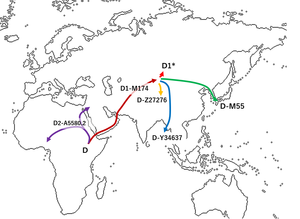
The negrito Andaman and Nicobar Islanders migrated between 70,000 and 50,000 years ago from Africa and Arabia along the coastlines, and eventually crossing the seas.  The Onges and Jarawas of Andaman and Nicobar belong to Haplotype D, a subtype of Haplogroup C, which is also common in Tibet and Japan. The Ainu aboriginal people of Japan are in haplotype D (Y-chromosome) and haplogroup X (mitochondrial chromosome).

Michael Petraglia, from the University of Cambridge, found stone tools at Jwalapuram in Andhra Pradesh, in southern India that were remarkably similar to those found in the African Middle Stone Age about 100,000 years ago. He states, “Whoever was living in India was doing things identical to modern humans living in Africa.”

Thomas Strasser and his team found hundreds of tools of African origin on Crete dating to between 100,000 and 130,000 years. Others have been found on the Iranian plateaus. Ancient African artifacts have even been found in China. There is considerable tool and pottery evidence indicating prehistoric movements out of the Nile Valley.

The 20,000 year old human skeletons found at Lake Mungo in New South Wales are likely descendants of early peoples who migrated from Africa, if we follow the red ochre trail. The Lake Mungo population buried its rulers in red ochre, derived from hematite (Fe2O3). This appears to have been a common practices among ancient peoples who dispersed out of Africa. The earliest known use of red ochre powder (300,000 years) is at the site GnJh-03 in the Kapthurin Formation of East Africa, and at Twin Rivers in Zambia.

The Kushite movement out of the Nile Valley is a more recent exodus. The Kushites went as far east as the Philippine Islands. (See Kushites in Mindanao.)


The Proto-Saharans (ca. 10,000-3000 BC)

Between 10,000-3000 years ago the Sahara was much wetter. Seasonal rainfall turned the Sahara into a fertile savannah with sedentary populations. The oldest known cemetery in the Sahara (ca. 7500 B.C.) reveals "The burial density, tool kit, ceramics, and midden fauna suggest a largely sedentary population with a subsistence economy based on fishing and on hunting of a range of savanna vertebrates." The discovery was made by National Geographic photographer Mike Hettwer in 2000.

Proto-Saharan peoples fished and hunted. Ancient Sudan rock paintings show fishing nets. The much older Khormusan sites of ancient Nubia (65,000 and 55,000 years) also reveal evidence of fishing and hunting.

The Proto-Saharans navigated the interconnected rivers which were their highways and trade routes. Sudan, Chad, Nigeria, and Niger had rivers and lakes that connected to major water systems that are identifiable today, such as the Niger, the Benue, Lake Chad and the Nile. The 8000 year old Dufuna boat, a fishing dugout, was found buried in the Sahara.

The cave paintings at Gilf Kebir in the Sahara date to about 6000 BC. At that time a sizeable community lived on this vast sandstone plateau near the Egyptian-Libyan border, about 400 miles from the Nile.

The Proto-Saharans raised cattle in the Lake Chad region which was a much larger lake. They venerated cattle and left behind engravings of bulls and cows with solar disc between their horns. This image was associated with Hathor, the Virgin Queen whose son was Horus. They built the oldest known fortress city dedicated to Horus and Hathor at Nekhen (4000 BC). At archaeologists have discovered a temple, elaborate burial sites, and evidence of animal sacrifice. The rulers of Nekhen had access to sub-Saharan mineral resources of the eastern desert. The high quality of the gold work at Nekhen is evidenced by the discovery of this gold plumed falcon representing Horus.


Proto-Saharan peoples moved into the Nile Valley as the Sahara began to dry. Some would later be called "Kushites." Some crossed the Indian Ocean from East Africa and settled in southern India. These are the Dravidians. There is a close linguistic and religious connection between the Kushites and the Dravidians. The Africanist Geoffrey Parrinder has noted that at least twenty-five tribes in East Africa worship Murungu as the Supreme God, and like the Dravidian god Murugan, the African Murungu self-reveals on sacred mountains.


The Kushite Expansion (ca. 3500-1500 BC)

Genetic research indicates that the term "Kushite" embraces a wide range of peoples. Some of Abraham's ancestors came out of the Nile Valley and are referred to as Kushites in Genesis 10:6-12. Kushite in the Bible refers to the descendants of Noah by his grandson Kush. However, the term includes many people of different skin tones and languages. The Amratian "Kushites" lived about 4000-3500 BC, before the time of Noah.

The Kushites included red and black Nubians, reddish Ainu, red, white and black Canaanites, red, black and yellow Nilotes, red-brown, light brown, black and yellow Egyptians, red-brown and black Sudra, and red, white and brown Mesopotamians. The variety of skin tones is evident on ancient monument paintings in Egypt, Sudan and in the Middle East and Turkey.

Red and black Nubian captives
(Detail from Ippolito Rosellini's drawing from the 1828 Franco-Tuscan expedition to Egypt)

Genesis 10 speaks of the migration of the Kushites into Mesopotamia. The Kushite migration has been confirmed by DNA studies. The Kushites were great pyramid builders and the ziggurats were a type of stepped pyramid similar to that of Djoser at Saqqara constructed between 2667–2648 BC. No pyramids had yet been built in Sumer/Kish. The ziggurats date to the Akkadian period, about 2334–2218 BC. The earliest monarch of Sumer whose historical existence has been independently attested through archaeological inscription ruled Kish about 2700–2600 BC.

Amenhotep III ruled between about 1382 and 1350 B.C. His name means "peace of Amen" and indicates a date when Amen, a name for God was favored over the name Set, which was favored in the Delta. It was during the 18th dynasty that the title 'King's Son of Kush' was first used. The earlier known Kushite ruler was called Kashta which means "The Throne of Kush." This is about 1000 years after the construction of ziggurats, so the Kushite expansion out of Africa is one of the most recent movements out of Africa.

The Kushite expansion out of the Nile Valley is one of the later migrations out of Africa, between about 3500 and 1500 B.C. The Kushites represent a highly organized people, consisting of numerous clans and castes. Their rulers controlled the major water systems and founded early mining industries along the Nile and in southern Israel. Nimrod was a Kushite kingdom builder. He and his brother Ramah were the sons of Kush (Gen. 10:6-12).

The Biblical term "Kushite" refers to peoples, castes and specific culture traits that emerged from the archaic Proto-Saharans. This would include Canaanites, Hittites, Sumerians, Elamites, and the Horite Hebrew/Habiru. Among these peoples there was a wide range of skin color and a great diversity of languages. To this day, the greatest linguistic and genetic diversity exists in Africa, from which the ancestors of these peoples spread along the coastlines and by sea around 70,000 years ago.

Linguistic Diversity

There are hundreds of language families in the world. Each subdivides into hundreds of languages, dialects and sub-dialects. The most diverse of the language groups is the oldest group, the Afro-Asiatic language family. This includes Chadic, Kushitic, Ugaritic, Elamite, Semitic, Hausa, Amharic, Ethiopic, Magyar, Ancient Egyptian, Ancient Babylonian, etc. There is also a linguistic connection to Dravidian and Yoruba.

All the peoples and rulers mentioned in Genesis 10 can be placed linguistically within this language family. The Bible is their story. It tells how God fulfilled the promise of the Son that was made to their ancestors in Eden (Gen. 3:15). These peoples exhibit a range of physical features so that it is impossible to speak of a "race" - a term that does not appear in the Bible. It is ignorant and groundless to assert that skin color is the result of God's judgment.

I agree with Dr. Joshua Zorn, a former young-earth creationist, who said: "The worst aspect of YECS teaching is that it creates a nearly insurmountable barrier between the educated world and the church."


Friday, February 6, 2015

Kushites in Mindanao


Mindanao Sultan Jamal ul-Kiram (seated at center), with his chiefs. 

They are holding knob sticks as the sign of their rank.
Also shown US Army officers and some visiting Muslims
Photo taken c. 1899-1901

Dear Madame Linsley,

I have additional thoughts I wish to share with you. Historically, what is now called Philippines in the period 600 AD - 1300 AD is part of geopolitical area called Tanah Melayu or Malay Lands under or allied with the Malay Shri Vijaya empire based at Palembang, Sumaterah, now part of Indonesia. What is now called Philippines is a groupings of Kingdoms or Rajahnates.

Central of this grouping of kingdoms is the Uranen Kingdoms. The people in these Kingdoms are called Iranun. Iranun Kingdom was centered in what is now present Lanao provinces in Mindanao. It was said that before the Spanish conquest of Visyas and Luzon on the Philippines, Mindanao was never conquered by the Spanish empire in its 377 years of colonial occupation, kingdoms in what is now Philippines is peopled by Iranuns and only broken down into various tribes during colonial occupations to divide and rule. Historically Iranun are skilled sailors and fierce warriors that Spain and America was not able to subdue Mindanao during its colonial occupation. In 1515 a Shariff from Johor, now part of Malaysia, arrived in Mindanao and began Islamization, and married to Iranun and thus the present Muslim family in Mindanao come about.

I am wondering about the word Uranen, Ir-anun, Bul-Anun. I am thinking that word Uranen is composed of two words combined together the word UR and ANNEN wich may have come from the word ANNUN. And if it is both a noun UR being place and ANNEN or ANNUN being people it would translate into PEOPLE OF UR. I was reading ancient history about the kingdom of UR a port city in what is now Iraque (aque is an Iranun word which mean friend) and it flash to my mind that an Iranun in the Philippines are people from UR Kingdom, what you think Madame Linsley. and in fact these people, or some of them belong to royalty; claimed they are descendants of Abraham or related to Abraham and even to Adam.


Dear Mr. Bulang,

The Vijaya empire was ethnically Kushite. "Kushite" is a general label for many peoples whose ancestors lived in prehistoric times in the Upper Nile-Lake Chad area.The Kushites spread from the Nile Valley into Ur of Mesopotamia and into the Tarum Valley of Southern China. These people were great warriors, sea travelers, astronomers, pyramid builder, and mining experts. They mummified their dead rulers.

The Kushan-Yuezhi of Central Asia called themselves Visha or the Vijaya. They are Kushites also. They spread through Central Asia, from around 180 BC to 30 AD. Some Vijaya went to Madagascar, Borneo, and Sulawesi in Indonesia. Your family is probably part of this group of Kushite Vijaya. They were famous as rice merchants, sea travelers, and scribes. It appears that there were two ruling houses that intermarried, but at some point the two groups separated.

Annen or Annun does mean people, but it also is a reference to a Nilotic people of very ancient genetic lineage. They are called Ainu or Annu. They spread across the earth from the Nile-Lake chad area. They are a "first empire" people. Some live today in Western China. Some Ainu live on the islands of Hokkaido and Okinawa, and some live in the Hudson Bay area of Eastern Canada. Abraham ancestors were Ainu. The Ainu spread out of Africa before the Kushites moved into Central Asia. Bul-Anun means kingdom or territory of the Ainu, the same as Bul-Gharia (Bulgaria) means kingdom or territory of the Ghar/Gur/Gurjar.

I hope that this is helpful. Here are some articles with more information:

The Kushite-Kushan Connection

More East Africa-Asia Connections

Solving the Ainu Mystery


Best wishes to you in the pursuit of your ancestry!

Alice C. Linsley

Friday, January 2, 2015

Adam Was a Red Man


Alice C. Linsley

The Biblical writers recognized that the people among them with red skin were of an ancestral line of extreme antiquity. Some of these people were rulers in Edom. These are listed in Genesis 36. Esau the Elder and Esau the Younger were among them. Esau is specifically described as being red in Genesis 26.

The name Adam is derived from the root אדם (A.D.M), which is a verb meaning "to be red or ruddy" (Strong’s #119).

The Hebrew word for red is edom and it is a cognate to the Hausa word odum, meaning red-brown. Both are related to the word dam, meaning blood, and to the name of the first man Adam, who was formed from the red clay which washed down to the Upper Nile Valley from the Ethiopian highlands. These soils have a cambic B horizon. Chromic cambisols have a strong red brown color. It is evident then that the Upper Nile is the urheimat of the Adam and Eve story.

Jeff A. Benner, an expert on ancient Hebrew, explains:

We are all familiar with the name "Adam" as found in the book of Genesis, but what does it really mean? Let us begin by looking at its roots. This word/name is a child root derived from the parent דם meaning, "blood". By placing the letter א in front of the parent root, the child rootאדם is formed and is related in meaning to דם (blood).

By examing a few other words derived from the child root אדם we can see a common meaning in them all. The Hebrew word אדמה (adamah) is the feminine form of אדם meaning "ground" (see Genesis 2:7). The word/name אדום (Edom) means "red". Each of these words have the common meaning of "red". Dam is the "red" blood, adamah is the "red" ground, edom is the color "red" and adam is the "red" man. There is one other connection between "adam" and "adamah" as seen in Genesis 2:7 which states that "the adam" was formed out of the "adamah".

In the ancient Hebrew world, a person’s name was not simply an identifier but descriptive of one's character. As Adam was formed out of the ground, his name identifies his origins. (From here.)

Though the story of red Adam comes originally from the Upper Nile, the account was preserved by his Edomite descendants, one of whom was Abraham. Abraham's territory was between Hebron and Beersheba. As can be seen from the map below, his territory was entirely in the region of Edom. The people who lived there had a reddish skin tone. That is why the Greeks called this region Idumea, meaning "land of red people."


Isaac was Abraham's proper heir, and as such, he inherited Abraham's territory. Edom was under the control of Horites, what the Jews call their "Horim." Both Hebron (where Sarah lived) and Beersheba (where Keturah lived) are in Edom. Abraham's territory extended between the settlements of his two wives, and included mountains, lowlands wells, and the water system at Engedi.

David is related to the Horite rulers of Edom and he is described in the Bible as red/ruddy. Samuel, the son of a Horite priest from Ramah, anointed him ruler.

And Samuel said to Jesse, "Are these all the children?" And he said, "There remains yet the youngest, and behold, he is tending the sheep." Then Samuel said to Jesse, "Send and bring him; for we will not sit down until he comes here." So he sent and brought him in. Now he was ruddy, with beautiful eyes and a handsome appearance. And the LORD said, "Arise, anoint him; for this is he." Then Samuel took the horn of oil and anointed him in the midst of his brothers; and the Spirit of the LORD came mightily upon David from that day forward. And Samuel arose and went to Ramah. (1 Samuel 16:11- 13)


Here are images of people whose skin tone ranges from brown-red to red-brown

Beja of Sudan

Egyptian man in red

Grieving Egyptian
Note the reddish-brown skin tone

A red people is mentioned in African creation stories. It is said that God created the first human by mixing soil with his blood. This is circulated among the Igbo, for example, whose ancestors originated in the Upper Nile Valley. The Igbo belong to MtDNA haplogroup L1, believed to have first appeared approximately 150,000 to 170,000 years ago in East Africa.


The red descendants of the Proto-Saharans appear mainly to be in Haplogroup R1b, the point of origin of which was the wetlands extending from the Nile to Lake Chad. Lake Chad was Noah's homeland. It is shown above in the dark red area in Central Africa.

Some of Abraham's Horite Habiru ancestors can be traced back to the shrine city of Nekhen. One of the more intriguing discoveries at Nekhen was the recovery of an almost complete beard in association with the redheaded man in Burial no. 79. The facial hair of the man in Burial no. 79 had been trimmed with a sharp blade. The presence of long wavy natural red hair and a full beard suggests that this individual may have been Ainu (Annu). The Ainu were among Abraham's ancestors, and although they were widely dispersed before Abraham's time, the Nile Valley appears to be their point of origin. The Annu built the original shrine of Heliopolis which is called "Onn" in Genesis 41. Joseph married the daughter of the high priest on Onn.

The map shows that the red peoples extended into southwestern China. The Tarum mummies of China had red hair and beards. The oldest Tarum Mummies found in China date from 1900 B.C. The so-called "Ur-David" mummy (shown below) was tall and had red hair. This mummy, also called Cherchen Man or Chärchän Man, dates to about 1000 B.C.

Note the solar mark on the face of this archaic ruler.

Related reading: Genesis in Anthropological PerspectiveArchaic Rulers, Ascendancy, and the Foreshadowing of Christ; The Kushite-Kushan Connection;  Solving the Ainu Mystery; The Nilotic Origins of the Ainu; Abraham's Ainu Ancestors; Samuel's Horite Family; What Color Was Abraham?; Millions of Years Between Genesis 4:1 and 4:17; Theories of Primal Substance; Ethical Concerns of Archaic Communities

Monday, December 29, 2014

Solving the Ainu Mystery


Ainu couple with pet bear and Japanese visitor circa 1930

The man wears the distinctive head gear of Ainu elders,  
the same worn by Micmac Ainu elders of Canada and 
by the Annu chiefs of the ancient Upper Nile.

Alice C. Linsley

For some time I have been exploring the possible connections between the ancient Annu of the Upper Nile, the Ainu of Hokkaido and Okinawa, and the Ainu of Canada's eastern seaboard. Recent DNA studies have revealed that the Ainu of Hokkaido and the Ryukyuans of Okinawa have a closer genetic affinity than either group has to the Japanese. The Ainu of Japan possess almost exclusively Haplogroup D-M174 chromosomes.

One theory is that the Ainu migrated to Japan from the Nile Valley by a northern route.


It is likely that they migrated by a southern route also and that there were different periods of migration. There is no doubt that the Ainu dispersed widely during the late Paleolithic and Neolithic Periods. "Ainu moshir" refers to the Ainu homeland, which includes many regions in which Ainu live. Tessa Morris-Suzuki has written that the geographical boundaries of the dispersed Ainu populations have never been precisely identified, and even the Ainu themselves are not able to identify all of them.

The ancient Nilotic Annu/Ainu were associated with the shrine at Heliopolis (Biblical On), one of the most prestigious of the ancient world. Anu is also the name of their God in Akkadian, suggesting that the Nilotic Annu were a preist caste that also migrated into Mesopotamia.

San of Botswana
Note the skin tone
Still missing is a definitive DNA study of the Micmaq Ainu of Canada. The information I provide here comes from a Canadian Ainu informant whose grandfather was pure Ainu. There are also Ainu living in western China, but I have little information about them.

The connections suggest a dispersion of Proto-Ainu much earlier than I would have guessed. The Ainu today appear to be the descendants of the prehistoric Wa. This indicates a connection back to Africa and to the Y-chromosomal Adam and Haplogroup A. The San are in Y-DNA Haplogroup A. This group is the foundation of all known patri-lineages carried by modern humans. However, Haplogoup A is found only among men in Africa, or among men outside of Africa of recent African extraction. The Ainu are in Y-DNA Haplogroup D, found in Northern Japan and Okinawa.

The Khoisan-Japanese connection calls for further research. The Arabic name for the San is Wakwak. The Sandawe (Tanzania) call the Bushmen Wanege. Wa was the earlier name for Japan and the word appears in the name Okina-wa.

While the Khoisan do not have a word for priest, they do recognize the role of the holy man who makes pure after blood is shed. W'b in ancient Egyptian refers to the priest caste, the pure ones, and the healer priest was called wab sxmt (wab sekhmet). There is an interesting connection to the Sumerian word wasabu which means to sit. The Egyptian word wabau is likely related. It refers to a healer-priest, one is sits by the sick person.

A comparison of the Kata Japanese and Hebrew scripts reveals a connection that is likely explained by the fact that the earliest scripts were those used by priests attached to rulers over many regions worldwide.


A scribe called Wani Kishi is said to have brought Kata to Japan. It is used by the Ainu of Northern Japan. Japan's earliest known population was Ainu. The Kojiki indicates that Wani Kishi arrived sometime after 372, but before 375 AD. Kata was a priestly syllabic system, similar to Hebrew. Wa-kishi is an African term that refers to the ancestors.

There are many connections between Japanese and African words. For example, the name Isahi appears to be a variant of Esau or Issa. Kishi appears to be a variant of Kish and Kush. Obito, the title for a regional chief in Japan, is related to the Edo (Africa)/Edomite (Southern Arabia) word for chief, which is Oba. The first ruler of Petra was the Horite ruler Obodas. These ancient rulers were said to have a reddish skin tone (as was the case with Esau and David). The ancient Greeks called Edom "Idumea" which means "land of red people." The original name of Tokyo was Edo.

There is artifact evidence of connections also. Consider the similarity between these two garments.

Banana thread (ito basho) robe of Ryukyu

Kente cloth of Ashante ruler-priests

The Ainu attus is made from the fiber of an elm tree native to Hokkaido. This traditional robe bears close resemblance to the traditional African dashiki.

Ainu attus
African dashiki

Luigi Cavalli-Sforza's genetic distance chart places the Ainu rather distant from the Bushman, but the anthropological and linguistic suggest a connection. Given this scheme, the dispersion of the ancestors of the Ainu out of Africa has to have taken place before the separation of Africans and Asians. Still, more research is needed.


Luigi Cavalli-Sforza's Genetic Distance Chart
places the Ainu at the center between Asian and African


The anthropological and linguistic evidence along with the evidence of migration studies strongly suggests that the urheimat of the ancestors of the Japanese Ainu and the Micmac Ainu of Eastern Canada may have been the Nile Valley. The genetic evidence is still outstanding. Molecular Geneticist, David Wilcox has written:

Let me clear up how the genealogies like Cavalli-Sforza's should be viewed. The position of the branches doesn't mean much - what counts is what they are connected to. Each branch point represents a point where two lineages diverged. The Japanese Aniu in the diagram are genetically closest to the group containing Japanese, Koreans, Mongols, Samoyed and Tibetian in their overall genomes. The present day Nilotic peoples are part of the African complex at the top. The distribution of the Haplogroup X (which did indeed arise from N in the Middle East - maybe 30 to 40,000 years ago), on the other hand, is interesting and might indeed indicate a migration from Europe rather than Asia - but it could also indicate an early migration from the west which was pushed eastward by the further migrations from Asia.  I'm not sure what to think about it, but I would suggest that a few of the Micmac people submit their DNA to the National Geographic project for tracing migrations and see what sort of result they get - preferably someone from the easternmost area which has the highest level of X, and thus probably the lowest level of Asian admixture.

Best wishes,

David Wilcox

The genetic evidence connecting the Ainu of Hokkaido and Okinawa with the Edo of Nigeria is rather more substantial. The latest writings indicate a consensus that YAP’s origin is in West Africa (Nigeria), with a founding derivative clade in the ancestors of the Shiya Muslims who made their way to South Asia (India), Central Asia and eventually to Japan.


Related reading: Japanese Author Traces Nippon Origin to Hebrew RaceWho Are the Ainu?The Nile-Japan Ainu ConnectionA Kindling of Ancient MemoryMore East Africa-Asia ConnectionsEdo, Edom, IdumeaThe ongoing mystery of the Ainu portraits in France

Friday, December 26, 2014

NPR's climate spin a distracton


Photo: Stephan C. Schuster/Penn State University


Some 22,000 years ago, they were the largest group of humans on earth: the Khoisan, a tribe of hunter-gatherers in southern Africa.

Today, only about 100,000 Khoisan, who are also known as Bushmen, remain. Stephan C. Schuster, professor at Nanyang Technological University in Singapore, has published new research about the tribe, many of whom now live in poverty, their cultural traditions endangered. We spoke to Schuster about his study and the lives of the Khoisan.

Read the NPR article here.


This NPR report barely scrapes the surface when it comes to putting the pieces of the ethnographic puzzle together. Study of the Khoisan and other "endangered peoples" is essential to seeing how the pieces fit together, but one wonders why someone felt it necessary to put the climate change spin on the report?

Keep in mind that genetic and linguistic diversity decrease the farther from Africa. Climate is a factor in why populations move, but it is not a factor in the loss of genetic and linguistic diversity. Climate changes are considered in migration studies.

The term "Khoi-san" represents the relationship between the Khoe-Khoe (Hottentot) and the San (Bushman). They are genetically kin, though not as close as researchers had expected. "San" is not what the Khoisan of Namibia call themselves. It is a term used among the Nama to indicate people who have no cattle; people of a lower social standing. "Koisan" in Japanese means "youngest daughter of an honored family" and this may provide a clue as to the original clan hierarchy of the Khoisan. Those without cattle were still family, but of a lower social status.

Notice the reddish skin tone of these Khoisan, an indicator of their genetic antiquity. The black tones came later with the arrival of the Bantu. There may be a connection between the San and the red Nubian Ainu, but more research needs to be done. There is evidence to suggest a connection between the Ainu of Northern Japan and the Micmac Ainu of Eastern Canada. Again more research needs to be done to solve the mystery of the widely dispersed Ainu.

The Ainu are at the center of Luigi Cavalli-Sforza's genetic distance chart, which is what would be expected of a people whose ancestors dispersed widely following major water systems. Today Ainu populations are found along the Nile, in Western China, in Northern Japan, and along the eastern seaboard of Canada.


Luigi Cavalli-Sforza's Genetic Distance Chart
places the Ainu at the center 


The Khoisan-Japanese connection seems more probable when we consider the Arabic name for the San: Wakwak. The Sandawe (Tanzania) call the Bushmen Wanege. Wa was the earlier name for Japan and the word appears in the name Okinawa. Likely this is related to the Ainu word for water: Ainu: ワㇰカ [wakːa]. The African variant of Okinawa would be Jokinawah (akin to the Biblical names Joachin/Joktan?). W'b in Ancient Egyptian refers to the priest caste, the pure ones. Recent DNA studies have revealed that the Ainu of Hokkaido and the Ryukyuans of Okinawa have a closer genetic affinity than either group has to the Japanese.


There are many connections between Japanese and African words. For example, the name Isahi appears to be a variant of Esau or Issa. Kishi appears to be a variant of Kish and Kush. Obito, the title for a regional chief in Japan, is related to the Edo (Africa)/Edomite (Southern Arabia) word for chief, which is Oba. The region of modern Tokyo was called Edo. The people of Benin in Africa call themselves Edo and their ruler is called Oba. The first ruler of Petra was the Horite ruler Obodas. These ancient rulers were said to have a reddish skin tone (as was the case with Esau and David). The ancient Greeks called Edom "Idumea" which means "land of red people."

A comparison on the Kata and Hebrew scripts reveals a connection that is likely explained by the fact that the earliest scripts were those used by priests attached to rulers over many regions worldwide.


A Korean scribe called Wani Kishi is said to have brought Kata to Japan. It is used by the Ainu of Northern Japan. Japan's earliest known population was Ainu. The Kojiki indicates that Wani Kishi arrived sometime after 372, but before 375 AD. Kata was a priestly syllabic system, similar to Hebrew. Wa-kishi is an African term found among the Ba-Kaonde of Northern Rhodesia. It refers to the ancestors.

Note that Cavalli-Sforza's chart does not include Jews. Dr. Harry Ostrer, director of the human genetics program at the New York University School of Medicine, led one of the studies that compared the genetic makeup of Jewish populations from around the world with African populations. Ostrer found that modern Jewish populations have African ancestry. David Reich, associate professor of genetics at Harvard Medical School, explored further and found that Jews can attribute about 5 percent of their ancestry to sub-Saharan Africans. Where would they fit on Cavalli-Sforza's genetic distance chart? Were I to venture a guess, I would say the urheimat of the ancestors of the Jews - their "Horim" - is the Upper Nile, and that these ancestors were red Nubian Ainu. This is why a reddish skin tone in mentioned in association with Biblical figures like Esau and David.

Linguistic research has demonstrated that about 30 percent of the Proto-Semitic roots are cognates to Sub-Saharan roots, including Proto-Bantu roots. Many of these roots express ideas found among the ancient Kushites and the Horim (Horites). In his study of the relationship of ancient Egyptian and Bantu languages, Ferg Somo wrote:

Proto-Bantu played an active part at the time of the expansion of Proto-Afro-Asiatic speakers in the Rift Valley of East Africa. These Proto-Bantu speakers going through the savannah formed part of the migration to Egypt. The Bantu languages together with other indigenous languages fused together and became embedded to form the Proto-Egyptian language. It is for this reason that the Ancient Egyptian language contains a substantial amount of Proto-Bantu or Bantu roots.

The Bantu expansion into the region of the Upper Nile and the Great Rift Valley had already taken place by 1500 BC. This is evident from the images of Nubian captives from the time of Ramesses II (1303-1213 B.C.) These images show red and black Nubian captives. The black Nubians have Bantu features. As the two groups were fighting together, it appears that they had already formed a moeity.


Detail from a Ippolito Rosellini painting 
done during the Franco-Italian Expedition to Egypt in 1828


There is archaeological evidence of the Khoisan peoples in Africa for at least 60,000 years, though the genetic evidence indicates a much longer existence. They are characterized by considerable diversity in customs and regional dialects. Some Khoisan inhabit regions closer to the Horn of Africa. The Hadza and Sandawe languages in Tanzania are classified as Khoisan also. The Hadzabe once roamed freely with their cattle over the Great Rift Valley. Genetic research has shown that the Hadzabe split from other Click-speaking populations perhaps as early as 100,000 years ago, but definitely by 50,000 years ago. (Science, 27 Feb. 2004, p. 1320)

Before the 20th century, many Sandawe lived in tepee-like huts called "sandu." Today these are built only as temporary shelters at circumcision sites.

It is likely that the ancestors of the Khoisan and Ainu dispersed between 50,000 and 40,000 years ago. Clearly some would have been able to migrate following the coastline of Africa and the once inter-connected lake basins shown in the map (right). These water systems expanded and contracted with changing weather conditions throughout the Late Pleistocene (125,000-5,000 years ago). There is conclusive scientific evidence that humans dispersed out of Africa, following the routes of major water systems, at different times and from different points during the Late Pleistocene.


Genesis data pertaining to the Ainu

Among the Nilotic Sandawe are the Bisa, a small population of people who conform to the older ways. The Bisa call their light skin cattle ánaku, which means "to bleach in the sun." (Eric Ten Raa’s The Couth and the Uncouth: Ethnic, Social, and Linguistic Divisions among the Sandawe of Central Tanzania, p. 148) The singular form of the word is ának. This is the probable origin of the Biblical term Anakim for Abraham’s Ainu ancestors who had a lighter skin. They are called the "mighty men of old" in Genesis. The NPR attribution: "kings of the planet" rightly applies to them.

Biblical On (Heliopolis) on the Nile was originally an Ainu shrine city. The Ainu were seafarers and had a priestly script which they introduced to the lands where they traveled and settled. Ainu scribe-priests had a syllabic writing system, like Hebrew and Kata.


The importance of the Anu shrine city of Heliopolis is indicated by alignment of the pyramids of Giza, Abusir and Saqqara to the the obelisk of Heliopolis. See the map above. The enigmatic Joseph married the daughter of the priest of On. Likely, she was a distant cousin.