Followers

Showing posts with label Akkadian. Show all posts

Friday, December 1, 2023

Nimrod's Mesopotamian Wife


Dr. Alice C. Linsley

One of Noah’s grandsons was named Cush (Gen. 10:6) whose territory was in the Nile Valley. Cush’s son Nimrod was sent away to establish himself at a distance from Cush’s proper heir. The sending away of non-ascendant sons is a typical feature of the Hebrew marriage and ascendancy pattern.

Genesis 10 states that Nimrod went to Sumer in Southern Mesopotamia where he began expansive building projects. This is explained in Genesis 10:10 – “The beginning of his kingdom was Babel, Erech, Accad, and Calneh, in the land of Shinar.” 

Nimrod married a daughter of Asshur the Elder, a Hebrew ruler in Mesopotamia. This may explain Nimrod's expanding authority. He then began monumental building projects in Northern Mesopotamia called Assyria. Genesis 10:11-12. explains, “From that land he went into Assyria and built Nineveh, Rehoboth-Ir, Calah, and Resen between Nineveh and Calah; that is the great city.”  Assyria is named for Asshur the Elder, a son of Shem.


Nimrod was a grandson of Ham, and his Mesopotamian kinsmen Asshur the Elder was a son of Shem (Gen. 10:22; 1 Chron. 1:17). Shem and Ham were brothers (Gen. 10). This means that Nimrod married a cousin. The Hebrew ruler-priest caste selected marriage partners only from their Hebrew kinsmen (caste endogamy).

Nimrod's wife was Hebrew, and her cultural context was Mesopotamian. She named their firstborn son Asshur, after her father. This "cousin bride's naming prerogative" is another feature of the Hebrew marriage and ascendancy pattern.

Typically, the Hebrew ruler's cousin bride named her firstborn son after her father. This is why it is necessary to distinguish between Asshur the Elder and Asshur the Younger. The pattern is evident in the case of Methuselah's cousin bride Naamah (Gen. 4). 


The wedding of Asshur’s daughter to Nimrod would have been a grand affair that solidified political relations between the royal families of Nimrod and Asshur. The ceremony probably took place at the palace in Uruk, on a channel of the Euphrates River between 4000-3200 B.C. The site of Uruk (Unug in Sumerian, Erech in Hebrew Torah) is known today as Warka. Settlement at the site began in the Ubaid period (c.5500-4000 B.C.). Uruk was the largest settlement in Mesopotamia at the time that Nimrod lived.

The name of Nimrod’s wife is not found in the Bible. According to the historian Eusebius, Nimrod's wife was called Semiramis or Sammur-amat. However, this queen lived long after the time of Nimrod. She was the wife of the Neo-Assyrian ruler Shamshi-Adad V (r. 824-811 B.C). She was the queen regent between 811 and 806 B.C., holding the throne for her young son Adad Nirari III until he reached maturity.

The practice of marrying high-status women to form political alliances and to become established in a new territory is illustrated by Nimrod’s marriage to a Sumerian princess. Nimrod was a Kushite kingdom builder (Gen. 10) and his marriage to Asshur’s daughter is evidence of the close connection between the rulers of the Nile Valley and the rulers of Mesopotamia, two early riverine civilizations.

By the time Nimrod married a daughter of Asshur, long-distance trade had become a source of wealth for the Mesopotamian lords and ladies. Ships coming from Bahrain (Sumerian "Dilmun") brought wool, gold, copper, lapis lazuli, and carnelian to the Sumerian cities of Ur, Nippur, and Uruk. As early as 7000 B.C., the island of Bahrain served as a major trade depot with its own commercial seal. Ancient documents speak of Dilmun's trade in gold, silver, ivory, sesame oil, wool, carnelian beads, lapis lazuli, and copper. One document details a cargo of eighteen tons of refined copper purchased in Dilmun. Dilmun was a maritime connection between Mesopotamia and the Indus Valley.

Sumerian ships brought cargo to Dilmun and to port cities in the Indus valley. Ships sailed southeast on the Tigris or Euphrates to the Persian Gulf, making stops at the port city of Dilmun, passing the Oman Peninsula, and entering the Arabian Sea. From there the ships sailed northeast on the Indus River to Mohenjo-Daro and Harappa. Trade in lapis lazuli and carnelian beads ran between Egypt, Mesopotamia, India, and Afghanistan as early as 4000 B.C. Indus seals with Harappan inscriptions have been found in Mesopotamia. Indus pottery and seals have been found along the maritime routes between the Indian subcontinent and Mesopotamia.

The city of Erech is mentioned in connection with Nimrod in Genesis 10:10. As early as 5000 B.C., Eridu was an important trade center in southern Mesopotamia. The Sumerian King List cites Eridu as the “city of the first kings”, stating, “After the kingship descended from heaven, the kingship was in Eridu”.

Archaeologists discovered a 4,000-year-old boat at Uruk. The boat was constructed out of organic materials, probably marsh reeds, and covered in bitumen, a tar-like substance used for waterproofing. This technique was used in the construction of Noah’s ark (Gen. 6:14).

This was a period of monumental construction by the Mesopotamian rulers. The ziggurat at Uruk was a pyramidal structure that dates to around 4000 B.C. It was dedicated to the High God who was called Anu. Anu’s symbol was the sun. The White Temple of Anu was built on top of it between 3500-3000 B.C. Anu’s counterpart was Ra, the High God of the Nilotic Annu people.

Asshur and his royal household enjoyed opulent riches and were served by craftsmen of great skill. These artisans crafted ritual objects to be used by the royal priests. These include the Warka Vase, the marble Mask of Warka, the earliest known naturalistic sculpture of the human face. The mask is also known as the "Lady of Uruk" and was found in the temple precinct of Inanna in Uruk.


Inanna receiving offerings from a priest.


The Sacred Vase of Warka (shown above) is the oldest known carved-stone ritual vessel (c.3200 B.C.). It was one of a pair of alabaster vases. It was discovered in 1934 by German excavators in the temple of Inanna in Uruk. The image on the Vase of Warka shows Inanna receiving offerings from a priest with a shaved body, a practice typical of the priests of the Nile Valley.

Nimrod's wife likely was a devotee of Inanna, the Sumerian version of Hathor. Inanna, like Hathor, was often shown wearing a headdress of bull horns. Both goddesses appear to have been venerated as early as 4000 B.C. Hathor's worship began long before Egypt became a political entity.

Nimrod's wife would have had authority over at least one water shrine dedicated to Inanna. High status women had administrative responsibilities at the water shrines. The water shrines were under the control of regional lords, but visitors were welcome to drink the water, and to take a ritual bath (similar to the Jewish mikveh). Women came to these places seeking to conceive and deliver healthy children. They prayed and made offerings to Inanna/Hathor.

The Sumerians and the early cattle herding Nilotes have so much in common that it is difficult to distinguish between them. It is likely that the rulers of ancient Sumer had more in common culturally and linguistically with the peoples of East Africa and Arabia than with the peoples of southern Europe. The Sumerian and Akkadian languages share many common roots and Akkadian is the oldest known Semitic language.

Nimrod's homeland was in East Africa. He is designated a son of Kush in Genesis 10:8. As a sent-away son, he established a territory of his own in Mesopotamia by marrying a Sumerian princess. This couple enjoyed a life of opulence and prestige. They were among the first lords and ladies, and people of great influence and power in the ancient world.


Sunday, December 12, 2021

The Horite Hebrew of Eden


Biblical Eden had forests, grasslands, marshes, rivers and lakes to sustain early humans, large herds, fish, and birds. The region was well watered by extensive inter-connected water systems including the Nile, Lake Victoria, the Tigris and the Euphrates.


Alice C. Linsley

Recently, I was asked how the history of the biblical Horites connects to Eden. The Horites were a group of priests who believed in God Father and God Son. The Nilotic Horites referred to the son of God as Horus. Thus, their name Horite, which can be written also as Horim. Jews refer to their parents and ancestors as their "horim." The Ancient Pyramid Texts make it clear that the Horite and the Sethite Hebrew worshiped the same God and served the same king.

There are texts in the Bible that come from the Horite and Sethite Hebrew. Genesis 3:15 and Psalm 91 refer to the trampling of the serpent. Psalm 91:12-13 - "They will bear you up in their hands, that you do not strike your foot against a stone. You will tread upon the lion and cobra, the young lion and the serpent you will trample down."

In Srimad Bhagavatam 10:16 we find a parallel to Genesis 3:15 where we are told that the serpent's head will be crushed under the feet of the Woman's Son. The Hindu text reads: "The Ancient Man danced on the serpent, who still spewed poison from his eyes and hissed loudly in his anger, and he trampled down with his feet whatever head the serpent raised, subduing him calmly..." (Cited in Andrew Wilson, Ed. World Scriptures, p. 449.)

The same is expressed in the earlier Horite Hebrew texts from 4200 years ago. Utterance 388 of the Pyramid Texts speak of how the Son of God, Horus "has shattered (crushed) the mouth of the serpent with the sole of his foot."

The root of the word Horus is HR. It means "Most High One" in ancient Egyptian. The faith of the Horite Hebrew is older than that of the Jews. Genesis 36:31 says that the Horite kings who ruled Edom and Seir reigned before there was any king in Israel.

How does this relate to Eden? 

The oldest known site of Horite Hebrew worship is Nekhen, located in Eden. Nekhen was a flourishing shrine city 5800 years ago. Genesis describes Eden as a vast well-watered region that extended from the Gihon and Pishon rivers at the source of the Nile in Uganda and Ethiopia to the Tigris and Euphrates in Mesopotamia. 

The phrase "east of Eden" in the Hebrew is quimat-Eden, an ancient Nilotic reference to a place of bulrushes. Quimat is derived from the root qma, an ancient Egyptian word that refers to bulrushes. 

The term "Eden" derives from the Akkadian term edinu, which refers to a fertile plain. Akkadian is the oldest known Semitic language.

It is evident that belief in God Father and God Son has deep roots among Abraham's Nilotic ancestors. He was a descendant of Nimrod, a son of Kush (Gen. 10). Kush/Cush refers to a region and population of the Nile Valley. 

The Nilotic Hebrew looked for a Righteous Ruler who would overcome death and lead His people to immortality. They produced the oldest known resurrection texts.


Tuesday, February 20, 2018

What the Bible Says About Eden


Alice C. Linsley

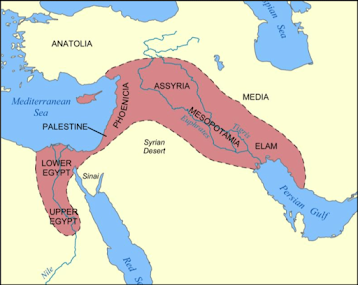
The Eden described in the Bible was a vast well-watered region that extended from the source of the Nile to the Tigris-Euphrates (Genesis 2). The biblical description comes from writers who lived long after the time that this region (shown in red) was wet.


Rock paintings of boats, people fishing and herding cattle have been found around the Sahara. These tell the story of life during the African Humid Period (the Aqualithic) when the wet Sahara sustained large herds.

Memory of Eden is preserved in Akkadian documents and ancient Egyptian texts. According to Genesis 13:10, the Garden of the Lord was well watered, like “the land of Egypt.” The Afro-Asiatic word for garden or virgin forest is egan, and the Hebrew word gan for garden, is cleared related. In Akkadian, the region is called Edinu and the word is derived from the Akkadian word edû - flow, spring (a Sumerian loan word). E. A. Speiser believed that the Sumerian word eden refers to a plain or a steppe (The Anchor Bible, Genesis, p. 16). However, the biblical description is of a flood plain, not an arid plain.

The Paradise of Eden is described as a well-watered garden. This was not a small garden that could be managed by a single gardener. It was God's garden. Today the region shown on the map is one of the driest on Earth.

If you are a gardener (as I am), you recognize the value of water, especially in hot weather. The text says that springs came up from the earth. This suggests that the biblical writer is making a play of words Eden = edû , meaning "flow" or "spring."

Genesis 2 gives the account of 4 major rivers: the Gihon and the Pishon in Africa, and the Tigris and Euphrates in Mesopotamia. The Ethiopians identify the Gihon with the Abay River, which circles the former African kingdom of Gojjam. Genesis 2:13 states that the Gihon "winds through all the land of Kush." The Pishon "winds through the whole land of Havilah" (Gen. 2:11). Havilah is both a place name and the name of one of Kush's sons (Gen. 10:7). This identifies the Gihon and Pishon with the Upper Nile region.

This ancient paradise supported forests (Gen. 2:9). Some believe that the earliest of Abraham’s ancestors were forest dwellers. This pushes those ancestors to a time before memory, and yet the Paradise they enjoyed is remembered. Jung might suggest that the Paradise of Genesis reflects the collective memory of Abraham’s Proto-Saharan ancestors.

Many discoveries, such as the 8000 year Dufuna boat, ancient petroglyphs of boats and cows in the  Sahara, and 9000-10,000 year burial sites provide evidence of extensive water systems and human populations. The paleoanthropologist, Paul Sereno, unearthed 9,700 year skeletons at Gobero in Niger. These were buried on the edge of a paleolake on the northwestern rim of the Chad Basin. The Gobero site is the earliest known cemetery in the Sahara and the skeletons found there indicated that some of the people were at least 6 feet tall.


Gobero skeleton (G3B8) measures 6 feet, 6 inches
Photo: Mike Hettwer, courtesy Project Exploration

At the time of the Gobero population, humans were dispersed globally, and during the time of Noah these populations were not destroyed. 

Many peoples have their point of origin in archaic Eden. This is the point of origin of the biblical Hebrew clans. The oldest identified Horite Hebrew shrine cities were Nekhen and Nekheb on the Nile. These twin cities date to 3,800 BC.


Painted tomb at Nekhen


The rulers of Tyre, an ancient seat of wisdom, are traced back to Eden. "Son of Man, raise a lament over the king of Tyre and say to him: Thus says the Lord God: You were the seal of perfection, full of wisdom and flawless beauty. You were in Eden, in the Garden of God; every precious stone was your adornment... and gold beautifully wrought for you, mined for you, prepared the day you were created." (Ezekiel 28:11-18)

Tuesday, January 30, 2018

The Proto-Saharan Rulers Cain and Seth


Alice C. Linsley


The social structure of the biblical Hebrew is explored in detail in a 7-part series. The first in the series is here.

In this post, we investigate the earliest Proto-Saharan rulers named in Genesis. These rulers had two wives, as did their descendants Terah, Abraham, Jacob, Amram, Moses, and Samuel's father, Elkanah.

© 2010 Alice C. Linsley
Segment I: The Half-Sister Bride and the ruler Enoch/Enosh/Enos

The ruler first bride was his half sister, as Sarah was to Abraham. The half-sister’s first-born son rules in place of his father. Thus Isaac was Abraham's proper heir and ruled over Abraham's territory in Edom. Likewise, Enoch ruled over the territory of his father Seth.


        Enoch  ∆  =  O  Half-sister bride
___|___
                        Kain   ∆         O  =   ∆   Seth   Gen. 5
                     |
                                                                 ∆  Enosh/Enoch the Younger


Segment II: The Cousin Bride’s Naming Prerogative and the ruler Seth/Seti

The ruler's second wife, taken later in life, was a patrilineal cousin bride. The cousin bride’s first-born son became a high official (vizier) in the kingdom of his maternal grandfather. So Seth was a ruler-priest in the territory of Seth the Elder, a Proto-Saharan Nilote. 

These ancestors are often called "Kushites," though the name Kush/Cush does not appear in the Genesis King Lists until Genesis 10:6-9, where we are told that one of Cush's sons was Nimrod, a Kushite kingdom builder in Mesopotamia.


    Seth/Seti, the Elder
 ∆
 |
                                       O  =   ∆  Enoch the Elder
                            |                                      
                          Seth the Younger  ∆   Gen. 5                                    


The pattern is evidence in this diagram. Lamech the Elder (Gen. 4) has a grandson named Lamech. Lamech the Younger is listed in Genesis 5 as the son of Methusaleh by his cousin bride, Naamah.


The Kushite movement out of Africa has been verified by genetic studies. Research verifying the Genesis record of Kushite migration from Africa into Eurasia can be found here: http://maxwellsci.com/print/crjbs/v2-294-299.pdf

Current Research Journal of Biological Sciences 2(5): 294-299, 2010
ISSN: 2041-0778© Maxwell Scientific Organization, 2010

The Kushite Spread of Haplogroup R1*-M173 from Africa to Eurasia
Clyde A. Winters, Ph.D

The marriage and ascendancy pattern of these early Proto-Saharan rulers drove their movement out of Africa. As the younger son of Kush, Nimrod was probably a "sent away son" who was expected to establish a kingdom of his own. Kingdom building brought honor to their fathers and extended their influence, including the spread of their religious beliefs and practices.

In Genesis 25:1-7 we read that Abraham gave gifts to all his sons and sent them away from Isaac who became the ruler over Abraham's territory in Edom

Likewise, Kush gave gifts to Nimrod and sent him away from his older brother Ramah who ruled a Kushite territory. (Ramah, between Bethel and Jerusalem, is also the name of Samuel's hometown.)

The sent-away sons named in the Bible faced struggle and hardship, but ultimately they prospered with God's help. Nimrod’s territory extended the length of the Tigris-Euphrates Valley, and within this territory the principal cities of Erech and Akkad (Gen.10:10) became famous urban centers. The script used in Nimrod’s kingdom was “Akkadian” and it preserves many of the roots and phonemes found in the Nilo-Saharan languages.

In Nigerian lore, Nimrod is known as Sharru-Kin which means “the righteous king.” Nimrod's Akkadian name was Šarru-kīnu, which is usually translated “the true king.”


Wednesday, June 27, 2012

The Nile and Tigris Linguistically Connected


Alice C. Linsley

Numerous linguistic connections between the Nile Valley and the Tigris-Euphrates Valley have been demonstrated here. Today another connection was called to my attention by an Oromo speaker living in the Horn of Africa. Among the Nilotic Oromo the word gurguru means "sell" and gurguraa means "seller." The word gurgur refers to metal workers who sold their wares in the city markets. Likely this is the root of the Japanese (Ainu) word guruma, meaning wheel. There is evidence that the Ainu dispersed out of the Nile.

The Akkadian name Dûr-gurgurri (Bad-tibiri) means Wall of Copper Smiths or Fortress of Smiths. The Akkadian prefix Dûr- means "fortress of" as in Dûr-Sharrukin, “Sargon’s fortress.” According to the Sumerian King List, Dûr-gurgurri was the second city to "exercise kingship" in Sumer, following Eridu (City of Idu). The word Eridu is related to Eredo, a sacred site in Nigeria protected by 70-foot barrier wall that runs for about 100 miles. Eredo appears to be associated with the royal House of Sheba in later times and with the Ido of Benin.

The building of Dûr-Sharrukin at the confluence of the Tigris and the Greater Zab rivers was undertaken by Sargon II in 717 BC. It was to be the new capital of Assyria, replacing Nineveh. The royal court relocated in 706 to Dûr-Sharrukin, although the city was not completed. The building project was abandoned after Sargon died in 705.

The fortress walls of Dûr-Sharrukin were huge, with 157 guard towers and 7 gates. The central temple was dedicated to Nabu, the guardian of scribe-priests. Nabu was the son of Marduk. A ziggurat was built within the confines of the royal palace.


Shedu from Khorsabad
University of Chicago Oriental Institute


The French consul, Paul-Émile Botta, began excavations at Dûr-Sharrukin in 1843. Botta painstakingly copied the cuneiform script he found etched on the palace walls. The subsequent translation by Rawlinson and Hinks revealed information that enabled historians to confirm Biblical information.

Finds at Dûr-Sharrukin include ivories encrusted with lapis lazuli, cuneiform inscriptions, bas-reliefs showing slaves yoked together, and monumental shedu, human-headed winged bulls. This is where the Assyrian King List was discovered which records kings from ca. 1700 BC until the middle of the 11th century BC.


Related reading: Hittite Religion; 70,000 year old settlement discovered in Sudan; Water Systems Connected Nile and Central Africa; The Genetic Unity of Black African Elamite, Dravidian and Sumerian Languages by Clyde A. Winters; Biblical Sheba and East African Settlements Linked; Afro-Asiatic Metal Workers; The Kushite-Kushan Connection

Sunday, September 20, 2009

Was the Garden of Eden a Virgin Forest?


Henry Breasted's map of the Fertile Crescent. He coined the term "Fertile Crescent."


Alice C. Linsley


The final of the nine questions asked by a reader of Just Genesis is: "Was the garden of Eden a real place or a myth?"

Eden, as it is described in Genesis 2, was a vast well-watered region that extended from the sources of the Nile in Uganda and Ethiopia to the Tigris and Euphrates in Mesopotamia. This corresponds to the Fertile Crescent described by Henry Breasted (shown above). The biblical writers were aware that this is the cradle of the earliest civilizations.

The term Eden is derived from the Akkadian word edinu which refers to a fertile plain or a well-watered region. Akkadian is the oldest known Semitic language and predates Hebrew by nearly 2000 years. The Akkadian language shares many roots with other Afroasiatic languages. A Yoruba word for the fertile soil of a virgin forest is egàn which is related to the Hebrew word gan, meaning for garden.


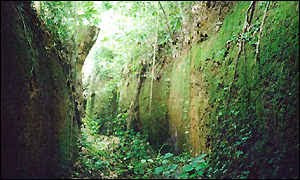
Eridu ramparts in the Nigerian jungle


Asar Imhotep made linguistic connections to ancient Egyptian and Yoruba:

Yoruba iju “jungle” is cognate with Egyptian ju “mountain.” The underlying semantic spirit of each term demonstrates a primary connotation of “wilderness.” The wilderness for the Yoruba was the jungle: for the Egyptians it was the inhospitable desert of the red mountains (dsrt). The inhospitable wilderness of the jungle is described in Yoruba as aginju “dark wilderness.” The qualifier agin- (cf. egàn “the soil under the forest cover” – black, fertile, soil) is from the same root oganjo (ogan-jo) “the dark part of the day,” the dead of night, oganjo oru.

(The word for mountain in Ancient Egyptian is usually transcribed djew, not ju.)

According to Genesis, the garden would have been east of Noah's homeland in the region of Lake Chad. In the language of the local Kanuri, Lake Chad is Bahar Nuhu, meaning "Sea of Noah." Other place names in that region are Benue and Borno. These place names mean "land of Noah." 

Genesis 3 states that God drove Adam and Eve out of the garden and caused them "to dwell east of the garden." The same explanation appears in reference to Cain's banishment to the "east of Eden" (Gen. 4:15). These early Hebrew were moving east, and the way back was closed by the angels stationed on the east of the garden (Gen. 3:24).