Followers

Showing posts with label Talmud. Show all posts

Monday, March 27, 2023

The Talmud's Influence on the New Testament Writers


Dr. Alice C. Linsley


The first 12 chapters of Genesis are rich in anthropological data. They speak of the Hebrew ruler-priests who established and expanded their territories, promoted technological advances, controlled river and land commerce, traded with kingdoms far from their own, developed systems of writing, and influenced the religious beliefs of many non-Hebrew populations. 

The Hebrew ruler-priests were the first lords of the earth, the potentates of 6000+ years ago. They believed that their authority was derived from the High God and that they were required to rule according to the sacred law codes of their ancestors. Genesis preserves their king lists in chapters 4, 5, 10, 11, 25 and 36. Genesis 36:31 clarifies that these "mighty men of old" (Gen. 6) ruled before there was any king in Israel.

The Hebrew ruler-priests were a caste that preserved their identity and wealth by marrying only within their caste. Among them are Cain, Seth, Lamech the Elder (Gen. 4), Lamech the Younger (Gen. 5), Noah, Ham, Shem, Sheba, Heth, Nimrod, and Abraham the Hebrew. 

Unfortunately, some of these early Hebrew are misrepresented in later writings, especially the Talmud and Mishnah. Though these were codified after 70 A.D. the ideas they contain were well known to the Jewish writers of the New Testament. In the first century there were many sects and schools in Jewish society and the diversity of opinion is expressed in the disputations of the rabbis.

Many Jews believe that the Talmud contains truth of greater authority than the Hebrew Bible. The Talmud itself encourages this. We read this explicit instruction: “My son, be more careful in the observance of the words of the Scribes than in the words of the Torah." (Talmud Erubin 21b)

SUNY professor, Robert Goldberg, has written: “The traditional Jew studies Talmud because it communicates ultimate truth—truth about God, truth about the world, and most important, truth about how God wants the holy community of Israel to live.”

New Testament writers were influenced by the Talmud in the way they present certain Old Testament characters: Cain, Esau, Korah, and Balaam are examples. Cain is remembered as a murderer, but Moses and David are not. Esau is posed as wicked though he forgives the deception of Jacob and welcomes him back to the “land of Seir” in Edom (Gen. 32:3). Moses’ half-brother Korah is remembered only for his challenge to Moses’ authority and not for his ritual purity, and Balaam becomes the archetype of a foolish false prophet.

By the time that Jude wrote his epistle (c. 68 AD) Cain was solidly established as the archetype of an earthly ruler. Jude warns those who might abandon Christ because of their suffering and false teachers that God punishes those who rebel against Him. He uses three men as examples: Cain the ruler, Balaam the prophet, and Korah the priest. These were the three most sacred offices among Abraham’s Hebrew people, and they were often filled by people corrupted by the world.

The pervasive influence of the Talmud on first century Jews makes it more remarkable that the New Testament writers recognized Jesus as Messiah and the Son of God.

Much of the argument developed by the writer of the book of Hebrews relies on rabbinic thought, not on historical realities. In Hebrew 7:14, the writer recognizes that the Messiah is from the clan of Judah and a descendant of David, but he seems unaware that both Judah and David are descendants of an ancient caste of ruler-priests. 

Hebrews 12:16 casts Esau as immoral, yet Esau welcomed his deceiving brother Jacob who sought to return home. Zevachim 14:4 claims that Esau's wives served idols, yet they were the daughters of the Hittite chiefs Elon and Beeri who served the same High God. Esau was Isaac's proper heir and he ruled over Isaac's territory in Edom. The intense dislike of Esau in Jewish writings appears to spring from jealousy.

In Hebrew 7:20-28, the author states that the former priests did not take oaths. However, there are historical documents that attest to oaths among the Horite and Sethite Hebrew priests. These include oaths of office, of loyalty, and of truth telling. The priest took an oath that declared loyalty to the high king who he served, and the oath was declared before the appointed royal official or high priest under whom the priest served.

In an oath taken before a priest of the Temple of Hathor on December 6, 127 B.C., a royal servant Petasatet declared his innocence in the case of cloth theft. Temples played an important role in resolving legal and personal disputes.

An oath was taken as a solemn appeal to divine authority represented by the high king. One type asserts a truth and is by nature a declaration such as that of Petasatet. A second type makes a promise pertaining to future actions. (See John A. Wilson, “The Oath in Ancient Egypt”.)

The writer of Hebrews admits that many of the religious practices of the period of the Exodus are not familiar to him. Of the Ark of the Covenant, the mysterious manna, and Aaron’s rod that budded, he explains in Hebrew 9:5 – “Of these things we cannot now speak in detail.” When the details that enable verification of narratives is lacking the reader has reason to question the source.

However, an empirical investigation of the Hebrew ruler-priest caste using the data in Genesis tells us who they were, what they believed, how they dispersed out of the Nile Valley, and that they are the first to hold the Messianic Faith concerning God Father and God Son. Their religion was not Judaism and they would find much in the Talmud confusing and unfamiliar.


Sunday, March 24, 2013

The Bible: Episode 4 - The King is Revealed


Alice C. Linsley


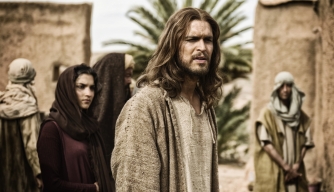
Episode four opens with Jesus healing a paralytic and a leper. He draws large crowds and the number of his disciples grows.

Among his followers is a woman named Mary. She is from Magdala near Tiberias, on the west shore of the Sea of Galilee. The notion that she was a prostitute comes from a Talmudic expression meaning "curling women's hair," which the Talmud applies to an adulteress. This is how the rumor began that Mary of Magdala was a prostitute.

Some Talmudic writings cast aspersions on the early Christian leaders. That Mary Magdalen, Jesus, and the Virgin Mary were hated by the Jewish authorities is a testimony to their prominence. All were slandered by the rabbis. Sanhedrin 106a says Jesus' mother was a whore: “She who was the descendant of princes and governors played the harlot with carpenters.” She is called "Charia" which means dung or excrement, and Jesus is called "Jeschu" which means "May his name be blotted out."

Many Jews believe that the Talmud contains truth of greater authority than the Bible. The Talmud itself encourages readers to place it above the authority of the Old Testament. We read this instruction: “My son, be more careful in the observance of the words of the Scribes than in the words of the Torah." (Talmud Erubin 21b)


The Jews divided over Jesus

With Jesus' appearing, a great conflict arose within Judaism. The Jewish rulers necessarily sought to avoid trouble with the Romans. Jesus was being hailed as the long-expected Messiah, the Seed/Son of God (Gen. 3:15) anticipated by the Patriarchs and Prophets of old. This caused division among the Jewish leaders. Some of the Jewish leaders became Jesus' followers. This is the case with Nicodemus and Joseph of Arimathea, both members of the Sanhedrin. Ari-Mathea refers to the Horite Hebrew priest line of Mathea (Mattai/Matthew).


Jesus in a scene with Mary of Magdala

Even today Jews remain divided on Jesus' identity.


Jesus feeds the multitude in Galilee

A small boy gives Jesus five small barley loaves and two small fish. Jesus blessed these and fed five thousand men; not including women and children. The abundance of this provision is expressed in the twelve baskets of left over pieces. The number twelve is significant because it represents how Jesus will equip his disciples to go forward in ministry. Such feedings symbolize the Lord's power to satisfy physical and spiritual hunger.


Jesus returns to Nazareth

Jesus was born in Bethlehem, but grew up in Nazareth of Galilee. His closest followers were from Galilee and it was to Galilee that Jesus returned and met with His disciples after His resurrection. At the Last Supper He informed his disciples: "After I have been raised, I will go before you to Galilee.” (Matt. 26:32)

In 1962 excavators discovered in the ruins of a Caesarea synagogue a small 3rd to 4th century marble fragment with a list of the twenty-four priestly divisions. This lists names the places where four of the divisions resided, including Nazareth. Until the discovery of this fragment, there was no extra-biblical record of Nazareth's existence before the sixth century A.D and no identification of a priestly division at that town.

According to 1 Chronicles 24:15, Nazareth was the home of the eighteenth priestly division, ha·pi·TSETS (Happizzez). The name Happizzez is related to the ancient Egyptian word for water, specifically the life-sustaining Nile which was call Hap. Earlier in the episode Jesus walked on water and at his first public miracle he turned water to wine at a wedding in Cana.

While in Nazareth, Jesus reads from the scroll of Isaiah. He opens the scroll to Isaiah 61:1-3 and reads about the Messiah. Then he says, "Today this Scripture is fulfilled in your hearing."


Jesus raises Lazarus from the dead

Jesus' raising of his friend Lazarus in Bethany causes a furor. Bethany is a short distance from Jerusalem and the news traveled quickly to the Jewish leaders. One of the signs of the expected Messiah was that he would raise the dead.


Jesus triumphal entry into Jerusalem

When Jesus enters Jerusalem riding on a donkey he is greeted as a king according to the ancient Jebusite tradition. In the time of Abraham and David Jerusalem was a Jebusite city and it was the custom to enthrone rulers using palm branches.

To this day, the Ijebu (Jebusites) use fresh palm fronds when installing a ruler or priest. The supreme ruler of the Ijebu is called "Awujali” and his coronation ceremony involves palm branches. The present Awajali describes how the Ijebus are descended from ancient Nubians and Egyptians (Kushites), as were Abraham and David, from whom Jesus descended.

Fresh palm tree fronds are used ceremonially at the installation of chiefs and kings and are used to decorate places of worship. When the people of Jerusalem used palm fronds to greet Jesus, they hailed him as one to be enthroned according to the custom of his ruler-priest ancestors. One of those ancestors was Melchizedek, the ruler-priest of Jerusalem.


The Last Supper

Jesus gathers with his disciples to eat the Passover meal in the upper room. His words and actions express the true meaning of the Passover whereby the Lamb of God becomes the meal. Jesus takes the bread and after breaking it says, "This is my body." Then he takes the cup of wine and says, "This is my blood. Do this to remember me."

The association of blood and wine is made in the prophecies concerning Judah, who will be elevated above his brothers and from whom “the scepter shall not depart… nor a lawgiver until Shiloh comes; And to Him shall be the expectations of the nations…who will “wash his garments in wine, And his clothes in the blood of grapes” (Gen. 49:10-11).

Jesus gives Judas a fragment of bread and whispers instruction that Judas should do his deed quickly. Judas flees from the upper room and vomits in the alley under the watchful eye of Satan.


The Arrest

Jesus is arrested and condemned to death at a secret trial held contrary to the law of Israel. Nicodemus recognizes that Jesus might be the Messiah, as is being claimed by the people. The religious leaders are intent upon eliminating this threat to their power, but fear a riot that would bring down upon them the wrath of Caesar. They have no authority to execute Jesus, but persuade Pilate to punish him. When that does not satisfy Jesus' enemies, Pilate consents to Jesus' crucifixion.

In 70 A.D. the greatest fears of the Temple authorities were realized. The Temple was destroyed by the Romans, "leaving not a stone upon a stone." The distinctive and unique marriage and ascendancy pattern of Jesus' ruler-priest people also came to an end, having fulfilled its purpose in the divine Son, Jesus Christ.


Related reading:  The Genesis Begats Speak of Archaic Rulers and Jesus Christ; The Significance of Galilee in Matthew's GospelThe Talmud versus the Doctrine of the Lord; Matthew's Testimony Concerning the Empty Tomb; The Messianic Priesthood of Jesus; The Bible: Episode 3 - The Messiah Appears!; The Bible: Episode 2 ; The History Channel Scores a C; Success of Bible Series Hard to Assess


Saturday, September 1, 2012

The Antecedents of Judaism


Alice C. Linsley

Judaism is a relatively new religion. I say that as one who studies culture traits with a duration of over 90,000 years. The faith system of Judaism is the elaboration of rabbinic thought over 3000 years, though it claims Abraham as its founder. By doing so, it gains an additional 1000 years of mythical history.

Dr. Shaye Cohen's portrayal of Abraham in this NOVA interview perpetuates the myth and yet Rabbi Cohen acknowledges that there is no historical basis for claiming Abraham as the first Jew. When asked if Abraham was the first Jew, Dr. Cohen responded, "The biblical narrative gets going with Abraham in Genesis chapter 12. Abraham in turn Isaac, in turn Jacob, in turn Joseph and the twelve tribes, this brings us directly to the people of Israel and the covenant at Sinai. So Abraham is thought of as the first Jew, the archetype."

The central narratives of Judaism surround the person of Moses, the Exodus, and the Law. The bulk of this material dates to the Neo-Babylonian Period (c.850-250 BC). The narrative is further developed by centuries of rabbinic writings.

Rabbis admit that Judaism is shaped by the Talmud, the writings of renown rabbis.


Often these writings conflict with the data of the Hebrew Scriptures.

The Talmud is a collection of rabbinic writings that are often ambiguous to the point of being useless. Consider this statement by Rabbi Johanan about when Messiah will appear: “The son of David will come only in a generation that is either altogether righteous or altogether wicked. (Sanhedrin 98a)
Jerusalem Talmud days to 300 BC, and the Babylonian Talmud to 100 BC. Both the Jerusalem (Yerushalmi) Talmud and the Babylonian (Babli) Talmud underwent redaction over the centuries. They became stable around 400 A.D.

The Babylonian Talmud acknowledges that Jesus was born to Mary and calls her "Charia" which means dung or excrement. In the Babylonian Talmud Jesus is called "Jeschu" which means May his name and memory be blotted out. Sanhedrin 106a acknowledges Mary's royal ancestry but calls her a whore. “She who was the descendant of princes and governors played the harlot with carpenters.”

In the Talmud Jesus is portrayed as illegitimate, as a fool, a conjurer, and a seducer. After his crucifixion he was buried and sent to hell. His followers are presented as idolaters deserving of death.

Nazareth was the home of the eighteenth division of Horite Hebrew priests, that of Happizzez (1 Chron. 24:15). 1 Chronicles 4:4 lists Hur (Hor) as the "father of Bethlehem".

The antecedents of Judaism are found in the religion of the early Hebrew (4000-2000 BC). Though Jews claim that Abraham was the first Jew, the Bible designates him as Hebrew. He belonged to the Hebrew ruler-priest caste, the oldest known caste. His faith more closely resembles the central beliefs of Christianity than those of Judaism, a religion which emerged c.1500 years after Abraham's time.


Monday, December 6, 2010

Challenge to Shaye Cohen's Portrayal of Abraham


Professor Shaye Cohen of Harvard admits that the conception of Abraham as the first Jew does not represent historical reality, yet he seeks to perpetuate this "myth" instead of admit that the Horim were Horites.


Alice C. Linsley


Shaye Cohen is the Littauer Professor of Hebrew Literature and Philosophy in the Department of Near Eastern Languages and Civilizations of Harvard. He is the author of The Beginnings of Jewishness.  In this essay, I will challenge Dr. Cohen's portrayal of Abraham as the archetypical Jew and perpetuates a common myth about Abraham.

When asked in this NOVA interview if Abraham was the first Jew, Dr. Cohen responded, "The biblical narrative gets going with Abraham in Genesis chapter 12. Abraham in turn Isaac, in turn Jacob, in turn Joseph and the twelve tribes, this brings us directly to the people of Israel and the covenant at Sinai. So Abraham is thought of as the first Jew, the archetype."

Region of Eden
Actually the biblical narrative begins with Genesis 1 where we are told that God creates by His generative Word, which John's Prologue identifies as the pre-incarnate second Person of the Trinity.  It moves very quickly to the first biblical promise in Genesis 3:15, the Edenic Promise received by Abraham's ancestors who were rulers in the well-watered region of Eden. This promise is the origin of the Messanic expectation among Abraham's people, who were not Jews, but Horites.

The Horites were a caste of ruler-priests whose origin was the Nile region of Sudan. They were devotees of Horus, who was called "son of Ra" as Horus' mother Hathor-Meri was said to be impregnated by the overshadowing of the Sun.

Horus is the celestial archetype whereby some of Abraham's Jewish descendants came to recognize Jesus as Messiah. Horus' death was mourned and his resurrection celebrated in a five-day festival observed by the Kushites and Egyptians. The first three days were marked by solemnity (as Plutarch noted in Isis and Osiris, 69). The last two days were a time of feasting and rejoicing. Horus is said to have died on the 17th of Athyr. His death was commemorated by the planting of wheat. On the third day, the 19th of Athyr, there was a celebration of Horus’ rising to life. Speaking of his passion, Jesus refers to this when he described his death and resurrection as a grain of wheat falling into the earth and rising to life again (John 12:24).

The double crown of the Israelite high priest was essentially the double crown of Horus worn by the rulers of the Nile Valley. The mitznefet was the white turban of the Upper Nile and the tzitz was the circlet worn around the turban, like the red circlet of the Lower Nile. Narmer (Menes) was the first recorded to wear the double crown. He was the founder of the First Dynasty around 3100 B.C.  Abraham was closely related to the rulers of Egypt. The Babylonian Talmud indicates that his maternal grandfather was a priest of Karnak in Egypt.

Abraham's mother is not mentioned in the Bible, but when we explore her identity we find that she was a high-ranking woman whose father, Karnevo, was associated with the Horus temple at Karnak. In the Karnak birth chapel we find a rendering of the miraculous birth of pharaoh Amenhotep III as the embodiment of Horus. This has led some to believe that Christianity is a conspiracy based on the Horus myth.  However, Amenhotep III died and did not rise from the grave.

While Genesis does indeed trace a direct line from Abraham to Isaac and to Jacob, it also traces the Horite lines of Esau and the Joktanite lines descending from Abraham and his patrilineal cousin-wife Keturah. It is evident also from analysis of the kinship pattern of Abraham's people that Isaac had two wives, one being his half-sister. So the direct line of which Cohen speaks always breaks into two lines with two first-born sons, a pattern which Jews choose to overlook. Given that these ruler-priests intermarried, the Israelites were a mixed people, like their Arab (Ar-ab) brethren. The lines of Kain and Seth intermarried, as did the lines of Ham and Shem, and the lines of Abraham and Nahor.

It is impossible to speak of only one direct line from Abraham to the Israelites because Abraham had nine sons and their descendants intermarried. The genealogical data strongly suggests that Abraham's first-born son was Joktan, the forefather of the Joktanite tribes of Arabia. By Cohen's reasoning, Abraham could as easily be described the first Arab, since most Arabs are descended from him through Joktan.

Abraham's descendants by Ishmael are Egyptians, since Ishmael's mother and wife were Egyptians.

It isn't possible to generalize the kinship pattern of Abraham's people to all Afro-Asiatics or to all the peoples among whom the Horites lived. The Horite ruler-priest marriage and ascendency pattern is distinctive and apparently unique to this caste. We are able to trace Abraham's descendents through the cousin-bride's naming prerogative. These are the ancestors of Joseph and Mary, both of priestly lines. This unique pattern of intermarriage appears to end with Jesus, who was recognized by many Jews of his day as the promised Son who came to save sinners and to restore Paradise. This has been verified by DNA studies which indicate that the unique pattern of intermarriage and ascendency stopped about 2000 years ago.


Cohen Admits to Myth-Building

Cohen admits that his portrayal of Abraham as the father of the Jews lacks historical support. He says, "Historically speaking, of course, this doesn't make much sense. It's hard to talk about Jews living around the year 1800 B.C.E. or anytime near that." This is true. We can speak of Jews only after about 580 B.C.E., when they returned to Judah from Babylonian captivity. However, we can trace expectation of the fulfillment of the Edenic Promise back to about 4000 B.C. which indicates that Christianity is an organic rather than a synthetic religion.  In other words, the Jews didn't invent Messianic expectation and Jesus didn't found Christianity. He fulfilled it.

Cohen's understanding of Abraham as the founder of Judaism is a post-exilic myth and doesn't align with the evidence.  He says, "We don't have any of the institutions, beliefs, social structures in place that will later characterize Jews and Jewishness." This is verifiably false. The hereditary priesthood, blood sacrifice, circumcision, sacred law and the office of the moreh/prophet existed in Abraham's time and before. Abraham consulted a prophet (moreh) at Mamre (Genesis 12: 6-8), between Bethel on the west and Ai on the east. The oak was associated with masculine anatomy and masculine virtues. Likewise, Deborah judged from her palm tree between Bethel to the north and Ramah to the south. Note the association of the female with north-south and the male with east-west, signaling a sacred mystery. The nut of the date palm (tamar) was associated with feminine anatomy and feminine virtues.

Cohen admits that this view of Abraham as the first Jew is of a "mythic kind".  He states, "So in a mythic kind of way we can say that Abraham recognizes God and that Abraham launches the process—biological and social and cultural—that will culminate in the people of Israel, who in turn will become Jews and the purveyors of Judaism." In this statement, Cohen gets one thing right:  Abraham recognized God. The rest is nonsense!  Some of Abraham's descendants by his nine sons became Jews, others became Arabs, and many others are of a mixed racial and religious heritage. Cohen is attempting to sell the myth of Jewish purity.

Cohen notes that "the rabbis of old imagined that Abraham observed the whole Torah, that Abraham observed all the commandments: He observed the Sabbath, he observed the festivals, he observed the laws of culture and food. He observed everything, not just circumcision, which is attributed to him explicitly in Genesis, but everything else as well. Because how can you imagine our forefather Abraham, the founder of Judaism, not observing the Jewish rules, not observing the Jewish laws? This is a wonderful anachronism, a charming conceit. But historically speaking, how could it be?"

The Levitical laws have precedent in older purity laws of the Nile Valley that pertained mainly to ruler-priests and their families for whom purity was especially important. Jews do come from these people which is why Jews call their ancestors and parents "horim." Abraham would have observed these laws. He would have been circumcised, ritually washed, sacrified lambs, shaved his head and performed atonement for blood guilt. On this last point, Genesis tells us that Abraham met with the ruler-priest Melchizedek after the battle of the kings. Doubtless this meeting involved priestly intercession for the relief of blood guilt.

Abraham's faith came not as special revelation, but as a tradition received from his forefathers. The distinctive traits of this tradition align remarkable well with the key features of catholic faith and practice:

  • All-male ruler-priests
  • Blood sacrifice at altars
  • Expectation of the appearing of God
  • "As in heaven, so on earth" - interpreted by prophets according to the celestial pattern
  • Belief in an eternal and undivided Kingdom
When the NOVA interviewer asked if Abraham discovered monotheism, Cohen replied that "The texts in Genesis simply have Abraham talking to God and God talking to Abraham, that's it. Later Jews could not imagine such events without explaining more fully how it was that Abraham came to recognize God and why it was that God chose Abraham."

This is true and the speculations of the rabbis now carries more weight among Jews than the canonical texts. It is from the Talmudic writings that Cohen draws this story: "

"And one of the most famous of these stories recounts how Abraham, the philosopher, sits and contemplates the natural order and realizes that there must be a first cause, that everything has a purpose. And behind the world that we can perceive, there must be some force that we cannot perceive but whose existence we can infer. That's how Abraham came to believe in God. And he went home to his father, Terah, who in the story is an idol maker, and Abraham then smashed all of his father's idols. And numerous Jewish children are convinced to this day that the story is found in the book of Genesis and are always shocked and amazed to discover that it isn't."

Their dismay is understandable. They thought that the rabbis were teaching them from the Hebrew Bible when in fact they were giving instruction from the Talmud. The Talmud itself encourages readers to place it above the authority of the Old Testament. We read this explicit instruction: “My son, be more careful in the observance of the words of the Scribes than in the words of the Torah." (Talmud Erubin 21b)

The NOVA interviewer raised this question: "So is Abraham the founder of monotheism?" Here is Cohen's response: "Ancient Jewish storytellers thought the answer was yes, and following them Christian storytellers thought the same. However, reading historically, we realize monotheism is a very difficult and elusive concept to define. Again, it's far too simple to say that Abraham discovers monotheism."

Indeed "too simple" and entirely misleading.  The truth is that the Horites were henotheists. They believed in a single supreme deity who was the creator and king of the universe. This deity was served by lesser assisting powers (spirits, angels, baals) who are in no way equal to their creator.

The NOVA interviewer ends by asking this:  "Does the Abraham account in Genesis have a central message, a central purpose?"

According to Cohen, "It teaches sacred values, sacred ideas—how to relate to God, to have faith in God. It's also simply a story about our founders. We humans are always curious to know about where we come from. All cultures have stories about their founders or great figures of the past. So here, too, we have stories about our great founder figure, Abraham, who sets the process going that makes us who we are, we meaning the people of Israel, the covenantal people."

Abraham stands as the archetypical Horite ruler-priest who lived in expectation of the birth of a son who would pass through death to life, from weakness to triumph. His faith is the central message.  St. Paul says, "For the promise to Abraham and his offspring that He would be heir of the world did not come through the law but through the righteousness of faith." (Rom. 4:13)

Abraham's faith is exemplified in the binding of Isaac.  As they ascended Mount Moriah, Isaac asked Abraham "where is the lamb" for the sacrifice. Abraham replied that God would provide the lamb, but God instead provided a ram. The ram signaled to Abraham that his offering had been accepted, because the lamb had become the ram. Abraham appears to have believed Isaac to be the Seed of the Woman (Gen. 3:15), but Isaac was spared because God would supply his own Lamb, Jesus Christ, who passed from weakness (kenosis) to fullness of power (resurrection). He is the Ruler-Designate to whom the Father will deliver the eternal kingdom. He is the fulfillment of the Eden Promise.

Abraham likely believed that Isaac was the foretold promised son since many of the circumstances surrounding Isaac align with the ancient Horus myth. Consider the following correspondences:

Isaac was born miraculously (Gen. 21:5) as was Horus, who was said to have been born of a virgin. Issac was not born of a virgin, but Jesus was.

God named Isaac as the son by whom Abraham's Seed would be called (Gen. 21:12). His brother Ishmael was banished. Horus was exalted after being abused by his brother who was banished.

Isaac was sacrificed by the father (by faith) and restored to life (Gen. 22:2-9), since to Abraham he was already given up (holocaust). Horus was restored to life on the third day. This is why many ancient Egyptian funerary amulets were made in the shape of the Eye of Horus.

Isaac received the kingdom from his father (Gen. 25:25) just as Horus/Osirus received a kingdom from his father Ra. Jesus receives the kingdom from the Father. In the Horite myth, Horus/Osiris and Ra are frequently interchangeable - "I and my Father are one", as Jesus explained (John 10:30). They are also all-seeing, even when their eyes are dimmed by blood.

Isaac had two wives who lived in separate settlements with separate flocks. Together these constituted his kingdom. There were practical reasons for this practice. In the event of attack, Isaac's line was more likely to survive if divided into two camps. This fear motivated Jacob to divide his people into two groups when returning to Canaan (Gen. 32). Likewise, Horus is said to have two land holdings as evidenced by one of his titles Har-pa-Neb-Taui, which means "Horus of the two lands."

The association of sheep with the Son of God is found in the Old and New Testaments. Horite priests kept herds from which they took the best to offer as sacrifices. Jesus comes from a long line of shepherds of the priestly lines, on Joseph's side and Mary's side. Keeping sheep was not their only occupation, however. Some were metal workers, others were carpenters, but all were skilled in various enterprises. The rulers of Egypt kept flocks and acknowledged that Jacob's people were especially skilled shepherds. This is why Pharaoh asked Joseph to put the best of shepherd of Jacob's clan in charge of the royal flocks (Gen. 47:6).

Jesus, the Good Shepherd, speaks of having other sheep in another fold (John 10:16). Often the two folds are cast as dispensations: one consisting of those who lived in expectation of the Son of God (Abraham's people) and the other being the witnesses of His resurrection (the Church). Together these comprise the Kingdom of God.

The ruler-priests among Abraham's people were shepherds. The signs of their authority were the shepherd's crook and the flail. These emblems of Pharonic authority have been found in pre-dynastic wall paintings. Hierakonpolis is the site of the most ancient temple and city in Egypt (circa 4000 B.C.). Priests placed invocations to Horus at the fort-summit as the first rays of the sun came over the eastern horizon. Of particular interest is the tomb painting of two men carrying crooks with objects that look like flails, the signs of the rulers of ancient Egypt.

In God's economy, which always gets the order of things right, the shepherds of Bethlehem, a Horite settlement (Hor/Hur) according to I Chronicles 4:4, were the first to receive the news of the birth of the Son of God.

Jesus is spoken of as the Lamb of God. In the story of the binding of Isaac, a ram is sacrificed in place of Isaac. The ram-headed deity, based on the earliest species - Ovis longipes palaeoagytiaca - was known throughout ancient Egypt, especially at Elephantine. So the ram in the story speaks of God's self-sacrifice and would have been confirmation for Abraham that his offering (though not realized) was accepted.

It appears that Abraham believed that Isaac would be raised to life after the sacrifice. The ram  was an ancient Horite symbol of God's rising (from east to west).  Abraham received confirmation that his son was indeed an acceptable offering to God, though Isaac was not the "Son of God" who would fulfill the promise made to Abraham's ancestors in Eden (Gen. 3:15).

Dr. Cohen speaks a good deal of "myth" yet he misses the fact that the core myth of Abraham's Horite people is essentially the core myth of Christianity.  Christianity emerges naturally out of the faith of Abraham's Horite people. This is why Jesus and His Apostles called the religious leaders in Jerusalem hypocrites. They claimed a special status as sons of Abraham but they rejected the faith of Abraham.

Fyodor Dostoevsky was right in declaring: “The most pressing question on the problem of faith is whether a man as a civilized being can believe in the divinity of the Son of God, Jesus Christ, for therein rests the whole of our faith.”


Related reading:  Messianic Jews and the Antecedents of Judaism; Jacob Leaves Beersheba; Mary's Ruler-Priest Lineage; Samuel's Horite Family; Moses' Horite Family; The Horite Ancestry of Jesus ChristThe Afro-Asiatic DominionWhat Language Did Abraham Speak?; Abraham's Faith Central to Genesis; Busting Myths About Abraham


Monday, October 20, 2008

The Myth of Lilith


Lilith is not mentioned in Genesis. It would be speculating well beyond the biblical evidence to say that Lilith was Adam's first wife. However, early Hebrew rulers did have two wives. The theological problem arises when evil Lilith is posed as Adam's first wife, which according to the Hebrew marriage pattern, would mean she was Adam's half-sister. Did God create an evil wife? The Talmud suggests this. But the Lilith story is based, not on the canonical texts, but on the much later Babylonian myth.


Alice C. Linsley

Did Adam have a wife before Eve? According to Ben Sira he did, and her name was Lilith. There is only one reference to Lilith in the entire Bible. Isaiah 34:14 reads "there too Lilith shall repose." The translation is disputed. Following the King James Version, many Bibles render the passage "there too the night creature" or "the screech owl also shall rest there". Compare these:

Romanized Hebrew: pagšu ṣiyyim et-ʾiyyim w-saʿir ʿal-rēʿhu yiqra ʾakšam hirgiʿah lilit u-maṣʾah lah manoḫ ("yelpers meet-[perfect] howlers; hairy-ones cry-[imperfect] to fellow. liyliyth reposes-[perfect], acquires-[perfect] resting-place." )
Lilith flanked by owls

King James: "The wild beasts of the desert shall also meet with the wild beasts of the island, and the satyr shall cry to his fellow; the screech owl also shall rest there, and find for herself a place of rest."

Regardless of the differences, the context is clear in both texts that those mentioned are under Yahweh's judgment.

Lilith (Hebrew לילית) is a Mesopotamian mythological figure. It is not likely that she was known to Abraham's African ancestors from whom we receive the story of the first Father and Mother in the Garden. Lilith belongs to the pantheon that Daniel and his Judahites companions refused to worship in Babylon. She was associated with wind and storms and was thought to bring disease and death, especially to women and infants. The figure of Lilith first appeared in a class of Sumerian storm spirits as Lilitu around 4000 BC.

According to the myth of Lilith, she left Adam because he insisted that she submit to him. She spoke the Divine Name and gained such power that she became an angel, but when God told her to return to Adam, she refused and became a demon. She is cast as the epitome of the evil seductress who works in league with Satan to torment and destroy Adam's offspring.

Here is the passage from a 6th century A.D. midrash The Alphabet of Ben Sira:

After God created Adam, who was alone, He said, 'It is not good for man to be alone'. He then created a woman for Adam, from the earth, as He had created Adam himself, and called her Lilith. Adam and Lilith immediately began to fight. She said, 'I will not lie below,' and he said, 'I will not lie beneath you, but only on top. For you are fit only to be in the bottom position, while I am to be the superior one.' Lilith responded, 'We are equal to each other inasmuch as we were both created from the earth.' But they would not listen to one another. When Lilith saw this, she pronounced the Ineffable Name and flew away into the air. Adam stood in prayer before his Creator: 'Sovereign of the universe!' he said, 'the woman you gave me has run away.' At once, the Holy One, blessed be He, sent these three angels to bring her back.

"Said the Holy One to Adam, 'If she agrees to come back, what is made is good. If not, she must permit one hundred of her children to die every day.' The angels left God and pursued Lilith, whom they overtook in the midst of the sea, in the mighty waters wherein the Egyptians were destined to drown. They told her God's word, but she did not wish to return. The angels said, 'We shall drown you in the sea.'

"'Leave me!' she said. 'I was created only to cause sickness to infants. If the infant is male, I have dominion over him for eight days after his birth, and if female, for twenty days.'

"When the angels heard Lilith's words, they insisted she go back. But she swore to them by the name of the living and eternal God: 'Whenever I see you or your names or your forms in an amulet, I will have no power over that infant.' She also agreed to have one hundred of her children die every day. Accordingly, every day one hundred demons perish, and for the same reason, we write the angels names on the amulets of young children. When Lilith sees their names, she remembers her oath, and the child recovers."

Lilith's existence as an historical person depends on a reading of Genesis 1 apart from Genesis 2. The woman created as Adam's equal in Genesis 1 is said to be Lilith and the woman created subservient (from Adam's rib) in Genesis 2 is said to be Eve. There are two immediately obvious problems with this interpretation. First, Lilith can hardly be an historical woman if Adam is not an historical person. Both Adam and Lilith belong to the realm of myth and a mythical Adam is as necessary as his historical counterpart Enoch. The Adam of rabbinic writings is more often mythical than historical. He may be considered the Form of Man, in the Platonic sense.

Second, Ben Sira and other rabbis were aware that the great chiefs listed in Genesis had two wives. They are constructing the Lilith myth on this culture trait, but culture traits only apply to historical persons living in real time. Lilith is not mentioned in Genesis because insinuating her presence overthrows the biblical picture of Adam and Eve living close to the Creator in Paradise. This paradise was lost due to disobedience of God's command given to them 'not to eat', not because Lilith refused to take the "missionary position" with Adam.

The Lilith myth reveals more about the 6th-century rabbis' attitude toward women than it does about God and creation.


(This article appeared in Yareah Magazine.)

Related reading: Adam and Eve: The Blood and the Birther; Adam Was A Red Man; The Historical Adam; The Lamech Segment Analysis; The Wisdom of Ben Sira