Followers

Showing posts with label genetics. Show all posts

Thursday, June 6, 2013

Scientific Verification of the Genesis 10 Dispersion

The dark red spot in central Africa is Lake Chad, Noah's homeland.

Alice C. Linsley


Findings in archaeology, linguistics, and genetics indicate a Nilo-Saharan dispersion across a vast expanse of the globe. The dispersion aligns with the movement of peoples in the R1b haplogroup (shown above). This dispersion is described in Genesis 10.

This could rightly be called the Afro-Asiatic Dominion since the rulers of these areas were related and shared common religious practices, such as falcon-shaped fire altars; elevated shrine cities ("high places"); and castes of royal priests, scribes and artisans. The priests served at Sun temples, that is, stone edifices that were aligned to the solar arc.  These were called "O-piru" and the priests who served at the temples were called 'Apiru or Habiru. From Habiru comes the English spelling of Hebrew.

In this article I will trace the dispersion of the Nilo-Saharans through investigation of tools, pottery, ancient texts and genetics. I have discussed the evidence of molecular genetics in Haplogroups of Interest to Biblical Anthropologists.


Tool evidence

Discoveries made by Michael Petraglia, from the University of Cambridge, cast doubt on the theory that the volcanic eruption of Toba in Indonesia was catastrophic for humans living even great distances from the mountain. The Toba super eruption has been dated to 74,000 years ago by multiple methods from multiple locations.

Petraglia's team found stone tools at Jwalapuram in Andhra Pradesh, in southern India. These were above and below a thick layer of ash from the Toba eruption of the Toba. The tools from each layer were remarkably similar and suggests that the huge dust clouds from the eruption did not wipe out the population or force them to relocate.

“Whoever was there seems to have persisted through the eruption,” Petragalia says.

Petragalia's team notes that the Indian tools found in southern India are like those from the African Middle Stone Age about 100,000 years ago.

He states, “Whoever was living in India was doing things identical to modern humans living in Africa.”

Thomas Strasser and his team found hundreds of  tools of African origin on Crete dating to between 100,000 and 130,000 years. Others have been found on the Iranian plateaus. Ancient African artifacts have even been found in China. There is considerable tool and pottery evidence indicating prehistoric movements out of the Nile Valley.

In a recent paper, Christine S. Lane, Ben T. Chorn, and Thomas C. Johnson describe core samples from Lake Malawi that reveal ash from the Toba eruption. The Toba ash was found 28 meters or about 92 feet below the most recent sediments to have fallen to the lake floor. The ash clearly dispersed as far a East Africa, but did not cause a significant change in climate or habitat. There is no evidence of a volcanic winter, as once supposed.


Pottery evidence

We can verify the connection between the Nile and Indus Valley by comparing the Egyptian and Indus pottery inscriptions in which 17 figures are virtually identical (see below).


As recently as 1000 BC the Nubian-Dravidian connection, based on pottery samples, seems definitive. The Indian archaeologist B.B. Lal believes that the Dravidians belonged to the C-Group. C-Group people spread culture from Nubia into Arabia, Iran and India between 2300-1500 BC as evidenced by the presence of Black-and-Red Ware (BRW).

Lal writes: "At Timos the Indian team dug up several megalithic sites of ancient Nubians which bear an uncanny resemblance to the cemeteries of early Dravidians which are found all over Western India from Kathiawar to Cape Comorin. The intriguing similarity extends from the subterranean structure found near them. Even the earthenware ring-stands used by the Dravidians and Nubians to hold pots were identical."

The C-Group people of Nubia, southern Egypt and Sudan are commonly called Kushites. Their black and red pottery that has been found from the Sudan, across Southwest Asia and India to China (Singh 1982). This BRW was used as early as the Amratian period (c.4000-3500 BC).

The C-group people - who we might call "Proto-Saharans" - maintained herds of cattle which were used for sacrifice and food. Bovine skulls were used to decorate their graves in archaeologically rich Sudan.

Many ancient C-Group people were agro-pastoral. They were the first to cultivate wild sorghum and millet. These became staple grains in Egypt and were taken to Pakistan and India between 3000 and 1000 BC. The evidence indicates that all of the African domesticates arose north of the equator and were introduced to the south relatively late. (Salas 2002)

Clyde A. Winters believes that the Dravidian speakers of C-Group took millet to India. B. B. Lal contends that the Dravidians/Proto-Dravidians came from southern Egypt and Sudan. This explains the darker complexion of the "Sudra." Lal also noted common burial practices incorporating megaliths, circular rock enclosures and rock-hewn tombs.

The origin of genetic diversity found in South Asia is much older than 3,500 years when the Indo-Aryans were supposed to have migrated to India. The Indo-Aryan migration theory was proposed in mid-19th century by German linguist Max Muller. Muller suggested that 3,500 years ago, Indo-European speakers from Central Asia introduced the Indo-European language family and the caste system in India. However, genetic studies indicate that this is not the case. A study led by scientists from the Centre for Cellular and Molecular Biology (CCMB) in Hyderabad, India (published in American Journal of Human Genetics in December 2011) shows clearly that there was no genetic influx 3,500 years ago.

The Proto-Dravidians apparently migrated from ancient Nubia across Arabia to India. The oldest known civilization in Arabia was the Tihama culture which flourished on the coastal plain along the Red Sea in present day Yemen. Rodolfo Fattovish believes that the Tihama civilization originated in Nubia, exactly what Genesis 10 indicates. He also recognizes the societal organization of chiefs in the Gash River region in Sudan (2,700-2,300 BC). Fattovich's excavations in the Gash Delta demonstrated a clear relationship between the C-Group and Kerma cultures in northern Nubia. His findings were confirmed by the Italian expedition to the eastern Sudan of 2011.

Horite fire altars at the Harappan water shrines of Kalibangan and Lothal provide further evidence for the dispersion of the Nilo-Saharans. The Dravidian word Har-appa means "Hor is father" and these altars are built in the shape of a falcon in flight. The falcon was the totem of Horus, called "Son" or "Seed" of Ra. The Shulba Sutras state that "he who desires heaven is to construct a fire-altar in the form of a falcon."


Evidence of ancient texts

The Indian historian and anthropologist Bharatiya Vidya Bhavan has written: "We have to begin with the Negroid or Negrito people of prehistoric India who were the first human inhabitants. Originally they would appear to have come from Africa through Arabia and the coastlands of Iran and Baluchistan." According to the Matsya, an ancient book from India, the world belonged to the Kushites (Saka/Saki) for 7000 years. 

Homer (ca. 8th century BC) alluded to the diversity and unity of the Kushite empires when he wrote, “a race divided, whom the sloping rays; the rising and the setting sun surveys.”

A seventh century Assyrian text says that Sargon's birthplace was a city on the banks of the Euphrates called Azu-piranu. It was a Horite shrine as evidenced by the word piranu. The ha-piru were a caste of priests devoted to Horus. They called their water temples and shrines O-piru, meaning "Sun House." Azu/Asa is an East African name for God. Azu-piranu means “House of God” and is equivalent to the Hebrew word Beth-el. Hur-azu was a title for Horus and the Babylonian word for gold.

A recent phoneme study has identified the Nile Valley as the point of origin of modern languages and the comparison of African phonemes with those found in ancient Hebrew suggest that Hebrew is an African language.


Evidence of genetics

In human mitochondrial genetics, L is the mitochondrial DNA macro-haplogroup that is at the root of the human mtDNA phylogenetic tree. As such, it represents the most ancestral mitochondrial lineage of all currently living modern humans. L3 is the haplogroup from which the vast majority of modern humans outside of Africa are descended, beginning about 70,000 years ago. The “Indians” bearing these genes live on the Andaman and Nicobar Islands and have negroid features. They represent this early, though probably not earliest, migration out of Africa.


Onges of Andaman and Nicobar Islands
The Onges and Jarawas belong almost exclusively to Haplogroup D


An estimated 60% of Indian DNA consists of haplogroup M which emerged from haplogroup L3 emerged. The apparent point of origin for M is the Nile and Sudan. A study by Afonso et al. (2008) found M in over 72% of the population of Sudan (112 samples). Molecular genetics has shown that Dravidians are phenotypically Africa.The most frequent haploids in India belong to L3M and L3N lineages. 

According to Maca-Meyer et al. (2001), "L3 is more related to Eurasian haplogroups than to the most divergent African clusters L1 and L2".

The Eurasian populations to which Maca-Meyer refers are mainly in Haplogroup D, believed to have arisen in Asia some 48,000 years ago. It is a descendant of haplogroup M. Haplogroup D is of special interest for Biblical Anthropologists as many of the peoples identified in Genesis fall into this mtDNA group. Here we find the Habiru (Hebrew), the Ainu, black and red Nubians, and other Kushites, such as the Afro-Sumerians and the Proto-Dravidians.


Source: Metspalu et al. Haplogroup D
Likely time of appearance about 40,000 years ago

There is much evidence for the Kushite migration out of Africa, as it is described in Genesis 10. DNA studies are but one method of tracing the Kushite dispersion. As Clyde Winters states, "The archaeological and molecular evidence provides footprints of a recent hg M ancestral migration from Nubia to India."

This is not the first migration out of Africa, but it is the one to which Genesis refers when it speaks of Kush's sons and grandsons moving from the Nile Valley into Arabia and Mesopotamia.

Kushite rulers were great kingdom builders who controlled the major water systems and the ancient world. Nimrod, the son of Kush, is but one example.

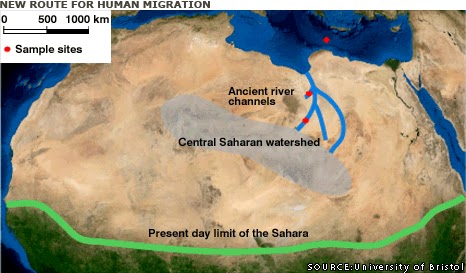
There is genetic evidence that the Proto-Saharan ancestors of the Kushites moved west along the interconnected water systems between the Nile, Lake Chad, and the Niger-Benue Trough. Outside of the Nile Valley and some north African countries, this is the only other place in Africa where the M haplogroup is found. The Nigerian historian, Dr. Catherine Acholonu, regards Iboland as the cradle of Afro-Sumerian peoples. Genetics does not support this view, however. The percentage of the population living at the confluence of the Niger and Benue Rivers with M lineage is extremely small.


Wednesday, May 1, 2013

More East Africa-Asia Connections


Alice C. Linsley


The peoples and languages of Madagascar, Borneo, and Sulawesi in Indonesia appear to have linguistic connections to populations in East Africa. The African–Indonesian connections have been confirmed by numerous genetic, linguistic, ethnographic and archaeological studies. The connections indicate migration and mixing of populations across the Indian Ocean, called "an Afro-Asiatic Mediterranean" in this study. The seasonal monsoon winds made movement and trade possible across great distances with boats hopping from island to island.

Findings published in the American Journal of Human Genetics, show that half of the genetic lineages of Madagascar derive from settlers from Borneo to the east, and the other half from East Africa. Archaeological evidence indicates that people were moving in and out of East Africa, Madagascar, Borneo and Sulawesi well before 1200 years ago. Evidently some travelers settled in these islands and contributed to the genetic makeup of their populations.
Young worker in Madagascar

According to Dr Matthew Hurles, of the Wellcome Trust Sanger Institute, the language of Madagascar, called Malagasy, has its closest linguistic relative in the Ma'anyan language of southern Borneo.

Malagasy peoples have a 50:50 Indonesian and East African ancestry. A team, from Cambridge, Oxford and Leicester, used Y chromosomes and mitochondrial DNA to test how similar the Malagasy were to populations around the Indian Ocean. The set of non-African Y chromosomes found in the Malagasy was much more similar to the set of lineages found in Borneo than in any other population. A 'Centre of Gravity' was estimated for every mitochondrial DNA to suggest a likely geographical origin for each.

"The Centres of Gravity fell in the islands of southeast Asia or in sub-Saharan Africa," explained Dr Peter Forster, from the McDonald Institute for Archaeological Research, University of Cambridge, one of the co-authors. "The evidence from these two independent bits of DNA supports the linguistic evidence in suggesting that a migrating population made their way 4500 miles across the Indian Ocean from Borneo." Read more here.


Sulawesians and Madagascans exhibit the same range of physical appearance, including African, Arabian, Indian, Indonesian and Chinese. They may be genetically related to the Dravidians, if the linguistic connections have a biological basis. Sulawe appears to be related to ancient Egyptian, Dravidian, and East African words for rice.

The term "Sulawesi" might be related to written rice records. If those who were moving from island to island were merchants, they would have recorded their transactions. Sulawe resembles the Egyptian word for writing ssw; and the Mande sewe; and the Dravidian ha-verasu (referring to written record of rice sales).

Linguistic connections are further evident in term for slash and burn cultivation used in Sulawesi and East Africa. The word trematrema is used in Northeast Betsimisaraa to refer to a one-to-three-year old slashed-and-burnt field. It is related to the Swahili word tema, ‘to cut’, and the redoubled form tematema, ‘to slash, to chop. This technique is used also by Sulawesians who practice "dry rice" planting.

Rice grain formed the basis of weight measurement from East Africa to Sulawesi. On Madagascar, the weight of one grain of rice is called vary and corresponds to the Swahili wari and to the Dravidian verasu. The Hebrew word for rice is orez and Arabic ruz and these share the RZ root with Dravidian. The Dravidian word reflects the written records of commercial weights.

There are two species of cultivated rice in the world: African rice (Oryza glaberrima) and Asian rice (Oryza sativa). African rice was domesticated from the wild ancestor Oryza barthii (Oryza brevilugata) by peoples living in the Benue-Niger floodplain about 3,000 years ago. The two strains of Asian rice are Oryza japonica and Oryza indica, identified with Japan and India.

Rice terraces in Madagascar
A Royal Society report edited by Murray P. Cox states, "The settlement of Madagascar is one of the most unusual, and least understood, episodes in human prehistory. Madagascar was one of the last landmasses to be reached by people, and despite the island's location just off the east coast of Africa, evidence from genetics, language and culture all attests that it was settled jointly by Africans, and more surprisingly, Indonesians. Nevertheless, extremely little is known about the settlement process itself. Here, we report broad geographical screening of Malagasy and Indonesian genetic variation, from which we infer a statistically robust coalescent model of the island's initial settlement. Maximum-likelihood estimates favour a scenario in which Madagascar was settled approximately 1200 years ago by a very small group of women (approx. 30), most of Indonesian descent (approx. 93%). This highly restricted founding population raises the possibility that Madagascar was settled not as a large-scale planned colonization event from Indonesia, but rather through a small, perhaps even unintended, transoceanic crossing."

Recently rock paintings dating to about 40,000 years have been found in caves at Maros in Sulawesi, Indonesia.


Other migrations out of the Nile Valley

The Nilotic Ainu also crossed great distances arriving in Northern Japan and continuing on to the Marianas which had human settlements 3,500 years ago. These long-distance migrations involved crossing the Indian Ocean. The Ainu, in mtDNA haplogroup X, also traveled overland to Finland, as shown in the chart below.


The Canadian Ainu (Micmac) report that their ancestors came to Canada via Finland, Greenland and Labrador.


Friday, March 2, 2012

Anu/Ainu a "First People"


Alice C. Linsley

The Ainu of Hokkaido are genetically closest to the Ryukyuan of Okinawa and to the Andaman Islanders. The negrito Andaman and Nicobar Islanders migrated between 70,000 and 50,000 years ago from Africa, and eventually crossing the seas. The Onges and Jarawas of Andaman and Nicobar belong to Haplotype D, a subtype of Haplogroup C, which is also common in Tibet and Japan. The Ainu aboriginal people of Japan are in haplotype D (Y-chromosome) and haplogroup X (mitochondrial chromosome).


The Ainu preserved their customs as they dispersed out of the Nile Valley. This is evident when we compare the dress of the Ainu chiefs in Hokkaido (top) and Canada's eastern seaboard (bottom).

Ainu chief of Hokkaido, northern Japan

Ainu chief of the Miqmac in eastern Canada


The Ainu are at the center of Cavalli-Sforza's genetic distance chart. This suggests that they were very selective in their choice of marriage partners and likely practiced clan endogamy. This is a practice of some of the oldest human populations, and suggests that the Annu/Ainu may one of the world's first people.

The Annu/Ainu originated in the Nile Valley and dispersed in many directions following coastal routes and crossing seas. The Nilotic Annu/Ainu priests were associated with the most prestigious shrine and temples of the ancient world, including Nekhen and Biblical On (Heliopolis). The shrine at Heliopolis was known as Iunu, place of pillars. Heliopolis was one of the places were the Habiru (Hebrew) Horites served as priests. Joseph married a daughter of the priest of Heliopolis. The pyramids at Giza, Abusir and Saqqara were aligned to the obelisk of On.

As the Ainu dispersed they took with them their religion and rituals. It was their custom to build water shrines in circular valleys or basins (kar) and their priests performed rituals (nak) at these shrines. Kar is a very ancient lexeme. Lexemes are words that represent a whole complex of related ideas. Ki-kar refers to a circle as in Exodus 25:11: ki-kar za-hav ta-hork, meaning "circle of pure gold." Kikkar ha-yarden refers to the Jordan valley.

This genetic distance chart indicates that the Ainu at at the center of the dispersion of modern humans.

Luigi Cavalli-Sforza's Genetic Distance Chart


What do the following words have in common?

Kena, Canaan, Qatna, Kano, khinna/henna, Karnak (Egypt), Karnataka (India), Katakana, and Kana
They all share the KN root, as in the place kar-nak, meaning place of rituals. Kena and Canaan are related to the word Kain. Kano is a city in Northern Nigeria named after Kain.  It is north of Nok, which name appears as Hanock in the Bible.

Kinna and henna speak of the color red. Kana are the syllabic Japanese scripts. In Japan, Katakana is used to write Ainu.

Qatna (Arabic قطنا, modern Tell el-Mishrife) is an archaeological site in the Wadi il-Aswad, a tributary of the Orontes, 18 km northeast of Homs, Syria. The Ainu shrine city of Meroe on the Orontes is also of special interest. Likewise, the rock shelters of the Ani in Turkey attest to the archaic settlements of these dispersed Annu/Ainu. Ani is a ruined medieval city situated in the Turkish province of Kars near the border with Armenia. Kar refers to fortifications at high elevations. These places had temples and shrines and were served by priests.

Karnak on the Nile and Carnak in Brittany are examples. In Dravidian car means "sheltered together" and kari refers to a river. In Manding kara means "to assemble." In ancient Sumerian é-kur refers to a mountain house, pyramid, or elevated temple.

Since the Kar were places of burnt offerings, the term is often associated with charcoal and soot. The Turkish kara means "black." In Magyar korom refers to soot, as does the Korean word kurim. Among the Nilotic Luo kar specifies a place with boundaries.

The kars of the archaic world were mainly circular. Ki-kar refers to a circle, as in Exodus 25:11: ki-kar za-hav ta-hor, meaning "circle of pure gold."  The word kikar can refer to a circular enclosure.

Rock shelters and fortified sites have been identified in the Carpathian mountain range. The range is called Karpaty in Czech, Polish, and Slovak, and Карпати in Ukrainian, Carpați in Romanian, Karpaten in German, Kárpátok in Hungarian, Karpati in Serbian, and Карпати in Bulgarian. In Albanian karpë means "rock."

Karnak was the site of Ainu devotion to Horus, the "son of God." The Ainu had a red skin tone. Abraham's father was Terah the Ainu. The Ainu originated in the Nile Valley and dispersed to Northern Japan, Northwestern China, and Eastern Canada.


Related reading: Haplogroups of Interest to Biblical AnthropologistsThe Nile-Japan Ainu Connection; A Kindling of Ancient MemoryAbraham's Ainu Ancestors; Does Genesis 10 Describe the Ainu Dispersion?; Solving the Ainu Mystery; Archaic Rulers, Ascendancy and the Foreshadowing of Christ; Edo, Edom, Idumea; Migrations Out of Africa


Sunday, August 7, 2011

King Tut and the Dispersion of R1b


Alice C. Linsley

Haplogroup R1b (Y-DNA)

Although Africa is its point of origin, the so-called "King Tut Gene" is found among widely dispersed populations of males. Studies reveal that about 60% of British men are classified in haplogroup R1b (Y-DNA). Biblical persons with this genetic ancestry include Noah, Abraham, and David.

Haplogroup R1b, also known as haplogroup R-M343, is the most frequently occurring Y chromosome haplogroup in Western Europe, parts of Russia (especially the Bashkir minority), Central Asia (e.g. Turkmenistan) and in the region of Lake Chad and along the Nile.

This is the Haplogroup of Abraham's Proto-Saharan ancestors who dispersed widely and are known my many different names in ancient history: Kushites, Kushan, Ainu, Saka, Hittites, etc. Among them was a caste of priests known in ancient texts as 'Apiru, Hapiru, Habiru or Hebrew.

Image from http://dnaconsultants.com/king-tut-gene. 


Tutankhamun became king in 1333 BC and ruled until is death at a young age in 1342. The exact cause of young Tutankhamun's death is not known. He suffered from malaria and necrosis, but otherwise he appeared to be fairly healthy. Apparently, he was lame and walked with a cane. More than 100 canes were found in his tomb.

Tutankhamun's cartouche shows the temple of On (Heliopolis) and bears the word shema which in Hebrew means "hear." The Creator Re is referred to as the "God of Manifestations." On was one of the most prestigious shrine cities of the ancient world. The pyramids at Giza, Abusir, and Saqqara were aligned to the obelisk at Heliopolis. Giza, Abusir and Saqqara are shown on the map south of Cairo. Heliopolis (biblical On) is shown to the north.


As was typical of the Kushite-Egyptian marriage and ascendancy pattern, King Tut's parents were half-siblings. This was true also of Abraham and Moses. Sarah was Abraham's half-sister and Moses' Kushite wife was his half-sister. At his ascent to the throne, Tut married his half-sister Ankhesenpaaten. Had he lived, he would have taken a second wife at a later age. She would have been a patrilineal cousin or niece.


Debate about Tut's DNA

Debate about the origins of the Egyptian ruler Tutankhamun (and the genetic stock of up to 70% of British men) was stirred recently by an unscientific claim made by iGENEA, a Swiss personal genomics company. iGENEA claims to have reconstructed a DNA profile for King Tut by watching the Discovery Channel, based on what they say are genetic markers that appeared on a computer screen during the Discovery Channel's program.

The company claims that the results suggest more than half of Western European men are related to Tutankhamun. The focus was on the Y-chromosome haplogroup R1b.

Researchers in Egypt who compared Tut's genome say that iGENEA's claim is "unscientific." The Discovery Channel's coverage was equally speculative.  So we have speculation upon speculation. However, biblical anthropology can shed light on this dispute.

Haplogroup R1b is the most frequently occurring Y-chromosome haplogroup in western Europe, especially Spain and France, parts of Central Asia and in sub-Saharan Central Africa, especially around Chad and the Benue Trough, the region of origin of the Kushites' ancestors.

The Y-chromosome traces genetic ancestry through the males, but it does not give the full picture without also tracing the mitochondrial DNA (mtDNA), which traces decent through the females. In reproduction, the nuclear DNA of one parent mixes with the nuclear DNA of the other. MtDNA, on the other hand, almost always passes unaltered from mother to offspring. Recent studies show that paternal mtDNA can on rare occasions enter an egg during fertilization and alter the maternal mtDNA through recombination.

The Discovery Channel report of the research in Egypt never took into account the complex marriage and ascendancy pattern of the Kushite rulers which involves descent through the wives. It is believed that King Tut was the grandson of Amenhotep III and the son of Akhenaten the Younger who was named by Amenhotep's cousin wife after her father. This means that Akhenaten the Younger ascended to the throne of his maternal grandfather, after whom he was named. This is typical of the Kushite marriage and ascendancy pattern which involves the ruler's two wives: one a patrilineal half-sister and the other a cousin or niece, often from the mother's side.

If Tut were the firstborn son of Akhenaten by his half-sister wife, Tut would have been the heir to Akhenaten's throne. His Y-chromosome would be identical to his father and his mother. His mtDNA would likely match his mother's, but not necessarily his father's. If Tut were the firstborn of Akhenaten's cousin or niece wife, he would have been the heir to the throne of his maternal grandfather. His Y-chromosome would be the same as his father and grandfather, but his mtDNA might be different than his father's.

A more interesting study would involve comparing mitochrondrial samples of King Tut and Mystery Mummy of Tomb KV55 near Luxor (Upper Nile). Likely the mtDNA is identical, but what if it is not exactly alike? By looking at the similarities and differences of the mtDNA of Amenhotep III, Mystery Mummy, and Tut researchers could possibly trace two distinct maternal lines. This is what would be expected from the marriage and ascendancy pattern of the Kushite rulers. They were the first to unite the kingdoms of the Upper and Lower Nile; the first to wear the double crown.

In an inscription at Karnak, Amenhotep III, a Kushite kingdom builder, was described as "... the good shepherd, vigilant for all people, whom the maker thereof has placed under his authority."
J.H. Breasted, Ancient Records of Egypt, Part II, § 900

Amenhotep III ruled in the Eighteenth Dynasty between about 1382 and 1350 B.C. (about 630 years after Abraham). He ruled over a kingdom that stretched from Nubia to Libya, Gaza and Syria. It was during the 18th dynasty that the title 'King's Son of Kush' was first used. The 42-foot tall statue shown above was excavated in Thebes (near Luxor) on the west bank of the Nile.

So what did the DNA study reported by Discovery Channel prove? It proved that Amenhotep III and the Mystery Mummy in Tomb 55 located on the Upper Nile had a common male ancestor; not surprising since intermarriage between patrilineal lines was a characteristic of the Kushite rulers. It does not prove that the Mystery Mummy was King Tut's father, Akhenaten. In fact, the identity of the "deified" ruler's father was usually kept secret. The suggestion that the ruler was miraculously conceived was part of the ruler's mystique.

Kushite and Egyptian rulers did not name their biological fathers in their king lists. This is because they believed that the ruler-priest was the son of Re whose emblem was the sun. The Pharaoh was called "son of Re" which is why Egyptian texts never mention an earthly father of the king. Kingship was rather a manifestation of the solar deity's overshadowing of noble women. Sargon the Great (biblical Nimrod) claimed not to know his father. He based his authority to rule on the suggestion that he was conceived according to the royal myth of miraculous virgin conception.

Amenhotep II was connected to the House of Sheba. Amenhotep II's mother was Queen Merytre-Hatshebsut. Her name means Pure Love-Sign of Sheba of the South. She bore the title "Lady of Two Lands" which means that she ruled after the Kushites had united the kindgoms of the Upper and Lower Nile.

Queen Tiye, Wife of Amenhotep II
She is called a "Nubian" queen, but Nubia is not an ethnicity. It means "Land of Gold. She was likely a princess of the House of Sheba.


Archaeologists have linked Sheba to settlements in East African and in Yemen.

It is likely that Queen Merytre-Hatshebsut selected a wife for her son Amenhotep II from among her people. We see this pattern associated with noble Egyptian mothers in Genesis 21:21 where we are told that Hagar found an Egyptian wife for her son Ishmael.


Explanation for the R1b Dispersion
 
R1 peoples moved in many directions along the complex water ways of 100,00 to 20,000 years ago. By 18,000 years ago there was a distinction between R1a and R1b. Peoples in the R1b haplogroup moved across the Levant and Mesopotamia, going into the Iberian Peninsula, ancient Gaul and as far as Central Asia. They populated Anatolia and moved as far north as the Tarum Valley in China. These were a pyramid building people who mummified their rulers. They are called "Kushan" and are related to the Nilotic Kushites and the Nilotic Ainu (Annum). The Ainu spread into Hokkaido and Okinawa and into the Hudson Bay area of Canada.

The R1a group spread along the Shari and Benue rivers, establishing kingdoms and chieftains in Nigeria, Cameroon, Niger, Ghana and into the southern Kordafan.


The Benue Trough
Linguistic and archaeological evidence supports this picture of dispersion from the Upper Nile region and it connective waters in west central Africa. Noah lived in the region of Lake Chad (Bor'No mean "Land of Noah") and his ancestors Cain and Seth (whose royal lines intermarried).

Kushite ruler-priests spread their culture and religious beliefs by the great water systems across what I've termed the ancient "Afro-Asiatic Dominion." During various humid periods the Nile, the Saharan lakes and the Benue Trough were much larger, allowing for connections between the Atlantic and the Red Sea.

Water systems of Kush
In ancient inscriptions from Africa and Eurasia these Nilotic kingdom builders were called Kushite and sometimes Ethiopian (from the Greek word for black). In Sumerian inscriptions they were called Meluha-Kasi, a designation for peoples who lived in the area of Nubia, Arabia and the Lower Nile.

"The Babylonian designation for Arabia is 'Magan and Meluha' and the two expressions are used distinctively, the one (Magan) to denote the eastern and southern part - that situated nearest to Babylonia, the other (Meluha) to denote the N. and W. The district of Sinai would thus form part of Meluha." (From here.) So there is textual evidence from antiquity linking Abraham to the Kushites and their early ancestors who lived around Lake Chad and in the Benue Trough.


Sunday, February 27, 2011

Political Zionism Does Not Align With the Bible


Alice C. Linsley


The yellow shows lands in which Palestinians lived before 1917 (left)
 and their limited land holdings in 2012 (right)

All peoples have a yearning for a homeland because it defines their ethnic identity. Scots who came to North America named the places where they settled after their native land: Nova Scotia. Midlothia, Inverness, Kirkland, etc. It is natural for dispersed peoples to yearn for the homeland, be it a real or an imagined. This is especially true when the homeland has been perceived to have been lost. The earliest sentiments of yearning can be traced to the Babylonian exile when the people of Judah yearned for restoration. Yearning for a homeland is reinforced by experiences of separation and loss, be they real or imagined.

The modern state of Israel was settled mainly by Ashkenazi Jews whose ancestors settled in France, the Rhine Valley and Poland. They are descendants of non-Jewish mothers and therefore not ethnically Jews. In fact, studies reveal that Ashkenazi Jews are genetically closer to the old Welsh than to most Arab populations.

Genetic studies have revealed that many who self-identify as Jewish are descendants of non-Jewish mothers who presumably converted to Judaism. Jon Entine. "Ashkenazi Jewish Women Descended Mostly from Italian Converts, New Study Asserts." Genetic Literacy Project (October 8, 2013). Excerpts:
"[...] Professor Martin Richards, who heads the University of Huddersfield's Archaeogenetics Research Group (and who participated in the 2002 study), and colleagues sequenced 74 mitochondrial genomes and analyzed more than 3,500 mitochondrial genomes - far more data than the 2006 survey, which reviewed only a short length of the mitochondrial DNA, containing just 1,000 or so of its 16,600 DNA units, in all their subjects. [...] According to Nicholas Wade of the New York Times, Doron Behar, one of the key authors of the 2006 analysis, said he disagreed with the conclusions, but has provided no detailed critique as yet. Wade also talked to David Goldstein, who said he believed the estimate that 80 percent of Ashkenazi Jewry originated in Europe was too high considering the unpredictability of mitochondrial DNA data. [...]"

The principal justification of political Zionism is that God gave the Jews the land of Israel and therefore it should be returned to the Jews. Zionists attempt to validate the Jewish claim to the land by insisting that Jews have always been in Israel. This is expressed in Melvin Koller's book. He writes:
The Jews did not come to Israel from anywhere else at any time. They have been there from time immemorial. They became a coherent people there, discovered God there, built a kingdom there, created the Torah there, and composed much of the Talmud there. Attempts to evict them partly succeeded, but their presence there has always been significant. Wherever they were in exile they longed to go back there, and in every generation some did. Their presence there is permanent, and future attempts to evict them will incur a huge cost.

However, this justification does not find support in Scripture, history or science.  Zionism as a political and religious ideology represents the gradual building up of a belief that has little to do with the Bible or anthropological evidence. This is set forth very convincingly by Shlomo Sand in his book The Invention of the Jewish People.


Sand explains, "it was only the appearance of prenationalist Jewish historiography in the latter half of the nineteenth century that gave the Bible a leading role in the drama of the rise of the modern Jewish nation. The book was transferred from the shelf of theological tracts to the history section... Above all, the Bible became an ethnic marker, indicating a common origin for people of very different backgrounds..." (page 127).

Most important to the study of Biblical Anthropology is the Zionist insinuation that God gave the present land of Israel to Abraham. The data of Scripture makes it clear that Abraham's territory did not correspond to the present land of Israel. Abraham ruled in ancient Edom which includes parts of Israel and Jordan.

Abraham's territory extended between his two wives. Sarah resided in Hebron and Keturah resided in Beersheba. Both Hebron and Beersheba were in ancient Edom. Edom was ruled by the Horite Hebrew and many of those rulers are listed in Genesis 36. Abraham was a Horite Hebrew ruler, not a Jew. Further, the substance of Abraham's faith does not correspond to the substance of Judaism.

The Horite Hebrew were a caste of ruler-priests who were devotees of Ra, Horus and his mother Hathor. Hathor was the patroness of Horite metal workers. Her shrine was found at the metal working site of Timnah. The Horite metal workers of Edom used the same techniques as the Horite metal workers who lived in the Timnah Valley in the Wilderness of Paran. Esau the Elder's son Eliphaz married Seir's daughter who was named Timnah.

The Horite rulers of Edom are listed in Genesis 36. Edom was ruled by the Horite clans of Seir and Esau the Elder who married Adah. Esau the Elder was a contemporary of Seir the Horite.

Esau the Younger married Oholibamah. It is possible that Esau the Younger was Jacob's half-brother, rather than his twin. Their father was Isaac, but they would have had different mothers, as Horite Hebrew rulers had two wives.


Abraham's territory was entirely in the region of Edom. It extended between on a north-south axis between Hebron and Beersheba and on an east-west axis between Engedi and Gerar. This region was called Idumea by the Greeks which means "land of red people." Esau, Abraham's grandson, and David are described as having a distinctive red skin tone. It is a characteristic of the R1b rulers who were aggressive kingdom builders. Their point of origin is the Nile Valley during the African Wet Period.

An early population living in Wales and Cornwall were the Damoni, which means “red people.” The word Dam-oni is derived from two words found in the Bible: dam, a reference to red and blood, and oni/On, a reference to the great shrine city of Heliopolis, biblical On (Genesis 41:45). Joseph married the daughter of a priest of On. The Dam-oni may have come from Carnac (Karnac) in Brittany because the stone monoliths in Damnonia are like those in Carnac, though smaller. On the Nile, the ancient shrine at Karnak was built with huge stones by skillful craftsmen, the likely ancestors of these early inhabitants of Cornwall.


Hebron and Beersheba (where Keturah lived)
mark the northern and southern boundaries of ancient Idumea.
Abraham's territory extended between the settlements of his two wives
and was entirely in the region of Edom/Idumea.


Horite priests were attached to the rulers of many territories in the ancient world. Some are associated in ancient Egyptian records with the Shasu on Nubia and Edom. Lists of place names in Nubian temples of Soleb and Amara West record six toponyms located in “the land of Shasu.” A monument of Ramesses II claims that he “has plundered the Shasu-land, captured the mountain of Seir”in Edom; a 19th Dynasty letter mentions “the Shasu-tribes of Edom” and Ramesses III declares that he has “destroyed the Seirites among the tribes of the Shasu.” Clearly, the Egyptians regarded the Shasu as a prominent part of the Edomite population which is described in Genesis 36.

The claim that God gave Abraham the land of Israel is not supported by the biblical evidence. This ideological claim is rooted less in the Bible than in what the rabbis have written and in the political realities facing Palestinians and Israelis today.

Y-chromosome studies have shown that 2/3 of Palestinians and 2/3 of Jews share 3 male ancestors who lived about 8000 years ago. These are the descendants of Abraham's Proto-Saharan ancestors, some of whom who are listed in the Genesis King Lists. Anthropologists have learned a great deal about the kingdom-building activities of these archaic rulers.


Myth and Reality

Zionism is well entrenched in American academia. Shaye Cohen at Harvard admits that the conception of Abraham as the first Jew does not represent historical reality, yet he seeks to perpetuate this "myth" instead of admit that Abraham was a Horite ruler. Cohen admits that his portrayal of Abraham as the father of the Jews lacks historical support. He says, "Historically speaking, of course, this doesn't make much sense. It's hard to talk about Jews living around the year 1800 B.C.E. or anytime near that." Cohen admits that this view of Abraham as the first Jew is of a "mythic kind". He states, "So in a mythic kind of way we can say that Abraham recognizes God and that Abraham launches the process—biological and social and cultural—that will culminate in the people of Israel, who in turn will become Jews and the purveyors of Judaism." In this statement, Cohen gets one thing right: Abraham recognized God.  So did his Proto-Saharan, cattle-herding ancestors. Some of Abraham's descendants by his nine sons can be identified as Jews, others as Arabs, and many others are of a mixed genetic heritage. Is Cohen attempting to sell the myth of Jewish purity?

When asked in this NOVA interview whether Abraham was the founder of monotheism, Dr.Cohen states, "Ancient Jewish storytellers thought the answer was yes, and following them Christian storytellers thought the same. However, reading historically, we realize monotheism is a very difficult and elusive concept to define. Again, it's far too simple to say that Abraham discovers monotheism."

Melvin Konner teaches in the anthropology, human biology, and Jewish studies programs at Emory. In his book Unsettled: An Anthropology of the Jews (Penguin 2004), he claims:

The great Jewish gifts to the world - monotheism, the Ten Commandments, resistance against tyranny - were born in weakness in a group of tribes, then a kingdom, buffeted between great empires; nurtured in a series of bitter exiles; and annealed in genocide. This produced allegiance to a single all-powerful God who could protect them, a code of laws that maintained decency in the face of perversions of power, and a searing sense of injustice.

It simply is not true that the Jews gave us monotheism. Monotheism existed in ancient Kush long before the Jews were identifiable as a distinct people. Archaeological and anthropological evidence indicates that the Horite priests as early as 3000 B.C. believed in a single supreme creator.

The Ten Commandments is indeed a gift from Judaism to the world, though it has antecedents in the oldest known moral code, the Law of Tehut.


Abraham ruled in Edom

Abraham's territory was in the region of Edom. Abraham was kin to the Horite rulers of Edom who are named in Genesis 36. This was the territory that Isaac received as Abraham's proper heir and in Abraham's time the Horites controlled a larger area than that identified as Edom 800 BC.


Edom about 800 BC.
 
The Bible and anthropological evidence indicate that Abraham's Horite ancestors originated in the Nile Valley. Nimrod, the son of Kush (Gen. 10), established his kingdom into the Tigris-Euphrates Valley. Nahor the Elder, his son Terah, and Abraham were descendants of Nimrod. They were ethnically Kushites and they belonged to the Horite caste of ruler-priests. The Horites controlled Edom, Southern Judah, and a large part of Arabia. Among them are people who would be identified today as Arabs. Josephus reported that the descendants of Abraham by Keturah were called "Horites" and, quoting an ancient historian, speaks of them as "conquerors of Egypt and founders of the Assyrian Empire."

The Jews claim to be descendants of Abraham through Isaac and Jacob, yet from the beginning the Habiru (Hebrew) lines intermarried, so that Jews, many Arabs, some Egyptians and Edomites share a common gene pool. Analysis of the Genesis king lists reveals that the lines of Cain and Seth intermarried, the lines of Ham and Shem intermarried and the lines of Nahor and Abraham intermarried. There was also intermarriage between these lines and the Horite rulers named in Genesis 36.

Abraham's ancestors came from the Nile Valley. Genesis 10 tells us that Nimrod was a Kushite kingdom builder. He was a sent-away son whose territory extended from Haran and Ur. According to Genesis 12, Abraham's father ruled this territory, and after his death, it was ruled by his son Nahor, Abraham's older brother. Then Abraham became a sent-away son to whom God promised a territory of his own. When it comes to yearning for a homeland, Jews might as well yearn for a homeland along the Nile. Linguistic, genetic, and anthropological evidence indicates that is their point of origin

DNA studies confirm the migration of the Nilotic Kushites out of Africa before Abraham's time. The Kushite rulers spread across a vast area of the ancient Afro-Asiatic Dominion, but the identification of a people called "Jews" came much later, after the Babylonia captivity. In Babylon the people of Judah experienced great suffering, far greater than that endured by their ancestors in Egypt. Zionism emerges out of their experience of exile and suffering. It is an expression of a people's determination to possess and control a land that they believe they lost.

Unfortunately, political Zionism it is bolstered by Bible passages that were never intended to exclude the descendants of Abraham through all of his nine sons. These are sons to whom Abraham gave gifts. They ruled over territories as kings and viziers and all married and ascended according to the pattern of their Nilo-Saharan ancestors.

The ethnic landscape of Palestine, Judah and Edom is complex historically. Peoples mixed more than is granted by the Jewish myth of racial purity. Anthropologically, some Jews and some Arabs have Horite blood. The true Horites did not mix with people outside their caste. The Horite ruler-priest lines intermarried.

Genetics tells the story rather well. J1 and T1 have a wide dispersion: Anatolia, Yemen, north-east Africa, Saudi Arabia, Madagascar, the Fertile Crescent, and the Caucasus. These are the many places to which the archaic rulers dispersed, taking with them their royal priests. ZS227 is a subclade of J1. ZS227 includes the Kohen haplotype found among both Jews and Arabs. The Kohen modal haplotype (CMH) is the signature haplotype of the paternally inherited Jewish priesthood (Thomas et al. 1998). J1-ZS227 is one of the most common subclades among Ashkenazi people. So there is no doubt about the dominant priest lineage of the Ashkenazi, but their maternal lineage is not "Jewish" and therefore, by the accepted standard, they are not Jewish. However, they are descendants of the Horites.

Saturday, January 16, 2010

Blood and Crosses


Alice C. Linsley


The association of blood and crosses can be traced to prehistoric times. The first man was formed from the red earth (Gen. 3). This is the etiology of the word Adam, or ha-dam, meaning the blood. The Hebrew word for red/ruddy is edom. The word edom and the Hausa odum and the Hebrew adam originally referenced the red clay that washed down from the Ethiopian highlands. These soils have a cambic B horizon. Chromic cambisols have a strong red brown color.

Red and black Nubians
Detail from a Champollion drawing


The blood-colored substance that is found naturally around the globe is red ochre or hematite (from the Greek word for blood, haema). When hematite powder is mixed with water is looks like blood.

The oldest site of red ochre mining is in the Lebombo Mountains of southern Africa. This ore was ground to powder and used to paint sacred objects and to bury the dead. The red ochre represented blood and the power of blood as a symbol of life. It implies an impulse to immortality among archaic populations of Africa.

In the cosmology of the Nubian's southern ancestors blood was associated with crosses. This is evidenced on the Blombos Cave artifact found in southern Africa. It is a red stone etched with X around the edges (see right).

This is the oldest known symbolic artifact and the plaque was likely taken from mines that were in operation about 80,000 years ago in the Lebombo Mountains. This was the site of major mining operations, as Stan Gooch explains:

One of the largest sites evidenced the removal of a million kilos of ore. At another site half a million stone-digging tools were found, all showing considerable wear. All of the sites in fact produced thousands of tools and involved the removal of large quantities of ore; and while some were open quarries, others had true mining tunnels.

In Israel red ochre burial has been found at the Qafzeh Cave dating to 90,000-100,000 years.

In the Lebombo Mountains H.B.S. Cooke and his associates discovered a human burial dating between 46,000 and 80,000 years old. The burial is that of a small boy buried with a seashell pendant and covered in red ochre.

The use of red ochre in burial was widespread in prehistoric times. A man buried 45,000 years ago at La Chapelle-aux-Saints in southern France, was packed in red ochre. “The Red Lady of Paviland” in Wales was buried in red ochre about 20,000 years ago. Her skeletal remains and burial artifacts are encrusted with the red ore.

Two flexed burials were found in Mehrgarh, Pakistan with a covering of red ochre on the bodies. These date from about 5000 BC. The ‘Fox Lady’ of Doini Vestonice, Czechoslovakia, who was buried 23,000 years ago, was covered in red ochre.

A 20,000 year old burial site in Bavaria reveals a thirty-year-old man entirely surrounded by a pile of mammoth tusks and submerged in red ochre powder.

The idea that blood is the substance of life seems obvious to us moderns who have learned some human anatomy and physiology. What is less obvious is the basis of blood for rebirth or life after death, a concept assigned to the realm of theology and therefore dismissed by most people.

From earliest times man observed that death occurred when an animal or human bled out. Blood was recognized as the substance of life.

Among Abraham's ancestors the resurrection of the ruler meant the salvation of the people. He was expected to lead them from life to the greater life, passing decisively through death. In pre-dynastic times and in the earliest dynasties people were believed to follow their deified ruler from this world to the next. Their immortality depended on the bodily resurrection of their king.

Proto-Saharan nobles were buried with red ochre at Nekhen in Sudan (3500 BC). Nekhen was a Horite shrine city dedicated to Horus whose totem was the falcon or hawk. Early dynastic Egypt adopted the Horite religion and never practiced cremation, as in the religions that seek to escape physical existence (samsara). Abraham and his Horite ancestors believed in the resurrection of the body and awaited a deified king who would rise from the grave and deliver his people from death.


Abraham's ancestors

Cultural anthropology and genetic studies shed light on the etiology of the association of blood and rebirth or resurrection. The anthropological, linguistic and genetic evidence indicates that Abraham's ancestors were Proto-Saharan and Nilotic peoples, probably Nubians. The Nubians have their own genetic marker which indicates migration from the sub-Sahara to the Nile and there has been virtually no immigration into the lower Nubia area from Asia according to the Y chromosome study done by Lucotte.

Among the Nubians the sun was a central symbol of life and was often shown as a red orb. This lent the additional association with the red eye of Horus. In this ancient Nubian relief we see baboons facing the sun. Baboons chatter at the rising sun. (In other versions two lions or two leopards face away from the sun. They are sentinels or guards.) The ankh or cross symbol is found over the heads of the baboons.


Between the baboons is the dung beetle or scarab. Among Abraham's Horite caste the heart was the single organ that was not extracted from the mummified body. All the other organs were removed and stored in canopic jars. The heart was the essential organ when it came to resurrection of the body, as it would be weighed in the afterlife. The body of the pure-heart would rise from the dead, as the sun rises in the morning. This is the significance of the dung beetle scarab placed over the mummy's heart.

Some claim that this image represents Duat which they interpret as the cycle of reincarnation or the transmigration of souls. However, the Duat of ancient Egypt is not the same as Samsara. It is about the mirror image of the cosmos patterned on the Sun's rising and setting. The long expected ruler rises from death with the sun on the third day.

Oh Horus, this hour of the morning, of this third day is come, when thou surely passeth on to heaven, together with the stars, the imperishable stars. (Pyramid Texts Utterance 667.1941b)

The body of the dead ruler was carried in procession to the tomb or pyramid, his retinue following behind. The procession to the tomb was the earthly journey that would be continued beyond the grave at the deified ruler's resurrection. This stands behind Paul’s description of Jesus Christ leading captives from the grave to the throne of heaven. This is why it says: When he ascended on high, he led captives in his train and gave gifts to men. (Ephesians 4:8)

In the image above, the eyes of Horus are seen to the right and left of the rising sun. This establishes the theological context as Horite. Abraham's ancestors were devotees of Horus, the seed or son of Ra. He was born of Hathor-Meri, a virgin queen who conceived by the overshadowing of the sun. Her totem was a cow and she is shown at Nile shrines holding her infant in a manger. Here we have elements of the Proto-Gospel and evidence that Messianic expectation is based on the Edenic Promise (Gen. 3:15) made to Abraham's Proto-Saharan and Nilotic ancestors.


Related reading: Of Dung Beetles and Red HerringsThree Specimens to Ponder, Water and Blood; Resurrection as Mirrored Reality; The Scarlet Cord Woven Through the Bible; The Horite Ancestry of Jesus Christ; The Solar Imagery of the Proto-Gospel; Sheol and the Second Death; Christianity Lacks Originality; Life is in the Blood