Followers

Showing posts with label rulers. Show all posts

Saturday, March 10, 2018

Rulers of the Ancient World


The winged sun was a symbol of the High God and his son.


Alice C. Linsley

The entire scope of biblical history indicates that God is eager to reveal His divine nature and eternal power (Rom. 1:20). This eagerness is an expression of His infinite love for the whole creation and especially for humanity.

In Genesis, the Creator communes with the humans in the Garden in the cool of the day. This is a picture of Paradise, a Paradise that was lost. However, God did not give up on His creation. He began to show humans His thoughts and plans. He appointed rulers who would obey to Him. He called forth prophets who would declare His Word. He anointed priests who would serve the needs of His people.

Many of these early rulers believed in a High God who had a son. The son's authority was such that the rulers often took his name - HR (Horus in Greek). In Ancient Egyptian, HR means "Most High One". Many early kings and royal priests had Horus names such as Her, Hor, Hur, Har or King Har-Pa-Shed (also spelled Arpachshad.) 

Many rulers of the ancient world had names that began with AR. Artaxerxes, Archelaos, Ar-Shem, Artix, Areli, Araxes, Arviragus, a Jebusite named Araunah, and Arishen, a Horite Hebrew who ruled a territory in the central Zagros between 2400-2301 BC. Ariaramnes was the great uncle of Cyrus the Great. The "Ar" is a shortened Horus name as is suggested by the Nabataean King Harithath IV who is called King Aretas in 2 Corinthians 11:32. 

The Greek word archegos can refer to a founder, conqueror, kingdom builder, and a ruler. This word described the founder of a city who gave his name to the place, like Philippi named for Philip of Macedon, or Alexandria named for Alexander the Great. The word archegos was used in the Greek translation of the Old Testament (Septuagint) to describe Adam, Noah, and Abraham, all Hebrew ruler-priests.

The rulers who are listed in Genesis chapters 4, 5, 10, 11, 25 and 36 were all Hebrew. They maintained their ethnic identity and genetic makeup by marrying only members of their caste (endogamy). They were rulers among the peoples listed in "Table of Nations". "Nations" is a misnomer since during the period in question, 6000-2000 BC, there were no nations as we define that term today.


Some of the early Hebrew ruler-priests are listed in the Table of Nations. This early ethnography reveals that these peoples have a linguistic relationship. All these ancient populations spoke languages with common roots. The early Hebrew dispersed widely (see map above) and they learned the languages of the peoples among who they resided. 

The rulers of these peoples appear to have common religious practices. They built east-facing temples and shrines. They retained royal priests to serve in their temples. They offered blood sacrifice for sin and oblations of oil, wine, and wheat. They drafted and ratified royal treaties in a similar way. Ancient paintings reveal a common solar symbolism as well.

The society of these ancient populations was hierarchical and highly structured. There were high kings (suzerain), lesser kings (vassals or viziers), clan chiefs, castes, and guilds of craftsmen and merchants. This was a period of early kingdom building. The Bible provides a great deal of information about the high kings. In Genesis 6:1-4 they are described as the “mighty men of old, as “heroes” and “men of renown.” They constructed temples, palaces, fortified shrine cities ("high places"), great stone monuments, and pyramids.

Genesis 6 also describes them as gibboriym, meaning “powerful ones”. The root of the word is gibor, meaning powerful or great. These early Hebrew rulers were also described a nephilim, from the Aramaic word npyl (nephil) which means “great” but is unfortunately rendered “giant” in many English Bibles.

Genesis also associates the mighty rulers of Genesis with the Anakim, the people of Anak and his father Arba. Anak and the Anakim dwelt in the region of Hebron, which was called Kiriath-Arba. This is where Sarah resided. Hebron was at the northern most boundary of the ancient kingdom of Edom. The Greeks called this Idumea, which means “land of red people.” Esau of Edom is described as red and hairy in Genesis 25:25.


The Anakim are associated with the Nephilim in Number 13:33. Unfortunately, many Bibles render the meaning of nephilim as “giants” when it should read “great ones.” Nephilim comes from the same root as the Aramaic npyl (nephil) which means giant as in great. This is equivalent to the Arabic nfy, meaning hunter. It is said concerning Nimrod that he was a “mighty hunter” or a “mighty man” before the Lord.

The early kingdom builders are described as “men of renown” and “heroes” in Genesis 6. They build fortified cities, palaces, treasuries, temples and river shrines. In Sumerian and Akkadian texts, the royal priests who served at the “sun temples” are called ‘Apiru, Hapiru, or Habiru. These words are related to the Ancient Akkadian word abru, meaning priest. 

The Hebrew were a ruler-priest caste that believed in a supreme Creator God who has a son. The Hebrew priests of the Nile called the creator Ra, and his son was called Horus. The Hebrew priests of Mesopotamia called the Creator Anu/An and his son Enki. En-Ki means “Lord over all” in Akkadian. Given that many ancient populations believed in multiple gods, the Father-Son belief of the early Hebrew is truly remarkable.

The wisdom of the Nilotic priests was so extensive that it was unrivaled in the ancient world. Much of the wisdom ascribed to the ancient Greeks was borrowed from the Nilotic Hebrew priests. Plato studied for 13 years with the priest Sechnuphis at the temple in Memphis. He reported that the ancient Nilotes had been keeping records of astronomical events for 10,000 years.

Genesis 36 lists some of the Horite Hebrew rulers of Edom. The prophet Jeremiah refers to Edom and Teman of Edom as seats of wisdom. "Concerning Edom: This is what the LORD Almighty says: 'Is there no longer wisdom in Teman? Has counsel perished from the prudent? Has their wisdom decayed?" (Jeremiah 49:7)

The Hebrew royal priests practiced endogamy, which is to say they married only within their priestly families. We will examine this more next week. Because the lines of ruler-priests married only within their group, geneticists are able to identify the priest gene among 90% of men who self-identify as having Jewish priests as ancestors. This is called the Cohen Modal Haplotype (CMH). These men carry a characteristic Y chromosome associated with Hebrew priests.

This CMH genetic marker also appears in men with no Cohen/Jewish ancestry. That is because the priesthood of Aaron was inherited from his ancestors long before Judaism. Jesus is associated with the older priesthood in Hebrews 7:1-21, where we read concerning our Lord, "Thou art a priest forever after the order of Melchizedek."

The priesthood of Judaism emerged from the Horite Hebrew priesthood. The word “Horite” appears numerous places in the Bible. I Chronicles 4:4 claims that Bethlehem was a Horite town. The Horite chief Salmon is called the "father of Bethlehem" in 1 Chronicles 2:54. Some of the Horite Hebrew rulers are listed in Genesis 36 (diagrammed below). In Hebrew Bibles the word “Horite” appears as “Horim,” which is what Jews call their ancestors.


The oldest known site of Horite Hebrew worship is at the royal city of Nekhen on the Nile (3800 BC). Archaeologists working at Nekhen discovered evidence of a temple with huge cedar pillars. Later Hebrew temples are patterned on the temple of Nekhen (Hierakonpolis).


Archaeologists describe the offerings at the Nekhen temple as “ten times larger” than the typical mace heads and bowls offered elsewhere, suggesting that this was a very prestigious shrine.

Nekhen had a twin city on the opposite side of the Nile. That sister city was Nekheb (Elkab). The royal tomb of Horemkhawef in Nekhen and the tomb of Sobeknakht in Nekheb were painted by the same artist. Further, Hormose, the chief priest of Nekhen, was able to request material goods from the temple at Elkab for use at the temple at Nekhen.

One of the more intriguing discoveries at Nekhen was the recovery of an almost complete beard in association with the redheaded man in Burial no. 79. The facial hair of the man in Burial no. 79 had been trimmed with a sharp blade. The presence of long wavy natural red hair and a full beard illustrates the genetic diversity that existed in Africa thousands of years ago. The Nekhen News (p. 7) reports, "The vast majority of hair samples discovered at Nekhen were cynotrichous (Caucasian) in type as opposed to heliotrichous (Negroid)."

By 3200 BC, Nekhen had a population estimated at 10,000 inhabitants and was the most important settlement along the Nile. The city stretched for over two miles along the edge of the floodplain and was an important commercial center. There were stone masons, weavers, potters, and beer brewers. Metal workers crafted sacred objects of gold and copper. The earliest preserved house in Egypt (3600 BC) was the house of a Nekhen potter. It was preserved when he accidentally burned it down while firing a load of pots.


Related reading: The Hebrew were a Caste; Sun Cities of the Ancient World; Hebrew Ruler-Priests at the Ancient Sun Cities; Twin Cities of the Ancient World; An Akkadian Lexicon; Hebrew, Israelite, Jew; Royal Treaties


Thursday, November 17, 2016

The Lion and Ancient Rulers


Alice C. Linsley

Akar

The twin lions face east and west on the banks of the Nile. The Sun rests at high noon over the life-giving waters. This is the time of no shadows when the earth is divinely overshadowed (James 1:17). Reflecting on the fact that the Sun was the emblem of the Creator and his son Horus, this is a Proto-Eucharistic image.


Rulers in the ancient world were identified with the lion. The lion was the animal totem of the ruling caste that are identified in Genesis as the "mighty men of old." Thus, many rulers named in the Bible have the AR affix, signifying both the lion and the ruler. Ari was used in Hebrew as an honorific for a man if distinction and power.

The Hebrew Ari or Aryeh is cognate with Akkadian aria, Aramaic arya, and the Sanskrit aryeh means "noble." Other names include Aroch (1 Chr 7:39, Ezr 2:5, Neh 6:18, Neh 7:10) and Ariel (Ezr 8:16, Isa 29:1, Isa 29:1, Isa 29:2, Isa 29:2, Isa 29:7). High ranking officials and rulers with the AR title include Arshem, Artix, and Araxes, all named in historical texts.

Arpacshad is one of the rulers named in Genesis with the AR affix. He was the son by Asshur's daughter. His name means "happy ruler" or "happy lion." He ruled during the time of the 7th- 10th Egyptian Dynasties (2445–2160 BC).

Two royal scribe castes are listed in Genesis 10: the Arvadites and the Arkaites. The Igbo of Nigeria call their scribes the Ar or Aro. The late Dr. Catherine Acholonu explained, "In Nigeria the caste under reference is the Ar/Aro caste of Igbo Eri priest-kings, who were highly militarized in their philosophy."

The association of the name Ar with the royal scribal caste is further demonstrated by the discovery of Aramaic scrolls written by the satrap Arsames to his Egyptian administrator Psamshek and to an Egyptian ruler named Nekht-hor. 

Another Bible name with the honorific title is Arba, the son of Anak. Hebron was called Kiriath-Arba.

In Genesis 49:9, Jacob refers to his son Judah as Gur Aryeh גּוּר אַרְיֵה יְהוּדָה, a "young lion."

The totem of Shobal's clan was the lion fierce in its youthful strength. Shobal is associated with the Zorites of Judah. 1 Chronicles 4:2 notes that there were multiple Zorites clans: "Reaiah the son of Shobal fathered Jahath, and Jahath fathered Ahumai and Lahad. These were the clans of the Zorathites." The Zorites or Zorathites are connected to Salma and Bethlehem, but not isolated to Bethlehem. Matthew 2 explains that the title "Nazarene" is derived from the prophecy "He will be called a Nazorean", but this has no Old Testament source. The source is likely from the much older Akkadian language. Na-Zor means "one belonging to the Zorites". In 1 Chronicles 2:54, Salma of Judah is called the father of the צרעי (Zorites). Salma is also called the "father of Bethlehem" in 1 Chronicles 2:51. So, the prophecy probably speaks of one born in Bethlehem, which was home to the Zorites.

Friday, March 18, 2016

Genesis on Sons and "The Son"


Alice C. Linsley

The marriage and ascendancy pattern of Abraham's ancestors involves rulers with two wives. This meant that the ruler usually had two first born sons. The first born son of the half-sister wife was the ruler's heir. So Isaac was Abraham's heir and ruled over Abraham's territory in Edom. Hebron (where Sarah lived) and Beersheba (where Keturah lived) are in Idumea (shown below). Abraham's territory extended between the settlements of his two wives and was entirely in Edom.

Edom or Idumea, land of red people


The first born son of the second wife, a patrilineal cousin, ruled in the territory of his maternal grandfather, after whom he was named. So Joktan (Yaqtan), Abraham's first born by his second wife Keturah, was named after Keturah's father Joktan the Elder. Joktan the Younger ruled as a regent or prime minister in his maternal grandfather's territory.

The first born son inherited his father’s earthly kingdom. Nahor, Abraham's older brother, inherited Terah's kingdom between Ur and Haran. Haran may have been the oldest of Terah's sons, but according to Genesis he died before his father. After Nahor inherited Terah's earthly kingdom, God led Abraham to leave his family and promised him a kingdom. This kingdom speaks of the Messianic kingdom.

Often there were other sons and to these the ruler gave gifts before his death and sent them away. These sent-away sons are often the great heroes of the Bible I that they receive divine grace to enable them in establishing territories of their own. Cain, Nimrod, Abraham, Joseph, Moses, David are examples.

The ruling sons formed 3-clan confederations based on common ancestry. Here are some confederations:

Cain Abel Seth (Gen. 4-5)
Ham Japeth Shem (Gen. 5-9)
Uz, Huz and Buz
Magog Og and Gog (Gen. 10 and Nu. 21:33)
Haran Nahor Abraham (Gen. 11-12)
Yishmael Yaqtan (Joktan) Yitzak (Gen. 16, 21, and 25)
Jeush Jalam Korah (Gen. 36: 4-18)
Jimnah, Jishvah and Jishvi (Gen. 46:17)
Korah Moses Aaron (Ex. and Nu.)
Dedan Tema Buz (Jeremiah 25)

In Genesis, we often find that the third son either dies or is hidden in the text.  Abel, Haran, and Onan are examples of sons who die. Og is an example of third son hidden in the text. Another example is Joktan, Abraham's first-born son. He is related to the Jokanite tribes of Arabia. Hidden sons invite us to come closer. The Markan mystery is about the hidden Son. Jesus command his followers to keep silence about his identity as Messiah. He was recognized in Tyre, not in Jerusalem.

We see this theme expressed in the Seder. The three matzohs are enveloped and the middle one is broken and hidden from the others. It is found after a search and returned to its natural group. The three matzohs are called the Unity, but we might as appropriately refer to the unity as Three in One, or a Trinity.

Hidden sons point to Jesus Christ, the Son hidden in the Father's bosom from before the ages. He inherits the Kingdom that is not of this earth. Genesis is the story of His ruler-priest ancestors.


Related reading:  Archaic Rulers, Ascendancy and the Foreshadowing of Christ; Abraham's Sons; The Marriage and Ascendancy Pattern of Abraham's People; Kushite Kings and the Kingdom of God; Why Jesus Visited Tyre

Thursday, May 7, 2015

Somewhere in Africa


Somewhere in Africa
(The Mitochondrial Eve)

I.
From somewhere in East Africa
Came one woman
First.

From her ancient flesh
& spirit she

Created
Not accidental mutants,
Not offspring of some now
Extinct monkey.

One mother
Who held in her womb
All glorious genetic oceans
Of human earth

All lines converge within her:
The diversity of nations, lineage
Of kings, the destiny
Of time.


II.
From this one mother
Flows all human
History:

The vague nagging memory
Of a beauteous garden
Where she once
Walked

& spoke as a friend.

Her own children
Intended to heal all time,
To flourish in hard, sweat
Labored lands,

Become stained by blood
Of son upon son, sacrificed too
Soon, as a Lamb out
Of season.

Her heart’s travail, a sharp sword,
Both curse & mercy, a bitter
Illness & a cure

Divine.

Despite a serpent’s arrogance
& the naked pride
Of propagated
Blame,

Guided always
By the outpouring memory,
The conscious
Care

Guiding cosmos,
Merciful, forever moving
Towards life returned,
Completed.


III.
Original strands of mitochondrial DNA
Pass unbroken in providential
Planned order,

Sent as secret genetic coding
Through red-soil sons
Of Noah’s
Sons:

Kingdom makers,
Race shapers, most ancient
Line of ruler-priests,

Fathers
Of each hued people;
Made of one forgotten kin
From one maternal
Blood.

From before time, an unforgotten mother,
Saved in time by her own Creator;
Firstborn; Pre-existent; both
Made & Unmade;
Fully Human;
Divine;

Her own distant son, the Lamb
Come at last, born, scorned
& Crucified, risen again
To take her very
Hand.

In full Love,
He finally knits her fall
Tying her back to the strong
Threads of heaven.

Placing
Her deepest longings,
Returning them safe again
To the Holy garden
Scheme

Where she now lives:
            Ancient
                        Honored
                                    Fallen
                                                & Redeemed.


Matushka Elizabeth Perdomo

Friday, September 23, 2011

Chronology of the Genesis Rulers

Alice C. Linsley


The following are approximate dates which have been calculated using the Genesis king lists. 

B.C. 2490-2415 – Noah, lived when the Sahara experienced a wet period (Karl W. Butzer 1966)

B.C. 2438-2363 – Ham, son of Noah by his cousin-wife

B.C. 2417-2342 – Kush/Cush, son of Ham and the father of Nimrod and Ramah

B.C. 2290-2215 - Nimrod , known in history as “Sargon the Great”

B.C. 2238-2163 - Arpacshad, son by Asshur's daughter, probably his cousin-wife. ("Shad" means happy.)

B.C. 2217-2042 - Salah, likely Arpacshad's son by his sister-wife.

B.C. 2196-2121 - Eber, likely Salah's son by his sister-wife.      

B.C. 2175-2100 - Peleg, likely Eber's son by his sister-wife. Peleg's brother was Joktan the Elder.

B.C. 2154-2079 - Reu , likely the head of Leah's line, who named her first-born son Reu-ben.

B.C. 2133-2058 - Serug, likely Reu's firstborn by his sister-wife.

B.C. 2112-2037 - Nahor, likely Serug's firstborn by his sister-wife.

B.C. 2091-2016 - Terah, likely Nahor's firstborn by his sister-wife.

B.C. 2039-1964 - Abraham, Terah's son by his cousin-wife.

B.C. 1987-1912 - Joktan, Abraham's firstborn son by his cousin bride, Keturah.


Standard Chronology of Egypt and Sudroid Asia

3200 - 3050 BC: Naqada III; the last century of the Predynastic period of Egypt. Time of transition during which the Upper and Lower Nile regions became culturally and politically unified. This is one of the places in Africa where flint knives have been found for ceremonial use in sacrifice and probably circumcision.

Menes is credited with first uniting the Upper and Lower Nile peoples into one Kingdom. Numerous later Egyptian writings claim Narmer as the conqueror of all the societies along the length of the Nile River. He wore the double crown to show that he was sovereign over both. The serekh surrounding Narmer’s name is surmounted by Horus’s totem, the falcon. Horus was regarded as a deity and called “son of God” at Nekhen in Sudan as early as 4000 B.C. During the 1897/1898 field season, British archaeologist J. E. Quibell found what is called the “Narmer Palette” at Nekhen (Hierakonpolis), The Narmer Palette illustrates Narmer’s unification of the Nilotic peoples.


2900 BC – 2334 BC: Mesopotamian wars of the Early Dynastic period.

2775 BC – 2650 BC: Second Dynasty wars in Egypt.

2700 BC: Early Dynastic (Archaic) period ended in Ancient Egypt (according to French Egyptologist Nicolas Grimol). This period includes 1st -2nd Dynasties.

c. 2700 BC: Old Kingdom started in Ancient Egypt. 3rd–6th Dynasties.

c. 2686 BC: Early Dynastic (Archaic) period ends in Ancient Egypt (other date is 2700 BC).

c. 2686 BC: Old Kingdom starts in Ancient Egypt (other date is 2700 BC).

 2686 BC: Egypt: End of Second Dynasty, start of Third Dynasty. Pharaoh Khasekhemwy died. Pharaoh Sanakhte started to reign.

c. 2685 BC: Bull lyre, from the tomb of Queen Puabi, Ur (modern Muqaiyir, Iraq) was made. It is now in University Museum, University of Pennsylvania, Philadelphia.

c. 2681 BC – c. 2662 BC: Reign of Djoser, Pharaoh of Egypt, Third Dynasty.

2668 BC: Pharaoh Sanakhte died.

c. 2667 BC: Pharaoh Djoser started to rule (other date is 2681 BC).

2660 BC: Archaic period ended in Ancient Egypt.

c. 2660 BC: Old Kingdom in Ancient Egypt started (Another date is 2715 BC).

c. 2648 BC: Pharaoh Djoser died (another date is 2662 BC).

2630 BC – 2611 BC: Imhotep, Vizier of Egypt, constructed the Pyramid of Djoser

2613 BC: End of 3rd Dynasty, start of 4th Dynasty. Pharaoh Huni died. Pharaoh Sneferu started to reign.

c. 2613 BC – 2494 BC: 4th Dynasty; The Great Sphinx at Giza was built

c. 2601 BC – c. 2515 BC: 4th Dynasty; Great Pyramids at Giza built for Menkaure, Khafre and Khufu.

c. 2601 BC: Khufu started to rule in Ancient Egypt.

2600 BC: The cities of Harappa (Har-appa mean “Hor is father”) and Mohenjo-daro, along with 4 other major shrine cities, became centers of a vast Afro-Asiatic civilization that included over 2,500 cities and settlements across the whole of Pakistan, much of India, and parts of Afghanistan and Iran, covering a region of around one million square miles.

2600 BC: End of the Early Dynastic II Period and the beginning of the Early Dynastic IIIa Period in Mesopotamia.


Alignment of Egypt Chronology with Genesis (Following Breasted* with some modification based on most current evidence)

First Intermediate Period 
2475-2445 BC: 5th - 6th Dynasties       Noah, Shem, Ham and Japheth

2445–2160 BC: 7th - 10th Dynasties      Arpachshad, Salah, Eber and Peleg and Joktan the Elder


Middle Kingdom 
2160-2000 BC: 11th Dynasty                Nahor, Terah and Abraham
Abraham likely had an audience with Nebhepetre Mentuhotep II, a powerful ruler of the 11th Dynasty who reigned for 51 years.
2000-1788 BC: 12th Dynasty                Jacob, Esau, Joseph


*James Henry Breasted (1865 – 1935) was an American archaeologist and historian. After completing his PhD at the University of Berlin in 1894, he joined the faculty of the University of Chicago. In 1901 he became director of the Haskell Oriental Museum at the University of Chicago, where he continued to concentrate on Egypt. In 1919 he became the founder of the Oriental Institute at the University, designed to be a lab for research into the rise of civilization in the Near East. In 1905 Breasted was promoted to professor in the first chair in Egyptology and Oriental History in the United States.


Related reading: Thoughts on Calculating the Dates of the Patriarchs

Thursday, July 7, 2011

Ossuary of Miriam, Daughter of Y'shua

2000-year-old ossuary of Miriam, daughter of Y'shua

Researchers from Bar-Ilan and Tel Aviv universities published a study confirming the authenticity of an ancient ossuary that was plundered from a tomb in the Valley of Elah (where David defeated Goliath).

The 2,000-year-old ossuary, a stone chest used for secondary burial of bones, belonged to a daughter of the Caiaphas family of high priests. It is marked with the 6 pointed star associated with the Horite ruling caste, and an Aramaic inscription that says, “Miriam Daughter of Yeshua Son of Caiaphas, Priests of Ma’aziah from Beth Imri.” The inscription dates to the time of the Second Temple.

The word Imri has scholars scratching their heads. It may be a reference to the present-day village of Beit Ummar in the hill country north of Hebron. As an alternative, the scholars Zissu and Goren suggest that ‘Beth Imri’ might be the name of a priestly family of Immer (Ezra 2:36–37; Neh 7:39–42), whose descendants might have been among the Ma’aziah priestly course.

The high priest Yehosef Bar Caiaphas was involved in the trial and crucifixion of Jesus. The historian Josephus informs us that his full name was Yosef bar Qayyafa. In 1990 his limestone ossuary was discovered in Jerusalem in a tomb which was in use during the Second Temple Period. The ossuary was inscribed with the name "Joseph son of Caiaphas," the name given by Flavius Josephus in Antiquities of the Jews 18:63.
 
The ossuary also contained the bones of a male individual in his 60’s. It is highly probable that the bones are those of the same Caiaphas who presided over the trial of Jesus (Matt. 26:57-67). He was appointed High Priest by the Roman prefect of Judaea, Valerius Gratus, in 18 CE and removed from office almost 20 years later. The Caiaphas family was related to the Ma’aziah priests, one of the 24 divisions of priests that maintained the offerings at the Temple in a rotation system. A list of priestly divisions can be found in 1 Chronicles 24:7-18, which is usually dated by scholars to the fifth century B.C.

The priests themselves lived not only in Jerusalem but also in other settlements in the land of Israel. When it was "time for the division to go up [to Jerusalem]" (Mishnah, Ta'anit 4:2), the priests left their homes, went up to Jerusalem for a week, and afterwards returned to their homes in Judea or Galilee.


The name "Miriam"

Miriam was a common name in Jesus' time and before.  The name is Meri in ancient Egyptian, Mania in Siamese, and Mari or Meru in the Nilo-Saharan languages.

The inscription on the ossuary is helpful in determining how the daughters of the ruler-priests were memorialized.  If we apply the same formula to the Virgin Mary, this is what we have:

"Miriam Daughter of Joachim Son of Pntjr (Panther) Priests of Nathan of Beth Lehem"

From the earliest predynastic times, ntjr designated the king among the Kushites. The name Panther or p-ntjr likely meant "God is King."

It is certain that Mary was of the ruler-priest caste because even those who hated her admit this. Sanhedrin 106a says: “She who was the descendant of princes and governors played the harlot with carpenters.” It is said that she was so despised that some Jews tried to prevent the Apostles from burying her body.

I Chronicles 4:4 lists Hur (Hor) as the "father of Bethlehem." The author of Chronicles knew that Bethlehem was originally a Horite settlement in the heart of Horite Hebrew territory. The prophets foretold Bethlehem as the birth place of the Son of God.

Joseph's family lived in Nazareth which was the home of the eighteenth division of priests, that of Happizzez (1 Chronicles 24:15).  The words happi and ntjr originate in the Nile Valley, as do the names of many of the ruler-priests listed in the genealogies in Luke and Matthew. Melchi, a name that appears twice in Mary's ancestry, means "my image" in Amharic.

Ma'aziah is Amaziah who ruled over Judah from 769 to 781 B.C. His mother was Jodah who is listed in Luke 3:27. As a member of this priestly family Caiaphas was probably born in the hills south of Bethlehem. This is not Yosef Bar Caiaphas, the Roman appointed high priest who interrogated Jesus. Miriam's paternal grandfather might have been the brother of Yosef.

Caiaphas is also spelled Ka-yafa.  Ka is the Kushitic word for king and yafa means beautiful.

Imri was the father of Zaccur who helped to rebuild a section of the wall of Jerusalem (Nehemiah 3:2). This priestly branch had been in captivity in Babylon. The Jews returned to Palestine between 338-315 B.C. The location of Beth Imri is not known. Some believe that it may be Beth Ummar located south of Bethlehem.

Y'shua is related to the name Shua. Shua was Judah's mother-in-law.  She is a descendant of the Shua mentioned in 1 Chronicles 7:32, a daughter of Eber.


The Six Prong Rosette/Solar Image

The six prong star is also found on the ossuary of Joseph Caiaphas, the high priest (shown below).


This is sometimes called a rosette, It appears on a tomb at Banais, Israel. Banais is thought to be one of the sources of the Jordan river. There is a large cave and various archaeological sites with pools of water running beneath and large cliffs rising above.


The same symbol appears on the top of the Magdala Stone (shown below) which was found in the western shores of the Sea of Galilee in September 2009.


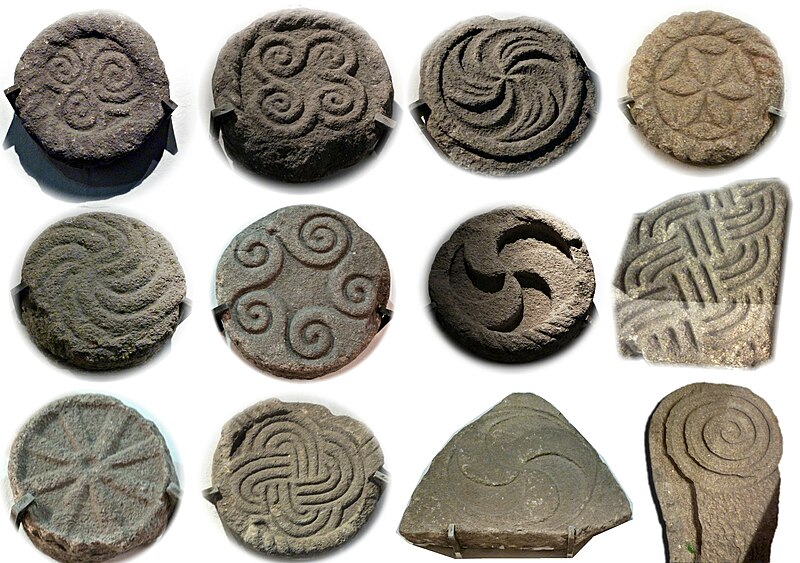
The 6-prong solar symbol was one of the images found among the Celts of the northern Iberian Peninsula. It is seen here on these 9th century BC artifacts found at the archaic high places.

Monday, August 11, 2008

Women Rulers in Ancient Israel

Alice C. Linsley


In Genesis we note many women of high social standing. Some are known as the wives of rulers: Adah and Zillah, Sarah and Keturah, and Rachel and Leah . Others are known as the daughters of famous priests: Asenath and Zipporah. Some are remembered for doing something extraordinary, such a when Zipporah circumcised her son, or when Jael [1] drove a tent peg through the skull of an enemy commander. In this essay, we will consider women rulers in ancient Israel from Deborah and Huldah to Salome Alexandra who ruled from 76-67 B.C.

Deborah, a Ruler in Israel

Judges 4:4-6 tells us, “Deborah, the wife of Lappidoth, was a prophet who was judging Israel at that time. She would sit under the Palm of Deborah, between Ramah and Bethel in the hill country of Ephraim, and the Israelites would go to her for judgment."[2]

Ramah is where the prophet Samuel resided. The elders of Israel came to Ramah to demand that Samuel appoint a king to rule over them. David fled to Ramah for Samuel's help when Saul sought his life. Bethel also has numerous references, all indicating that it had cultic significance. Deborah is associated with a tree midway between these two important shrines. [3]

The idea of being at the center is reminiscent of Abraham's setting up his tent at the Diviner's tree (called the “Oak of Moreh”) between Ai and Bethel (Gen. 13). In this between place God visited Abraham in the heat of the day (Gen. 18). Here Abraham deliberated with the Lord about the fate of Sodom and Gomorrah. This information rounds out our picture of Deborah as one who deliberated with the Lord on behalf of Israel as a judge and a prophet, and we see the significance of sacred trees in connection to those elevated to leadership. She judged from her date nut palm [4] between Ramah (meaning high or lifted up) and Bethel (meaning house of God).

Though Deborah had great authority, she didn’t rule over all of Israel. She lived at a time before the monarchy in Israel. This period of time is described in the book of Judges, which records the deeds of a dozen judges: Othniel, Ehud, Shamgar, Deborah, Gideon, Tola, Jain, Jephthah, Ibzan, Elon, Abdon and Samson. Though they are presented in what appears to be chronological order, some of these judges were contemporaries, each with his or her tribal jurisdictions.

Deborah's duties would have been like those of other judges. We are told that judges were called by God, helped to settle disputes, gave direction to people from God, and were respected by all the people. Judges 4 and 5 tells us that under Deborah’s rule, the land had peace for forty years.

Palm Trees and Oaks

The association of palm trees with rulers and prophets is a common among many African tribes. Fresh palm tree fronds are used ceremonially at the installation of rulers. Palm tree branches are also used to decorate places of worship. The tamar is a sacred symbol in Africa and the Negev, analogous to the oak for the Jews and the Greeks.

In Africa, rulers and oracles sit in the shade of such trees. That Deborah did so indicates that she was indeed both a judge and a prophet in Israel. "Torah" [5] means that which is thrown by the hand of the Moreh (oracle or prophet). Abraham received guidance when he pitched his tent at the Oak of Moreh. The word "Torah" is usually rendered guidance or instruction, but the word is also associated with a prophet sitting under a tree.

When the people used palm fronds to greet Jesus as he entered Jerusalem, they greeted him as one to be enthroned. The connection between rulers and trees at sacred centers is found among the tribal peoples of West Africa. Among the Yoruba, fresh palm tree leaves are “employed on occasions of installation to the position and rank of a sovereign, and to the office of a priest of high rank.”[6]

Palm tree branches are commonly employed to decorate places and objects of worship in Africa and the Arabian Peninsula. The palm tree’s height, strength, durability and the upward direction of its younger branches represents the righteous heart. The palm tree was regarded as sacred both by the Etrurians and the Greeks, just as the oak was considered sacred by Jews, Greeks, and the ancient Celts of Gaul and Britain.

Huldah

Huldah lived approximately 655 years after Deborah. She too served as a judge in Israel. We read in 2 Kings 22:14 that King Asaiah sent his priests to consult the “prophetess” Huldah. She was living in Jerusalem, in the new section. Her name indicates that she belonged to the tribe of Hul, a son of Aram (Gen. 10:23).

Queen Salome Alexandra

The August '08 issue of Biblical Archaeology Review reports on a Judean queen named Salome Alexandra who ruled alone from 76-67 BC. Here is an excerpt:

When people hear the name Salome, they immediately think of the infamous dancing girl of the Gospels. Herod Antipas—the man Jesus denounced as a “fox”—had married his brother’s wife, Herodias. When John the Baptist denounced this illicit union, Herod Antipas cast him into prison. It was Herodias’s daughter, Salome, who danced before Herod at his drunken birthday gala. Her performance so pleased Herod that he promised her anything she wished: up to half his kingdom! At her mother’s urging, Salome asked for the head of Herod’s most famous prisoner on a platter. Fearful of breaking his word before his guests, Herod granted ­Salome’s request and ordered John the Baptist beheaded.

In antiquity there was a considerably more famous Salome, however, who was revered for centuries. She was so admired that generations of mothers named their daughters Salome in her honor. This Salome was the only woman ever to govern Judea as its sole ruler. She is even mentioned in the Dead Sea Scrolls: the sole woman, and one of only 18 people named in the scrolls. She presided over a number of religious reforms that shaped the Judaism of Jesus’ day as well as our own. During a time of chaos, men chose her to lead their nation and fight their battles. Centuries later, the authors of the Talmud regarded her reign as a golden age. Yet this remarkable woman has been largely erased from history. Her name is Queen Salome Alexandra.

The BAR article provides information about Salome from the Nahum Pesher which alludes to her as a prostitute. We recall that this same accusation was brought against Tamar when she sought to claim her rights (Gen. 38).


Related reading:  Deborah Warrior Bee; Mary's Ruler-Priest Lineage; The Daughters of Horite Priests


NOTES

1. Read the story of Jael in Judges 4:17-22.

2. The population centers referred to in Judges 4–9 can be identified with reasonable certainty. These include Hazor, Ramah, Bethel, Kedesh-Naphtali, Taanach, Ophrah, Tabbath, Succoth, Shechem, Arumah, and Thebez. Hazor, Bethel, Taanach, Succoth, Shechem, and Thebez have been excavated thoroughly.

3. Mircea Eliade, a Romanian sociologist of religion, wrote about the significance of the sacred center for primitive peoples. See his Cosmos and History: The Myth of the Eternal Return. Many ancient cultures regarded their most sacred places as the center of the cosmos. The ancient Incas regarded Cuzco as the “ombligo” (navel) of the earth.

4. The date nut palm is called a “tamar”. Tamar is also the name of two prominent females in the Old Testament: David’s ancestor, and David’s sister.

5. Torah is "what is thrown by the Moreh". This can be the 'arrow' from the archer or the 'direction' (teachings and instructions) from the teacher. The true Hebraic understanding of Torah is "instructions" and "teachings" such as from a father to his children. Read more about the meaning of Torah, here: http://www.ancient-hebrew.org/5_torah.html

6. To Read more about the palm tree in connection with rulers, priests and shrines, go here: http://www.sacred-texts.com/afr/mind/mind24.htm