Followers

Showing posts with label Kushite expansion. Show all posts

Saturday, March 8, 2014

From the Nile to the Philippines


Dear Ms. Alice Linsley,

Blessings of Peace and Good Health to You.

I have read your blog for about two months now and what has been bothering me mentally for the past 50 years has been lightened. I seem to understand now why my father, who died in 1994, as said by my uncle who recently died, witness by my mother from their acquaintances in their early years, until I witness it myself, would wake at dawn every day to face the rising sun and pray for two hours, and in the midday, he stopped whatever he was doing to pray, and in the afternoon he faced the downing sun to pray again.

And when in my younger years I asked why he faced the sun to pray he would say "because it is the emblem of God." He would lie kissing the ground but in all his life he was not a follower of Islam. In fact, in the Catholic church in Dauis, Bohol his grandfather Damiano Bulang's name is etched in the first right side Column. How I longed and wish I can show my father to you in his position while performing his dawn prayer facing the sun, and I can hug him today.

Father of Jose C. Bulang

When I was about 9 or 10 years old after reading history of Daniel, about Samson in the Bible, about Alexander the Great in World History, one time I asked my father where we were descended from and he would say it was not clearly known, but his great great great grandfather was a name of Osman and once said that he come from the house of Sulaiman. And so I embark on research in my later life, and I found out that my family name Bulang was name of the place kampung Bulang of the royalty of Malacca/Johore (Hindu-Malay) empire from 1400-1800.

I have read every entry of the www.royalark.net pertaining to Malaysia and Singapore. In fact, I noticed the brother-sister-cousin marriage practice. And it appeared that my great grandfather is a sent away first son of the Sultan Sulaiman Badr Ul Alam Shah who ruled Johor Empire from 1720-1760, and this is together with the sent away grandson of his successor son Sultan who was murdered. The period being the most turbulent in South East Asia being occupied and conflict area by the Dutch and English. In fact, in that Genealogy it appeared that the wife of Sultan Husain who signed the cession of Singapore with Sir Stamford Raffles to British was named Inche Puan Bulang. And so I was wondering and bewildered where our roots are coming from.

And two years ago I have myself DNA profiled under 16 Y-STR, and to my great surprise although I can not exactly understand and interpret it result some of my individual data under are aplenty in Iberian peninsula.


You can see picture of my father while 20 years old when you google the "House of Bulang."  But take no mistake, we are poor and we are working hard to progress as a family. We are related to family who have family name like Tubal, Tubio, and Abejaron which may be read Abd el Iaron.

Anyway, in the wikipaedia there is an entry about Gujarat. It speaks of Gujjars whose origin is unknown but it says that these people were Sun worshipers. It said that its plate has an emblem of God, Sun.

Is it possible that these people known as Gujjars are descended from Horite ruler-priests and maybe descendants of Keturah?

My apology for taking much of your time. I think I just got excited. I am really thankful you have helped me in my research and I hope to God I am not wrong about my presumption.

Thank you and more Power. May Almighty God Bless you always in all your labors.


Very respectfully yours,

JOSE C. BULANG


I am very grateful to Mr. Bulang for contacting me and for his kind words about my research in Biblical Anthropology. It is my hope that this research will help and bless many people. Here I hope to answer some of Mr. Bulang's questions.

The Bulang clans are found in many parts of the world. Some are the original inhabitants of Yunnan in China. Yunnan can also be Yon or Y-On (as in Biblical On on the Nile) or Y-Ainu. There the Bulang live in huts, often on pillars, in the humid mountain forests. A rite of passage to signal readiness for marriage among the Chinese Bulang involves dying their teeth. Among the Nilotic Luo and the Natufians of ancient Lebanon, Palestine, Jordan and Syria, the rite, called nak, involved removing six front teeth.

The round houses of the Bulang and their old ways of life resemble those of the Ainu of Northern Japan. Here is a photo of a Bulang women cooking in Yunnan.


Compare this image to the photo below of Ainu women and their homes in Northern Japan.


Note the letter Y in the place called Yunnan. This ancient symbol indicated a people who venerated the Sun, like the Biblical Horites. In fact, the word Jo-hor reflects Horite beliefs. A variant spelling would be Y-Hor and it means Horus is God's appointed, or the Messiah. The point of origin for Messianic expectation is the Nile Valley and the expectation is expressed in the language, images and religion of Abraham's Nilo-Saharan ancestors for whom the Y was a solar cradle that indicated the ruler-priest. That is why the names of many Biblical rulers begin with Y. Yaqtan (Joktan), Yacob (Jacob), Yosef (Joseph), Yeshua (Joshua), Yetro (Jethro) and Yishai (Jesse) are examples.

The cultural context of these people is Kushite. According to Genesis 10, they are descendants of Noah through his grandson Kush and Kush's sons Ramah, Dedan and Nimrod. These are the rulers, priests, merchants and craftsmen of the ancient Afro-Asiatic Dominion. The Bible speaks of them as "the mighty men of old." They migrated out of the Upper Nile Valley in different directions, but the main movement was to the east.

Migrations out of the Upper Nile traced genetically

DNA evidence confirms the Kushite migration out of the Nile Valley. There were many migrations, but the Kushan-Yuezhi provide evidence of a relatively recent movement of Kushite craftsmen-traders. By this time, human populations were scattered across the earth wherever there were major water systems. Some of those populations resulted from earlier migrations out of Africa. The first took place about 120,000 years ago and the second about 70,000 years ago. The Kushite expansion coincided with the spread of the Horite religion by the Hapiru. In the proto-Saharan languages p is replaced by b so Hapiru also appears as Habiru (Hebrew).

The Habiru venerated the Sun as the emblem of the Creator, just a Christians venerate the Cross as the emblem of Jesus Christ. They did not worship the Sun, as the Wikipedia article claims. Even today in Judaism the Birka Hachama or “Sun Blessing” is performed every 28 years.

Some Kushite craftsmen-traders moved into central Asia and China, and others moved into Japan. They are also called Gujjar and Gurjar. Gurjar is a reference to their mercantilism and metal work. Bulgaria likely refers to a territory (bul) in which the Gurjar lived.

In Akkadian gurguri means metalworkers or copper smiths. In Somali Oromo gurguru means to sell (gurgurtaa = sale, gurguraa = seller). In Somali gur- refers to collecting something and gurgure means one who collects and keeps collecting. The Gurgure clan of the Somali Dir refers to traders who collect wares and resale them. Among the Dir guri means stick, rod or firearm. Among the Ainu of Northern Japan guruma means wheel. The Ainu of Japan believe the "koro-pok-guru" lived there before the Ainu.

A Gurjar friend tells me that her people are descended from the Kushan and Huns. There are 10 Gujar clans in India: Kasana/Kushana (the largest), Baisla (Baileus in Greek), Khatana, Hoon, Hepthali, Tongar, Chechi, Chawda, Guj and Gorsi. The Kushana of India and the Gurjars of Punjab worship Nana, the goddess of the Nile. There are hundreds of Gurjar clans spread across India, Pakistan, and Afghanistan. (The plight of the Gurjars is discussed here.)

These traders and merchants of the ancient world did business along the great rivers and were also seafaring. Their commodities were weighed and evaluated at the shrines by the Horite ruler-priests. This custom is evident in the book of Leviticus where it equates twenty gerahs to one shekel (Lev. 27:25). The custom of the priests weighing and placing value on offerings and traded commodities explains the linguistic connection between the Gurjars and the Horites and between the words ghar/khar and har. In ancient Egypt khar referred to a unit of measurement offered at the temple (James Orr, The International Standard Bible Encyclopedia, page 1421). The association of the roots gr (trader) and hr (Horite) is evident in Southern India in place names such as Gurgaon Haryana. Mr. Bulang's forefathers came from this part of India.

The movement of craftsmen-traders out of the Nile Valley began long before Abraham's time, so it is not possible for Mr. Bulang to establish lineage from Abraham and Keturah. His ancestors may well have been in Southern India when Abraham lived in Canaan, or they may have been closer to the Philippine Islands. If they came from Arabia originally, they might be related to the Joktanite (Yaqtani) clans of southern Arabia who descend from Keturah's father, Joktan the Elder. In some ancient Near Eastern texts these Arabian craftsmen-traders are called "Sauda-gar."


Related reading: The Kushite-Kushan ConnectionChinese Geneticist: Chinese Ancestors Were AfricansThe Nile-Japan Ainu ConnectionA Kindling of Ancient Memory; The Horite Marriage and Ascendancy Pattern; The Urheimat of the Canaanite Y; Boats and Cows of the Nilo-Saharans; The Afro-Arabian Dedanites; More East Africa-Asia Connections; Making Sense of Genesis 10; Sent Away Sons


Dear Ms Linsley,

May Blessings of God most merciful and generous be upon you.

I felt so insignificant and humbled by the knowledge you imparted to me. When I was younger my father would cuddle me while sayings his prayers to God, and blessings upon me. Even now I can visually imagine him standing covering my head with his two palms while I am kneeling and pronouncing blessings for me and to his future descendants.

Thank you for your very valuable help. I felt I have just started my journey back and it is a long way home. It has been a long hard travel of my forefathers from somewhere in Nile through the valleys and mountains of Arabia, the valleys and mountains of India, the rivers and seas of South East Asia, the peace and wars, and finally where and what I am today. I know it is the same experience for others too.


JOSE C. BULANG


Dear Mr. Bulang,

Thank you for sending your DNA Profile. This traces your Y-chromosome ancestry, or your patrilineal ancestry. Y-STR profiles are exactly the same among distantly related males down centuries of patrilineal lines.

Here is an explanation about how DNA profiling works:
http://www.dna-fingerprint.com/static/Null-Alleles.pdf

Scroll down to where it shows the null allele at DYS448. Here no signal was detected in your DNA. So this eliminates from your ancestry all men with this allele. DYS448 is found most in East Asian populations. So it appears that your ancestors did not originate in East Asia.

The primitive Iberian ancestry is really Paleo-North African. This might include ancient Nilo-Saharan peoples, some of whom went to Southern India.

Best wishes,
Alice C. Linsley


Saturday, May 18, 2013

Genesis on the Ancient Kingdom Builders


Tomb painting at Nekhen, c. 3300 B.C.


Alice C. Linsley


Genesis tells a story of a mighty race of archaic rulers who dispersed widely taking with them skilled craftsmen and priests. Obviously, since the rulers listed in Genesis 4 and 5 are Neolithic kings, Genesis begins the story of Abraham's Nilo-Saharan ancestors much later than the earliest humans. It does provide some anthropologically significant data, however, about early human communities, ancient castes, and the religious beliefs honored by the people.

Ancestor veneration was practiced universally and it appears that there was a widespread expectation of a righteous ruler who would establish universal rule of peace and justice. He was a man who carried a big stick. He was expected to produce children to enlarge the clan. He would have had more than one female partner. He was honored at his death by a proper burial, usually in hidden subterranean caves or in remote mountain caves.

The first historical ruler named in Genesis is Kain/Kayan (Kahn), which means king. His line intermarried with the line of his ruler Seth. This means that Cain's line was not cut off in the flood. Likewise, the lines of Ham and Shem intermarried. Abraham is a descendant of both.

Nahor the Elder was Abraham's grandfather. Abraham's mother and father had the same father but different mothers, as shown in the diagram below. Nahor was the royal title of Abraham's older brother. He ruled in the territory of his maternal grandfather and of his father Terah in the region of Aram Na-haraim, between the western Tigris and the Euphrates. This territory was established by Nimrod, one of Nahor's ancestors (Gen. 10:8-12) Na-Haraim means "dedicated to Horus."  This was Horite territory.

The Horite rulers of Edom are listed in Genesis 36. They are described as having a red skin tone.


Nahor the Elder was a descendant of Nimrod, the great Kushite kingdom builder. Erech (Uruk), Accad and Calneh were shrine cities in Nimrod's territory. Accad is Agade, the original name of a river settlement in Odukpani, Nigeria. Accad is a variant of Agades, a city in Niger which is famous for metalwork.

From there Nimrod expanded his territory to include other important cities, including Asshur, Nineveh, Rehoboth-Ir, Calah, and Resen. All these cities had a common script - the Akkadian cuneiform.

In Nigerian lore Nimrod is known as Sharru-Kin which means “the righteous King.” Nimrod's Akkadian name was Šarru-kīnu, which is usually translated “the true king.” Nimrod’s territory was called Kish, which is Kush. A seventh century Assyrian text designated Azu-piranu on the Euphrates as a principal city. It was a Horite shrine as evidenced by the word piranu. The Hapiru (Hebrew) devotees of Horus called their temples O-piru, meaning House of the Sun. Azu is an Nilo-Saharan name for God - Asa. Variant spellings include Asha, Ashai and Am-ashai (Nehemiah 11:13). Azu-piranu means “House of God” and is equivalent to the Hebrew Beth-el. 

The language of Nimrod's territory was related to Elamite, Dravidian, Chadic and Nilo-Saharan languages. Nimrod was a son of Kush (Gen. 10:8-12). Abraham's family demonstrates the movement of peoples out of Africa along ancient water ways.

Linguistics and DNA studies have shown that Abraham and his ancestors were Kushites whose cultural context was that of the Afro-Asiatic Dominion which extended from West Africa to India. The region in red shows the area of Kushite expansion. "Kushite" is a general term that includes many peoples and skin tones, including red, brown, reddish brown and black.


The Archaic Afro-Asiatic Dominion
(Image from Clyde A. Winters)


This marriage and ascendancy pattern of the Kushite rulers drove expansion out of Africa. Genesis indicates that Kushites moved out of Africa into Mesopotamia and Central Asia. They brought their religious practices and beliefs with them. Kushite rulers, such as Nimrod and his priests spread a common worldview to India, Nepal, Cambodia and beyond. This stone relief at Anghor Wat shows the Ra's solar boat with Horus flying as a falcon at the top of the mast. Anghor is ankh-Hor which means "Long live Horus!"


Nimrod was a younger son of Kush and was a "sent away" son. Sent-away sons are especially famous in the Bible for founding new territories or ascending to prominence in neighboring territories. Cain, Abraham, Ishmael, Jacob, Joseph and Moses are examples. Jesus Christ is God's sent-away son who establishes the eternal kingdom. 

Just as Abraham gave gifts to all his sons and sent them away from his heir Isaac, so Kush gave gifts to his son Nimrod and sent him away from his older brother Ramah whose territory was in Arabia. As with all sent-away sons in the Bible, there was struggle and hardship, but ultimately by God's grace, these sons prospered. Nimrod’s territory was far greater than Ramah's.


Scribes, Warriors and Smiths

Rulers such as Nimrod, Nahor and Terah were supported by the Ar clans, who were royal scribes. Among the Igbo, the scribe clans were called Ar or Aro. The Nsibidi script, said to be the oldest script of Africa, contains may Sumerian and Egyptian hieroglyphs. Likewise the Akkadian reflects the movement of royal scribes from the greater Chad basin along a west-east corridor.

The rulers were highly effective warriors who were served by metal workers who fashioned their weapons and symbols of authority such as iron beads and crooked staffs. These are called the Nes, Neshi or Nehesi. The metal-working Nes of Anatolia are their kin. The Neshi still function as priests in Igboland.  

The Nes were a caste of smiths who venerated the cosmic serpent, the totem of their people. The ancient Egyptian Asa-ar means the Serpent of Asa (Deity). The peoples living in Arvad, Tyre and Sidon employed serpent imagery in their temples and shrines. The serpent was venerated among the Kushite ruler-priests of Israel. Aaron forged a bronze serpent on a rod which Moses raised over the people. All who looked upon it were saved from death.

Nehesi and the Biblical name Nahor share a common NH root. Na-Hor means the Na of Horus, that is to say "One who serves Horus." In Akkadian, Na is a modal prefix indicating service to, affirmation, or affiliation. Nahor was apparently a Horite ruler-priest, as was his father Terah. Terah means priest. It is evident that Terah and Nahor are titles.

Nehesi means "One who serves Hesi."  Hesi was another name for Hathor-Meri, Horus' mother. Throughout the ancient Afro-Asiatic world shrines were dedicated to both Horus and Hathor. These were mound cities with water sources. Tell-Hesi is an example. Other mound shrines included Hazor and Beersheba.

Nehesi also refers to people of the Upper Nile, and often appears as Ta-Nehesi, meaning Land of Nehesi. Ancient Kush was also called Ta-Nuhusi, a variant of Ta-Nehesi. Today this is designated as Nubia.

Ne-Hesi monument found in Nubia

This evidence indicates a back and forth east-west movement of peoples along a well-watered equatorial zone. Given the antiquity of haplogroup L2a1 (c. 100,000) it appears that there was more mixing of peoples in the well-watered Saharan region than generally recognized. Haplogroup L2a1 also was found at Tell Halula in Syria (c. 9600).

It appears that the Akwa neshi dwarfs, the Khwe, and their southern Pygmy neighbors, share a common cradle land in the region of Nigeria-Cameroon where they enjoyed the benefits of the Benue and Niger Troughs that connected to the greater Chad Basin and to various lakes in Sudan and to the Nile. The interconnection of these water systems made travel and commerce possible across vast distances. 

Genetic comparisons of the Khwe and the sub-Saharan Kung San indicate different peoples living in close proximity. The Kung mtDNAs are mainly L1a2, a subset of the sub-Saharan Pygmy. Genetically, the Khwe (Kwa/Akwanshi) are more closely related to western African Bantu-speaking populations than to the Kung San. The Nigerian historian, Dr. Catherine Acholonu, describes the Khwe or Kwa Igbo as the "Diaspora Igbo," indicating movement along those water systems. She calls the Akwanshi the "Igbo First People."

Dr. Acholonu argues that Iboland is the cradle of the dispersed kingdom builders. That view is not supported by a limited study done at the University of Khartoum. The findings are in this report:

The area known today as Sudan may have been the scene of pivotal human evolutionary events, both as a corridor for ancient and modern migrations, as well as the venue of crucial past cultural evolution. Several questions pertaining to the pattern of succession of the different groups in early Sudan have been raised. To shed light on these aspects, ancient DNA (aDNA) and present DNA collection were made and studied using Y-chromosome markers for aDNA, and Y-chromosome and mtDNA markers for present DNA. Bone samples from different skeletal elements of burial sites from Neolithic, Meroitic, Post-Meroitic and Christian periods in Sudan were collected from Sudan National Museum. aDNA extraction was successful in 35 out of 76 samples, PCR was performed for sex determination using Amelogenin marker. Fourteen samples were females and19 were males. To generate Y-chromosome specific haplogroups A-M13, B-M60, F-M89 and Y Alu Polymorphism(YAP) markers, which define the deep ancestral haplotypes in the phylogenetic tree of Y-chromosome were used. Haplogroups A-M13 was found at high frequencies among Neolithic samples. Haplogroup F-M89 and YAP appeared to be more frequent among Meroitic, Post-Meroitic and Christian periods. Haplogroup B-M60 was not observed in the sample analyzed.

For extant DNA, Y-chromosome and mtDNA haplogroup variations were studied in 15 Sudanese populations representing the three linguistic families in Sudan by typing the major Y haplogroups in 445 unrelated males, and 404 unrelated individuals were sequenced for the mitochondrial hypervariable region.

Y-chromosome analysis shows Sudanese populations falling into haplogroups A, B, E, F, I, J, K, and R in frequencies of 16.9, 8.1, 34.2, 3.1, 1.3, 22.5, 0.9, and 13% respectively. Haplogroups A, B, and E occur mainly in Nilo-Saharan speaking groups including Nilotics, Fur, Borgu, and Masalit; whereas haplogroups F, I, J, K, and R are more frequent among Afro-Asiatic speaking groups including Arabs, Beja, Copts, and Hausa, and Niger-Congo speakers from the Fulani ethnic group.

Accordingly, though limited on number of aDNA samples, there is enough data to suggest and to tally with the historical evidence of the dominance by Nilotic elements during the early state formation in the Nile Valley, and as the states thrived there was a dominance by other elements particularly Nuba/Nubians."


Sunday, April 28, 2013

Coin Confirms Medieval China-East Africa Trade


Ancient Chinese Coin Found on Kenyan Island by Field Museum Expedition


A joint expedition of scientists led by Chapurukha M. Kusimba of The Field Museum and Sloan R. Williams of the University of Illinois at Chicago has unearthed a 600-year-old Chinese coin on the Kenyan island of Manda that shows trade existed between China and east Africa decades before European explorers set sail and changed the map of the world.

The coin, a small disk of copper and silver with a square hole in the center so it could be worn on a belt, is called “Yongle Tongbao” and was issued by Emperor Yongle who reigned from 1403-1425 AD during the Ming Dynasty. The emperor’s name is written on the coin, making it easy to date. Emperor Yongle, who started construction of China’s Forbidden City, was interested in political and trade missions to the lands that ring the Indian Ocean and sent Admiral Zheng He, also known as Cheng Ho, to explore those shores.

“Zheng He was, in many ways, the Christopher Columbus of China,” said Dr. Kusimba, Curator of African Anthropology at The Field Museum. “It’s wonderful to have a coin that may ultimately prove he came to Kenya,” he added.

Read it all here.


Coins Useful in Tracking Ancient Trade Routes


Alice C. Linsley

Human remains and other artifacts were found on the Kenyan island that predate the 600-year old coin.
According to researchers, the coin is further confirmation that trade took place between Africa and China as late as the 15th century A.D.

The Kushites moved out of Africa between 12,000 and 10,000 years ago. They were great kingdom builders who established their centers of commerce on the major water systems. Kushite populations still inhabit southwestern China. They are called Kushan-Yuezhi or Gueis-Huang. The Kushan capital was Hucao at the lower Wakhsh (Oxus) and the Darya-i Pandj (Ochus) river valley towards Aï Khanum.

Another Kushite group is the Ainu of China, described as a "caste of circumcisers." They number approximately 6,500 people. Most live scattered over northwest China in the counties of Hetian, Luopu, Moyu, Shache, Yingjisha, and Shulekuche, near the ancient oasis city of Kashgar. They keep sheep and goats.

In 1944, Australian soldier Maurie Isenberg, stationed on an island to man a radar station, found a trove of 1000 year coins on an island off northern Australia. The coins came from the former Kilwa Sultanate, now a World Heritage ruin on an island off Tanzania. Kilwa was a trade port with links to India and Asia between the 13th and 16th century. In 1331-1332, Ibn Battouta stayed in Kilwa and described the it as one of the most beautiful cities of the world.

The coins were minted in sub-Saharan Africa.

The trade with gold, silver, pearls, perfumes, Arabian stone ware, Persian ceramics and Chinese porcelain made Kilwa one of the most influential ports in East Africa.


Monday, April 15, 2013

The Pyramids of Bosnia


The Bosnian Pyramid Valley consists of the five pyramids.


According to Wikipedia everything is fabricated and a hoax and these pyramids are random hills. However, there is no doubt that the people living in the Visoko region were pyramid people. Here is a photo of a votive pyramid unearthed in Visoko. It dates to ca. 5th millenium BC. These were likely the ancestors of the Kushan who constructed similar pyramids in the Tarum Valley of China.
 

Pyramid of the Sun, Visoko, Bosnia
Photo credit: Jock William Doubleday


This tunnel is reinforced with timbers, but the original is very similar to the well-preserved fogou at Carn Euny in Cornwall, England. Genetic and linguistic studies indicate that ancient stone masons from Serbia migrated to South Western England.


Artificial, extremely hard ancient concrete on the Bosnian Pyramid of the Sun
Photo credit: Jock William Doubleday, taken July 26, 2014


There is little doubt that thousands of years ago rulers were building pyramids across the surface of the earth. The pyramids reflect a fairly sophisticated knowledge of astronomy and architecture. The Visocica hill that rises above the town of Visoko, near Sarajevo, appears to be a natural mound worked by humans probably no earlier than 5000 years ago.

Semir Osmanagic investigated the site in his homeland. "The hill was already there," he said. "Some ancient civilization just shaped it and then coated it with this primitive concrete -- and there you have a pyramid."

Ancient sites such as pyramids, tombs and fortresses often align with the cardinal points and open to the east and/or west. The alignments of many ancient sites appears to reflect knowledge of sidereal astronomy. Some sites align to the point of origin of the people who built them. Old Arabic is sometimes called "Dedanite" because that is where the largest concentration of old Arabic scripts has been found. The oldest mosques were aligned to a site in Dedan.

Ancient Nilotic rulers aligned their pyramids at Giza, Saqqara and Abusir to the obelisk at Heliopolis (Biblical Onn/Annu), the geodetic center of Egypt. The corners of most of the 4th - 6th dynasty pyramids are aligned to Heliopolis. The pyramid triads at Giza, Zaqqara and Abusir are examples. Baalbek in Lebanon, also called Heliopolis, aligns to the obelisk in Heliopolis, the City of the Sun.


Number Symbolism of Pyramids and Shrines 

The number 72 represents the number of years it takes for the constellations to move one degree due to precession. The Great Pyramid and Angkor Wat are nearly 72° apart, along the circle's circumference (diagram below). It has been noted also that Angkor Wat is located 72° of longitude east of the Pyramids of Giza. Angkor is related to the ancient Egyptian Anhk-Hor, meaning "Long live Horus."

Credit: Jim Alison


Point A represents the Angkor Wat complex of 72 shrines.
G represents the Great Pyramid of Egypt.

Point I represents Har-Appa in the Indus valley. Har-Appa means "Horus is Father." 

Point M is the pyramid at Machupicchu with 72 steps. Point E is Easter Island.


The number 72 also represents deified rulers, or Horim. In Exodus Moses and Joshua appointed 70 elders to serve with them. In the Qur'an there are 72 Houris. These are not full-breasted virgins to be enjoyed by martyrs in the afterlife. In a note to his fellow hijackers, September 11 ringleader Muhammad Atta reminded them of their impending "marriage in Paradise" to the 72 virgins or Houris. Islamic extremists refer to suicide bombing as a "wedding to the black-eyed in eternal Paradise." However, the shock of Atta's afterlife will be to discover that the 72 Houris are, as Arabic scholar Dr. Maher Hathout argues "beings of distinction."

Walls of Eredo in Nigeria
The walls of Eredo are about 72 feet high and run a length of about 100 miles, making this Africa's largest monument. The British archaeologist Patrick Darling is credited with drawing world attention to the discovery of the Eredo system of walls. He reports, "We are not linking what we found to a city, but to a vast kingdom boundary rampart."
The New Temple described in Revelation 21:17 has walls that are 72 yards high (144 cubits).


Tomb Building and Mining

In the ancient world the people who were experts in mining operations were also responsible for building excavated tombs and pyramids such as those found in Bosnia and the Tarum Valley of China. This continued to the time of Jesus. Joseph of Ar-Mathea was a mining expert who had business and probably family in Cornwall, England. He was also a tomb builder. Jesus' body was laid to rest in Joseph's own tomb. This would have been a tomb fitting for a ruler-priest. Joseph was a member of the Sanhedrin.

Thursday, January 17, 2013

Is Hebrew an African Language?


Alice C. Linsley

I believe the evidence supports the view that many of the languages in the Afro-Asiatic family have words that can be traced back to biliteral roots found in Africa. Some of the figures or marks found in later scripts are found on Proto-Saharan pottery and on petroglyphs in Sudan and Somalia.

Before the Old Testament books - originally all separate clay tablets or scrolls - there were Paleo-Hebrew writings found in the region of Judah and Edom. Mostly these were commercial records, trade agreements, and political records. They were sealed with Paleo-Hebrew bullae/seals, many of which used the Holy Name or variants of the Holy Name like Yah or Yahu. This name was known in ancient Nubia.

The Hebrew Bible has many non-Hebrew words that are derived from proto-languages of peoples who migrated out of the Nile Valley and the Sahara. Hebrew relies on Proto-Canaanite and ancient Egyptian and Proto-Saharan words. The ancient Egyptian signs (hieroglyphs) provide valuable clues to understanding many of the non-Hebrew words that appear in the Old Testament that have a Nilo-Saharan origin. Egyptian hieroglyphs were widely used among the early Semites because Egypt had become very powerful and exercised great influence in Canaan as evidenced by the Egyptian shrines on the ancient Horus road.

Proto-Sinaitic inscriptions have been found in the region of ancient Nubia that date to 1900 BC. Descendants of Proto-Canaanite writing systems include Ugaritic, Phoenician, South Arabian and North Arabian scripts.

Another writing system that is important for understanding non-Hebrew words in the Old Testament is Sumerian. Some Sumerian words like: sahar (sand, dust, black, ashes); eden (steppe land, watered plain), and harran (route, roadway) appear in the oldest material in the Old Testament. Sahar שחר is the Hebrew word for black.

Sumerian marks resemble those of the Nilotic cattle-herding peoples. Here we will find some very ancient marks: V, T, X and the solar symbols O and Y. Many of these appear in the old Oasis North Arabian scripts like Thamudic, Dumaitic, and Taymanitic. The urheimat of the Canaanite Y is the Proto-Saharan cattle herding and boating populations. They are among Abraham's ancestors.

The Akkadian language of Nimrod's empire in the Tigris-Euphrates region, is also important when it comes to understanding material in the Old Testament. Nimrod was the sent-away son of Kush. He represents the Kushite dispersion out of the Nile Valley into Canaan and beyond. It is not surprising that there is an affinity between Akkadian and Proto-Hebrew.

Arabic, Aramaic and Hebrew share a common proto-system. Some of the oldest Arabic scripts are called "Dedanite" because the highest concentration of these scripts has been found in the region of Dedan. The Ainu script shares signs with these proto-scripts because the point of origin of the Ainu was the Nile Valley.

All of the scripts I have mentioned are in the same Afro-Asiatic language family, except the Ainu, the origin of which is still disputed. The evidence suggests that it may be related to proto-languages of Turkey and Hungary. The Hungarians called themselves "Magyar" and claim to be descendants of Noah, a Nilo-Saharan ruler. It is also known that the archaic Nilotic rulers moved into Turkey because they built the shrine city Meroe on Mount Silpius overlooking the Orontes River. The fortress on the spur of Mount Silpius was named IO, which means “pillared place dedicated to the Creator.” The O was a solar image. The sun was the Creator's symbol or emblem. Heliopolis (Biblical On) was called “Iunu” which means "place of pillars" because it was constructed with many pillars.

The earliest paleo scripts were used to communicate things like directions for people migrating, forks in trails, bend in rivers, mountains, caves, crossings, direction to go, feeding grounds for herds, etc. Many of the figures used in the later writing systems are derived from these symbols that appear on the walls of caves. See Symbols of Archaic Rock Shelters.


Words related to Horite religion

In ancient Egypt, the three superior planets Mars, Jupiter and Saturn were associated with Horus. Mars was named "Horus of the Horizon" or "Horus the Red." Jupiter was called "Horus Who Illuminates the Two Lands." Saturn was named "Horus, Bull of the Sky." These three superior planets were always depicted with the falcon-head of Horus (Krupp 1979).

The association of the falcon or owl with Horus is the likely source of the Semitic malk or melek, meaning king. In ancient Egyptian the owl was called m-l-k (See Gabor Takacs, Etymological Dictionary of Egyptian, p. 1).

In Hausa, a type of owl is called bambani. The word is related to ba-na, horni and hanu. Here we have a suggestion of the connection between Horus and Hanu or Ainu. (See Dictionary of Hausa, p. 19) Abraham's father bore an Ainu title- Terah, meaning priest.

In Hausa the word for king or ruler is sarki (See Charles Henry Robinson, Dictionary of Hausa, XXIV Preface). Auran saraki refers to the king's minister and is usually rendered chief. The word auran is related to Harun and Aaron, and to the Greek and Latin word for gold which is aurum. Aaron was asked by the Hebrews to fabricate a golden calf. The calf was the totem of Hathor-Meri, the mother of Horus. The oldest know site of Horus worship is Nekhen in Sudan. This appears to be the area where Abraham's ancestors listed in Genesis 4 and 5 originated.

Moses had a Kushite wife, probably his half-sister since Zipporah was his cousin bride.The Kushites were descended from Noah, a great Proto-Saharan chief. His grandson was name Kush and his great grandson Nimrod was a Kushite kingdom builder.

Kush was famous for gold, a fact to which Genesis alludes when speaking of the river Pishon that flowed through the land of Ha'vilah, where there is gold (Gen. 2:11). Another African river is the Gihon which wound through the land of Kush (Gen. 2:13). The high quality of Kushite gold is seen at Nekhen, the oldest known shrine city of Horus. An example is this gold plumed falcon representing Horus.


During his stay in Kano (1895), Henry Robinson persuaded a classical Arabic scholar to translate the Gospels of St. John and St. Luke from Arabic into Hausa, the scholar's first language. Here are some more interesting connections between Hausa, Hebrew and Ancient Egyptian.

The Hausa word for day  is rana. The root is ra, which is the Ancient Egyptian name for the Creator whose emblem was the Sun.

Al and El are synonyms for God. The plural form Allohi in Arabic is also found in Hausa and is equivalent to the Hebrew Elohim.

Atvali - ancestors in Hausa is related to the Hindi sm-atvali. Vali is related to the Arabic Wali, meaning guardian or protector.

Azvha - dawn in Hausa, related to Adah, wife of Lamech (Gen. 4)

Amaria refers to lawful wife, as opposed to a concubine. There may be a relationship to the Amari speakers of Papua New Guinea. The Amari dialect is spoken in 14 villages from the Umi River to the Markham- Ramu Divide, with about 5,300 speakers remaining.

Baban kai - great head in Hausa. Baba is father in Yoruba. The Dravidian word for great head or father is appa. Har-appa means Horus is head or father. The chief priest is sometime referred to as Babalawo. Baba is father and awo means he is a prophet who can see a vision of the future.


Related reading:  Recovering the African Background of Genesis; Abraham's Kushite Ancestors; Fascinating Conversation with Laouali Yahaya; Twin Pyramids and Sphinx in Zinder; Kushite Wives; Hebrew, Israelite or Jew?; Early Written Signs


Wednesday, May 23, 2012

Kushite Gold


Alice C. Linsley


A Nilo-Saharan ruler by the name of "Kush" (Cush) is first mentioned in the Bible as the father of Nimrod and Ramah. Kush and his sons were rulers who controlled the water ways in their territories. The rivers were used to transport cargo and supplied the necessary water for mining industries. Kush was famous for gold, a fact to which Genesis alludes when speaking of the river Pishon that flowed through the land of Ha'vilah, where there is gold (Gen. 2:11). Another African river is the Gihon which wound through the land of Kush (Gen. 2:13).

For the Kushites gold symbolized the Sun, the emblem of the Creator. The Creator's appointment of rulers is depicted by a solar image on or over their heads, as seen on this bust found in Nigeria.


Hathor is depicted as being overshadowed by the Sun. This indicted that she is appointed to bring forth Horus, the son of Ra. Ra was sometimes referred to as a "mountain of gold." Horus is called the Golden One" and is depicted as a falcon perched on the mast of Ra's solar boat or with golden rays of the Sun on his head. Similar solar imagery is found wherever the Kushites dispersed.

The gold mines of Kush were described by the Greek author Diodorus Siculus. He mentions fire-setting as a method used to break down the hard rock. The same method is used today in Africa to extract gem crystals from the hot rock over which buckets of water are poured repeatedly and in quick succession to cause rapid cooling.

The ore was then ground to a fine powder before washing. The process required a substantial source of water, such a river. Mining operations found in desert areas suggest that there was more water during the time of the Kushite expansion.

Genesis 10 speaks of the migration of the Kushites into Mesopotamia, Anatolia and Bactria where they are called "Kushan." This is one of the later migrations out of Africa, between 4000 and 1500 BC.

Nimrod is noted in Genesis 10 as one of the Kushite kingdom builders. He and his brother Ramah were the sons of Kush. Both moved out of the Nile Valley to establish territories; Ramah in Arabia and Nimrod along the Euphrates in Mesopotamia.

The Kushite rulers were a highly organized and militaristic. They ruled of territories consisting of numerous clans and castes. The marriage and ascendancy pattern of their rulers drove their expansion into new territories. They were skilled in hunting, combat, sailing, astronomy and metal working. Their rulers controlled the major water systems and founded early mining industries along the Nile and in southern Israel.

As Robert Morkot notes in his book The Black Pharoahs, the Upper and Lower Nile regions were first united by sub-Saharan Nilotes. The Subsequent history of Egypt was largely based on the religious and social practies of the Upper Nile. We see this as late as Amenhotep III. He ruled Nubia, Libya, Gaza and Syria in the 18th Dynasty (BC. 1382 -1350).  His name means "peace of Amen." In the Upper Nile,
Amen, a name for God was favored over the name Set, which was favored in the Delta. It was during the 18th dynasty that the title 'King's Son of Kush' was first used.

The first rulers of a unified Nile Valley were Upper Nilotes. The Biblical prophets group Mizraim (Egypt) and Kush (Upper Nile/Sudan/Ethiopia) together because the Lower and Upper Nile regions were first unified by the Kushite ruler Menes (Meni) around 3000 BC. Whether Menes was Narmer or Ahauiti, his unification of the Upper and Lower Nile established him as the founder of a new House/Dynasty. This remained the case even after Mentuhotep II reunited Egypt after the 1st Intermediate Period. Instead of being recognized as the founder of a new House, Mentuhotep II was considered a ruler of the 11th Dynasty.

Another Kushite ruler was called K-ash-ta, meaning "the Throne of Kush." The Saharan origins of the rulers of Egypt has been well documented by the Canadian archeologist Mary McDonald.

Biblical Kush was a vast region that included Egypt, Sudan, Nubia, the coastal areas of the Horn of Africa, and the Afro-Arabian populations living in Ramah, Sheba and Dedan. DNA studies show "genetic unity and linkage" between the Sudanic, Egyptian, Nubian and other Nilotic peoples, as well as some populations of the Horn of Africa. (Yurco (1996), Keita (1993, 2004, 2005) Lovell (1999), Zakrewski (2003, 2007). The Copts are one of the oldest Egyptian populations. This is based on the relatively high frequency of the B-M60 marker, indicating early pre-dynastic colonization of Egypt by Nilotes.


Kushite Mining Operations

In 2007, archaeologists from the Oriental Institute discovered a 4000 year gold-processing center along the middle Nile in the Sudan. The site is called Hosh el-Guruf and is located about 225 miles from Khartoum. More than 55 grinding stones made of granite-like gneiss were found at the site. The ore was ground to recover the gold and the water was used to separate the flakes from the particle residue. Similar grinding stones have been found in Egypt and at Timnah in southern Israel.

The oldest mines at Timnah are at least 6,000 years old. The miners at Timnah recovered turquoise and copper. They followed ore veins underground and created shafts with stone chiseling tools. These galleries spread in all directions, following the ore. The mines were worked by Kushite metal working clans between 2000 to 1500 BC. Ancient rock carvings showing Kushite warriors in chariots, holding axes and shields have been found in the area. A temple dedicated to Hathor was discovered at the southwestern edge of Mt. Timnah by Professor Beno Rothenberg of Hebrew University. In his book Timna, Rothenberg concluded that the peoples living in the area were "partners not only in the work but in the worship of Hathor." (Timna, p. 183)


The Kushites Reflect Proto-Saharan Burial Practices


Workmen clear the surface of a second-millennium cemetery discovered by Geoff Emberling's team. The site is now flooded by a massive dam. 
(Oriental Institute Nubian Expedition)


Geoff Emberling, Director of the Oriental Institute Museum and a co-leader of the expedition that discovered the gold working operation at Hosh el-Guruf, reported that his team also discovered a cemetery with Kushite artifacts at the nearby site al-Widay. These included high-status pottery vessels that appear to have been made at Kerma, about 225 miles away.

Kerma was one of the most important centers of ancient Kush. Excavations at Kerma have uncovered a walled town surrounding a monumental mud-brick temple. In a royal cemetery to the east, four massive grave tumuli contained several hundred human remains. The remains were surrounded by thousands of cattle skulls. This was a common burial practice among to the Proto-Saharan peoples.

The cemetery near Hosh el-Guruf included 90 closely packed stone circles. The covered shafts were circular and lined with stones, a typical feature of the Pan Graves of Proto-Saharan nobility. Pan Grave cemeteries have been found at a number of sites in Sudan, Egypt and Ethiopia. These graves are associated with the Beja, an ancient metal working people of the Sahara. The Egyptians called them "Medjayu." They brought gold to Egypt from mines deep in the heartland of Nubia and Kush. At the Temple at Dendur in Nubia the sons of a local Beja chieftain, Pedisi and Pihor, are honored. Ped-isi refers to Hathor who was later called Isis, and Pi-hor refers to Horus.

In the first room of the Dendur temple, reliefs show the ruler praying. The middle room was used for offering ceremonies and the inner most room was the sanctuary of Hathor. The only carvings in these two rooms are around the door frame leading into the sanctuary and on the back wall of the sanctuary. These show Pihor worshiping Isis and Pedesi worshiping Horus.


The Kushite Cities of Kerma, Nekhen, and Akkad


Temple precinct of Kerma

The oldest layer of occupation at Hosh el-Guruf dates to the later Neolithic period (ca. 4000-3000 BC.) and corresponds to the urban center at Nekhen, the shrine city of Horus. His mother, Hathor, was venerated as the patroness of metal workers. The Kushite center at Kerma, by comparison, dates from 2450-2000 BC.

The rulers of Nekhen had access to sub-Saharan the mineral resources of the eastern desert. The high quality of the gold work at Nekhen is evidenced by the discovery of this gold plumed falcon representing Horus.


The mining center at Hosh el-Guruf and the nearby cemetery document the sub-Saharan kingdom of Kush, but the book of Genesis provides the most significant information about the Kushite expansion into Arabia, Canaan and Mesopotamia. It tells us that Kushite rulers moved out of Africa and became established in distant regions. Nimrod, a son of Kush, is mentioned as a specific example. The center of his kingdom was Akkad in Mesopotamia and the script of his kingdom was Akkadian.

Genesis helps us to connect the dots historically.  Unfortunately, many archaeologists ignore such valuable information. The result is a great deal of mis-information such as this statement by Emberling: “The Kingdom of Kush was unusual in that it was able to use the tools of power—military and governance—without having a system of writing, an extensive bureaucracy or numerous urban centers.”

Emberling adds to this distorted picture with this statement: “Studying Kush helps scholars have a better idea of what statehood meant in an ancient context outside such established power centers of Egypt and Mesopotamia.” Statehood would have been a foreign notion to the Kushites.  They were empire builders and the evidence points to the power centers of Egypt and Mesopotamia as owing a great debt to the Kushites.


The Linguistic Connection

The Afro-Asiatic languages have four geographical groups: northern peripheral, northern central, southern central, and southern peripheral. Akkadian and Amorite are in the northern peripheral group. The northern central group includes the ancient Canaanite, Ugaritic, ancient and modern Syriac and Hebrew, Moabite, Old Aramaic, Amorite, and Phoenician and its Punic dialect. The southern central region includes Arabic, Maltese, and the archaic Oasis North Arabian dialects, some of the earliest attested belonging to the group. The southern peripheral region includes South Arabian dialects and the languages of northern Ethiopia.

GOLD

Ancient Egyptian - nub
Akkadian - dahh-ubu
Arabic - dha-hab
Hebrew - za-hab

Gold was associated with Horus, whose emblem was the sun. This is evident in the Babylonian word for gold hur-asu.  The Egyptian hr means "the One on high." The Turin Canon, which provides important information on Egypt's early history, describes the Predynastic rulers as "Followers of Horus" and Horus as the "Ruler of the Two Horizons."

The ancient Egyptians observed the death of Horus (Osirus) in a 5-day festival. The first 3 days were marked by solemnity and fasting, as Plutarch noted in Isis and Osiris, 69.  His death on the 17th of Athyr was commemorated by the planting of grain. On the third day, the 19th of Athyr, there was feasting to celebrate Horus’ rising to life. It is no coincidence that Jesus alludes to the ancient Horite myth when informing his disciples of his impending death.  He said, "I tell you the truth, unless a kernel of wheat falls to the ground and dies, it remains only a single seed. But if it dies, it produces many seeds." (John 12:24)  In referring to himself as the "Seed" Jesus alludes to the promise God made to Abraham's Edenic ancestors that the Seed of the Woman would one day crush the serpent's head and restore paradise (Gen. 3:15).

Monday, May 14, 2012

False Assumption #3 of Young Earth Creationists


Dr. Alice C. Linsley


This continues the series on "False Assumptions of Young Earth Creationists." To date we have considered False Assumption 1: Genesis is history and should be read as a chronological account, and False Assumption 2: The Genesis “begats” list the first people living on Earth


False Assumption 3:  Bishop Ussher's timeline is reliable and can be used to calculate the age of the Earth. 

Ussher did not recognize that the Genesis genealogies are regnal, not generational. The begats cannot be used to count generations because they are king lists and some kings ruled simultaneously.

Ussher was unaware of the marriage and ascendancy pattern of the Hebrew rulers whereby the ruler had two wives and two firstborn sons. Ussher's timeline is flawed because he failed to take this into consideration.

The early Hebrew marriage and ascendancy pattern was well established among these powerful rulers, indicating that they had been in power long before Noah's time. The oldest known site of Horite Hebrew religion at Nehken dates to about 4200 B.C. and reflects a high level of technological and cultural achievement. This is 6200 years ago, the time when the earth was created according to Ussher.

Menes is credited with first uniting the Upper and Lower Nile peoples into one Kingdom. He wore the double crown to show that he was sovereign over both regions. The serekh surrounding his name is surmounted by the falcon, the totem of HR (Horus). Horus was called “son of God” and in ancient Egyptian HR means "Most High One".

At the Horus temple of Nekhen, votive instruments were ten times larger than the mace heads and bowls found elsewhere, suggesting that this was a very prestigious shrine. Horite priests placed invocations to the Creator at the summit of the fortress as the sun rose. Likely, this is the origin of the sun blessings in Hinduism (the Agnihotra morning ritual) and in Judaism (the Birka Hachama, or “Sun Blessing” ritual performed every 28 years).

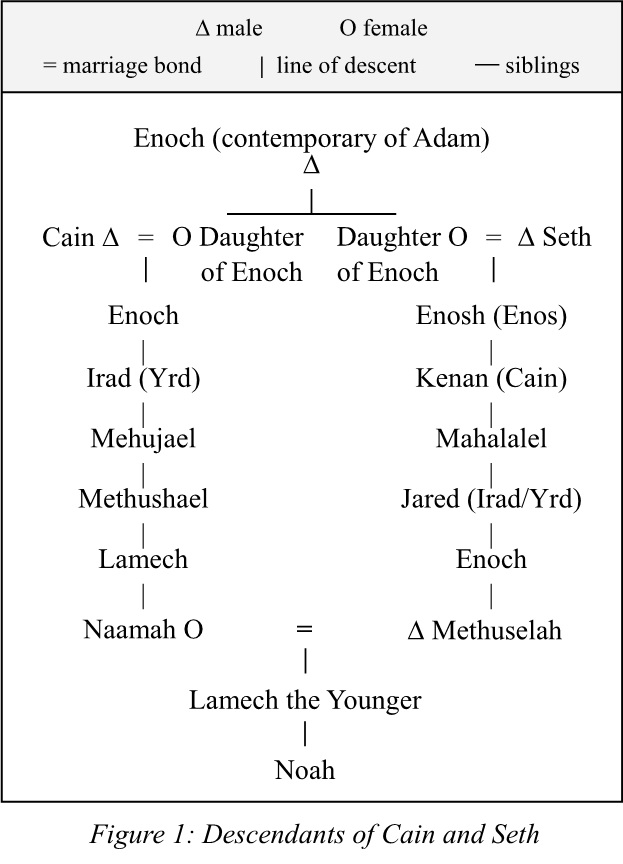
Young Earth Creationists are wrong to use Archbishop James Ussher’s chronology to date the age of the Earth. Ussher assumed that the "begats" of Genesis chapters 4 and 5 refer to the first people on earth and he concluded that the earth's age is between 6000-8000 years. Today the anthropological tool of kinship analysis reveals the flaw in Ussher's approach. The diagram below shows that the lines of Cains and his brother Seth intermarriage according to a long-standing marriage and ascendancy pattern that is characteristic of the early Hebrew ruler-priest caste.


Cain and Seth married patrilineal cousins who were the daughters of a ruler named Enoch. These wives named their firstborn sons after their father, according to the cousin bride's naming prerogative. Lamech the Elder's daughter Naamah married her cousin Methuselah and named their firstborn son Lamech after her father.

This shows that the historical Adam had a contemporary called Enoch, which is a royal title referring to one who ascends to the throne of his father. 

Ussher did not take into consideration is that Kushite rulers, like Egyptian rulers, did not name their biological fathers in their king lists. This explains why many of the names that appear in the Genesis 4 and 5 lists are titles of royal persons rather than proper names.

The Kushites believed that the ruler-priest was the son of Re whose emblem was the sun. (Re in ancient Egyptian means "father".) The Pharaoh was called "son of Re" which is why Egyptian texts never mention the king's earthly father. Kingship was a manifestation of the High God's overshadowing of noble women. 

Sargon the Great claimed not to know his father. He based his authority to rule on the suggestion that he was conceived according to the Horite Hebrew myth of miraculous virginal conception. However, any ruler could make that claim. The true proof of the ruler's deity was resurrection from the dead.  Sargon stayed dead, as did all the rulers of Egypt and Mesopotamia. However, Jesus Christ, a descendant of their royal lines, did indeed rise from the dead and his rising was verified by many eye witnesses


Dating more accurately

The early Hebrew rulers of Genesis 4 and 5 lived and reigned within the periods of early Egyptian history.


First Intermediate Period
2475-2445 BC: 7th - 8th Dynasties Noah, Shem, Ham, Japheth and Kush

2445–2160 BC: 9th -10th Dynasties Nimrod, Arpachshad, Salah, Eber and Peleg and Joktan


Middle Kingdom
2160-2000 BC: 11th Dynasty Nahor, Terah and Abraham

2000-1788 BC: 12th Dynasty Jacob, Esau, Joseph


The early Kushite expansion into ancient Sumer/Chaldea has been well-documented. In Sumerian inscriptions the Kushites were called Meluha Kasi. The dispersion of the early Hebrew out of the Nile Valley is evident in Genesis 10 which speaks of the Kushite kingdom builder Nimrod who built a great empire in the Tigris-Euphrates Valley. 


The Pattern of Two Wives and Two Sons

Horite and Sethite Hebrew rulers maintained two wives in separate households on a north-south axis. The ruler's first wife was a half-sister (as was Sarah to Abraham) and the second wife was a patrilineal cousin (as was Keturah to Abraham). The firstborn son of the half-sister wife ascended to the throne of his biological father. As Abraham's proper heir, Isaac ruled over Abraham's territory in ancient Edom (Idumea).

The firstborn son of the patrilineal cousin wife served as a high official in the territory of his maternal grandfather after whom he was named. Joktan, Abraham's son by his cousin wife Keturah, served in the kingdom of Joktan the Elder, his maternal grandfather. The Joktanite clans resided in Arabia.


There was a hierarchy of Hebrew chiefs, vassals, and kings. Analysis of the kinship pattern of the early Hebrew rulers indicates segmentary lineages. The first loyalty is to the lineage of father and his principal (half-sister) wife and their son, the heir. The second loyalty is to the father and his second (cousin) wife and their son who belongs to the household of his maternal grandfather. The third loyalty is to the household and clan of the cousin.

A Bedouin proverb summarizes the philosophy behind segmentary lineages:

I against my brother
I and my brother against my cousin
I, my brother, and my cousin against the world

 
Sons who were not the firstborn were given gifts of camels, jewelry, flocks, herds, and servants and sent away to establish settlements of their own. The importance of these "sent-away sons" as a driving factor in the Kushite expansion out of the Nile Valley.

This pattern is evident in the case of the Kushite kingdom-builder Nimrod. Nimrod, one of Abraham's ancestors, was sent away from his older brother Ramah whose territory was in northern Arabia. After numerous conquests, Nimrod’s territory was far greater than his brother’s. It extended the length of the Tigris-Euphrates Valley, and the principal cities were Babel, Erech, and Akkad (Gen. 10:10). The language of Nimrod’s empire was Akkadian, the oldest known Semitic language. It has close affinity to the languages of the Nile Valley.


Related reading:  The Hebrew Were a Caste; Hebrew Rulers with Two WivesHorite and Sethite Mounds; Abraham's Kushite Ancestors; Kushite Kings and the Kingdom of God; Hebrew Names and Titles; The Welcome Demise of American Fundamentalism