Followers

Showing posts with label Young Earth Creationism. Show all posts

Thursday, December 14, 2023

Time to Jettison Young Earth Creationism


100,000-year red ocher burial at Qafzeh (Israel). Red ocher was a symbolic blood covering.


Dr. Alice C. Linsley

Young Earth Creationists believe that the days of Genesis 1 were six consecutive 24-hour days which occurred 6,000–8,000 years ago. They cannot explain the huge body of material evidence that proves an old earth and the presence of humans on earth for millions of years. They argue almost exclusively from geological anomalies. They believe that the surface of the earth was radically rearranged by a global flood. The extinction of species is explained by the flood. Creatures that were not preserved on Noah’s Ark perished and were subsequently buried in the flood sediments. YEC creationists believe that the catastrophic global flood was responsible for most of the rock layers and fossils. They maintain that some rock layers and some fossils were deposited before the Flood and other layers and fossils were produced in localized sedimentation events or processes.

Proponents of Young Earth Creationism include the Baptist Pastor and biochemist Duane Gish, Terry Mortenson, a missionary for 26 years with Campus Crusade, and Henry M. Morris, a civil engineer and author of several books on Young Earth Creationism.

Most who adhere to the Ken Ham view of the Bible do not care about the scientific evidence that supports biblical history because they have been taught to distrust the sciences. Nevertheless, the sciences of anthropology, archaeology, climates studies, genetics, geology, hydrological studies, linguistics, and migration studies agree on the deep history of humans of Earth.

Young Earth Creationism is criticized for lacking a scientific basis. It also should be criticized for lacking a biblical basis. Consider the following points:

If Adam and Eve were the parents of Cain, they could not be the first humans on Earth because Cain built a settlement that he named for his son Enoch (Gen. 4:17). Enoch is a royal title derived from the ancient Akkadian first-person pronoun: anāku and the Ancient Egyptian anochi, a reference to one who ascends. The word anochi is also found among African populations. Among the Igbo, anochie means "a replacer" or "to replace". Among the Ashante the word anokyi means "Ano Junior" or the "Ano who follows his father." Here we find the idea of succession from father to son. A Nigerian friend says that anochie also means "direct heir to a throne."

Clearly, Enoch is associated with royal ascendancy among the early Hebrew. One of Cain’s descendants is called Lamech, another royal title. Lamech is related to the Hebrew melech, which means king. According to the Bible scholar Umberto Cassuto, Lamech is related to the Mesopotamian word lumakku, meaning “priest.” (Commentary on Genesis, Vol. 1, p. 233). Two men named Lamech appear in the Genesis 4 and 5 lists of Hebrew ruler-priests (Gen. 4:18 and Gen. 5:25).

Cain and his son cannot be among the first people on earth because they already had a royal succession and territories over which they ruled. They are among The First Lords of the Earth.

The dogmas of YEC hinge on interpretations that have been demonstrated to be inaccurate. One is Bishop James Ussher's scheme whereby he counted the generations to conclude that the creation of the Earth occurred around 10,000 years ago. Ussher did not recognize that the "begats" of Genesis are not generational. They are regnal. All the men listed are rulers and some of their reigns coincided. Tubal-Cain (Gen. 4) and Methuselah (Gen. 5) ruled at the same time over different territories.

YEC assumes, contrary to the biblical evidence, that the line of Cain was wiped out by the flood. However, analysis of the kinship pattern of Genesis 4 and 5 reveals that the descendants of Cain and Seth intermarried (caste endogamy). A feature of their marriage and ascendancy pattern is the naming of the cousin bride’s firstborn son after his maternal grandfather. The pattern is evident in this diagram.

Lamech the Elder had a daughter named Naamah. She married her patrilineal cousin Methuselah. This marriage took place c. 4300 B.C.  


One of their descendants was Nimrod, a Kushite kingdom builder (Gen. 10:6-12). He married a Sumerian princess between 3500-3300 B.C. Erech (Uruk) was one of the cities ruled by his father-in-law. Uruk was the largest settlement in Mesopotamia at that time. Settlement at that site began in the Ubaid period (c. 5500-4000 B.C.), that is 7500 years ago, about the time that Young Earth Creationists claim the earth was formed.

Around 3100 B.C. Uruk may have had 40,000 residents (See Algaze, Guillermo, 2013, "The end of prehistory and the Uruk period" in Crawford, Harriet (ed.), The Sumerian World (PDF). London: Routledge. pp. 68–95. ISBN 9781138238633.)


A Better Approach to the Biblical Material

The empirical approach of Biblical Anthropology (a science) contributes to a better understanding of biblical history. Genesis makes it clear that Abraham's ancestors lived in the land of Kush as he descended from the Kushite kingdom builder Nimrod (Gen. 10). Analysis of the kinship pattern of the early Hebrew rulers listed in Genesis 4, 5, 10, 11, 25 and 35 proves they are of the same caste and they are historical figures.

Adam and Eve lived c. 5000-4800 B.C. in a vast well-watered region called Eden. The Genesis 2 description of this region corresponds to the ancient Fertile Crescent. At this time humans were already globally dispersed. Further, humans were making tools, jewelry, and ritual objects for thousands of years before the time of Adam and Eve.

Nimrod left Kush and established his territory on the Euphrates River c. 3500 B.C. (Gen. 10). That is why we find Abraham living in Mesopotamia. After he relocated to Canaan (around 2000 B.C.), Abraham controlled the water systems at Hebron and Beersheba and had wells in Gerar. We see a gradual movement out of Africa into Mesopotamia and Canaan. (See Rulers of the Ancient Water Systems.)

We also see a span of time of at least 3000 years between Adam and Eve and Abraham. The different time periods and cultural contexts of these rulers cannot be made congruent by the final Jewish hands on the Hebrew Scriptures coming after 580 B.C. 

Consider a Native American chief with a fleet of birch wood canoes controlling trade between villages on the Mississippi in 1720. Fast forward a mere 200 years to 1920 when a river magnate controls commerce on the same river with his fleet of riveted steel ships. Same river, very different contexts. To understand biblical history, we must grapple with these contextual incongruities and the best disciplines to apply in this effort are cultural anthropology, archaeology, molecular genetics, and linguistics.


Related reading: The Roots of the Gospel are in AfricaArtifacts of Great AntiquityNimrod's Sumerian Wife; YEC Dogma is Not Biblical; YEC's Silence on Anthropology; Facts About Human Origins; YEC Hinders Understanding of the Bible; Think Like a Biblical Anthropologist; A Healthy Approach to the Bible


Sunday, July 14, 2013

"Millions of years" a stumbling block


This cartoon illustrates why conversation between Old Earth Creationists and Young Earth Creationists is next to impossible. Bible literalists tend to think of the Bible the way Muslims think of the Qu'ran, that is, that it was dictated and copied down word for word as God delivered it. They also tend to be ignorant of the Afro-Asiatic worldview that Genesis represents and the implications of that for proper interpretation of Genesis.

From Ted Davis' Seminar Scientific Creationism: Part 1

Related reading: Smoking Gun Evidence of an Ancient Earth;  Between Biblical Literalism and Biblical Illiteracy; YEC Dogma is NOT Biblical; A Scientific Timeline of Genesis; Objections to a Fundamentalist Reading of Genesis; Scientific Confirmation of the Genesis 10 Dispersion; Theories of Creation


Monday, May 13, 2013

YEC Dogma is NOT Biblical


Young Earth Creationism has been criticized for lacking a solid scientific basis. It also should be criticized for lacking a solid Biblical basis.


Alice C. Linsley

Young Earth Creationists use Archbishop James Usher’s chronology to date the age of the Earth. They believe that the genealogies in Genesis 5 and 11 are chronological and can be used to estimate when God created the Earth. They calculate the earth's age at 6000 years on the basis of lifespans assigned to the men named in Genesis 5 and 11. They ignore the line of Cain in Genesis 4 because they assume that his line became extinct in Noah's flood.

Biblical studies and discoveries in various sciences have left Usher's erroneous interpretation in the dust.

Usher lived before the development of molecular genealogy which has shed much light on human origins, and especially on the dispersion of the ancient Nilotes and Kushites. He also lived before the development of kinship analysis which makes verification of the Genesis King Lists possible. It can no longer be claimed that these rulers did not live in history. Their marriage and ascendancy pattern is authentic and can be traced from Genesis 4 to the New Testament records of Mary and Joseph's families. It is not possible that this aspect of Biblical history could have been written back into the texts since the 66 books of the Bible represent the contributions of numerous scribes and authors over about 1200 years.

Usher's scheme is terribly flawed. He failed to recognize that the so-called "genealogies" are actually King Lists. These lists are not generational, but regnal, and the reigns of some kings coincided. Tubal-Cain (Gen. 4) and Methuselah (Gen. 5) ruled at the same time. Tubal-Cain's sister, Naamah, married Methuselah. (See diagram below.) This is an example of how people abuse Biblical lists.

Usher also missed the fact that the lines of Cain and Seth intermarried, and as St. John Chrysostom recognized, the line of Cain received great mercy. Not only 7 fold for Cain, but 77 fold for Lamech the Elder (Gen. 4:24), and 777 in the case of Lamech the Younger (Gen. 5:31).

Further, these men are not the first humans on earth, but rulers of the Afro-Asiatic Dominion. They were kingdom builders, like Nimrod the Kushite (Gen. 10:8). This was a time of  law codes such at the Law of Tehut, warriors, weapons, shrine cities such as Nekhen in Sudan, and numerous technologies associated with the Neolithic Period. These earliest rulers of Genesis lived between 6000 and 3000 B.C., millions of years after the appearance of archaic humans. The evidence of the Bible and the various sciences indicates that they lived in Africa or migrated out of Africa.

This last fact reveals the un-biblical and racist nature of YEC dogma. At the back of YEC books one finds the 12 Affirmations and Denials. Affirmation XII claims that the diversity of languages and skin color came about as a result of divine judgment at the Tower of Babel.

XII. We affirm that all people living and dead are descended from Adam and Eve...and that the various people groups (with their various languages, cultures, and distinctive physical characteristics, including skin color) arose as a result of God's supernatural judgment at the Tower of Babel..."

Africa always has had the greatest genetic and linguistic diversity of any continent. Long before the earliest Genesis rulers there already existed diversity of skin color. Here are images of red, black and brown Nubians.


Red and black Nubians
(Ippolito Rosellini)


Red and brown Nubians
They resemble the warriors of Petra who had long wavy hair and wore feathers.
(Dr. Arthur Brack)

The Habiru (Hebrew) marriage and ascendancy pattern

Usher's errors reflect ignorance of the marriage and ascendancy structure of Abraham's ancestors as it is revealed in Genesis 4, 5 and 11. This same pattern characterizes Moses' family and Samuel's family. It is the distinctive pattern of the ancient Habiru (Hebrew), a caste of ruler-priests.

Ussher did not understand that the rulers listed had two wives so there were two first born sons. The first born son of the half-sister wife was heir to his father's throne. So Isaac was heir to Abraham's territory between Hebron and Beersheba. The first born son of the patrilineal cousin wife was named after his maternal grandfather and served as a prime minister in his grandfather's territory. So Joktan, Abraham's first born son by Keturah, was not Abraham's heir. He would rule in the territory of Joktan the Elder.

Judah likely had two wives. In Genesis 46, we read that Judah went into Egypt with his brothers and presumably settled in the land of Goshen with his wife and children. In Genesis 38, we read that Judah had sons by Shua who lived in the region of Adulla, Mareshah and Chezib in Horite territory.

Some lists provide the names of the first born sons of half-sister brides. Other lines are traced through the cousin bride who named her first born son after her father. This is the case with Methuselah's wife, Naamah, who named their first born son "Lamech" after her father (see bottom of diagram).


Let us examine in greater detail the problems with Ussher's scheme.

Ussher did not recognize that the Genesis genealogies are regnal, not generational. They cannot be used to count generations because they are king lists and some kings ruled simultaneously. Others ruled for short periods, and still others ruled for longer than a generation (40 years).

Usher insisted on reading Genesis as chronology, and therefore missed that some rulers were contemporaries. Lamech the Elder was a contemporary of Enoch, Methuselah's father. Abraham was a contemporary of Job. Nahor's son Tahash was a contemporary of Isaac.

None lived the lifespans assigned to them. These numbers are symbolic, with Kabalistic meanings coming from a later period. (Kabal is derived from the Egyptian words ka and ba which in modern parlance would "body and soul.")

Ussher did not recognize that some of the Biblical lists are telescopic. Telescopic lists leave out some names. Such lists give the names of only the most famous rulers. This means that we cannot use the king lists to date the earth.

Ussher ignored the later king lists, such as the Horite rulers in Genesis 36 and their royal kinsmen in Genesis 22:20-24. Here we find the identical marriage and ascendancy pattern as among the Genesis 4 and 5 rulers.

Ussher did not recognize that the lines of Cain and Seth intermarried, as did the lines of Ham and Shem and the lines of Abraham and Nahor.  Each ruler had two wives. The cousin bride named her first born son after her father. Thus we find Esau the elder and Esau the Younger, Joktan the Elder and Joktan the Younger,   Kenan is a variant of Kain, and could be called Cain the Younger. Likewise, Irad is a variant of Jared and could be called Jared the Younger.

In the case of Lamech's daughter, Naamah, the pattern is quite clear. She married her cousin Methuselah and named her first-born son Lamech after her father. This pattern of marriage can be traced from Genesis 4 and 5 to the lines of Joseph and Mary in the New Testament, demonstrating that Jesus is a direct descendant of the people to whom God made the first promise of the Bible that a woman of their ruler-priest lines would bring forth the "Seed" of God (Gen. 3:15).

Jesus' mother's name was Miriam daughter of Joachim Son of Pntjr (Panther) Priests of Nathan of Beth Lehem. From predynastic times, ntjr designated the ruler among the Kushites. The name Panther or p-ntjr meant "God is King." It is certain that Mary was of the ruler-priest caste because even those who hated her admit this. Sanhedrin 106a says: “She who was the descendant of princes and governors played the harlot with carpenters.”

Ussher didn't know about the cousin bride's naming prerogative which meant that the cousin bride's father and her first born son had the same name. This explains the recurrance of names skipping a generation. There are two named Enoch; two named Lamech; two named Joktan, and two named Sheba. There are also two named Esau, as shown below.

Here we see that Esau the Elder married Adah. Esau the Younger married Oholibamah, a prefigurement of the Virgin Mary.


Seir is identified as a Horite in Genesis 36. The names Esau, Dishon, Uz, Lot/Lotan and Timna are Horite names. The name "Adah" can be traced back to Lamech the Elder. One of his wives was named Adah (Gen. 4:23).


Related reading: Facebook Conversation on CreationismEvidence of an Old EarthSmoking Gun Evidence of an Ancient EarthGenesis on the Ancient Kingdom BuildersCain as RulerLamech's Story and Horite KingshipBishop Ussher GoofedDNA Research Confirms Kushite Migrations; Biblical Anthropology...the Science, not speculative theology; Calculating the Dates of the Patriarchs; The Genesis King ListsTwo Named Esau; Abraham and Job, Horite Rulers; The Cousin Bride's Naming Prerogative; Objections to the Fundamentalist Reading of Genesis


Friday, February 15, 2013

Stephen M. Barr on Young Earth Creationism


“Creation Science”, which claims that the universe is only a few thousand years old, requires the abandonment of most of what we know about geology, astrophysics, cosmology, and biology, not to mention a certain amount of nuclear physics. Scientific knowledge is a highly reticulated structure of mutually supporting facts and inferences. Every well-established scientific fact is held in place by numerous links to other known facts, both closely related and seemingly distant.--Stephen M. Barr (From here.)


"There are two fundamentally different battles raging in the current debates about evolution. The first pits nearly the entire scientific community against creationists, who believe that they are upholding the veracity of Scripture by denying that evolution happened at all.

The second battle concerns not the fact of evolution but the standard neo-Darwinian explanation of it, and the issues at stake are primarily philosophical and scientific."--Stephen M. Barr (From here.)


Related reading: Smoking Gun Evidence of an Ancient EarthYEC Dogma is NOT BiblicalBetween Biblical Literalism and Biblical Illiteracy; Objections to a Fundamentalist Reading of Genesis 1-5; Biblical Anthropologists Discuss Darwin, Scientists Against Scientism


Five False Assumptions of Young Earth Creationists

Assumption 1: Genesis is history and should be read as a chronological account. (Response is here.)

Assumption 2: The Genesis “begats” list the first humans living on Earth. (Response is here.)

Assumption 3: Bishop Ussher's timeline is reliable and can be used to calculate the age of the Earth. (Response is here.)

Assumption 4: All the peoples and nations came from Noah’s three sons after a worldwide flood. (Response is here.)

Assumption 5: Skin color and linguistic diversity are the result of God’s judgment at the Tower of Babel. (Response is here.)


Monday, December 10, 2012

What Do Young Earth Creationists Fear?


The NATURAL HISTORIAN on Ken Ham's Blog in which Ham shares a Letter from a "Concerned Church Member"

This week, on his blog, Ken Ham shared a letter (Chicago church compromiser) sent to him from a concerned church member about his churches hiring of a non 6 day creation pastor especially in light of their creationist history. In that letter the author recounts a discussion with the pastor and includes this comment:

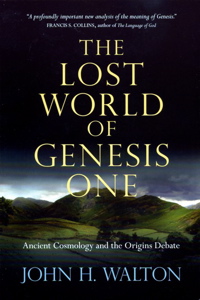
The Lost World of Genesis One
“The Lost World of Genesis One” by John Walton
He then handed me a book to read written by John Walton who is a professor of Old Testament at Wheaton College in Illinois.  The book entitled “The Lost World of Genesis”  claims that by studying  ancient Near Eastern cultures we are able, for the first time, to know what God was trying to tell us in Genesis and what it all means.  I politely left the book on his desk when I left.
He then states that he searched from reviews about the book and makes some rather distorted statements about Walton’s conclusions. He criticizes the pastor for not being able to support his position but then when he is given a book he leaves it behind. This is exactly what Ken Ham wants his followers to do – not to even give the other side a hearing. I’m not sure that Walton’s book would be the best choice but a full appreciation for the issues involved in the creation debate is not suited for short discussion. Reading several books is necessary to get a fuller understanding of the issues. This author admits that the creation science literature have answered all his questions. Ham constantly warns against listening to any compromiser and so the reaction by YECs is often to simply rely on the reviews of books like this by Ham himself to get the “other” side. I expect this author has also heard a creation seminar in which the salty sea was provided as a scientific evidence for a young earth. He will never read Davis Young’s book or 20 other Christian scientists books, or my blog, that refute that argument because we are labeled compromisers. As I state in my first part of my salt series, there is a confidence bias at work and this person is demonstrating how effectively it can be by simply only listening to once source and dismissing all others out of hand.

Read more here.


Alice C. Linsley

Why do Young Earthers run away from discussions of the cultural-historical context of Biblical texts? Why should they fear that the Bible emerges from a specific cultural context?  Will facing the evidence cause them a crisis of confidence in the Bible's authority? Doesn't this reveal a lack of confidence in the truth of Scripture?

If the Bible is true, it will stand up to the most stringent analysis. This writer is dedicated to demonstrating the veracity of the Bible through an anthropological approach. Today people want to know that there are solid scientific reasons to take the Biblical texts seriously. This is the time in which we live.

Young Earth Creationism is destined to fade away because the younger generation thinks empirically and rationally about the Bible. Under leaders like Ken Ham, YEC fails to explore the Bible scientifically and imposes quasi-science that misrepresents what the Bible makes clear. Their condensing of Earth's history to 6000 years based on Bishop Ussher's miscalculations is an artifact of historical interest, but not a Biblical position. People should be shown that the Biblical timeline is fully supported by the sciences.

Perhaps Young Earth Creationists recognize that a serious investigation of the cultural-historical context of the Bible will tilt their worldview so drastically that they will never recover their comfortable interpretations. They will have to recognize the Nilotic and Proto-Saharan context of Genesis and that the people listed in Genesis 4 and 5 were rulers, not the only people on earth. They are the first of the rulers than can be traced from Eden to Jesus. To neglect this means missing how it is that the Bible from Genesis to Revelation is about one thing: Jesus Christ.

In holding to their idol of Young Earth Creationism, fundamentalists will also misunderstand the wisdom literature that reflects Horite beliefs. They will neglect that Abraham's ancestors were Kushites, and that Abraham was Ha-piru, not a Jew. They will fail to see the profound historical implications of Jesus Christ as a direct descendant of Cain, Seth, Ham and Shem because their lines intermarried. Yes, that means that Cain's line survived the Flood. Noah was one of his ruler-priest descendants. Tilt! Tilt! Tilt!


Sunday, October 21, 2012

Objections to the Fundamentalist Reading of Genesis


Alice C. Linsley
Objections to the Fundamentalist Reading of Genesis 1-5

This essay follows A Scientific Timeline of Genesis

God created the primal elements, and the Ruach of God brought order to the primal elements.

Here is the Fundamentalist reading of Genesis 1-5.

God created the world between 6000 and 10,000 years ago.
God created Adam and Eve, the first human couple.
Eve gave birth to a son named Cain (Kain/Qayan/Kayin/Kenan/Kahn).
After Cain killed Abel, God granted Eve another son, Seth (Set/Seti/Ta-Seti).
Cain's line was cursed and died out in a worldwide flood.
Only Seth's line survived and no other peoples were on the surface of the Earth.
Noah and his 3 sons and their wives are descendants of Seth only.
The Earth was re-populated after the flood by Noah's 3 sons.


If humans have been on the surface of the Earth for over 3 million years, and Adam and Eve represent the first created humans, then there is a gap of time between Adam and Eve and Cain.  How then are we to interpret Genesis 4:1? Fundamentalists insist that Cain is Eve's offspring. The Hebrew text suggests that Cain is Eve's royal descendant.

Here is what Genesis actually reveals:

The creation stories of Genesis 1 and 2 have a specific historical-cultural context and should be understood in that context. These stories come from the ancient Afro-Asiatics who believed that the first substance on Earth was chaotic water and the Breath (ruach) of God moved over the water establishing order. The Breath or Spirit of God separated the waters above from the waters below and the dry land from the seas. They also believed that blood (dam in Hebrew) is what constitutes Being. The word Ha-dam means the blood or the Being, and this is the likely etymology of Adam (Human Being/First Man).

Fundamentalists calculate the Earth's age at 6000 years on the basis of ages assigned to the rulers in Genesis. They accept Bishop James Ussher's chronology, which has been shown to be inaccurate. Ussher assumed that Cain was the biological son of Adam and Eve and that the men listed in the so-called "genealogies" are the first people to live on Earth. However the lists in Genesis 4, 5, 10 and 11 are not genealogies. They are King lists. These lists represent a time in the past when established kingdoms, laws, armies (warriors), weapons, settlements, strongholds (cities) and numerous technologies existed that are associated with the Neolithic Period (the new stone age). This places the earliest rulers of Genesis between 10,200 and 3000 B.C. (It is possible, however, to narrow this considerably using the Biblical data, as we see here.)


Neolithic cooking utensils

The earth is about 4.5 billion years old. This is based on radiometric age dating of meteorite material and the earth's oldest rocks, and is consistent with lunar samples. Fundamentalists argue that radiometric dating is not reliable because it contradicts what they believe the Bible says about the age of the Earth. For the sake of argument, let us consider that radiometric calculations are off by 50%. Were this the case (and it is not), the earth would still be over 2.2 billion years old. The oldest human fossils are about 3.6 million years. Again for the sake of argument, let us consider that the carbon dating of the oldest human fossils is off by 50%. These humans would still have lived over 1 million years ago.

Bishop James Ussher's scheme did not recognize that the "begats" of Genesis are not generational, but regnal. All the men listed are kings and the reigns of some kings coincided. For example, Tubal-Cain (Gen. 4) and Methuselah (Gen. 5) ruled at the same time over different territories.

Further, the names of these rulers are not proper nouns; they are honorific titles. Terah means priest. Cain/Kain means king. The female equivalent is Kandake/queen, which is rendered in English Bibles as the proper name Candace. Enoch means "one to ascends to the throne." Lamech is a variant of la-melech which appears on several thousand Egyptian seals. It means "of the King" or "for the King." Lamech the Elder's daughter was Naamah, another word associated with Abraham's ruler-priest ancestors and descendants. Naamah is a royal name as attested by the connection to King David. The royal mother of one of David's grandsons was Naamah (II Chron. 12:13).


Cain as Ruler

Now Adam knew Eve his wife, and she conceived and bore Cain, and said, "I have gotten/gained (qa-nithi) a man with the help of the Lord." Genesis 4:1; The Hebrew Study Bible

Here is another rendering from The Schocken Bible, Vol. 1:
The human knew Havva his wife, she became pregnant and bore Kayin. She said: Ka-niti (Qanithi)/ I have gotten a man, as has YHWH.

E.A. Speiser noted that Qany(ty) or Qan-itti shows close affinity to the Akkadian itti, as in itti šarrim which means "with the king".  Cain is associated with the concept of rule or dominion among ancient Nilotic peoples.

Genesis 10 tells us that Nimrod was a Kushite, so it is not surprising to find that Akkadian shares many words with Nilotic languages. Among the Oromo of Ethiopia and Somalia, itti is attached to names. Examples include Kaartuumitti, Finfinneetti and Dimashqitti. That itti is associated with Nilotic rulers is evident in the name Nefertitti.

If we take Eve to be the first woman created by God, we must place her creation before the oldest human fossils at about 3.8 million years. This poses a problem. Is it possible that Genesis 4:1 is speaking of Eve as the ancestral mother of the kings (ka-ntr) listed in Genesis 4, 5, 10 and 11? Is this another prophecy concerning the King who was expected to overcome the grave; a parallel to Genesis 3:15 concerning the Seed born of the Woman (not Eve)? Among Abraham's ancestors the ka was provided by the mother. It refers to life or essence. The word ntr refers to ruler or king. It appears from Genesis 4:1 that Eve is declaring that she has given life to a king, such as is the Lord.

The Epistle of Jude alludes to Cain as a king, along with the prophet Balaam and the priest Korah (verse 11). Kings, prophets and priests were the three highest offices in Biblical times. Further, Genesis provides many anthropologically significant details that point to Cain's status as a ruler.

He was a tiller of the soil (Gen. 4:2) which means that he controlled an area of land, as did Noah, one of his descendants, who planted a vineyard.

He was a city builder (Gen. 4:17) as was his descendant Nimrod who built cities in the Tigris-Euphrates Valley. These cities were shrine cities or sacred centers within the ruler's territory.

Cain is associated with metal working. One of his descendants, Tubal-Cain, is said to be the “father” of smiths. In the ancient world, Smiths were a caste with high social status. They were in the service of the rulers. In the Upper Nile, Badari smiths smelted copper during the Chalcolithic or Late Neolithic Period (about 4000-2,800 B.C.). However, the Badari smiths used ritual flint knives for circumcision, as did Moses' wife, Zipporah, when she circumcised their son. Relics of this period found at Al-Badari include necklaces, beads, copper pins, fine linen cloth, and elaborate grave offerings. Al-Badari is on the Upper Nile at the border of Egypt and Sudan.
Cain offered sacrifice to God (Gen. 4:5). In the ancient Afro-Asiatic world only ruler-priests offered sacrifice.

Cain married a royal daughter of the House of Enoch (Nok). Only rulers married the daughters of rulers. She was his cousin as evidenced by the following analysis of the Genesis 4-5 marriage and ascendancy pattern.


We see from this analysis that Cain as a "son" of Adam and Eve must refer to the fact that kings came from the first created couple, but this particular Cain/King lived long after Adam and Eve. The founding father of the lines of Cain and Seth was Enoch/Nok. Enoch comes from the African word anochie, meaning one who is to ascend to the throne. The Nok civilization is found in the part of Africa from which Abraham's ancestors came. It is associated with the ancient Kushites. Kush (Cush) was Noah's grandson. According to the Matsya, an ancient book from India, the archaic world belonged to the Kushites (Sa-ka) for 7000 years.


Nok figurine, found at Nok on the Jos Plateau of Northern Nigeria

As can be seen from the diagram above, Seth was a great ruler also. He married a royal daughter of Enoch/Nok. As is characteristic of royal families, the lines intermarried, as is shown in the diagram below.


This segment reveals that the rulers had 2 wives. The first wife was the bride of the ruler's youth and his half-sister. Abraham's half-sister wife was Sarah. The second wife was a patrilineal cousin or niece and this marriage was consummated shortly before the heir ascended to the throne. Abraham's cousin wife was Keturah, who gave birth to 6 sons (Gen. 25).

With two wives, there were two first-born sons. They ascended to different thrones. The first born son of the sister wife ascended to the throne of his biological father. So Isaac became Abraham's heir.  The first born son of the cousin wife became a ruler in the territory of his maternal grandfather, after whom he was named.  Lamech the Younger ruled in the territory of Lamech the Elder, not in the territory of his biological father Methuselah. Bishop Ussher was not aware of this unique marriage and ascendancy pattern.

The Genesis "begats" and the material in Genesis 10 are annals of ancient royal lines that intermarried. Ruler priests married the daughters of ruler-priests. Only some sons could ascend to the throne. Other sons were sent away to establish territories for themselves. These sent-away sons drove the Kushite expansion out of Africa, an expansion that has been verified by DNA studies.


Expansion Out of Eden

Genesis 2:10-14 says that Eden was watered by four rivers: the Tigris, the Euphrates, the Pishon and the Gihon. The first two are in Mesopotamia and the last two are in East Africa. This is the heart of the ancient Afro-Asiatic Dominion and the place of origin of the ruler-priests and of "him that holds the scepter from the house of Eden" (Amos 1:5).

The description of Eden as a well-watered region is supported by climate and geological studies. These four rivers encompass the heart or "Eden" of the ancient Afro-Asiatic Dominion which was ruled by a network of ruler priests. They controlled the major water systems and built shrines along the rivers.  From Eden Cain's descendants spread far and wide; his line did not die out in the flood.

The lines of Cain and Seth intermarried, as did the lines of Ham and Shem. Abraham, King David and Jesus Christ are descendants of these great ruler-priests. Perhaps this is why Jesus' King-Priest identity was recognized in Tyre in Mark’s Gospel, not on a mountain, as in Matthew's account of the Transfiguration. For Mark, the Messiah’s appearing means the beginning of the restoration of Paradise. Mark was probably thinking of this passage from Ezekiel 28: "Son of Man, raise a lament over the king of Tyre and say to him: Thus says the Lord God: You were the seal of perfection, full of wisdom and flawless beauty. You were in Eden, in the Garden of God; every precious stone was your adornment... and gold beautifully wrought for you, mined for you, prepared the day you were created."

Monday, August 27, 2012

"The Science Guy" Reveals His Ignorance


Alice C. Linsley


In this clip posted online on Thursday, Bill Nye bashes creationists and those who doubt the claims of Darwinian evolutionists. He lumps all creationists together and is apparently unaware that Old Earth Creationists accept evident aspects of Darwin, such as adaptation and mutation. We part ways, however, when it comes to Darwin's theory that humans and apes share a common ancestor. Why should we believe this when the material evidence does not support the theory? Instead, the evidence indicates that Lucy and her community were fully human.

Nye says that a creationist worldview would have to be "fantastically complicated," again referring to Young Earth Creationists whose beliefs cannot be substantiated by the sciences. He believes (and I hope he is right) that "in another couple of centuries that world view, I'm sure, will be, it just won't exist. There's no evidence for it."

Nye takes issue with Creationists who believe the Earth is between 6000 and 10,000 year old. He points to the great age of fossils and stars as proof that their view is not tenable. He said,

"Here are these ancient dinosaur bones or fossils, here is radioactivity, here are distant stars that are just like our star but they're at a different point in their lifecycle. The idea of deep time, of this billions of years, explains so much of the world around us. If you try to ignore that, your world view just becomes crazy, just untenable, itself inconsistent."
 
I agree. That is why I have exposed the false assumptions of Young Earth Creationists. I have also exposed the false assumptions of Darwinians. Good science must operate with skepticism about all assumptions.
 
Nye encourages parents to teach evolution to the next generation, but he never clarifies what he means by that. Is he asking that they teach theistic evolution, allowing for God and the supernatural? Or is he recommending the materialist view of evolution as a mechanism not requiring a Creator?
 
Theistic evolution has strong advocacy, especially among Thomistic Roman Catholics and the BioLogos Evangelicals. I disagree with the Thomistic view because Aristotle's teleology does not allow for randomness. (He was an Essentialist, though of a different sort than Plato.) I disagree with the BioLogos crowd because they have largely failed to consider the evidence of anthropology pertaining to both archaic human remains and material culture. 
 
The materialist view has advocacy among popular atheists like Richard Dawkins, Daniel Dennett, Sam Harris, and Victor J. Stenger. Their challenge is to convince the many scientists who believe in the existence of God and who recognize order in the universe. The randomness that the Materialists posit is not supported by the material evidence. Randomness mitigates against their claims of validity. Science would be out of business were it not for the fact that we can depend on the constancy of the laws of physics and genetics.

There is also the problem of reconciling the evidence of migration, climate and DNA studies with the picture painted by those who so easily dismiss religious texts as significant sources of data. Consider, for example, the alignment of the Kushite expansion out of Africa with DNA studies. There is no conflict between the Historical Timeline of Genesis and findings in the Sciences.

Saturday, August 18, 2012

Colleges Old Earth Creationists Should Avoid


If you are an old earth creationist you probably should avoid these colleges:

Bob Jones University
Cedarville University
Jackson Hole Bible College
Liberty University
Northland International University
Ohio Christian University 
Pensacola Christian College
Tennessee Temple University
Warner University

Read the list and Answers in Genesis (AiG) statement here. Phil Jones critiques the AiG statement here.

I expose the false assumptions of Young Earth Creationism in the following articles:

False Assumption #1: Genesis is history and should be read as a chronological account

False Assumption #2:  The Genesis "begats" list the first people living on Earth

False Assumption #3:  Bishop Ussher's timeline is reliable and can be used to calculate the age of the Earth

False Assumption #4:  All the peoples of the Earth came from Noah’s three sons

False Assumption #5:  Diversity of languages and skin color is the result of God’s judgment at the Tower of Babel


Related reading: Facebook Conversation on Creationism; YEC Dogma is NOT BiblicalBetween Biblical Literalism and Biblical Illiteracy; Evangelical Colleges Battle Over Creationism


Thursday, August 18, 2011

Reactions to My Genesis Research


Alice C. Linsley


After more than thirty years of presenting aspects of my Genesis research and engaging various viewpoints, I can accurately anticipate the reaction of different groups to the research.


Racists of all colors

It has not been welcomed by white supremacists because in their worldview nothing good comes out of Africa. White supremists recently took note of this blog and apparently have a bone to pick with me. They seem to think that only white people have contributed to the early development of organized religion. There is no arguing from facts with those who are dedicated to apartheid in America.

Sadly, there is evidence of this racism in the writings of Young Earth creationists. Most of their books contain the Twelve Affirmations and Denials of this movement. Let us consider Affirmation XII.

We affirm that all people living and dead are descended from Adam and Eve...and that the various people groups (with their various languages, cultures, and distinctive physical characteristics, including skin color) arose as a result of God's supernatural judgment at the Tower of Babel..."

The Tower of Babel story explains the division of related dialects into Afro-Arabian and Afro-Asiatic languages. This happened over a period of time, which does not exclude the possibility of divine intervention. The linguistic division occurred before Abraham's time. There are seventeen language families in the world. Each breaks down into hundreds of languages, dialects and sub-dialects. All the people groups mentioned in Genesis Chapter 10 belong to the Afro-Asiatic language group which originated in the Nile region and spread across Arabia, the Levant and Mesopotamia. Genesis tells us that Abraham's ancestors were Kushites, people of dark skin color, so it is ignorant and racist to say that skin color is the result of God's judgment.

Neither has my research been greeted charitably by black supremacists who insist that everything of value comes out of Africa. They would rather ignore the evidence that Asiatics played a large role in the spread of early law codes and the Messianic Faith (pre-Judaism). They tend to forget that all living humans have Africa and their ancestral point of origin.

Black supremists are not to be confused with Afrocentrist scholars such as W.E.B. Dubois, Carter G. Woodson and Clyde A. Winters, all scholars who are concerned with archaeological, linguistic and genetic discoveries related to African peoples, their migration and their contributions.


Biblical literalists

These Biblical literalists or "Fundamentalists" distort what the Bible reveals by imposing an ideology that makes the Bible acceptable to them. It is clear, however, that even these reductionists don’t agree. Some filter the Bible through Calvinism, with its emphasis on divine sovereignty, covenant theology and predestination. Others filter the material through the bestsellers of famous Protestant pastors. Many reductionists filter the Bible through the dispensational framework articulated in the Scofield Bible. This last approach breaks the single strand from Genesis to Revelation into numerous independent strands or “dispensations” in which the unchanging God changes. This would have been both foreign and anathema to Abraham’s Horite people.

Biblical literalists feel threatened when their assumptions about Genesis are questioned. In my view, their Young Earth position presents the greatest obstacles to understanding Genesis and the entire Bible. Their false assumptions are, without doubt, the most pervasive cause of confusion. The righteous tone with which they assert their version of Genesis fools some into believing that Young Earth Creationism is Biblical. In fact, their doctrines are quite contrary to what Genesis reveals.

Perusal of their books and websites causes the educated and scientifically-minded to scratch their heads in wonder. The Earth is only 6000 years old? Humans and dinosaurs co-existed? God created the Grand Canyon with the appearance of great age? These far-fetched conclusions contribute to prejudice against a scientific approach to Genesis, making my work as a Biblical Anthropologist more difficult. Many in the scientific and academic communities assume that all Christians think like Young Earth literalists and are unaware of the remarkable correspondence between the Biblical timeline and scientific studies.

Young Earth Creationists are building a Noah's Ark theme park in Kentucky. It will be a fun place for families and will perpetuate their ideology. Evangelicals who have bought into Darwinian evolutionary theory probably won't visit the park, but Biblical literalists will flock there in droves, as they do to Ken Ham's other attraction, the Creation Museum in Cincinnati.

Young Earth Creationism is declining in popularity among Evangelicals, especially those influenced by the BioLogos crowd which tends to think that Darwinian evolution is the only alternative to literalism, and that is not true. An anthropological approach to Genesis acknowledges Earth's great age and the milleniums of human existence without accepting the unproven tenets of evolution concerning human origins. Biblical Anthropology, as scientific study of the text, requires setting aside both ideological templates in order to determine the meaning in cultural context. This is a labor to which I am fully committed.


East Indians

Another group that attempts to refute my research are East Indians who insist that India is the cradle of the ancient religions and civilizations. I receive emails from them fairly regularly. Contrary to the evidence, they insist that the ancient practice of sacrifice at falcon-shaped altars and metal working came to the Nile and ancient Kush from India. This ignores the evidence of molecular genetics, linguistics, climate studies, anthropology and archaeology which reveal several movements out of Africa into Southern Pakistan and India.

There is also the evidence of place names such as Orisha/Orissa, Borno/Borneo, Karnak/Karnataka, and words such as sarki (priest caste) which is found from Nigeria to Nepal. Many Dravidian settlements and monuments are now submerged under the sea, but originally they were on a land bridge between the Arabian Peninsula and Southern Pakistan. This is sometimes referred to as the "Harappa" civilization. Har-appa means "Horus is Father" in the Dravidian language.

The origin of Dravidian religion was the Nile and ancient Kush. The Indian historian and anthropologist Bharatiya Vidya Bhavan has written: "We have to begin with the Negroid or Negrito people of prehistoric India who were the first human inhabitants. Originally they would appear to have come from Africa through Arabia and the coastlands of Iran and Baluchistan."

According to the Matsya, an ancient book from India, the world belonged to the Kushites (Saka) for 7000 years.

Vedic references to Kusha, Rama, Hori, Krishna and the Ancient One are all found in older Hebrew and Aramaic texts. Indeed, a study of Hindu religious motifs demonstrates that all were found among the Nilotics peoples, many of whom dispersed across Arabia, the Indian Sub-continent and into Indonesia and Japan. The Nile-Japan Ainu connection has been well demonstrated. There is also a connection between the Kushites and the Kushan (Kuşāņa) of Bactria and China.

For more on the expansion out of Africa see The Afro-Asiatic Dominion.


Jews

Most rabbis have ignored the research, secure in their often esoteric interpretations of the Bible. Rabbinic myth weaving has penetrated many commentaries on Genesis, especially commentaries written from an Evangelical perspective. Evangelicals, especially the American brand, tend to think that everything written by Jews has special authority. Yet these myths distort what Genesis and the Bible present about Abraham and his people. All of the Bible is about the fulfillment of God's promise to send the Divine Seed into the world to conquer death. This is what Abraham's ancestors expected and Jesus is the fulfillment of that ancient (pre-Israel) expectation.

Messianic passages of the Bible have parallels in the more ancient Horite texts. Consider how Horus, the archetype of Christ, describes himself in the Coffin texts (passage 148):

“I am Horus, the great Falcon upon the ramparts of the house of him of the hidden name. My flight has reached the horizon. I have passed by the gods of Nut. I have gone further than the gods of old. Even the most ancient bird could not equal my very first flight. I have removed my place beyond the powers of Set, the foe of my father Osiris. No other god could do what I have done. I have brought the ways of eternity to the twilight of the morning. I am unique in my flight. My wrath will be turned against the enemy of my father Osiris and I will put him beneath my feet in my name of ‘Red Cloak’.” (Myth and Symbol in Ancient Egypt by R.T. Rundle Clark, p. 216)

Note the similarity to Psalm 110:1, a messianic reference: The Lord says to my Lord: “Sit at My right hand until I make Your enemies a footstool for Your feet.”

Shaye Cohen, Professor at Harvard, is the author of The Beginnings of Jewishness in which he portrays of Abraham as the first Jew. Reading Cohen, it becomes evident that he does not personally believe this myth. During a November 2008 NOVA interview, Cohen admits that this view of Abraham as a Jew is of a “mythic kind.” He states, "So in a mythic kind of way we can say that Abraham recognizes God and that Abraham launches the process—biological and social and cultural—that will culminate in the people of Israel, who in turn will become Jews and the purveyors of Judaism.”

Cohen gets one thing right: Abraham recognized God. The rest is nonsense! Abraham's nine sons are the progenitors of many peoples, some of whom are identified today as Egyptians, Ethiopians, Jews and Arabs. Cohen is attempting to sell the myth of Jewish purity. However, the only lines which maintained blood purity through exclusive intermarried were the Horite priestly lines and there are Coptic, Jewish and Arab descendants of those lines.

Cohen notes that "the rabbis of old imagined that Abraham observed the whole Torah, that Abraham observed all the commandments: He observed the Sabbath, he observed the festivals, he observed the laws of culture and food. He observed everything, not just circumcision, which is attributed to him explicitly in Genesis, but everything else as well. Because how can you imagine our forefather Abraham, the founder of Judaism, not observing the Jewish rules, not observing the Jewish laws? This is a wonderful anachronism, a charming conceit. But historically speaking, how could it be?"

Dr. Cohen recognizes that the myth of Abraham as a Jew is not historically accurate, but he refuses to accept that Abraham and his caste were Horites. This would mean recognizing that they worshiped Horus and expected the myth of Horus to be fulfilled as promised in Genesis 3:15. There's the rub!  Jews always start their history after Genesis 3:15. Cohen says, “The biblical narrative gets going with Abraham in Genesis chapter 12. Abraham in turn Isaac, in turn Jacob, in turn Joseph and the twelve tribes, this brings us directly to the people of Israel and the covenant at Sinai. So Abraham is thought of as the first Jew, the archetype.”

While Genesis does trace a line from Abraham to Isaac and to Jacob (Yacob), it also traces the Horite lines of Seir and Esau, the lines of Ishmael the Egyptian, and the lines of Joktan the Arabian. Given that these ruler-priest lines intermarried exclusively, it is evident that some Jews, Arabs and Egyptians share common Horite blood. This becomes apparent when one digs deeper into the genealogical information.

The Genesis genealogical data makes it possible to trace Abraham’s ancestors as well as his descendants. This is the genealogical information that Dr. Cohen seeks to avoid by beginning the biblical narrative at Chapter 12.

It is impossible to speak of only one direct line from Abraham to the Israelites because Abraham’s descendants by his nine sons intermarried. The genealogical data strongly suggests that Abraham's first-born son was Joktan, the forefather of the Joktanite tribes of Arabia. This being the case, Abraham could as easily be described the “first Arab” or the “archetype” of the Arab, since Arabs are descended from him through his sons Joktan (Yaqtan) and Ishmael (Yismael).

Myth makers come in all stripes, including by angry bigots such as Herbert Schweigers and vicious killers such as Anders Breiviks. These days the Bible is used to promote all sorts of agendas. One of the benefits of Biblical Anthropology is that it exposes such lies.


Here are the reactions of people who have followed the research:

"I read the material she has gratuitously given me in response to my questions. I read it and make my own assessment. I am not an anthropologist, but I do have a pretty good BS detector. Her material and artifacts and explanations make sense to me and are both fascinating and enlightening. Could she be in error? Sure. Is she knowledgeable? Definitely. The main thing I noticed about @Alice_Linsley is that when I give her new data, new genomic studies, she is able to mesh it up with her previous work. If it matches up she will tell you, if it contradicts, she will also tell you. She does follow the data where it goes, so she is doing real science. Does her Christian beliefs help or hinder her scientific work? I say it helps, as her faith inspires her. Because she will honestly report and mesh the new findings and these new findings or changes to her understanding through science have NO IMPACT on her faith."-- Patrick Trischitta

Alice's analysis of the kinship pattern of the biblical Hebrew "opened my eyes to understand not just Genesis and not just the Pentateuch, but the whole diacronic layers in all of the Old Testament." --Shalom Rutgaizer, Israeli archaeologist (Tel Aviv University)

Just Genesis is "an interesting blog dedicated to anthropological sleuthing of pre-Abrahamic origins."-- Madison Gentsch

"Alice C. Linsley is an original and originals are few."-- Dr. Catherine Acholonu

"If only Christian discourse in this country were filled with such enlightened, such profound insights into the origins of human thought and life! You do us all a great service in writing things like this."-- Arturo Vasquez

"She has an excellent blog. I am amazed at the sources she analyzes and presents in her blog." -- Dr. Clyde Winters

"Alice, thank you so much for your research and blog. I am in my senior year at an evangelical university and taking a course in Genesis, but cannot reconcile with what's being taught. Your work has encouraged my faith in a way that words fail right now." -- Adam

"Alice, you are doing awesome work." -- Father Rick Lobs

"You are an excellent researcher. Your insights have the effect of exploding fluorescence. You have made me feel like the eons gone past are just within our reach; we don't need to look very far."--John Ogutu (Luo consultant)

"Alice, I am thoroughly taken with your blog - - what a wonderful gift! Keep up the great work." --Dr. William G. Brown, Vice President and Academic Dean, Midway College

In terms of tertiary studies, I learned Old Testament from 'extreme liberals' as well as 'moderate conservatives.' Then for years I felt satisfied that, although by no means a specialist, I had worked out a sensible approach to the Old Testament that was authentically Christian while avoiding the pitfalls of fundamentalism, marcionism and liberalism . . . especially with regard to the Book of Genesis.

That was until I found Alice Linsley's work.

One of my favourite blogs is JUST GENESIS which combines her biblical, historical, theological, cultural, historical, anthropological and archeological research, and takes the reader into fascinating areas which really do make sense (and have caused me to change quite a number of my previously held views!).
 -- Bishop David Chislett SSC (Read more here.)

"Alice, you are an amazing scholar! I have been searching for toponymic evidence for Enoch in Africa for a long time. You are a brave pioneer. Your blog is a box of jewels. I wish I could examine each gem more closely."-- Susan Burns, Biblical Anthropologist

"I have been immersed, (baptized) in your remarkable scholarship and compelling style. Thank you for sharing your gift and what can only be described as a passion." -- Father David W. Cardona

"The significance of my research is that I have identified the marriage and ascendancy pattern of Abraham's Horite caste and have demonstrated that this marriage structure drove Kushite expansion and the diffusion of the proto-Gospel. Using the tools of kinship analysis, I have traced the Horite ancestry of Jesus Christ from his earliest named ancestors in Genesis 4 and 5." --Alice C. Linsley