Monday, February 27, 2012

Nilotic Cattle Herders


Cattle were domesticated in what is today Kenya 15,000 years ago. The common term for cattle or cow in the many African languages is nag (Wolog, Fulani), nagge (Hausa), ning (Angas, Ankwe) and ninge (Susu). This corresponds to the Egyptian ng or nag.

The evidence suggests that cattle herding originated among the Nilotic peoples. It may be that they took with them their domesticated cows when they dispersed to Mesopotamia, southern Africa, and India. For example, the Kannada word for cattle is ha-su and could possibly be a reference to the Susu from which they received the cows. Kannada is a southern Dravidian language.

Here is an interesting report that connects DNA and anthropological studies to develop a picture of how cattle came to southern Africa. It appears that cattle were introduced there by Nilotic peoples.


“Africa has the most genetic diversity in the world, but it is one of the least-studied places,” said Brenna Henn, a doctoral student in anthropology who was the study’s lead author. “I’ve always felt like there were a lot of stories there that nobody’s had the time or interest to look into.”

The Stanford scientists picked the Y sex chromosome to examine for clues to migration because it changes very little from one generation to the next. Autosomes - the non-sex chromosomes - come in pairs, and the members of a pair can exchange bits of DNA during reproduction, making each autosome a mishmash of DNA from all of an individual’s ancestors. But the Y chromosome is a singleton; males inherit one Y chromosome and one X chromosome, while women have two X chromosomes. In men, only a tiny region of the Y chromosome can swap DNA with the X chromosome. This means almost all of the Y chromosome moves intact from father to son, changing only infrequently when a new mutation arises. That allows researchers to examine several generations of ancestry by looking at the Y chromosomes of living men.

“The family tree of the Y chromosome is very, very clear,” Mountain said.

The team analyzed Y chromosomes from men in 13 populations in Tanzania in eastern Africa and in the Namibia-Botswana-Angola border region of southern Africa. They discovered a novel mutation shared by some men in both locations, which implied those men had a common ancestor. Further analysis showed the novel mutation arose in eastern Africa about 10,000 years ago and was carried by migration to southern Africa about 2,000 years ago. The mutation was not found in Bantu-speakers, suggesting that a different group - Nilotic-language speakers - first brought herds of animals to southern Africa before the Bantu migration.

This new genetic evidence correlates well with pottery, rock art and animal remains that suggest pastoralists - herders who migrated to new pasture with their flocks - first tended sheep and cattle in southern Africa around 2,000 years ago. The genetic finding also helps explain linguistic similarities between peoples in the two regions.

“I like the fact that the linguistic, genetic and archaeological evidence all line up,” Henn said. “When you see lines of evidence converge on a single model, it means that’s probably something that actually happened.”

Read the full report here.


Red and black Nubian cattle herders


The first representation of Jesus Christ was as a calf born in a manger to his mother, Hathor-Meri. This image is found in temples along the Nile and was known to Abraham's Horite ancestors. The Horites were a caste or ruler-priests who were devotees of Horus. In the time of Noah they lived in the Sahara among other Proto-Saharan peoples. The Proto-Saharans venerated cattle and left behind engraving of bulls and oxen with solar disc between their horns.This image was associated with Hathor-Meri, the virgin queen whose son was Horus.


Related reading:  Evolutionists Reveal Ignorance of Culture, The Horus Myth Speaks of Jesus Christ; Terah's Nubian Ancestors; Twin Pyramids and Sphinx in Zinder


Friday, February 24, 2012

The Nazareth-Egypt Connection

Alice C. Linsley


Since Jesus grew up in Nazareth of Galilee, it is not surprising that his closest followers were from Galilee. It was to Galilee that the Master returned and met with His disciples after His resurrection.  At the Last Supper He informed his disciples: "After I have been raised, I will go before you to Galilee.” (Matt. 26:32)

An angel at the empty tomb told Mary Magdalene and the other women that they were to notify the Disciples: “He is going before you into Galilee; there you will see Him.” (Matt. 28:7) As the women were on their way to inform the disciples, Jesus appeared to them and said: “Rejoice!… Do not be afraid. Go and tell my brethren to go to Galilee, and there they will see Me.” (Matt. 28:9-10)

Later, “the eleven disciples went away into Galilee, to the mountain which Jesus had appointed for them” and “worshiped Him” (Matt. 28:16).

Nazareth sat in a basin. It was described as a flower or a shell protected all around by hills. It was not isolated however. A caravan route connected Nazareth and Jerusalem.  To the south of Nazareth there was a road that went all the way to Egypt. This would have been the route that Joseph traveled with Mary and Jesus. The angel of the Lord appeared to Joseph in a dream and said, "Get up, take the child and his mother with you, and escape into Egypt." (Mat. 2:13).

Nazareth was also near the cities of Tiberias, Genneseret (Kinnaret) and Capernaum on the Sea of Galilee. This the was the region of Jesus' Galilean activities and where He taught in the local synagogue. It was also the home town of the apostles James, Andrew and John, and Matthew.

A first-century AD dwelling in Capernaum was remembered by early Christians as Peter's home. According to the Matthew 8:14-16, Jesus stayed here. An octagonal Byzantine church was built atop the ruins of the dwelling.

Capernaum was under the control of the the Canaanite fortified town of Kinna-ret (Gennesaret) as early as 3100 B.C.  Kinna-ret is mentioned by ancient Ugarit scribes and appears to refer to the Kinna people who were called kinah-hu in the Nuzi tablets.  This is the origin of the name Canaanite.

Kinah is related to the name Kenan. Genesis 5 lists Kenan as Cain's grandson by his un-named daughter. The name Kenan is a variant of Kain and Ghayin.  Geoffrey W. Bromiley (2007) writes that ghayin lies behind the word kinah-hu at Nuzi.  In the Canaano-Akkadian, "hu" is a pronominal suffix.


Galilee under Egyptian Rule

Pharaoh Tuthmose III captured several cities in Galilee in 1468 BC, including Kadesh, Hazor and Beth She'an. At one time Egypt ruled from Nubia to Syria. Galilee would have been at the center of this vast kingdom.

Dr. Tom McCollough of Centre College (KY) has excavated in Galilee and found many amulets that date to Jesus' time. His team excavated at Sepphoris, a sprawling site on top of a large hill in Galilee.  Here there was an amphitheater, a synagogue, a rich collection of mosaics and several nearby villages and roads. Sepphoris is located only 5 miles from Nazareth, northwest across the rolling hills.

The influence of Egypt is evident in the mosaic floor of the Nile House in Sepphoris (shown below).


Mosaic depicts scenes from the Nile


Likewise, the flora and fauna of Canaan appear on reliefs in two of the smaller rooms in Tuthmose III's temple at Karnak near Luxor. The Babylonian Talmud (Jasher 7:50) indicates that Abraham's mother was the daughter of a Horite priest associated with Karnak (Karnevo).

Karnak was dedicated to Amun-Ra, the Hidden Creator, whose son was called Horus. Horus was born in a manger to Hathor. The Horites and their metal-working brethren were devotees of Horus and Hathor.

Chalcolithic metal works at Timnah were found at the Wadi Nehushtan in the foothills along the western fringe of the southern Arabah Valley. The smelting works, slag and flints at this site were found to be identical to those discovered near Beersheba where Abraham spent much of his time.  The metal workers of Timnah and the metal workers of Beersheba were kin. The patroness of their mining and smelting operations was the Hathor, the mother of Horus.  In his book Timna, Beno Rothenberg (Hebrew University) concluded that the peoples living in the area were "partners not only in the work but in the worship of Hathor." (Timna, p. 183)

Egypt is mentioned more than 300 places in the biblical narratives. Some of Jesus' ancestors (Horim/Horites) were ruler-priests in Egypt.  The Horites expected the Son of God to be born to a woman of their ruler-priest lines. This expectation can be traced to the first promise and prophecy of Scripture - Genesis 3:15 - given to Abraham's Nilotic ancestors.

The Horites observed the death of Horus in a 5-day festival. The first 3 days were marked by solemnity (as Plutarch noted in Isis and Osiris, 69). The last 2 days were a time of feasting and rejoicing. Horus is said to have died on the 17th of Athyr. His death was commemorated by the planting of grain. On the third day, the 19th of Athyr, there was a celebration of Horus’ rising to life. It is no coincidence that Jesus alludes to the Horite myth when describing his passion and resurrection. “Truly, truly, I say to you, unless a grain of wheat falls into the earth and dies, it remains alone; but if it dies, it bears much fruit." (John 12:24) He identifies himself as the "Seed" of Genesis 3:15.

Egypt was a safe place for Abraham's divine Seed, as it was for Abraham, Isaac and Jacob in times of famine.  Joseph, like his famous namesake, did not arrive in Egypt under the best of circumstances, but his obedience to the angelic warning preserved the life of Mary's Son.

The Apostles believed that the return of Jesus from Egypt fulfills the prophesy of  Hosea 11:1: "I called my son out of Egypt."  Jews insist that this refers to Israel as a people, and certainly that is the context of the Hosea passage.  Matthew's Gospel says:  So Joseph got up and, taking the child and his mother with him, left that night for Egypt, where he stayed until Herod was dead.  This was to fulfil what the Lord had spoken through the prophet:  "I called my son out of Egypt."  (Matthew 2:15)


Related reading:  Egypt in the Book of Genesis; Egypt in the Christmas Narrative; Exploring Hosea 11:1 - "Out of Egypt"; Who Were the Canaanites?; Why Jesus Visited Tyre


Wednesday, February 22, 2012

Abraham's Faith is Central to Genesis


Alice C. Linsley


Now to Abraham and his Seed were the promises made. He saith not, and to seeds, as of many; but as of one, and to thy Seed, which is Christ… And if ye be Christ’s, then are ye Abraham’s seed, and heirs according to the promise. (Galatians 3:16, 29)


Abraham is a pivotal figure in the Bible. He is mentioned in 230 verses and he is the central figure of the book of Genesis.

The first part of Genesis is the story of God’s dealings with Abraham and his Nilotic ancestors. The second half deals with his descendants before the Israelites became established in Canaan. The sections are joined by the account of Abraham’s death and his burial attended by his sons. The transition tells us that Isaac ruled after Abraham’s death and lived among the Egyptian Ishmaelites near the well of Lahai Roi. Issac and Ishmael were together at the burial of their father (Gen. 25:9).

Ishmael and his children must be regarded as an Egyptian since his mother and his wife were both Egyptian.

Isaac's ascension to Abraham's throne took place after his marriage to his cousin wife. Cousin or niece wives were usually the second wives.  Assuming that Isaac continued to marriage and ascendancy pattern of his Horite people, his first wife would have been his half-sister, as was Sarah to Abraham.
 

Abraham the Horite

Abraham was a Horite. The Horites were a caste or ruler-priests who were Habiru (Hebrew in English). The Habiru were shrine priests who were devotees of Ra and Horus. Their beliefs have been traced back to the oldest Horite shrine city, Nekhen in Sudan. They expected a Divine Seed to come into the world who would overcome death.  Jesus fulfills the Horus myth of Abraham and his ancestors.

When we recognize the centrality of Abraham to Genesis, numerous verses of the Bible fall into context. Consider the following:

Romans 4:1 calls Abraham "the chief of our forefathers."

John 8: God promised to provide through Abraham’s seed (see Acts 7:2ff.). Paul adds that the “seed” of Abraham, through whom blessings are bestowed on all who believe is Jesus; not Israel.

Lazarus called out to "Father Abraham" (Luke 16:22-31) as one who was not gathered to the bosom of Abraham.  Jesus here illustrates that the Jewish rulers were wrong to claim heavenly recogition by virtue of being Abraham's descendants. This is clearly Jesus' intention, because He said to them, “If you are Abraham’s children, do the deeds of Abraham. But as it is, you are seeking to kill Me, a man who has told you the truth, which I heard from God; this Abraham did not do."

Hebrews 4:2 states that the Gospel was preached to the Apostles and to their ancestors in Moses's time. However that generation died in the wilderness because they were not united with their Horite ancestors in faith. Christians often assume that living in the dispensation of the Church we are the sole recipients of God's grace and revelation of His Son. Hebrews indicates that Abraham and Moses did share the faith of their ancestors to whom God first revealed the plan of salvation. That plan concerned a divine Son who would be born of the Horite ruler-priest lines. He was expected to pass through death to life and lead his people from the grave to eternal life.

Abraham died at age 175 and was “gathered to his people” (Gen. 25:8). This phrase is used interchangeble with "gathered to his fathers" and both are used only for rulers among Abraham’s people. Among the ancient Egyptians 175 was regarded as the ideal lifespan, further evidence of Abraham's Nilotic context.

Genesis is the story of God’s dealings with Abraham and his ancestors (chapter 1-12). The other chapters deal with Abraham's descendants before the establishment of Israel. Because this is so, we must recognize that the promise concerning the coming of the Seed of God by the Woman (Gen. 3:15) does not originate with the Jews. It is much older. The expectation was preserved by Abraham's ancestors to whom the promise was first made in Eden, a well-watered region that extended from East Africa to the Tigris-Euphrates Valley. This appears to be the point of origin of the Proto-Gospel and the faith of Abraham.


Related reading: Is it Possible to Speak of the Proto-Gospel?; Challenge to Shaye Cohen's Portrayal of Abraham; The Habiru Were Devotees of Horus


Saturday, February 18, 2012

Evolutionists Ignorant of Culture

Alice C. Linsley


Culture and human ingenuity are rarely noted in the Evolutionist scheme. Instead, humans evolve mechanistically.  No wonder many find the evolutionary view of human origins laughable and insulting.

Evolutionists maintain that our ancestors emerged in southern East Africa and evolved from fruit-eating primates to scavengers and then to hunters.  Their bodies and social customs adapted to changing environmental conditions.  This view is exemplified by the assumed gradual "development of lactose tolerance in adult humans—a genetic mutation selected for in populations that herd animals and consume dairy."

This reasoning fails to consider breast milk, goat milk and milk mixed with cow's blood. In other words, it reveals ignorance of African practices. In tribal areas, and among the nomadic Maasai, infants are typically breast fed for up to 6 years. By that age most children are able to tolerate cow milk, and if not cow's milk, goat's milk. Archaic East African peoples had cows and goats, as well as sheep.


Nubian goat milk

The Nubian goat has been herded by Nilotic peoples for thousands of years. Goat milk is more easily tolerated by children than cow's milk. An estimated 20 to 50 percent of all infants tested with cow's milk protein intolerance reacted adversely to soy proteins (Lothe et al., 1982), yet 40 percent tolerated goat milk proteins (Brenneman, 1978; Zeman, 1982).


The Nubian goat is the oldest known species of goat

Swedish studies have shown that cow milk was a major cause of colic in 12 to 30 percent formula-fed, less than 3-month-old infants (Lothe et al., 1982). In breast-fed infants, colic was related to the mother's consumption of cow milk (Baldo, 1984; Cant et al., 1985; Host et al., 1988). In older infants, the incidence of cow milk protein intolerance was approximately 20 percent (Nestle, 1987).

Goat milk fat normally has 35 percent of medium chain fatty acids (C6-C14) compared to cow milk fat 17 percent. Three are named after goats: Caproic (C6), caprylic (C8), capric (C10), totaling 15 percent in goat milk fat vs. only 5 percent in cow milk fat (See Table 1 here).

Capric, caprylic and other medium chain fatty acids are used to treat malabsorption syndrome, intestinal disorders, coronary diseases, pre-mature infant nutrition, cystic fibrosis, and gallstones. They provide energy and lower, inhibit and dissolve cholesterol deposits (Schwabe et al., 1964; Greenberger and Skillman, 1969; Kalser, 1971; Tantibhedhyangkul and Hashim, 1975, 1978).


The healthy Maasai

The Maasai of East Africa have a limited diet. It consists mostly milk and blood, which one might expect would result in a poor health. However, German researcher Nadja Knoll found the opposite proved true.

Maasai  making "porridge"
Knoll was part of a joint project with Kenyan scientists from the Jomo Kenyatta University and the Jena University which focused on the diet of the nomadic Maasai in Kenya's Kajiado District. She found that "the Maasai are in a good health status in spite of a limited diet."

Blood tests showed that there is a high content of healthy omega-3 fatty acids in the Maasais' red blood cell walls, even though these acids are not ingested.

The scientists discovered that the Maasai have strongly sweetened milk tea for breakfast. Some Maasai eat a kind of "porridge" in the morning, a liquid mixture of cornmeal, water, some milk and sugar.

For lunch and dinner there is milk fermented in calabashes, producing a yoghurt-like drink with pro-biotic benefits. This is taken with "Ugali," a kind of polenta made from cornmeal and water.

According to this study the Maasai diet is more than 50 percent vegetarian. The preferred meat is that of sheep and goats. Cows are slaughtered and eaten only for ritual festivities, though their blood is draw once a month and mixed with milk. This mixture of milk and blood is taken at weddings, at rites of passage and is given as a tonic to the sick, the elderly, and women who have just given birth.


Maasai cow bleeding
(Photo Claudia Chang and Christina Erb)

A leather strap is tightened around the cow's neck to force a vein to the surface. A warrior shoots an arrow into the vein and the blood is drained into a gourd. No more than 3 liters of blood is taken at a time. The wound is sealed with mud and the animal is released to the herd.

Bovine serum albumin (BSA) has an unusually high bioavailability, allowing for the absorption of many amino acids that aid healing and health. Studies show that the immunoglobulins extracted from healthy bovine peripheral blood are effective in boosting the immune system.


Related reading: The Maasai and Heart Disease by Chris Masterjohn; Nadja Knoll: Maasai People Are Healthy; Gender, Sexuality and Spirituality Among the Loita Maasai by Chris Masterjohn

Thursday, February 16, 2012

Who Were the Canaanites?


Alice C. Linsley


Canaan became the father of Sidon his firstborn, and Heth and the Jebusites, the Amorites, the Girgashites, the Hivites, the Arkites, the Sinites, the Arvadites, the Zemarites, and the Hamathites. (Gen. 10:15-18 NRSV)

The Bible passages that speak about “the Canaanites” reflect authors who lived well after the Patriarchal Period (2200-1800 BC). In the Canaan that Abraham knew, there were many peoples and castes living in settlements and in shrine cities such as Hazor. Egypt was the dominant political power and the socio-religious context of the Canaanites was Afro-Arabian and Kushite. This has been demonstrated by scientific analysis drawing on the disciplines of anthropology, linguistics, archaeology and molecular genetics.

In Genesis 10 the peoples who descend from Noah through his grandsons Sidon and Het (Heth) are said to be the original inhabitants. Noah was a Proto-Saharan chief living in the region of Lake Chad. He lived approximately 2490-2415 BC, when the Sahara experienced a wet period (Karl W. Butzer 1966). This is the period of the Old Kingdom, a time of great cultural and technological achievement.Two of his sons were Ham and Shem. The ruler-priest lines of Ham and Shem can be traced throughout the Bible. Their lines intermarried.

According to Genesis 9:20-26, Noah's curse fell upon the Canaanites. This transparent attempt to obfuscate the Kushite origins of Israel clearly entered the text long after the time of Moses the Horite. Noah's three sons were Shem, Ham and Japheth and their lines intermarried. Therefore, if Noah cursed his grandson Canaan, the curse fell upon all his descendants.


Israelites and Canaanites are related peoples

In II Chronicles 8:7 and I Kings 9:20 the term “Canaanite” is used to distinguish the Israelites from the other clans living in the land. However, it is clear that the Israelites were related to these Canaanite clans. The Canaanites were blood-related Afro-Arabian peoples whose ancestry can be traced back to the Nile Valley. They were ruled by chiefs who maintained mound-city shrines throughout the land of Canaan.

The Kushite peoples included Edomites, red and black Nubians, Nilotes, Egyptians, Sudra, Horites, and the Ainu. The Ainu are often regarded as the First Nation people who built Heliopolis and spread across the ancient Afro-Asiatic Dominion.

Migration routes of the Nilotic Proto-Saharans

Genesis 10 attempts to establish Canaan as the eponymous ancestor of the Canaanite clans who spread, according to Genesis 10:19, from "Sidon to Gerar near Gaza, and all the way to to Sodom, Gomorrah, Admah and Zeboiim near Lesha."  All of the Canaanite clans named in Genesis are also listed as the original inhabitants of the land in Exodus 3:8; Deuteronomy 7:1; Joshua 3:10; 24:11 or in extant texts of the period.

Melchizededk, the high priest of Jerusalem, was a Jebusite.  He ministered to Abraham after the bloodshed between the kings. (Gen. 14)  The Jebusites were a Kushite people.

The Hivites were likely a Horite clan (Genesis 14:6).  It is not surprising then that Abraham the Horite was living among them and was buried among them at Machpelah.

The Arvadites (residents of Arvad) and Arkites (Gen. 10:15-18) were clans of royal scribes and related to the Amorites. During Abraham's time, the Amorites were centered in Engedi, a large oasis on the western shore of the Dead Sea bounded on the south by the Wadi Arnon.

The terms “Amorites” and "Canaanites" are synonymous in Genesis 15:15-16 and Joshua 24:15, 18. The Amorites were the Am-Ar, meaning the people/tribe/caste of Ar. They are called the Aro among the people living at the confluence of the Benue and Niger Rivers in Nigeria. Some migrated to this well-watered region before the time of Abraham. The Nigerian historian, Dr. Catherine Acholonu, claims that they were a caste of scribes.

The Amorites were living in Palestine as early as 2300 B.C., 260 years before the time of Abraham (c. 2039-1964). The first biblical ruler of this name is Ar-pacshad, who lived four generations after Noah. He was a descendant of both Ham and Shem.

Ar appears in the titles of many ancient rulers, including Ar-Shem, Arsames, Artix, and Araxes.  Ar also is found in the names of places, such as Wadi Arnon. Ar-non (originally Ar-nxn) means the Ar of Onn. Onn is another name for Heliopolis, the City of the Sun. Joseph married the daughter of the high priest of Heliopolis, a Horite shrine city.


A time of kingdom building

The rulers named in Genesis 4, 5. 10 and 11 controlled the major water systems of Lake Chad, the Nile, and the Tigris and Euphrates. The interconnected waterways were their roads. Noah would have been familiar with boats and likely had a fleet.

These ancient rulers imposed taxes on cargo that moved through their territories. They used the rivers to expand their kingdoms and to spread their Afro-Asiatic worldview. Nimrod is an example. His father was Kush, a ruler who controlled a vast region of the Upper Nile. Nimrod left the Nile region and built his kingdom along the Tigris in Mesopotamia (Gen. 10:8-12). He was a sent-away son. Most of the great heroes of the Old Testament were sent-away sons: Kain, Nimrod, Abraham, Jacob, Joseph, Moses, etc.

Sent-away sons were the great kingdom builders of the ancient world. Genesis is one of the most significant sources of information about these ancient rulers.


The Kushite Connection

Noah's other grandson was Kush, the father of Nimrod.  From ancient Kush Abraham's ancestors spread far and wide as rulers in the ancient Afro-Asiatic Dominion. Genesis is the most reliable record of Horite rule.

Some scholars believe that "Canaan" is derived from an Aramaic word meaning “to be low.” William F. Albright suggested that "Canaan" originally meant “a merchant” because the people who lived there, called "Phoenicians" by the Greeks, were merchants.

The word kinah-hu, found in the Nuzi tablets, refers to the Canaanites and to the color red. This aligns with what is known about Abraham's Annu ancestors, who had a red skin tone. Some equate the word "Canaan" with the red purple dye used to make the garments of Tyrian rulers. However, it is more likely that kinah-hu relates to the Horites of Edom (red), to whom Abraham was related and from whom Moses descended.  This is substantiated by Joshua 15:21,22 which reports that, "The southernmost towns of the tribe of Judah in the Negev toward the boundary of Edom were: Kabzeel, Eder, Jagur, Kinah, Dimonah, Adadah..."

Kinah is related to the name Kenan. Genesis 5 lists Kenan as Cain's grandson by his un-named daughter. The name Kenan is a variant of Kain and Ghayin. Geoffrey W. Bromiley (2007) writes that ghayin lies behind the word kinah-hu at Nuzi.  In the Canaano-Akkadian, "hu" is a pronominal suffix.


To speak of Canaan as the eponymous ancestor of the Canaanites makes less sense than to speak of Kenan as their eponymous ancestor. Kenan lived six generations before Noah. That being the case, it is evident that the Canaanite or Kenanite people existed before Noah's time. Nor can it be argued that they were wiped out by a worldwide flood.

Consider the following population estimates by urban center between 2400 and 2200 BC, the time when Noah's flood would have occurred:

Memphis, Egypt - 32,000 inhabitants

Lagash, Iraq - 60,000 inhabitants
Mohenjo-daro, Pakistan - 40,000 inhabitants

Mari, Syria -50,000 inhabitants

Baodun settlements, China - Baodun is the largest settlement, covering an area of about 373 miles. There is no evidence of destruction by flooding though all six Baodun settlements straddled the Min River in central Sichuan province. The Min is a tributary of the upper Yangtze River.

There is no evidence that any of these peoples were wiped out by a worldwide flood The evidence simply does not support the interpretation that all the peoples of the earth were destroyed in a catastrophic global flood and that the earth was repopulated by Noah's descendants.

As a fascinating side note, the oldest known zoological collection was discovered during excavations at Nekhen (Hierakonpolis) in Sudan in 2009. This royal menagerie dates to about 3500 BC and included hippos, hartebeest, elephants, baboons and wildcats. The story of Noah preserving a collection of animals is based on historical reality.


Related reading:  Scientific Verification of Genesis 10 DispersionPetra Reflects Horite BeliefsThe Peoples of Canaan; The Amorites: caste of royal scribes?; The Descendants of Noah; The Nioltic Origin of the AinuMoses and Abraham: Different Origins of Israel?; Jebusites: An Extant Biblical Tribe; The Edomites and the Color Red; Eden: A Well-Watered Region

Wednesday, February 15, 2012

Sophomoric Essay on Women's Status in Genesis

Dear Readers,

Sit down before you read this.  Are you sitting?  Here is the opening of this young woman's essay.


Between cultures and continents there are varying degrees of gender stratification. Some cultures rely on nature or religion to justify the status of women in their society. The Holy Bible is an important religious text that is used to justify perceived differences between men and women. An examination of women’s status in the Holy Bible can be divided into three areas of study: The Old Testament, the Gospels of Jesus, and the New Testament Epistles. In the Old Testament women are represented as inferior to men and are considered the property of men. With the coming of Jesus Christ a revolutionary new message was preached. Women and men are represented as equals before God and in the early Church. After the death of Christ new doctrine gradually reverted the role of women to the way it was before the time of Jesus. Both the Old Testament and the New Testament appeal to the authority of God and his messengers to support their constructed gender roles. In both the Old and the New Testament the same God is used to justify different views on women. Although gender characteristics are often presented as being natural and integrally connected to sex, the changing status of women throughout the Holy Bible shows that people and not God construct gender.

The Old Testament contains many passages that dictate the status of women. The very first book, Genesis, establishes women as inferior to men in creation and in social position. As a creation story the words of Genesis are sacred and are attributed directly to God. Although the first chapter of Genesis describes God as creating both the male and female at the same time, suggesting equality between the two, the second chapter says that man was made first and that woman was made from a part of man to be his helper. The term helper may be seen as suggesting either an equal or an inferior status for Eve. Her inferiority is firmly established in Genesis 3:16 when God discovers that she has eaten from the tree of knowledge.
_________________________
 
 
In Genesis 3:15 God declares that the Woman will bring forth the Seed who will crush the Serpent's head, but in the next verse God declares her to have an inferior status. Wow!  Almost renders one speechless.
 
 
Related reading:  The Bible as the Woman's Story; Survey of Women in Genesis; Kushite Wives; The Daughters of Horite Priests; The Status of Women in Ancient Egypt and Arabia; Women Rulers in Ancient Israel

Monday, February 13, 2012

Osiris and Dionysus Foreshadow Christ


Alice C. Linsley


C.S. Lewis accepted that the pagan myths of Osiris and Dionysus foreshadowed Christianity and spoke of spiritual realities. J.R.R. Tolkien expected Christ-figures to appear in myths, because from the beginning, the human has longed for a great ruler with the power to defeat death. Both understood the lasting power of myth compared to historical accounts.  Were I to interview random persons, most if not all, would be able to tell me about Adam and Eve. However, few if any, would be able to recount key events of 1520 or 1880. Myths have staying power.

All myths about a dying deity who returns from the grave are really the same myth with variations on the theme. As Joseph Campbell noted this myth has a wide global dispersion, indicating that it is very old. The Greeks, who were much infatuated with ancient Egyptian religion, borrowed Osiris for their Dionysian cult. To understand how this myth is about Jesus Christ, we must investigate the religion of Abraham's Horite people. The expectation of a Righteous Ruler who would destroy death originated among them.

The Horites were devotees of the high God (Ra) whose emblem was the Sun. Ra's son was Hor (Horus) whose emblem or totem was the falcon.  Hor is sometimes shown flying above the Sun on Ra's solar boat.  This is important because it is Hor who dies and rises, not Osiris.  Osiris was murdered and his body dismembered and scattered. The pieces of his body were rejoined and he became the lord of the dead. Osiris did not rise from the grave.  He descended to the shadow land of Sheol.

The ancient Egyptian priests taught that the dead person continues as a shadow and they considered the blessed dead “the living ones.” [1] The word Sheol is derived from the Egyptian word Sheut (šwt), meaning shadow. Statues or ancestor figurines of deified rulers were painted black to convey their continued existence as shadows. On the final day, some in shadowland will be granted eternal life and others will die the second death.

Genesis 25:8 says, “Then Abraham breathed his last and died at a good old age, an old man and full of years; and he was gathered to his people.” The phrase “gathered to his people” or “gathered to his fathers” applies to the Horite ruler-priest caste to which Abraham, Job, Moses, Aaron and David belonged, and from whom Jesus Christ came as a direct descendant. Abraham, Job, Moses Aaron and David all died and remained in the grave, but Jesus Christ rose. As Hebrews attests, He is our great High Priest, after the order of Melchizedek.

This phrase "gathered to his people" should not be generalized. It does not apply to all people, but is specific to the unbroken line from Abraham to Christ our Lord. This is why I believe the phrase relates specifically to the Horites or Horim who were a priestly caste. This is evidenced again in Numbers 20:26: “Remove Aaron's garments and put them on his son Eleazar, for Aaron will be gathered to his people; he will die there.”

In Predynastic times, the whole people was embodied by the ruler who was expected to intercede in life and death for his people. Great pains were taken to bury the ruler so that he would rise from the grave. Likely, Abraham's beliefs about resurrection would have corresponded to those of his Horite ancestors who were called "gods" (elohiym).

The rulers of Egypt were associated with Osiris in death. Osiris controlled the shadowlands and rose daily from the deep as the Sun rises. His death is symbolized by the setting of the sun in the west.  There his son, Hor/Horus reigned for him as his heir. The Egyptian word hr (her, hor, har) means "the one on high." The Turin Canon, which provides important information on Egypt's early history, describes the Predynastic rulers of Egypt as "Followers of Horus" and Horus as the "Ruler of the Two Horizons."

Horus was identified with ruler-priests in ancient Egypt. His identification with the king was shown on early decorated monuments from Nekhen (Hierakonpolis). The Horites believed that heavenly recognition of a people depended on the righteousness of their ruler-priest.  If God turned His face away from the ruler, the people suffered from want and war. If the ruler found favor with God, the people experienced abundance and peace. The ruler's resurrection meant that he could lead his people beyond the grave to new life. This is why great pains were taken to insure that the ruler not come into contact with dead bodies, avoid sexual impurity, and be properly preserved after death. The ruler's burial was attended by prayers, sacrifices and a grand procession to the royal tomb.

Heavenly recognition for the Horites was never an individual prospect. Heavenly recognition came to the people through the righteousness of their ruler-priest. This is the context for the Christian understanding of Jesus as the risen ruler who leads his people from the grave to the throne of heaven.

Horite rulers hoped to rise from the grave in union with Osiris and inherit eternal life. They were a caste of ruler-priests whose origins are veiled in great antiquity.  They were honored in 4400 B.C. at Nekhen, the oldest known center of worship of Horus of Nekhen.  His totem was the falcon.

As the priests became more ambitious, the idea that heavenly recognition depended upon the Righteous Ruler who could defeat death shifted.  The cult of Osirus became very powerful and very profitable for the priests. Costly initiation rites were encouraged by priests willing to change the tradition of their Horim to line their pockets.This shift began about 500 years after Abraham and is reflected in the Vedic Age. People sought to be initiated into an emerging Osiris/Horus cult.[2] They hoped that ritual association with Horus' death and resurrection would bring them resurrection. They no longer expected a Righteous Ruler to actually rise from the dead.

Expectation of life beyond the grave came to depend, not on the appearance of a Righteous Ruler, but on the agency of priests and sacrifice. This happened among the Vedic and Pagan priests who encouraged animal sacrifice to such extreme proportions that blood flowed from their altars. A Vedic proverb states that "Sacrifice is the navel of the world." The priests taught that the merit of the sacrifice depended on its costliness. Sacrifices of twelve and three victims (trittues) were the most common, but hundreds of animals might be sacrificed at a time.

The priests of Israel distanced themselves from the Pagan and Vedic priests. They taught that sacrifice was for the atonement of sin, but they also looked for the coming of the Righteous Ruler.  Many had hoped that David would be that ruler, but he too died and was gathered to his fathers. He did not rise from the grave.  In all of history, there is but one Righteous Ruler who rose from the dead, even Jesus Christ, the Son of God.


1. Conceptions of God In Ancient Egypt: The One and the Many", Erik Hornung (translated by John Baines), p. 233, Cornell University Press, 1996, ISBN 10-8014-8384-0

2. “Man, Myth and Magic", Osiris, vol. 5, p. 2087-2088, S.G.F. Brandon, BPC Publishing, 1971.


Saturday, February 11, 2012

Migrations Out of Africa


Alice C. Linsley


There have been multiple migrations out of Africa over many thousands of years.  Genesis 10 speaks of the migration of the Kushites into Mesopotamia. This is one of the later migrations out of Africa, between about 3500 and 1500 B.C.  The Kushites represent a highly organized people, consisting of numerous clans and castes. Their rulers controlled the major water systems and founded early mining industries along the Nile and in southern Israel.  Nimrod (Gen. 10:8-12) was a Kushite kingdom builder.  He and his brother Ramah were the sons of Kush.

Amenhotep III ruled between about 1382 and 1350 B.C. (about 600 years after Abraham's son Jok-tan). His name means "peace of Amen" and indicates a date when Amen, a name for God favored over the name Set, which was favored in the Delta. It was during the 18th dynasty that the title 'King's Son of Kush' was first used. The earlier known Kushite ruler was called K-ash-ta which means The Throne of Kush.

Penelope Aubin has written, "According to I. Hofmann (and several other scholars starting with F. Cailliaud in 1822), similarities in art may attest to significant cultural contacts between the Indian subcontinent and ancient Kush. In addition, there are very clear resemblances between the Egyptian numeral system, particularly the Hieratic, and the oldest Indian forms. Resemblances in script strengthen the hypothesis of contacts with the Nile Valley."


Earlier Migrations out of Africa

Evolutionists maintain that "modern" humans originated in Africa about 200,000 years ago, reaching full behavioral modernity around 50,000 years ago.  However, this evolutionary language is misleading because Neanderthals and Denisovans were equally human.

DNA studies are helping to piece together a clearer picture of archaic populations, their migrations and the mixing of archaic peoples. Of particular interest is the migration of Haplogroup C, which traces lineage by the Y-chromosome.


Onges of Andaman and Nicobar Islands
The Onges and Jarawas belong to Haplotype D, subtype of Haplogroup C

The negrito Andaman and Nicobar Islanders belong to M130 (Haplogroup C) designated by Spencer Wells, who leads the Genographic Project. This lineage of Nilotic peoples migrated between 70,000 and 50,000 years ago from Africa and Arabia, traveling along the coastlines and eventually crossing the sea. They moved eastwards to India, Japan and Australia. The 20,000 year old human skeletons found at Lake Mungo in New South Wales are likely descendants of the early Nilotic peoples.  Both groups buried their rulers in red ochre, derived from hematite, Fe2O3. The earliest known use of red ochre (300,000 years) is at the site of GnJh-03 in the Kapthurin Formation of East Africa, and at Twin Rivers in Zambia.

Haplogroup C migration

The Onges and Jarawas belong to Haplotype D, a subtype of Haplogroup C, which is also common in Tibet and Japan. The Ainu aboriginal people of Japan are in haplotype D (Y-chromosome) and haplogroup X (mitochondrial chromosome).  The Ainu have a red skin tone similar to Abraham's Horite (Edom = red) people. This explains why the Hebrew and Japanese alphabets are similar.


The Ainu/Annu also migrated westward and settled in Greenland, Labrador and the eastern coastline of Canada. The Ainu share a common female ancestors and are classified in mtDNA haplogroup X. The heaviest concentration of mtDNA haplogroup X is found among the descendants of the Annu living in Eastern Canada. They say that their ancestors crossed to the New World from Wales (which explains the absence of haplo X in Siberia).  This is supported by the discovery of red ochre burial in the Upper Paleolithic in Wales.


The genetic sequences of haplogroup X diverged from haplogroup N which originated in the Nile. Haplogroup X diverged further about 30,000 years ago with two sub-groups X1 and X2 now identified. Overall haplogroup X accounts for about 2% of the population of Europe, the Near East, and North Africa.

Sub-group X1 is restricted to North and East Africa, and also the Near East. Sub-group X2 appears to have undergone population expansion and dispersal after the last glacial maximum, between 21,000 and 15,000 years ago. Sub-group X1 is more strongly present in the Near East, the Caucasus, and Mediterranean Europe. There are concentrations of sub-group X2 in Georgia (8%), the Orkney Islands (7%) and amongst the Druze (27%), most of whom live in Galilee and have a red skin tone.


Related reading:  The Nilotic Origins of the AinuMining Blood; A Kindling of Ancient Memory; Abraham's Annu Ancestors; Sub-Saharan DNA of Modern Jews; 58,000 Year South African Color and Glue Factory

Friday, February 10, 2012

Denisovan Population


Who were the Denisovans?  That is the focus of a fascinating Science Magazine feature and the buzz among molecular geneticists.

The Denisova hominin represents an archaic human species living in the Altai Mountains of southern Siberia at least 41,000 years ago. This was an ice-age population.

The results of the complete genome sequence recovered from a finger bone of a female in southern Siberia have been released here.

The growth plates were not fused, indicating that this was a young child. She lived between 30,000 and 50,000 years ago. A comparative analysis of the genome with those of modern humans indicates that this lineage survives in the genes of some inhabitants of Papua New Guinea and islands northeast of Australia.  These small populations share one-twentieth of their DNA with the Denisovan population.

The Denisova mtDNA studied indicates a common female ancestor for Neanderthal humans and modern humans. 

Biological anthropologist Maria Mednikova of the Russian Academy of Science has said, “It remains unknown what the Denisovan looked like or how he behaved.”

However, the new discovery of a Denisovan toe bone suggests that African, Asian and European populations were interbreeding. This is likely the genetic seedbed of the later Afro-Asiatics.

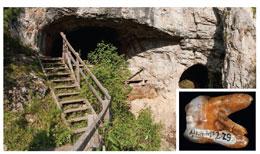
A finger bone and a tooth (inset) from Denisova Cave have illuminated a mysterious strand of hominin.
A finger bone of a young child (found in 2008) and a tooth (2000) were discovered in the Denisova Cave in Siberia.

The molar tooth and the finger bone mtDNA sequences were very similar, indicating that both individuals belonged to the same population.

The DNA analysis further indicates that the Denisovan population was the result of an early migration out of Africa. The ancestors of some Papuans and the Denisovans migrated, probably from the Nile region, between 100,000 and 70,000 years ago.


Related reading:  Complete Denisovan genome offers glimpse of ancient variation; Fossil genome reveals ancestral link

Tuesday, February 7, 2012

Terah's Territory and Legacy

Alice C. Linsley

Abraham's father was Terah, a great Kushite ruler and a descendant of Nimrod (Sargon the Great). His kingdom extended the length of the Euphrates River.

This kingdom was called Aram-Naharaim. In Old Syrian/Aramean aram means "high ground" and naharaim means "between the rivers."  Genesis 24:10 says that Abraham's servant Eliezar took gifts and set out for the city of Terah in Aram-Naharain. This may refer to Damascus, and who better to send than his own son by his concubine Masek who was Syrian?

Other regions are designated as aram in the Bible. For example, the ruler of Aram Soba (Zobah) was defeated by Saul, according to 1 Samuel 14:47, and Joshua confiscated the land of the ruler of Aram Maaka, according to Joshua 12:16.  It was typical for rulers to built their cities on high ground near sources of water.  The Jebusites were especially famous for this and according to Joshua 15:63, the Israelites were never able to uproot the Jebusites from Jerusalem.


The rulers of Genesis controlled vast territories along the ancient rivers.  The extreme boundaries of their territories were marked by the cities or settlements of their two wives.  As the rivers were oriented more or less on a north-south axis, so were their wives.  The ruler traveled between his wives on a north-south axis, as the sun travels between the horizons from east to west. Knowing the marriage custom helps us to identify the extent of  Terah's territory.  One wife lived in Ur to the south and the other wife lived in Haran to the north.

Abraham also set his wives on a north-south axis, with Sarah in Hebron and Keturah in Beersheba.

There is another explanation in Genesis for why the ruler's two wives were placed on a north-south axis rather than on an east-west axis. The explanation involves Lamech who bragged to his two wives Adah and Zillah (Gen. 4). Theodor H. Gaster noted that the names Adah and Zillah seem to have a relationship to words for dawn and dusk, suggesting a celestial or sacred marriage motif.  However, it was not unusual for archaic rulers to brag about their greatness by claiming to control all the land from the sunrise to the sunset.

For the author of Genesis, Lamech the Elder is portrayed as a braggart and a murderer.  As such, he set himself above God's law. In other words, he posed himself as God by placing his wives on an east-west axis, for this is the territory of the Creator, whose solar emblem moves daily from east to west.


Lamech the Younger is the firstborn son of Methuselah by his cousin wife Naamah. He is the great great grandfather of Nimrod/Sargon the Great who apparently shared his ancestor's hubris because he claimed to rule from the Persian Gulf to the Mediterranean or "from sunrise to sunset."

It is likely that the final redactor of Genesis was a priest living during the reign of David. He would have known that the name Naamah was associated with David's dynasty.  The mother of Rehoboam, David's grandson, was a princess by that name.  If so, he would have mentally connected Lamech and David, both of whom shed innocent blood.  David was repentant and almost inconsolable. Lamech, as far as we know from the Bible, was not repentant.  On the other hand, the redactor may have intended a comparison rather than a contrast. This is the view of St. John Chrysostom who believed that by confessing his sins to his wives, Lamech brought to light what Cain tried to hide from God, and “by comparing what he has done to the crimes committed by Cain he limited the punishment coming to Him.” (St. John Chrysostom’s Homilies on Genesis, Vol. 74, p.39. The Catholic University Press of America, 1999.)


Sunday, February 5, 2012

Philip Ochieng: Kushite Flight from Canaan


Philip Ochieng, a Kenyan contemporary of President Obama's father, relates how the Kalenjin, a Kushite people, once resided in Egypt and Canaan and fled before their oppressors. They claim to have fled oppression in Egyptian held lands and wandered for 40 years in the wildernesses of Sudan and northwestern Kenya where they encountered God at the sacred mountain El-gon. There is linguistic evidence to support this. For example, the Kalenjin capital is Kericho which is Jericho.

The Kalenjin were a warrior caste in ancient Egypt. They have been identified with the Midianites. Midian is a Kalenjin clan of Baringo district of Kenya. Kalenjin were identified by clan divisions, namely Sebei, Sabaot, Miot and Midian until modern times. Here we have a suggestion of a Sheba-Midian-Egyptian confederation. This may explain the confusion in Genesis 37 where we are told that Joseph was sold to a caravan of Ishmaelite/Egyptian merchants (verse 25) and Midianite merchants (verse 28).

The linguistic connection between ancient Egypt and the Kalenjin is evidenced in the correspondance of many common words. The ancient Egyptian word for country was kmt, which corresponds to the Kalenjin word kemet. In both languages ntr designates divinity. The Kalenjin were a hill country people who dwelt in the region of their sacred mountain "El-gon" in the Tororo (n-trr) Hills of eastern Uganda. From there they migrated to Egypt, where they stayed for thousands of years. Some migrated back to Kenya and Uganda. Others moved into Canaan and Mesopotamia.

The Kalenjin, like the Egyptians, regarded the sun as the emblem of the Creator. Their word Asiis refers to both God and the sun. This is also an ancient Egyptian name for the Creator and is found among other African tribes who originated in the Nile Valley. The Asante of Ghana are the people (nte) of As.

The Kalenjin appear to be one of many groups that moved from the Nile Valley into Canaan and Mesopotamia. This Kushite migration is referenced in Genesis 10 and confirmed by historical records of Sargon the Great, who is likely Nimrod, the son of Kush.

Today, it is estimated that 44% of the Kalinjin are Christians.

Read more of Ochieng's take on the Kalenjin here.


Related reading:  The Migration of Abraham's Ancestors; Abraham's Kushite Ancestors; Sacred Mountains

Friday, February 3, 2012

Documentary Hypothesis Not Compatible With Modern Research


The Graf-Wellhausen theory or Documentary Hypothesis has been shown to be a defective device for interpreting the different theological perspectives found in Genesis. Although incompatible with anthropological and archaeological studies, the Documentary Hypothesis continues to obscure the cultural uniformity of Abraham's ancestors and his descendants up to the time of the Babylonian captivity.

Genesis: An Authorship Study in Computer-Assisted Statistical Linguistics (Analecta Biblica No. 903, Vol. 20) by Yehuda T. Radday and Heim Shore (Sept 1, 1985) is yet another rebuttal of the Documentary Hypothesis.  Radday explains:

Biblical scholarship in the nineteenth century, and until quite recently, concentrated either on Lower Criticism, i.e. reconstructing an allegedly corrupt Massoretic text, or on Higher Criticism, i.e. differentiating the sources from which the Massoretic text was thought to be composed. Lower Criticism, as it would be, finds little need to attend to matters of structure, while Higher Criticism, which takes any repetition in the flow of a narrative as evidence of separate source materials, is by definition bound to overlook the very essence of chiasm, namely the fact that such repetitions may have been employed in a given composition as an intentional stylistic device. The result, in the final analysis, is that both approaches, and indeed the somewhat myopic scholarly fixation on detailed and minute analysis generally, can combine to preclude even the most dedicated scholar from perceiving the overall structure of many compositions which reveals the presence of chiasm in longer passages and entire books.

But scholarly attitudes are changing. The general attitude toward biblical exegesis has become less text-critical, especially as the discoveries of Ugaritic and Essene literatures frequently sustain the Massoretic text against its major detractors. Furthermore, disillusionment with the crass rationalism of the last century has brought about a more cautious posture vis-î-vis ancient literatures than the confident attitudes which spawned much of Higher Criticism. These changes in the intellectual climate have slowly enabled scholars to agree that several techniques other than the naturalistic manner of telling a tale may exist in the Bible.

From here.


Radday designed a statistical study of the Documentary Hypothesis. Using computer-assisted statistical linguistics, his research team  produced an interpretation of the authorship of Genesis. The team did not find statistical validity for the attribution of the book to J, E, and P. Instead, the evidence calls for a division of the book into three categories: divine speech, human speech, and the narrator. The book provides much of the mathematical material on which the conclusions are based.

Apparently the King Lists were not part of the analysis. In my opinion, this necessarily skews the results.


Related reading:  The Documentary Hypothesis; Should Genesis Be Taught in the Public Schools?

Wednesday, February 1, 2012

Analysis of the Flood Story

Alice C. Linsley


There are two flood traditions in Genesis, expressing different perspectives on that event. In the chart that follows we see how the traditions are crafted into a chiastic narrative. The narrative reflects a Nilotic perspective and a Mesopotamian or Akkadian perspective. Both are very old, and the narrative is the work of an author who was familiar with both traditions. (Genesis 4 has a ABBAABB…ABBA chiastic structure.)

The Nilotic perspective is evident in the water and mountain archetypes, and in the use of the number 40.  The Nile flooded for 40 days and it took 40 days for the waters to abate.  The Mesopotamian perspective is evident in the covenant language and in the use of the number 7.

The two different birds may represent the different traditions concerning ravens and doves. However, both birds would have been native to East Africa, Arabia and Mesopotamia.

In Africa, the dove represents prophetic discernment, so sending out a dove was Noah’s way of seeking guidance. The most common dove in the region of the flood is the Pink-bellied Dove. This species is abundant near water and would have been associated with river shrines such as those along the Nile. The pink belly is suggestive of blood sacrifice which made peace between the penitent and God. This peace is symbolized by the olive branch which the dove brought to Noah.

The raven or crow was a trickster in Annu tradition.  While the dove returns with a message, the trickster does not. Annu means "those of royal blood" (See Gwendolyn Leick, A Dictionary of Ancient Near Eastern Mythology, 1998, p. 7.) and Abraham had Annu ancestors. Abraham's father was Terah, a royal name among the Nilotic Annu.

The analysis is from here.  The lines form the image of a bird in flight, perhaps representing Horus? Horus was shown with the body of a man and the head of a falcon. The falcon was his totem and a symbol of divine kingship. Horus or Hr is "the lord of the sky or "the one on high." The Horites spread their religious practices and beliefs from ancient Kush to Mesopotamia and beyond. The oldest fire altars were falcon shaped. This is why the Shulba Sutras state that "he who desires heaven is to construct a fire-altar in the form of a falcon."

Horite stone altar
In both the Nilotic and Mespotamian traditions we find water and mountains archetypes.  The pyramids of the Nile and the ziggurats of Mesopotamia are stylized mountains or the meeting place of God and the divinely appointed or chosen ruler. The ziggurat had 7 terraces.

The sacred center of the flood story (P in the chart above) casts us back to the beginning of creation when the Spirit moved over the waters (Gen. 1:2). "And God remembered Noah, and every living thing, and all the cattle that was with him in the ark: and God made a wind/spirit (ruach) to pass over the earth, and the waters asswaged..."

The temporal sacred center is when the Sun rests at the peak of the day, when there are no shadows (James 1:17).  In terms of the solar day, this is the temporal sacred center.

The spatial sacred center is between heaven and earth, on the mountain top where God meets with the chosen leader. Abraham, Moses, and Elijah encountered God on mountains. The spatial sacred center is the mountain, prefiguring the Christ's crucifixion and tranfiguration.  The center of the Genesis 6 flood narrative is bracketed by the covering/veiling and revealing/unveiling of mountains. Here we have a sign pointing to God's self-revealing in the Person of Jesus Christ.

The sacred center in ancient Canaan was Shechem (modern Nablus). It was located between the mountains of Ebal on the northern side of the valley and Mount Gerizim on the southern side. Mount Ebal rises 3084 feet above sea level, some 194 feet (59 meters) higher than Mount Gerizim. From Mount Gerizim the priests declared the blessings and from Mount Ebal the curses (Deut. 11:29). This was part of the covenant at Shechem, but curiously only the curses are recorded in Scripture (Deut. 27).

The mountain as celestial archetype is very old. The mountain is the safest place when the waters become the chaotic deep (tehom in Hebrew: תְּהוֹם‎). Noah's ark came to rest on the "mountain of vehemence" (ararat in Arabic). The binary opposite of tehom is tehut, divine order/wisdom.  The oldest known moral code is the Egyptian "Law of Tehut" which dates to about 5,000 B.C.  When God spoke the creation into being He fixed boundaries which those who honor the Creator are not trespass. Trespassing established boundaries invites chaos (tehom) to return like a great flood to the world. Tehom and tehut are binary opposites, and typical of the binary worldview of Abraham's people, there is a hierarchy, with tehut being greater because it preserves order and life.

The binary conception is evident also in the relationship of dry land and waters, which God separated in the beginning. The victory of tehut (order) over tehom (chaos) relates to the annual inundation of the Nile and helps us to understand the Egyptian concept of creation. One of the oldest creation myths envisioned the first place in the world as a mound emerging from the waters of a universal ocean. Here the first life form, a lily, grew on the peak of the primeval mound. The ancient Egyptians called the mound Tatjenen, meaning "the emerging land."


The map above shows the natural habitat of both the Fan-Tailed Raven (crow) and the Pink-bellied Dove, the birds that Noah may have released from the ark. It is also the Afro-Asiatic Dominion, with the Nile at the center. This vast area was controlled by the ruler-priests named in the king lists of Genesis 4, 5, 10, 22:20-24 and 36.  According to the flood account and Genesis 10, Shem, Ham and Japheth are the royal ancestors of the rulers of Mesopotamia and the Horite territory of Edom.


Feminine Imagery

The association of the waters with the origins of life is a distinctly feminine image which may explain the emergence of the goddess Tiamat, who along with Lillith, pertains to a later period of Babylonian mythology.  Among the Yoruba, living descendants of the ancient Nilotic peoples, the association of waters with the feminine principle is evident in the symbolism of the calabash and the rainbow. The calabash symbolizes the waters below and the womb, and the rainbow symbolizes the waters above. Together these represent the entire cosmos.

The mountain image for the Virgin Mary and the Nativity of Christ follows verses such as Habakkuk 3.3 - "God came from Mount Paran" and the portrayal of Mary as "Holy mountain" rests on ancient cosmology. The Virgin Mary, whose womb swelled with the Son of God, is sometimes portrayed in icons as the mountain of God. The Prophet Daniel saw a mountain, from which a stone was cut by the hand of God (Dan. 2:34, 45). This is the stone which the builders rejected and which has become a stumbling block, even Jesus Christ, the Son of God.


Related reading:  The Extent of Noah's Flood; Noah's Descendants; Mount Mary and the Origins of Life; The Victory of Tehut Over Tehom