Followers

Showing posts with label DNA. Show all posts

Friday, November 28, 2025

The Mysterious Tarim Mummies


Dr. Alice C. Linsley

The Tarim Basin of Xinjiang, China, with its fertile rim of oases, was home to a homogeneous population living in two settlements about 600 kilometers apart. It is likely that marriage partners were exchanged between the settlements.

The physical features of the Tarim mummies initially suggested that they were Indo-European migrants. Many had high cheekbones and red or blonde hair. However, DNA analysis revealed they were a genetically isolated population descended from Ancient North Eurasians (ANE) who had not mixed with other groups for thousands of years. The Tarim population had remained isolated genetically.

Investigation of their genomic origins found that this population practiced endogamy. Scientists analyzed genome-wide data from thirteen of the earliest known Tarim Basin mummies, dating to between 2,100 and 1,700 B.C., together with five individuals dating to 3,000 - 2,800 B.C. in the neighboring Dzungarian Basin. This first genomic study of prehistoric populations in the Xinjiang Uyghur Region included the earliest yet discovered human remains from the region. The researchers found that the Tarim Basin mummies were direct descendants of a once widespread Pleistocene population that had largely disappeared by the end of the last Ice Age.

Hundreds of mummified bodies have been found in the Tarim Basin. The oldest mummified remains date to about 2000 B.C., the time of Abraham. They are well preserved due to the dry conditions of the Taklamakan Desert. The process of desiccation dramatically slowed decomposition of the bodies and clothing. Some of the burial sites held boat-shaped coffins covered with cattle hides, woven textiles, cheese, grains, and death masks.

“Despite being genetically isolated, the Bronze Age peoples of the Tarim Basin were remarkably culturally cosmopolitan – they built their cuisine around wheat and dairy from the West Asia, millet from East Asia, and medicinal plants like Ephedra from Central Asia,” says Christina Warinner, a senior author of the study, a professor of Anthropology at Harvard University, and a research group leader at the Max Planck Institute for Evolutionary Anthropology in Leipzig, Germany.

Below is a photo of one of the Tarim mummies, known as the "Ur-David" mummy or "Cherchen Man" (Chärchän Man). He wore a red twill tunic and leggings. The mummy dates to about 1000 B.C., the time of King David. He had reddish-brown hair and a ginger beard. Note the solar image on his cheek, suggesting that he was a chief. At that time, rulers were believed to be divinely appointed by being overshadowed by the sun, the primary symbol of the High God. A sun pattern on the mummy's face was applied using yellow ochre.


The image on his cheek appears to be a celestial horse., a symbol of the High God. Some burial sites included wooden horse bits and whips, indicating as equestrian culture. The kings of Judah constructed horses at the entrance to the temple in dedication to the sun, the symbol of the High God. (2 Kg. 23:11). Consider 2 Kings 2:11 - "As they [Elijah and Elisha] were walking along and talking together, suddenly a chariot of fire and horses of fire appeared and separated the two of them, and Elijah went up to heaven in a whirlwind."


Celtic coin showing the celestial horseman.


Some believe that the first horseman of the Apocalypse who rides a white horse represents Christ.

Joseph Campbell discovered that horse narratives involving a celestial rider are widespread, and often involve a hero who dies and rises, leading his people to victory. Some interpret this as reflecting solar and seasonal changes that mark public occasions such as harvest festivals, solstice celebrations, etc. Campbell considered this a "monomyth" because of the wide distribution of the common elements and themes. However, this belief in a celestial rider who overcomes death may be a glimmer of the Messianic beliefs of the early Hebrew ruler-priests (4000-2000 BC). 

Wednesday, February 13, 2013

Tut's Father Had Two Queens


An ark found in the tomb of King Tut. It has Anubis, 
one of the four manifestations of Horus, the son of Ra.


In recent years, DNA analysis has shed light on the parents of Egypt’s most famous pharaoh, the boy king Tutankhamun, known to the world as King Tut. Genetic investigation identified his father as Akhenaten and his mother as Akhenaten’s unknown sister.

Genetic studies have shown that Nefertiti was not the mother of King Tut. Tutankhamun was born of Akhenaten's half-sister wife. This means that Akhenaten, as with all the high kings in the R1b haplogroup, had two queens: one a half-sister and the other a cousin (probably patrilineal cousin). This is consistent with the marriage and ascendancy pattern of the Horite rulers of the Nile Valley and those who dispersed into the Arabian Peninsula and the Tigris-Euphrates Valley. It appears that Akhenaten was upholding a tradition received from his ancestors of the Upper Nile. That is where the affix "itti" is still found in names.

French Egyptologist Marc Gabolde offered a different interpretation of the DNA evidence. Speaking at Harvard’s Science Center, Gabolde said he’s convinced that Tut’s mother was not his father’s sister, but rather his father’s first cousin, Nefertiti.

Nefertiti was already known to be Akhenaten’s wife and in fact the two had six daughters. Gabolde believes they also had a son, Tutankhamun, and that the apparent genetic closeness revealed in the DNA tests was not a result of a single brother-to-sister mating, but rather due to three successive generations of marriage between first cousins.

Read the Harvard Gazette report here.


Gabolde is right. This is demonstrated through DNA studies and analysis of the Genesis King Lists which identifies the marriage and ascendancy pattern of the Kushite rulers who united Egypt and established the earliest dynasties. Likely Tut's father had two wives. One was a half-sister and the other was a cousin. Tut was the son of the cousin wife. Usually this son served as a prime minister in the territory of his maternal grandfather.

The significance of my research is that I have identified the marriage and ascendancy pattern of Abraham's Horite caste and have demonstrated that this marriage structure drove Kushite expansion and the diffusion of the proto-Gospel. Using the tools of kinship analysis, I have traced the Horite ancestry of Jesus Christ from his earliest named ancestors in Genesis 4 and 5.

Scans of Tut's tomb has revealed secret rooms.


Related reading: Identifying King Tut's Father; King Tut and the Dispersion of R1b; A Visit to King Tut's Seattle Exhibit; Solar Imagery of the Proto-Gospel; Why Eliezar Was Abraham's Heir

Thursday, January 10, 2013

Endogamy and the Melungeons


Alice C. Linsley

The term "Melungeon" refers to an Appalachian ethnic group with distinct physical, cultural, historical and genetic characteristics. These characteristics served to set Melungeons apart from other peoples dwelling in southeastern North America from the 1500's onward.

Today most Melungeons live in Kentucky. They practiced cousin marriage over an extended period of time (in some cases 400 years). Their marriage pattern is consistent with that of Sephardic Jews, Moors and Arabians. This makes sense since they are descendants of Semitic peoples, mostly Sephardic Jews and Moors banished from Spain. Many came to the United States via France and England. Having intermarried with Native Americans and converted mainly to the Primitive Baptist religion (some with serpent veneration), the Melugeons represent an isolated and mostly forgotten people. When remembered it is usually to crack a joke about them as backward people due to in-breeding (endogamy).

In his book The Genetic History of the Jewish People Harry Ostrer notes that the Sephardic Jews who were the focus of harsh treatment in Spain during the Inquisition, were more prone to marry outside their bloodlines whereas the Ashkenazim are relatively homogeneous despite the fact that they are spread throughout Europe and immigrated to the Americas. He reports that DNA studies confirm that there is a distinctive Jewish "race" but fails to mention that the Kohen Modal Haplotype is also found among Arabs of Horite blood.

Harry Ostrer, director of the human genetics program at the New York University School of Medicine, led one of the studies that compared the genetic makeup of Jewish populations from around the world with African populations. Ostrer found that modern Jewish populations have African ancestry. This confirms the Genesis 10 information that indicates Abraham's ancestors were Nilotes and Proto-Saharans.


Here is a review of Harry Ostrer's Legacy: A Genetic History of the Jewish People.
(Oxford University Press, 288 Pages, $24.95)

In his new book, “Legacy: A Genetic History of the Jewish People,” Harry Ostrer, a medical geneticist and professor at Albert Einstein College of Medicine in New York, claims that Jews are different, and the differences are not just skin deep. Jews exhibit, he writes, a distinctive genetic signature. Considering that the Nazis tried to exterminate Jews based on their supposed racial distinctiveness, such a conclusion might be a cause for concern. But Ostrer sees it as central to Jewish identity.

“Who is a Jew?” has been a poignant question for Jews throughout our history. It evokes a complex tapestry of Jewish identity made up of different strains of religious beliefs, cultural practices and blood ties to ancient Palestine and modern Israel. But the question, with its echoes of genetic determinism, also has a dark side.

Geneticists have long been aware that certain diseases, from breast cancer to Tay-Sachs, disproportionately affect Jews. Ostrer, who is also director of genetic and genomic testing at Montefiore Medical Center, goes further, maintaining that Jews are a homogeneous group with all the scientific trappings of what we used to call a “race.”

Read it all here.


Related reading:  Eastern Kentucky Language; The Bible and the Question of Race; Hebrew, Israelite or Jew?; Sub-Saharan DNA of Modern Jews; DNA Studies Confirm Mixed Ancestry of Jews; Abraham: Descendant of Both Shem and Ham


Tuesday, October 16, 2012

Genetics Confirms Biblical Migrations


Alice C. Linsley


Genesis places a region called Eden as the point of origin of Abraham's ancestors. Eden was a large well-watered area that was a distant memory by the time Genesis was written. Eden extended from the Upper Nile to the Tigris-Euphrates Valley. Genesis 2:10-14 says that Eden was watered by four rivers: the Tigris, the Euphrates, the Pishon and the Gihon. The first two are in Mesopotamia and the last two are in Africa. This is the heart of the ancient Afro-Asiatic Dominion and the place of origin of the ruler-priests and of "him that holds the scepter from the house of Eden" (Amos 1:5).

Abraham's ancestors established territories throughout Eden and beyond.  Nimrod's kingdom building is but one example.  He was a Kushite ruler in Mesopotamia and his capital Akkad (Agade in Sumerian) was a shrine city and trade center. The language of his kingdom was Afrasian. Dr Christopher Ehret has written: "The linguistic, genetic, and archaeological evidence combine in locating the origins of this [Afrasian] family far south in Africa, in Eritrea or Ethiopia, and not at all in Asia. A complex array of lexical evidence confirms that the proto-Afrasian society belonged to the pre-agricultural eras of human history." (History of Africa, p.4)

The migration and kingdom building activies of Nimrod and the other Kushite rulers continued the custom of their more ancient ancestors who emerged in Africa about 200,000 years ago.

DNA studies help to piece together a clearer picture of archaic populations, their migrations and the mixing of archaic peoples. Of particular interest is the migration of Haplogroup C, which traces lineage by the Y-chromosome.


Onges of Andaman and Nicobar Islands
The Onges and Jarawas belong almost exclusively to Haplotype D, a subtype of Haplogroup C.


Some scientists believe that the aboriginal peoples of the Andaman Islands are the direct descendants of the first humans to migrate out of Africa into Asia. These aboriginal inhabitants of the Andaman Islands in the Bay of Bengal have physical resemblance to African pygmies.  A DNA study of hair samples from Andamanese individuals confirms the link between these peoples.  The study was done using hair collected by Alfred R. Radcliffe-Brown in 1907.

Carlos Lalueza Fox (University of Cambridge) extracted DNA from 42 out of 70 hair samples and amplified a short segment of DNA from the mitochondria. Mitochondrial DNA traces lineage by the mitochondria, received from the mothers. MtDNA is less directly related to physical characteristics than chromosomal DNA and is believed to be less sensitive to the pressures of natural selection. Fox's research confirmed that the sequences of base pairs in the mtDNA fragments clustered closer southern African pygmies than to Asian ones.

The negrito Andaman and Nicobar Islanders belong to M130 (Haplogroup C) designated by Spencer Wells, who leads the Genographic Project.


Other migrations out of Africa

The Ainu are another out-of-Africa group that has been traced.  The Ainu originated in the Nile Valley and Sahara during the Holocene Wet period.  They migrated as far Japan and also crossed into Europe and migrated to the eastern seaboard of Canada.

The Ainu are in mtDNA haplogroup X. The dispersion of haplogroup X is shown below. The greatest concentrations are indicated by the darker shade.


Note the small dot in Southern Siberia. This is the only known archaic HgX population in that entire region, indicating that the Ainu did not come to North America across the Bering Strait. According to Ainu oral tradition, they came into North America through Finland, Greenland and Labrador.

The Ainu call themselves "First People" and are at the center of Luigi Cavalli-Sforza's genetic distance chart. The Ainu were the first rulers of the Lower Nile. One of their sanctuaries was called Annu, the original name for Heliopolis, to which the great pyramids were aligned.

Abraham's Nilo-Saharan ancestors were sea-faring rulers who controlled the major water systems during the late Holocene Wet Period.  Abraham's father Terah was associated with the Ainu temple of Het (Heth). Het also refers to a ruler-priest line found among the Canaanites. DNA studies have confirmed the migration of the Nilo-Saharan Kushites out of Africa.


Related reading:  Haplogroups of Interest to Biblical Anthropologists; Confirmation of Early Biblical Populations; Scientific Verification of the Genesis 10 Dispersion; The Nile-Japan Ainu Connection; A Kindling of Ancient Memory; Abraham's Ainu Ancestors

Saturday, September 8, 2012

Ethiopian DNA Study Ignores Significant Data


Ethiopians are described by representatives of the Wellcome Trust Sanger Institute, one of the organizations involved in the study, as one of the most genetically diverse cultures in the world. By studying their DNA, the researchers detected mixing from some Ethiopians and non-Africans dating back to approximately 3,000 years ago.

“The origin and date of this genomic admixture, along with previous linguistic studies, is consistent with the legend of the Queen of Sheba, who according to the Ethiopian Kebra Nagast book had a child with King Solomon from Israel and is mentioned in both the Bible and the Qur’an,” the Institute said in a press release.

As part of their work, which is detailed in the American Journal of Human Genetics, the scientists studied the DNA of more than 200 subjects from 10 Ethiopian and two neighboring African populations, Helen Briggs of BBC News reported on Thursday. Approximately one million genetic letters in each genome were analyzed in what is being called the largest Ethiopian-centered genetic investigation of its kind.

Read it all here.


I reserve skepticism about this study.  The oldest common ancestor of the subjects studied would have to date to at least 6000 years ago, about 3000 years before Solomon.

Further, we have no proof that the Queen of Sheba came from Ethiopia. She may have come from the kingdom of Sheba in Arabia.


Before the time of Solomon it is likely that Sheba controlled both sides of the mouth of the Red Sea. This is suggested by the archaeological and linguistic evidence connecting Sheba in Arabia to East African settlements.

The connection between Sheba and Jerusalem is evident in the time of Abraham. Melchizedek was the priest-king of Jerusalem and the son of Sheba. It appears that Solomon's sexual liaison with a royal daughter of the House of Sheba was intended to ease tensions after David had Sheba killed at Abel beth Maachah and to add the clout of the House of Sheba to Solomon's dynastic claims.


Related reading: Biblical Sheba and East African Settlements Linked; 7000 BC Horse Burial Linked to Sheba; Jebusites: Extant Biblical Tribe; Lamech Segment Analysis


Monday, September 3, 2012

Hunter-Gatherer Study Inconclusive


Alice C. Linsley


Although the oldest human fossils date to about 3.8 million years, modern humans arose in Africa around 200,000 years ago. One theory says that the archaic human populations died out. A recent study published in the journal Cell casts doubt on that theory. Apparently, Neanderthals had company in Africa.  As early as 100,000 years ago humans were already moving out of Africa.

DNA samples along the paths of migration of early populations out of Africa reveal genetic drift. The farther from Africa, the more genetically similar the human populations. No geographic origin outside of Africa accounts as well for the observed patterns of genetic diversity. There is little doubt that humans originated in Africa. (Further investigation needs to be done to confirm migrations routes, as in the case of the Nilotic Ainu who are at the center of Cavalli-Sforza's genetic distance chart.)

The Cell publication “Evolutionary History and Adaptation from High-Coverage Whole-Genome Sequences of Diverse African Hunter-Gatherers” focuses on three hunter-gatherer populations: the forest-dwelling Pygmies of Cameroon and the Click-speaking Hadza and Sandawe of Tanzania.

Hadza warriors
Photo: Sarah Tishkoff

The publication covers the genomes of five individuals from these groups and highlights yet again that the genetic diversity of African populations is greater than anywhere else on Earth. The authors discovered over 3.4 million genetic variants, or SNPs, of which five million are previously unknown. They report:

We sequenced the whole genomes of five individuals in each of three different hunter-gatherer populations at 60× coverage and identify 13.4 million variants, substantially increasing the set of known human variation. We found evidence of archaic introgression in all three populations, and the distribution of time to most recent common ancestors from these regions is similar to that observed for introgressed regions in Europeans.

The "Click" or Khoisan language family is very old. Genetic data show that the Sandawe and southern African click speakers share rare mtDNA and Y chromosome haplogroups. The common ancestry of the Click populations dates back 35,000 years. DNA studies indicate that the common ancestry of the Hadza and Sandawe populations dates back to15,000 years. These findings suggest that at the time of the spread of agriculture and pastoralism, the Click-speaking populations were already isolated from one another which explains linguistic divergence among the respective Click languages.

Baka Pygmies of Cameroon

Not surprisingly, the Pygmy population has multiple highly differentiated loci on genes on chromosome 3 which affect growth and pituitary function associated with height. This may account also for the early age of reproduction among the Pygmies.

Hypothetical branching shows theoretical common
ancestor of African populations and chimps

SNPs not found in any modern populations can be explained by the practice of endogamy which is common in Africa, and especially characteristic of hunter-gatherer communities. Others speculate that these represent an unknown, yet-to-be discovered human population that might be a sibling to Neanderthal humans. Co-author of the study Joshua Akey of the University of Washington in Seattle states, "Fossils degrade fast in Africa so we don't have a reference genome for this ancestral lineage... one of the things we're thinking is it could have been a sibling species to Neanderthals."

Richard Klein, paleoanthropologist at Stanford University, considers this speculation “irresponsible” because there is no fossil evidence for this mysterious hominid. Klein excavated at South African Stone Age sites and his research on hunter–gatherers who lived more than 50,000 years ago makes him an important authority on the subject. He believes that the claim of archaic and modern human interbreeding “is a further example of the tendency for geneticists to ignore fossil and archaeological evidence, perhaps because they think it can always be molded to fit the genetics after the fact.” Klein urges skepticism about such claims "when they are so clearly at odds with the fossil and archaeological records."

What strikes me about this research is how little importance is given to marriage and kinship structures among these populations. To speak of "interbreeding" without knowing the kinship structure is to shoot in the dark. For example, do the forest Pygmies of Cameroon have a kinship and marriage structure like that of the Mbuti Pygmies of the Ituri rainforest in the Congo? Their skin tone and languages are different, but are they genetically kin? Clearly, further investigation is needed. Such questions must be answered to gain an accurate anthropological history of Africa.

Mbuti Pygmies
Notice the red skin tone. Their language is in the Central Sudanic group.

It is conceivable that at one time these forest dwellers lived as one population or in proximity to each other and were related by blood and marriage. Their geographical separation can be explained by the practice of sending away younger sons to establish their own territories. Geographical separation does not stop intermarriage between the clans, except in the cases of catastrophic events that might cause isolation. Kinship structures have been shown to be highly resistant to change.

Luigi Cavalli-Sforza's distribution of African Pygmies

The common ancestry and languages of the Hadza and Sandawe populations dating back to15,000 years further suggests that geographical separation did not interrupt kinship structure.

Perhaps it is time for paleoanthropologists, molecular geneticists and kinship analysts to start sharing information.


Related reading:  The Beginnings of Spoken Language; Biblical Anthropologists Discuss Darwin; Sent Away Sons; The Marriage and Ascendancy Pattern of Abraham's People

Tuesday, June 19, 2012

About Race, Human Populations, and the Purpose of Mankind

Alice C. Linsley


Part 7: Answers to Questions about Race and Population
This continues the series "Answers to Hign Schoolers' Questions About Genesis."

Part 1: About God
Part 2: About Adam and Eve
Part 3: About the Serpent
Part 4: About the Flood
Part 5: About the Earth
Part 6: High Schoolers Wonder "Why Abraham?"


Q:  How did the different races come about?

A:  The modern conception of race is not biblical. This explains why the term "race" does not appear in the Bible. All humans share common ancestry and our point of origin is Africa millions of years ago.

Instead of race, the Bible speaks of ethnicities. In fact it mentions many ancient populations and cultures.

In Genesis 25, we find the words goyim and leumim (peoples) to describe two peoples who descend from Jacob by Rebekah. 

In the New Testament, the Greek word ethnos is used for peoples or nations. The Hebrew goyim is used to distinguish non-Jews from Jews. Both goyim and ethnos refer to peoples or nations, not to races.

The term "race" is misleading. Today molecular genetics classifies populations by "haplogroups" and people who look very different can be in the same haplogroup.

Haplogroups characterize the early migrations of human populations and can be used to connect ancestry with a geographical region or regions. A haplogroup identifies the descendants of a single individual who first showed a particular single nucleotide polymorphism, or SNP. An SNP is a point on the DNA where a single base changes. This SNP change is passed through generations of the family, clan or caste, and can be used to genetically define populations. Individuals with the same genetic SNP mutation or "marker" can be linked back to the population where the marker first made an appearance. 

Y-chromosome and mitochondrial DNA haplogroups have different haplogroup designations. The Y-chromosome traces paternal ancestry and the mt-DNA traces maternal ancestry.

Genesis does not tell us about all the haplogroups. It tells us about the peoples in Y-DNA haplogroup A, the lineage of all human males. 


It also tells us about the dispersion of the Y-DNA R1 populations out of Africa, shown on this map.


The dark red spot in central Africa is Noah's homeland, the region of Bor-No.


Mitochondrial Eve


"Mitochondrial Eve" lived about 200,000 years ago. She is the most recent female common ancestor. Found in the energy-producing centers of cells, mitochondrial DNA is passed down the maternal line, and can be traced back to one woman. Both males and females inherit the Mt-DNA from their mothers, but only females pass it on to their children. The people of Genesis are grouped according to their clan mothers: J1, N, X and L1, L2 and L3. 

In these haplogroups we find every "racial" feature: black, white, yellow, and red skin tones; brown, blue, and green eyes; woolly, wavy, and straight hair; facial hair and no facial hair; slanted almond-shaped eyes, round eyes, heavy lids; high foreheads and low foreheads, thick lips and thin lips, prominent noses and flat noses, and every head shape.

The fact that the lines of Ham and Shem cannot be separated linguistically or genetically underscores that their lines intermarried. It also testifies to the biblical assertion of Genesis 11:1 that all the peoples listed in the Table of Nations were one people with common ancestry. The lines of Ham and Shem intermarried as demonstrated by analysis of the marriage and ascendancy pattern of Abraham's ancestors.


Q:  If Adam and Eve's children married each other, isn't that the sin of incest?

A:  Incest is universally defined as sexual relations between parent and child, not between siblings. In the culture of Abraham's Horite Hebew people, the preferred marriage arrangement for the first wife was a half-sister. Sarah was Abraham's first wife and his half-sister. Jochebed was Amram's half-sister and his first wife. However, sex between parent and child was taboo and forbidden. Such perversion was regarded as so despicable that it was used to slander Lot's Ammonite and Moabite descendants (Gen. 19: 30-38).


Q:  How did the whole earth's population come from just Adam and Eve?

A:  The Bible does not say that all human populations came from Adam and Eve. It does state that all who live today are of "one blood." 

It also is not possible to say that the whole earth's population came from Noah's descendants after the flood. Noah lived about 3490-2800 BC when the Sahara experienced a wet period (the African Aqualithic). He lived at the same time as the Horite Hebrew shrine city of Nekhen.


Q:  Did other families exist on earth at the same time that Adam and Eve lived?

A: In the Bible, Adam and Eve are present different ways. Adam is posed as the archetypal first father and Adam and Eve as the original couple. This is an archetype, not to be taken as historical.

However, Adam and Eve are also presented as historical in the Bible. They are the parents of Cain and Seth who married the daughters of Enoch, a contemporary of Adam. The data of Genesis suggests that Adam and Enoch are the ancestors of the rulers listed in Genesis 4, 5 and 11. This may explain why the names Adam and Enoch are parallel in Psalm 8:4:

What is man (Enoch) that you are mindful of him,
or the son of man (ben adam) that you care for him?


The Apostle Paul speaks of Adam analogically. He draws and analogy between Adam by whom sin and death entered and Jesus Christ, the Second Adam, who overturns the curse, defeats death and restores paradise.


Q:  Did all the peoples of the earth come from Noah's three sons after the flood?

A:  No. Humans were already dispersed into Europe and Asia by 100,000 years ago, long before Noah's time. They were in the New World by 11,000 years ago.


Q:  How many generations are from Adam and Eve to Abraham?

A:  That is impossible to answer this because we cannot know when Adam and Eve existed. We also cannot say exactly how many generations from Cain to Abraham since the Genesis Kings lists do not correspond to generations, but to the reign and succession of the Horite Hebrew rulers.

Between 100,000 and 500 BC the average man lived less than 40 years and the average woman lived less than 38 years. These life spans would have been longer for rulers due to their superior diets and access to medical resources. So it is conceivable that the rulers named in Genesis lived relatively long lives, with the exception of those who died by assassination or in battle. We might estimate their life spans to be between 60 and 80 years (average would be 70). This would mean that a dynastic line of a depth of 10 rulers would represent between 300 and 400 years. 

One factor that must be considered is whether a ruler is the firstborn of the sister-bride or the cousin/niece bride. The sister-bride was the first wife and the wife of the ruler's youth. The cousin/niece bride was the wife that the heir married before ascending the throne. For the sister-wife's firstborn son, the father's age would be between 18 and 25 (median would be 21). So we can estimate that generally the firstborn son of the sister-wife would have been born when his father was about 21. For the cousin/niece bride's firstborn son the father's age would be between 45 and 60 (median would be 52). So we can estimate that the cousin-bride produced an heir or priest (for her father, not her husband) when her husband was about age 52.

We do not know how long the rulers of Genesis lived. Noah is said to have lived 950 years. Methuselah lived 969 years. Methuselah's son, Lamech the Younger, lived 777 years. Abraham's father, Terah, lived longer than Jacob by 58 years. The numbers assigned to the Genesis rulers are symbolic and some are linked to astronomical observations. Clearly, symbolic numbers cannot be used to determine actual life spans. 


Q:  Why were the men in Genesis so old?

A. The life spans assigned to the kings of Genesis are symbolic. Ancient clay tablets have been discovered that recount the greatness ofassign as much as a thousand years to some Sumerian and Akkadian rulers. However, all these lived normal live spans for rulers of the time. The average life span for rulers was between 73 and 75 years.

Paleontology indicates that the average lifespan of commoners was shorter. The life span of peoples living in the Nile Valley, Turkey and Mesopotamia during the time of the Genesis rulers was about 35 years for males and 30 years for females. This data corresponds to peoples in the Late Paleolithic (BC 30,000 to 9,000) when males lived about 34 years and females about 30 years. During the Mesolithic (BC 9,000 to 7,000) males lived about 33 years and females about 31 years. During the Early Neolithic (BC 7,000 to 5,000) males lived about 34 years and females about 30 years.

St. Jerome notes: "I am reviewing carefully the places in Scripture where I might find old age mentioned for the first time. Adam lived for 930 years, yet he is not called an old man. Methuselah's life was 969 years, and he is not called an old man. I am coming down all the way to the flood, and after the flood for almost three thousand years, and I find no one who has been called old. Abraham is the first, and certainly he was much younger than Methuselah." (Homilies on the Psalms 21)

Jerome observes that Abraham is the first man described as "old" in Genesis. Those who lived before him are not called old because the numbers assigned to them are symbolic. 


Q:  Why did God create Mankind?

A: The answer to this question varies from religion to religion. Islam teaches that Mankind was created to live in submission to Allah and for the purpose of worshipping Allah. Qur'an 51:56 states, "I have created the jinn and humankind only for My worship."

The Jinn are divided into followers of Islam and followers of the abased Iblis (a sort of fallen angel). The Jinn were commanded to bow down before Adam, but Iblis refused. God said, "What prevented you from prostrating when I commanded you?" He replied, "I am better than him. You created me from fire and You created him from clay." God said, "Descend from heaven. It is not for you to be arrogant in it. So get out! You are one of the abased." Surah 7 (al-A`raf), 11-13.

In Judaism, Man exists at God's pleasure and has liberty to obey or not to obey God's commands. The rabbis say that "Adam was created from the dust of the place where the sanctuary was to rise for the atonement of all human sin," and this means that sin should not be a permanent or inherent part of man's nature. 

Genesis 1 claims that humans are a special creation, fashioned in the image of the God. Christians believe that Mankind was created to enjoy perfect fellowship with God in Three Persons (the Trinity), in whose image and likeness we were made. When we seek God, we are renewed in our intended nature through Jesus Christ, and grow more like Him by the in-dwelling Holy Spirit. 


Related reading: Three Portraits of Adam; The Historicity of Noah's Flood; The Marriage and Ascendancy Pattern of Abraham's People; Thoughts on Calculating the Dates of the Patriarchs; Lifespans of Archaic Peoples: John Calvin on God's Motive in Creation


Sunday, May 20, 2012

Ket-Navajo Linguistic Connection


Alice C. Linsley


This 2008 study showed that Ket, spoken in Siberia, and Na-Dene, the language of the Navajo, are cognate languages. Another study that traces the connection based on DNA has been reported at Science Daily.

Linguistic evidence indicates that the Yeniseian family of languages, spoken in central Siberia, is most closely related to the Na-Dene family of languages spoken, for the most part, in northwestern North America. This hypothesis locates the source of one of the three migrations responsible for the peopling of the Americas.

These reports indicate that some native peoples of the Pacific Northwest, Alaska and the American southwest came from Asia. This is not new information among anthropologists or linguists. What is new information is the migration of the Nilotic Annu. The Ainu did not come across the Bering Strait. They came through Finland, Greenland and Labrador to Eastern Canada. Why is this not grabbing media attention?

Many native peoples of the Atlantic coast of North America migrated from the Nile Valley, via Finland, Greenland and Labrador. These are the Ainu, a seafaring people who also went to Japan. The Ainu are at the center of Cavalli-Sforza's genetic distance chart, which is what we might expect from such an early migration out of Africa.

The Ainu are connected to Abraham's ancestors. Abraham's father held the title Tera which meant "priest" among the royal Ainu of the Upper Nile. Tera-neter means priest of  God. The name is associated with Het-u temples. Genesis 10 lists Het as a descendant of Noah. Het and Sidon are indicated as the original inhabitants of Canaan.


Related reading:  The Orign of the Na-Dene; Navajo and Ket are Cognate Languages; The Nile-Japan Ainu Connection; A Kindling of Ancient Memory

Saturday, February 11, 2012

Migrations Out of Africa


Alice C. Linsley


I have discussed the evidence of molecular genetics in Haplogroups of Interest to Biblical Anthropologists.

Genesis 10 speaks of the migration of the Kushites into Mesopotamia. This is one of the later migrations out of Africa, between about 3500 and 1500 B.C. The Kushites represent a highly organized people, consisting of numerous clans and castes. Their rulers controlled the major water systems and founded early mining industries along the Nile and in southern Israel. Nimrod (Gen. 10:8-12) was a Kushite kingdom builder. He and his brother Ramah were the sons of Kush.

Amenhotep III ruled between about 1382 and 1350 B.C. (about 600 years after Abraham's son Jok-tan). His name means "peace of Amen" and indicates a date when Amen, a name for God favored over the name Set, which was favored in the Delta. It was during the 18th dynasty that the title 'King's Son of Kush' was first used. The earlier known Kushite ruler was called K-ash-ta which means The Throne of Kush.

Penelope Aubin has written, "According to I. Hofmann (and several other scholars starting with F. Cailliaud in 1822), similarities in art may attest to significant cultural contacts between the Indian subcontinent and ancient Kush. In addition, there are very clear resemblances between the Egyptian numeral system, particularly the Hieratic, and the oldest Indian forms. Resemblances in script strengthen the hypothesis of contacts with the Nile Valley."


Earlier Migrations out of Africa

Evolutionists maintain that "modern" humans originated in Africa about 200,000 years ago, reaching full behavioral modernity around 50,000 years ago.  The genetic root of modern humans is mtDNA Haplogroup L.

DNA studies are helping to piece together a clearer picture of archaic populations, their migrations and the mixing of archaic peoples. Of particular interest is the migration of Haplogroup C, which traces lineage by the Y-chromosome.


Onges of Andaman and Nicobar Islands
The Onges and Jarawas (Harwas) belong to Y-DNA Haplotype D, subtype of Haplogroup C

The negrito Andaman and Nicobar Islanders belong to M130 (Haplogroup C) designated by Spencer Wells, who leads the Genographic Project. This lineage of Nilotic peoples migrated between 70,000 and 50,000 years ago from Africa and Arabia, traveling along the coastlines and eventually crossing the sea. They moved eastwards to India, Japan and Australia.

The indigenous Orang Asli (aboriginal peoples) populations in the Malay Peninsula such as the Negritos (Jahai and Kensui) and Proto-Malays (Temuan) are associated with the first wave of human migration from Africa. It is believed that they may be descended from the Hoabinhians, as their mtDNA variation shows strong evidence for indigenous origins within Malay Peninsula, with time depth of ∼60,000 years ago. However, their origin and the route of their migration to Asia is still a matter of great speculation.

The 20,000 year old human skeletons found at Lake Mungo in New South Wales are may be descendants of the early Nilotic peoples who were seafaring.  Both groups buried their rulers in red ochre, derived from hematite, Fe2O3. The earliest known use of red ochre (300,000 years) is at the site of GnJh-03 in the Kapthurin Formation of East Africa, and at Twin Rivers in Zambia. Prominent persons were buried in red ochre for at least 40,000 years.

Haplogroup C migration


The Onges and Jarawas belong to Haplotype D which is also common in Tibet and Japan. The Ainu aboriginal people of Japan are in haplotype D (Y-chromosome) and haplogroup X (mitochondrial chromosome).  The Ainu have a red skin tone similar to Abraham's Horite (Edom = red) people. This explains why the Hebrew and Japanese alphabets are similar.


The Ainu/Annu also migrated westward and settled in Greenland, Labrador and the eastern coastline of Canada. The Ainu share a common female ancestors and are classified in mtDNA haplogroup X. The heaviest concentration of mtDNA haplogroup X is found among the descendants of the Annu living in Eastern Canada. They say that their ancestors crossed to the New World from Wales (which explains the absence of haplo X in Siberia).  This is supported by the discovery of red ochre burial in the Upper Paleolithic in Wales.


The genetic sequences of haplogroup X diverged from haplogroup N which originated in the Nile. Haplogroup X diverged further about 30,000 years ago with two sub-groups X1 and X2 now identified. Overall haplogroup X accounts for about 2% of the population of Europe, the Near East, and North Africa.

Sub-group X1 is restricted to North and East Africa, and also the Near East. Sub-group X2 appears to have undergone population expansion and dispersal after the last glacial maximum, between 21,000 and 15,000 years ago. Sub-group X1 is more strongly present in the Near East, the Caucasus, and Mediterranean Europe. There are concentrations of sub-group X2 in Georgia (8%), the Orkney Islands (7%) and amongst the Druze (27%), most of whom live in Galilee and have a red skin tone similar to the tone of the red Nubians and the Edomites/Horites of Genesis 36.

Red and black Nubian captives
(Detail from Ippolito Rosellini's drawing from the 1828 Franco-Tuscan expedition to Egypt)

Related reading:  Scientific Verification of the Genesis 10 Dispersion; The Nilotic Origins of the Ainu; Mining Blood; A Kindling of Ancient Memory; Abraham's Annu Ancestors; Sub-Saharan DNA of Modern Jews; 58,000 Year South African Color and Glue Factory; Denisovans


Monday, January 30, 2012

Enns Casts Evangelicals as Anti-Darwin


I recently read this article by Peter Enns and, while I agree with much that he says, his premise - "If evolution is right about how humans came to be, then the biblical story of Adam and Eve isn't." - is false and misleading.  Enns needs to learn the facts about human origins.

One wonders what Enns means by the terms "evolution" and "Evangelical" and does he recognize that Evangelicals who hold an evolutionary view of human origins are equally guilty of imposing a foreign notion on the ancient text?  The Biologos crowd, with which he is associated, is characteristic of that position.

Then there is the evidence of molecular genealogy which supports the biblical assertion that humans appeared suddenly and unheralded in East Africa (the point of origin of Abraham's ancestors) many thousands of years ago. When Enns speaks of Adam and Eve as first humans he should clarify that this story comes from Abraham's Nilotic ancestors and is about their first parents who they believed to have a red skin tone (adam, edom, dam - red).


Peter Enns


Evangelicals have been butting heads with evolution for 150 years. A lot is at stake.

If evolution is right about how humans came to be, then the biblical story of Adam and Eve isn't. If you believe, as evangelicals do, that God himself is responsible for what's in the Bible, you have a problem on your hands. Once you open the door to the possibility that God's version of human origins isn't what actually happened -- well, the dominoes start unraveling down the slippery slope. The next step is uncertainty, chaos and despair about one's personal faith.

That, more or less, is the evangelical log flume of fear, and I have seen it played out again and again.
In recent years, the matter has gotten far worse. Popular figures like Richard Dawkins have done an in-your-face-break-the-backboard-slam-dunk over the heads of defenders of the biblical story. They've taken great delight in making sure Main Street knows evolution is true, and therefore the Bible is "God's big book of bad ideas" (Bill Maher) and Christians are morons for taking it seriously.

Evangelicals have been on high alert damage control mode.

Then you have the mapping of the human genome. It's a done deal: humans and primates are 90-something percent related genetically. The best explanation for it, geneticists tell us, is that humans evolved from primates. Since my greatest scientific achievement is doing puppet shows with dissected feral cats in high school biology, I feel I have no right to contest -- and I likely speak for many other evangelicals in that regard (sans puppet show). And it doesn't help things that an evangelical, Francis Collins, was the one who pointed all this out, got the Presidential Medal of Honor for it, and talked about it (twice) on "The Colbert Report."

If that wasn't enough, evolution is being used nowadays to explain all sorts of things about us humans -- including why we believe in God. If God is a product of evolution, like bipedalism and tool making, well, the jig's up (and not just for evangelicals).

Evolution is a threat, and many evangelicals are fighting to keep Adam in the family photo album. But in their rush to save Christianity, some evangelicals have been guilty of all sorts of strained, idiosyncratic or obscurantist tactics: massaging or distorting the data, manipulating the legal system, scaring their constituencies and strong-arming those of their own camp who raise questions.

These sorts of tactics get a lot of press, but behind them is a deeper problem -- a problem that gets close to the heart of evangelicalism itself and hampers any true dialogue.

It has to do with what evangelicals expect from the Bible.

Evangelicals look to the Bible to settle important questions of faith. So, faced with a potentially faith-crushing idea like evolution, evangelicals naturally ask right off the bat, "What does the Bible say about that?" And then informed by "what the Bible says," they are ready to make a "biblical" judgment.

This is fine in principle, but in the evolution debate this mindset is a problem: It assumes that the Adam and Eve story is about "human origins." It isn't. And as long as evangelicals continue to assume that it does, the conflict between the Bible and evolution is guaranteed.

Since the 19th century, through scads of archaeological discoveries from the ancient world of the Bible, biblical scholars have gotten a pretty good handle on what ancient creation stories were designed to do.

Ancient peoples assumed that somewhere in the distant past, near the beginning of time, the gods made the first humans from scratch -- an understandable conclusion to draw. They wrote stories about "the beginning," however, not to lecture their people on the abstract question "Where do humans come from?" They were storytellers, drawing on cultural traditions, writing about the religious -- and often political -- beliefs of the people of their own time.

Their creation stories were more like a warm-up to get to the main event: them. Their stories were all about who they were, where they came from, what their gods thought of them and, therefore, what made them better than other peoples.

Likewise, Israel's story was written to say something about their place in the world and the God they worshiped. To think that the Israelites, alone among all other ancient peoples, were interested in (or capable of) giving some definitive, quasi-scientific, account of human origins is an absurd logic. And to read the story of Adam and Eve as if it were set up to so such a thing is simply wrongheaded.

Reading the biblical story against its ancient backdrop is hardly a news flash, and most evangelical biblical scholars easily concede the point. But for some reason this piece of information has not filtered down to where it is needed most: into the mainstream evangelical consciousness. Once it does, evangelicals will see for themselves that dragging the Adam and Eve story into the evolution discussion is as misguided as using the stories of Israel's monarchy to rank the Republican presidential nominees.

Evangelicals tend to focus on how to protect the Bible against the attacks of evolution. The real challenge before them is to reorient their expectation of what the story of Adam and Eve is actually prepared to deliver.

These kinds of conversations are already happening, though too often quietly and behind closed doors. Evangelicals owe it to their children and their children's children to bring the discussion out into the open.

From here.


Related reading:  Biblical Anthropologist Discuss Darwin; Q and A on Creation and Evolution; Christians Debate Genesis and Evolution; Is Genesis Really About Human Origins?; Genesis and Genetics; Parsing Genesis 1:1-2; A.S. Haley Series: Did Adam and Eve Exist?; Science Teachers and Creationism; Brief Overview of Human Origins

Wednesday, January 18, 2012

Genesis and Molecular Genealogy


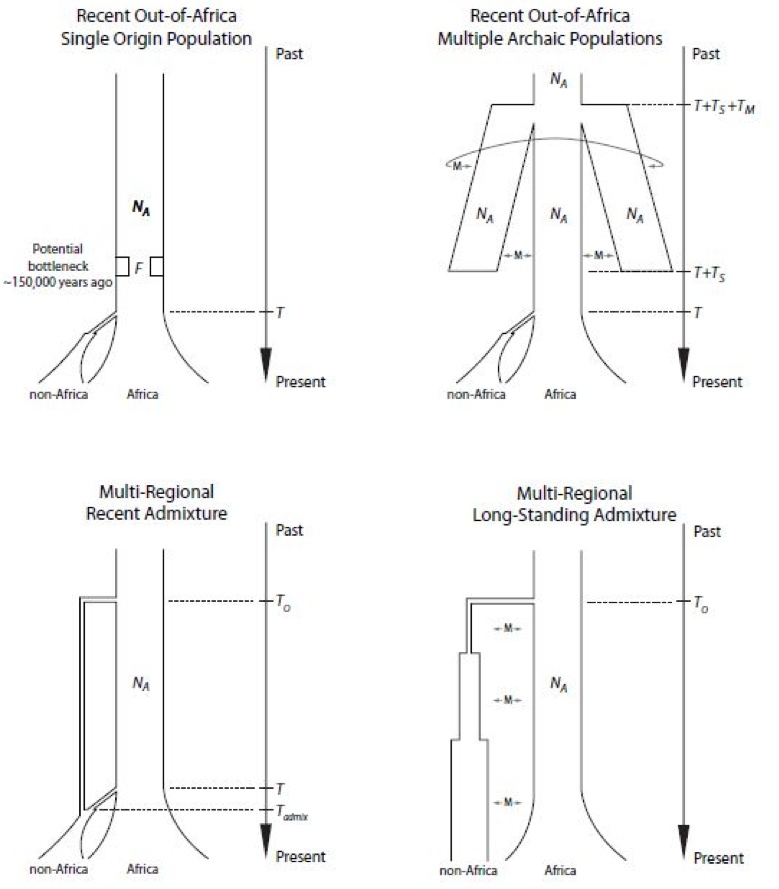
There are five scenarios to explain the current distribution of human populations. They can be seen in the figures below.

Source: http://arslanmb.org/ArmenianDNAProject/screenshot-38.jpg


Explanation of Molecular Genealogy Models

1. Recent out of Africa: Single Origin Population model
In this model, humans are a young species that underwent a bottleneck, and Eurasians are descended from a group of Africans that migrated out of Africa. This model has been criticized for its inability to explain deep divergence in autosomal DNA (atDNA). Autosomal DNA is a term used in genetic genealogy to describe DNA which is inherited from the autosomal chromosomes.  Each set of autosome is received from your mother and your father.  Their atDNA was received from their parents and their grandparents, these becoming more disjointed with each generation since most people no longer marry close kin.  Within endogamous groups such as Abraham's Horite people, the disjunction is considerably less, and depending on the mating structure, may be preserved quite well.

In this model, the African Eve, traced by mitochondrial DNA, lived 170,000 years ago while the African Adam, traced by Y-chromosome DNA, is believed to have lived 100,000 years ago. 

The Y-chromosone determines gender and is passed virtually unchanged from father to son. The mutation rate is very slow so the Y-chromosone can be used to trace lineage back many generations. 

Mitochrondrial DNA (mtDNA) passes from mother to daughter from generation to generation with very little change and is therefore a rich source of information for those studying deep ancestry. The Horites married only Horite women, so Horite ancestry can be traced by mitochondrial DNA. As Horite rulers married half-sisters and patrilineal cousins or nieces, there would be considerabe genetic stability. This stability was valued because the Horites expected God's Son to be born of their ruler-priest caste which practiced endogamy.

Mitochondrial Eve’s line will not die out because mitochondrial DNA is passed down to both male and female offspring. On the other hand, Y-Chromosomal Adam's line will not be the same at any point in history due to the fact that male lines can die out. When this occurs, a more recent ancestor becomes the new “Adam.” The most recent common male ancestor is believed to have lived 100,000 year ago.


2. Recent out of Africa: Multiple Archaic Populations model
This model is advocated by those who believe that modern humans evolved from ancestors common to modern humans and other archaic humans (hominins), some of whom became extinct.

Dienekes Pontikos holds this view but mainains that the mating structure of the African population indicates isolated long-standing subpopulations.  In this view, Eurasians are Afro-Asiatics who descend from one of these African subpopulations. The variants that have deep origins are presumed to have evolved separately in different African subpopulations and entered the modern gene pool after unstructured mating (panmictic) became more common.

Anthropological and archaeological discoveries support the recent Out-of-Africa view for modern humans, but don't support the view of separated archaic humans who became extinct. This view lacks physical evidence that the theorized extinct hominids were unlike modern humans.  This has been shown to be false by paleontologist Jeremy DeSilva and others.

DeSilva compared the ankle joint, the tibia and the talus fossils of human ancestors between 4.12 million to 1.53 million years old, he discovered that all of the ankle joints resembled those of modern humans rather than those of apes. Chimpanzees flex their ankles 45 degrees from normal resting position. This makes it possible for apes to climb trees with great ease. While walking, humans flex their ankles a maximum of 20 degrees. The human ankle bones are quite distinct from those of apes. Read about DeSilva’s research here.

Further, the discovery of a complete fourth metatarsal of A. afarensis at Hadar that shows the deep, flat base and tarsal facets that "imply that its midfoot had no ape-like midtarsal break. These features show that the A. afarensis foot was functionally like that of modern humans." (Carol Ward, William H. Kimbel, Donald C. Johanson, Feb. 2011) Read the report here.

Multi-Regional: Recent Admixture model
This view agrees on the recent African origin of modern humans, but maintains a place for long isolated pre-existing Eurasian populations who contributed some of their mtDNA to modern humans. Multiregionalism posits that the descendants of  H. erectus evolved into Neandertals, Denisovans, and modern humans in different regions. Populations coming from Africa mingled with the other groups and modern humans emerged.

This model presumes two variants with deep common ancestry stemming from the separated Eurasian and African strains. This model has found support by analysis of the Neandertal genome. However, recent studies have revealed that only 2–3% of the genome of non-Africans might come from Neanderthals.  Further, some believe that Neandertal introgression into Eurasians can be explained by the Multiple Archaic Populations in Africa model.


Multi-Regional: Long Standing Admixture model

In this view Africa is the point of origin of human Y chromosomes and mtDNA and separation took place about 150,000 years ago. Modern humans are descended from populations from around the world between which there has been gene flow. This model explains divergence, but does not offer an explanation for the African origin of the uniparental markers, the evidence for the appearance of anatomical modernity in East Africa and the evidence for less genetic variation in Eurasia with increasing distance from East Africa. 


Ancestral Bottleneck model
This view is proposed by Blum and Jakobsson, who speculate a bottleneck 150,000 years ago in an ancestral structured population. This model combines elements of the Single Origin Population model and the Multiple Archaic Populations model. It hypothesizes a single origin model for extant humans and allows for the possibility of structure in Africa prior to the bottleneck.  The breakdown of structured mating is set before the bottleneck. 

Blum and Jakobsson write, "Through the analysis of a public DNA sequence database, we find, similar to previous estimates, that the common ancestors of autosomal and X-linked genes are indeed very old, living, on average, respectively 1,500,000 and 1,000,000 years ago. However, contrary to previous conclusions, we find that these deep gene genealogies are consistent with the Out-of-Africa scenario provided that the ancestral effective population size was approximately 14,000 individuals. We show that an ancient bottleneck in the Middle Pleistocene, possibly arising from an ancestral structured population, can reconcile the contradictory findings from the mitochondrion on the one hand, with the autosomes and the X-chromosome on the other hand."                 

In other words, they support the view that the earliest human populations were in Africa and had a mating structure that preserved a genetic identity until about 130,000 years ago. The hand axe is the most common artefact of these early East African and "Old World" peoples.


Which of these views aligns with Genesis or does Genesis suggest yet another possible model?

What do you think?

Tuesday, January 17, 2012

Abraham, Descendant of Both Shem and Ham


A reader has asked this question: "Alice, I read your post about Horites. Fascinating and very helpful. In my reading, I understand that Abraham is a descendant of Shem (Genesis 11). Can you explain how he is a descendant of Ham?  Thanks!

Francien


Francien asks a question which is often posed to me.  He has read Genesis 11 and concluded that Abraham is a descendant of Shem only.  This is a common error.  All the genealogical data in Genesis is related so we must look at all of it, not simply one section.

Abraham's ancestors and descendants were related by both blood and marriage. The Horiete Hebrew clans intermarried (endogamy) and the rulers of the clans married according to a structure which is made evident in analysis of the Genesis King Lists found in chapters 4, 5, 11 and 36 with additional information in Genesis 10 and 22:20-24. Analysis of all the data makes it clear that Abraham was a descendant of both Shem and Ham.


Before Ham and Shem, the lines of Cain and Seth intermarried also. These were ruler-priest lines, so the Genesis King lists speak of the marriage and ascendency structure of the Horites.


Further evidence that the lines of Ham and Shem intermarried is found with the names Lud and Ludim (Ludites). In Genesis 10, Lud is named as a son of Shem, and in Genesis 10:13 the Ludim are said to be of Ham.

The marriage structure of the Horite rulers involved two wives living in separate households. One wife was a half-sister (as was Sarah to Abraham) and the other wife was a patrilineal cousin or niece (as was Keturah to Abraham).

The brides were the daughters of ruler-priests. They contributed the mtDNA and their ruler husbands contributed the Y chromosome since males who share a common patrilineal ancestor also share a Y chromosome, diverging only with respect to accumulated mutations. The distinctive Kohan DNA or "priest marker" is identifiable because Horite priests married daughters of priests exclusively. 

In 1995, Canadian nephrologist Karl Skorecki designed an experiment to find out whether the descendants of the ancient Jewish ruler-priest - kohamim - could be verified by genetics. Skorecki reasoned that Jewish males who claim to be kohanim should have an identical set of marker mutations that trace back to biblical times. So the researchers gathered saliva from 200 Jewish males, a third of whom identified themselves as kohanim, at the Western Wall during the High Holidays. No matter whether they were Sephardic, Ashkenazic, or Oriental Jews, 98.5% of those who said they were kohanim shared a genetic marker for a common male ancestor.

Were the same sort of study done of Arabs who descend from Abraham's Horite Hebrew line by his firstborn son Joktan, it is likely that this same genetic signature would be found in at least 3% of the Joktanite population of Arabia.

In 1996, a more extensive study found a set of marker mutations common to approximately 60% of self-proclaimed kohanim. Using complex mathematical calculations the research team identified the Cohan Modal Haplotype (CMH), a series of six genetic markers common to the kohanim which originated more than 3,000 years ago.

It is evident from Genesis that the Horite Hebrew ruler-priests originated well before 3000 years ago. Aaron and his half-brother Korah were not the first Hebrew ruler-priests. Their father Amram was a ruler-priest and the descendant of a long line of ruler-priests who can be traced to at least 6000 years ago. The oldest known site of Horite Hebrew worship is at Nekhen (Hierakonpolis) on the Nile and dates to c. 4000 BC.


DNA studies confirm that the Horite Hebrew ancestors of the priests of ancient Israel did marry exclusively within the priestly divisions/lines, which is what analysis of the Genesis genealogical material shows. This is the ancestry of Jesus Christ who was born to Mary, the wife of Joseph, both in the ruler-priest lines.


Related reading:  The Daughters of Horite Priests; Moses' Wives and Brothers